The lunacy of Britain’s Sizewell C nuclear project

Tom Burke:
All of these problems have been pointed out to the Government
very often, by many energy experts for several years. Even so this only
tells you part of the lunacy of this project. Britain’s electricity
consumers will start paying for Sizewell C now and will go on doing so
without receiving any electricity from it for the next 12-15 years.
They are in effect compulsory investors. However, unlike the private sector
investors in the project they will not receive a handsome double digit
returned on their forced capital investment. Instead they will then be
forced, as the Bloomberg diagram shows, to pay about three times as much
for Sizewell C’s electricity than would otherwise be available to them from
other sources as cheaper electricity will be forced off the grid in order
to preferentially take that from Sizewell C. It is truly said that those
whom the Gods destroy they first make mad.
FT 27th Aug 2025,
https://www.ft.com/content/ee89bce2-a3e9-48ed-82eb-85916eb24777#comments-anchor
‘It doesn’t make sense’: Marine biologist on Kenya’s proposed nuclear power plant.
Elodie Toto, Mongabay, 29 Aug 2025
- Kenya is considering building a nuclear power plant in Uyombo, a coastal town in Kilifi county. It would be near Mida Creek mangroves, Arabuko Sokoke Forest Reserve and Watamu National Marine Park and Reserve, all recognized for their high biodiversity, including endemic species and coral reefs.
- The plant’s cooling system could raise water temperatures in the area. This could harm marine life, potentially causing further coral bleaching and disrupting plankton and other critical species, which would, in the long run, affect the entire food chain.
- Residents and environmentalists, including marine biologist Peter Musila, have criticized the project and the government for poor communication, lack of public consultation and insufficient information on nuclear waste management.
- Musila argues Kenya does not need nuclear energy given the country’s renewable energy potential, and such a project raises concerns about potential accidents and long-term impacts on ecosystems and local livelihoods.
Kenya is in the process of building its very first nuclear power station. According to forecasts by the Kenya Nuclear Power and Energy Agency (NuPEA), construction is due to start by 2027 and will produce 1,000 MW of power. The town of Uyombo, in Kilifi county on the Kenyan coast, is one of three sites where NuPEA considers building the plant. Very quickly, a cry united the population: “Sitaki Nuclear,” no to nuclear power in Swahili. Demonstrations broke out, followed by a lawsuit filed by citizens, which was later dismissed, and a petition was also circulated online. But the project still seems to be going ahead, much to the dismay of residents and some environmentalists.
Uyombo is located on the edge of the Mida Creek mangrove swamps, a few kilometers from the Arabuko Sokoke Forest Reserve, the largest remaining coastal forest in East Africa, recognized as a biodiversity hotspot due to the concentration of many endemic species and habitat loss. It lies in close proximity to Watamu National Marine Park and Reserve, recognized as a UNESCO Biosphere Reserve because of its coral reefs and the richness of its marine life, including whale sharks (Rhincodon typus) and manta rays (Manta alfredi).
What impact could this project have on this biodiversity? Peter Musila is a marine biologist and program coordinator with the NGO A Rocha Kenya. For the NGO, he monitors the state of the region’s corals and is involved in their restoration. As a coral specialist, he is livid about this nuclear power station project.
Mongabay met him in the town of Watamu.
Mongabay: When you heard that a nuclear power station could be built in Uyombo, what was your first reaction?
Peter Musila: I first heard of this nuclear power plant in 2022. For me, it doesn’t make sense because the area they are trying to put it in is a very pristine area for wildlife, with all sorts of wildlife, even terrestrial wildlife, including birds. Mida Creek is one of the most important areas for birds. It hosts a lot of migratory birds that come here to breed. There’s so much wildlife here.
It’s also an important marine mammal area [like dolphins and whales], and the sharks and rays are here. They use this space for breeding, for nesting. We don’t want a nuclear power plant in our area.
Mongabay: As you said, this is an important marine area. As well as mammals, there are also corals. What state are they in?
Peter Musila: Before the 1990s, the reef was very good. It was very pristine. I did not see it back then, but I wish I did. There were over 200 genera of corals. The major problem that has affected this area, coral-wise, is bleaching. The first time it happened was in 1997. After that, the coral cover declined quite substantially. It was 60% [preserved before 1997] and then it declined to 10% [in 1998]. That was really bad. And then it has been trying to recover. But bleaching is now occurring more often because there was another one in 2005 and then 2007, 2013, 2016 and 2020………………………………………………………………………………………………………………………………………….. Even if it were to be built up to standard, with no corruption, it can still go wrong. That is why other big countries are going against nuclear energy because it’s not the most sustainable energy source. I don’t know why we as Kenyans are even putting that on the table, considering there are all these other technologies that can produce energy more sustainably, more cheaply. I don’t get it.https://news.mongabay.com/2025/08/it-doesnt-make-sense-marine-biologist-on-kenyas-proposed-nuclear-power-plant/
Russian engineer-physicist Ozharovsky spoke about deportation from Mongolia.
Andrey Ozharovsky was detained in Mongolia while exploring the Gobi Desert. He was trying to find out if there was radiation contamination where the French were mining uranium. Metro asked the Russian nuclear scientist what happened to him.
Metro Moscow 27th Aug 2025, https://www.gazetametro.ru/articles/rossijskij-inzhener-fizik-ozharovskij-rasskazal-chto-proizoshlo-s-nim-v-mongolii-27-08-2025
The media reported on the detention of the Russian activist on August 19. As Ozharovsky himself said, in Mongolia he was deprived of his freedom, passport and the opportunity to talk to his relatives. At the same time, Mongolian security forces behaved correctly with him.
Why Russian Researcher Deported from Mongolia
“I came to help local activists figure out whether there is radioactive contamination in the part of the Gobi Desert where the French company Orano mines uranium using the underground solution method,” Ozharovsky told Metro.
According to him, Mongolian activists invited him to participate in the research of the area because the scientist’s equipment had previously detected similar contamination in Russia. During three days of research in Mongolia, Ozharovsky found deviations – the consequences of uranium mining by the French.
“Apparently, those who mine uranium in the Gobi did not like this. And perhaps the French nuclear scientists are behind my deportation,” the scientist concluded.
Suddenly a jeep with three security officers and a female employee of the migration service arrives. After that they take my passport for inspection and give it back only a week later.— deported nuclear physicist Andrei Ozharovsky
Ozharovsky believes that the circumstances of his arrest were extremely strange.
“We finished taking measurements in the desert, then moved to a new location, the Maradai mine. That’s where the immigration service detained me. Before that, we had only met one shepherd the previous day,” he explained.
According to the researcher, he was first taken under guard for interrogation to the provincial capital, the city of Choibalsan. And only after that was he sent to Ulaanbaatar.
“Russian spy” and “Rosatom saboteur”
As Ozharovsky says, shortly before his arrest, an active campaign against him began in the local media. The scientist emphasizes that in their materials, Mongolian journalists called him a spy and intelligence officer who was in Mongolia “in the interests of Rosatom.”
— After completing the measurements in Gobi, we traveled for more than a day to a new location. And during this time, as if on command, several articles were published in which journalists called on the Mongolian authorities to take decisive action, because “a Russian spy is driving around the country’s uranium mines,” the nuclear physicist explains.
At the same time, after his arrest, representatives of Mongolian intelligence stated that they had no claims against Ozharovsky. And his case was forwarded to the police.
However, the nuclear physicist emphasizes that Mongolia is now allegedly trying to hide a major environmental problem that he and local activists managed to discover.
“I found three areas in Mongolia where the usual Gobi dose rate of 0.1 microsievert per hour was exceeded by 20-50 times. In problem areas, the pollution level reached 5 microsievert per hour,” he said.
Microsieverta unit of measurement that can be used to determine how much radiation a person has received
According to the researcher, such indicators can already have serious consequences for humans. And the nomads living in the region can make specific assumptions about what caused the increase in cancer cases.
“One nomad we spoke to had a father who died of cancer. And his young wife was diagnosed with breast cancer,” the scientist said.
Deportation and its consequences
The nuclear physicist fully admits that he could have violated Mongolian law. But he emphasizes that this happened due to ignorance of its subtleties.
— In Mongolia, it is prohibited to measure the radiation environment with devices that have not been accredited in the country. That is, even if you have proof of the functionality of the equipment in other countries, you must bring your device to the authorities, pay money for the inspection, and only then receive the right to conduct research, he explained.
In addition, the country has very specific restrictions for Russians. And Ozharovsky could have accidentally violated one of them.
— According to Mongolian law, Russians can stay in the country without a visa only if they are tourists. After the dosimeter was turned on, according to the law enforcement officers who deported me, I ceased to be one, — the nuclear scientist added.
According to the researcher, he plans to contact lawyers to assess the legality of the punishment. He also emphasized that he does not plan to abandon his research in Mongolia, but will now conduct it in other ways.
What will happen if the Ukrainian Armed Forces attempt to strike the Kursk Nuclear Power Plant?
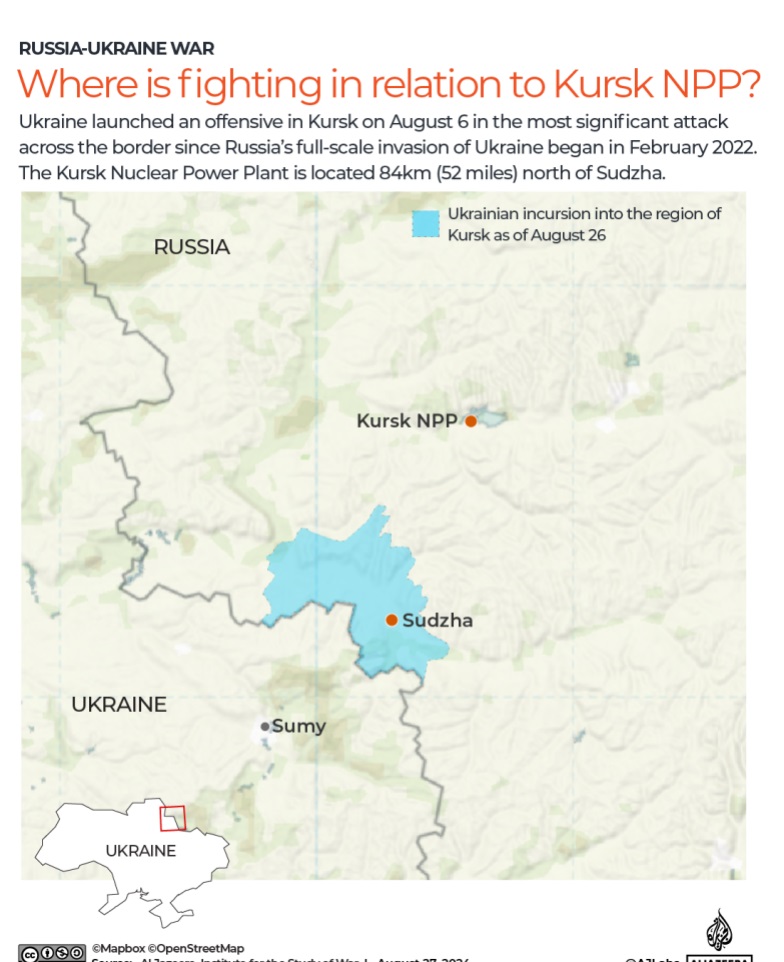
A drone of the Ukrainian Armed Forces was shot down near the Kursk Nuclear Power Plant. Metro learned what such an attack would entail if it hit the station
On Thursday, Kursk Region Governor Alexey Smirnov reported the destruction of a Ukrainian drone 5 kilometers from the Kursk Nuclear Power Plant. According to official information, the Ukrainian Armed Forces attempted to hit the nuclear power plant, but the drone was destroyed on approach.
As Andrey Ozharovsky, an engineer-physicist and expert on the Radioactive Waste Safety program, told Metro , the Kursk NPP is extremely vulnerable to external influences.
— The Kursk nuclear power plant has a serious feature that makes it extremely vulnerable to a military or terrorist attack. These are RBMK-100 reactors of the Chernobyl type. At this station, as at the Ukrainian one, there is no protective shell for the reactors. That is, the “cap” that usually covers the reactor itself at nuclear power plants and thus protects it from external influences, — the expert explained.
He noted that due to such a technical solution, any shelling poses a very serious danger to the station. According to the scientist, it is especially dangerous that the reactors at the Kursk NPP are located in non-specialized buildings.
“Of course, these Chernobyl-type reactors have been modernized and a literal repeat of Chernobyl is impossible. But in the event of a shelling at the station, a graphite fire and the release of a huge amount of radioactive substances into the environment with contamination of territories hundreds of kilometers away from the reactor cannot be ruled out,” the nuclear physicist emphasized.
He added that the recent attack by the Ukrainian Armed Forces could have been not on the station, but on another facility in Kurchatov.
Alberta Revives Its Nuclear Energy Dreams.

And a cabinet minister gets a free trip for ‘Canada-UK Nuclear Day’ in London.
TheTyee, David Climenhaga 28 Aug 2025
Alberta Affordability Minister Nathan Neudorf jetted off Wednesday for a nice 10-day holiday in the United Kingdom — mostly at his own expense.
Not entirely at his own expense, though, since Alberta taxpayers will presumably be picking up the tab for his airfare in his other cabinet role as minister of utilities (with the exception, this being Alberta, of utilities that generate electricity of the renewable sort).
That ministerial job got him a nice invite to the World Nuclear Symposium in London and a corking “Canada-U.K. Nuclear Day” party on Wednesday at Canada House.
If you’re thinking you probably couldn’t afford a vacation like that, it’s nice to know the minister of making sure you can afford stuff (how’s that going, anyway?) will have the opportunity to “explore nuclear energy in London,” as the Alberta government’s news release put it Wednesday, with well-heeled nuclear industry lobbyists, CEOs and the like from all over the world.
In all, the MLA for Lethbridge-East (and perhaps soon to be the MLA for the new riding of Lethbridge-Gerrymander) will get to spend 15 days in Blighty, at least five of them in a very nice hotel, I’m sure.
“Alberta’s government is working hard to secure an affordable, reliable and sustainable energy future and nuclear can play a key role,” Neudorf said in the inevitable canned quote in the government’s news release Wednesday. “Gatherings like this one are an excellent opportunity to connect with international partners and I look forward to learning more about the potential of this technology and how it can fit into Alberta’s energy mix.”
I’ll bet. There’s nothing cheap about nuclear power. Even the so-called “small modular reactors” that the United Conservative Party is so enamoured of are multibillion-dollar megaprojects, and they never come in on budget. Indeed, SMRs may be nuclear reactors, but they’re not small and they’re not really modular. The term is a marketing gimmick.
“Nuclear projects are almost always subject to time and cost overruns,” explained the Calgary-based Pembina Institute in a news release this week, “with some being delayed by up to a decade and costing double the original projected amount.”
If you want cheap and reliable energy, as the Pembina news release rather plaintively pointed out, wind, solar and battery storage would be just the ticket. Those are things that Neudorf and the United Conservative Party aren’t about to consider, though, probably because of the turbines that spoiled the view at Donald Trump’s golf course in Scotland.
Nevertheless, tout le monde nuclear energy will be in London — even a senior official of Rosatom, the Russian state atomic energy corporation. (That said, you have to dig a bit to suss out the Rosatom connection.)
Meanwhile, the Alberta government wants to hear what you think about nuclear power — presumably as long as it’s the same as what they think. Otherwise, get lost!
Premier Danielle Smith struck yet another panel Monday, this one to sell Albertans on the idea of adopting nuclear power — pardon me, “to join the conversation on nuclear energy in the province.”
There’s even a survey — and I can tell you it’s not quite as obviously biased as the “Alberta Next” surveys, although I’d say it’s been designed to help suss out voter concerns so that talking points can be drafted quickly to tell you to have no fear for atomic energy……………………………………
If you worry about this stuff, nothing’s going to happen any time soon except more lobbying and conferences in interesting locales for UCP ministers to attend.
A small modular reactor project has never been successfully completed outside of China and Russia. Indeed, some say Rosatom’s Akademik Lomonosov, dubbed by some the “floating Chernobyl,” may be the world’s only working small modular reactor…..https://thetyee.ca/Opinion/2025/08/28/Alberta-Revives-Nuclear-Energy-Dreams/
East Lothian Council calls for a study into new nuclear at Torness
EAST Lothian Council will ask the UK Government to carry out a study into
the possibility of creating a new nuclear power station at Torness. The
Council will ask the UK Government to fund the study. The Tories and Labour
supported the motion; SNP and Greens opposed it.
Musselburgh Courier 28th Aug 2025, https://www.pressreader.com/uk/musselburgh-courier-SAXC/20250828/281548002004589
An Elbit-Bain Consortium is Nightmare Fuel: the UK Government Must Not Award £2bn Contract to These Corporate Horrors
Why are Israel’s largest arms firm and a company mired in a corruption scandal even being considered for training British troops?
ANDREW FEINSTEIN, PAUL HOLDEN and JACK CINAMON, DECLASSIFIED UK.
28 August 2025
Britain’s Ministry of Defence might imminently award a 15 year contract, worth £2.5bn, to a consortium headed by the British subsidiary of the Israeli arms firm Elbit Systems and including the US management consultancy firm, Bain and Company.
If successful, Elbit’s consortium would be responsible for training as many as 60,000 members of the UK military.
The consortium seems well-placed to win the contract; it is, in fact, one of only two shortlisted and preferred bidders.
The Ministry of Defence has already given the consortium a £2m contract so that it can develop its proposals further.
This is unacceptable. And it is frankly unbelievable that this consortium is even in the running considering its track record.
Elbit Systems UK is the fully-owned subsidiary of Elbit Systems Limited. Elbit Systems Limited is headquartered in Tel Aviv and is listed on both the Israeli and US stock exchanges.
Elbit is one of the two largest Israeli weapons manufacturers and is central to the IDF’s operations, providing 85% of its drones. Elbit International is also a major contributor to the F-35 fighter jet program, bragging that it plays a ‘critical role’ in the ‘success of the world’s most advanced fighter jet.’
In July 2025, Francesca Albanese, the UN Special Rapporteur for the Occupied Palestine Territories, published an excoriating report setting out corporate complicity in Israel’s “plausibly” genocidal conduct in Gaza – for which she was subsequently sanctioned by Donald Trump.
Her report is clear that Elbit forms a central part of Israel’s military-industrial complex, which has become “the economic backbone of [Israel].”
“Elbit has cooperated closely on Israeli military operations, embedding key staff in the Ministry of Defence,” Albanese points out, further noting that Elbit provides “a critical domestic supply of weaponry.”
Bain
But we’re also deeply concerned about Elbit’s partner, Bain and Company. Bain and Company (not to be confused with the mega hedge fund Bain Capital, which confirmed to us that it is not involved in the Elbit consortium) is a US-based management consultancy firm. …………………………………………………………………….. https://www.declassifieduk.org/labour-must-not-award-elbit-a-2-billion-military-deal/
Assessment of Asse storage chamber conditions begins
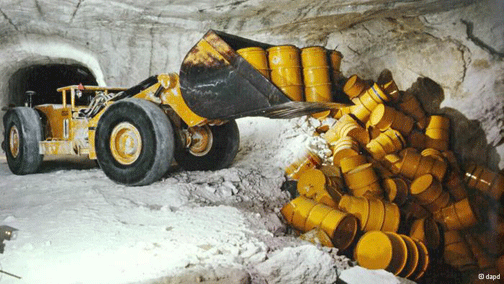
Tuesday, 19 August 2025, https://www.world-nuclear-news.org/articles/assessment-of-asse-storage-chamber-conditions-begins
An exploratory borehole is providing the first indications of the condition of the stored drums containing radioactive waste within Storage Chamber 12 at the former Asse II salt mine in the district of Wolfenbüttel, Lower Saxony, Germany.
Between 1967 and 1978, thousands of barrels of mostly low-level radioactive waste were emplaced in a total of 13 former mining chambers at the Asse II mine on behalf of the federal government. However, the facility has proven unstable and retrieval of the waste has been legally mandated since 2013.
Germany’s Federal Company for Radioactive Waste Disposal (BGE) has announced it “made significant progress” in its preparations for the retrieval of radioactive waste from the Asse II mine at the beginning of August.
“Through a tennis ball-sized hole, we were able to take a look into Storage Chamber 12 for the first time in decades,” said Iris Graffunder, Chair of the Management Board of BGE. “Our first impression is that at least the visible barrels are in good condition. Now we will find out the exact composition of the chamber atmosphere and measure the activity levels in the chamber. For this, we need more space and will have to expand the borehole.”
Storage Chamber 12 contains 7,464 containers, including 6,747 drums and 717 so-called ‘lost concrete shields’ (drums encased in concrete). The containers were stacked horizontally. Storage took place in 1973 and 1974. The eventual formation of a sump containing contaminated solution in the access area to this storage chamber led, among other things, to the Asse II mine being placed under nuclear law in 2009.
Storage Chamber 12 is one of the highest radon emitters in the Asse II mine. At the end of May 2024, miners began the targeted drilling into the chamber under the highest radiation protection standards. At a depth of 750 metres, a borehole about 117 metres long was drilled to access the chamber. On 6 August, radiation protection measurements during drilling showed elevated radon levels, indicating that the chamber had been reached.
A planned gas measurement will reveal the composition of the chamber atmosphere and the factors that influence it. Further geological exploration is also underway. Preliminary investigations revealed that the chamber ceiling was deeper than expected. The first images from the chamber confirm these radar and magnetic measurements. A planned 3D scan is intended to provide a more complete picture of the emplacement chamber.
All of the measured values obtained will be utilised in the further planning of retrieval and in future licensing procedures. Among other things, they will allow BGE to determine which recovery technologies can be used in Storage Chamber 12.
BGE – a federally owned company within the remit of the Federal Environment Ministry – took over responsibility as operator of the Asse II mine and the Konrad and Morsleben repositories from the Federal Office for Radiation Protection in April 2017. It is also tasked with searching for a repository site to dispose of the high-level radioactive waste generated in Germany on the basis of the Site Selection Act that came into force in May 2017.
According to current planning, retrieval of the radioactive waste stored in Asse II is scheduled to begin in 2033. Currently, costs of about EUR4.7 billion (USD5.5 billion) are expected until retrieval begins, including the costs of keeping the mine open and implementing the emergency planning precautions. The costs for retrieval, interim storage, and final disposal after 2033 have not been taken into account.
Why won’t 519 other congresspersons join Rep. Marjorie Taylor Green and 13 other congresspersons in condemning US enabled Israeli genocide in Gaza?
Walt Zlotow, West Suburban Peace Coalition, Glen Ellyn IL, 29 Aug 25.
Only 14 of Congress’s 533 members (2 vacancies) are correctly calling Israel’s genocide in Gaza… genocide and calling for end to all US weapons fueling that genocide.
The most impassioned and articulate in condemning the most grotesque US foreign policy in its 250 years is Georgia Republican Marjorie Taylor Green. She doesn’t hold back while the 519 congresspersons who dare not jeopardize their standing with the Israel Lobby cower in the background. “I don’t know about you, but I don’t want to pay for genocide in a foreign country against a foreign people for a foreign war that I had nothing to do with. And I will not be silent about it.”
Greene is an outlier in the Israeli genocide loving Republican Party. All 272 other Republicans in the House and Senate want nothing to do with Greene’s principled stance.
Democrats are just a tad better. The other 13 congresspersons condemning Israel’s genocide and calling or end to all US weapons fueling it are Democrats. But that is only 5% of 260 Democrats in Congress, a sorrowful indictment of the so called progressive party. Supporting genocide is not progressive. It is ghastly.
My peace organization West Suburban Peace Coalition in Glen Ellyn IL in the IL 6th District, reached out to our Congressman Sean Casten in January, 2024 and this month on Zoom regarding the genocide. He refuses to join the morally centered congresspersons calling the genocide what it is and demanding end to all genocide weapons to Israel. He continues to claim he’s “doing everything he can to end the suffering of the Palestinian people.” Nonsense, he doing nothing except engaging in ‘happy talk’ designed to lull his constituents into believing he cares about a people being wiped out of their homeland with his tacit cooperation.
My appeal to Congressman Casten including this appropriate warning. “Congressman Casten, please do not let ignoring the genocide you surely know is happening remain a stain on your congressional resume for one more day during your congressional career.”
Sadly, my Congressman Sean Casten remains in league with the other 518 congresspersons who refuse to stand up against the Israeli genocide their government, of which they are members of and are complicit with, is supporting.
On fusion liability, Energy Minister completely sidelines the issue.

NFLA 27th Aug 2025
NFLA Secretary Richard Outram is disappointed that the new Energy Minister has completely missed the point that taxpayers should not be on the hook for unlimited liabilities to the nuclear fusion industry ‘resulting from incidents involving nuclear matter or emissions of ionising radiation arising from fusion activities relating to the STEP programme’.
On July 21, Climate Minister Kerry McCarthy issued a Departmental Minute to Parliament indicating that the Government will assume these liabilities for STEP (the Spherical Tokamak for Energy Production) project, the fusion experimental plant being built on a former power station site in West Burton with taxpayer money.
Richard wrote to his MP, Debbie Abrahams protesting that ‘As a citizen, I do not want my future taxes in hoc to a private company whose insurance risk for its nuclear activities would reside 100% with the future taxpayer. The procedure is certainly experimental; it may also be risky’. He asked that a request be placed with the Minister ‘with a full published risk analysis for STEP’ prior to a Parliamentary debate and vote.
In response, Ms Abrahams advised Richard that she had written to ‘the Department for Energy Security and Net Zero to make further enquiries about the STEP programme and make representations about your concerns’.
Ms McCarthy has now written back with a standard response in which she waxes lyrical about the supposed benefits that will be delivered through nuclear fusion, yet this is a technology described in the minister’s response as ‘nascent’, a euphemism for currently non-functioning.
The Minister makes a summary assessment that the risk presented by fusion is low, yet concedes ‘there is no private insurance market to provide cover to UKIFS (UK Industrial Fusion Limited) or their industry partners for liabilities in the unlikely event that radiological material or radiation is released from STEP outside of permit conditions‘.
This could suggest that the private sector might not want to insure any emerging nuclear fusion market because of the risk it presents, and if this is the case His Majesty’s Government might ultimately also have to indemnify nuclear fusion operators other than STEP in the future.
The Ministerial Direction effectively saddles the British taxpayer with responsibility to indemnify UKIFS ‘for an unlimited amount of money, for an unlimited time’.
And there is ambiguity in the timescale as some sources suggest STEP will be operational by 2040, whilst the Minister’s statement of 21 July says ‘by the 2040s’. This could mean 2049.
Finally, Richard was gratified to hear that the Minister’s letter was made in response to ‘a number of constituents’ suggesting some level of public disquiet with the Government’s decision………………………………………………………………………………………………………………………. https://www.nuclearpolicy.info/news/on-fusion-liability-energy-minister-completely-sidelines-the-issue/
The nuclear fusion delusion -Government proposals re Nuclear Fusion Siting Policy

Twelve months after a consultation on a proposed new siting policy for
nuclear fusion concluded in July 2024, the Department for Energy Security
and Net Zero finally published the government’s response to the
submissions received. This new policy (EN-8) mirrors that under development
for nuclear fission (EN-7). Consequently, the NFLAs submitted a response to
both consultations which shared many similarities.
It is clear from the
flavour of the government response that the new Climate Minister Kerry
McCarthy MP has like her predecessors been drinking from the fusion ‘Kool
Aid’, continuing to believe that fusion technology will be deployable on
time and at scale to provide a remedy to climate change.
NFLA 26th Aug 2025, https://www.nuclearpolicy.info/wp/wp-content/uploads/2025/08/A438-NB324-Govt-proposals-over-nuclear-fusion-siting-policy-Aug-2025.pdf
The Detached Cruelty of Air Power- From Guernica to Gaza Mass Killers Have Been Above It All .

The increasing American reliance on air power rather than combat troops has shifted the concept of what it means to be “at war.”…………… congressional approval was unnecessary since the United States wasn’t actually engaged in military “hostilities” — because no Americans were dying in the process.
By Norman Solomon, August 28, 2025
Killing from the sky has long offered the sort of detachment that warfare on the ground can’t match. Far from its victims, air power remains the height of modernity. And yet, as the monk Thomas Merton concluded in a poem, using the voice of a Nazi commandant, “Do not think yourself better because you burn up friends and enemies with long-range missiles without ever seeing what you have done”
Nine decades have passed since aerial technology first began notably assisting warmakers. Midway through the 1930s, when Benito Mussolini sent Italy’s air force into action during the invasion of Ethiopia, hospitals were among its main targets. Soon afterward, in April 1937, the fascist militaries of Germany and Italy dropped bombs on a Spanish town with a name that quickly became a synonym for the slaughter of civilians: Guernica.
Within weeks, Pablo Picasso’s painting “Guernica” was on public display, boosting global revulsion at such barbarism. When World War Two began in September 1939, the default assumption was that bombing population centers — terrorizing and killing civilians — was beyond the pale. But during the next several years, such bombing became standard operating procedure.

Dispensed from the air, systematic cruelty only escalated with time. The blitz by Germany’s Luftwaffe took more than 43,500 civilian lives in Britain. As the Allies gained the upper hand, the names of certain cities went into history for their bomb-generated firestorms and then radioactive infernos. In Germany: Hamburg, Cologne, and Dresden. In Japan: Tokyo, Hiroshima, and Nagasaki.
“Between 300,000-600,000 German civilians and over 200,000 Japanese civilians were killed by allied bombing during the Second World War, most as a result of raids intentionally targeted against civilians themselves,” according to the documentation of scholar Alex J. Bellamy. Contrary to traditional narratives, “the British and American governments were clearly intent on targeting civilians,” but “they refused to admit that this was their purpose and devised elaborate arguments to claim that they were not targeting civilians.”
Past Atrocities Excusing New Ones
As the New York Times reported in October 2023, three weeks into the war in Gaza, “It became evident to U.S. officials that Israeli leaders believed mass civilian casualties were an acceptable price in the military campaign. In private conversations with American counterparts, Israeli officials referred to how the United States and other allied powers resorted to devastating bombings in Germany and Japan during World War II — including the dropping of the two atomic warheads in Hiroshima and Nagasaki — to try to defeat those countries.”
Prime Minister Benjamin Netanyahu told President Joe Biden much the same thing, while shrugging off concerns about Israel’s merciless killing of civilians in Gaza. “Well,” Biden recalled him saying, “you carpet-bombed Germany. You dropped the atom bomb. A lot of civilians died.”
Apologists for Israel’s genocide in Gaza have continued to invoke just such a rationale…………………………………………………………………….
The United Nations has reported that women and children account for nearly 70% of the verified deaths of Palestinians in Gaza. The capacity to keep massacring civilians there mainly depends on the Israeli Air Force (well supplied with planes and weaponry by the United States), which proudly declares that “it is often due to the IAF’s aerial superiority and advancement that its squadrons are able to conduct a large portion” of the Israeli military’s “operational activities.”
The “Grace and Panache” of the “Indispensable Nation”
The benefactor making possible Israel’s military prowess, the U.S. government, has compiled a gruesome record of its own in this century. An ominous undertone, foreshadowing the unchecked slaughter to come, could be heard on October 8, 2023, the day after the Hamas attack on Israel resulted in close to 1,200 deaths. “This is Israel’s 9/11,” the Israeli ambassador to the United Nations said outside the chambers of the Security Council, while the country’s ambassador to the United States told PBS viewers that “this is, as someone said, our 9/11.”
Loyal to the “war on terror” brand, the American media establishment gave remarkably short shrift to concerns about civilian deaths and suffering. The official pretense was that (of course!) the very latest weaponry meshed with high moral purpose. When the U.S. launched its “shock and awe” air assault on Baghdad to begin the Iraq War in March 2003, “it was a breathtaking display of firepower,” anchor Tom Brokaw told NBC viewers with unintended irony. Another network correspondent reported “a tremendous light show here, just a tremendous light show.”
As the U.S. occupation of Iraq took hold later that year, New York Times correspondent Dexter Filkins (who now covers military matters for The New Yorker) was laudatory on the newspaper’s front page as he reported on the Black Hawk and Apache helicopter gunships flying over Baghdad “with such grace and panache.” Routine reverence for America’s high-tech arsenal of air power has remained in sync with the assumption that, in the hands of Uncle Sam, the world’s greatest aerospace technologies would be used for the greatest good.
In a 2014 commencement speech at West Point, President Barack Obama proclaimed: “The United States is and remains the one indispensable nation. That has been true for the century passed and it will be true for the century to come.”
After launching two major invasions and occupations in this century, the United States was hardly on high moral ground when it condemned Russia for its invasion of Ukraine in February 2022 and frequent bombing of that country’s major cities. Seven months after the invasion began, President Vladimir Putin tried to justify his reckless nuclear threats by alarmingly insisting that the atomic bombings of Japan had established a “precedent.”
Whoever Doesn’t Count Goes Uncounted
…………………………………………………………………………………………………………………………….. Normal and Lethal
When Shakira and Guljumma lost relatives to bombs that arrived courtesy of the U.S. taxpayer, their loved ones were not even numbers to the Pentagon. Instead, meticulous estimates have come from the Costs of War project at Brown University, which puts “the number of people killed directly in the violence of the post-9/11 wars in Afghanistan, Pakistan, Iraq, Syria, Yemen, and elsewhere” at upwards of 905,000 — with 45% of them civilians. “Several times as many more have been killed as a reverberating effect of the wars — because, for example, of water loss, sewage and other infrastructural issues, and war-related disease.”
The increasing American reliance on air power rather than combat troops has shifted the concept of what it means to be “at war.” After three months of leading NATO’s bombing of Libya in 2011, for instance, the U.S. government had already spent $1 billion on the effort, with far more to come. But the Obama administration insisted that congressional approval was unnecessary since the United States wasn’t actually engaged in military “hostilities” — because no Americans were dying in the process.
………………………………………………………………………………….the nation’s actions targeting Libya involved “no U.S. ground presence or, to this point, U.S. casualties.” Nor was there “a threat of significant U.S. casualties.” The idea was that it’s not really a war if Americans are above it all and aren’t dying………………………………………
in a September 2021 speech at the United Nations soon after the last American troops had left Afghanistan, President Biden said: “I stand here today, for the first time in 20 years, with the United States not at war.” In other words, American troops weren’t dying in noticeable numbers. Costs of War project co-director Catherine Lutz pointed out in the same month that U.S. engagement in military actions “continues in over 80 countries.”
…………………the Biden and Trump administrations have directly sent bombers and missiles over quite a few horizons, including in Yemen, Iraq, Syria, Somalia, and Iran.
Less directly, but with horrific ongoing consequences, stepped-up U.S. military aid to Israel has enabled its air power to systematically kill Palestinian children, women, and men with the kind of industrial efficiency that fascist leaders of the 1930s and 1940s might have admired. The daily horrors in Gaza still echo the day when bombs fell on Guernica. But the scale of the carnage is much bigger and unrelenting in Gaza, where atrocities continue without letup, while the world looks on. https://tomdispatch.com/from-guernica-to-gaza/
The World Bank can now fund nuclear energy projects: Here’s what’s next.
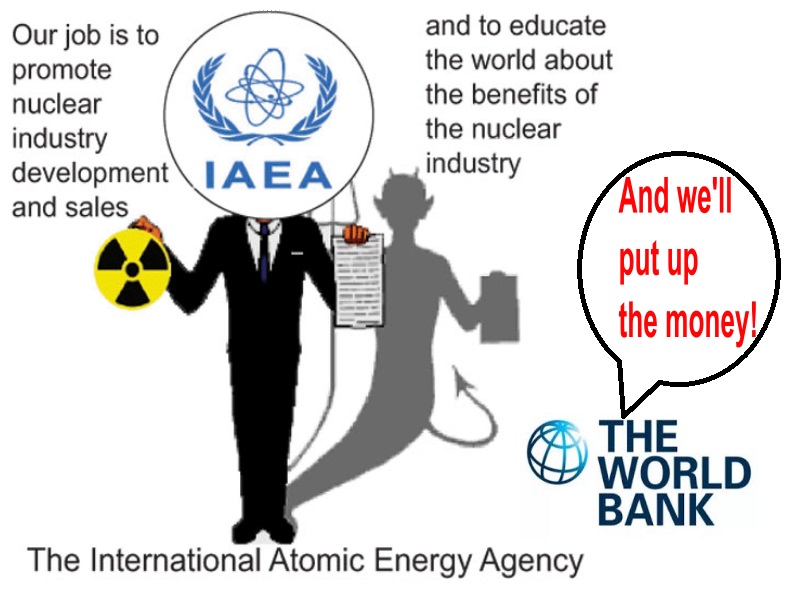
Specifically, the agreement pledges that the IAEA will provide subject-matter expertise to the World Bank Group that will help the group support lifetime extensions of existing nuclear power plants and advance the commercial deployment of small modular reactors (SMRs).
Bulletin, By Marina Lorenzini | August 28, 2025
As a growing number of countries look to strengthen their domestic energy production, meet baseload power generation needs, and manage low-carbon climate goals, they’re increasingly looking to nuclear—and some previous skeptics are looking with them. On June 11th, the World Bank Group (WBG) announced an end to its longstanding ban on funding nuclear power projects. The ban had only been in place formally since 2013, but the last and only time the WBG funded a nuclear power project was 1959—a $40 million loan to build a nuclear power plant in Italy.
Two weeks after the ban was dropped, the group’s President Ajay Banga signed an agreement with the International Atomic Energy Agency (IAEA), committing to support countries that seek to include nuclear energy as part of their development strategies. The policy change builds on similar commitments from the 2023 climate negotiations in Dubai to triple global nuclear capacity, private financial industry pledges of capital for nuclear energy investments, and bipartisan support for nuclear in Washington, D.C.
The World Bank Group’s policy shift on nuclear energy was enabled by a similar reversal from German leadership, one of the bank’s foremost contributors. Germany has long opposed nuclear energy, famously extending the life of coal-fired power plants while committing to shut down its nuclear fleet at home; Germany’s position on nuclear power is an oft-cited motivation for the Bank’s enduring ban. Although German Chancellor Friedrich Merz would need to overcome significant opposition from within his own governing coalition to resurrect a nuclear power fleet in Germany, at the moment, Merz is increasingly accepting of nuclear power as an energy source at the EU-level and internationally.
The World Bank Group is composed of five affiliated agencies: the International Bank for Reconstruction and Development; the International Finance Corporation; the International Development Association; the International Centre for Settlement of Investment Disputes; and the Mulitlateral Investment Guarantee Agency. The International Bank for Reconstruction and Development and the the International Development Association provide loans and grants to low- and middle-income countries and are commonly referred to as the “World Bank.” The agreement with the IAEA is intended to quickly infuse expertise into all five of the World Bank Group’s teams of economists and country experts. Specifically, the agreement pledges that the IAEA will provide subject-matter expertise to the World Bank Group that will help the group support lifetime extensions of existing nuclear power plants and advance the commercial deployment of small modular reactors (SMRs). While the agreement doesn’t identify specific countries for investment, some parameters have emerged for evaluating likely candidates to receive WBG funding.
Lifetime extensions for existing reactors. There are nearly 440 nuclear power reactors around the world, many of which are approaching or have surpassed their designed lifespans, usually around 40 years. Efforts to upgrade existing power plants and extend their lifetime to 60 or even 80 years can allow countries to continue producing electricity using their original reactors.
There are a few countries seeking lifetime extensions that hold open accounts with the World Bank Group, and four emerge as leading contenders: Argentina, India, South Africa, and Ukraine. If the Bank cannot front the whole cost, the Bank may seek to deepen co-financing partnerships with regional development banks. For example, in February 2025, the Asian Development Bank and the WBG signed a framework allowing borrowers to follow one set of rules related to project design, preparation, appraisal, supervision, completion, and evaluation. In that spirit, other arrangements could be made with the African Development Bank, the Development Bank of Latin America and the Caribbean, or the European Bank for Reconstruction and Development to lessen the burden on one bank.
In the EU, countries may have access to debt or equity financing from the world’s largest multilateral development lender, the European Investment Bank. The most likely candidate in the EU for the WBG’s lending arm is Romania, which already receives funding from the bank. Their nuclear power plant owner recently revealed a proposal for a JP Morgan–led €500 million bond issuance, intended to finance the refurbishment of the nuclear power plant at Cernavoda, which will be submitted to a shareholder meeting in September 2025. However, if that proposal is unsuccessful, WBG may have an opportunity to contribute.
The WBG may later consider expanding its portfolio into new traditional reactor builds on already existing sites, such as in Brazil or Bulgaria, before building completely new sites with traditional reactors.
A longer time horizon for newcomers and SMRs. While less output and per–project costs make SMRs more suitable for emerging economies, the technology may not be commercially viable for the next several years. A measured dose of skepticism is warranted regarding the timelines for any of the SMR designs to be commercially widespread.
As a first step, Banga aims to advance standardization across design variations of SMRs, which would help achieve the economies of scale necessary for commercialization. Standardization at the regulatory and industrial levels is already an active area for the IAEA. The regulatory landscape for nuclear energy varies widely across jurisdictions and each country has unique licensing processes and technical standards for nuclear reactors. A lack of harmonization forces each SMR supplier to customize engineering designs and licensing strategies for each market, a time-consuming and expensive process that hinders the scalability of SMRs.
Banga has also signaled that the WBG may sign purchase agreements with SMR manufacturers to expedite the deployment of prototypes and provide guaranteed revenue. Countries with existing nuclear industries would be obvious prospects for new builds and SMR partnerships. Armenia, for example, operates a Soviet-era VVER-440 pressurized water reactor at Metsamor. The reactor is in the early stages of a lifetime extension with Rosatom, which seeks to sustain the remaining operational reactor until 2036. However, Metsamor’s operation will likely conclude in the coming decade, and preparations must be made for replacing or even expanding Metsamor’s current contributions to the electric grid. With investments from the United States in power-hungry AI computing and physical infrastructure already underway, Armenia could be a strong candidate for the WBG to contribute to the bilateral energy security goals between the two nations.
For countries without a proven track record in the nuclear power industry, the WBG may seek to establish connections with countries already engaged in international agreements and standard setting regarding nuclear technology. This could include countries negotiating a 123 agreement with the United States, which establishes terms for working with US companies on nuclear projects, or adopting the IAEA’s Milestones Approach, an infrastructure development framework for nuclear power newcomers. In addition, prospective countries should have an industrial and manufacturing base, strong electric grid, and proximity to a reliable water source. Under these criteria, Ghana, Indonesia, and the Philippines emerge as potential frontrunners for gaining WBG support……………………………………………………….
Momentum in Washington. Aside from Germany, the Trump administration is a leading driver of the WBG nuclear policy change and will be a key partner in executing the policy……………………………………………..
it is important to recognize that while the WBG’s investment will be transformational for specific sites and countries, the challenge is global. If the group’s funds and expertise can’t improve the industry’s ability to deliver on time and within budget, their presence may only make a marginal contribution to global electricity needs or climate goals in the next decade. https://thebulletin.org/2025/08/the-world-bank-can-now-fund-nuclear-energy-projects-heres-whats-next/?utm_source=ActiveCampaign&utm_medium=email&utm_content=The%20World%20Bank%20s%20nuclear%20projects&utm_campaign=20250825%20Monday%20Newsletter%20%28Copy%29
Is the UK’s giant new nuclear power station “unbuildable”?

The design of the UK’s latest nuclear power station is “terrifying”,
“phenomenally complex” and “almost unbuildable”, according to Henri
Proglio, a former head of EDF, the French state-owned utility behind the
project.
One month after the final green light for Sizewell C, 1,700
workers are on site in Suffolk, on the UK’s east coast, preparing the
sandy marshland for two enormous reactors that will eventually generate
enough electricity for 6mn homes. The plant will be a replica of the
European Pressurised Reactor (EPR) design that is running four to six years
late and 2.5 times over budget at Hinkley Point C in Somerset, which has
had problems wherever it has been built, in France, Finland and China.
But unlike at Hinkley, where EDF was responsible for spiralling costs and took
a hit of nearly €13bn after running late and over budget, the UK
government and bill payers are on the hook for Sizewell. The state will
provide £36.5bn of debt to fund the estimated £38bn price tag and be
responsible if costs go beyond £47bn
“Being able to build an EPR in the
timeframe, with the planned costs? I don’t think so,” Proglio, a critic
of the design, told the Financial Times. “The EPR is a machine that is
phenomenally complex to build, with more rebar than concrete, it is
terrifying . . . it’s almost unbuildable. As long as the design has
not changed, the difficulty of building will not have changed either.”
FT 27th Aug 2025,
https://www.ft.com/content/ee89bce2-a3e9-48ed-82eb-85916eb24777
Donald Trump’s assault on U.S. nuclear watchdog raises safety concerns

Donald Trump’s attack on the independence of the US nuclear safety watchdog
has accelerated a severe “brain drain” at the agency, raising the risks
of future accidents, former officials have warned. Almost 200 people have
left the US Nuclear Regulatory Commission since the president’s
inauguration in January, and the pace of executive departures shows little
sign of slowing with the resignation of the agency’s director of nuclear
security and its general counsel.
Nearly half of the agency’s 28-strong
senior leadership team has been installed in an “acting” capacity, and
only three of five NRC commissioner roles are occupied. Trump sacked
commissioner Christopher Hanson in June and Annie Caputo resigned
unexpectedly last month. “It is an unprecedented situation with some
senior leaders having been forced out and many others leaving for early
retirement or worse, resignation,” Scott Morris, the former NRC deputy
executive director of operations who retired in May, said in an interview.
FT 28th Aug 2025, https://www.ft.com/content/f082e338-d4bf-4b5b-882d-09a8795a93ef
-
Archives
- February 2026 (211)
- January 2026 (308)
- December 2025 (358)
- November 2025 (359)
- October 2025 (376)
- September 2025 (258)
- August 2025 (319)
- July 2025 (230)
- June 2025 (348)
- May 2025 (261)
- April 2025 (305)
- March 2025 (319)
-
Categories
- 1
- 1 NUCLEAR ISSUES
- business and costs
- climate change
- culture and arts
- ENERGY
- environment
- health
- history
- indigenous issues
- Legal
- marketing of nuclear
- media
- opposition to nuclear
- PERSONAL STORIES
- politics
- politics international
- Religion and ethics
- safety
- secrets,lies and civil liberties
- spinbuster
- technology
- Uranium
- wastes
- weapons and war
- Women
- 2 WORLD
- ACTION
- AFRICA
- Atrocities
- AUSTRALIA
- Christina's notes
- Christina's themes
- culture and arts
- Events
- Fuk 2022
- Fuk 2023
- Fukushima 2017
- Fukushima 2018
- fukushima 2019
- Fukushima 2020
- Fukushima 2021
- general
- global warming
- Humour (God we need it)
- Nuclear
- RARE EARTHS
- Reference
- resources – print
- Resources -audiovicual
- Weekly Newsletter
- World
- World Nuclear
- YouTube
-
RSS
Entries RSS
Comments RSS
 nuclear-news