Time to Step Up – Campaigner calls on MP to challenge decision to give fusion indemnity over accident liabilities

Renowned nuclear campaigner, and friend to the Nuclear Free Local
Authorities, Dr David Lowry has just written to his local Member of
Parliament calling on her to challenge ministers over their pledge to
provide an absolute indemnity over costs incurred by a nuclear fusion pilot
plant being built in the Midlands should there be ‘incidents involving
nuclear matter or emissions of ionising radiation arising from fusion
activities relating to the STEP programme.’
In a written statement issued
to Parliament just prior to MPs leaving for the summer recess, Minister for
Climate – and seemingly defacto Nuclear Minister – Kerry McCarthy –
announced that this latest financial ‘get out of jail free’ card for the
nuclear industry would be ‘remote and uncapped’. The assumption by the
Treasury – and therefore by taxpayers – of any liability is Ms McCarthy
insists necessary to ‘address the gap in the insurance market’ which
rather suggests that no-one in the commercial insurance market is prepared
to take on the risks associated with this nascent technology.
NFLA 22nd July 2025, https://www.nuclearpolicy.info/news/time-to-step-up-campaigner-calls-on-mp-to-challenge-decision-to-give-fusion-indemnity-over-accident-liabilities/
AUKUS Submarine Regulations: Friends of the Earth Adelaide submission

Friends of the Earth Adelaide > Publications > Adelaide FoE Notes > AUKUS Submarine Regulations: FoE Adelaide submission
Philip White July 24, 2025, https://adelaidefoe.org/aukus-submarine-regulations-foe-adelaide-submission/
Friends of the Earth Adelaide today (24 July 2025) sent a submission in response to the government’s call for public comments on draft Australian Naval Nuclear Power Safety Regulations. These Regulations were drafted under the Australian Naval Nuclear Power Safety Act, which was passed in October last year. Our submission can be accessed here.
The consultation is open until 30 July 2025. Details can be found on the following web site: https://www.defence.gov.au/about/reviews-inquiries/australian-naval-nuclear-power-safety-regulations-public-consultation
FoE Adelaide’s submission can be summarised as follows:
— AUKUS should be cancelled. It compromises Australia’s sovereignty and is not in our strategic, economic, or environmental interests.
— If it is not cancelled, there should be a proper consultation about the Stirling and Osborne designated zones, which were declared in the Australian Naval Nuclear Power Safety Act without consultation.
— The principles of “free, prior and informed consent” should be followed in siting any site for storage and disposal of radioactive waste.
— That includes respecting laws of State and Territory governments that restrict or prohibit siting of nuclear waste facilities.
— The Regulator must be completely independent of the Defence portfolio. In the current proposal it will be answerable to the Minister for Defence.
— All submissions should be published in full, unless the submitter specifically requests otherwise. Government representatives informed us on 17 July at a public forum in Port Adelaide that they only intend to publish a summary put together by bureaucrats.
Belgian court bans military shipments to Israel in activist victory

Anti-armament activists in Belgium celebrated a major victory as a judge ordered the Flemish government to halt military shipments to Israel.
July 23, 2025 by Ana Vračar, https://peoplesdispatch.org/2025/07/23/belgian-court-bans-military-shipments-to-israel-in-activist-victory/
In what could become a landmark ruling, a Belgian judge recently ordered the Flemish government to halt the transit of goods that could be used to continue or expand the genocide in Gaza. The decision follows a joint campaign by four organizations – Intal, Vredesactie (Peace Action), 11.11.11, and the Human Rights League – which was triggered by the discovery of containers in the port of Antwerp addressed to Israeli company Ashot Ashkelon Industries. The containers included materials used for the assembly of Merkava tanks, the same model implicated in the attack that killed six-year-old Hind Rajab.
The presence of these containers was brought to the attention of the organizations through links with investigative media outlets, Isabelle Vanbrabant, national coordinator of Intal, told Peoples Dispatch. Based on these alerts, Vredesactie initiated a formal inspection request and succeeded in detaining one container, though another was allowed to proceed. “We were doubtful about the effectiveness of a single inspection,” Vanbrabant says, noting activists feared the shipment might go unnoticed or that the inspection would impact only one case – despite knowing that Antwerp had previously been used to transport ammunition, and that similar cargo was en route aboard new vessels.
“We formed a coalition and contacted a lawyer. We had a solid case, so we decided to push further,” Vanbrabant explains. What followed was a swift but well-prepared legal campaign, which moved beyond a single shipment to challenge the broader conduct of Flemish authorities regarding military and dual-use exports to Israel. “We chose to argue that this wasn’t about one container, but about a wider pattern of the government allowing such cargo to pass through,” she said.
In a separate statement, Intal emphasized that facilitating the transit of military equipment to a country committing war crimes makes a government complicit. In this case, legal accountability involves both local and international law. Pledges made in 2009 explicitly state the region would not “issue arms export licenses that would strengthen the military capabilities of the warring parties” in occupied Palestine. Yet, as Vanbrabant describes, Flemish authorities have been, put mildly, pretty lax about implementing this line of policy towards Israel. “One of the key things this case proves is that having good-sounding legislation on paper isn’t enough,” she says. “You need to ensure it’s applied in practice, with proper oversight of the agencies involved.”
Implications for ongoing and future campaigns
While the judge criticized the government’s failure to follow domestic law, the ruling also leaned heavily on international legal standards. “That’s something new – and a very good development,” Vanbrabant stresses. “The government made no reference to international law. We did. This could set a real precedent for future arms transfer cases.”
Activists praised the court’s ruling as both thorough and principled. In addition to requiring the Flemish government to comply with its own regulations, the judge imposed financial penalties for possible violations: if similar cargo bound for Israel is discovered, the government will be fined €50,000 per container. Vanbrabant points out that, in the context of Europe’s push for rearmament and renewed austerity, the ruling might force the government to allocate additional resources to inspection agencies, currently underfunded and thus undercapacitated.
The ruling is also expected to influence ongoing and future campaigns in Belgium. There are already efforts underway challenging the country’s stance on arms shipments via its maritime and airspace. The organizations behind the Flemish case are also mobilizing against domestic and EU-level plans to weaken export controls under the ReArm Europe agenda. “What we achieved locally can be expanded,” Vanbrabant says. “This isn’t only about Palestine, it’s also about the broader arms export system.”
A tool that extends beyond the courts
The implications of the case are wide-ranging. “Legal action is becoming a growing tool [in the Palestine solidarity and anti-armament movements],” Vanbrabant notes. “But it goes beyond that.”
This is particularly relevant in the context of intensifying anti-militarization efforts across Europe and Intal’s wider work. “As a strong BDS partner and an organization that works on militarization more broadly, the issue of arms embargoes is central to us,” Vanbrabant adds. “In a way, it’s part of our DNA as an anti-imperialist group, the BDS campaign and the knowledge that genocide is only possible because of our governments’ complicity.”
The case is also expected to give a boost to the Palestine solidarity movement, which has faced constant repression in much of Europe. While the role of Antwerp port workers wasn’t as visible as that of logistics workers in Greece or France, who have repeatedly refused to load military cargo, this campaign provided an important opportunity for labor collectives to raise awareness and consult their members. Ultimately, as Vanbrabant emphasizes, the ruling proves that even without major resources, it’s possible to take on authorities – and win. The entire case was funded through small donations, showing widespread public support for the cause.
“There’s this belief that you have to be big and powerful to win,” she says. “But this proves it doesn’t have to be that way.”
Anti-Genocide Protesters Block Hundreds of Israeli Tourists From Disembarking in Greek Port
A group of residents on the island of Syros organized the protest and said it was ‘unacceptable’ that Israeli tourists be welcomed as Palestinians suffer from starvation and war in Gaza
News Desk, JUL 22, 2025, https://thecradle.co/articles/anti-genocide-protesters-block-hundreds-of-israeli-tourists-from-disembarking-in-greek-port
Israeli passengers on a cruise ship arriving in Greece on 22 July were unable to disembark the vessel due to a large crowd of pro-Palestine protesters demonstrating against the Israeli genocide of Palestinians in the Gaza Strip.
The MS Crown Iris, owned by Israeli cruise line Mano Maritime, arrived on Tuesday at the Greek island of Syros in the Aegean Sea. The passengers were supposed to disembark for six hours.
However, they were forced to remain on board due to the protests in support of Palestine.
“The demonstrators posed no danger to us,” an Israeli on board the ship told Hebrew news site Walla.
Between 120 and 300 protesters waved Palestinian flags and held banners reading “stop the genocide” as the ship arrived.
Israeli Foreign Minister Gideon Saar spoke with his Greek counterpart, Giorgos Gerapetritis, to request intervention to resolve the issue.
Yet the cruise ship ended up being redirected to Limassol, Cyprus. Around 1,600 Israelis were traveling on the MS Crown Iris, according to Israel’s Channel 12.
A group of the Greek island’s residents organized the protest and posted on social media that they “raise their fists in solidarity with the Palestinians in Gaza,” adding that “it is unacceptable that tourists from Israel continue to be welcomed here while the Palestinians are suffering in the Strip.”
Israel’s genocidal war has resulted in a significant decline in Tel Aviv’s popularity worldwide.
Israeli soldiers responsible for war crimes, including the destruction of civilian infrastructure in Gaza, are regularly pursued and targeted with criminal complaints issued by pro-Palestine organizations in courts around the world.
Two Israeli soldiers were detained at the Tomorrowland festival in Belgium last week. Belgian police released them after conducting an interview.
The legal complaint was filed by the Hind Rajab Foundation (HRF), which has been leading a global campaign against Israeli soldiers involved in war crimes.
In January, the Israeli army issued restrictions against media coverage of active-duty soldiers due to legal risks they face over war crimes in Gaza while traveling abroad.
This came after an Israeli army reservist’s vacation in Brazil ended abruptly after HRF convinced a federal judge in Brazil to open a war crimes investigation into his participation in the demolition of civilian homes in Gaza.
Dell’s complicity in Israel’s genocide
Omar Zahzah The Electronic Intifada 22 July 2025. https://electronicintifada.net/content/dells-complicity-israels-genocide/50824
In January 2023, Dell Technologies Inc, an American multinational, won a tender from the Israeli defense ministry to provide servers and related services to the Israeli military, other security bodies and the ministry itself.
The deal was valued at over $150 million.
Corporate watchdog WhoProfits.org reported on the tender and revealed that Dell subsidiaries like VMware and EMC Israel Advanced Information Technologies, along with Dell staff, provided technology and training to the Israeli military and partnered in occupation-linked initiatives such as the National Cyber Park in the Naqab, which Israel established after “a government decision to promote national capabilities in the cyber space as part of a concept of combined work between government, academia, industry and the military.”
However, internal documents obtained by The Electronic Intifada suggest Dell is more closely entwined with the Israeli military than previously known, particularly by supplying technology for Israel’s artificial intelligence (AI) -assisted genocide in Gaza.
Dell’s ties to Israel stretch back two decades: In 2006, it won a tender to provide 50,000 computers to the Israeli army and another to supply portable computers to the government.
In 2016, Dell rebranded to Dell Technologies after merging with software firm EMC Corporation, enabling greater focus on emerging cloud technologies.
Dell also absorbed EMC’s extensive Israeli presence – it had been active there since 1996, establishing its first research and development center in Ramat Gan in 2006.
In 2011, after acquiring several Israeli start-ups, the R&D center was rebranded “a center of excellence.”
“Deeply committed”
Michael Dell, founder and CEO of the company that bears his name, told the Dell Future Ready Conference in May 2016 that Dell is “deeply committed to Israel.”
“We want to be here, we want to be a partner in the incredible innovation that occurs here.”
He also met Israeli Prime Minister Benjamin Netanyahu, now wanted by the International Criminal Court for war crimes and crimes against humanity, at the conference.
In January 2024, months into Israel’s Gaza genocide, Dell shared a photo of himself and Israeli President Isaac Herzog – whose words blaming “an entire nation” in Gaza for 7 October would be cited later that month in the International Court of Justice ruling ordering Israel to cease all genocidal acts in Gaza.
“It’s an honor to stand with @Isaac_Herzog and Israel,” Dell wrote.
As such, the company’s practice of technologically fortifying Israel’s oppressive policies is not exactly a secret. Still, scrutiny tends to focus primarily on how the company bolsters military occupation.
Nearly two years into the Gaza genocide, Google, Amazon and Microsoft have borne the brunt of criticism for their participation in Project Nimbus and Azure – tech projects which provide AI and cloud services that power the Israeli military’s surveillance of Palestinians and potentially help generate kill-lists.
“Mass assassination factory”
A November 2023 report by +972 Magazine and Local Call revealed that the Israeli military was using “The Gospel,” an AI program that generates infrastructure targets, including private residences, for the Israeli military to strike. One source described it as enabling “a mass assassination factory.”
In April 2024, a partner report found that the Israeli army was using another artificial intelligence program, “Lavender,” to generate kill- lists.

Lavender notoriously has a 10 percent margin of error. This is compounded by criteria the Israeli military gives the program to automate the identification of potential targets so broad, the kill lists are essentially arbitrary.
Another automated program, “Where’s Daddy,” allows the Israeli military to track Palestinians with the express purpose of carrying out bombings once the individual has gone home.

Mass casualties are guaranteed by these AI-assisted operations.
With such blatantly murderous applications, it is no surprise that there is growing protest against Big Tech’s role in Israel’s genocide.
A bombshell report from Francesca Albanese, United Nations Special Rapporteur on the Situation of Human Rights in the Occupied Palestinian Territory, exposes how Israel’s “forever-occupation has become the ideal testing ground for arms manufacturers and big tech – providing boundless supply and demand, little oversight, and zero accountability – while investors and private and public institutions profit freely.”
The report spells out the direct responsibility that corporate entities hold not to engage in potential violations of human rights nor undertake any endeavors that undermine the Palestinian right to self-determination. Corporate entities and executives found to be in violation can potentially be subjected to domestic and international legal action.
“AI is one of today’s weapons of mass destruction and Google is a willing war profiteer,” Mohammad Khatami, Zelda Montes, and Katie Sim, three Google employees fired for taking part in mass civil disobedience against Project Nimbus in April 2024, wrote in The Nation.
“Systems like The Gospel and Lavender are made possible through the kind of cloud computing infrastructure that companies like Google, [Amazon Web Services,] and Intel provide.”
Now, it seems that Dell is also implicated in this process.
Internal documents shared with The Electronic Intifada reveal that Dell technology is supporting a host of Israeli military operations, including AI used to monitor and target Palestinians. These materials show that Dell hardware is used when running Lavender and The Gospel to automate targeting decisions and minimize human oversight, increasing the speed of military assaults.
Israel’s notorious cyberwarfare force Unit 8200, uses Dell’s AI-powered Pro-Rugged 13 laptops for intelligence gathering, surveillance and military operations.
Dell also provides laptops and servers that enable Israeli AI company AnyVision’s facial recognition systems – which facilitate mass surveillance of Palestinians at checkpoints and other sites.
Paper thin
The technology that Dell provides to AnyVision, as well as to CISCO Israel (laptops, edge servers, VMware, networking solutions) and Cognyte Technologies Israel Ltd. (laptops, servers, networking solutions) all facilitate mass surveillance of Palestinians.
CISCO provides communication infrastructure for surveillance, enabling real-time monitoring of civilian populations and military activities. Cognyte Technologies Ltd. uses Dell tech for cyber-intelligence systems that track people in Gaza and the West Bank.
The documents also reveal that beneficiaries of Dell technologies include the Israeli army’s Golani Brigade – implicated in the murder of 15 paramedics and emergency workers in Rafah in April, the naval unit Flotilla 13 and the Israeli air force.
Elbit Systems Land & C41 – the Israeli arms manufacturer’s military communications technology arm – also reportedly receives laptops, servers and networking solutions from Dell Technologies.
When contacted for comment, Dell initially sent the following statement:
“Dell is committed to the highest standards and complying with local laws and regulations where we do business. Please refer to our Human Rights policy, provided below.”
That policy stipulates how: “Dell respects the human rights of all people as reflected in the Universal Declaration of Human Rights.”
It goes on to say that the company “will not be complicit in human rights violations, and we hold our suppliers and other business partners to this same standard.”
Finally, the policy asserts that the company complies with “local laws and regulations wherever we do business. If local law conflicts with the principles in this policy, within the bounds of local laws we seek ways to honor the principles of internationally recognized human rights and influence progress towards the highest standards.”
Then, bizarrely, the company, which uses Outlook for communications, apparently tried to recall the statement it sent this journalist (but since the message had already been opened, its contents were still available.)
Shortly after notification of the recall attempt, a final message from Dell’s media team was received, asking to “please hold on this statement. We may have an updated one for you.”
This “updated” statement has not come as of time of writing.
Dell’s close association with a state charged with genocide at the International Court of Justice surely undermines the company’s effort to portray itself as an ethical company.
Dell’s website boasts that it was recognized in 2025 as “One of the World’s Most Ethical Companies” for the 13th time by the for-profit Ethisphere Institute.
In May 2024, Dell even announced a partnership with governments around the world to address ethical concerns regarding AI.
But these gestures are paper-thin: Ethisphere charges for company ratings, and other recipients of the “Most Ethical Companies” title have included US weapons manufacturer Leidos and Elbit Systems America, a subsidiary of Israel’s Elbit systems.
Dell’s track record is distinctive, though not in the way it wants to be perceived:
By providing the technologies that power Israel’s racialized surveillance and killing machine from AI programs, Dell belongs right next to Google, Amazon, Intel and Microsoft as a corporate profiteer of occupation, apartheid and the first live-streamed genocide in history.
Omar Zahzah’s book, Terms of Servitude: Zionism, Silicon Valley, and Digital Settler Colonialism in the Palestinian Liberation Struggle will be published by The Censored Press and Seven Stories Press on 16 September, 2025.
Trillion dollar AUKUS subs plus nuclear waste in perpetuity?

by Rex Patrick | Jul 22, 2025 , https://michaelwest.com.au/trillion-dollar-aukus-subs-plus-nuclear-waste-in-perpetuity/
Everything about AUKUS nuclear waste is a political secret, including the cost, which will more than double the $368B announced AUKUS price tag. Former submariner Rex Patrick with the story.
Rex Patrick with the story.
If we ever get these subs, the total price tag may well be over $1 trillion. I’m in the Federal Court at present, trying to pry open a November 2023 report into how the Government intends to deal with the high-level nuclear waste from AUKUS submarines.
But there’s already a lot we can deduce by combining what has been extracted from the Government using Freedom of Information (FOI) laws, from Senate testimony and also looking at how the United States does and doesn’t take care of its naval nuclear waste.
Cost explosion
For starters, there was a short but insightful exchange in Senate Estimates last year between Senator Lidia Thorpe and the head of the Australian Submarine Agency (ASA), Admiral Jonathon Mead.
After making quick reference to the cost of nuclear waste facilities overseas, Senator Thorpe asked about the waste costs for AUKUS, “There’s no costing as yet; is that right?” Mead responded, “That’s correct”.
For an organisation that is required to cost its capability from cradle to grave, including support facilities, it’s a huge omission. It might be the case that
“they’re too frightened to do the math.”
As I will set out below, the price of safely storing AUKUS waste is likely to double the AUKUS price tag. But first, we need to take a look at what radioactive waste AUKUS will produce and what will be done with it.
Low-level waste
We know that Australia’s nuclear-powered submarines will produce small amounts of low-level waste every year (disposable gloves, wipes, reactor coolant and Personal Protective Equipment). ASA Senate Estimates briefs obtained under FOI suggest that this will amount to “roughly the volume of a small skip bin each year.”
This, along with low-level waste from US and UK submarines operating out of Perth, will be stored at HMAS Stirling until the Australian Waste Management Agency builds and commissions the National Radioactive Waste Management Facility.
Barely noticed by the national media, the Parliamentary Standing Committee on Public Works approved the construction of a ‘Controlled Industrial Facility’ at HMAS Stirling in August 2024.
High-level waste
When each AUKUS submarine decommissions, Australia will need to handle the recovery, transport, storage and disposal of two different types of high-level nuclear waste: spent nuclear fuel, about the size of a small hatchback, and the reactor compartment, about the size of a four-wheel drive.
Noting the total lack of transparency around Australia’s plans, MWM is making a reasonable assessment as to how this waste will be handled by looking to the US.
Fuel rods will be removed from the submarine at a decommissioning yard (possibly Henderson in WA for the Virginia Class and Osborne in SA for the SSN-AUKUS submarines).
The hull is cut open, and a defueling enclosure is installed on the submarine to provide a controlled work area. The fuel is removed into a shielded transfer container and moved to a wharf enclosure. It’s then placed into a specially designed shipping container for transfer to, in the case of the US, an intermediate ‘storage site’ in Idaho. Despite 70 years of nuclear-powered submarine operations (USS Nautilus was commissioned in 1955), the US has not yet sorted out its long-term ‘disposal site’.
It is not clear whether Australia will have an intermediate ‘storage site’ and a ‘disposal site’ or a combined site. Certainly, both storage and disposal are talked about in the information that has been released under FOI.
Australia is not permitted, by the text of the AUKUS Treaty and by commitments made to the International Atomic Energy Agency, to reprocess the fuel. Reprocessing involves separating the plutonium and fissile uranium from the spent fuel to reduce the amount of spent fuel that needs to be stored long term, but doing so raises nuclear weapon proliferation concerns.
For Australia, we have to find a geologically suitable place to bury the fuel in the state it was when it left the submarine. Whilst the Defence Minister has declared this will be on ’Defence land’, the ASA can identify a news site and the Minister can compulsory acquire it – anywhere in Australia.
Reactor compartment
To deal with the reactor compartment, all of the elements of the reactor that will remain in the compartment – the pressure vessel, piping, tanks and fluid system components – are drained to the maximum extent practicable. About 2% of the liquid remains trapped in discrete pockets.
All openings are then sealed.
The reactor compartment is then cut from the submarine, and with the pressure hull remaining as part of the disposal package, the high-strength steel serves as an outer seal.
In the United States, the reactor compartment is transported to “Trench 94” in Washington state.
It is not yet known whether the Australian Government will bury the reactor compartments in a final disposal site.
Looking after high-level nuclear waste is complex. You can’t responsibly just bury it or dump it in a deep mine shaft.
Nuclear waste facility
A waste facility must be carefully located, away from seismic activity, away from flooding and other weather events and generally where geological structure allows for deep, very long-term storage. Geoscience Australia has looked at suitable locations for a high-level radioactive Waste store on occasions between 1976 and 1999 (subject to a National Archives request).
It must also be located with suitable transport pathways from the submarine dismantling yard or possibly several yards.
The site must be prepared and built/bored. It must have access to electricity supplies, water, communications and sewerage. It must allow for the safe receipt and storage of fuel and the reactor compartments, it must be resilient to loss of heating or ventilation, loss of electricity, flow blockages, structural failures, etc.
“It must be resilient for well over a millennium.”
It must also be designed with the necessary security in mind, with access control, constant monitoring, intrusion detection and central alarms in place, and be secure in relation to protest and sabotage and have a co-located response capability. It must provide for safe long-term storage, with multiple barriers in place to prevent release of radioactive material, and be designed to deal with large accidental radioactive releases.
At the same time, the facility will be subject to international non-proliferation safeguards overseen by the International Atomic Energy Agency, which will require periodic access and perhaps remote monitoring and surveillance.
It will likely need a level of remoteness, but be able to be staffed by relevantly qualified personnel, and to receive surge responders in the event of an emergency.
Design and construction would take close to ten years.
What will it take?
The Government has committed to consultation as it selects a site for long-term disposal, yet the law does not require it.The decision to locate a National Radioactive Waste Management facility at Kimba in South Australia involved a lot of communication, some consultation, but very little listening. The Federal Court ultimately found that the decision-making process for that site was seriously flawed. The Liberals get a D minus.
Labor got the Parliament to declare both HMAS Stirling in Perth and the shipyard precinct at Osborne in Adelaide a ‘designated zone’ for nuclear activities. There was no consultation, so they get an F.
Section 10(2)(c) of the Australian Naval Nuclear Power Safety Act 2024 allows the minister to designate more zones. The consultation can be of a ‘tick-the-box’ nature.
While we don’t know what the cost of an underground storage/disposal facility would be, documents released under FOI show that a 2019 cost estimates study by Altus Expert Services placed the cost of an above ground facility at Kimba at $923 million. We could reasonably expect a deep storage facility could cost billions.
Then there are the ongoing operational costs of the facilities, over several hundred years.
Even at an annual cost of only $30 million per annum, that’s close to $4B over 120 years. And if the site is then sealed for 100,000 years, as the Finnish intend to do with their underground facility, there’s even more cost. Even if monitoring of sealed waste only cost 1/10th of the yearly operating cost, say $3million, the cradle-to-grave cost of dealing with AUKUS high level waste will add up to more than $300 billion; $300B that seems to have slipped ASA’s minds.
One thing’s for sure, there’s been too much secrecy around this radioactive hot potato. Maybe things will fall my way in the Federal Court. But it would be much better if the Government was just be up-front with everyone, particularly as we tax-payers have to pay for it.
Rex Patrick
Rex Patrick is a former Senator for South Australia and, earlier, a submariner in the armed forces. Best known as an anti-corruption and transparency crusader, Rex is also known as the “Transparency Warrior.”
The inside story of how America sent nuclear weapons to Britain
Nukewatch UK explains how it tracked the bombs being flown across the Atlantic.
American nuclear weapons with three times the power of the Hiroshima bomb
were transported to England last week, new evidence suggests. The arsenal
is under the control of president Donald Trump and could be used without
British approval.
Our team at Nukewatch UK observed a special flight
carrying the bombs as it landed at RAF Lakenheath in Suffolk on 17 July,
having tracked its journey and monitored radio messages. The transport
plane, a giant C-17 Globemaster (flight number RCH4574 or Reach 4574) had
taken off from Lewis–McChord base in Washington state two days earlier.
Declassified UK 22nd July 2025, https://www.declassifieduk.org/the-inside-story-of-how-america-sent-nuclear-weapons-to-britain/
EDF not repeating its costly Hinkley nuclear blunder – for Sizewell C, the UK tax-payers will cop the costs.

In response to the Government’s announced funding plan to build new EPR
reactors at Sizewell, Dr Douglas Parr, Policy Director for Greenpeace UK,
said: “The UK’s unswerving loyalty to the one energy source that
consistently increases in price remains undimmed by our cost of living
crisis.
At a time when much cheaper renewables and storage, grid
improvements and a decoupling from gas would do so much more to reduce
energy costs, this announcement is testament to both the lobbying skills of
the nuclear industry, and a blind optimism from the government when it
comes to building atomic infrastructure that actual experience seems
incapable of shifting.
The only significant difference between the slowly
unfolding economic blunder of Hinkley C and the forthcoming economic
disaster of Sizewell C is that Hinkley’s predictable construction
problems, delays and cost overruns were borne by EDF. EDF know they can’t
afford to make that mistake again, and so this time those costs will be
borne by you, the British public.”
Greenpeace 22nd July 2025, https://www.greenpeace.org.uk/press-centre/
Precisely Designed Mass Starvation”: Aid Access as Weapon in Israel’s War on Gaza, Researchers Find
July 21, 2025
The starvation crisis in Gaza is deepening under Israel’s brutal blockade and amid regular massacres of civilians attempting to secure aid at the only officially sanctioned aid sites, run by Israeli troops and American mercenaries. The so-called Gaza Humanitarian Foundation and the onset of famine are the subjects of a new report by analysts Davide Piscitelli and Alex de Waal for the research organization Forensic Architecture on the “architecture of genocidal starvation” in Gaza. “I’ve been working on this field of famine, food crisis and humanitarian action for more than 40 years, and there is no case, over those four decades, of such minutely engineered, closely monitored, precisely designed mass starvation of a population as is happening in Gaza today,” says de Waal, who is also the author of Mass Starvation: The History and Future of Famine.
Transcript
AMY GOODMAN: In one of the deadliest days yet for aid seekers in Gaza, Israeli forces killed at least 115 people on Sunday, including 92 who were killed while seeking aid. In the deadliest attack, at least 79 people at the Zikim crossing in North Gaza were massacred as they gathered near an aid convoy sent by the U.N. World Food Programme in northern Gaza in the hopes of getting flour. In a statement, the U.N. agency said, quote, “As the convoy approached, the surrounding crowd came under fire from Israeli tanks, snipers and other gunfire,” unquote.
These latest killings come as the starvation crisis in Gaza continues to deepen. UNRWA, the U.N. agency for Palestinian refugees, has accused Israel of starving civilians, including a million children. The entire population, more than 2 million people, lack access to sufficient food, putting their lives at immediate risk. Health authorities in Gaza say 19 people died of starvation over the last day, including at least one infant. This is the uncle of 3-month-old Yahya Al-Najjar.
ANAN AL-NAJJAR: [translated] He died due to malnutrition and the unavailability of baby formula at the Gaza Strip. We urge the entire world, all Arab countries and everyone with a living consciousness, humanity and dignity, to just stand with the children, just to let baby formula get into the Gaza Strip.
AMY GOODMAN: Since late May, when militarized aid sites run by the U.S.- and Israeli-backed so-called Gaza Humanitarian Foundation were established, nearly 900 Palestinians have been killed while attempting to access aid, and more than 5,700 have been injured……………………………………………………………………………………………………………………….https://www.democracynow.org/2025/7/21/forensic_architecture
East Suffolk Council Statement following Sizewell C Final Investment Decision announcement
East Suffolk Council 22nd July 2025, https://www.eastsuffolk.gov.uk/news/sizewell-c-final-investment-east-suffolk-council-statement/
A statement from Cllr Tom Daly, East Suffolk Council’s Cabinet Member for Energy Projects, following confirmation by the government of Final Investment Decision for the construction of the Sizewell C Nuclear Power Station:
“East Suffolk Council acknowledges today’s decision by government on the Final Investment Decision for the Sizewell C new nuclear power station promoted by Sizewell C Co at Sizewell, Suffolk. Final Investment Decision is a key financial milestone for the project and follows on from the announcement of a further £14.2bn funding announced as part of the government’s Spending Review in June. The project will now proceed with certainty.
“The project was granted development consent by the Secretary of State for Business, Energy, and Industrial Strategy in 2022 and formally commenced in January 2024. Construction is expected to take approximately nine to 12 years. At this time, the technological development of renewables and the market situation will be such that the case for a massive inflexible nuclear provision will be, at best, unclear.
“East Suffolk Council recognises the continued challenges this will bring to East Suffolk’s communities as a result of the scale of construction works associated with the development, alongside other planned energy infrastructure development in East Suffolk. The Council will continue to work with the project promoter and all key stakeholders, seeking a coordinated and strategic approach to the delivery of energy infrastructure projects in East Suffolk.
“East Suffolk Council believes that renewable energy, like offshore wind and solar, provides a better long-term answer to the energy security and carbon reduction future of the UK. ESC requests that alongside this significant investment in large scale nuclear, similar investment will come forward for community energy initiatives and domestic insulation, to help meet our climate commitments in the climate crisis, and to support our communities with unaffordable energy prices.”
Sizewell C’s Final Investment Decision has only crawled over the line (- with the public purse)

“This much-delayed Final Investment Decision has only crawled over the
line thanks to guarantees that the public purse, not private investors,
will carry the can for the inevitable cost overruns. Even so, UK households
will soon be hit with a new Sizewell C construction tax on their energy
bills. It is astounding that it is only now, as contracts are being signed,
that the government has confessed that Sizewell C’s cost has almost
doubled to an eye watering £38 billion – a figure that will only go up.
Given that Ministers claimed not to recognise the cost was close to £40
billion is there any wonder there is so little trust in this project?”
Stop Sizewell C 22nd July 2025,
https://mailchi.mp/stopsizewellc/finalinvestmentdecision?e=326ee81c22
Pushing Military Spending and Neoliberal Austerity, French PM Emulates Trump

Both the left and the far right in France see the government budget plan as something of a class war budget.
By C.J. Polychroniou , Truthout, July 17, 2025
On July 4, U.S. President Donald Trump signed the “One Big Beautiful Bill“ Act into law, implementing his reactionary policy agenda. This megabill is the most sweeping legislation in modern U.S. history and elevates neoliberalism to a new stage with huge tax cuts for the rich and equally huge cuts to the social safety net, including food programs and Medicaid coverage. Indeed, those who somehow interpreted Trump’s policies as representing an end to the neoliberal order in the U.S. could hardly have been more wrong.
Now, it is the turn of the French government to show the world that neoliberalism remains the dominant organizing principle for advanced capitalist societies. Confronted with a faltering economy, big budget deficits, and record-high debt levels, the government of Prime Minister François Bayrou has unveiled a budget plan that shares some uncanny similarities with Trump’s megabill, although it is surely not as brutal as the “Big Ugly Bill” will be for most U.S. citizens.
with proposals that include slashing thousands of civil service jobs, shutting down so-called “unproductive” national agencies, cutting prescription drug subsidies, reducing health care expenditure by €5 billion, and freezing pensions and virtually all other benefits paid out by the government to 2025 levels. The controversial budget plan proposed by the French prime minister also includes abolishing two statutory holidays from the country’s annual calendar — Easter Monday and May 8. The latter, known as Victory Day, is a pivotal holiday that commemorates the victory of the Allies over Nazi Germany. The government claims that abolishing those two public holidays would generate several billion euros in additional state revenues through increased economic activity. The French prime minister has also left open the possibility of additional statutory holidays receiving the axe…………………………………………………..
………………………………………………there is more obscenity included in the French government budget plan than already mentioned. Just like Trump’s megabill, Bayrou’s budget plan slashes the social safety net but expands the defense budget. …………………………………..
……………………Bayrou’s budget plan will add €3.5 billion to the 2026 defense budget and €3 billion to the 2027 budget. Bayrou himself declared the defense budget to be “sacrosanct” and exempt from budget cuts.
Neoliberal economics is of course tightly linked to militarism and warmongering. Most NATO countries are boosting their military spending to 5 percent of GDP, largely because the alliance remains subservient to the United States and European leaders want to appease Donald Trump, who has threatened to disengage from NATO over the U.S. paying an “unfair share” as member. But in so doing, the European governments become full and willing partners in the militaristic adventures of the United States, which now views China, not Russia, as the biggest threat to its supremacy. In any case, the idea that Russia somehow has strategic aims to militarily attack Europe is as ludicrous as it is nonsensical. To what end? A question never asked by European leaders and therefore never answered………………………………………………………………………………………………………………………… https://truthout.org/articles/pushing-military-spending-and-neoliberal-austerity-french-pm-emulates-trump/
Iran to resume nuclear programme as a matter of ‘national pride’.
Abbas Araghchi, the country’s foreign minister, conceded that uranium
enrichment had been temporarily stopped by the US bombing of nuclear
facilities. Iran will resume its nuclear programme as a matter of
“national pride”, its foreign minister said on Monday. Abbas Araghchi
conceded that uranium enrichment had been halted by the US bombing of three
main facilities a month ago after a breakdown in talks with Washington and
targeted killings of nuclear scientists by Israel. But he said that this
was a temporary hiatus and the regime in Tehran remained committed to
nuclear development, as well as to the production of more missiles.
Times 22nd July 2025, https://www.thetimes.com/us/american-politics/article/iran-to-resume-nuclear-programme-as-a-matter-of-national-pride-r7fgnhdp9
Why Starmer’s nuclear power push raises cancer fears
The UK is investing £14.2bn in a new Sizewell plant and £2.5bn in small nuclear reactors. In 1942, the Mallinckrodt Chemical Works in Missouri, US, was
processing uranium for the first atomic bomb. It ran out of space for its
radioactive waste and moved it to an open air storage site near Coldwater
Creek, north of St Louis.
More than 80 years later, Harvard University has
found that communities living near the creek, a tributary of the Missouri
River, have an elevated risk of cancer. The findings, released this week,
showed a dose-response effect, with those nearest the water having a far
higher chance of developing most cancers than those living farther away.
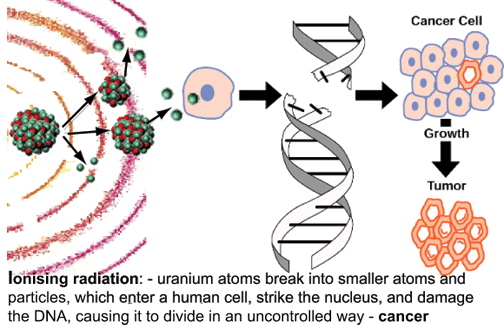
Researchers say it highlights the dangers of exposure to even small amounts
of radiation over time. They say governments must be cautious when building
new nuclear sites near towns and villages. The public was first alerted to
the possibility that nuclear plants could be causing cancer when an ITV
documentary in 1983 revealed a high number of childhood leukaemia cases
between 1955 and 1983 in the village of Seascale, near Sellafield. While
less than one case should have been expected in such a small community,
researchers found seven youngsters suffering from the condition. Residents
feared that radioactive discharges may be to blame and the Committee on
Medical Aspects of Radiation in the Environment (Comare) was set up to
investigate.
Investigations by Comare did show that rates of two types of
childhood leukaemia and non-Hodgkin lymphoma, were significantly higher
than expected, and researchers found a similar cluster at Thurso near
Dounreay. However, researchers did not find raised rates in other villages
near Sellafield and Dounreay, leading them to think that something else was
causing the rise, potentially local infections which are known to trigger
cancer in some cases. The investigators theorised that an influx of workers
moving to Seascale and Thurso to work in the nuclear industry might have
exposed local residents to new infections, sparking a rise in childhood
cancer rates. Viruses such as Epstein-Barr are thought to be linked to
cancers such as non-Hodgkin’s lymphoma.
Telegraph 19th July 2025, https://www.telegraph.co.uk/news/2025/07/19/why-starmers-nuclear-power-push-raises-cancer-fears/
Ed Miliband admits Sizewell C cost has almost doubled to £38bn
New power station approved despite costs almost doubling from an estimate made five
years ago. Ed Miliband has admitted Sizewell C will cost at least £38bn to
build as he gave final approval for the construction of the nuclear power
station. The Energy Secretary took the final investment decision on the
controversial power station on Tuesday.
The site will take at least a decade to build. The Government confirmed the project will cost £38bn in 2024 prices, or £39.3bn once inflation since then is factored in. The
total is almost double the £20bn estimate given by the government and
developers EDF in 2020.
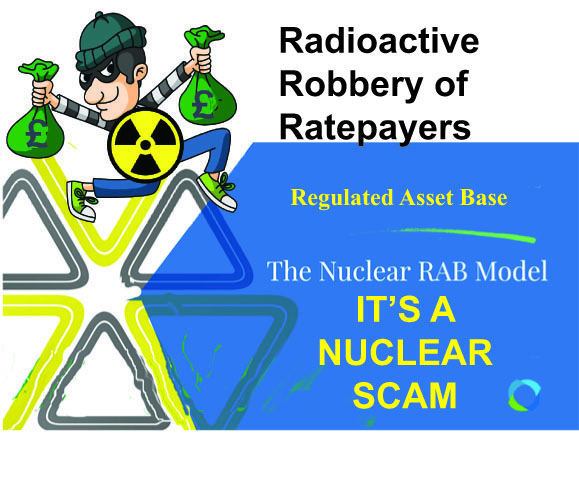
Sizewell C will be part-funded by a new levy on
household electricity bills called the Regulated Asset Base. The aim is to
pay the construction costs as they are incurred rather than borrow and then
pay decades of interest. Mr Miliband has claimed this levy will add only
£12 a year to the average household bill, but his claim is being treated
with scepticism by critics who point out that almost all major nuclear
projects suffer massive delays and cost overruns.
Telegraph 22nd July 2025 https://www.telegraph.co.uk/business/2025/07/22/miliband-gives-sizewell-c-nuclear-plant-the-green-light/
1 This Month
To see nuclear-related stories in greater depth and intensity – go to https://nuclearinformation.wordpress.com/
31st January – Challenging the War Machine – a DECLASSIFIED UK SUMMIT





Website of the Week
Now until to February 10, 2026 Radioactive waste storage in France: the debate is finally open! How to participate?
-
Archives
- January 2026 (306)
- December 2025 (358)
- November 2025 (359)
- October 2025 (376)
- September 2025 (258)
- August 2025 (319)
- July 2025 (230)
- June 2025 (348)
- May 2025 (261)
- April 2025 (305)
- March 2025 (319)
- February 2025 (234)
-
Categories
- 1
- 1 NUCLEAR ISSUES
- business and costs
- climate change
- culture and arts
- ENERGY
- environment
- health
- history
- indigenous issues
- Legal
- marketing of nuclear
- media
- opposition to nuclear
- PERSONAL STORIES
- politics
- politics international
- Religion and ethics
- safety
- secrets,lies and civil liberties
- spinbuster
- technology
- Uranium
- wastes
- weapons and war
- Women
- 2 WORLD
- ACTION
- AFRICA
- Atrocities
- AUSTRALIA
- Christina's notes
- Christina's themes
- culture and arts
- Events
- Fuk 2022
- Fuk 2023
- Fukushima 2017
- Fukushima 2018
- fukushima 2019
- Fukushima 2020
- Fukushima 2021
- general
- global warming
- Humour (God we need it)
- Nuclear
- RARE EARTHS
- Reference
- resources – print
- Resources -audiovicual
- Weekly Newsletter
- World
- World Nuclear
- YouTube
-
RSS
Entries RSS
Comments RSS
 nuclear-news