US and Israel Quit Gaza Ceasefire Talks in Doha as Palestinians Starve to Death
Hamas’s long-standing position is that it’s willing to release all remaining captives in exchange for a permanent ceasefire. But Israel has rejected this, and there’s no sign the Trump administration is willing to put pressure on Israel to change its position.
Steve Witkoff blamed the collapse of negotiations on Hamas while Hamas said it was caught off guard and wanted to continue talks
by Dave DeCamp | July 24, 2025 , https://news.antiwar.com/2025/07/24/us-and-israel-quit-gaza-ceasefire-talks-in-doha-as-palestinians-starve-to-death/
The US and Israel have withdrawn negotiators from Gaza ceasefire talks in Doha, Qatar, dashing hopes for a breakthrough as the humanitarian situation in Gaza is as bad as ever, and Palestinians are starving to death due to the US-backed Israeli blockade.
Israel announced it was bringing its negotiators home after Hamas presented its latest counter-proposal. The Israeli announcement was quickly followed up by a statement from US Middle East envoy Steve Witkoff.
Both the US and Israel are blaming Hamas for the collapse of the negotiations. However, Israel has maintained a hardline position throughout the talks and made clear that it would agree only to a temporary ceasefire since Israeli officials announced a plan to build a concentration camp in southern Gaza during the truce. One of Hamas’s conditions has been for a stronger guarantee that an initial 60-day ceasefire would lead to a permanent one.
Hamas’s long-standing position is that it’s willing to release all remaining captives in exchange for a permanent ceasefire. But Israel has rejected this, and there’s no sign the Trump administration is willing to put pressure on Israel to change its position.
“We have decided to bring our team home from Doha for consultations after the latest response from Hamas, which clearly shows a lack of desire to reach a ceasefire in Gaza. While the mediators have made a great effort, Hamas does not appear to be coordinated or acting in good faith,” Witkoff said in a post on X.
“We will now consider alternative options to bring the hostages home and try to create a more stable environment for the people of Gaza. It is a shame that Hamas has acted in this selfish way. We are resolute in seeking an end to this conflict and a permanent peace in Gaza,” he added.
It’s unclear what sort of “alternative options” the US and Israel may be considering, but the collapse in negotiations comes as the Israeli military has launched a ground offensive in Deir el-Balah, central Gaza, an area where Israelis believe many of the remaining captives may be held.
In response to Witkoff’s statement, Hamas said that it has been flexible and that it was “committed to reaching an agreement that halts the aggression and ends the suffering of our people in the Gaza Strip.” Hamas said it presented its “final response” in consultations with other Palestinian factions and mediators.
“We are surprised by the negative statements of US envoy Steve Witkoff regarding the Movement’s stance, especially when the mediators have expressed their welcome and satisfaction with this constructive and positive position, which opens the door to reaching a comprehensive agreement,” Hamas said.
“The Movement reiterates its commitment to continuing negotiations and engaging in them to help overcome obstacles and reach a permanent ceasefire agreement,” the group added.
According to Axios, Hamas had asked for more Palestinian prisoners to be released in exchange for Israeli captives, including 2,000 Palestinians who have been abducted in Gaza since October 7, 2023, instead of the 1,200 the US and Israel proposed. The two sides have also been at odds over the amount of territory Israel will occupy, as Israel is refusing to withdraw its forces back to the positions it held during the short-lived ceasefire deal that was signed in January 2025.
‘A heroic endeavour’: Sizewell C’s £38bn plan to keep the lights on

As construction finally starts how will this megaproject be built, can
it avoid the pitfalls of previous nuclear plants, and is it worth the
money?
Hinkley Point is overdue and over budget, while the EPR has been
plagued by problems in other countries where it has been built. Small
wonder, then, that some have asked whether replicating Hinkley is a good
idea.
Julia Pyke is here to tell people that copying Hinkley is exactly
what we should be doing. “It’s better to build the thing you know how
to build because … it will be cheaper.” Hinkley has helped build up a
nuclear workforce that was in decline. Pyke recalled the first batch of
university interns at Sizewell C. “The majority of them literally
didn’t know that the UK had a nuclear industry. It had been that
quiet,” she said.
The deal struck last week will see the government take
a 45 per cent stake, with Canadian pension fund La Caisse holding 20 per
cent, British Gas owner Centrica 15 per cent, EDF 12.5 per cent, and Amber
Infrastructure the remaining 7.6 per cent.
The gargantuan cost will be 65
per cent funded by debt, and 35 per cent by equity. The government has
pencilled in a total cost of £55 billion for contingency and inflation
over the lifetime of the plant. Last week there was much noise around the
fact that Sizewell’s price tag had ballooned from an estimate of £20
billion, in 2015 money. The new figure accounts for inflation and “some
cost increase”, according to Pyke. One big difference between Hinkley and
Sizewell, she argued, is that the design is now better understood and
contracts will be tighter. Many of Hinkley’s overruns were blamed on
“cost-plus” contracts that allowed suppliers to ratchet up their bills.
Pyke pointed to a recent deal for civil engineering at Sizewell: “It’s
a contract which, roughly speaking, pays the contractors the actual cost of
doing a day’s work. And it aligns profit to achieved milestones. So
they’re not incentivised to run the job long.”
In any case, Pyke argued, talk of cost misses the point. Sizewell C will ultimately be an
asset for the taxpayer. And the project will pay billions in tax over its
lifespan. “The cost is an investment for society because it’s going to
give us energy security and lower bills, as well as pay tax … it has much
wider societal benefits.”
Alison Downes, executive director of the Stop
Sizewell C campaign, said that as a group, they had always tried to
emphasise the wider problems with the project, beyond their self-interest.
“One former EDF chief executive described the EPR design as too
complicated — almost unbuildable,” she said. “The long delays at EPRs
elsewhere in the world, the massive cost overruns, suggest that this
project will be very difficult to build. And the Sizewell site is complex.
Any savings are likely to be frittered away in more complicated
groundworks.”
Times 26th July 2025, https://www.thetimes.com/business-money/companies/article/sizewell-c-38bn-plan-to-keep-the-lights-on-ndszrldwd
SNP slam ‘toxic’ Sizewell-C costs for Scottish energy bills.

THE SNP have demanded Scots are not forced to pay for “toxic” overspending
on the Sizewell-C budget. Prior to the summer recess, Energy Secretary Ed
Miliband quietly revealed that energy bills in Scotland will rise as a
result of a significant budget increase on the project – doubling in cost
to £38 billion with further revelations a loan facility of up to £36.6bn
will be provided, pushing the upper limit to £47.7bn.
Sizewell-C now becomes more costly than Hinkley Point C, the most expensive nuclear power
plant in the world.
Independent analysis from the House of Commons Library
confirmed that Scots will pay at least £300 million extra on energy bills
now to cover the overspend, with Miliband admitting there will be a
decade-long “nuclear tax” on bills north of the border.
SNP Energy spokesperson, Graham Leadbitter MP, said: “This toxic overspend now totals
£48bn and Anas Sarwar has serious questions to answer as to whether he
thinks it’s acceptable for Scots to foot the bill through higher energy
bills. “It is an absolute disgrace that energy rich Scotland will see
Scots face higher energy bills because of a nuclear plant running over
budget in Labour-run England.” With 2.5m households in Scotland, Miliband
forecasted that bill payers will pay an extra £12 per year to cover the
power plant, though experts have warned that figure is likely a minimum
with costs expected to rise further.
The National 27th July 2025 – https://www.thenational.scot/news/25342880.snp-slam-toxic-sizewell-c-costs-scottish-energy-bills/
Out of Step with the World: Australia’s Refusal to Recognise Palestine is a Moral Failure
27 July 2025, Michael Taylor, https://theaimn.net/out-of-step-with-the-world-australias-refusal-to-recognise-palestine-is-a-moral-failure/
In a world that is finally waking up to the urgent need for justice and peace in the Middle East, Australia has chosen silence and hesitation. While 147 of the 193 United Nations member states have formally recognised the State of Palestine – including France, Spain, Ireland, and Norway – Australia continues to sit on its hands. This refusal is not only out of step with global momentum; it is out of step with the values of fairness, dignity, and the will of the Australian people.
Recognition of Palestine is not an endorsement of violence, nor is it a rejection of Israel’s right to exist. It is a simple acknowledgement that the Palestinian people – stateless for 76 years – deserve the same rights and recognition afforded to others. It is a step toward equality, toward dialogue, and ultimately toward peace.
Yet Australia clings to a failed policy of “not yet” – as though Palestinian dignity must forever be postponed for fear of offending a powerful ally. In doing so, our government aligns itself not with justice or international law, but with the shrinking minority of countries who continue to look the other way.
This decision does not reflect the views of the Australian public. Poll after poll shows a majority of Australians support Palestinian statehood and an end to the occupation. We are a people who believe in the fair go, in standing up for the underdog, in peace over power. And yet, our government refuses to act – cowed by geopolitical caution and domestic political pressure.
Refusing to recognise Palestine is not a neutral act. It is a political choice – one that undermines the international consensus, emboldens the status quo, and tells the Palestinian people that their suffering is invisible.
Australia once stood tall in the fight against apartheid. We helped build international pressure that led to its end in South Africa. Why, then, do we hesitate now?
If we truly believe in a two-state solution – if we truly believe in peace – then we must recognise both states. It is time for Australia to find its moral courage and join the vast majority of the world in recognising Palestine.
Justice delayed is justice denied.
Israel is changing the legal system governing the West Bank to accelerate annexation: report
Netanyahu’s government is building on a long-standing legal matrix to accelerate Israel’s de facto annexation in the West Bank
Mondoweiss, By Jeff Wright July 24, 2025
Israel is accelerating its efforts to cement its permanent control over the West Bank through a number of sweeping legal and institutional changes, according to a new report from Adalah, The Legal Center for Arab Minority Rights in Israel.
The 87-page report, Legal Structures of Distinction, Separation, and Territorial Domination, describes the ways in which the Netanyahu government is rapidly building on a long-standing legal matrix that further threatens Palestinians’ right to self-determination.
“These developments are not something new to us,” Dr. Suhad Bishara, Legal Director of Adalah and lead author of the report, told Mondoweiss. “All eyes are on Gaza, justifiably so,” she said. “However… it is important to highlight the intensity of the structural changes that have taken place since the current government took over in December 2022.”
“What is happening in the West Bank is dangerously fast-forwarding annexation policies in a blatant violation of international law,” Bishara said. “Israel is intensifying measures to change the status of the West Bank, the status of many Palestinians living in Area C who are subject to intensified displacement induced by settler violence and Israeli policies.” She said, “This is in addition to settler expansion and further restrictions on Palestinian development in the area.”
Thoroughly researched and footnoted, the report documents how the current extremist government has built on what Adalah describes as “foundational mechanisms through which Israel has entrenched a land regime that facilitates territorial domination and racial segregation.”
Area C comprises over 60 percent of the West Bank, and is under full Israeli military control.
Here are the mechanisms of territorial domination Adalah examines in these areas.
Civilian governance for Israeli settlers; military rule over Palestinians………………………………………
1. Administration by local authorities
……………………………………Israel can argue that the settlements operate now under Israeli sovereignty. But applying Israeli law in occupied territory, Adalah maintains, is a violation of international human rights law and constitutes “a measure of de facto annexation.”
2. Financial incentives for settlements ………………………………
3. Declaring State land …………………………………….
The planning system in Area C……………………………………………
………………………..Paralleling the judgments of the ICJ, UN experts, and international, Palestinian, and Israeli human rights groups, the report ends by listing the five international crimes that Adalah finds Israel guilt of: violations of International Humanitarian Law; the deepening of the illegal mechanism of de facto annexation; the denial of Palestinian people’s right to self-determination; the deepening of the apartheid system in the occupied Palestinian territory; and the commission of war crimes and crimes of aggression on the part of Israel……………………………………………………………………………………
Free speech is under attack—especially when it comes to Palestine. https://mondoweiss.net/2025/07/israel-is-changing-the-legal-system-governing-the-west-bank-to-accelerate-annexation-report/
The next Chernobyl? Soviet-era nuclear power plant is branded a ‘ticking time bomb’ that could go off at ‘any moment’
A Soviet-era nuclear power plant in an earthquake zone has been branded
‘Chernobyl in waiting’ and a ‘ticking time bomb’ amid fears of a looming
disaster. The Armenian Nuclear Power Plant was opened in 1976 and comprises
two reactors, reportedly supplying the nation with 40 per cent of its
electricity. But it stands in a seismic zone, and has already been
shuttered once before, closing for six years after the Spitak Earthquake in
1988.
Daily Mail 25th July 2025,
https://www.dailymail.co.uk/sciencetech/article-14939915/Chernobyl-nuclear-power-plant-ticking-time-bomb.html
Ed Miliband put up your energy bills (for Sizewell nuclear)– and hoped you wouldn’t notice
Miliband took the last day of term before MPs knocked off for a
six-week-long holiday – sorry, I mean “working in the constituency”
– to let slip that he was putting up your energy bills. This is to pay
for the ballooning cost of the Sizewell C nuclear plant in Suffolk.
Incidentally, another thing that the Energy Secretary let out the bag on
Tuesday was that the cost of this had almost doubled to £38 billion.
That is regrettable but Miliband did not want us to get too down about it. The
UK Government expects that it will be “limited to an average of around
£1 a month on a typical household bill”. Given the way that energy bills
have gone in recent years, I doubt that anyone feels anything less than
seething resentment at paying even another penny.
The National 25th July 2025, https://www.thenational.scot/politics/25342653.ed-miliband-put-energy-bills—hoped-wouldnt-notice/
Tory peer apologises for helping set up ministerial meeting for a nuclear firm he advises
Deputy speaker Ian Duncan found to have breached rules by providing parliamentary service for Terrestrial Energy
The former junior climate minister has been an adviser to Terrestrial Energy since 2020. When he joined he was given share options, which allowed him to buy shares in the company at a preferential rate if they became profitable.
The Guardian revealed that, in 2023, Duncan forwarded a letter to Andrew Bowie, the nuclear minister at the time, from Simon Irish, the firm’s chief executive who wanted a meeting with the minister at short notice. The peer signed off his email “Lord D of S”.
The chief executive of the company, which is developing a new type of nuclear reactor, secured the meeting with Bowie at which he lobbied for Terrestrial Energy to be given easier access to government funding.
In his response to the watchdog, Duncan said Bowie was a “friend of long standing” who had helped him get elected as a member of the European parliament in 2014 and had then worked in his Brussels office.
Margaret Obi, the Lords commissioner, decided that the rule prohibiting peers from providing “parliamentary services in return for payment or other incentive or reward” was absolute.
She added: “It did not provide an exemption in cases where there was an existing personal relationship.”
She ruled: “Although Lord Duncan stated he was not paid specifically for facilitating this introduction, he received an allocation of share options as consideration for his work for Terrestrial Energy.
“I consider that this can reasonably be understood to have been an incentive or reward for the various tasks he undertook for the company.”
Guardian 25th July 2025, https://www.theguardian.com/politics/2025/jul/25/tory-peer-ian-duncan-apologises-for-helping-set-up-ministerial-meeting-for-firm-he-advises
They’re Starving Civilians To Steal A Palestinian Territory, And They’re Lying About It
Caitlin Johnstone, Jul 26, 2025, https://www.caitlinjohnst.one/p/theyre-starving-civilians-to-steal?utm_source=post-email-title&publication_id=82124&post_id=169279261&utm_campaign=email-post-title&isFreemail=true&r=1ise1&triedRedirect=true&utm_medium=email
Just so we’re all absolutely clear about what we’re watching here, Israel is intentionally starving civilians in order to bring about the ethnic cleansing of Gaza and steal a Palestinian territory. That’s all this is, and anyone who says otherwise is lying.
This isn’t a theory. This is what’s happening. The facts are in and the case is closed. Israeli officials aren’t even hiding it anymore.
Israel’s Heritage Minister Amichai Eliyahu is telling the Israeli media that “the government is racing ahead for Gaza to be wiped out,” and that “all Gaza will be Jewish.”
Israel’s National Security Minister Itamar Ben-Gvir is tweeting in Hebrew that a “complete halt of ‘humanitarian aid’” will allow “encouragement of migration” and “settlement” in the Gaza Strip.
Israeli Defense Minister Israel Katz announced earlier this month that the official plan is to build a giant concentration camp for Gaza’s population on the ruins of Rafah while working to deport the population to other countries.
Prime Minister Benjamin Netanyahu himself made it clear back in May that implementing Donald Trump’s plan for the ethnic cleansing of Gaza was a precondition to having peace in the enclave.
Trump made it clear back in February that his plan was for “all” Palestinians to be removed from the Gaza Strip on a “permanent” basis.
Within days of Israel’s assault on Gaza in October 2023, Israel’s Intelligence Ministry was circulating a plan for the entire population of Gaza to be moved to the Sinai Peninsula in Egypt, and an Israeli think tank had drawn up a strategy for the “relocation and final settlement of the entire Gaza population.”
Indeed, Israel has been on record scheming to find a way to relocate the population of Gaza for many decades.
That’s what this is all about. That’s all this has ever been about. It’s not about hostages. It’s not about Hamas. It’s not about Israel defending itself. It’s about stealing a Palestinian territory, and anyone who says otherwise is lying.
And the lies have been erupting like a geyser in recent days. Israel and its apologists have been frantically pushing the narrative that Gaza is starving because the UN isn’t allowing aid in (swiftly refuted by Drop Site News), that Gaza is starving because Hamas is stealing the aid (swiftly refuted by Reuters), and that Gaza is starving because Hamas attacks people who try to go to aid sites (already refuted by Israeli soldiers telling the Israeli press that they’re the ones shooting the aid seekers).
The more evil Israel gets, the more frenetic its apologists need to get with their lies to justify its behavior.
Starvation deaths in Gaza are skyrocketing. Many of those still alive have already suffered permanent damage, and even with a massive influx of aid and complete reversal of Israeli policies it will be very difficult to undo the effects of the famine.
Western governments are beginning to speak out against the mass atrocity in Gaza, far too little and far too late. We can expect Israel and the United States to respond to this outcry by saying that Palestinians need to be evacuated out of Gaza as quickly as possible in order to rescue them from this deliberately manufactured humanitarian crisis. We can expect them to denounce anyone who opposes this ethnic cleansing operation as evil monsters who want to starve the poor Palestinians.
And it will all be lies. They lied this entire time.
It’s about the most evil thing you could possibly come up with, really. If this is not evil, then nothing is.
Sizewell C loans could see project cost rise above Hinkley to £47.7bn
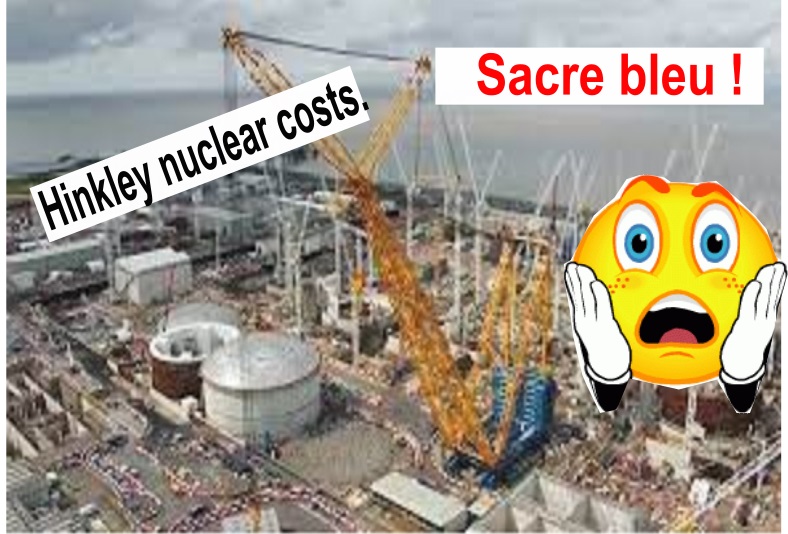
The National Wealth Fund said it will provide a loan facility for the nuclear power station of up to £36.6bn, pushing the upper limit to £47.7bn.
July 22nd 2025, https://www.energyvoice.com/renewables-energy-transition/576872/sizewell-c-loans-could-see-project-cost-rise-above-hinkley-to-47-7bn/
Project costs for the Sizewell C nuclear power station could rise to an upper threshold of £47.7 billion as a result of a new government loan extension.
The National Wealth Fund (NWF) has increased the size of its loan facilities to provide a debt buffer in case project costs rise, the government has confirmed.
The government’s new sovereign fund said in a statement that Treasury has recapitalised the fund from a prior capitalisation of £27.8bn so it can provide a loan facility for nuclear power station Sizewell C of £36.6bn.
The NFW, which started operating in October, will act as a lender of record for the project and continue to have the capacity to invest across its mandated sectors, a spokesperson said.
According to the statement, an additional £5bn of debt will be guaranteed by France’s export credit agency Bpifrance Assurance Export.
An energy department spokesperson told Energy Voice that “in order to finance a project of this size, the project partners have made available finance to fund costs up to £47.7bn (real) to safeguard taxpayers in the event of cost overruns”.
“This is based on a remote scenario for the project and is not what the company is managing the project to,” the government spokesperson said.
“The central target in terms of costs is around £38bn real, but as is standard for big and complex projects, we have secured a financing which contains contingency in case of overruns.”
According to people close to the matter, one of whom cited project documents, while Sizewell C is estimated to cost £38bn, the lower threshold for financing is £40bn, with a higher upper threshold of £47.7bn.
The newly secured loan capital would raise the projected upper limit of financing for the power station by nearly £10bn if it was fully drawn down over the course of the project’s lifecycle, they indicated, although a spokesperson for the fund said that would be unlikely. He said the facility provided for the effect of inflation.
“It is likely that NWF would not be exposed to the full amount of its debt provision, meaning its total debt exposure is likely to be less than the nominal maximum it has provided for,” the fund’s spokesperson said.
This increase would provide for a maximum project cost of £47.7bn, which would make the nuclear project more expensive than stalled Somerset nuclear power station Hinkley Point C, which is estimated to cost in the region of £46bn.
The UK Department for Energy Security and Net Zero (DESNZ) confirmed this morning that it had secured investors to commit a total of £38bn to Sizewell C. That included investment commitments from EDF, Centrica, Amber Infrastructure Group and Canadian fund La Caisse.
Together Against Sizewell C chair Jenny Kirtley said: “The scale of potential exposure of public funds to the Sizewell C project is revealed as a staggering £54.589bn in the government’s FID subsidy scheme.
“So much for claims made by EDF and government that there would be huge cost savings from ‘lessons learned’ from the Hinkley Point C build.”
She added that “future generations will have the responsibility to protect the Sizewell C site until the late 2100s and are depending on us to get it right”.
Sizewell C, which reached a final investment decision in the early hours of Tuesday, is expected to be a more efficient replica than its delayed and long-awaited Somerset counterpart, with efficiencies estimated to be between 20% and 25% greater than the first two reactors at Hinkley.
Supply chain ‘incentivised to keep costs down’
Investors insist that they are confident that costs will not overrun, yet Somerset nuclear power station Hinkley Point C is years overdue and over budget.
“The project supply chain is strongly incentivised to keep costs down and investors will see lower returns if there are overruns, reducing risk for taxpayers,” DESNZ told Energy Voice by email.
The new Suffolk nuclear power station at Sizewell is expected to be delivered by the mid-2030s.
Yet Hinkley Point C, which secured a contract-for-difference to operate in 2015, is still not fully built.
Project owner EDF received a dressing down from the French auditor earlier this year, which insisted that it should refinance Hinkley before investing in another nuclear power station in the UK, Sizewell C.
EDF has subsequently reduced its stake to 12.5%, representing an equity commitment of £1.1bn. Centrica has agreed to invest £1.3bn in a 15% stake, while Amber Infrastructure Group and Canadian fund Le Caisse have committed to take an initial 7.6% and 20% stake respectively.
The UK government said it will initially take a stake of 44.9% in Sizewell C, which is expected to reduce if Amber and La Caisse’s combined stake rises to 30%, according to a person familiar with the matter.
From hero to zero- When western leaders realised that Zelensky isn’t a corruption-fighting democrat –
Indeed, war has turbo-charged corruption to a new and more disgusting level.
it is impossible that British and European governmental agencies would not be aware of the huge graft within the Ukrainian state…… Having held up the ‘nothing to see here’ signs for so long, our political leaders may now be starting to worry about how they will account for and continue to justify the billions that western nations are pumping into Ukraine.
Ian Proud, The Peacemonger, Jul 25, 2025
Since the start of the war in Ukraine, in February 2022, Volodymyr Zelensky has been elevated to the status of a hero King, pure in thought and deed, interested only in saving humble Ukraine from the onrushing hordes of Russian Orcs. Like Aragorn from Lord of the Rings, but short, thin-skinned and with a gravelly voice.
Zelensky has been completely immune from criticism in the west, with allegations dismissed and labelled as Kremlin talking points, and accusers called out as Quislings.
Yet, in an instant, that illusion has been shattered.
For the first time since February 2022, Zelensky has been revealed as no different from every President of Ukraine since the country gained independence in August 1991; corrupt and authoritarian.
This comes as no surprise to most realists, but offers a devastating blow to the neo-liberal true-believers who invested their reputations and cash into defeating Russia.
This week, President Zelensky signed a law that stripped two important anti-corruption bodies – the National Anti-Courrption Bureau of Ukraine (NABU) and the Specialised Anti-Corruption Prosecutor’s Office (SAPO) of their independence, making them report to the Prosecutor General, who he appointed.
In the face of widespread protest, Zelensky has been forced to backtrack, although it is not year clear what the new arrangements will be, or when they will be implemented, and the Verkhovna Rada has started its summer recess.
Let’s be clear, corruption is and has been a totemic issue in Ukraine, right back to the onset of the Maidan protests in late 2013 and, of course, before that. During my visits to Ukraine, while posted to Russia, it was clear that young people saw tackling corruption as a top priority for the government. This formed part of their desire for Ukraine to move towards European Union membership and for their country to integrate into a community more clearly governed by democracy and the rule of law.
Whether they might consider the European Union to be democratic today, as unelected Commission President Ursula von der Leyen centralises ever more powers, is another question. But that European and anti-corruption aspiration was real back in 2013.
Yet scant progress has been made in tackling corruption since that time. In February 2015, one year after the height of the Maidan protests, the British Guardian newspaper published a long piece entitled ‘Welcome to Ukraine, the most corrupt country in Europe’. The Ukrainian Prime Minister, Arseny Yatseniuk, who had been personally selected by Victoria Nuland at the U.S. State Department, was forced to resign in April 2016 in the face of allegations of widespread corruption within his government.
In 2021, the European Court of Auditors produced a report entitled Reducing Grand Corruption in Ukraine: several EU initiatives, but still insufficient results. It defined Grand Corruption as ‘the abuse of high-level power that benefits the few, and causes serious and widespread harm to individuals and society’.
In January 2023, an article in the Hill remarked on the need to defeat corruption as Ukraine’s ‘other enemy’. Shortly after that article, a piece, again in the Guardian, discussed the challenges faced by the Head of Ukraine’s National Agency for Corruption Prevention (NACP), which works closely with the now de-clawed NABU and SAPO.
That report in particular talked about specific examples of corruption in President Zelensky’s inner circle. Occasionally, Zelensky has purged his cabinet, to show his commitment to governmental reform, for example, sacking his former Defence Minister, Oleksii Reznikov, in the face of widespread accusations that the Ukrainian Defence Ministry was siphoning off foreign donations on an industrial scale.
But the occasional show trial has never taken the whiff away that Zelensky’s administration is every bit as corrupt as those that preceded it.
This stripping of powers from NABU and SAPO took place as those organisations were closing in with investigations against senior members of the Zelensky administration. Zelensky has spoken about the need to deal with Russian influence, but most people have seen through that smoke screen.
Zelensky was voted into office in 2019 on a platform to eradicate corruption in Ukraine. He has not done so.
And, as I have pointed out often, war has held back real steps to address the problem.
Indeed, war has turbo-charged corruption to a new and more disgusting level. Money for infrastructure projects has been siphoned off, weapons’ orders have been falsified with officials skimming the profits. You’ll see as many hypercars tooling round Kyiv as might be witnessed at the Monaco Grand Prix. Want to get out of enlistment? We can make an arrangement for the right money. Need to cross the border? Just hand over the cash.
This has prompted the mother of all holy shit moments, in which European politicians are quickly waking up to the fact that their hero, Zelensky, is just a flawed human like everyone else. Although, from my personal experience, it is impossible that British and European governmental agencies would not be aware of the huge graft within the Ukrainian state.
Having held up the ‘nothing to see here’ signs for so long, our political leaders may now be starting to worry about how they will account for and continue to justify the billions that western nations are pumping into Ukraine. Two thirds of Ukrainian state expenditure is effectively paid for by us, non-Ukrainian citizens, through the donations of western governments.
And yet Ukraine has become more corrupt…………………………………………………………https://thepeacemonger.substack.com/p/from-hero-to-zero?utm_source=post-email-title&publication_id=3221990&post_id=169225133&utm_campaign=email-post-title&isFreemail=true&r=1ise1&triedRedirect=true&utm_medium=email
Chinese hackers gain access to US oversight of nuclear weapons in widespread Microsoft hack: report

The tech giant blamed a vulnerability in its SharePoint document software
Anthony Cuthbertson,Rhian Lubin, Wednesday 23 July 2025, https://www.the-independent.com/tech/security/china-hack-nuclear-microsoft-sharepoint-b2795333.html
Chinese hackers gained access to the U.S. government agency that oversees nuclear weapons in a widespread Microsoft hack.
Microsoft issued an alert Tuesday warning that hackers affiliated with the Chinese government have been exploiting cybersecurity vulnerabilities in the company’s SharePoint software.
Tens of thousands of servers hosting the software, which is used for sharing and managing documents, were said to be at risk as a result.
The National Nuclear Security Administration, a semi-autonomous agency within the U.S. Department of Energy responsible for maintaining the nation’s stockpile of nuclear weapons, was breached in the attacks on July 18, Bloomberg first reported.
The agency is responsible for providing the Navy with nuclear reactors for submarines and responds to nuclear and radiological emergencies in the U.S. and overseas. No sensitive or classified information has leaked in the cyber attack, according to Bloomberg.
“On Friday, July 18th, the exploitation of a Microsoft SharePoint zero-day vulnerability began affecting the Department of Energy,” an agency spokesman said in a statement to the outlet. “The department was minimally impacted due to its widespread use of the Microsoft M365 cloud and very capable cybersecurity systems. A very small number of systems were impacted. All impacted systems are being restored.”
Security firm Eye Security said that 400 organizations and agencies globally were impacted, including national governments in Europe and the Middle East.
Microsoft linked the attack to two main groups, Linen Typhoon and Violet Typhoon, and flagged that another China-based group, Storm-2603, had also targeted its systems.
The Education Department, Florida’s Department of Revenue and the Rhode Island General Assembly were also breached in the attack, according to Bloomberg.
Eye Security warned that the breaches could allow hackers to impersonate users or services by stealing cryptographic keys — alphabetical codes or sequences of characters — even after software updates. Users should take further steps to protect their information, the firm said.
Microsoft said in a message to customers that it has since released “new comprehensive security updates” to deal with the incident.
But security researchers warned that the full extent of the breach and its consequences are yet to be fully revealed.
“This is a critical vulnerability with wide reaching implications,” Carlos Perez, director of security intelligence at TrustedSec, who previously trained U.S. military cyber protection teams, told The Independent.
“It enables unauthenticated remote code execution on SharePoint servers, which are a core part of enterprise infrastructure. It is already being actively exploited at scale, and it only took 72 hours from the time a proof of concept was demonstrated for attackers to begin mass exploitation campaigns.
“What makes it even more severe is the way it exposes cryptographic secrets, effectively allowing attackers to convert any authenticated SharePoint request into remote code execution. That is a dangerous capability to put into the hands of threat actors.”
Microsoft said it had “high confidence” that firms who do not install the new security updates could be targeted by the groups.
The tech firm said the attackers had been uploading malicious scripts which are then “enabling the theft of the key material” by hackers.
In a statement, the company added: “Investigations into other actors also using these exploits are still ongoing.”
Additional reporting from agencies.
Four Major News Agencies Warn Gaza Staff Face Starvation Due to Israeli Blockade
Gaza’s Health Ministry said two more Palestinians starved to death under the siege
by Dave DeCamp | July 24, 2025, https://news.antiwar.com/2025/07/24/four-major-news-agencies-warn-gaza-staff-face-starvation-due-to-israeli-blockade/
Four of the world’s major news agencies have issued a rare joint statement warning that their journalists in Gaza are unable to feed themselves due to the US-backed Israeli blockade, as Palestinians continue to starve to death under the siege.
“We are desperately concerned for our journalists in Gaza, who are increasingly unable to feed themselves and their families,” AFP, The Associated Press, Reuters, and BBC News said. “For many months, these independent journalists have been the world’s eyes and ears on the ground in Gaza. They are now facing the same dire circumstances as those they are covering.”
The news agencies said that journalists “endure many deprivations and hardships in war zones. We are deeply alarmed that the threat of starvation is now one of them.” They urged the “Israeli authorities to allow journalists in and out of Gaza” and said it was “essential that adequate food supplies reach the people there.”
On top of the starvation, journalists in Gaza continue to be targeted by the IDF. On Wednesday, Walaa al-Jabari, who worked for local news outlets, was killed along with her husband and four children. Al-Jabari was pregnant at the time of her killing, and the Gaza Government Media Office said her death brought the total number of journalists killed by Israel since October 7, 2023, to 231.
The statement from the news agencies came as Gaza’s Health Ministry said another two Palestinians had starved to death over the previous 24-hour period. Starvation deaths have spiked over the past week, with dozens, mostly children, dying of malnutrition due to Israeli-imposed restrictions and the killing of aid seekers. The Health Ministry said it has recorded a total of 113 starvation deaths.
Palestinians in Gaza also continue to be gunned down while attempting to reach food aid. Since the end of May, more than 1,000 aid seekers have been killed by Israeli forces, mainly near distribution sites run by the US and Israeli-backed Gaza Humanitarian Foundation (GHF).
Sabreen Abu al-Kass, a mother of 10 in Gaza, told Al Jazeera on Thursday that she attempted to get aid from a GHF site on Thursday but failed. “I went to get food, to support my children, and I fainted there. No one helped me,” she said. “I couldn’t bring back any aid at all. We returned home empty-handed, just like we came. Out of maybe 50 attempts, I was only able to get some food once. One time, among thousands of women.”
Trump’s Ukraine Plan: Power Play or Exit Strategy?

Beneath the rhetoric lies a fundamental truth: America is disengaging. Not with a decisive withdrawal, but through a form of diplomatic sleight-of-hand. By recasting its role from arsenal to arms dealer (insisting NATO nations pay “a hundred percent” for U.S.-made weapons) the United States transforms the principle of collective defense into a commercial transaction.
Beneath the rhetoric lies a fundamental truth: America is disengaging. Not with a decisive withdrawal, but through a form of diplomatic sleight-of-hand. By recasting its role from arsenal to arms dealer (insisting NATO nations pay “a hundred percent” for U.S.-made weapons) the United States transforms the principle of collective defense into a commercial transaction.
Uncover the hidden logic behind Trump’s delayed weapons aid, NATO rifts, and realpolitik tactics reshaping U.S. foreign policy and Ukraine’s fate.
Post-Liberal Dispatch, Jul 24, 2025, This piece was written by guest contributor Sérgio Horta Soares and has been reviewed and edited by Paulo Aguiar, founder of Post-Liberal Dispatch.
In geopolitics, there are no saints, only actors grappling for advantage, cloaking raw interests in the language of freedom, democracy, and humanitarian concern.
The recent choreography surrounding former U.S. President Donald Trump’s ostensible reentry into the Ukraine conflict lays bare the mechanics of power as they actually function: not through moral imperatives, but through calculated ambiguity, resource preservation, and the exploitation of time.
What masquerades as renewed support for Ukraine is, in substance, a meticulously engineered performance, designed not to rescue Kyiv, but to extricate Washington. Trump’s pronouncements of “billions” in arms, and his threats of tariffs against nations buying Russian oil, are not expressions of strategic commitment; they are instruments of political theater, signals issued to multiple audiences with competing agendas, none of whom are meant to receive a clear message.
To understand this gambit, one must first understand the war’s trajectory. Since Russia’s full-scale invasion of Ukraine in February 2022, Western countries (led by the United States) have supplied billions in weapons, economic assistance, and intelligence to Ukraine in an effort to repel Russian advances and prevent the collapse of the post–Cold War European security order.
Initially, this support was framed in terms of values: defending sovereignty, democracy, and international law. But as the war dragged on into its third year, cracks emerged in the Western coalition (rising costs, strained defense stockpiles, and growing domestic opposition to what many now view as an open-ended commitment).
Beneath the rhetoric lies a fundamental truth: America is disengaging. Not with a decisive withdrawal, but through a form of diplomatic sleight-of-hand. By recasting its role from arsenal to arms dealer (insisting NATO nations pay “a hundred percent” for U.S.-made weapons) the United States transforms the principle of collective defense into a commercial transaction.
NATO, once a bastion of mutual obligation, is being refashioned into a procurement agency. The nations of Europe are no longer being asked to fight beside the U.S.; they are being asked to shop.
That this approach incites confusion and resentment among allies is the point. Strategic ambiguity, long a hallmark of Trump’s foreign policy, is not a flaw but a deliberate tactic. By maintaining a posture of conditional engagement, the U.S. preserves its leverage, avoids definitive entanglement, and keeps both adversaries and allies on edge. This calculated vagueness allows for plausible deniability and quick reversals. It ensures that commitments can be revoked, blame can be shifted, and outcomes can be rebranded.
What emerges is not policy, but posture, a stance of strength unmoored from obligation. The imposition of delayed tariffs and the promise of weapons that will not arrive in time to affect the current Russian offensive are not strategic errors; they are expressions of strategic intent. They buy time; not for Ukraine, but for Russia.
Intelligence suggests that Russian commanders believe they can achieve key battlefield objectives within weeks, before weather and logistics slow their operations. Trump’s 50-day deadline for triggering sanctions likely falls outside of that window. This is not coincidence; it is complicity, veiled beneath performative deterrence.
Ukraine, under siege and starved of arms, is left to decipher whether the promised aid is a lifeline or a leash. Meanwhile, Washington hedges its bets, calibrating its involvement to extract maximum geopolitical return with minimum exposure.
The material realities further erode any illusion of robust support. Western arsenals are depleted. Since 2022, the U.S. and its NATO allies have shipped tens of thousands of artillery shells, air defense systems, and armored vehicles to Ukraine. Yet the West’s military-industrial base is still operating on peacetime rhythms, struggling to keep pace with the demands of high-intensity warfare. Arms production in the U.S. and Europe cannot meet short-term demand, and weapons systems, such as Germany’s promised Patriots, are delayed by months.
These constraints reveal a widening gap between political intent and logistical feasibility. Without urgent expansion of industrial capacity, Western efforts risk falling behind Russia’s war economy, rendering even well-publicized support strategies operationally irrelevant
The fragmentation of NATO in response to the Trump plan is less an aberration than a revelation.
France and Italy reject participation outright, prioritizing domestic industry and fiscal restraint. Hungary abstains on ideological grounds, and the Czech Republic prefers alternative aid mechanisms. Even those nations nominally listed as partners (Finland, Denmark, Sweden) were reportedly blindsided by the announcement. This is improvisation, and it exposes the brittle scaffolding of transatlantic unity, where each state calculates its own interests and distances itself from burdens it cannot (or will not) carry.
Within this fractured landscape, Ukraine is not a partner but a bargaining chip, leveraged between competing powers with conflicting priorities. Trump’s ultimate objective is not Ukrainian victory but………………………………………………..(Subscribers only) https://postliberaldispatch.substack.com/p/trumps-ukraine-plan-power-play-or?utm_source=post-email-title&publication_id=4747899&post_id=169097642&utm_campaign=email-post-title&isFreemail=true&r=ln98x&triedRedirect=true&utm_medium=email
The Flamanville EPR is still shut down: we know more after the visit of the nuclear regulator
Shut down since mid-June 2025 due to a leak on a protection valve, the Flamanville EPR received a visit from a team from ASNR, the nuclear regulator.
The Flamanville EPR is still shut down: we know more after the visit of the
nuclear watchdog. Shut down since mid-June 2025 due to a leak on a
protection valve, the Flamanville EPR received a visit from a team from
ASNR, the nuclear regulator.
La Presse de la Manche 22nd July 2025, https://actu.fr/normandie/flamanville_50184/lepr-de-flamanville-est-toujours-a-larret-on-en-sait-plus-apres-le-passage-du-gendarme-du-nucleaire_62944598.html
1 This Month
10 March A LIVE WEBINAR THE REAL EFFECTS OF NUCLEAR POWER
What the Industry Isn’t Telling Us
1:00 PM Mountain, 2 pm Central, 3 pm Eastern. Live on the Keepers of the Water Facebook page



18 March Webinar @ 1 PM EST: An Assessment of SMR Projects: The Case of Canada
register for the zoom:
https://us02web.zoom.us/webinar/register/WN_o8BIIOUvQ2ONJR1nta65DQ#/registration


of the week – STOP SMALL MODULAR REACTORS IN CANADA
To see nuclear-related stories in greater depth and intensity – go to https://nuclearinformation.wordpress.com
-
Archives
- March 2026 (99)
- February 2026 (268)
- January 2026 (308)
- December 2025 (358)
- November 2025 (359)
- October 2025 (376)
- September 2025 (258)
- August 2025 (319)
- July 2025 (230)
- June 2025 (348)
- May 2025 (261)
- April 2025 (305)
-
Categories
- 1
- 1 NUCLEAR ISSUES
- business and costs
- climate change
- culture and arts
- ENERGY
- environment
- health
- history
- indigenous issues
- Legal
- marketing of nuclear
- media
- opposition to nuclear
- PERSONAL STORIES
- politics
- politics international
- Religion and ethics
- safety
- secrets,lies and civil liberties
- spinbuster
- technology
- Uranium
- wastes
- weapons and war
- Women
- 2 WORLD
- ACTION
- AFRICA
- Atrocities
- AUSTRALIA
- Christina's notes
- Christina's themes
- culture and arts
- Events
- Fuk 2022
- Fuk 2023
- Fukushima 2017
- Fukushima 2018
- fukushima 2019
- Fukushima 2020
- Fukushima 2021
- general
- global warming
- Humour (God we need it)
- Nuclear
- RARE EARTHS
- Reference
- resources – print
- Resources -audiovicual
- Weekly Newsletter
- World
- World Nuclear
- YouTube
-
RSS
Entries RSS
Comments RSS
 nuclear-news