Why Starmer’s nuclear power push raises cancer fears
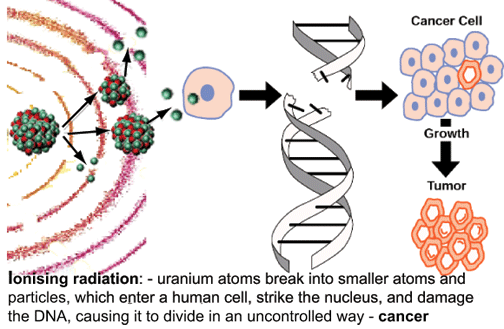
The UK is investing £14.2bn in a new Sizewell plant and £2.5bn in small nuclear reactors. In 1942, the Mallinckrodt Chemical Works in Missouri, US, was
processing uranium for the first atomic bomb. It ran out of space for its
radioactive waste and moved it to an open air storage site near Coldwater
Creek, north of St Louis.
More than 80 years later, Harvard University has
found that communities living near the creek, a tributary of the Missouri
River, have an elevated risk of cancer. The findings, released this week,
showed a dose-response effect, with those nearest the water having a far
higher chance of developing most cancers than those living farther away.
Researchers say it highlights the dangers of exposure to even small amounts
of radiation over time. They say governments must be cautious when building
new nuclear sites near towns and villages. The public was first alerted to
the possibility that nuclear plants could be causing cancer when an ITV
documentary in 1983 revealed a high number of childhood leukaemia cases
between 1955 and 1983 in the village of Seascale, near Sellafield. While
less than one case should have been expected in such a small community,
researchers found seven youngsters suffering from the condition. Residents
feared that radioactive discharges may be to blame and the Committee on
Medical Aspects of Radiation in the Environment (Comare) was set up to
investigate.
Investigations by Comare did show that rates of two types of
childhood leukaemia and non-Hodgkin lymphoma, were significantly higher
than expected, and researchers found a similar cluster at Thurso near
Dounreay. However, researchers did not find raised rates in other villages
near Sellafield and Dounreay, leading them to think that something else was
causing the rise, potentially local infections which are known to trigger
cancer in some cases. The investigators theorised that an influx of workers
moving to Seascale and Thurso to work in the nuclear industry might have
exposed local residents to new infections, sparking a rise in childhood
cancer rates. Viruses such as Epstein-Barr are thought to be linked to
cancers such as non-Hodgkin’s lymphoma.
Telegraph 19th July 2025, https://www.telegraph.co.uk/news/2025/07/19/why-starmers-nuclear-power-push-raises-cancer-fears/
No comments yet.
-
Archives
- February 2026 (199)
- January 2026 (308)
- December 2025 (358)
- November 2025 (359)
- October 2025 (376)
- September 2025 (258)
- August 2025 (319)
- July 2025 (230)
- June 2025 (348)
- May 2025 (261)
- April 2025 (305)
- March 2025 (319)
-
Categories
- 1
- 1 NUCLEAR ISSUES
- business and costs
- climate change
- culture and arts
- ENERGY
- environment
- health
- history
- indigenous issues
- Legal
- marketing of nuclear
- media
- opposition to nuclear
- PERSONAL STORIES
- politics
- politics international
- Religion and ethics
- safety
- secrets,lies and civil liberties
- spinbuster
- technology
- Uranium
- wastes
- weapons and war
- Women
- 2 WORLD
- ACTION
- AFRICA
- Atrocities
- AUSTRALIA
- Christina's notes
- Christina's themes
- culture and arts
- Events
- Fuk 2022
- Fuk 2023
- Fukushima 2017
- Fukushima 2018
- fukushima 2019
- Fukushima 2020
- Fukushima 2021
- general
- global warming
- Humour (God we need it)
- Nuclear
- RARE EARTHS
- Reference
- resources – print
- Resources -audiovicual
- Weekly Newsletter
- World
- World Nuclear
- YouTube
-
RSS
Entries RSS
Comments RSS
 nuclear-news
Leave a comment