How Britain enticed investors to back its costly new nuclear plant
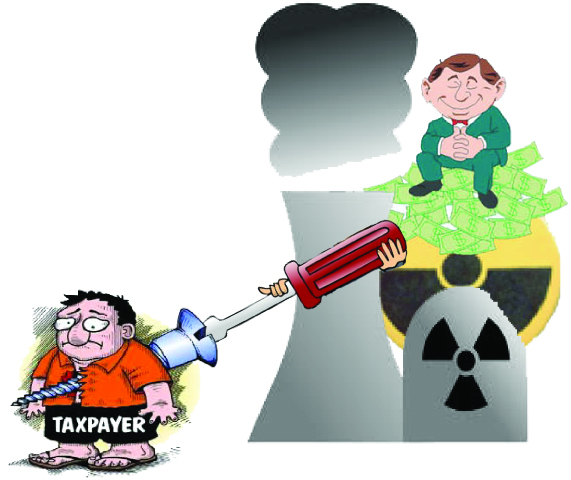
Taxpayers will bear most of the cost and risk, while most of the funding is
in the form of government loans. It has attracted private sector investment
from the likes of Centrica and La Caisse, but the UK taxpayer will bear
most of the cost and risk associated with the project, and most of the
funding will be in the form of government loans.
La Caisse said it was “thrilled” to be one of the investors, while Centrica was
“delighted” the project was moving forward.
Here’s why they are getting a good deal. Under the financing package announced by the
government on Tuesday, private investors are putting in a total of £3.25bn
of equity. France’s state-owned utility EDF, which has led the project
and is supplying the reactor technology, is contributing £1.05bn in
equity, while France’s export credit agency will provide guarantees on
about £5bn in commercial bank loans.
But the vast majority is coming from
the UK government — £3.8bn in equity and £36.55bn in loans from its
National Wealth Fund, funded in turn by government borrowing. A further
£400mn in equity is being supplied by the Nuclear Liabilities Fund, owned
by EDF, the UK government and a public trust set up to pay for nuclear
decommissioning.
Centrica, which is investing £1.3bn for a 15 per cent
stake, said it expected a 12 per cent internal rate of return.
International Public Partnerships, which is investing £250mn, said it
expected a “low teen IRR” until the 2030s. Investors typically expect
about 7 per cent for infrastructure projects, say experts, although they
want higher returns for riskier schemes.
In this case, the risks appear
low. One investor highlighted “predictable, inflation-linked cash
flows”, “enhanced investor protections”, “cash yield from day
one” and “no exposure to power price volatility”. Dieter Helm,
infrastructure expert at Oxford university, said “there is always a
balance between risk and return and even nuclear is worth investing in if
it is de-risked in this way”. “In this case the government and the
taxpayer bear a considerable proportion of the total risk.”
FT 22nd July 2025,
https://www.ft.com/content/e1e1b8df-4eb4-4423-a623-ca76858023c7
No comments yet.
1 This Month


18 March Webinar @ 1 PM EST: An Assessment of SMR Projects: The Case of Canada
register for the zoom:
https://us02web.zoom.us/webinar/register/WN_o8BIIOUvQ2ONJR1nta65DQ#/registration


of the week – STOP SMALL MODULAR REACTORS IN CANADA
To see nuclear-related stories in greater depth and intensity – go to https://nuclearinformation.wordpress.com
-
Archives
- March 2026 (139)
- February 2026 (268)
- January 2026 (308)
- December 2025 (358)
- November 2025 (359)
- October 2025 (376)
- September 2025 (258)
- August 2025 (319)
- July 2025 (230)
- June 2025 (348)
- May 2025 (261)
- April 2025 (305)
-
Categories
- 1
- 1 NUCLEAR ISSUES
- business and costs
- climate change
- culture and arts
- ENERGY
- environment
- health
- history
- indigenous issues
- Legal
- marketing of nuclear
- media
- opposition to nuclear
- PERSONAL STORIES
- politics
- politics international
- Religion and ethics
- safety
- secrets,lies and civil liberties
- spinbuster
- technology
- Uranium
- wastes
- weapons and war
- Women
- 2 WORLD
- ACTION
- AFRICA
- Atrocities
- AUSTRALIA
- Christina's notes
- Christina's themes
- culture and arts
- Events
- Fuk 2022
- Fuk 2023
- Fukushima 2017
- Fukushima 2018
- fukushima 2019
- Fukushima 2020
- Fukushima 2021
- general
- global warming
- Humour (God we need it)
- Nuclear
- RARE EARTHS
- Reference
- resources – print
- Resources -audiovicual
- Weekly Newsletter
- World
- World Nuclear
- YouTube
-
RSS
Entries RSS
Comments RSS
 nuclear-news
Leave a comment