It’s A Genocide, But It’s Also So Much More Than That
Caitlin Johnstone, Jul 23, 2025, https://www.caitlinjohnst.one/p/its-a-genocide-but-its-also-so-much?utm_source=post-email-title&publication_id=82124&post_id=169008966&utm_campaign=email-post-title&isFreemail=true&r=1ise1&triedRedirect=true&utm_medium=email
The mass atrocity in Gaza is a genocide, obviously, and is an undisguised ethnic cleansing operation.
But it’s also a lot more than that.
It’s an experiment — to see what kinds of abuses the public will accept without causing significant disruption to the imperial status quo.
It’s a psychological operation — to push out the boundaries of what’s normal and acceptable in our minds so that we will consent to even more horrific abuses in the future.
It’s a symptom — of Zionism, of colonialism, of militarism, of capitalism, of western supremacism, of empire-building, of propaganda, of ignorance, of apathy, of delusion, of ego.
It’s a manifestation — of violent racist, supremacist and xenophobic belief systems that have always been there but were previously restrained, meeting with the unwholesome nature of alliances that have long been in place but have been aggressively normalized.
It’s a mirror — showing us accurately and impartially who we currently are as a civilization.
It’s a disclosure — showing us what the western empire we live under really is underneath its fake plastic mask of liberal democracy and righteous humanitarianism.
It’s a revelation — showing us who among us really stands for truth and justice and who has been deceiving us about themselves and their motives this entire time.
It’s a catalyst — a galvanizing force and a rallying cry for all who realize that the murderous power structures we live under can no longer be allowed to stand, and a blaring alarm clock opening more and more snoozing eyes to the need for revolutionary change.
It’s a test — of who we are as a species and what we are made of, and of whether we can transcend the destructive patterning that is driving humanity to its doom.
It’s a question — asking us what kind of world we want to live in going forward, and what kind of people we want to be.
It’s an invitation — to become something better than what we are now.
Trump has backed himself into a corner on Ukraine
The chances of President Putin backing down without any concessions from Ukraine or from their European sponsors are so low as to be almost non-existent.
the additional military support that the US is now offering to Ukraine, paid for by European NATO allies, won’t be sufficient to tip the military balance in Ukraine’s favour…………….. the military facts on the ground are that Russia continues to gain ground…………………. fifty days favours Russia more than Ukraine, militarily.
He now has fifty days to reach agreement on Ukrainian neutrality
Ian Proud, Jul 17, 2025, https://thepeacemonger.substack.com/p/trump-has-backed-himself-into-a-corner?utm_source=post-email-title&publication_id=3221990&post_id=168542067&utm_campaign=email-post-title&isFreemail=true&r=1ise1&triedRedirect=true&utm_medium=email
One year after he undertook to end the Ukraine war in one day, and just past six months into his Presidency, Donald Trump has kicked the peace can down the road by fifty days. The ultimatum to President Putin to make peace or face sanctions has practically no chance to changing Russian aims in Ukraine. Backed into a corner, Trump may finally be forced to address Russia’s underlying concerns.
In televised remarks on 14 July during his meeting with NATO Secretary General, Mark Rutte, President Trump said, ‘if we don’t have a [peace] deal in fifty days, we’re going to be doing very severe tariffs, tariffs at about a hundred percent, you’d call them secondary tariffs.’
As he was in 2017, Trump also now finds himself hemmed in by beltway politics and unable to deliver a reset in US-Russia relations that he instinctively seems to want.
The Sanctioning Russia Act of 2025 would put in place so-called secondary sanctions on Russia by imposing stiff tariffs of up to 500% against countries such as China and India that inter alia import Russian energy. US lawmakers want to strong arm Trump into forcing President Putin to back down in Ukraine via the back door. But there is a yawn-inducing sense of déjà vu here.
The 2017 Countering American Adversaries Through Sanctions Act, signed into law on 2 August 2017, had no impact on Russian policy towards Ukraine, but led to a huge collapse in US-Russia relations. This was illustrated most clearly by the decision to cut US diplomatic staffing in Russia by 755 personnel, meaning among other things, that today it is practically impossible for a Russian citizen to apply for a US visa inside of Russia itself; the US Embassy simply doesn’t have enough staff.
To avoid a repeat of 2017, Trump now appears to be buying himself fifty days in DC to reach peace in Ukraine before he is forced by the Senate to impose secondary sanctions on Russia. The 14 July announcement was therefore about domestic US politics more than about foreign policy.
But what Trump has in fact done is to set a clear ultimatum on Russia to reach a peace deal with Ukraine, with no clear commitment to meeting Russia’s specific demands, the key demand being Ukraine’s neutrality and revocation of its NATO aspiration.
As an ultimatum, this won’t work, because the additional military support that the US is now offering to Ukraine, paid for by European NATO allies, won’t be sufficient to tip the military balance in Ukraine’s favour.
Additional Patriot missiles and interceptors may well reduce the overall impact of Russian drone and missile strikes on Ukrainian cities. But the military facts on the ground are that Russia continues to gain ground. At several points along the front line, around Pokrovsk, and Kupiansk, towards Konstiantynivka and Siversk, there have been significant recent Russian gains, by the slow attritional standards of this war.
As reported by the Guardian in the UK, even some Ukrainian politicians and bloggers have come out to say that fifty days will simply allow Russia to occupy further Ukrainian land. The most interesting point about that report is the revelation that a British mainstream media outlet is reporting oppositionist views from Ukraine, rather than the narrative from Zelensky’s propaganda machine.
So, fifty days favours Russia more than Ukraine, militarily.
And the so-called secondary tariffs are only secondary to Russia. To countries like China they would be actual tariffs, taxing Chinese goods and those from other affected countries at an additional 100% on top of exist rates.
Yet, when the US last hiked tariffs on China at a rate of 145%, Trump was quickly forced to back down as China simply increased their tariffs against US goods by a proportionate rate. If Trump believes that China would not do so again, then I’m afraid he is deluded.
Even in the (frankly) unlikely event that China did not respond to ‘secondary’ tariffs in kind, it is far from clear how President Xi Jinping would force President Putin to change his war aims in Ukraine, without himself appearing to lose face in China, which would be politically damaging to him.
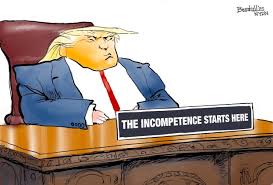
Which brings us back to Trump’s ultimatum. One commentator remarked that he has managed to ‘back himself into a corner in the Oval Office’, which is not an easy thing to do. The chances of President Putin backing down without any concessions from Ukraine or from their European sponsors are so low as to be almost non-existent.
Donald Trump, who appears largely to have sub-contracted resolving the Ukraine war to Marco Rubio and Keith Kellogg (where has Steve Witkoff disappeared to?), may now be forced to invest more personal time to bringing the war to an end.
Yes, he has engaged directly with President Putin in talks which is to be welcomed, in a diplomacy-starved war. But his real problem is his inability to encourage Ukraine and its European sponsors to address Russia’s underlying concerns about the war.
The most significant concern is, and has always been, about the need for Ukraine to adopt neutrality and revoke its aspiration to NATO membership. There has been absolutely no sign of compromise on this key underlying concern in Kyiv, Brussels, Berlin or London.
Offering Ukraine more weapons, however well-intended, will simply encourage Zelensky, Mark Rutte, Ursula von der Leyen, Friedrich Merz and Keir Starmer, in their view that Ukraine’s NATO aspirations remain alive and well. And, unfortunately, Russia will not silence its guns until, at the very least, a deal on Ukrainian neutrality is reached.
That leaves Trump with only one place to go. He must now invest personal time into urging Ukraine and Europe to accept neutrality for Ukraine as part of a ceasefire deal and longer-term peace process. If he doesn’t, the politics of Washington DC may force him to impose tariffs on China in a way which will, more than anyone else, hurt American people, and hurt his reputation.
How Britain enticed investors to back its costly new nuclear plant
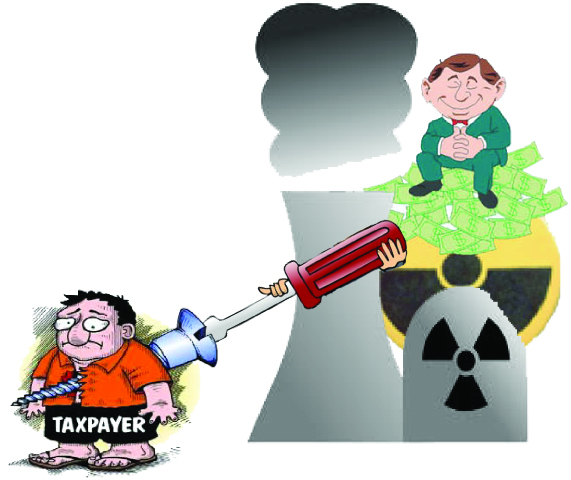
Taxpayers will bear most of the cost and risk, while most of the funding is
in the form of government loans. It has attracted private sector investment
from the likes of Centrica and La Caisse, but the UK taxpayer will bear
most of the cost and risk associated with the project, and most of the
funding will be in the form of government loans.
La Caisse said it was “thrilled” to be one of the investors, while Centrica was
“delighted” the project was moving forward.
Here’s why they are getting a good deal. Under the financing package announced by the
government on Tuesday, private investors are putting in a total of £3.25bn
of equity. France’s state-owned utility EDF, which has led the project
and is supplying the reactor technology, is contributing £1.05bn in
equity, while France’s export credit agency will provide guarantees on
about £5bn in commercial bank loans.
But the vast majority is coming from
the UK government — £3.8bn in equity and £36.55bn in loans from its
National Wealth Fund, funded in turn by government borrowing. A further
£400mn in equity is being supplied by the Nuclear Liabilities Fund, owned
by EDF, the UK government and a public trust set up to pay for nuclear
decommissioning.
Centrica, which is investing £1.3bn for a 15 per cent
stake, said it expected a 12 per cent internal rate of return.
International Public Partnerships, which is investing £250mn, said it
expected a “low teen IRR” until the 2030s. Investors typically expect
about 7 per cent for infrastructure projects, say experts, although they
want higher returns for riskier schemes.
In this case, the risks appear
low. One investor highlighted “predictable, inflation-linked cash
flows”, “enhanced investor protections”, “cash yield from day
one” and “no exposure to power price volatility”. Dieter Helm,
infrastructure expert at Oxford university, said “there is always a
balance between risk and return and even nuclear is worth investing in if
it is de-risked in this way”. “In this case the government and the
taxpayer bear a considerable proportion of the total risk.”
FT 22nd July 2025,
https://www.ft.com/content/e1e1b8df-4eb4-4423-a623-ca76858023c7
On the hook! Taxpayers to foot much of £38 billion bill for Sizewell C farce.
“It is astounding that it is only now, as contracts are being signed, that the government has confessed that Sizewell C’s cost has almost doubled to an eye watering £38bn – a figure that will only go up”.
NFLA 22nd July 2025, https://www.nuclearpolicy.info/news/on-the-hook-taxpayers-to-foot-much-of-38-billion-bill-for-sizewell-c-farce/
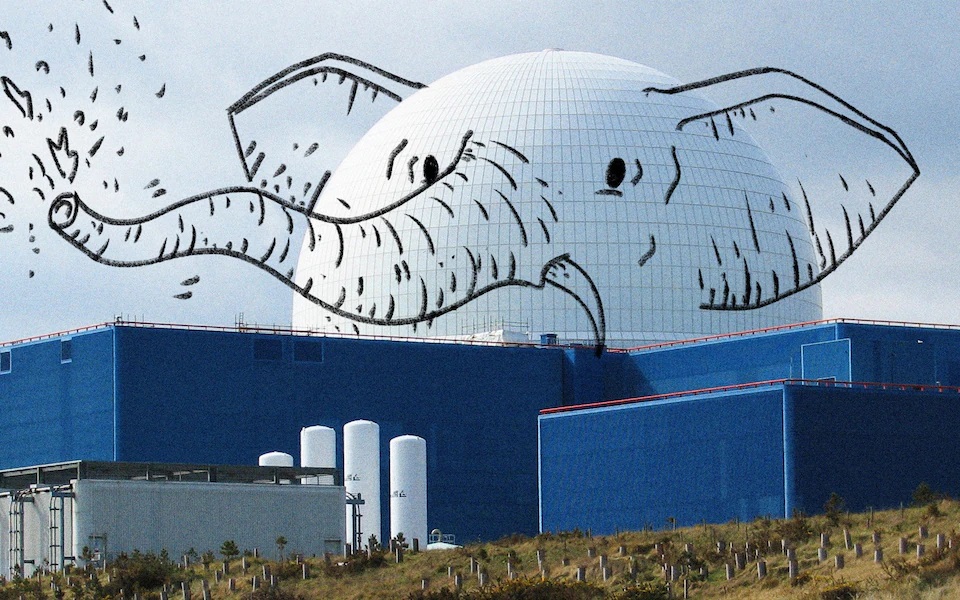
As Energy Secretary Ed Miliband signals the go ahead to the Sizewell C nuclear power plant with today’s approval of the Financial Investment Decision,[i] it is notable that the estimated cost of building the UK’s latest nuclear white elephant has already almost doubled to £38 billion.
Taxpayers will be on the hook for billions, as Ministers have failed to secure the full private sector funding that they desperately wanted and as France has reined in its own commitment.
The UK government’s stake is now 44.9%, whilst Amber Infrastructure (7.6%), Centrica (15%), EDF Energy (12.5%), and La Caisse (20%) will also take stakes. The National Wealth Fund – the government’s principal investor and policy bank – is also making its first investment in nuclear energy.
Interestingly, although much was made of continued French Government involvement through its sole ownership of EDF, President Macron cannot have been very impressed with the hospitality he received on his recent visit to the UK as the French subsequently reduced their stake to 12.5%. Originally both the UK and French Government had each committed to taking a near 20% stake.
The previously published official cost for the project was £20 billion, with the plant expected to be generating in the mid to late 2030s. But sceptics never believed the claimed £20 billion figure and they placed little faith that the delivery date will be met given that Sizewell C is largely a remake of her older sister, Hinkley Point C, which is massively over budget and behind schedule.
This plant under construction in Somerset is now expected to cost £46 billion to complete, and it will be delivered up to six years late; but at least in the case of Hinkley Point C it is French-state owned EDF Energy that must stump up the extra cash.
Clearly some prospective investors baulked at the cost unknowns and project risks of the Suffolk white elephant, and Alison Downes, Director of Stop Sizewell C, said that consequently the latest project had “only crawled over the line thanks to guarantees that the public purse, not private investors, will carry the can for the inevitable cost overruns”.
Whitehall and industry insiders have previously revealed to the press that the £20 billion only represented half the true cost and Julia Pyke, Sizewell C’s Managing Director had conceded that the earlier £20 billion cost estimate failed to account for inflation or risk.
In Sizewell C’s media release today, Ms Pyke revealed the price hike:
“Our plan is to deliver Sizewell C at a capital cost of around £38bn. Our estimate is the result of very detailed scrutiny of costs at Hinkley Point C and long negotiations with our suppliers. It has been subject to third-party peer review and has been scrutinised by investors and lenders and has been subject to extensive due diligence as part of the financing process. A capital cost of £38bn represents around 20% saving compared with Hinkley Point C and demonstrates the value of the UK’s fleet approach.”[ii]
In response, Ms Downes added: “It is astounding that it is only now, as contracts are being signed, that the government has confessed that Sizewell C’s cost has almost doubled to an eye watering £38bn – a figure that will only go up”.
Also commenting, the Chair of a second local campaign group, Together Against Sizewell C (TASC), Jenny Kirtley, said,
“This decision is a financial and environmental disaster for the UK and a betrayal of future generations.
“We are in a climate crisis that needs immediate action, yet this government has chosen to squander billions of public funds on a project that will not be operational until the late 2030s and has already seen a staggering 90% uplift in cost over the last 5 years.
“At nearly double the original £20bn price tag, a figure still being touted by joint managing director Julia Pyke until recently, how can anyone believe that £38bn Sizewell C will provide ‘value for money’ for consumers and taxpayers. The scale of potential exposure of public funds to the Sizewell C project is revealed as a staggering £54.589 billion in the government’s Financial Investment Decision subsidy scheme[iii].
“So much for claims made by EDF and government that there would be huge cost savings from ‘lessons learned’ from the Hinkley Point C build.
“In TASC’s view, the cost of this risky project can only increase as there are still many unresolved issues, including the recently revealed hidden sea defences which were not included by EDF in the 2020 DCO planning application even though EDF knew they would be needed in 2017.[iv] Future generations will have the responsibility to protect the Sizewell C site until the late 2100s and are depending on us to get it right.”
Although disappointing, the news was not unexpected by campaigners. The Nuclear Free Local Authorities are therefore confident that they shall soon pick themselves up and continue the fight, and we shall stand alongside them as the battle continues.
US nuclear weapons ‘on UK soil’ for first time in 17 years.
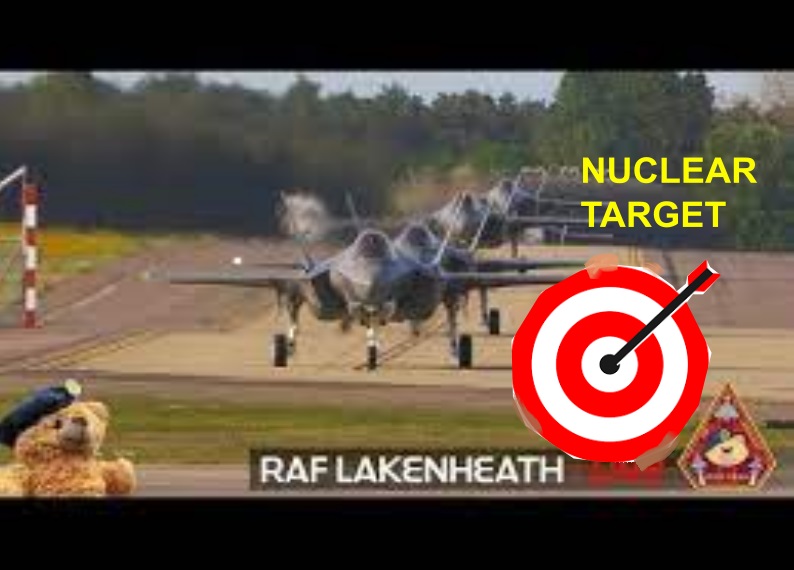
Flight from New Mexico to RAF Lakenheath believed to have dropped off B61 nuclear bombs that can be carried by Britain’s new F-35A fighter jets
The US has stationed nuclear weapons in Britain for the first time in
nearly 20 years for potential deployment on a new squadron of British jets,
analysts have said. A transport plane was tracked on Thursday during a
ten-hour flight from Kirtland Air Force Base in New Mexico, the US Air
Force’s main nuclear storage site, to RAF Lakenheath in Suffolk.
Analysts said that the route taken by the C-17 transport looked like a “one-way
drop-off” and meant that it was likely that the UK was hosting US nuclear
weapons for the first time since 2008. The US and the UK declined to
comment.
Times 21st July 2025, https://www.thetimes.com/uk/defence/article/us-nuclear-weapons-uk-soil-first-time-17-years-wvgz8m6wl
Investment decision to be made on Sizewell C nuclear.

The UK government is expected to reach a final investment decision on the
Sizewell C nuclear power plant on Tuesday. “We are in constructive,
commercially sensitive negotiations with a range of potential investors as
part of the equity raise process,” a spokeswoman for the Department for
Energy Security and Net Zero told Energy Voice in an emailed statement.
“A final investment decision will be made following the conclusion of the
process, which we are targeting for this summer.”
The Financial Times reported that the price tag for the planned nuclear power station in
Suffolk, a replica of Hinkley Point C, will hit £38 billion including
equity and debt. Ministers will reportedly unveil the cost of the project
by the parliamentary recess on Wednesday.
Campaign pressure group Together
Against Sizewell C (TASC)’s chair Jenny Kirtley said: “What
right-minded government would commit billions of public funds to a project
that has already seen a staggering 90% uplift in cost over the last 5
years? “This government and Sizewell C Limited both denied recent build
cost estimates of £40bn for Sizewell C stating there would be a 30%
reduction from Hinkley Point C’s costs due to ‘lessons learned’ so,
why would anyone believe government claims that £38bn Sizewell C will
provide ‘value for money’ for consumers and taxpayers?”
The group has called for a value-for-money assessment of the project to be independently
audited to establish what cost provisions have been included for
“unresolved issues”, including sea defences that were not in EDF’s
original development consent order application.
The main developer on the project, EDF, has reduced its equity stake in the project to 12.5%, valued at about £1.1bn, Energy Voice reported this month. British energy supplier
Centrica is expected to take a 15% stake in the nuclear power plant.
According to a report in Les Echos, Amber Infrastructure and Canadian fund
la Caisse de dépôt et de placement du Québec (CDPQ) now plan to take a
stake of between 25% and 30% in the project.
Reports suggest that a
consortium led by Brookfield Asset Management pulled out of its bid to take
a 25% stake in Sizewell C at the last minute. Greencoat Schroders, which
had entered the round with Brookfield, has also exited the bidding,
according to a separate report. This latest reshuffle would leave the UK
government with an implied minority stake of as little as 42.5%.
Energy Voice 22nd July 2025, https://www.energyvoice.com/renewables-energy-transition/576815/investment-decision-expected-on-sizewell-c/
Trump axes nuclear waste oversight panel
By Francisco “A.J.” Camacho | 07/21/2025, https://www.eenews.net/articles/trump-axes-nuclear-waste-oversight-panel/
The move comes at a time when Republicans and Democrats alike are pursuing a nuclear expansion, with Presiden Donald Trump aiming to quadruple nuclear power capacity by 2050.
President Donald Trump dismissed all but one of the members of the U.S. Nuclear Waste Technical Review Board, diminishing oversight over the country’s long-term spent nuclear fuel storage program.
“On Wednesday, the White House sent emails to seven Board members — Drs. Richelle Allen-King, Miles Greiner, Silvia Jurisson, Nathan Siu, Seth Tuler, Scott Tyler, Brian Woods — dismissing them from the Board, effective July 16, 2025,” Christopher Burk, the board’s director of external affairs, said in an email. “As a result, Dr. Peter Swift, Board Chair, is the sole member of the Board. The NWTRB staff and funding have remained in place.”
The move came at a time when Republicans and Democrats alike are pursuing a nuclear expansion, with Trump aiming to quadruple nuclear power capacity by 2050. It also comes amid a major shakeup at the Nuclear Regulatory Commission, with administration officials directing the agency to apply minimal scrutiny in reviewing reactors backed by the departments of Energy or Defense and the firing of Christopher Hanson, a Democratic commissioner and former NRC chair under former President Joe Biden.
Centrica really can’t lose at Sizewell
Centrica’s £1.3 billion investment in Sizewell C guarantees substantial returns, even with cost
overruns. Now we know what Ed Miliband means by his “golden age of
nuclear” — golden for the companies putting their money into Sizewell
C. Yes, reactor projects have a habit of blowing up private investors. But
maybe not this one. It looks more like an exercise in transferring risk to
consumers and the taxpayer.
Times 22nd July 2025, https://www.thetimes.com/business-money/companies/article/centrica-really-cant-lose-at-sizewell-k33brftl2
US Nuclear Industry Revival on the Horizon

In late May, President Trump issued four separate Executive Orders (EOs)
with respect to growing the nuclear power industry in the US. As the
implementation of these orders begins, several Washington focused
publications have written about one emerging consequence of these EOs—the
likely termination of NRC oversight with respect to approval of new nuclear
reactor designs.
This major responsibility is being moved to the Pentagon
and the Department of Energy. One administration official referred to the
NRC’s prospective role in reactor approval as akin to a rubber stamp. The
implied criticism here being that the NRC was much too slow in approving
new reactor designs and are an obstacle to the President’s goal of
dramatically increasing nuclear power in the US. So, in effect, they got
FEMA’d. This raises the question whether we are effectively deregulating
commercial nuclear energy technologies, assuming, of course, that the
prospective review processes of the Pentagon and DoE are less rigorous than
the NRC’s.
Oil Price 21st July 2025, https://oilprice.com/Alternative-Energy/Nuclear-Power/US-Nuclear-Industry-Revival-on-the-Horizon.html
Trump axes nuclear waste oversight panel
The move comes at a time when Republicans and Democrats alike are pursuing a nuclear expansion, with Presiden Donald Trump aiming to quadruple nuclear power capacity by 2050.
By: Francisco “A.J.” Camacho | 07/21/2025
ENERGYWIRE | President Donald Trump dismissed all but one of the members of the U.S. Nuclear Waste Technical Review Board, diminishing oversight over the country’s long-term spent nuclear fuel storage program.
“On Wednesday, the White House sent emails to seven Board members — Drs. Richelle Allen-King, Miles Greiner, Silvia Jurisson, Nathan Siu, Seth Tuler, Scott Tyler, Brian Woods — dismissing them from the Board, effective July 16, 2025,” Christopher Burk, the board’s director of external affairs, said in an email. “As a result, Dr. Peter Swift, Board Chair, is the sole member of the Board. The NWTRB staff and funding have remained in place.”
The move came at a time when Republicans and Democrats alike are pursuing a nuclear expansion, with Trump aiming to quadruple nuclear power capacity by 2050. It also comes amid a major shakeup at the Nuclear Regulatory Commission, with administration officials directing the agency to apply minimal scrutiny in reviewing reactors backed by the departments of Energy or Defense and the firing of Christopher Hanson, a Democratic commissioner and former NRC chair under former President Joe Biden………………..
Energy Wire 21st July 2025, https://subscriber.politicopro.com/article/eenews/2025/07/21/nuclear-waste-oversight-panel-finally-gets-the-ax-under-trump-00463505
…
Ukrainian bots want the BBC to endorse war crimes
Social media trolling takes a new and sinister turn
Ian Proud, Jul 23, 2025, https://thepeacemonger.substack.com/p/ukrainian-bots-want-the-bbc-to-endorse?utm_source=post-email-title&publication_id=3221990&post_id=168976248&utm_campaign=email-post-title&isFreemail=true&r=1ise1&triedRedirect=true&utm_medium=email
On 18 July I made a post on social media platform X in response to a BBC report entitled ‘Kill Russians, win points: is Ukraine’s new drone scheme gamifying war?’ It produced a spectacularly dark backlash from the Ukrainian bot community.
The BBC report explored a Ukrainian military scheme in which its soldiers could claim points for kills by First Person View (FPV) drones and use those points to buy the most preferred military technology in an ‘Amazon for war’.
While Paul Adams, the BBC diplomatic correspondent, touches briefly on the moral challenges that this scheme presents, he was clearly impressed.
‘The e-points scheme is typical of the way Ukraine has fought this war: creative, out-of-the-box thinking designed to make the most of the country’s innovative skills and minimise the effect of its numerical disadvantage.’
‘Points for kills. Amazon for war. To some ears, it might all sound brutal, even callous. But this is war and Ukraine is determined to hold on. By fighting as effectively, and efficiently as it can.’
Every day, military personnel on both sides of the conflict are killed by drones and other military technologies. That is why I have consistently called for the war in Ukraine to be ended through diplomatic means and is why I continue to do so.
The problem I had with the article was its heading – about killing Russian soldiers using drones – was accompanied by a photograph of a soldier (one might presume, Russian) with his back turned to the First Person View on screen with his hands in the air, suggesting surrender. I found this juxtaposition, on UK state-owned media, deeply troubling.
One might easily gain the impression by the headline and the photograph combined that the soldier’s fate was death. And if that was so, then that would constitute a war crime.
Under the Statute of the International Criminal Court, “killing or wounding a combatant who, having laid down his arms or having no longer means of defence, has surrendered at discretion” is a war crime in international armed conflicts
One cannot know the fate of the soldier and whether he is killed or taken prisoner. And the article goes on to point out that Ukrainian soldiers can claim higher points for encouraging a Russian soldier to surrender, though does not point out how this would be possible with an armed drone.
It is certainly the habit of the western media to churn out clickbait headlines in a bid to maintain waning public appetite for a war that Ukraine is losing and which Europe is funding at enormous expense.
However, it sets a dangerous precedent if the UK state-owned broadcaster is producing articles that infer war crimes are taking place and implicitly endorse the means of that happening.
I therefore included in my post a poll which asked people to vote on:
Do you want the BBC through its reporting implicitly to endorse war crimes and show images purporting to or giving the impression of the circumstances leading up to a war crime taking place?
I don’t have a huge X following, but my post garnered 20,000 votes over three days with over 90% of those who voted responding ‘no’, specifically that appearing to endorse war crimes in media reporting was wrong.
As I didn’t mention a specific country, some people argued that the allegation might also be levelled at BBC reporting of IDF atrocities in Gaza.
However, on 21 July my post was seized on by very-obviously-Ukrainian bots flinging all sorts of insults in my direction, such that I spent several hours blocking and reporting offensive content on my feed.
In a very short space of time, my account was swarmed by a blizzard of insults and false accusations, including of being an asset of the KGB (sic!).. being a Putin apologist, sucking Russian dicks and being a paedophile who uses teenage Russian prostitutes.
I was added to hate ‘Lists’ that x members keep, such as ‘nazi whore cowards’ and ‘vatniks’ (Russian propagandists).
All very annoying and intended to discredit me en-masse. But as Glenn Diesen joked when we spent some time together in Tblisi, in early June, ‘if you wanted to be popular, you should have sold ice creams’.
When one expresses a personal view on such an emotive topic as this pointless war in Ukraine, you are likely to get attacked from one direction or the other, or even both. However, some made more disturbing comments that can only be interpreted as threats of causing me physical harm.
Many made generalised comments about how any Russian solider in Ukraine should deserve such a fate (to die while surrendering) and so on. However, this was not the most sinister aspect of the response to my post.
In addition to voting that the BBC should not implicitly endorse war crimes, the other option was to vote for: ‘Please endorse war crimes’.
353 people voted in the poll before I closed my post to public comments. 213 people voted in favour of the BBC endorsing war crimes through its reporting of Ukraine. That’s right, just over 60% of, one assumes, mostly Ukrainian or Ukraine-supporting voters, endorses the BBC endorsing war crimes, in this context committed by Ukraine.
Herein the central truth of this and all wars; that they generate intense hatred of the other. That hatred fires the bloodlust that drives war crimes in any theatre of conflict. No war is free of war crimes. British, French, American, Russian and, yes, Ukrainian, service personnel have been documented as having committed war crimes, together with those of many other countries.
War reduces humanity to the darkest depths of depravity in which the most unconscionable acts are justified on the basis of defeating the hated other. Forgive me for believing that the BBC should not be glorifying that, even if implicitly, or encouraging others to do so.
I would far sooner they were pushing for a negotiated settlement to this terrible war.
Ministers prepare to reduce UK stake in Sizewell C nuclear project.
Under changes to investors, Brookfield dropped in favour of Canadian pension fund
and London-based investment manager. Ministers are preparing to reduce the
UK government’s stake in Sizewell C by more than expected, after a
last-minute move to change the roster of private investors in the
multibillion-pound nuclear project.
Canadian investment manager Brookfield
had been expected to take a 25 per cent stake in the Suffolk development as
recently as Friday, according to people familiar with the matter. The
proposed deal would have made the firm the biggest single investor in the
project — part of a push by ministers to use nuclear power to ease
Britain’s transition away from fossil fuels — with British Gas owner
Centrica taking 15 per cent and French energy giant EDF holding 12.5 per
cent.
But the government in recent days moved to drop Brookfield in favour
of selling a larger stake to a combination of Canadian pension fund La
Caisse and London-based investment manager Amber Infrastructure, the people
said. Two of the people said Brookfield had been angered by the decision,
which was first reported by Les Echos. La Caisse will now take a 20 per
cent stake in Sizewell and Amber will take a 10 per cent stake, according
to the people, while the stakes of Centrica and EDF are unchanged.
The increased private investor stake means the UK government will own 42.5 per
cent of the project, which is set to cost £38bn, down from 47.5 per cent
under previous plans. The government currently owns about 84 per cent of
the project. Ministers are set to announce the final investment decision on
Tuesday in a rush to seal the long-awaited deal before parliament’s
summer recess.
Energy bill payers will pay back the investors via a
surcharge on bills under the structure used to develop the scheme, known as
the “Regulated Asset Base” model.
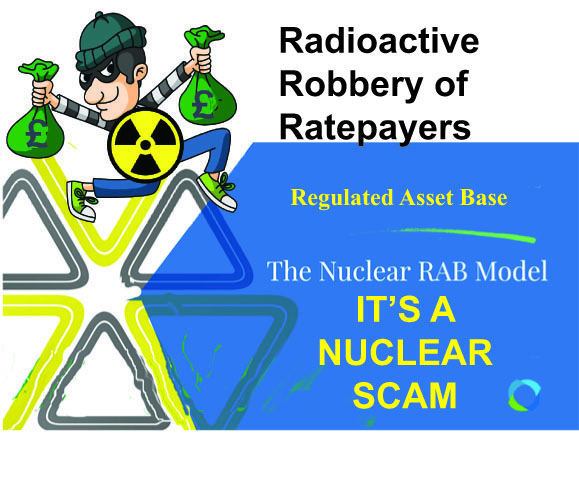
Energy bill payers will pay back the investors via a surcharge on bills under the structure used to develop the scheme, known as
the “Regulated Asset Base” model.
FT 21st July 2025, https://www.ft.com/content/4ae7842c-df91-41c3-a7a0-5b626f6cb6d9
1 This Month


18 March Webinar @ 1 PM EST: An Assessment of SMR Projects: The Case of Canada
register for the zoom:
https://us02web.zoom.us/webinar/register/WN_o8BIIOUvQ2ONJR1nta65DQ#/registration


of the week – STOP SMALL MODULAR REACTORS IN CANADA
To see nuclear-related stories in greater depth and intensity – go to https://nuclearinformation.wordpress.com
-
Archives
- March 2026 (139)
- February 2026 (268)
- January 2026 (308)
- December 2025 (358)
- November 2025 (359)
- October 2025 (376)
- September 2025 (258)
- August 2025 (319)
- July 2025 (230)
- June 2025 (348)
- May 2025 (261)
- April 2025 (305)
-
Categories
- 1
- 1 NUCLEAR ISSUES
- business and costs
- climate change
- culture and arts
- ENERGY
- environment
- health
- history
- indigenous issues
- Legal
- marketing of nuclear
- media
- opposition to nuclear
- PERSONAL STORIES
- politics
- politics international
- Religion and ethics
- safety
- secrets,lies and civil liberties
- spinbuster
- technology
- Uranium
- wastes
- weapons and war
- Women
- 2 WORLD
- ACTION
- AFRICA
- Atrocities
- AUSTRALIA
- Christina's notes
- Christina's themes
- culture and arts
- Events
- Fuk 2022
- Fuk 2023
- Fukushima 2017
- Fukushima 2018
- fukushima 2019
- Fukushima 2020
- Fukushima 2021
- general
- global warming
- Humour (God we need it)
- Nuclear
- RARE EARTHS
- Reference
- resources – print
- Resources -audiovicual
- Weekly Newsletter
- World
- World Nuclear
- YouTube
-
RSS
Entries RSS
Comments RSS
 nuclear-news