The first US atomic rush was a bust. Will Trump’s big nuclear-for-AI plans fare any better?
Bulletin, By Chloe Shrager | July 18, 2025
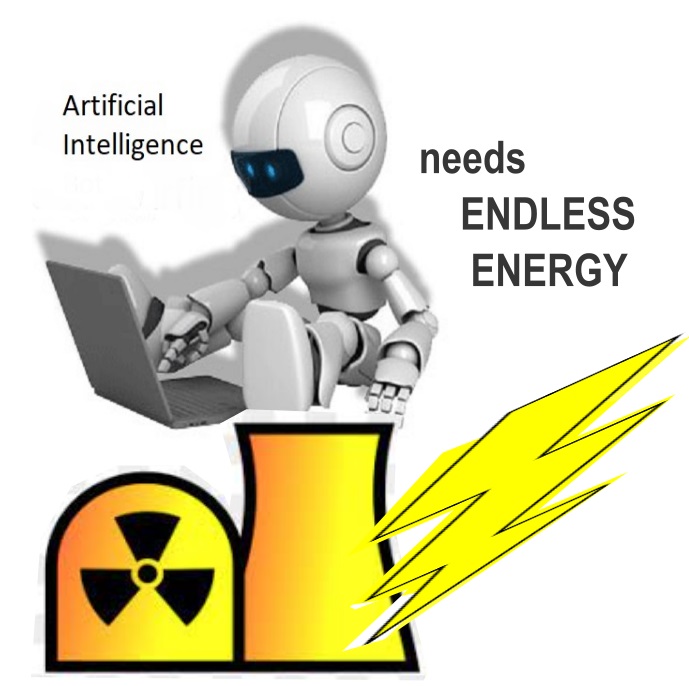
As Big Tech turns to nuclear power to solve the artificial intelligence power problem, critics have cast doubt on energy developers’ ability to build new reactors on a timeline that will satisfy data centers’ energy needs.
High costs and lack of commercial economic viability have been persistent obstacles to new nuclear infrastructure development. But on May 23, President Donald Trump signed four executive orders that represent the most explicit government commitment to nuclear power for artificial intelligence yet.
Three of the orders explicitly mention AI as a driver for nuclear energy development and a potential beneficiary. One directive incentivizes the operation of privately funded advanced nuclear reactor technologies on federal sites—mainly national laboratories or military installations—allegedly to power AI infrastructure, labelled as “critical defense facilities,” and mandates the deployment of small modular nuclear reactors on one of these sites within 30 months.
Previously, tech companies were the most vocal advocates pushing for nuclear power to meet AI’s energy demands. Now the US government—heavily influenced by Big Tech’s hand—has made nuclear power for AI a national security priority, setting a goal of quadrupling the United States’ nuclear capacity from 100 gigawatts to 400 gigawatts by 2050. Whether government intervention can overcome the challenges that have plagued nuclear deployment for decades remains to be seen—and if so, at what cost?
Déjà vu. As with the rise of the nuclear power industry in the 1950s and 60s, the demand for nuclear energy is being created, justified, and incentivized by the government and its national security interests rather than by market forces.
Robert Duffy, a professor of political science at Colorado State University, summarized the history of the US nuclear power industry in a 2004 paper.
“The atomic energy subgovernment was endowed with additional prestige and power because of the program’s identification with national security issues,” Duffy wrote. “The actors in this tightly knit monopoly were united by the conviction that the development of atomic energy, first as a weapon but later as a means of generating electricity, was both necessary and desirable for the nation’s welfare.”
Duffy showed that the government’s rush to create a nuclear industry in the United States ultimately undermined that very industry. The hasty development, government incentives, and ambitious timelines led to cost overruns, safety problems, and public opposition that ultimately killed new nuclear construction for decades.
Today, the Trump administration is repeating history by declaring AI technologies driven by advanced nuclear power generators a key national security interest.
“There seems to be an aspect to the government’s interest in AI which is sort of positing that as the next nuclear weapons race,” Tim Judson, executive director of the Nuclear Information and Resource Service, observes. “If you expect the most powerful countries in the history of the world, and the wealthiest corporations that have ever existed, which are trying to develop […] ‘digital gods,’ to not do everything they can to win that race, then you don’t understand human nature, and you don’t understand geopolitics.”
But by trying to rush nuclear power development again for geopolitical reasons (then the Cold War, now the global AI race), the US government risks creating another failed—or at least costly and insufficiently safe—nuclear program…………………………………………
………………………………………………………………………………………………………..Sticky problems. Even without the economic hurdles, the fundamental problem remains timing, and presidential orders cannot change the laws of physics. As Mycle Schneider, an independent nuclear policy analyst and main contributor to the World Nuclear Industry Status Report, bluntly states: “I doubt that any SMR would be operating 10 years from now in the Western world.”
Schneider’s skepticism isn’t unfounded. Construction times for nuclear plants average around 10 years, he said, and that’s just the construction phase—which only begins with the pouring of reactor foundations. Even with the Trump administration’s regulatory streamlining and federal site access, the reality of nuclear development timelines clashes directly with AI’s immediate energy needs. “All of these deals with nuclear companies are about future power plants maybe coming online in the 2030s, but all the AI data centers are being built today,” Judson observes.
Small modular reactors have long been promoted by the industry—and now also the government—as a solution to nuclear power’s problems, promising faster construction, lower costs, and standardized designs. The Trump administration’s nuclear orders specifically enable SMR testing and deployment on federal sites, betting that government support can make SMR promises a reality.
But the reality has proven far more complex, even with unprecedented government backing. Canada’s recent approval of the world’s first SMR in a G7 country demonstrates both the promise and the problems. The project’s price tag sits at nearly $21 billion Canadian dollars ($15.1 billion US dollars) for four reactors at Ontario’s Darlington site, roughly $12.5 million US dollars per megawatt—far exceeding the costs of renewable alternatives that can be deployed in a fraction of the time. Even more so, Judson says the energy company GE Vernova-Hitachi chose to pursue its SMR project in Canada because the Canadian Nuclear Safety Commission regulations allow construction permit applications to be submitted with much of the design still incomplete. “The jury is very much still out on whether the BWRX-300 [SMR design] will prove feasible to build on time and on budget, but what we know so far is not encouraging,” Judson said.

The long-term management of nuclear waste also poses a sticky issue to new nuclear development, especially the relatively higher waste per gigawatt from SMRs compared to full-scale reactors, which has no permanent solution yet……………………………………………………………. https://thebulletin.org/2025/07/the-first-us-atomic-rush-was-a-bust-will-trumps-big-nuclear-for-ai-plans-fare-any-better/
No comments yet.
1 This Month

Petition to revoke the licensing of the Near Surface Nuclear Disposal Facility (NSDF) at Chalk River. https://www.ourcommons.ca/petitions/en/Petition/Details?Petition=e-7247


of the week – STOP SMALL MODULAR REACTORS IN CANADA
To see nuclear-related stories in greater depth and intensity – go to https://nuclearinformation.wordpress.com
-
Archives
- March 2026 (152)
- February 2026 (268)
- January 2026 (308)
- December 2025 (358)
- November 2025 (359)
- October 2025 (376)
- September 2025 (258)
- August 2025 (319)
- July 2025 (230)
- June 2025 (348)
- May 2025 (261)
- April 2025 (305)
-
Categories
- 1
- 1 NUCLEAR ISSUES
- business and costs
- climate change
- culture and arts
- ENERGY
- environment
- health
- history
- indigenous issues
- Legal
- marketing of nuclear
- media
- opposition to nuclear
- PERSONAL STORIES
- politics
- politics international
- Religion and ethics
- safety
- secrets,lies and civil liberties
- spinbuster
- technology
- Uranium
- wastes
- weapons and war
- Women
- 2 WORLD
- ACTION
- AFRICA
- Atrocities
- AUSTRALIA
- Christina's notes
- Christina's themes
- culture and arts
- Events
- Fuk 2022
- Fuk 2023
- Fukushima 2017
- Fukushima 2018
- fukushima 2019
- Fukushima 2020
- Fukushima 2021
- general
- global warming
- Humour (God we need it)
- Nuclear
- RARE EARTHS
- Reference
- resources – print
- Resources -audiovicual
- Weekly Newsletter
- World
- World Nuclear
- YouTube
-
RSS
Entries RSS
Comments RSS
 nuclear-news
Leave a comment