Small Nuclear Reactor company’s focus turns to raising $500+ million.
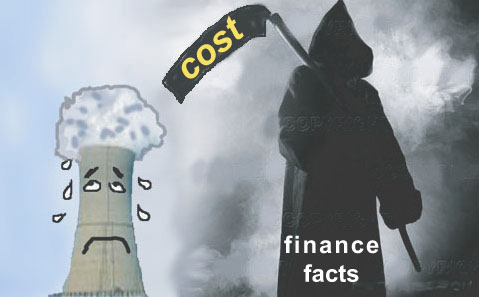
COMMENT. The ask for $500-million has been out there for about two years. Deadbeats, all of them involved in this sorry excuse for a project. It’s pathetic.
It comes after review by Canadian Nuclear Safety Commission that it hopes to parlay into newfound investment
Adam Huras, Jul 10, 2025,
https://tj.news/new-brunswick/smr-companys-focus-turns-to-raising-millions-to-finish-design-work
ARC Clean Technology says its focus is now raising what is likely still the hundreds of millions of dollars it needs to finish the design work of its small modular nuclear reactor.
It’s a figure that’s likely upwards of $500 million, according to two former ARC CEOs.
That’s with the aim to enable NB Power to submit a license to construct application hopefully by 2027, with a target commercial deployment at Point Lepreau in the early 2030s.
It comes after the completion of a review by the Canadian Nuclear Safety Commission that it hopes to parlay into newfound private investment.
Earlier this week, the country’s safety commission said it identified “no fundamental barriers” to licensing the ARC’s proposed sodium-cooled fast neutron reactor, after completing a second design review that had stretched on for over three years.
It’s a result that ARC is calling a “pivotal step” toward commercial deployment.
That’s while adding it gives the company new “global credibility” in a race to market.
Its focus now is raising new money.
“Our current focus is on advancing strategic partnership and investment discussions to set the stage for the next phase of design work to support a license to construct application,” ARC Clean Technology spokesperson Sandra Donnelly told Brunswick News.
Asked specifically how much money is needed, Donnelly declined to say.
“We continue to evaluate the going forward cost estimate through current discussions with strategic partners,” she said.
“We are not sharing specific numbers.”
ARC’s former CEO Bill Labbe had previously said the ARC-100 would cost $500 million to develop and needed an additional $600 million more in power purchase agreements to move the project forward.
That was after the Higgs government gave $20 million to ARC, while the feds awarded the company another $7 million.
Ottawa also provided NB Power with $5 million to help it prepare for SMRs at Point Lepreau.
The Gallant Liberal government also first spent $10 million on ARC and Moltex, the province’s other company pursuing SMR technology, as they set up offices in Saint John now roughly eight years ago.
In an interview with Brunswick News on Thursday, another former ARC president and CEO, Norm Sawyer, who left the company in 2021 and is now a board member at the National Research Council Canada, pegged the figure needed to likely be between US$500 and $700 million.
“A preliminary design is almost essentially complete,” Sawyer said of the Phase 2 review. “Obviously, the next step needs money.
“They would also have to staff up.”
Sawyer said further design work could involve upwards of 100 employees with intensive final engineering to be completed.
That doesn’t include the construction of a facility at Lepreau, Sawyer said.
Brunswick News first reported last spring that ARC had handed out layoff notices to employees, while confirming that, in parallel, its president and CEO since 2021, Labbe, was leaving the company.
Asked if staffing levels will now change, Donnelly said that’s now “being reviewed as part of preparations for the next phase of design work.”
“It’s a positive step for them, it’s just can they leverage it now to get to the next step which is really investment,” Sawyer said. “I think there’s value there for investors.
“It’s also up to how much risk investors are willing to take. I think the investor would want a PPA (power purchase agreement) first.”
A power purchase agreement is a long-term contract where a nuclear power plant sells electricity to a buyer, often a utility, government, or large energy consumer.
NB Power CEO Lori Clark told a committee of MLAs at the provincial legislature earlier this year that ARC is “looking for investors now.”
Clark herself travelled to South Korea last December to promote ARC’s “commercialization possibilities,” in part to drum up new financial support.
A trilateral collaboration agreement was announced last year between South Korea’s utility, ARC, and NB Power with the goal of establishing “teaming agreements for global small modular reactor fleet deployment.”
ARC also said that it welcomed in February “multiple delegations” from South Korea’s utility.
No financial agreement has been revealed as of yet.
Finding the money necessary to finish design work is integral to building timelines.
“Our next objective is to complete the required design work by 2027 to enable NB Power to submit a license to construct application, with a target commercial deployment in early 2030s,” Donnelly said.
“Timelines will continue to be reviewed as design work and partnership discussions progress.”
The company still faces other challenges.
Brunswick News has also reported that ARC is still in search of a new enriched uranium supplier, after it originally planned to buy from Russia. It’s a problem Sawyer has suggested might result in a redesign of the company’s small modular nuclear reactor technology.
Asked if the concern over an enriched uranium source has been resolved, Donnelly said that “the availability of HALEU (high-assay low-enriched uranium) fuel remains an overall market issue.
“We are encouraged that the HALEU supply chain has advanced significantly over the past year with strong government support in multiple countries, and we continue to evaluate multiple options to secure a fuel supply for the first ARC unit,” she added.
The enriched uranium is an integral component of the company’s ARC-100 sodium-cooled fast reactor.
But it’s not as simple as finding that enriched uranium closer to home. While Canada mines uranium, and there are currently five uranium mines and mills operating in Canada, all located in northern Saskatchewan, it does not have uranium enrichment plants.
The U.S. opened its first and only enrichment plant, operated by Centrus Energy in Ohio, amid a federal push to find a solution to the Russia problem. It remains the only facility in the U.S. licensed to enrich uranium, and has a lineup for SMR firms seeking its fuel.
That said, there appeared to be a glimmer of hope on the uranium front late last year as the Trudeau federal government’s fall economic statement promised support to strengthen nuclear fuel supply chains.
“To support demand for allied enriched nuclear fuel and bolster supply chain resiliency, the 2024 fall economic statement announces the government’s intent to backstop up to $500 million in enriched nuclear fuel purchase contracts from the United States or other allied countries, including high-assay low-enriched uranium (HALEU), subject to further consultations with industry stakeholders on program details, and provide $4 million over 10 years, starting in 2024-25, for Natural Resources Canada to administer the program,” reads the fall mini budget.
The current Carney government has yet to table a budget laying out whether that commitment will continue to go ahead.
No comments yet.
1 This Month


Tell the Ukrainian Government to Drop Prosecution of Peace Activist Yurii Sheliazhenko

Petition to revoke the licensing of the Near Surface Nuclear Disposal Facility (NSDF) at Chalk River. https://www.ourcommons.ca/petitions/en/Petition/Details?Petition=e-7247


of the week – STOP SMALL MODULAR REACTORS IN CANADA
To see nuclear-related stories in greater depth and intensity – go to https://nuclearinformation.wordpress.com
-
Archives
- March 2026 (204)
- February 2026 (268)
- January 2026 (308)
- December 2025 (358)
- November 2025 (359)
- October 2025 (376)
- September 2025 (258)
- August 2025 (319)
- July 2025 (230)
- June 2025 (348)
- May 2025 (261)
- April 2025 (305)
-
Categories
- 1
- 1 NUCLEAR ISSUES
- business and costs
- climate change
- culture and arts
- ENERGY
- environment
- health
- history
- indigenous issues
- Legal
- marketing of nuclear
- media
- opposition to nuclear
- PERSONAL STORIES
- politics
- politics international
- Religion and ethics
- safety
- secrets,lies and civil liberties
- spinbuster
- technology
- Uranium
- wastes
- weapons and war
- Women
- 2 WORLD
- ACTION
- AFRICA
- Atrocities
- AUSTRALIA
- Christina's notes
- Christina's themes
- culture and arts
- Events
- Fuk 2022
- Fuk 2023
- Fukushima 2017
- Fukushima 2018
- fukushima 2019
- Fukushima 2020
- Fukushima 2021
- general
- global warming
- Humour (God we need it)
- Nuclear
- RARE EARTHS
- Reference
- resources – print
- Resources -audiovicual
- Weekly Newsletter
- World
- World Nuclear
- YouTube
-
RSS
Entries RSS
Comments RSS
 nuclear-news
Leave a comment