Israeli Minister: ‘Gaza must be in Ruins for Decades,’ as Airstrike Kills Children seeking Water
Juan Cole07/14/2025. https://www.juancole.com/2025/07/minister-airstrike-children.html
Ann Arbor (Informed Comment) – In an interview with Israel’s Channel 14, Minister of Energy Eli Cohen said that “Gaza must remain in ruins for decades to come” and that Israel will not help rebuild its civilian infrastructure. The Israeli army has damaged or destroyed some 90% of the Gaza Strip’s housing stock, as well as destroying most hospitals and all schools and universities, as well as water purification plants and other essential infrastructure, leaving over 2 million people to try to live in rubble.
Note that Cohen is a member of the ruling right wing Likud Party headed by Prime Minister Benjamin Netanyahu rather than being from the extremist Religious Zionism bloc that is in coalition with the Likud. A former accountant and teacher of business at Tel Aviv University, Cohen has been listed among the top 100 most influential Israelis.
Keeping millions of Palestinians in Gaza, half of them children, living in ruins for decades is not the sort of goal announced by sane, civilized, ordinary European politicians. At least, not since the 1930s. If a Likud Party stalwart like Cohen openly speaks like this, imagine what the Religious Zionism and Jewish Power cabinet members and members of parliament sound like.
Also on Sunday, the Associated Press reports from an eyewitness, Ramadan Nassar, that some 14 adults brought 20 children to collect water from a distribution point in Nuseirat in central Gaza. As though out of nowhere, an Israeli missile struck them, killing six children and four adults. AP says that the Israeli military alleged that the strike was a technical error. There seem to be a lot of those, since over half of the 58,000 Palestinians Israel has killed since October 2023 have been women and children, and many of the rest were noncombatant men.
Most water in Gaza is not potable, since Israel has deliberately destroyed water purification plants, and ground water is full of bacteria. Watery diarrhea, which can lead to dehydration and even death, is common in the Palestinian population of Gaza, including among vulnerable infants and children.
Just as civilized politicians don’t talk about making millions of people live in rubble for decades, civilized militaries don’t have rules of engagement that allow for 20, or 50, or even 100 civilian deaths for every militant targeted.
NATO is refusing to do joint military operations with Israel because of these unacceptable rules of engagement, which would get any NATO officer court-martialed who tried to implement them.
In addition, Palestinian media sources reported that Israeli airstrikes and attacks left 95 people dead on Sunday, 52 of them in Gaza City.
On Monday, UNICEF announced that it recorded 5,800 cases of malnutrition among children in the Gaza Strip during the month of June, as IMEMC reports:
Severe acute malnutrition involves muscle wastage and pencil-like arms, and produces permanent brain damage.
About the Author
Juan Cole is the founder and chief editor of Informed Comment. He is Richard P. Mitchell Professor of History at the University of Michigan He is author of, among many other books, Muhammad: Prophet of Peace amid the Clash of Empires and The Rubaiyat of Omar Khayyam. Follow him on Twitter at @jricole or the Informed Comment Facebook Page
US DOGE (Department of Government Efficiency) told regulator to ‘rubber stamp’ nuclear.

The Nuclear Regulatory Commission’s historic role of assuring safety is changing as the White House shifts some responsibility to the Department of Energy.
Politico, By Francisco “A.J.” Camacho and Peter Behr, 07/14/2025
A DOGE representative told the chair and top staff of the Nuclear Regulatory Commission that the agency will be expected to give “rubber stamp” approval to new reactors tested by the departments of Energy or Defense, according to three people with knowledge of a May meeting where the message was delivered.
The three people said Adam Blake, detailed to the NRC by the Department of Government Efficiency, described a new regulatory approach by NRC that would expedite nuclear safety assessments.
“DOE, DOD would approve stuff, and then NRC would be expected to just kind of rubber-stamp it,” said one of the three people, who were all granted anonymity because of the sensitivity of the issue.
The meeting was held after President Donald Trump signed a May 23 executive order that would supplant the NRC’s historical role as the sole agency responsible for ensuring commercial nuclear projects are safe and won’t threaten public health.
Two of the three people said Blake used the term “rubber stamp” at the meeting that included NRC Chair David Wright, senior agency staff and DOE officials. Under Trump’s executive order, the NRC could not revisit issues assessed by DOE or the Pentagon, but the people with knowledge of the meeting said Blake and DOE officials went a step further to suggest the NRC’s secondary assessment should be a foregone conclusion.
Trump’s executive order and staff departures have added to concern at the independent agency and among nuclear experts that the White House is exerting more control over the NRC’s mandate under the Atomic Energy Act of 1954 than any previous administration.
“The NRC is working quickly to implement the executive orders reforming the agency and modernizing our regulatory and licensing processes,” said NRC spokesperson Maureen Conley. “We look forward to continuing to work with the administration, DOE and DOD on future nuclear programs.”
The NRC’s Wright was not made available for an interview. POLITICO’s E&E News also reached out for comment from Blake about the “rubber stamp” remark and his role at the agency. Blake and the White House did not respond to requests for comment.
When asked about the May meeting, a DOE spokesperson referenced Trump’s executive order.
Trump has said he wants to quadruple the U.S. supply of nuclear power by 2050. Tech industry allies, Republicans in Congress and Secretary of Energy Chris Wright have been sharply critical of the NRC for what they say is an unreasonably slow approval process that has held back the nuclear industry.
Defenders of the NRC and former agency officials agree that today’s smaller reactor designs require a new approach to licensing nuclear technology. They’re also adamant that a political push to build more nuclear reactors, and fast, doesn’t change NRC requirements under the law to ensure new reactor designs are safe.
Nuclear is now in political vogue again, with bipartisan support lately driven by Silicon Valley and Trump administration plans to use nuclear power to fuel huge artificial intelligence data centers. Some clean energy supporters see new, smaller nuclear reactors as crucial sources of carbon-free power in the 2030s.
Ongoing shake-up
In the weeks following the “rubber stamp” comment, the NRC experienced significant upheaval, including the abrupt June 13 firing of Christopher Hanson, a Democratic commissioner originally appointed during Trump’s first term and the former chair under President Joe Biden.
Hanson took to social media to protest the termination, saying it was done “without cause, contrary to existing law and longstanding precedent regarding removal of independent agency appointees.”
Anna Kelly, a White House spokesperson, told POLITICO at the time that “all organizations are more effective when leaders are rowing in the same direction,” adding that Trump “reserves the right to remove employees within his own Executive Branch who exert his executive authority.”
Wright’s term on the commission expired at the end of June as his reappointment from Trump waited in a Senate committee. Wright’s appointment squeaked through the Environment and Public Works Committee on Wednesday on a party-line vote after Democrats decried what they characterized as the administration’s “hostile takeover” of the NRC.
The decision by Trump and top aides to insert DOE into the NRC’s statutory licensing process was spelled out in four executive orders Trump signed May 23 — prompting nuclear experts to warn of “serious consequences” if the NRC’s loss of independence erodes safety.
Trump ordered a “wholesale review” of the NRC’s reactor design and safety regulations, with a nine-month deadline for proposed changes and final action in another nine months. The order said commission reviews of new designs must be completed within 18 months, with shorter deadlines set as appropriate.
A committee of at least 20 people would perform the review, including representatives of DOGE and the Office of Management and Budget, headed by Russ Vought, the architect of Project 2025’s conservative blueprint for shrinking the federal government.
Leadership at Idaho National Laboratory, which has been one of the centers of DOE’s research on nuclear reactors, has said DOE can perform safety evaluations of new reactors, and in doing so move more quickly and efficiently than the NRC………………………………………………….
………………………………………….
Big tech companies such as Microsoft, Google, Amazon and Meta are also signing long-term agreements with utilities that own nuclear reactors and SMR startups for future purchases of electricity to power their AI data centers.
The NRC is assessing a plan to reopen a closed unit at the Three Mile Island nuclear plant in Pennsylvania. And last month, the agency received a combined license application from Fermi America, a Texas-based company led by former Energy Secretary Rick Perry that plans to build the nation’s largest nuclear power complex. The “HyperGrid” site is in Amarillo, Texas, near the largest U.S. assembly plant for nuclear weapons known as Pantex.
“The Chinese are building 22 nuclear reactors today to power the future of AI,” said Perry, the former Texas governor. “America has none. We’re behind, and it’s all hands on deck.”
One of the three people with knowledge of the May meeting and Blake’s “rubber stamp” remark said the influx of nuclear license applications — and from politically connected people — is adding pressure and scrutiny to the process. “This is where the rubber hits the road,” the person said.
All of this comes amid a shake-up of senior leadership at the NRC. That includes the commission’s Executive Director of Operations Mirela Gavrilas, who had worked at the agency for more than 20 years and who was effectively forced out, according to the three people.
As the Senate Environment and Public Works Committee sent Wright’s renomination to the full Senate on Wednesday, its top Democrat, Sheldon Whitehouse of Rhode Island, withdrew his support……………………………..https://www.politico.com/news/2025/07/14/doge-to-regulator-rubber-stamp-nuclear-00450658
IAEA Director General Statement on Situation in Ukraine
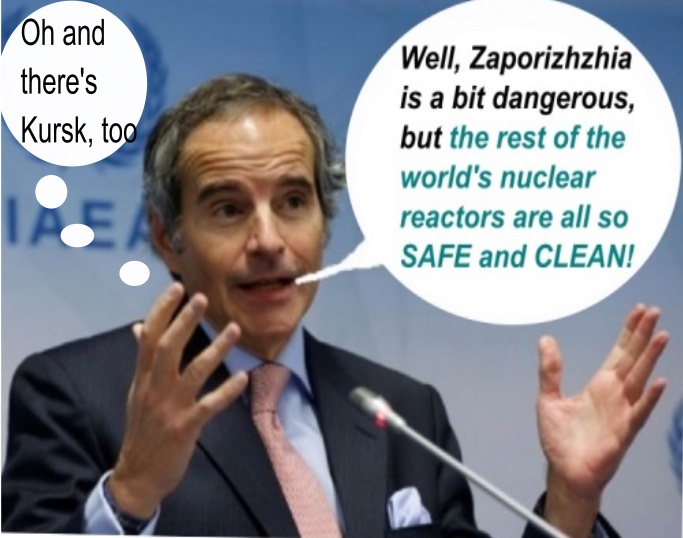
The IAEA team at Ukraine’s Zaporizhzhya Nuclear Power Plant (ZNPP) reported hearing hundreds of rounds of small arms fire last night, the latest sign of military activity potentially threatening nuclear safety and security, Director General Rafael Mariano Grossi said today.
The large number of shots – repeatedly fired for about an hour from 10pm local time – was unusual, the team members reported.
Conducting a site walkdown this morning, they saw numerous small calibre casings lying scattered on the ground near reactor units 5 and 6. There was no sign of broken windows or other physical damage.
The IAEA team at the ZNPP is seeking further information about the incident.
“Such military activity at or near a major nuclear power plant is clearly unacceptable,” Director General Grossi said.
Saturday evening’s shooting came after a series of purported attacks and other incidents involving drones near the ZNPP and other nuclear facilities in Ukraine in recent months, including a report of a strike a few days ago in the city of Enerhodar, where most ZNPP staff live.
Director General Grossi reiterated his deep concern about the apparent increased use of drones near nuclear power plants since early this year, saying such weaponry posed a clear risk to nuclear safety and security.
Any drone strike on a nuclear facility would violate the Seven Indispensable Pillars for nuclear safety and security during an armed conflict as well as the Five Principles to help ensure nuclear safety and security at the ZNPP, outlined by the Director General in March 2022 and May 2023, respectively.
“We are seeing a clear escalation in drone strikes during this war, also affecting Ukraine’s nuclear power plants and potentially putting them in further danger. As I have repeatedly stated, any military attack on a nuclear site – with or without drones – jeopardizes nuclear safety and must stop immediately,” Director General Grossi said.
Instigating Murder
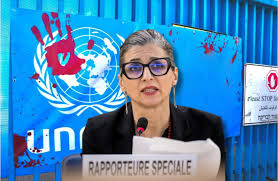
The US Attack on Francesca Albanese is even worse than meets the eye
Tarik Cyril Amar, Jul 10, 2025, https://www.tarikcyrilamar.com/p/instigating-murder
Sometimes – or, actually, very often – the behavior of the West’s ruling “elites” (if that is the word) is so obviously absurd and vicious that it’s, literally, stunning. In the sense that it almost knocks out a sane and morally decent individual’s capacity to fully grasp all aspects of any given new piece of depravity.
Instead, if you are still halfway normal in this West ruled by the clearly criminal and perverse, their frequent peak performances in depravity leave you with a dazed sense of “What just happened, again?” And once you recover from that shock, you can’t entirely shake the eerie feeling that you’ll never quite catch up with “their” constant and, again literally, limitless production of new evils.
None of the above is abstract. On the contrary, concrete examples abound. Recently, for instance, we have witnessed Israeli genocider-in-chief and fugitive under international law Benjamin Netanyahu publicly nominate genocide co-perpetrator Donald Trump for the Nobel Peace Prize.
Together with his gang, the same Donald Trump, also of course serving as president of the still single most powerful (alas!) rogue state on the planet, has attempted to simply wipe out the memory of the Epstein sex abuse (at least) and political blackmail scandal. Most likely – as in, we all know it – because he himself and many of his donors were ensnared in that Israeli operation of controlling the West’s “elites” and depriving the West’s populations of the last, miserable shreds of having a say in their own countries.
Meanwhile, in Britain, those who resist the Gaza Genocide perpetrated by Israel and the West together are brutally suppressed as “terrorists,” while cabinet minister Lisa Nandy literally conspires with Israeli diplomats to make the already outrageously pro-Zionist BBC even more so.
And then, essentially at the same time, there has been America’s massive and unambiguously criminal attack on the UN Special Rapporteur on the Occupied Palestinian Territories, Francesca Albanese. And that is, perhaps, the case displaying with greatest clarity that odd, stunning quality of the West’s atrocities and outrages.
The gist of the matter is that the US has sanctioned Albanese as if she were a criminal or even a terrorist. US secretary of state Marco Rubio has claimed that Albanese, an internationally recognized authority on human rights and international law, is waging a “campaign of political and economic warfare against the United States and Israel.” In particular, Rubio charged her with having supported the prosecution of Israeli leaders – that is, in reality, genocide perpetrators, also guilty of any other crime in every other book, from war crimes, via crimes against humanity, to apartheid and ethnic cleansing – by the International Criminal Court, another body under heavy sanctions fire from the US.
That, according to Rubio’s non-logic which is, of course, identical with that of the Israeli criminals – amounts to “antisemitism.” As a special highlight of absurdity, Rubio added that Albanese’s activities threaten the US’s “sovereignty.”
Let’s not waste time. No, it is neither necessary nor just nor intellectually healthy to treat these American allegations seriously, in the sense of going into any detail about why precisely they are deranged lies. Only so much, if Rubio and the other Trumpists are looking for someone destroying US “sovereignty” then the guy the American president has a habit of seating in his chair like a waiter may be a really good starting-point. And Netanyahu would, obviously, only be a small, nasty part of something much bigger called Israel and its lobby in America.
What is really happening here is clear: Albanese is a prominent critic and opponent of Israeli genocide. The US and its Western vassals are, at best, accomplices or, more realistically, co-perpetrators of that genocide. No Western state, conversely is fulfilling its clear legal obligations under the 1948 UN Genocide Convention and the 1998 Rome Statute (the US, to be fair, has always been vile enough not to even sign the latter; but that makes no difference to the fact that it is a signatory of the Genocide Convention): namely, not only not to commit the crime of genocide but to prevent it and to punish its perpetrators.
The US conclusion from the above, true to form is to persecute Albanese. It’s – literally – the criminals going after the sheriff. Because they can. For the worst and meanest rogue nation of them all, the US, with its trusty mass-murderous sidekick Israel, believes that might makes right. The rest – rules-based this or that, values, etc. – is pure hypocrisy.
None of the above is surprising or, make no mistake, new: No, this is not merely “Trumpism,” it is real-existing Americanism, as it has been for a long, long time. Ask the native Americans who were exterminated not “merely” by bloody violence but also by one broken agreement after another. Ask, more recently, the Iraqis or Libyans, for instance. What the Trumpists have added is merely a special note of in-your-face: Going after Albanese as if she were a terrorist while simultaneously not only sucking up once again to the genocidal führer of Israel but also a died-in-the-wool real terrorist, the head-cutting, pogrom-running puppet now in charge in Syria – that is almost a Gesamtkunstwerk of real-existing Americanism. Or maybe a Gestalt of evil and lies of satanic purity.
Likewise, the assault on Albanese – while a fresh peak performance – stands in a long tradition of harassing her as well as other opponents of Western-Israeli genocide, and not only in the US, of course. In Germany, Albanese was treated like a dangerous extremist who must not be allowed to speak in public. In the US, the attempt to cancel Albanese has a long history. Other critics of Israel and its crimes have been subjected to massive lawfare, on both sides of the Atlantic. Most recently, the German journalist Hüsein Dogru and his pregnant wife, too, have been terrorized by lawless EU sanctions that aim at nothing less than his economic destruction.
The reason: his reporting on protests against German complicity in the Gaza Genocide, which was absurdly re-interpreted as destabilizing Germany and – drum roll – playing into Russian hands. By that “logic” any criticism of any policy in the West can now lead to punitive sanctions (without any legal process, simply by bureaucratic fiat, Kafka-style) designed to destroy an individual’s existence.
All of the above, though, is obvious. Indeed, it is stunningly obvious in the sense mentioned at the beginning of this text: It arrests the mind, as it were. One gets stuck as if meditating on a perverse mandala of the unholy. Yet there seems to be one aspect of the attack on Albanese that receives too little attention, although it is second to none in its viciousness.
Consider that the Israelis have a long history of not “merely” smearing and undermining the UN, its offices, and representatives, but of deliberately mass-murdering them, too. To his eternal shame, UN Secretary-General Antonio Guterres has betrayed his own brave staff by never daring to say what the world knows: The hundreds of UN, in particular UNRWA, personnel killed in Gaza since October 2023 have been the victims of an Israeli campaign to destroy UNRWA as a last lifeline for the Palestinian victims. A campaign that is part of Israel’s use of starvation as yet another weapon of genocide. Its “logical” conclusion has been the replacement of UNRWA with the mercenary death squads, cooperating with the equally murderous IDF, of the so-called Gaza Humanitarian Foundation, funded, of course, by Israel.
If hundreds of UN staff have been mass-murdered as part of Israel’s Gaza Genocide, let’s not forget that Israel has a long tradition of assassinating UN officers, indeed, including the very highest: In 1948, Folke Bernadotte, a mediator and emissary of the UN Security Council was murdered by the Lehi terrorist organization (aka Stern Gang). Its members received a general amnesty in 1949. Later, one of Lehi’s leaders would go on to become Israeli prime minister (another one, of course, had led Irgun, another Zionist terror organization), and a military decoration would be named after it as well.
Israel, in sum, has a proud tradition of murdering UN representatives. It also has a long tradition of impunity in this area – as in all others – of criminality as well. Against this background, it is impossible that Rubio, Trump, and other US officials have missed one simple fact: They have not only assaulted Albanese with criminal lawfare. They have also signaled to Israel that they won’t mind if Israeli criminals go a step further and murder this UN representative, too.
That is the stark reality: Albanese’s punishment for standing up against genocide is not “merely” massive harassment but a very real death threat. Or to be precise, an implicit encouragement for Israel, a murderous state founded by ethnic cleansers and terrorists, to make true on the death threat Albanese lives under already. And Trump and his henchmen know this.
The phases of Ukraine – continued.
By Gordon Hahn – March 1 , 2025 – Source
Russian and Eurasian Politics, Translated by Wayan, proofread by Hervé, for Saker Francophone.
– – ……………………..……………………………………………………..The collapse of the Ukrainian army
The collapse of the front is expected to occur simultaneously or shortly after the collapse of the Ukrainian army. The state of the Ukrainian army is indeed dire. It suffers not only from a growing shortage of weapons, but also from a shortage of personnel, discipline, morale, and capabilities, all crippled by corruption. The 2024 military mobilization failed. Desertion and refusal to obey orders are endemic, and corruption not only hinders recruitment but also promotes high levels of absence without leave, reducing the number of Ukrainian soldiers actually fighting at the front.
The military mobilizations of the past and present year are having a debilitating effect on the economy, and society is failing to replace current losses at the front with completely inexperienced recruits with low or zero morale. There are no more volunteers, and by spring, some Ukrainian officials report, the situation will be irremediable. Moreover, almost all of the new recruits are elderly or demotivated, reports The Economist .
Frontline commanders, such as the commander of the drone battalion of Ukraine’s 30th Mechanized Brigade, confirm that the 2024 mobilization was an absolute failure and that there are now too few men to replace combat losses. Mobilization is carried out through harsh, often violent, measures. Verkhovna Rada deputy Alexander Bakumov of Zelenskiy’s
Servants of the People party said in a session that the mobilization in the Kharkiv region is forced, resembling a filtration of the Ukrainian population (referring to the practice of detaining, beating, and torturing citizens of the occupied areas in an ostensible search for fighters and collaborators), with exits from the city blocked by “recruitment “ gangs and lawyers for the mobilized men beaten. Small businesses are facing mass closures due to the lack of workers willing to leave for fear of being drafted into the army. Others have reported data falsification at recruiting offices to justify recruitment . There are numerous reports and videos of the violence used by recruiting gangs. Ultimately, what can be said of an army whose military system must force citizens to fight, even by forcibly seizing priests leading a religious procession and sending them to the front?
Moreover, many men are fleeing the country in greater numbers to avoid Ukraine’s desperate and draconian forced mobilization measures, sometimes risking their lives and sociopolitical stability. More recently, Western governments have pressured Kyiv to extend mobilization to the 18-25 age cohort, which would lead to a near-catastrophic demographic collapse of a population already reduced by some 30 percent due to war deaths and emigration. Even the recruitment centers themselves are trying to avoid the draft. When Rada deputies proposed filling the personnel shortage by creating a brigade from among the mobilization gangs, the chairman of the mobilization centers claimed that there were not enough of them to form a full brigade. The low number of volunteers and the failure of mobilization are creating distortions in the force structure. ” Zombie brigades ” or ” paper brigades ” are partially manned units simply called brigades to impress Western donors and facilitate the corruption of commanders who garnish salaries allocated to non-existent personnel.
The large number of desertions from the Ukrainian army, a phenomenon completely ignored by the Western media for three years, was finally revealed in November to have exceeded 100,000 since the start of the war. This would perhaps represent more than 10% of the Ukrainian army at its current size, given that Zelenskiy recently claimed that it has 800,000 recruits. Moreover, more than half of these desertions took place in the first ten months of 2024 alone. This is already large-scale desertion and includes mass desertions .
Military blogger Yurii Butusov, Servant of the People MP Maryana Bezuglaya, and others reported late last year the desertion of an entire 1,000-man brigade trained in France upon their arrival at the front. This may have been a case of the commander’s failed attempt to form so-called ” zombie brigades .” Indeed, military personnel have questioned the recent practice of creating new brigades when existing ones are woefully underequipped, apparently suspecting the corruption scheme behind the practice. One Ukrainian commander told a Polish newspaper that sometimes in combat there are more deserters than killed and wounded.
Desertions are one of the symptoms of lax discipline and, above all, low morale, increasingly plaguing the Ukrainian army. Commanders report that 90 percent of their frontline troops are newly mobilized men forcibly. Sources in the Ukrainian General Staff report the same . Thus, desertions are accompanied by unauthorized retreats, which are becoming increasingly frequent. For example, hundreds of people fled the battle at one point last fall in Vugledar (Ugledar) before the town fell. Vugledar was once a stronghold that, in 2023, Russian forces stormed dozens of times without success.
Ukrainian soldiers refuse to carry out operational orders because they amount to suicide operations and are beginning to surrender in entire units, in one case almost an entire battalion (for example, the 92nd Combat Squadron). Indeed, refusals to follow orders or undertake counteroffensive measures are increasing. In one recent case, the Azov Brigade’s chief of staff, Bogdan Koretich, accused a Ukrainian general of such poor command that he was described as responsible for more Ukrainian war deaths than Russians, forcing his dismissal. At lower levels, commanders are being dismissed in large numbers. At the same time, field commanders publicly criticize senior commanders and staff for their strategic incompetence and negligence.
One reason for the disintegration of discipline and morale is that there is no relief for the troops, as there is no long-term demobilization or time away from the front other than that resulting from brief episodic troop rotations; a consequence of insufficient troop numbers. Soldiers and their families have been lobbying for over a year for a demobilization law that would allow long rotations for troops to return home, but no such law is in sight. This would likely lead to a deadly shortage of troops and the complete rout of the Ukrainian army on the battlefield.
However, perhaps the main problem in the Ukrainian military, as in the rest of the Ukrainian state and society, is corruption. It is endemic and pervasive in the production and procurement of weapons, mobilization (evasion of conscription through bribes), the purchase of leave and absences from the front, and the staffing of brigades. One Ukrainian defense minister told a journalist that the problem was ” catastrophic .” Anna Skorokhod, an independent Rada MP, claims that only 15% (!) of rank-and-file soldiers serve at the front, with a large number either nonexistent (dead souls) in service or having bribed their way into hiding somewhere in the rear.
This is how Ukrainian officers describe the widespread corruption in the army. According to a Ukrainian army captain:
” Due to false information about the presence of personnel, the commanders of the branches receive false information. And they operate with ‘dead souls’, developing combat plans. For example, at a point where the Russians have broken through a section of the front, the commander orders a certain brigade to send a battalion with an attached group as reinforcements. In fact, the battalion has long since left, its number is now only one company, some have bought their way to the rear or deserted. As a result, there is nothing to close the breakthrough, because of the threat, the flanks of neighboring brigades begin to collapse. “
According to a source in the General Staff of the Ukrainian Armed Forces: ”
If we take the number of Russian soldiers we have at the front on paper, then if the Russians have a numerical advantage, it is less than double. But that’s on paper. In practice, the situation is different. Let’s imagine a section separated from the front. According to the newspapers, there are 100 people on our side and 150 on the Russian side. In other words, the enemy’s advantage is insignificant. With such numbers, it is quite possible to maintain the defense. But in a real battle, the situation is radically different. At most 40 of our 100 people participate. And often even fewer. The rest are deserters, who simply refuse to fight, etc. And the Russians have 140 to 145 people out of 150 fighting. In total, the advantage has already more than tripled. Why does this situation exist?” Our army was initially based on a core of volunteers, ATO veterans, and highly motivated soldiers who went into battle without coercion and seized the initiative. The Russians had a major motivation problem from the very beginning. But they worked on this issue and gradually created their own system of military-repressive coercion. And it works by sending soldiers into battle and stopping cases of insubordination and desertion. We haven’t created anything like that. And I doubt we’re even capable of creating such a system. Our state system is too weak and corrupt for that. And now that the volunteers are dead, either from wounds or simply exhausted, and the army is replenished with fake conscripts who have close to zero motivation, there’s no way to force them to fight. A separate problem is the quality of the command staff and the combat management system. There are also some very big failures here, as many experienced commanders have died and worthy replacements do not always come after them .”
Moreover, corruption reaches the top of the Ukrainian military establishment (as well as the civilian establishment). The suspension of US aid to Ukraine until April and the investigation into US arms supplies to Kyiv announced by the new administration of President Donald Trump resonated in the Ukrainian capital, leading to the opening of an investigation into the procurement practices of the Defense Ministry and Defense Minister Rustem Umerov, whose predecessor, Aleksey Reznikov, had also been ousted on suspicion of massive corruption. Umerov immediately moved to fire the head of the procurement organization, but
she refused to leave her office. There have been rumors for months that Zelenskiy was seeking to oust Umerov, and following the announcement of the investigation, calls for his resignation are growing . This adds crisis to crisis, dealing another blow to the military establishment at a pivotal moment in a catastrophic war.
Ukraine’s endemic and universal corruption has seen the artificial or outright absence of construction of fortifications at the front, bringing us back to the previous section on the collapsing front lines.
It is a state of corruption, low morale and incapacity reminiscent of Bashar al-Assad’s recently collapsed Syrian army.
This kind of Ukrainian army, or its collapse, poses a threat to both the Maidan regime and the Ukrainian state. The troops of a collapsed Ukrainian army will become a force that can be mobilized by a military or civilian leader to carry out a coup d’état and possibly a neo-fascist revolution, or by peripheral and local figures to establish separate fiefdoms. Recall that during the Maidan protests, leaders in Lvov and elsewhere first broached the idea of seceding from Ukraine, then controlled by Yanukovych. After the Maidan uprising and Yanukovych’s overthrow, it was Crimea and Donbass that moved toward separatism.
Ukrainian regime splits, then falls
With the army in collapse or even on the verge of collapse, political instability can be expected to intensify, with internal infighting intensifying as what remains resembles a front line moves closer to Kyiv. Russian forces will reach the Dnieper River by this summer and may capture territory along much or all of its length this year. With the fall of industrial giants, such as the cities of Dnipro and Zaporozhe, rump Ukraine will be reduced to a country of Western Ukrainian traders in a decimated economy, society, and political regime, assuming the Russians decide to stop at the Dnieper. Already, HUR leader Kyryll Budanov and the head of the Office of the President (OP), Andriy Yermak, are at odds, with rumors circulating for months that Zelenskiy is preparing to fire Budanov. In late January, Ukrainskaya Pravda , a pro-Maidan newspaper, reported that Budanov shocked Rada deputies at a closed-door meeting by declaring that if peace talks did not begin soon, processes would begin that would lead to the destruction of Ukraine . There has been some cooperation in the opposition between Zelenskiy’s dismissed armed forces commander, General Valeriy Zaluzhniy, and former Ukrainian President Petro Poroshenko. Both have been investigated for alleged treason by Zelenskiy’s prosecutors and the secret police, the SBU, and have been the subject of political attacks by the PO. The leader of the parliamentary faction of Zelenskiy’s ” Servants of the People ” party in the Ukrainian Verkhovna Rada, David Arakhamiya, is reportedly on the way out and will soon be replaced as party faction chairman. Arakhmiya is one of the few Ukrainian figures to acknowledge that Ukraine almost reached a peace deal with Russia in March 2022 that would have brought a swift end to the war, but that the West scuttled the agreement by withholding security guarantees and urging Kyiv to fight. Recently, as the new Trump administration put peace talks back on the agenda, Arakhmiya appeared to encourage the process by noting that he was in contact with Kremlin-linked Russian oligarch Roman Abramovich and had good ties to Republicans in the United States, likely increasing Zelenskiy’s suspicions about his loyalty. https://lesakerfrancophone.fr/les-quatre-prochaines-phases-deffondrements-de-lukraine
These internal struggles are compounded by the unfulfilled revolutionary aspirations of its ultranationalist and neofascist wing, which led the Maidan takeover in the first place ten years ago in February 2024. More recently, the founder and former leader of the neofascist Right Sector group and advisor to former Ukrainian Army Commander-in-Chief Zaluzhniy, Dmitro Yarosh,
repeated his call for the completion of the neofascist revolution on his Facebook page: “
It turned out that during the Revolution of Dignity and the Russo-Ukrainian War, Ukrainian nationalists became the main factor in the Ukrainian national liberation struggle in the 21st century. I am a Ukrainian nationalist—this sounds proud both in Ukraine and around the world. The next power after the War of Independence should be nationalist.” Otherwise, we will once again be drawn into an unbreakable cycle of national humiliation, corruption, degeneration, moral degradation, economic decline, inferiority, and defeat. Therefore, after the War of Independence, the wise, courageous, and noble must reign in Ukraine. Glory to the Nation! ” The leader and commander of the neo-fascist Azov Brigade, Andrey Biletskiy,
sounded the alarm about the army in December and called for far-reaching reforms, perhaps with the aim of taking over the leadership of the army and even the state. In short, the Zelenskiy government has opponents , even enemies, in all political camps, from the military to moderate nationalists to neo-fascists, even in his own largely discredited and corrupt Servant of the People party.
These developments within the elite are compounded by the collapse of Zelenskiy’s popularity and public trust. General Zaluzhniy is favored over Zelenskiy in the most recent opinion polls in Ukraine. Ukrainians’ trust in Zelensky
has plummeted from 80% in May 2023 to 45% a year later, according to the US National Democratic Institute. A recent Ukrainian opinion poll conducted by the Kyiv-based Center for Social Monitoring shows that only 16% of Ukrainians are willing to vote for Zelenskiy in any future presidential election, and 60% would prefer him not to run. Meanwhile, Zaluzhniy, ousted by Zelenskiy, would lead in such an election and would have 27% support, the poll found. According to previous internal opinion polls by the Presidential Office, Zelenskiy would lose a presidential election to Zaluzhniy today. The dismissed general ranks as the
most popular political and military figure in Ukraine, according to other recent polls (). In approval ratings, Zelenskiy has fallen to third place, after Zaluzhniy and the head of military intelligence (HRU) Budanov, whom the President’s Office is trying to fire . The stumbling block may be Budanov’s long-standing ties to US and Western intelligence services . In a more recent survey, Zaluzhniy (71.6%) and Budanov (46.7%) retained higher approval ratings than Zelenskiy (40.8%).
All of the above strongly suggests that the regime is fracturing behind the scenes and that Zelenskiy will be unable to maintain the situation as crises at the front and in the army intensify. The Maidan regime is threatened by a regime divided into competing factions, each putting forward its own claim to the sovereignty of the Ukrainian state or parts of it. Zaluzhniy’s reported contacts with opposition figure Poroshenko would mark the defection of a key actor from the Maidan regime to the political opposition to Zelenskiy. Such defections play a decisive role in regime transformations, whether transitional or revolutionary. It is sufficient to recall the effect that Eltsion’s defection from Mikhail Gorbachev’s reformist Soviet CPSU regime had on Soviet politics, exacerbating the polarization to both the ” left ” and ” right ” of Gorbachev’s perestroishchiki and leading to the sweeping August coup against both and ultimately the collapse of the USSR.
On top of all this, the regime’s stability is being undermined by the Trump administration’s push for peace talks with Moscow and, most recently, its implicit decision to remove Zelensky from the presidency to facilitate those negotiations. The February 2 call by Trump’s Ukraine peace envoy, Keith Kellogg, for presidential elections to be called by the end of the year appears to spell doom for Zelenskiy, given General Zaluzhniy’s far greater popularity. For Zelenskiy, an electoral defeat or a decision not to run would be a saving grace compared to other means by which he could be removed from power. But Kellogg’s mere suggestion, let alone an actual presidential campaign waged as the front and the army collapse, will intensify the power struggle, perhaps to the breaking point.
Then there is the very real potential for a popular uprising as the economy deteriorates and corruption becomes more publicized, especially as it is linked to the military’s difficulties. Ukrainians already view this as a greater threat than the Russian military, according to a recent poll conducted by the Kyiv-based sociological research group Reinting . The poll showed that more Ukrainians cited price increases and the general state of the economy (32% and 33%, respectively) as more worrisome than the expansion of Ukrainian territory occupied by the Russian military (25%). Social discontent with the regime’s shortcomings, highlighted by the extravagant lifestyles visible online by Zelenskiy’s family, his inner circle, and the Ukrainian elite in general, is a time bomb waiting to explode.
This crisis of the Maidan regime is likely to trigger a state crisis, perhaps state failure and territorial collapse. Domestic infighting and instability could very well lead to military and/or palace coups, and even to internecine wars and the division of parts of the country by mutually antagonistic Ukrainian factions of one kind or another.
The Failure and Collapse of the Ukrainian State
The collapse of the regime could lead to the organizational and administrative collapse of the state, leaving no functioning central government. This would facilitate territorial dissolution through warlord-led secessions, regions dominated by ethnic minorities, and/or vengeful takeovers by foreign powers: Poland, Romania, not to mention Russia. All of this could be compounded by economic dislocation and social chaos, leaving both Europe and Russia with a major security problem on their borders. One need only recall the Ukrainian national separatism that arose in Lvov and other regions of western Ukraine during the Maidan protests. These initial separatist measures preceded those taken in Crimea and Donbass, but came months after the collapse of the Yanukovych regime and the victory of the Maidan uprising. Below, I review various aspects or phases of Ukraine’s potential collapse as a state: state disorganization and functional failure; territorial collapse on a Ukrainian nationalist and/or quasi-criminal basis; minority ethnonational separatism; and foreign national revanchism.
The Ukrainian state is vulnerable to organizational incapacity and administrative failure due to an increasingly dysfunctional economy and the almost total dependence of its economy and state budget on foreign aid, loans, and grants. I and others have noted the destruction of Ukraine’s energy grid and other infrastructure and the further debilitating effect of military mobilization on businesses.
Against the backdrop of such grave difficulties and what can only be greater economic dislocation caused by the buildup and advance of the Russian military, Ukraine’s largest donor, the United States, has frozen all foreign aid, excluding only Israel and Egypt from the decree, as announced by the Trump administration. This will soon leave the Ukrainian government without the necessary funding to govern, provide public goods, and so on. Ukrainians already view prices as a greater threat than the Russian military, as noted above.
Thus, Ukraine’s loss of sovereignty to the West, primarily Washington, means a complete collapse with the withdrawal of funding. This is already evident in the most transparent of USAID corruption revelations, which revealed that 85% of Ukrainian media outlets will have to close without USAID funds. One can imagine the destructive impact on other sectors of Ukraine’s lifeline of Western aid: the economy, healthcare, social benefits, and so on. One can then expect regional governments, supported by ambitious oligarchs opposed to the Zelenskiy government or even the entire Maidan regime itself, to become separate fiefdoms for said oligarchs, paving the way for regional hoarding of key assets and possibly even separatism.
Furthermore, Ukraine suffers from an ethnically based “state problem,” driven by regions populated by ethnic minorities and foreign legacies encompassing most of western Ukraine. These regions became part of Ukraine following the Soviet defeat of Nazism in the Great Patriotic War and the occupation of these regions by the Red Army, which were subsequently incorporated into the Ukrainian SSR of the Soviet Union. As I wrote in my book ”
Ukraine on the Brink : Russia, the West, and the ‘New Cold War’ ” (McFarland, 2016), today’s Ukrainian state was built by Lenin, Stalin, and later Khrushchev (Crimea). Thus, in the Transcarpathian region of western Ukraine, there are subregions with large Romanian and Hungarian populations whose lands previously belonged to Romania and Hungary, respectively, then allies of the Nazis. These populations were already subjected to linguistic and other forms of discrimination at the hands of the state and its Ukrainian ultranationalist and neofascist allies before Russia’s invasion in 2022. Now, they are being brutalized by Zelenskiy’s military mobilization gangs, perhaps disproportionately compared to ethnic Ukrainian areas. This may fuel a desire to return to their national homelands by enlisting their aid by incorporating them into Romania and Hungary, respectively. Territorially speaking, this is a far lesser danger than the potential for Polish revanchism, which would mean the dissolution of the Ukrainian state. Fortunately for Kyiv, such developments are for the time being a remote possibility. But if the Ukrainian state begins to disintegrate, let alone experience internecine warfare or an incipient civil war, the potential for external revanchism will become more kinetic.
Conclusion
There is nothing inevitable about the cascade of collapses proceeding at full speed. Regime collapse can still be avoided, but regime collapse will quickly follow that of the front and the army. The only ways to fully prevent this cascade of collapses are a ceasefire, a full-fledged peace agreement, a full-scale NATO military intervention, or the conquest of all of Ukraine by Russia. Of these, only a ceasefire agreement is theoretically possible this year, and as early as April, a ceasefire could come too late or prove ineffective in stopping several of these collapses, holding the front line but unable to prevent the collapse of the army, the regime, and the state. Roving bands of idle soldiers on little or no pay will remain a combustible force, and a ceasefire could force the equally combustible crucible of presidential and parliamentary elections. In this, one can agree with HUR leader Budanov, who stated that if Ukraine does not begin peace talks by the summer, processes could begin to destroy the country. And Budanov’s assertion may be an understatement of the urgency. Trump must place Ukraine at the top of his agenda and pursue a settlement with maximum effort, using all the levers of persuasion Washington still possesses. Otherwise, Ukraine could explode. The fact that Kellogg’s call for elections produced a statement the very next day from Zelenskiy finally supporting negotiations with Moscow and thus seeking to break off direct US-Russian talks ” on Ukraine without Ukraine ” and without Europe is a demonstration of how pressure on the increasingly politically weak and emotionally damaged Zelensky could produce rapid results. But time is running out, and Ukraine’s four collapses are approaching.
1 This Month


Tell the Ukrainian Government to Drop Prosecution of Peace Activist Yurii Sheliazhenko

Petition to revoke the licensing of the Near Surface Nuclear Disposal Facility (NSDF) at Chalk River. https://www.ourcommons.ca/petitions/en/Petition/Details?Petition=e-7247


of the week – STOP SMALL MODULAR REACTORS IN CANADA
To see nuclear-related stories in greater depth and intensity – go to https://nuclearinformation.wordpress.com
-
Archives
- March 2026 (204)
- February 2026 (268)
- January 2026 (308)
- December 2025 (358)
- November 2025 (359)
- October 2025 (376)
- September 2025 (258)
- August 2025 (319)
- July 2025 (230)
- June 2025 (348)
- May 2025 (261)
- April 2025 (305)
-
Categories
- 1
- 1 NUCLEAR ISSUES
- business and costs
- climate change
- culture and arts
- ENERGY
- environment
- health
- history
- indigenous issues
- Legal
- marketing of nuclear
- media
- opposition to nuclear
- PERSONAL STORIES
- politics
- politics international
- Religion and ethics
- safety
- secrets,lies and civil liberties
- spinbuster
- technology
- Uranium
- wastes
- weapons and war
- Women
- 2 WORLD
- ACTION
- AFRICA
- Atrocities
- AUSTRALIA
- Christina's notes
- Christina's themes
- culture and arts
- Events
- Fuk 2022
- Fuk 2023
- Fukushima 2017
- Fukushima 2018
- fukushima 2019
- Fukushima 2020
- Fukushima 2021
- general
- global warming
- Humour (God we need it)
- Nuclear
- RARE EARTHS
- Reference
- resources – print
- Resources -audiovicual
- Weekly Newsletter
- World
- World Nuclear
- YouTube
-
RSS
Entries RSS
Comments RSS
 nuclear-news