Tehran stands by Leader’s fatwa banning nuclear weapons: Parliament

July 13, 2025. https://www.tehrantimes.com/news/515569/Tehran-stands-by-Leader-s-fatwa-banning-nuclear-weapons-Parliament
TEHRAN — The Iranian Parliament has once again underlined the country’s unwavering commitment to the peaceful use of nuclear energy, with top lawmakers emphasizing that Iran’s nuclear doctrine remains fully aligned with the Leader’s religious decree prohibiting nuclear weapons.
Speaking on Sunday, Ebrahim Rezaei, spokesperson for the Parliament’s National Security and Foreign Policy Committee, stated that both the Islamic Republic and the Parliament—as a central institution in national decision-making—remain firmly opposed to the development or use of nuclear arms.
“The position of the Islamic Republic of Iran and the Parliament, including the Speaker, is clear: we categorically reject the use of nuclear weapons,” Rezaei said.
He added that even during the recent 12-day conflict, while the committee adopted motions such as suspending cooperation with the International Atomic Energy Agency (IAEA), it never endorsed the idea of pursuing nuclear weapons. On the contrary, he said, the committee has consistently reaffirmed the Leader’s binding fatwa against such weapons.
In a recent televised interview, Parliament Speaker Mohammad Baqer Qalibaf also reiterated Iran’s official position: “We have consistently told the international community and international organizations that we have never sought nuclear weapons. But uranium enrichment is our right.”
Qalibaf added that Iran’s nuclear policy is grounded in international law: “Our stance is clear. Nuclear technology is our legitimate right, not just a red line but beyond it. This right is guaranteed under the Non-Proliferation Treaty (NPT), which allows all signatories to enrich uranium for peaceful purposes.”
Rezaei emphasized that Iran remains committed to the NPT, and that the temporary suspension of cooperation with the IAEA should not be interpreted as a step toward abandoning the treaty or seeking nuclear arms.
He concluded by reaffirming Ayatollah Khamenei’s well-established position: “The Leader of the Islamic Revolution has clearly and repeatedly declared that the use of nuclear, chemical, and biological weapons is religiously forbidden. That fatwa stands. There has been no shift in Iran’s nuclear doctrine.”
The next four phases of Ukraine’s collapse.

Now, a major collapse of Ukraine’s defense fronts along the entire or nearly entire battle line—which stretches from Kherson just north of Crimea in the east, then north through Donetsk to Kharkiv and Sumy—is imminent
by Gordonhahn, July 14, 2025, https://gordonhahn.com/2025/07/14/les-quatre-prochaines-phases-deffondrements-de-lukraine/
*Translated by Wayan, proofread by Hervé, for Saker Francophone .
I wrote some time ago : “ With the collapse of the front and the army on the verge of dissolving, Zelenskiy’s post-Maidan regime is deeply divided and in danger of dissolution, which could lead to state collapse, internecine warfare, and widespread chaos .” Below, I detail these four imminent or potential collapses—collapses of the battlefront, the Ukrainian army, the Maidan regime, and the Ukrainian state itself—because this issue is of crucial importance to the question of war or peace in Ukraine and to the challenges that will be faced in any reconstruction.
A dysfunctional Ukrainian army, regime, and state will prevent Kyiv from concluding any peace process and treaty that U.S. President Donald Trump or others might develop. In fact, the peace effort Trump is beginning to enlist Russian President Vladimir Putin in will almost certainly be thwarted by a cascade of two or more of the four major dysfunctions, collapses, and crises that appear to await Ukraine unless the war ends or a radical shift occurs in the correlation of Russian and NATO-Ukrainian forces. The first two of these collapses, of the front and the army, will almost certainly occur this year. The last two—of the Maidan regime and the Ukrainian state—may be postponed until next year.
The collapse of the military front in Ukraine
Ukraine’s defensive fronts have slowly weakened and increasingly collapsed over the past year. Throughout last year, Russian territorial gains and, for most of this year, Ukrainian losses increased monthly, just as I predicted more than a year ago. The infamous Institute for the Study of War , a Washington-based organization that relies on Ukrainian propaganda and turns itself into “ data ,” falsely claimed : “ Russian forces gained 4,168 square kilometers (1,609 square miles, GH), largely consisting of fields and small settlements in Ukraine and Kursk Oblast, at a reported cost of more than 420,000 casualties in 2024. Ukrainian Commander-in-Chief Col. Gen. Oleksandr Syrskyi said on December 30 that Russian forces suffered 427,000 casualties in 2024. ISW observed geotagged evidence to estimate that Russian forces advanced 4,168 square kilometers in 2024, indicating that Russian forces suffered approximately 102 casualties per square kilometer of Ukrainian territory seized .”
The propaganda element here lies primarily in the claim that Russia’s territorial gains were ” largely fields and small settlements ” and in the figures for Russian losses. The Russians seized ” largely fields and small settlements ” because the landscape of Ukraine, like that of any country, is largely made up of arable land and small villages.
However, Russia did capture several small towns and the main Ukrainian strongholds of Avdiivka, Vuhledar, Kurakhove, Selydove, Novosilevke, Toretsk, and almost all of Chasov Yar. The Russians may not have suffered 420,000 casualties over the course of the entire war, let alone in 2024. For 2024, the Mediazona institute—which, in affiliation with the BBC and the Russian opposition outlet Meduza , scours internet sources, social media, obituaries, and regional government announcements—counted 120,000 Russians killed in action between the start of the country’s ” special military operation ” in February 2022 and the end of 2024. It found that at least 31,481 Russian soldiers died between January 1, 2024, and December 17, 2024. Even if we increase this figure by 50%, taking into account the typical 1:3 ratio of killed to wounded, we still arrive at a figure of only about 180,000 Russian casualties in 2024, half of the reported Ukrainians/ ISW .
What is going on here? The acceleration of what I have called Russia’s ” attrition and advance ” strategy has been downplayed by ISW by accompanying it with data on territorial gains from the Ukrainian Defense Minister and other Ukrainian military sources on Russian losses in order to give the impression of massive Russian losses disproportionate to the ” modest ” territorial gains. This is done to support the Western myth that Russia is throwing away the lives of its soldiers in ” human wave ” attacks.
ISW carefully avoids the prospect of negative comparison by omitting any mention of Ukrainian casualties, mimicking the Ukrainian Defense Ministry and US-funded ” Ukrainian ” news outlets such as Ukrainskaya Pravda .
The raw data show that Russian territorial gains have indeed increased throughout the year on a nearly monthly basis, with the possible exception of December, which saw a decline compared to November. As Western media outlets finally began to expose the fallacy of the “ Ukraine is winning ” propaganda line in the fall of last year, the New York Times referenced data from a military expert with the Finland-based Black Bird group, Pasi Paroinen.
It turned out that Russian gains were being made all along the front line, from the north at Kharkiv to the south at Zaporozhye. Paroinen’s measurement of Russia’s overall gains in the first ten months of 2024 confirmed my own expectation of an intensified Russian advance. Russian advances during this period amounted to over 1,800 square kilometers and were made at an increasingly accelerated pace:
“ Half of Russia’s territorial gains in Ukraine so far this year have been made in the last three months alone. In August, Ukraine’s defensive lines buckled and Russia quickly advanced 16 km. In October, Russia made its most significant territorial gains since the summer of 2022, as Ukrainian lines buckled under sustained pressure. October’s gains amounted to over 257 square km of land in Ukraine’s eastern Donbas region alone .” Russian forces advanced 2,356 square kilometers in September, October, and November 2024, making 56.5% of their 2024 territorial gains during this period . November proved to be the most successful month for Russian forces in terms of territorial gains in 2024, “ advancing at the significantly higher rate of 27.96 square kilometers per day ” during that month.
ISW was careful not to compare Russia’s territorial gains in 2024 with those made in 2023, so as not to highlight the crucially important trend of accelerating Russian advances and Ukrainian retreats, but France 24 television picked up the slack . It noted that the Russian military had advanced in 2024 “ seven times more than in 2023 ,” taking “ 610 square kilometers in October and 725 square kilometers in November. These two months saw the Russians capture the most territory since March 2022, in the opening weeks of the conflict. Russia’s advance slowed in December, reaching 465 square kilometers in the first 30 days of the month. But it is already nearly four times greater than in the same month last year and two and a half times more than in December 2022. ”
Now, a major collapse of Ukraine’s defense fronts along the entire or nearly entire battle line—which stretches from Kherson just north of Crimea in the east, then north through Donetsk to Kharkiv and Sumy—is imminent. Some fronts may hold out longer, but they are unlikely to survive 2025. Russian forces are beginning to encircle the crucial industrial, mining, and transport center of Pokrovsk. After its fall, perhaps in two months, Moscow’s army will have a relatively unimpeded march toward Dnipro, Zaporozhye, and other points less south of the Dnieper. After that, the territorial advance will continue to accelerate at an ever-increasing pace and could lead to major breakthroughs across the Dnieper at any moment now, given the already dire and deteriorating state of Ukraine’s armed forces.
The collapse of the Ukrainian army
To read further: https://lesakerfrancophone.fr/les- quatre-prochaines-phases-dplombs-de-lukraine
Ailing Leaders Heighten Nuclear War Concerns
“This is particularly the case for the United States, where a leader can in principle authorise the release of nuclear weapons on their own, a situation referred to as a ‘nuclear monarchy’.”
14 Jul 2025, https://www.miragenews.com/ailing-leaders-heighten-nuclear-war-concerns-1495665/
Many former leaders of the world’s nine nuclear-armed nations were impaired by health conditions while in office, raising concerns over their decision-making abilities while they had access to nuclear weapon launch codes, a study from the University of Otago, New Zealand, has found.
The study analysed the health information of 51 deceased leaders of nuclear-armed countries: China, France, India, Israel, North Korea, Pakistan, Russia, the United Kingdom and the United States. Eight of the leaders died from chronic disease while still in office, five from heart attacks or strokes. Many of the leaders had multiple serious health issues while in office, including dementia, personality disorders, depression and drug and alcohol abuse.
The research was led by Professor Nick Wilson, from the Department of Public Health at the University of Otago, Wellington – Ōtākou Whakaihu Waka, Pōneke, with Associate Professor George Thomson and independent researcher Dr Matt Boyd.
Professor Wilson says that of the leaders who left office while still alive, 15 had confirmed or possible health issues which likely hastened their departure.
Professor Nick Wilson
“Probably all of this group of 15 leaders had their performance in office impaired by their health conditions. In some cases, the degree of impairment was profound, such as in the case of two former Israeli Prime Ministers: Ariel Sharon, who became comatose after suffering a stroke in office, and Menachem Begin, whose depression was so severe he spent his last year as leader isolated in his home. Impairment during crises was also seen in the case of Richard Nixon’s bouts of heavy drinking – including during a nuclear crisis involving the Middle East.
“There have also been occasions where health information about leaders has been kept secret at the time.”
This was the case for multiple US presidents, including Dwight D Eisenhower, whose doctor described his 1955 heart attack as a digestive upset; John F Kennedy, whose aides lied about him having Addison’s disease, a serious, chronic condition; and Ronald Reagan, whose administration hid the extent of his injuries after he was shot in 1981, and the likely signs of his dementia near the end of his term.
Professor Wilson says Kennedy was in poor health during his first two years in office in 1961 and 1962, with his performance likely impaired from Addison’s disease, back pain, and his use of anabolic steroids and amphetamines. It was in 1961 that he authorised the failed CIA-backed Bay of Pigs invasion of Cuba and that his poor performance at a Cold War summit with Soviet leader Nikita Khrushchev in Vienna was noted. In turn, Khrushchev’s poor mental health probably contributed to him triggering both the Berlin Crisis and the Cuban Missile Crisis.
In France, long-serving President François Mitterrand clung onto power until the end of his term in 1995, despite keeping secret his advanced prostate cancer and after his doctor had concluded in late 1994 that he was no longer capable of carrying out his duties.
This latest study follows previous research involving Professor Wilson on the health of former New Zealand Prime Ministers. It found the performance of at least four of the leaders was impaired, in three cases by poor health, and, in the case of Robert Muldoon, by his heavy drinking.
Professor Wilson says with the rise in international instability following the Russian invasion of Ukraine in 2022 it has become even more important to ensure there is good leadership and governance in those countries with nuclear weapons.
“This is particularly the case for the United States, where a leader can in principle authorise the release of nuclear weapons on their own, a situation referred to as a ‘nuclear monarchy’.”
He says there is a range of measures which could reduce global security risks from leaders whose judgement is in question. They include removing nuclear weapons from ‘high alert’ status, adopting ‘no first use’ policies where nations refrain from using nuclear weapons except as a retaliatory second strike, ensuring any weapon launches need authorisation by multiple people, and progressing nuclear disarmament treaties.
Professor Wilson says democracies could consider introducing term limits for their leaders, as well as recall systems, so voters could petition for politicians to step down. Requirements for medical and psychological assessments could be introduced for leaders before they take office, and during their terms.
“Maintaining a strong media with investigative journalists can also help expose impairment in leaders.”
Professor Wilson says politicians in general are exposed to high levels of stress, which can affect their mental wellbeing. A study of UK Members of Parliament has found they were 34 per cent more likely to experience mental health problems than other high-income earners.
“Finding ways to reduce stress on politicians and better address their mental health needs is another way global security risks can be reduced.”
Publication details
Nick Wilson, George Thomson & Matt Boyd
BMC Research Notes
The associated recent study of impaired New Zealand Prime Ministers is detailed in this University of Otago media release.
Wildfires: Could this be the worst year ever?
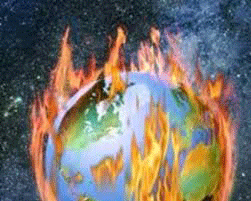
The area of land burnt in Europe this year is significantly higher than the average, and Britain is at risk as well thanks to sustained high global temperatures. Even Britain,
a country with a climate not normally conducive to wildfires, is recording
record amounts of burnt land for this stage of the summer. These fires are
starting abnormally early, and appear to be more severe than previous
years. What is causing them, and could 2025 be the worst year yet?
Times 13th July 2025, https://www.thetimes.com/uk/environment/article/wildfires-could-this-be-the-worst-year-ever-twnx25v7s
1 This Month

Petition to revoke the licensing of the Near Surface Nuclear Disposal Facility (NSDF) at Chalk River. https://www.ourcommons.ca/petitions/en/Petition/Details?Petition=e-7247


of the week – STOP SMALL MODULAR REACTORS IN CANADA
To see nuclear-related stories in greater depth and intensity – go to https://nuclearinformation.wordpress.com
-
Archives
- March 2026 (153)
- February 2026 (268)
- January 2026 (308)
- December 2025 (358)
- November 2025 (359)
- October 2025 (376)
- September 2025 (258)
- August 2025 (319)
- July 2025 (230)
- June 2025 (348)
- May 2025 (261)
- April 2025 (305)
-
Categories
- 1
- 1 NUCLEAR ISSUES
- business and costs
- climate change
- culture and arts
- ENERGY
- environment
- health
- history
- indigenous issues
- Legal
- marketing of nuclear
- media
- opposition to nuclear
- PERSONAL STORIES
- politics
- politics international
- Religion and ethics
- safety
- secrets,lies and civil liberties
- spinbuster
- technology
- Uranium
- wastes
- weapons and war
- Women
- 2 WORLD
- ACTION
- AFRICA
- Atrocities
- AUSTRALIA
- Christina's notes
- Christina's themes
- culture and arts
- Events
- Fuk 2022
- Fuk 2023
- Fukushima 2017
- Fukushima 2018
- fukushima 2019
- Fukushima 2020
- Fukushima 2021
- general
- global warming
- Humour (God we need it)
- Nuclear
- RARE EARTHS
- Reference
- resources – print
- Resources -audiovicual
- Weekly Newsletter
- World
- World Nuclear
- YouTube
-
RSS
Entries RSS
Comments RSS
 nuclear-news