What Greenland’s Ancient Past Reveals about Its Fragile Future
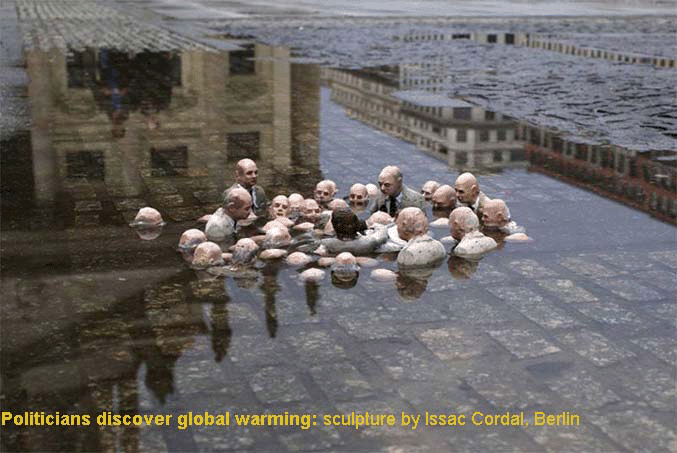
The collapse of the world’s second-largest ice sheet would drown cities
worldwide. Is that ice more vulnerable than we know?
Last year, Scientific American chief multimedia editor Jeffery DelViscio spent a month on the
Greenland ice sheet, reporting on the work of scientists taking ice and
rock cores from the Northeast Greenland Ice Stream (NEGIS) and the bedrock
underneath. This massive flow of ice drains ice into the ocean, and its
melt has been speeding up in the past decade.
Bedrock samples under ice
from an area in northwest Greenland indicate it was ice-free as recently as
about 7,000 years ago when global temperatures were only a few degrees
warmer than they are now. The sheet won’t melt all at once, of course,
but scientists are increasingly concerned by signs of accelerating
ice-sheet retreat. A recent report showed that it has been losing mass
every year for the past 27 years. Another study found that nearly every
Greenlandic glacier has thinned or retreated in the past few decades.
The NEGIS itself has extensively sped up and thinned over the past decade. If
the entire Greenland ice sheet melted, global sea levels would rise by
about 24 feet, inundating coastal cities, farmland and homes. “I have,
for the first time ever in my career, datasets that take my sleep away at
night,” says Joerg Schaefer, GreenDrill’s co-principal investigator.
“They are so direct and tell me this ice sheet is in so much trouble.”
Scientific American 17th June 2025, https://www.scientificamerican.com/article/greenlands-ice-sheet-collapse-could-be-closer-than-we-think/
No comments yet.
1 This Month

Petition to revoke the licensing of the Near Surface Nuclear Disposal Facility (NSDF) at Chalk River. https://www.ourcommons.ca/petitions/en/Petition/Details?Petition=e-7247


of the week – STOP SMALL MODULAR REACTORS IN CANADA
To see nuclear-related stories in greater depth and intensity – go to https://nuclearinformation.wordpress.com
-
Archives
- March 2026 (156)
- February 2026 (268)
- January 2026 (308)
- December 2025 (358)
- November 2025 (359)
- October 2025 (376)
- September 2025 (258)
- August 2025 (319)
- July 2025 (230)
- June 2025 (348)
- May 2025 (261)
- April 2025 (305)
-
Categories
- 1
- 1 NUCLEAR ISSUES
- business and costs
- climate change
- culture and arts
- ENERGY
- environment
- health
- history
- indigenous issues
- Legal
- marketing of nuclear
- media
- opposition to nuclear
- PERSONAL STORIES
- politics
- politics international
- Religion and ethics
- safety
- secrets,lies and civil liberties
- spinbuster
- technology
- Uranium
- wastes
- weapons and war
- Women
- 2 WORLD
- ACTION
- AFRICA
- Atrocities
- AUSTRALIA
- Christina's notes
- Christina's themes
- culture and arts
- Events
- Fuk 2022
- Fuk 2023
- Fukushima 2017
- Fukushima 2018
- fukushima 2019
- Fukushima 2020
- Fukushima 2021
- general
- global warming
- Humour (God we need it)
- Nuclear
- RARE EARTHS
- Reference
- resources – print
- Resources -audiovicual
- Weekly Newsletter
- World
- World Nuclear
- YouTube
-
RSS
Entries RSS
Comments RSS
 nuclear-news
Leave a comment