Iran could resume enriching uranium within months, UN nuclear watchdog boss says
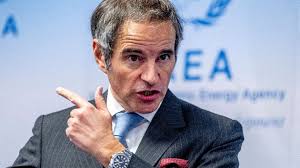
Rafael Grossi, the director-general of the International Atomic Energy Agency (IAEA), told CBS News in an interview on Sunday that Iran’s capabilities to resolve any damage to its nuclear program do not appear to have been wiped out.
30 June 25, https://www.abc.net.au/news/2025-06-30/iran-could-enrich-uranium-within-months-iaea-says/105475434
In short:
Iran could resume producing enriched uranium in months, according to the head of the United Nations’ nuclear watchdog.
Rafael Grossi from the International Atomic Energy Agency has raised more doubt about the efficacy of the US bombing of key Iranian nuclear facilities.
What’s next?
US President Donald Trump has suggested individuals could be prosecuted if found responsible for leaking a classified report that also cast doubt on the success of the US strikes.
Iran could resume producing enriched uranium in months, according to comments made by the head of the United Nations’ nuclear watchdog that have raised more doubts about the efficacy of US strikes on Tehran’s nuclear program.
Officials in the United States have repeatedly stated that the strikes on Iran’s Fordow, Natanz and Isfahan nuclear facilities “obliterated” them, although President Donald Trump said on Friday that he would consider bombing the Middle Eastern nation again if it was enriching uranium to worrisome levels.
Rafael Grossi, the director-general of the International Atomic Energy Agency (IAEA), told CBS News in an interview on Sunday that Iran’s capabilities to resolve any damage to its nuclear program do not appear to have been wiped out.
“The capacities they have are there. They can have, you know, in a matter of months, I would say, a few cascades of centrifuges spinning and producing enriched uranium, or less than that,” he said.
“Frankly speaking, one cannot claim that everything has disappeared and there is nothing there.”
US officials also obtained an intercepted phone call between Iranian officials appearing to suggest the government in Tehran believes the US strikes were less devastating than expected, according to a report from The Washington Post.
In an interview on Sunday local time, Mr Trump also suggested that his government would look to investigate and potentially prosecute individuals found responsible for leaking an internal, preliminary classified report that cast doubt on how successful the US strikes in Iran were.
“They should be prosecuted. The people who leaked it,” the president said on the Fox News US.
“We can find out. If they wanted, they could find out easily.
“You go up and tell the reporter: ‘National security, who gave it?’ You have to do that, and I’ll suspect we’ll be doing things like that.”
Mr Trump’s interview with Fox aired as his “Big Beautiful Bill” cleared a procedural hurdle in the US Senate, before it entered a 10-hour debate process.
The US strikes came after Israel said this month it wanted to remove any chance of Iran developing nuclear weapons, launching its own attacks on Tehran that ignited a 12-day war between the two countries.
Iran says its nuclear program is for peaceful purposes only.
Mr Grossi said the US strikes on the three Iranian sites had significantly set back Iran’s ability to convert and enrich uranium.
Western powers, however, have stressed that Iran’s nuclear advances provide it with an irreversible knowledge gain, suggesting that while losing experts or facilities may slow progress, the advances were permanent.
“Iran is a very sophisticated country in terms of nuclear technology,” Mr Grossi said.
“So, you cannot disinvent this. You cannot undo the knowledge that you have or the capacities that you have.”
Mr Grossi was also asked about reports of Iran moving its stock of highly enriched uranium in the run-up to the US strikes and said it was not clear where that material was.
“Some could have been destroyed as part of the attack, but some could have been moved,” he said.
On Friday, Mr Trump scoffed at Ayatollah Ali Khamenei’s heated warning to the US not to launch future strikes on Iran, as well as the Iranian supreme leader’s assertion that Tehran “won the war” with Israel.
Mr Trump said the ayatollah’s comments defied reality after 12 days of Israeli strikes and the US bombardment, and the US president suggested the comments were unbecoming of Iran’s most powerful political and religious figure.
“Look, you’re a man of great faith. A man who’s highly respected in his country. You have to tell the truth,” Mr Trump said.
“You got beat to hell.”
Mr Trump also told reporters at the White House that he expected Iran to open itself to international inspection to verify that it does not restart its nuclear program.
Asked if he would demand during expected talks with Iran that the IAEA or some other organisation be authorised to conduct inspections, Mr Trump said Iran would have to cooperate with the group “or somebody that we respect, including ourselves”.
Seizing Zaporizhzhia: A Meltdown in Nuclear Governance
By Robert Schuett – 30 June 2025, https://www.globalpolicyjournal.com/blog/30/06/2025/seizing-zaporizhzhia-meltdown-nuclear-governance
This is not just about Ukraine. Robert Schuett argues that Russia’s occupation of the Zaporizhzhia Nuclear Power Plant signals a broader unravelling of global nuclear governance—one that must urgently be addressed.
“There cannot be a crisis next week,” Henry Kissinger once quipped. “My schedule is already full.”
Decades later, the line reads less like a joke about the work ethic and demands of high office, and more like a grim diagnosis of the current global condition. From the ongoing war in Europe—where Russian armed forces continue their relentless aggression, with recent escalations in Kyiv and Odesa—to the deepening geopolitical fracture in the Middle East, international society is not short on crises, violence, and human suffering.
The real strategic risk for global policy is that when pre-emptive force becomes the de facto tool for upholding non-proliferation principles, the entire framework of nuclear governance begins to fracture.
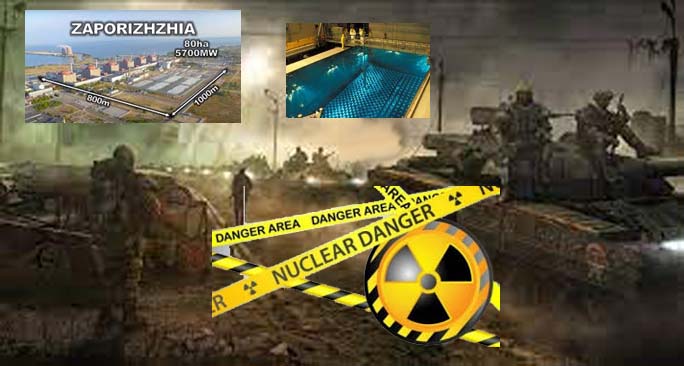
Yet among them, one threat quietly festers in a war zone on the east bank of the Dnipro River: the occupation of the Zaporizhzhia Nuclear Power Plant (ZNPP)—after all, the largest in Europe—located in the city of Enerhodar, in Ukraine’s Zaporizhzhia Oblast. Overshadowed by battlefield developments and Russia’s broader diplomatic brinkmanship, this overlooked flashpoint risks unravelling the foundational norms of nuclear safety, civilian infrastructure protection, and international law itself.
Captured by Russian forces in March 2022, the facility has become a symbol of everything that should not happen in modern warfare. Russia has consistently ruled out transferring control of the ZNPP—either back to Ukraine, the US, or any international authority. The Kremlin maintains a posture of legal reinterpretation, insisting on its operational authority despite international condemnation.
Although all six reactors remain in cold shutdown, the risk is far from neutralized. The plant now depends on a single functioning high-voltage line to power critical cooling and safety systems, which is a stark contrast to the ten off-site lines it had before the illegal Russian war of aggression. The destruction of the Kakhovka Dam in 2023 eliminated its primary cooling reservoir, forcing the plant to rely on makeshift groundwater wells.
Russian forces have reportedly deployed military assets within the facility, further compromising its integrity. While the International Atomic Energy Agency (IAEA) maintains a presence onsite, its ability to enforce safety protocols is severely limited under conditions of foreign military occupation.
As IAEA Director General Rafael Mariano Grossi recently warned, the power supply to Zaporizhzhia remains “extremely fragile,” placing the site, and the entire region, at persistent risk.
This is not merely a technical or regional issue, however. Russia’s nuclear blackmail is a serious threat to global nuclear order.
Russia’s occupation of ZNPP constitutes a rupture in the international legal and regulatory architecture that safeguards civilian nuclear infrastructure. For decades, global norms and laws—rooted in instruments like the Geneva Conventions, the Convention on the Physical Protection of Nuclear Material, and IAEA guidance—have treated nuclear power plants as protected, non-military assets. Seizing or attacking them was once unthinkable. Russia’s actions have shattered this principle, undermining legal norms from which it has historically benefited.
The twist is as alarming as it is cynical. Russian state entities like Rosatom, which in peacetime present themselves as responsible global stewards of nuclear safety, are now party to an act of strategic subversion and tool of ruthless state power. Rosatom and its subsidiaries regularly construct and operate nuclear plants abroad, complying with international standards and cultivating an image of professionalism. But at Zaporizhzhia, the same actor has helped transfer control of the facility to a newly created Russian-operated entity. The contradiction is jarring: the self-proclaimed guarantor of global nuclear norms is now violating them in pursuit of pseudo-geopolitical gain. Rosatom has recently confirmed its long-term intention to restart ZNPP, despite the unresolved security, political, regulatory, and moral challenges on the ground.
At a strategic level, this selective application of international rules and norms sets a dangerous precedent. If civilian nuclear infrastructure can be seized and operated by military force—while cloaked in the language of regulation—it opens the door to the normalization of impunity. The rulebook governing civilian nuclear conduct risks becoming a tool of expedience rather than a binding constraint. Such erosion undermines not only nuclear safety but also the predictability and trust that underpin broader technical agreements, from arms control to climate-related energy cooperation.
The longer Zaporizhzhia remains a “nuclear hostage,” the more the world risks sleepwalking into disaster. The plant is not operational, but that is no guarantee of safety. The worst-case scenarios, ranging from damage to spent fuel pools, sabotage of safety systems, or collapse of staff morale, are not theoretical. The ongoing uncertainty erodes public trust in nuclear energy, destabilizes non-proliferation efforts, and sends dangerous signals to other regimes watching how the world responds.
Moreover, the moral implications cannot be ignored. Civilian nuclear facilities were never meant to be pawns in geopolitical contests. They exist to serve public needs, not strategic or revanchist ambitions. Allowing one state to weaponize this infrastructure risks eroding the civilian character of nuclear energy itself.
What’s at stake is far more than a single nuclear plant—or even the authority of one international watchdog. This is a stress test for the entire system of rules that keeps the world from tipping into chaos. If the norms protecting nuclear safety can be so casually violated, what’s to stop similar breaches in artificial intelligence, biotechnology, climate regulation, or space?
The responsibility now lies with the international community not only to condemn, but to act. Diplomatic actors—especially those in Europe and within multilateral institutions—must ensure that the Zaporizhzhia crisis remains at the forefront of international attention. It cannot be allowed to drift into the background of conflict fatigue or be buried beneath newer headlines.
Sustained diplomatic pressure, public engagement, and policy innovation are essential to prevent normalization of the unacceptable. The defense of global norms must not be reactive or selective. Rather, it must be proactive, persistent, and principled.
If international society won’t defend longstanding rules at Zaporizhzhia, it may find itself unprepared when those rules collapse everywhere else.
Robert Schuett is co-founder and managing partner at STK Powerhouse, a global risk advisory firm. A former Defence civil servant, he also serves as Chairman of the Austrian Political Science Association and is a long-standing Honorary Fellow at Durham University.
Iran’s uranium enrichment: myths, realities, and what Canada should understand

Canadians deserve an informed debate about the potential proliferation dangers of these new reactor designs, especially as the intention is to export them around the world.
BY ERIKA SIMPSON, GORDON EDWARDS | June 29, 2025, https://www.hilltimes.com/story/2025/06/29/irans-uranium-enrichment-myths-realities-and-what-canada-should-understand/465192/
Confusion and misinformation continue to shape public discussion about uranium enrichment in Iran. As tensions rise in the Middle East and the fear of nuclear weapons proliferation returns to the headlines, it is important for Canadians to understand the basic scientific facts, the real risks, and the broader international implications.
Uranium enrichment sounds mysterious, but is a well-understood process. Natural uranium contains only 0.7 per cent uranium-235, the rare variety of uranium that can undergo the kind of nuclear chain reaction needed for nuclear power or nuclear bombs. The other 99.3 per cent is uranium-238, a heavier variety of uranium that cannot sustain such a chain reaction. Enrichment is simply the process of raising the percentage of uranium-235.
It is often reported that 90 per cent uranium enrichment is “needed” to have a nuclear weapon. This is not true. The Hiroshima bomb had only 80 per cent enrichment. Iran has a good deal of 60 per cent enriched uranium, and one can make a powerful bomb from 60 per cent enriched uranium. It would be larger in size than a bomb with 90 per cent enrichment, and so more challenging to deliver, but not much more so. The recent bombings are unlikely to have destroyed the hundreds of kilograms of 60 per cent enriched uranium already in Iran.
The mechanism needed for making an atomic bomb from uranium is much simpler than that needed for a plutonium bomb. It’s called a “gun-type” atomic bomb rather than an “implosion-type” atomic bomb.
The gun-type bomb just fires one chunk of uranium into another chunk (the target) so that the two chunks add up to more than a “critical mass.” It is so simple it cannot possibly fail. The United States never tried out this type of bomb before using it; it was dropped on the city of Hiroshima, Japan, with no prior testing. Such a bomb needs a precision-timed “neutron source,” but that is old technology, well known for a long time.
The implosion-type bomb is needed when plutonium is the nuclear explosive. Implosion is much more demanding. It requires a perfectly spherical mass of plutonium metal surrounded by concentric plastic explosives to drive the sphere inward toward the centre—an “ implosion.” It is so tricky it’s pretty well got to be tested first. The U.S. detonated one such plutonium bomb at Alamagordo, New Mexico, three weeks before dropping another one on the Japanese city of Nagasaki.
Nuclear authorities maintain that a powerful nuclear explosive device (gun-type) could be made with any uranium enriched to 20 per cent or more. At the 20-per-cent level such a device would be a lot bulkier; it could not easily be carried by rocket or aeroplane, but could be delivered in the hull of a ship, in a truck or cargo container, or even in the trunk of a car, and detonated by remote control.
For this reason, highly enriched uranium—which is uranium with 20 per cent enriched or more—is increasingly being prohibited from most civilian use.
Up to now, all operating power reactors fuelled with uranium use an enrichment level of no more than five per cent. Fuel at that level of enrichment is not weapons-usable material. But some new reactors proposed in Canada and elsewhere demand fuel that is a lot more enriched. The ARC sodium-cooled reactor planned for New Brunswick uses uranium fuel enriched to more than 13 per cent, while the eVinci reactor being studied in Saskatchewan is designed to use 19.9 per cent enriched uranium.
Independent experts have pointed out that uranium enriched to such high levels—between 12 per cent and 20 per cent—could also be used (like highly enriched uranium) to make an enormously destructive nuclear explosive device. This danger is not officially acknowledged by regulators, and is generally not recognized by politicians and other decision-makers in Canada. The nuclear fuel needed for some of the “fast” or “advanced” SMNRs being proposed in this country is weapons-usable material even though it is below the 20 per per cent enrichment level, and is, therefore, not classified as highly enriched uranium.
Canadians deserve an informed debate about the potential proliferation dangers of these new reactor designs, especially as the intention is to export them around the world.
Gordon Edwards is a nuclear safety consultant and president of the Canadian Coalition for Nuclear Responsibility. Erika Simpson is an associate professor of international politics at the University of Western Ontario.
Israel ‘not an ally’, says former British ambassador
Sir Richard Dalton tells Declassified the US and Israel pose greater threat to Middle East peace than Iran.
MARK CURTIS, 26 June 2025, Declassified UK,
- Keir Starmer’s flouting of international law over Gaza and Iran does a “disservice” to Britain
- “Intense” lobbying by Israel exerts undue influence over UK foreign policy
- “Majority” of Iranians may support their country acquiring nuclear arms after Israeli/US attacks
“Israel is not an ally” of Britain, former UK ambassador Sir Richard Dalton has told Declassified in a wide-ranging interview.
He also warns that Britain’s Israel lobby is getting “stronger” and exerts “a very powerful force in our society” including over politicians and political parties.
In a discussion on the current conflicts in the Middle East, Dalton, who served as Britain’s top official in Tehran from 2003-06, said that the United States and Israel together constituted “a greater threat to the stability of the region than Iran”.
He added that prime minister Keir Starmer’s backing of Israeli and American air strikes on Iran this month does “a disservice to Britain, and a disservice to the cause of preserving international law as guidance for nations in their interactions with each other”.
Dalton told Declassified that the contention that Iran was on the verge of developing nuclear arms is “false” and that “no such threat existed”.
The seasoned diplomat, who served as Britain’s Consul-General in Jerusalem from 1993-7, observed, “I think that Israel cannot be regarded as an ally because their objectives in resolving the central problems of the Near East are so different from ours”.
“We believe in the self-determination of the Palestinian people. The Israelis do not. We believe in a two state solution. The Israelis, not all of them, but the dominant ones, do not.
“We believe that the state of Israel should be based on its 1948 borders. The Israelis do not. We believe that settlements across the Green Line are illegal and an obstacle to peace, the Israelis are bent on expanding them and, we believe that the Palestinians have a right to a peaceful existence on their own land”.
Dalton acknowledged that Israel does provide intelligence cooperation with Britain about extremist movements.
But he felt the idea that Israel is an ally because it is “the only democracy in the Middle East” is undermined since it “constantly oppresses its neighbouring people and subjects them to inhuman circumstances” such as in Gaza.
“It’s forfeited its right to be regarded as an ally just because it has an internal democracy”, Dalton said.
Condemning the “appalling and grossly illegal” Hamas attacks of 7 October 2023, the former ambassador added that “the balance indicates that this [Israel] is not a country with a similar set of values to us”.
‘Pro-Israel lobby in British foreign policy making’
Dalton, who held a range of positions in the Foreign Office until leaving in 2006, believes the UK has not taken a clear position on international legal issues over Gaza due to “the desire not to open up a wide gulf with the United States as a matter of principle”.
“I find it shocking”, he says. “There are European countries that have taken a much more robust and intelligent and humane and legal stance.”
Dalton added: “The reason we have never developed an independent policy on the turmoils and travails of the Middle East is because we are always looking over our shoulders at what the Americans want, what the Americans are saying”.
The second reason explaining UK support for Israel over Gaza is the Israel lobby, the former ambassador reasoned.
The “balance of opinion in parliament” is such that “those willing to uphold the Palestinian right to self-determination and to be free from gross human rights abuses are relatively weak”.
There’s also “the effect of intense Israeli lobbying and the linkage of Israeli lobbying to financial interests. It is a very powerful force in our society. Those who support the Israeli government through thick and thin, have traditionally been very influential”, Dalton added.
‘Powerful allies’
The Israel lobby has “powerful political allies in some political parties, and in some sections of the media. So a desire for a quiet life and a good career, means that many politicians swallow potential dislike of aspects of Israeli policy in order to toe the Israeli line”.
Asked if he sees evidence of the strength of the pro-Israel lobby in Britain’s Foreign Office and Ministry of Defence, Dalton replied: “Oh, yes. There’s no doubt that the Israeli public have a right to be proud of their diplomatic service and the ability of the State of Israel to leverage sources of influence within British society”………………………………………………………………………………………………………………………………………………………………………………………………………………………. https://www.declassifieduk.org/israel-not-an-ally-says-former-british-ambassador/
In Gaza, survivors accuse Britain of complicity

“This massacre was not random. Everything was calculated precisely, as if they were tracking every move.
“When I learned that the US and Britain provided Israel with intelligence from reconnaissance planes, I felt betrayed from above.
Eye witnesses to an Israeli massacre believe British intelligence contributed to the slaughter.
SHAIMAA EID, 29 June 2025, https://www.declassifieduk.org/in-gaza-survivors-accuse-britain-of-complicity/
The smell of blood and smoke still lingers in the memory of those who lived through the Nuseirat massacre in the heart of the Gaza Strip.
One year has passed since the slaughter on 8 June 2024, when Israeli forces launched a “hostage rescue” operation against Hamas.
However, that military raid – which killed more than 270 Palestinians, the vast majority of them civilians – left behind nothing in Nuseirat but devastation and collective loss.
As families continue to mourn, media reports, including by the New York Times, have added another layer of pain.
They revealed that Western countries, including the US and UK, provided intelligence ahead of the operation through surveillance flights and advanced monitoring technology.
Today, survivors of the massacre hold those countries responsible, saying that surveillance planes which filled the skies over the camp in the days leading up to the operation may have been “British and American eyes directing the fire from above.”
‘Unforgivable’
Raed Abdel Fattah, 38, is still unable to return to normal life after what he experienced that bloody morning.
“I was with my wife and our three children in the market when the airstrikes began. We ran aimlessly through the street, just trying to survive.
“We tried to take cover in a parked car on the side of the road. We passed it just seconds before it was struck by a missile and went up in flames. Had we been a moment later, we would have been buried under the rubble.”
Raed pauses, then continues in a tense voice: “We ran into the Nuseirat market as bullets rained down around us, with bodies and the wounded filling the streets.
“There was no safe place. In front of us was a young man selling sweets – suddenly, a quadcopter drone shot him in the head.
“His brain spilled out before my eyes. I couldn’t hold myself together. It was a moment of human collapse I haven’t recovered from to this day.”
He adds: “This massacre was not random. Everything was calculated precisely, as if they were tracking every move.
“When I learned that the US and Britain provided Israel with intelligence from reconnaissance planes, I felt betrayed from above.
“These planes were not only Israeli. If they supplied images or data, they are part of the decision – and partners in the outcome.”
Raed is not seeking sympathy: “We do not want diplomatic apologies. Whoever provided the information opened the door to the massacre, even from afar. This is unforgivable and cannot be forgotten.”
Britain has sent more than 500 surveillance flights over Gaza since the war began, supposedly to help Israel locate hostages.
The raid on Nuseirat is one of the only examples where Israel freed captives through military force, increasing the likelihood that British intelligence contributed in some way.
British pilots conducted 24 flights over Gaza in the two weeks leading up to and including the day of the massacre.
UN expert urges criminalizing fossil fuel disinformation, banning lobbying

Rapporteur calls for defossilization of economies and urgent reparations to avert ‘catastrophic’ rights and climate harms.
Nina Lakhani Climate justice reporter, Mon 30 Jun 2025 , https://www.theguardian.com/environment/2025/jun/30/un-expert-urges-criminalizing-fossil-fuel-disinformation-banning-lobbying
A leading UN expert is calling for criminal penalties against those peddling disinformation about the climate crisis and a total ban on fossil fuel industry lobbying and advertising, as part of a radical shake-up to safeguard human rights and curtail planetary catastrophe.
Elisa Morgera, the UN special rapporteur on human rights and climate change who presents her damning new report to the general assembly in Geneva on Monday, argues that the US, UK, Canada, Australia and other wealthy fossil fuel nations are legally obliged under international law to fully phase out oil, gas and coal by 2030 – and compensate communities for harms caused.
Fracking, oil sands and gas flaring should be banned, as should fossil fuel exploration, subsidies, investments and false tech solutions that will lock in future generations to polluting and increasingly costly oil, gas and coal.
“Despite overwhelming evidence of the interlinked, intergenerational, severe and widespread human rights impacts of the fossil fuel life cycle … these countries have and are still accruing enormous profits from fossil fuels, and are still not taking decisive action,” said Morgera, professor of global environmental law at the University of Strathclyde.
“These countries are responsible for not having prevented the widespread human rights harm arising from climate change and other planetary crises we are facing – biodiversity loss, plastic pollution and economic inequalities – caused by fossil fuels extraction, use and waste.”
Island nations, Indigenous and other vulnerable communities – who have benefited least from fossil fuels – now face the worst and compounding harms caused by the climate crisis and other environmental harms linked to their extraction, transport and use for energy, fuel, plastics and synthetic fertilizers.
The report points to a mountain of evidence on the severe, far-reaching and cumulative damage caused by the fossil fuel industry – oil, gas, coal, fertilizers and plastics – on almost every human right including the rights to life, self-determination, health, food, water, housing, education, information and livelihoods.
Morgera makes the case for the “defossilization” of our entire economies – in other words the eradication of fossil fuels from all sectors including politics, finance, food, media, tech and knowledge. The transition to clean energy is not enough to tackle the widespread and mounting harms caused by the fossil fuels, she argues.
In order to comply with existing international human rights law, states are obliged to inform their citizens about the widespread harms caused by fossil fuels and that phasing out oil, gas and coal is the most effective way to fight the climate crisis.
People also have the right to know how the industry – and its allies – has for 60 years systematically obstructed access to this knowledge and meaningful climate action by peddling disinformation and misinformation, attacks on climate scientists and activists, and by capturing democratic decision-making spaces including the annual UN climate negotiations.
“The fossil fuel playbook has undermined the protection of all human rights that are negatively impacted by climate change for over six decades,” said Morgera in the imperative of defossilizing our economies report.
States must ban fossil fuel ads and lobbying, criminalize greenwashing (misinformation and misrepresentation) by the fossil fuel industry, media and advertising firms, and enforce harsh penalties for attacks on climate advocates who are facing a rise in malicious lawsuits, online harassment and physical violence.
Communities across the world are facing growing threats from sea level rise, desertification, drought, melting glaciers, extreme heat, floods, and other climate-related impacts. This is on top of the deadly air pollution, water scarcity, biodiversity loss, and forced displacement of Indigenous and rural peoples associated with every stage of the fossil fuel lifecycle.
Meanwhile, fossil fuel and petrochemical companies have benefited from huge profits, taxpayer subsidies, tax avoidance schemes and undue protection under international investment law – without ever reducing energy poverty and economic inequalities. In 2023, oil and gas companies globally earned $2.4tn, while coal companies pocketed $2.5tn, according to the report.
Removing fossil fuel subsidies, estimated to have topped $1.4tn for OECD members and 48 other countries in 2023, would alone reduce emissions by up to 10% by 2030.
Redirecting these subsidies would help wealthy fossil fuel-producing states fulfill their legal obligations to aid developing countries to phase out fossil fuels – and provide financial and other remedies for the widespread human rights violations and environmental damage they have caused – and continue to cause.
The compensation could also be funded by enforcing penalties for damages caused by fossil fuel companies, and cracking down on tax evasion and avoidance by the industry, as well as introducing wealth and windfall taxes. States could – and should – require the industry to finance climate adaptation, mitigation and loss and damage through climate superfunds or other mechanisms that are directly accessible to affected communities.
Land unjustly appropriated for fossil fuel operations should be cleaned up, remediated and returned to Indigenous communities, people of African descent and peasants, if they want it back, or they should be fairly compensated, Morgera argues.
The report lays out the human rights case for decisive and transformative political action to limit the pain and suffering from the climate crisis. The recommendations offer a glimpse at a world in which the basic rights of all people are prioritized above the profits and benefits enjoyed by a few, but will probably be dismissed by some as radical and untenable.
“Paradoxically what may seem radical or unrealistic – a transition to a renewable energy-based economy – is now cheaper and safer for our economics and a healthier option for our societies,” Morgera told the Guardian.
“The transition can also lead to significant savings of taxpayers’ money that is currently going into responding to climate change impacts, saving health costs, and also recouping lost tax revenue from fossil fuel companies. This could be the single most impactful health contribution we could ever make. The transition seems radical and unrealistic because fossil fuel companies have been so good at making it seem so.”
1 This Month

of the week – Shut Down Drone Warfare!


Tell the Ukrainian Government to Drop Prosecution of Peace Activist Yurii Sheliazhenko

Petition to revoke the licensing of the Near Surface Nuclear Disposal Facility (NSDF) at Chalk River. https://www.ourcommons.ca/petitions/en/Petition/Details?Petition=e-7247
To see nuclear-related stories in greater depth and intensity – go to https://nuclearinformation.wordpress.com
-
Archives
- April 2026 (91)
- March 2026 (251)
- February 2026 (268)
- January 2026 (308)
- December 2025 (358)
- November 2025 (359)
- October 2025 (376)
- September 2025 (257)
- August 2025 (319)
- July 2025 (230)
- June 2025 (348)
- May 2025 (261)
-
Categories
- 1
- 1 NUCLEAR ISSUES
- business and costs
- climate change
- culture and arts
- ENERGY
- environment
- health
- history
- indigenous issues
- Legal
- marketing of nuclear
- media
- opposition to nuclear
- PERSONAL STORIES
- politics
- politics international
- Religion and ethics
- safety
- secrets,lies and civil liberties
- spinbuster
- technology
- Uranium
- wastes
- weapons and war
- Women
- 2 WORLD
- ACTION
- AFRICA
- Atrocities
- AUSTRALIA
- Christina's notes
- Christina's themes
- culture and arts
- Events
- Fuk 2022
- Fuk 2023
- Fukushima 2017
- Fukushima 2018
- fukushima 2019
- Fukushima 2020
- Fukushima 2021
- general
- global warming
- Humour (God we need it)
- Nuclear
- RARE EARTHS
- Reference
- resources – print
- Resources -audiovicual
- Weekly Newsletter
- World
- World Nuclear
- YouTube
-
RSS
Entries RSS
Comments RSS
 nuclear-news