Anxiety grips Gulf Arab states over threat of nuclear contamination and reprisals from Iran

Almost 60 million people in Gulf Arab countries rely on desalinated sea water from the Persian Gulf for drinking, washing and usable water. Regional leaders have warned that contamination from Iran’s Bushehr nuclear power plant, if attacked, could have severe environmental consequences for this critical water source.
“(The water) would be entirely contaminated … No water, no fish, nothing, it has no life,”
By Mostafa Salem, CNN, June 19, 2025, https://edition.cnn.com/2025/06/18/middleeast/gulf-anxiety-iran-strikes-nuclear-contamination-latam-intl
Concern is rising in Gulf Arab states about the possibility of environmental contamination or reprisal attacks if Israel or the United States strikes Iran’s nuclear facilities just across the Persian Gulf.
In Oman, users on messaging apps circulated advice on what to do in the event of a nuclear incident. Residents are instructed to “enter a closed and secure indoor space (preferably windowless), seal all windows and doors tightly, turn off air conditioning and ventilation systems” if the worst were to happen.
In Bahrain, 33 shelters are being prepared for emergencies, and sirens were tested nationwide, the state news agency said Tuesday. Concern about nuclear fallout has also risen over the past week, with news outlets across the Middle East publishing guides on how to deal with radiation leaks.
Elham Fakhro, a Bahraini resident and fellow at the Middle East Initiative at Harvard Kennedy School, said people are “definitely concerned” about the prospect of Israeli and US strikes on Iran’s nuclear facilities.
Iran’s only functional nuclear power plant, in Bushehr, is closer to several US-allied Arab capitals than it is to Tehran.
“Primarily there is fear of environmental contamination, especially in shared waters,” Fakhro said.
She added that other concerns include “the possibility of an Iranian reprisal on US military facilities in the Gulf states, which could impact civilians, and extended airspace closures.”
Despite its improved relationship with Arab neighbors, Iran has implicitly warned that it would target nearby US interests if it were struck by the American military.
Bahrain, for example, hosts the US Naval Forces Central Command, which could be a target.
The Gulf Cooperation Council, an economic and political bloc that comprises Bahrain, Kuwait, Oman, Qatar, Saudi Arabia and the United Arab Emirates, on Monday activated its Kuwait-based Emergency Management Centre, to ensure that all “necessary preventive measures are taken at environmental and radiological levels.”
The UAE’s foreign minister, Sheikh Abdullah bin Zayed, warned “against the risks of reckless and miscalculated actions that could extend beyond the borders” of Iran and Israel. The Qatari foreign ministry spokesperson also warned of “uncalculated” strikes that could affect the waters of Gulf countries.
Almost 60 million people in Gulf Arab countries rely on desalinated sea water from the Persian Gulf for drinking, washing and usable water. Regional leaders have warned that contamination from Iran’s Bushehr nuclear power plant, if attacked, could have severe environmental consequences for this critical water source.
Running out of water ‘in three days’
In March, US journalist Tucker Carlson asked Qatari Prime Minister Mohammed Al Thani what would happen if the Bushehr nuclear plant were “blown up.”
“(The water) would be entirely contaminated … No water, no fish, nothing, it has no life,” Al Thani said.
The Qatari prime minister said at the time that his country previously ran a risk exercise to analyze how a damaged Iranian nuclear power plant could affect them.
“The water we use for our people is from desalination … We don’t have rivers and we don’t have water reserves. Basically, the country would run out of water in three days … That is not only applied for Qatar … this is applied for Kuwait, this is applied for UAE. It’s all of us,” he said. Qatar has since built massive water reservoirs for protection.
US President Donald Trump appears to be warming to the idea of using US military assets to strike Iranian nuclear facilities and souring on the possibility of a diplomatic solution to end the conflict, two officials told CNN on Tuesday.
This represents a shift in Trump’s approach, though the sources said he remains open to a diplomatic solution – if Iran makes concessions.

“I may do it, I may not do it. I mean, nobody knows what I’m going to do,” Trump said Wednesday.
Gulf states, including the UAE, Qatar and Saudi Arabia, are attractive destinations for businesses and foreign expatriates, offering no income tax, high salaries and a stable political environment. People CNN spoke to in Kuwait and the UAE said there isn’t a feeling of panic amongst residents, and trust remains that regional authorities have safe contingency plans.
“I don’t feel worried or concerned, I have an unwavering trust in my safety here,” said an American woman living in Abu Dhabi. “I would, however, feel worried if the US decides to strike (Iran) because of the uncertainty in what happens next.”
Another Egyptian resident of Dubai, who chose to remain anonymous, said she feels “very safe” and “in the right country” but her anxiety is now heightened over the news she’s reading on escalation and war.
“Everyone is stressed out … and it’s becoming very real,” she said. “The situation is not something to be taken lightly and war feels nearby.”
Working Hard to Justify Israel’s Unprovoked Attack on Iran

Belén Fernández, https://fair.org/home/working-hard-to-justify-israels-unprovoked-attack-on-iran/ 18 June 25
Imagine for a moment that Country A launched an illegal and unprovoked attack on Country B. In any sort of objective world, you might expect media coverage of the episode to go something along the lines of: “Country A Launches Illegal and Unprovoked Attack on Country B.”
Not so in the case of Israel, whose special relationship with the United States means it gets special coverage in the US corporate media. When Israel attacked Iran early last Friday, killing numerous civilians along with military officials and scientists, the press was standing by to present the assault as fundamentally justified—no surprise coming from the outlets that have for more than 20 months refused to describe Israel’s genocide of Palestinians in the Gaza Strip as genocide.
‘Preemptive strike’
From the get-go, the corporate media narrative was that Israel had targeted Iranian military and nuclear facilities in a “preemptive strike” (ABC, 6/13/25), with civilian casualties presented either as an afterthought or not at all (e.g., AP, 6/18/25). (As the Israeli attack on Iran has continued unabated for the past week in tandem with retaliatory Iranian strikes on Israel, the Iranian civilian death toll has become harder to ignore—as, for example, in the Washington Post’s recent profile of 23-year-old poet Parnia Abbasi, killed along with her family as they slept in their Tehran apartment building.)
On Monday, June 16, the fourth day of the assault, the Associated Press reported that Israeli strikes had “killed at least 224 people since Friday.” This figure appeared in the eighth paragraph of the 34-paragraph article; the first reference to Iranian civilians appeared in paragraph 33, which informed readers that “rights groups” had suggested that the number was a “significant undercount,” and that 197 civilians were thus far among the upwards of 400 dead.
Back in paragraph 8, meanwhile, came the typical implicit validation of Israeli actions:
Israel says its sweeping assault on Iran’s top military leaders, uranium enrichment sites and nuclear scientists, is necessary to prevent its longtime adversary from getting any closer to building an atomic weapon.
That Israel’s “preventive” efforts happened to occur smack in the middle of a US push for a diplomatic resolution to the Iranian nuclear issue has not proved to be a detail that is overly of interest to the US media; nor have corporate outlets found it necessary to dwell too deeply on the matter of the personal convenience of war on Iran for Israeli prime minister Benjamin Netanyahu—both as a distraction from the genocide in Gaza, and from his domestic embroilment in assorted corruption charges.
In its own coverage, NBC News (6/14/25) highlighted that Netanyahu had “said the operation targeted Iran’s nuclear program and ‘will continue for as many days as it takes to remove this threat.’” Somehow, it is never deemed worth mentioning in such reports that it is not in fact up to Israel—the only state in the region with an (undeclared) nuclear arsenal, and a non-signatory to the Nuclear Non-Proliferation Treaty—to be policing any perceived nuclear “threat.” Instead, Israeli officials are given ample space, time and again, to present their supposed cause as entirely legitimate, while getting away with murder—not to mention genocide.
‘Potential salvation’
Its profile of the young poet Abbasi notwithstanding, the Washington Post has been particularly aggressive in toeing the Israeli line. Following Netanyahu’s English-language appeal to Iranians to “stand up” against the “common enemy: the murderous regime that both oppresses you and impoverishes you”—a pretty rich accusation, coming from the man currently presiding over mass murder and all manner of other oppression—Post reporter Yeganeh Torbati (6/14/25) undertook to detail how some Iranians “see potential salvation in Israel’s attack despite risk of a wider war.”
In her dispatch, Torbati explained that in spite of reports of civilian deaths, “ordinary Iranians” had “expressed satisfaction” at Israel’s attacks on Iran’s “oppressive government.” As usual, there was no room for any potentially relevant historical details regarding “oppressive” governance in Iran—like, say, the 1953 CIA-orchestrated coup d’état against the democratically elected Mohammad Mossadegh, which paved the way for the extended rule-by-terror of the torture-happy Iranian shah, whose oppression was aided by manic acquisition of US weaponry.
On Monday, Torbati was back with another report on how, amid Israel’s attacks on Iran, the Iranian population had “lamented the lack of adequate safety instructions and evacuation orders” from its government, “turning to social media for answers.” The article quotes a Tehran resident named Alireza as complaining that “we have nothing, not even a government that would bother giving safety suggestions to people”—although it’s anyone’s guess as to what sort of suggestions the government is supposed to offer given the circumstances. Try not to be sleeping in your apartment when Israel decides to bomb it?
We thus end up with an entire article in a top US newspaper suggesting that the issue at hand is not that Israel is conducting illegal and unprovoked attacks on Iran, but rather that the Iranian government has not publicized proper safety recommendations for dealing with said attacks. At one point, Torbati concedes that “the government did provide some broad safety instructions,” and that “a government spokeswoman, Fatemeh Mohajerani, recommended that Iranians take shelter in metros, mosques and schools.”
Refusing to leave it at that, Torbati goes on to object that “it was unclear why mosques and schools would be safer than other buildings, given that Israel had already targeted residential and other civilian structures”—which again magically transforms the issue into a critique of the Iranian government for lack of clarity, as opposed to a critique of Israel for, you know, committing war crimes.
‘It’s all targeted’
Which brings us to the New York Times, never one to miss a chance to cheerlead on behalf of Israeli atrocities—like that time in 2009 that the paper’s resident foreign affairs columnist literally advocated for targeting civilians in Gaza (FAIR.org, 1/30/25), invoking Israel’s targeting of civilians in Lebanon in 2006 as a positive precedent. Now, a Times article (6/15/25) headlined “Israel’s Attack in Iran Echoes Its Strategy Against Hezbollah” wonders if another Lebanese precedent might prove successful: “Israel decimated the group’s leadership last fall and degraded its military capabilities. Can the same strategy work against a far more powerful foe?”
After reminiscing about “repeated Israeli attacks on apartment buildings, bunkers and speeding vehicles” in Lebanon in 2024—which produced “more than 15 senior Hezbollah military commanders eliminated in total”—the piece speculates that Israel’s ongoing attacks on Iran and assassinations of top Iranian officers seem “to be following the script from last fall” in Lebanon. Swift confirmation comes from Randa Slim at the Middle East Institute in Washington: “It’s all targeted, the assassination of their senior officials in their homes.”
Never mind that Israel’s activity in Lebanon last fall amounted to straight-up terrorism—or that somehow these “targeted assassinations” managed to kill some 4,000 people in Lebanon between October 2023 and November 2024 alone. In unceasingly providing a platform to justify Israeli aggression and mass civilian slaughter throughout the region, the US corporate media at least appears to be following its own script to a T.
US Reportedly Assesses Only a Nuclear Bomb Could Destroy Iran Nuclear Facility
One expert has warned that attacks on nuclear facilities “should never take place” because of the radioactive fallout.
By Sharon Zhang ,
The Pentagon has reportedly assessed that the only weapon that could
destroy a nuclear facility in Iran deemed by war hawks to be a key part of
Iran’s nuclear program is a nuclear bomb — an intensely ironic finding
in a war fought over the pretense of stopping nuclear proliferation.
According to U.S. sources cited by The Guardian, defense officials have
been told that only a “tactical nuclear weapon” could penetrate deep
enough underground to destroy Fordow, a nuclear facility reportedly built
inside a mountain in northwestern Iran.
Truthout 20th June 2025, https://truthout.org/articles/us-reportedly-assesses-only-a-nuclear-bomb-could-destroy-iran-nuclear-facility/
Scotland wants no part in further dangerous nuclear experiments
Frances McKie:
IN 1976 the British Government accepted the
findings of the Flowers Report, which advised: “It would be morally wrong
to commit future generations to the consequences of fission power on a
massive scale unless it has been established beyond reasonable doubt that
at least one method exists for the safe isolation of these wastes for the
indefinite future.”
In 1987, I attended a Venstre political conference in
Norway where Professor Torbjorn Sikkeland, the distinguished nuclear
physicist and radiation biophysicist, explained, with illustrations, that
nuclear fuels and nuclear waste would never be safely or securely
contained: they are simply too corrosive.
At the same conference, Professor
Sikkeland also declared that it was accepted by his colleagues that
hydrogen was the answer to world energy needs but it was unlikely to emerge
as an option while the nuclear lobby stood in the way of necessary research
and investment.
30 years later, radiation corrosion still plagues nuclear
reactors wherever and however they are built; there is still no safe
containment for the corrosive nature of nuclear waste In 2025, however,
despite the 40-year-old commitment to the common sense and morality of the
Flowers Report, we now have a desperate government in Westminster:
economically bankrupt, at the mercy of whatever corporate lobbyists come
their way.
Westminster, flailing around with post-Brexit bankruptcy, does
not have a meaningful energy, environment or defence policy: it has just
broadcast its latest version of panicky, ridiculous and dangerous ideas.
Scotland should have nothing to do with them – but continue calmly with
policies which bypass more failed nuclear experiments and the production of
nuclear waste that no-one, still, knows how to contain.
The National 20th June 2025, https://www.thenational.scot/community/25253405.scotland-wants-no-part-dangerous-nuclear-experiments/
Climate misinformation turning crisis into catastrophe, report says

Rampant climate misinformation is turning the crisis into a catastrophe,
according to the authors of a new report.
It found climate action was being
obstructed and delayed by false and misleading information stemming from
fossil fuel companies, rightwing politicians and some nation states. The
report, from the International Panel on the Information Environment (Ipie),
systematically reviewed 300 studies.
The researchers found climate
denialism has evolved into campaigns focused on discrediting solutions,
such as the false claims that renewable energy caused the recent massive
blackout in Spain. Online bots and trolls hugely amplify false narratives,
the researchers say, playing a key role in promoting climate lies.
The experts also report that political leaders, civil servants and regulatory
agencies are increasingly being targeted in order to delay climate action.
The misinformation ranges from industry promoting fossil gas as a
“low-carbon fuel” to bizarre conspiracy theories such as that wildfires
in southern California this year were planned by officials in order to
destroy child-trafficking tunnels.
In the European context, rightwing
populist parties are “actively contravening climate science”, the
report says, including the AfD in Germany, Vox in Spain, and the National
Rally in France. Media outlets with conservative or rightwing political
ideologies give priority to and amplify denial, scepticism and conspiracy
theories regarding climate change, the report says.
Guardian 19th June 2025, https://www.theguardian.com/environment/2025/jun/19/climate-misinformation-turning-crisis-into-catastrophe-ipie-report
Israel – Iran: The Confrontation

while the Iranian documents seized by the Mossad did not reveal a military nuclear program, [ 18 ] despite the statements of Benyamin Netanyahu, the neutrality of the Argentine Rafael Grossi, director of the International Atomic Energy Agency (IAEA), has been questioned based on the first Israeli documents seized by the Iranian Ministry of Intelligence. They show that he passed on observations of his organization to Israel, even though Israel is not a member. Among the IAEA governors, Russia, China and Burkina Faso opposed this resolution.
Coincidentally, Rafael Grossi has already been grilled about his strange silence during the Russian special operation in Ukraine: during a speech at the Davos Forum in 2022, he revealed that the Ukrainian regime had stored 30,000 kilos of plutonium and 40,000 kilos of enriched uranium at the Zaporijia plant. After that, nothing more, despite Russian objections.
The day after the publication of the documents seized by Iran, Tel Aviv attacked Iran. This is exactly the same behavior as during the 2006 war against Lebanon…………In reality, it attacked to block investigations by the Lebanese police and judiciary into a vast network of Israeli espionage and terrorism in Lebanon
Thierry Meyssan
Voltairenet.org
Tue, 17 Jun 2025 https://www.sott.net/article/500180-Israel-Iran-The-Confrontation
The confrontation between Israel and Iran does not correspond at all to the image presented by the media. Its roots go back to the time before the Islamic Republic and have nothing to do with the production of a nuclear bomb.The current start of the war is intended to cover up the misdeeds of the Argentine Rafael Grossi, director of the International Atomic Energy Agency.
The time has come: the confrontation between Israel and Persia has begun. Its origins lie not in the Islamic Republic, but in everything that preceded it. This war will continue until one of the opponents is exhausted.
To understand what is happening and avoid falling into one of the two official narratives that obscure the reality of the problem, we need to take a few steps back.
Iran’s Enemies in the 20th Century
All demonstrations in Iran against external enemies end with the inevitable “Death to the United Kingdom, Death to the United States, Death to Israel!” It is a cry that comes from the depths of Persian suffering since World War I.
Although we in the West are not aware of it, Iran was the victim of the largest genocide of the First World War in 1917-1919 [ 1 ] . 6 to 8 million people died of hunger out of a population of 18 to 20 million, i.e. between a quarter and a third of Iranians. Iran, although neutral, was crushed by the British armies, against a background of rivalry with the Bolsheviks and the Ottomans. This horror left a traumatic memory that is still very much present in Iran [ 2 ] For an Iranian there is no doubt that the United Kingdom is the first enemy of his country.
The British, who had colonized Iran with the help of one of his officers, Reza Shah (1925-1941), overthrew him to install his son, Mohammad Reza Pahlavi (1941-1979), in power. Behind these guises, they plundered the country’s oil. In 1951, the Shah appointed Mohammad Mossadegh as prime minister. Mossadegh nationalized oil at the expense of London. What followed was a conflict in which the British attacked viciously and organized a color revolution with the help of the Americans. This was “Operation Ajax” [ 3 ] . The new [Persian] regime was no longer led by London, but by Washington. The American embassy, which installed the telephone system, tapped all the ministers’ lines so that they could listen in live, without their knowledge. This system was discovered during the 1978 revolution. So Iranians have no doubt that the United States is their second enemy.
When Mossadegh was ousted, the British appointed General Fazlollah Zahedi in his place. Zahedi was a Nazi they had imprisoned in Cairo, but London was counting on him to restore “order.” So he set up a secret police force modeled on the Gestapo. He recruited former Nazis to train them, and several hundred “revisionist Zionists” were sent by Yitzhak Shamir (then working for the Mossad) to supervise them [ 4 ] . The horrors of the Savak, the most horrific secret police in the world at the time, can still be seen in the museum dedicated to it in Tehran [ 5 ] . So there is no doubt in the Iranian mindset that Israel is their third enemy.
Israel’s Only Enemy in the 20th Century
Contrary to what the Israeli public believes after 25 years of “revisionist Zionist” propaganda, Iran – neither that of the Shah nor that of the Islamic Republic – has never had the goal of destroying the Jewish population of occupied Palestine. As President Mahmoud Ahmadinejad made clear, the goal was to destroy the State of Israel in the same way that Russia had destroyed the USSR [ 6 ] .
No, the only enemy of the State of Israel is the one that has sabotaged every attempt at peace between Jews and Arabs for 80 years: the United Kingdom. As I have often explained, when the Foreign Office drew up its plan, The Future of Palestine, in 1915, it specified that a Jewish state should be established in Mandatory Palestine, but that it should in no way be able to guarantee its own security.
It was not until two years later that the government of David Lloyd George drew up the Balfour Declaration, which announced the establishment of a Jewish National Home, and the government of Woodrow Wilson committed itself to the establishment of an independent state for the Jews of the Ottoman Empire.
The author of this text, Lord Herbert Samuel, became the British High Commissioner in Palestine. True to himself, he preferred the “revisionist Zionists” of Jabotinsky on the one hand and the anti-Semite Mohammed Amin al-Husseini as Grand Mufti of Jerusalem on the other. He was subsequently appointed Under-Secretary of State for the Home Department in the government of Archibald Sinclair.
This policy continues unabated to this day, with the UK still supporting the “revisionist Zionist” Benjamin Netanyahu on one side and the Muslim Brotherhood, of which Hamas is the Palestinian branch, on the other.
The continuation of the conflict between the “revisionist Zionists” and Iran
Continue readingIsraeli missile defense at risk of collapse in coming days: WashPo
- ByAl Mayadeen English
- Source: The Washington Post
- 18 Jun 2025 https://english.almayadeen.net/news/politics/israeli-missile-defense-at-risk-of-collapse-in-coming-days
A Washington Post report reveals that “Israel’s” missile defense could fail within days under sustained Iranian attacks, as costs skyrocket and interceptor supplies dwindle.
A long war of attrition between “Israel” and Iran may not be sustainable for Tel Aviv, according to a new report by The Washington Post, which highlights mounting costs and dwindling interceptor supplies as critical vulnerabilities in “Israel’s” air defense network.
The report, published Monday, cites assessments from US and Israeli intelligence officials indicating that without urgent resupply or direct US military intervention, “Israel” may only be able to sustain its current level of missile defense for another 10 to 12 days.
“They will need to select what they want to intercept,” one source briefed on the matter said. “The system is already overwhelmed.”
The Post’s analysis aligns with recent warnings by military-focused open-source intelligence (OSINT) account @METT_Project, which projected that Iran’s sustained ballistic missile salvos could begin heavily breaching “Israel’s” multi-layered missile shield around Day 18 of the war. That projection, based on interceptor usage rates and known inventories, suggested that daily missile penetrations would increase significantly as the Israeli grid begins to ration munitions and prioritize critical zones.
Read more: Analysis finds Israeli missile defenses may crumble by day 18 of war
High cost of BMD necessitates quick end to war
The economic strain of defending against Iran’s heavy missile barrages is also becoming untenable. According to The Marker, an Israeli financial outlet, the cost of operating missile defense systems has soared to approximately one billion shekels per night, about $285 million. “Israel’s” reliance on high-end systems like the Arrow-2 and Arrow-3, whose interceptors cost roughly $3 million apiece, has raised alarms over the sustainability of its current escalation.
High cost of BMD necessitates quick end to war
The economic strain of defending against Iran’s heavy missile barrages is also becoming untenable. According to The Marker, an Israeli financial outlet, the cost of operating missile defense systems has soared to approximately one billion shekels per night, about $285 million. “Israel’s” reliance on high-end systems like the Arrow-2 and Arrow-3, whose interceptors cost roughly $3 million apiece, has raised alarms over the sustainability of its current escalation.“It’s like shooting a 9-millimeter pistol at a freight train,” said Israeli strategic analyst Efraim Inbar, describing the mismatch between cheaper, widely deployed Iron Dome interceptors and the supersonic ballistic missiles used by Iran. While Iron Dome is optimized for short-range rocket threats, such as those from Gaza, it is virtually ineffective against long-range Iranian missiles that travel through the upper atmosphere.
The Washington Post report adds that US officials are closely monitoring the pace of Iran’s strikes and the strain on Israeli systems. As Iranian salvos continue, Israeli commanders are increasingly forced to make difficult decisions about which targets to protect, a scenario that could soon expose strategic infrastructure and population centers to successful hits.
Read more: Iran’s heavy barrages impact multiple Israeli targets overnight
Inside Britain’s top nuclear bunker.

Secure vaults containing decades-old enriched uranium and plutonium are
dotted across Britain’s sprawling atomic weapons establishment site in
the Berkshire countryside. Some are underground, inside 1960s-era
buildings, guarded by police on the roof tops armed with C8 Carbine assault
rifles used by the Special Air Service (SAS).
Cameras keep watch and
security guards patrol the perimeter — lined by a fence and razor wire,
like a prison — and 56 dogs are on hand to sniff out any sign of toxic
chemicals. “The guards and guns are not here to protect us, they are here
to protect the material,” said one of the scientists giving a tour of the
grounds. “You can’t get anywhere near them [the vaults] even if you
tried,” added another.
Times 19th June 2025,
https://www.thetimes.com/uk/defence/article/uk-nuclear-uranium-bunker-fr6szg6tn
Stop Sizewell C campaigner slams Labour lies over nuclear power

Alison Downes from the Stop Sizewell C campaign group spoke to Socialist Worker
Thursday 19 June 2025, https://socialistworker.co.uk/environment/stop-sizewell-c-campaigner-slams-labour-lies-over-nuclear-power/
Labour energy secretary Ed Miliband claims Britain needs new nuclear power plants “to deliver a golden age of clean energy abundance”.
But Alison Downes from the Stop Sizewell C campaign group says it’s the last thing we need to stop climate breakdown.
The Labour government pledged over £14 billion last week towards building a new nuclear power station on the Suffolk coast. Construction of Sizewell C began last year, next to the live Sizewell B plant.
Alison told Socialist Worker she opposes it because of “the climate emergency and the need for quick, cost effective action to reduce our carbon emissions”.
“This type of reactor has got such a bad track record in the other places where it’s been built, or attempted to be built,” she explained.
“And the slowness of completion all count against it as a solution for a climate emergency.”
The new nuclear plant would cost billions at a time when Labour is pushing austerity. Alison said, “In 2020 the cost was estimated at £20 billion and I think very credibly is now predicted at around £40 billion.
“Our assumption is that at least 50 percent of Sizewell C would be paid for by the taxpayer.”
She added, “A lot of this information is not in the public domain. Every time we ask, we get batted away with reasons of commercial confidentiality.
“But our understanding is that the government still intends to be a majority owner in the project.”
Sizewell C, which will be built by French state-owned company EDF, is expected to be operational some time in the 2030s.
It will be funded using a Regulated Asset Base model. This will guarantee EDF a return on its investments and means that electricity suppliers will contribute to the cost of building the plant.
“And that comes from consumer bills,” says Alison. “Consumers just have to keep paying for as long as the project is under construction.”
Radioactive waste disposal underlines that nuclear power is not an environmentally-friendly option.
In the long term, it would need to be stored deep underground.
Alison explained, “A disposal facility for all of Britain’s waste is under consideration. But they still haven’t found a willing host community in a place where the geology is suitable.
“We don’t really know when it would be available and how much it would cost. Sizewell B waste is here and is going to be here for decades to come.
“And, of course, you have big question marks about the impacts of climate change. Every time new studies are released they suggest that those impacts are bigger and faster than previously thought.
“So you have to factor in the cost of keeping this site safe from flooding for a century or more.”
The leaderships of the Unite and GMB unions have enthusiastically welcomed the Sizewell C announcement.
Alison said, “Well, of course, major infrastructure projects bring jobs. We definitely agree that opportunities for young people are very important. But they’re not necessarily very long term jobs.
“There was a major boom and bust in this area when Sizewell B was built. A lot of people feel that the area has really struggled in the aftermath as a result of the crash once construction was finished.
“The thing that really frustrates us about this is that the number of permanent long term jobs at Sizewell C is relatively small. It’s about 700 with a couple of hundred contractors.”
Alison said that home insulation would make people’s energy bills go down and create thousands of new jobs.
Stop Sizewell C has run advertising campaigns on the London Underground, lobbied county councils, met with ministers and stopped pension funds from investing in the project.
“Keir Starmer was due to come here last week and he cancelled at short notice,” said Alison. “I think he probably thought that it might be wise to stay away.”
Unions should fight for investment in green energy and a just transition for workers in nuclear.
Sizing up Sizewell C
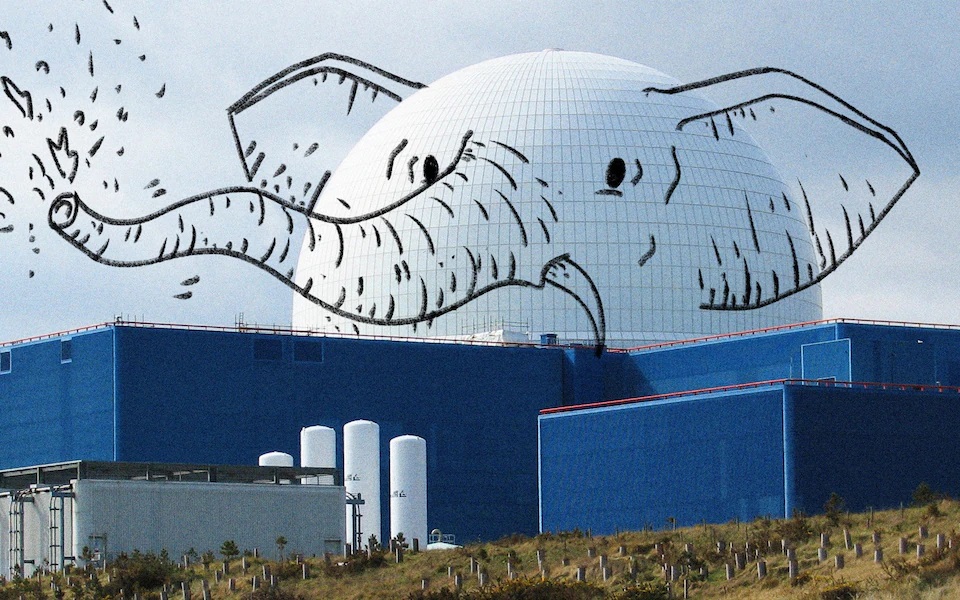
The British approach to nuclear power has been a disaster of nuclear proportion
The Critic Artillery Row By Matthew Kirtley, 19 June, 2025
s part of last week’s spending review, the government announced a further investment of £14.2bn for the Sizewell C nuclear power station. This puts the state’s total commitment into the project at £17.8bn.
Despite the scale of these numbers, the government’s pledges for Sizewell C seem to only cover a minority of the plant’s construction costs. That’s because, per leaks to the FT, Sizewell C’s construction budget is likely to balloon to over £40bn.
Government spokespeople have defended these costs by pointing out that Sizewell C is set to be significantly cheaper than the Hinkley Point C plant — conservatively, using CPI inflation, the latter’s construction costs are set to run up to £46.8bn in 2025 prices. The lessons from Hinkley Point C, which is a virtually identical facility that also uses the European Pressurised Reactor (EPR) architecture, are apparently being realised into cost savings.
However, this does conceal the big point: the EPR plants are both grossly expensive, relative to Britain’s historic plants. Sizewell B, the last new nuclear plant built in Britain, came online in 1995 and cost £2,030mn in 1987 prices — £5.85bn in 2025, using CPI inflation.
Even accounting for the fact that Sizewell B’s nameplate capacity is 1,250MW compared to the 3,260 MW of the two EPRs, the capital costs per MW are far more expensive. The construction costs of the cheaper EPR, Sizewell C, are set to stand at £12.3mn per MW. By comparison, Sizewell B’s construction costs amount to £4.7mn per MW. So even adjusting for inflation and plant size — which should nominally reduce the cost per MW via economies of scale — the EPR reactors are nearly three times more expensive than their predecessors.
So why has nuclear become so much more expensive?
One elephant in the room is the EPR architecture. The system was designed with the ethos of risk minimisation at all costs, employing countless redundancies. Whereas many contemporary pressurised water reactors minimise risk through passive safety systems, EPRs build in countless new pumps and active countermeasures to avert a disaster. The result is an orders of magnitude increase in plant complexity, and thus cost.
However, while there’s much to be said about the faults of EPR, it probably takes a backseat to a more pressing structural problem: the way that Britain funds nuclear projects……………………………………………………….
These heightened costs are felt by consumers — Hinkley Point C’s energy via exceptionally high energy prices through a pre-agreed Contract for Difference (CfD) price, and Sizewell C’s via increased energy bills during construction via a Regulated Asset Base (RAB) price hike. While in the long-run RAB is a better model than CfD for cost-minimisation, both still push up energy prices by forcing consumers to cover the far more expensive private debts of investors………….. https://thecritic.co.uk/sizing-up-sizewell-c/
Cross your fingers, Australia, and hope the AUKUS deal collapses

he Americans agreed to the deal because they saw it to be in their strategic interest, not ours. As then-U.S. Deputy Secretary of State Kurt Campbell observed (indiscreetly) last year, “we have them locked in now for the next 40 years.”
All that AUKUS and its associated alliance commitments have done for Australia is paint more targets on our back.
The crazy irony is that we are spending huge sums to build a new capability intended to defend us from military threats that are most likely to arise simply because we have that capability
The U.S. sub purchase was a bad deal then and it makes even less sense now.
By Gareth Evans, Project Syndicate, https://www.japantimes.co.jp/commentary/2025/06/18/world/australia-should-hope-for-aukuss-collapse/
MELBOURNE –
The AUKUS partnership, the 2021 deal whereby the United States and the United Kingdom agreed to provide Australia with at least eight nuclear-propelled submarines over the next three decades, has come under review by the U.S. Defense Department.
The prospect of its collapse has generated predictable handwringing among those who welcomed the deepening alliance, and especially among those interested in seeing Australia inject billions of dollars into underfunded, underperforming American and British naval shipyards. But in Australia, an AUKUS breakdown should be a cause for celebration.
After all, there has never been any certainty that the promised subs would arrive on time. The U.S. is supposed to supply three or possibly five Virginia-class submarines from 2032, with another five newly designed SSN-AUKUS-class subs (built mainly in the U.K.) coming into service from the early 2040s. But the U.S. and the U.K.’s industrial capacity is already strained, owing to their own national submarine-building targets and both have explicit opt-out rights.
Some analysts assume that the Defense Department review is just another Trumpian extortion exercise, designed to extract an even bigger financial commitment from Australia. But while comforting to some Australians (though not anyone in the Treasury), this interpretation is misconceived.
There are very real concerns in Washington that even with more Australian dollars devoted to expanding shipyard capacity, the U.S. will not be able to increase production to the extent required to make available three — let alone five — Virginia-class subs by the early 2030s. Moreover, Elbridge Colby, the U.S. under-secretary of defense for policy who is leading the review, has long been a skeptic of the project and he will not hesitate to put America’s own new-boat target first.
Even in the unlikely event that everything falls smoothly into place — from the transfers of Virginia-class subs to the construction of new British boats, with no human-resource bottlenecks or cost overruns — Australia will be waiting decades for the last boat to arrive. But given that our existing geriatric Collins-class fleet is already on life support, this timeline poses a serious challenge. How will we address our capability gap in the meantime?
Cost-benefit analysis should have killed the project from the outset. But in their eagerness to embrace the deal, political leaders on both sides of parliament failed to review properly what was being proposed. Even acknowledging the greatly superior speed and endurance of nuclear-powered subs and accepting the heroic assumption that their underwater undetectability will remain immune from technological challenge throughout their lifetimes, the final fleet size seems hardly fit for the purpose of national defense.
Given the usual operating constraints, Australia would have only two such subs deployed at any one time. Just how much intelligence gathering, archipelagic chokepoint protection, sea-lane safeguarding or even deterrence at a distance will be possible under such conditions? Moreover, the program’s eye-watering cost will make it difficult to acquire the other capabilities that are already reshaping the nature of modern warfare: state-of-the-art drones, missiles, aircraft and cyber defense.
The remaining reason for believing, as former Australian Prime Minister Paul Keating put it, that an American opt-out “will be the moment Washington saves Australia from itself,” concerns AUKUS’s negative implications for Australia’s sovereignty. The Americans agreed to the deal because they saw it to be in their strategic interest, not ours. As then-U.S. Deputy Secretary of State Kurt Campbell observed (indiscreetly) last year, “we have them locked in now for the next 40 years.”
It defies credibility to believe that the U.S. would transfer such a sensitive technology to us — with all the associated emphasis on the “interchangeability” of our fleets and new basing arrangements in Australia — unless it could avail itself of these subs in a future war. I have had personal ministerial experience of being a junior U.S. ally in a hot conflict situation — the first Gulf War in 1991 — and my recollections are not pretty.
Alongside the Pine Gap satellite communications and signals intelligence facility — which has always been a bull’s-eye — one can add Perth’s Stirling submarine base, the Northern Territory, with its U.S. Marine and B-52 bases and possibly a future east-coast submarine base.
The crazy irony is that we are spending huge sums to build a new capability intended to defend us from military threats that are most likely to arise simply because we have that capability — and using it to support the U.S., without any guarantee of support in return should we ever need it.
If the AUKUS project does collapse, it would arguably still be possible for Australia to acquire replacements for its aging submarine fleet within a reasonable time frame — and probably at less cost, while retaining real sovereign control — by purchasing off-the-shelf technology elsewhere. One can even imagine us going back to France, which was snubbed in the AUKUS deal, and making a bid for its new-generation Suffren-class nuclear-powered sub.
But a better defense option may simply be to recognize that the latest revolution in military technology is real and that our huge continent and maritime surroundings will be better protected by a combination of self-managed air, missile, underwater and cyber capabilities than by a handful of crewed submarines. There is no better time to start thinking outside the U.S. alliance box.
Gareth Evans was Australia’s foreign minister (1988-1996), president of the International Crisis Group (2000-2009) and chancellor of the Australian National University (2010-2019). © Project Syndicate, 2025
Israeli and U.S. intelligence differ on status of Iran’s nuclear program.
Israeli Prime Minister Benjamin Netanyahu has argued for decades that Iran
was on the verge of producing a nuclear weapon. And he ordered the attack
on Iran because he believed Tehran was “marching very quickly” toward a
bomb. “The intel we got and we shared with the United States was absolutely
clear, was absolutely clear that they [the Iranians] were working, in a
secret plan, to weaponize the uranium,” Netanyahu said in an interview with
Fox News.
However, the U.S. intelligence community has long had a somewhat
different interpretation. The Americans say Iran suspended its nuclear
weapons program in 2003, shortly after the U.S. invaded Iraq. While Iraq
did not have the weapons of mass destruction the U.S. claimed, the invasion
of a neighboring country appeared to rattle Iran, believing it too could
face a U.S. incursion.
NPR 18th June 2025 https://www.npr.org/2025/06/18/nx-s1-5436758/israel-and-u-s-intelligence-differ-on-status-of-irans-nuclear-program-whos-right
Israel’s Bombing Won’t Stop Iran from Going Nuclear
NPEC – Non Proliferation Policy Education Center, June 17, 2025
Spotlighting Greg Jones‘ latest research on the difficulty of targeting Iran’s nuclear program. Mr. Jones is one of the nation’s top nuclear analysts and has had close ties to NPEC for more than three decades.
Most of the analyses of Israel’s air campaign against Iran’s nuclear program have focused on two questions: Can Israel destroy Iran’s enrichment plants on its own? Or does Israel need Washington’s help to knock them out?
The question too infrequently asked, however, is can any bombing campaign, with or without U.S. assistance, keep Iran from getting a bomb? Greg’s short answer is no.
As he points out, bombing Iran’s enrichment plants may temporarily put them out of commission, but the centrifuges and cascades can be repaired. Tehran, he argues, can remove undamaged centrifuges, build new cascades, and be back in business in four to six months.
Fordow, for now, remains untouched. Conservatively, Fordow could produce a bomb’s worth of nuclear fuel every 2.5 weeks. Again, the centrifuges there can be removed to other locations.
Then, there’s the matter of the 440 kgs. of 60 percent enriched uranium that Iran already has – conservatively, enough to build 12 bombs. This material, Greg points out, is stored in hardy metal cylinders that are extremely difficult to destroy via bombing attacks and can be moved by truck to remote locations. Meanwhile, the International Atomic Energy Agency has determined that Iran has all but developed the nonnuclear components necessary to build a nuclear weapon.
This is why Greg concludes that any quick military fix to prevent Iran from going nuclear is impractical and that the threat of an Iranian nuclear weapon will remain until and unless Iran agrees to relinquish its entire stockpile of enriched uranium and eliminates its centrifuge enrichment program.
You can read Greg’s full, footnoted analysis here.
…………………………………………………………………………………………………… https://npolicy.org/israels-bombing-wont-stop-iran-from-going-nuclear/
Apollo to finance UK Hinkley Point nuclear plant with £4.5bn loan.
Funding for electricity group EDF, the UK’s largest ever private credit
deal, eases pressure on the troubled project. US private capital group
Apollo will provide £4.5bn in debt financing to support the UK’s Hinkley
Point C nuclear power station, easing mounting financial pressure on the
delayed and over-budget project. The investment-grade package will be
provided as unsecured debt at an interest rate just below 7 per cent,
according to people familiar with the matter. EDF, which is building two
new nuclear reactors at the site in Somerset, said it will be able to
borrow £1.5bn each year over three years as part of the package. The debt
has a maximum maturity of 12 years. The debt package addresses a
significant gap in the finances of the project, which has struggled with a
shortfall since China General Nuclear Power Group (CGN), which was supposed
to provide a third of the cost of the project, stopped providing further
financing in 2023.
FT 20th June 2025, https://www.ft.com/content/d4e6b540-ae57-434f-9eea-9d96431980e9
Report: Trump Privately Approved Plans To Attack Iran But Has Withheld Final Order

Iran has made clear it will hit US bases in the region if the US attacks
by Dave DeCamp | Jun 18, 2025, https://news.antiwar.com/2025/06/18/report-trump-privately-approved-plans-to-attack-iran-but-has-withheld-final-order/
The Wall Street Journal reported on Wednesday that President Trump has told his top officials that he approved plans to attack Iran but is holding off on giving the final order for now.
Sources told the Journal that Trump was waiting to see if Iran would agree to give up its nuclear program, which is almost certainly not going to happen. Iranian Supreme Leader Ayatollah Ali Khamenei has rejected the US president’s calls for surrender, and Tehran’s position is that it won’t negotiate while under Israeli attack.
Iran also has no reason to trust the US at the moment since Trump backed Israel’s attack amid negotiations between Washington and Tehran. Trump has refused to say if he will launch airstrikes on Iran, telling reporters on Wednesday, “I have ideas on what to do, but I haven’t made a final—I like to make the final decision one second before it’s due.”
The Journal report didn’t specify what attack plans Trump approved, but it would likely involve US airstrikes on the Fordow nuclear plant, which is buried deep underground, making it impossible to do significant damage without US bunker buster bombs and the US heavy bombers needed to drop them.
Iran has made clear it would hit back if the US launches airstrikes, and many US bases in the region are in range of Iranian missiles. Trump could be planning to launch limited airstrikes to damage Fordow, but American casualties could lead the US into deeper involvement in the war.
Israeli officials are expecting the US to intervene with direct attacks on Iran soon. “The whole operation is premised on the fact that the US will join at some point,” an Israeli official told CNN on Tuesday.
Israeli Prime Minister Benjamin Netanyahu launched the war based on the pretext of preventing Iran from obtaining nuclear weapons, but US intelligence had assessed that Tehran wasn’t seeking a nuclear bomb.
1 This Month
Chernobyl: The Lost Tapes – A good documentary on Chernobyl on SBS available On Demand for the next 3 weeks– https://www.sbs.com.au/ondemand/tv-program/chernobyl-the-lost-tapes/2352741955560

of the week–London Campaign for Nuclear Disarmament

Tell the Ukrainian Government to Drop Prosecution of Peace Activist Yurii Sheliazhenko
To see nuclear-related stories in greater depth and intensity – go to https://nuclearinformation.wordpress.com
-
Archives
- April 2026 (139)
- March 2026 (251)
- February 2026 (268)
- January 2026 (308)
- December 2025 (358)
- November 2025 (359)
- October 2025 (376)
- September 2025 (257)
- August 2025 (319)
- July 2025 (230)
- June 2025 (348)
- May 2025 (261)
-
Categories
- 1
- 1 NUCLEAR ISSUES
- business and costs
- climate change
- culture and arts
- ENERGY
- environment
- health
- history
- indigenous issues
- Legal
- marketing of nuclear
- media
- opposition to nuclear
- PERSONAL STORIES
- politics
- politics international
- Religion and ethics
- safety
- secrets,lies and civil liberties
- spinbuster
- technology
- Uranium
- wastes
- weapons and war
- Women
- 2 WORLD
- ACTION
- AFRICA
- Atrocities
- AUSTRALIA
- Christina's notes
- Christina's themes
- culture and arts
- Events
- Fuk 2022
- Fuk 2023
- Fukushima 2017
- Fukushima 2018
- fukushima 2019
- Fukushima 2020
- Fukushima 2021
- general
- global warming
- Humour (God we need it)
- Nuclear
- RARE EARTHS
- Reference
- resources – print
- Resources -audiovicual
- Weekly Newsletter
- World
- World Nuclear
- YouTube
-
RSS
Entries RSS
Comments RSS
 nuclear-news