The nuclear mirage: why small modular reactors won’t save nuclear power
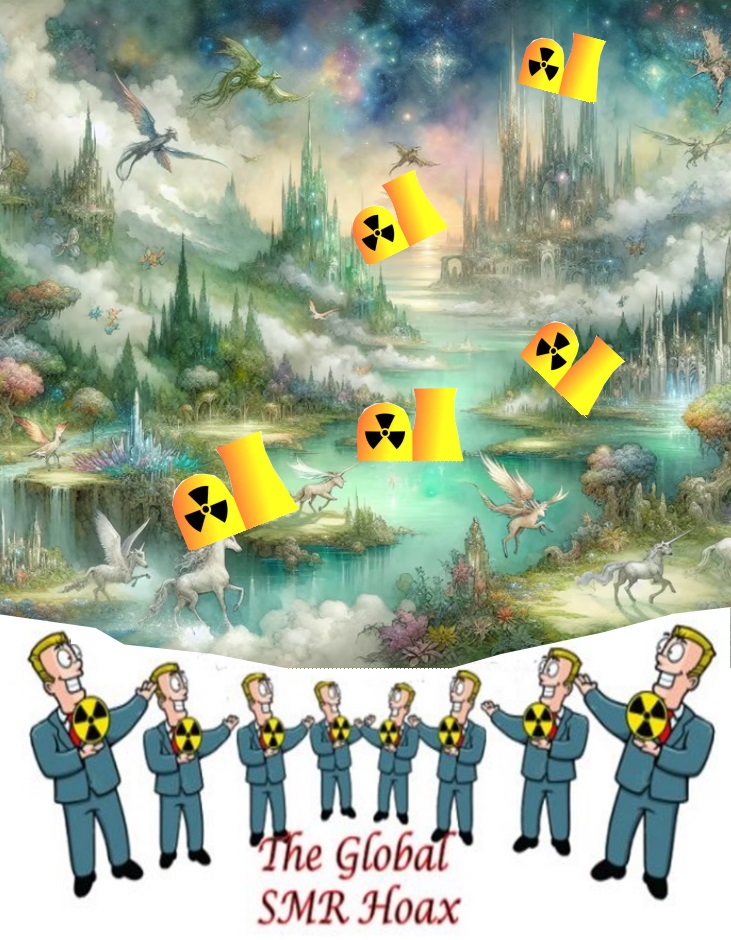
Small Modular Reactors (SMRs) are the nuclear industry’s latest shiny dream. It is more hope than strategy. SMRs only exist in the imagination of the nuclear industry and its supporters. SMRs can only be found on glossy PowerPoint slides. That is why Mycle Schneider dubbed SMRs “power point reactors.” There are no engineering plans, no blueprints, no working prototypes.
Climate and Capital Media, by Arnie Gundersen | Jun 20, 2025
Don’t believe the hype, says a 50-year industry veteran
“The definition of insanity is doing the same thing repeatedly and expecting different results.”
Everywhere you look, the nuclear industry’s hype machine is in overdrive. Columbia University’s Center on Global Energy Policy urges a “warp speed” nuclear revival. Goldman Sachs, Microsoft, and the UK government all tout small modular reactors (SMRs) as the silver bullet for climate change and energy security. Tech billionaires are hiring nuclear veterans. Wall Street is whispering about “round-the-clock power” for AI data centers. The UK is betting billions on “mini nukes” to fill its looming energy gap.
For those old enough to remember, this should sound familiar. For those who don’t, listen up. I spent over 50 years in the nuclear industry, advancing to Senior Vice President and managing projects at 70 nuclear power plants. I hold a nuclear safety patent and co-authored three peer-reviewed papers on the spread of radiation after meltdowns.
I once believed in the dream. I helped build the dream. And now, watching this third act unfold, I can only shake my head at the déjà vu. Because the nuclear industry’s latest pitch is not a revolution, but a rerun — an expensive distraction from real climate solutions.
The nuclear industry’s latest pitch is not a revolution, but a rerun — an expensive distraction from real climate solutions.
What is an SMR, anyway?
Small Modular Reactors (SMRs) are the nuclear industry’s latest shiny dream. It is more hope than strategy. SMRs only exist in the imagination of the nuclear industry and its supporters. SMRs can only be found on glossy PowerPoint slides. That is why Mycle Schneider dubbed SMRs “power point reactors.” There are no engineering plans, no blueprints, no working prototypes.
Still, hope springs eternal, and the idea is to build advanced atomic fission reactors, typically defined as producing up to 300 megawatts of electricity per unit, less than a third the size of a conventional nuclear plant.
The “small” part refers to their reduced output and physical footprint, while “modular” means they’re designed to be built in factories, shipped to sites, and installed as needed, supposedly making them cheaper and faster to deploy than traditional reactors. In theory, you could add modules over time to scale up output, like snapping together Lego blocks.
Too small to succeed
But let’s not be fooled by the word “small.” Even a single SMR is a massive, highly radioactive industrial machine, capable of powering a mid-sized city and containing a radioactive inventory far greater than the bombs dropped on Hiroshima and Nagasaki.
The “small” label is relative only to the behemoths of the last century. In practice, a “small” reactor brings all the big problems of a conventional reactor: dangerous radioactive fuel, complex safety systems, and the risk of catastrophic failure or sabotage. The only thing that’s truly small about SMRs is their inability to benefit from the economies of scale that, in theory, were supposed to make large reactors affordable — but never actually did.
All risk, no advantage
So, the SMR is a lose-lose: all the risks and headaches of traditional nuclear, but with none of the cost or scale advantages that never materialized in the first place.
But that is not stopping nuclear power zealots from championing what will be another failed chapter in the sad legacy of commercial atomic power. Sensing blood, the battered commercial nuclear industry is back with its most audacious pitch yet: SMR lobbying of governments worldwide for taxpayer money. Why? No private investor will touch nukes with a ten-foot uranium rod.
The irony is rich: while Goldman Sachs, Microsoft, and Amazon herald SMRs as the solution to everything from AI’s energy hunger to coal’s decline, the nuclear vendors themselves won’t promise atomic power will be cheaper than renewables. Perhaps they recall the Westinghouse executives who were imprisoned for defrauding the public on atomic project costs. They know what I know: it is pure fantasy to think smaller, less powerful SMRs will magically generate cheap power. Power generation doesn’t work that way.
A legacy of failure — and my place in it
I started my career in the early 1970s, a young engineer with a master’s degree and a reactor operator’s license, working on Millstone Unit 1 in Connecticut. We were going to make electricity “too cheap to meter.” Instead, we made it too expensive to afford — and too complex to run reliably…………………………………………………………………………………………………………………….
“The NRC is truly a captured agency… NEI complained that the agency’s proposed language for a new rule to weaken security for new nuclear reactors was too stringent. So, the NRC complied and completely eviscerated the draft. Pathetic,” said Dr. Edwin Lyman, Union of Concerned Scientists
Who’s who in SMRs
But none of this has stopped nuclear vendors from pushing their SMR hopefuls:
- Holtec: It has never built a reactor. Its design has changed three times in three years, each version more complex. Larger and expensive than the last. At one point, Holtec claimed its reactor would be as safe as a chocolate factory. Willy Wonka would disagree.
Natrium: Backed by Bill Gates, it uses liquid sodium coolant and a thermal storage gimmick. The design is so complicated that the only thing it’s likely to generate is more press releases — and perhaps a few more government grants. And here’s the kicker: the only fuel available for Natrium’s first core load was to come from Russia. When Russia invaded Ukraine, the project was immediately delayed by at least two years, exposing the folly of building a new generation of reactors dependent on a single, geopolitically fraught source of fuel.- NuScale: The first to get NRC approval for an SMR design, but has no customers and just canceled its flagship project due to cost overruns. Its original 50 MW design was quickly upsized to 77 MW after the economics failed to pencil out. After revisiting the drawing board, the new version was just approved in May, but there are no unsubsidized potential buyers.
- Westinghouse: The old hand. Its AP1000 reactors in Georgia nearly bankrupted the company. Now it’s back with an even smaller AP300. Because if at first you don’t succeed, shrink the reactor and try again.
Goldman Sachs, Microsoft, and the UK: The new true believers
But never let facts get in the way of a good story. It’s almost touching to see the world’s financial and tech giants lining up behind SMRs, as long as they are subsidized by someone else……………………………………………….
Why nuclear can’t compete with renewables
The dream of the first nuclear plants was that mining uranium was a lot cheaper than mining coal. But while nuclear costs continue to rise, wind, solar, and battery storage are becoming increasingly cheaper and more reliable every year. And the sun and wind give energy for free. Renewables are now the lowest-cost source of new electricity in most markets. Nuclear, by contrast, has never achieved cost reductions through learning or mass production. Every new design is a new experiment, with new risks and new costs……………………………………………….
SMRs will never be built
Here’s the final irony: despite all the headlines and billions in taxpayer subsidies, an SMR will never be built — not in time to matter, and not at a price that makes sense. But that won’t stop the industry from burning through billions more in public money, chasing a fantasy that distracts and diverts resources from real, proven solutions. As Yogi Berra said, “It’s déjà vu all over again.” And as someone who’s lived through every act of this atomic opera, I can only add: Fool me once, shame on you. Fool me twice, shame on me. Fool me a third time? Well, that’s just nuclear insanity.
Arnie Gundersen is a former nuclear industry executive and Chief Engineer at Fairewinds Energy Education. He has testified as an expert on nuclear safety and reliability worldwide.
Officials Concede They Don’t Know the Fate of Iran’s Uranium Stockpile.
Both Vice President JD Vance and Rafael Grossi, the head of the
International Atomic Energy Agency, acknowledged questions about the
whereabouts of Iran’s stockpile of near-bomb-grade nuclear material.
New York Times 22nd June 2025, https://www.nytimes.com/2025/06/22/us/politics/iran-uranium-stockpile-whereabouts.html
Trump speculates about ‘regime change’ in Iran as Tehran vows ‘decisive response’ to US attack
23 June 25, https://www.bbc.co.uk/news/live/cn7ze4vmk2pt
- Donald Trump has floated the possibility of leadership change in Iran, hours after his team said replacing the Iranian government was not the aim of US attacks
- Iran’s military vows a “decisive response” after Trump says US strikes caused “monumental damage” to Iranian nuclear sites – the UN’s nuclear watchdog calls for a ceasefire in order to inspect the damage
Israel’s military is striking Tehran with “unprecedented force”, the country’s defence minister says, after “one of the most intense attacks” on Iran’s military infrastructure overnight- Iran’s foreign minister is in Moscow for talks with Putin about “common challenges and threats” – the UK’s foreign secretary is among those urging Iran not to escalate its response
- Elsewhere the US asks China to put pressure on Iran not to close the Strait of Hormuz, a critical shipping route
Trump Bombs Iran, Then Demands Iran Agree to End the War.
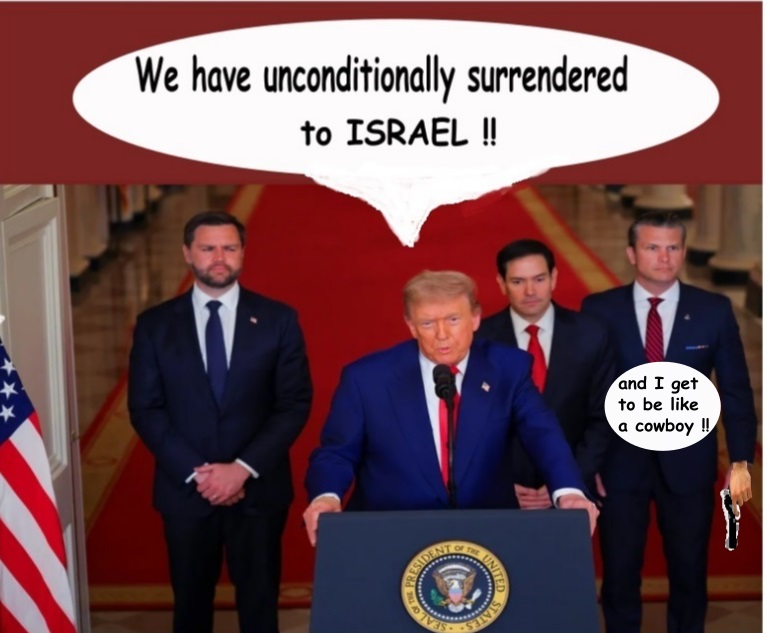
After the unprovoked attack, Trump demanded that Iran effectively surrender while continuing to threaten the country.
By Sharon Zhang , Truthout, June 21, 2025, https://truthout.org/articles/trump-bombs-iran-then-demands-iran-agree-to-end-the-war/?utm_source=Truthout&utm_campaign=4917bf90b8-EMAIL_CAMPAIGN_2025_06_22_07_19_COPY_01&utm_medium=email&utm_term=0_bbb541a1db-cb3a7b1ac8-650192793
resident Donald Trump announced on Saturday that the U.S. military struck three sites in Iran, in an unprovoked act of aggression. The strikes come after Israel launched its own unprovoked attack on Iran on June 13, leading to an all-out war between the two countries. The U.S. strikes mark a major escalation and threaten to bring further instability to the region.
In a post on Truth Social, Trump said that the U.S. has bombed three nuclear facilities in Iran, at Fordow, Natanz, and Esfahan.
The Iranian government’s Atomic Energy Organization confirmed the strikes, saying that they “were attacked in a violent act against international laws, including the Non-Proliferation Treaty, by the enemies of Islamic Iran.” Regional Iranian officials also confirmed the strikes, as Iranian news outlets have reported.
Iran has not directly targeted U.S. bases with an attack thus far in its war with Israel. Still, in his post announcing the strikes, Trump also demanded that Iran effectively surrender.
“NOW IS THE TIME FOR PEACE!” he wrote. In a follow-up post, he said, “IRAN MUST NOW AGREE TO END THIS WAR.”
The strikes mark the U.S.’s official direct entry into the war, though the U.S. has provided Israel with support in its bombings on Iran and has also helped provide defense for Israel. The attacks come after politicians and war mongers in the U.S. have called for war with Iran for decades.
In a brief address on Saturday night, Trump layered further threats against Iran, saying that the U.S. would continue its strikes if Iran doesn’t “make peace.” He called Iran the “bully of the Middle East” and said the strikes had gone “a long way to erasing this horrible threat to Israel” — the state that, in addition to currently conducting a genocide in Gaza, has been relentlessly attacking and invading countries and territories around it for decades.
“This cannot continue. There will be either peace, or there will be tragedy for Iran far greater than we have witnessed over the last eight days. Remember, there are many targets left,” Trump said.
Numerous lawmakers slammed the strikes, saying that they are unconstitutional as domestic law prohibits the president from launching an unprovoked strike without approval from Congress. Rep. Alexandria Ocasio-Cortez (D-New York) called for Trump to be impeached.
“The President’s disastrous decision to bomb Iran without authorization is a grave violation of the Constitution and Congressional War Powers. He has impulsively risked launching a war that may ensnare us for generations. It is absolutely and clearly grounds for impeachment,” said Ocasio-Cortez.
UN Secretary-General António Guterres condemned the strikes, and called for de-escalation and diplomacy.
“This is a dangerous escalation in a region already on the edge — and a direct threat to international peace and security. There is a growing risk that this conflict could rapidly get out of control — with catastrophic consequences for civilians, the region, and the world,” Guterres said.
Rogue States: The illegality of the U.S.-backed Israeli attacks on Iran

Israel has stockpiles of conventional, hi-tech, nuclear, chemical, and biological weapons, allows no international inspections of them, and refuses to ratify the Non-Proliferation Treaty (NPT).
they have extended the argument to absurd levels, basing their justification for war not on a claim that Iran has WMDs, but that they might someday acquire them.
international law does not allow for so-called “anticipatory self-defense” or so-called “pre-emptive strikes.”
The attack on Iran is just the latest crime in the Israeli regime’s path of destruction across the Middle East. Its Western-backed impunity has become a global threat.
Mondoweiss, By Craig Mokhiber June 18, 2025 Craig Mokhiber is an international human rights lawyer and former senior United Nations Official.
The Israeli regime, drunk with western-backed impunity, flush with western-supplied weapons, and driven by a violent, western-born racist ideology, is rampaging across the Middle East, leaving a trail of blood and destruction in its wake.
The Israeli regime’s blatant act of aggression against Iran is just the latest crime perpetrated by the regime in its current twenty-month orgy of violence in the region.
But Israel is not a lone rogue. And it could not get away with its crimes without a powerful backer.
The U.S. provided the Israeli regime with the greenlight for its surprise attack, the distraction of (perhaps disingenuous) diplomatic talks to facilitate the attack, U.S. tax dollars to finance the operation, the intelligence for targeting, the weapons and ammunition for killing, the diplomatic cover to protect it from Security Council action, U.S. forces for the interception of Iran’s defensive response, the promise of direct U.S. military backing if Israel requires it, and the propaganda cover of complicit U.S. media corporations. Now the U.S. appears poised to enter the military assault directly.
Once again, the U.S. is a co-perpetrator in Israel’s crimes.
The resulting Israeli impunity, the principal byproduct of U.S. collaboration with the Israeli regime, not only threatens Palestinian self-determination and the sovereignty of countries across the region, but global peace and security itself.
The global threat of Israeli impunity
In recent months, the Israeli regime has perpetrated genocide and apartheid in Palestine, a transnational terrorism attack with booby trapped pagers in Lebanon, thousands of armed attacks on Lebanon, Syria, Yemen, & Iran, the unlawful occupation of Palestinian, Lebanese, and Syrian territory, several extrajudicial executions on foreign territory, the assault on and commandeering of the humanitarian flotilla ship the Madleen, countless attacks on United Nations staff and facilities, and the use of its proxies in Western countries to harass human rights defenders and to corrupt governments.
Israel has stockpiles of conventional, hi-tech, nuclear, chemical, and biological weapons, allows no international inspections of them, and refuses to ratify the Non-Proliferation Treaty (NPT). And it is governed by a far-right, deeply racist, and fundamentally violent regime that is unconstrained by any norms of international law, international diplomacy, or common morality.
Add the ingredient of impunity, and you have a formula for global disaster. The western-guaranteed impunity that the Israeli regime has enjoyed is what has produced the regime’s serial criminality. And that criminality threatens the entire region and, potentially, the world.
Worse, to further insulate the Israeli regime, the U.S. and its allies have systematically corrupted, captured, or crushed virtually every government in the region, and battered the parts of Lebanon (Hezbollah) and of Yemen (Ansar Allah) still challenging the regime and its violent hegemonic project. Only Iran is left standing. As such, it represents an intolerable element to the Israeli regime and its U.S. sponsor: deterrence.
A war for U.S.-Israel regional hegemony
Thus, Iran is being targeted because it is the last independent state still standing in the region, following the corruption and capture of most Arab governments by the U.S., and the systematic destruction of those that refused to submit (e.g. Iraq, Libya, Syria).
The essence of this plan was revealed more than two decades ago by U.S. General and former NATO Commander Wesley Clarke, when he described U.S. plans to “attack seven Muslim countries in five years.” On the list were Iraq, Libya, Syria, Lebanon, Somalia, Sudan and, of course, Iran.
Even after decades of sanctions, sabotage, aggression, destabilization efforts, and the meddling of Western intelligence agencies, Iran has defiantly refused to submit to the U.S.. Despite sustained pressure, it has refused to abandon the Palestinian people, to normalize Israeli settler-colonialism and apartheid, or to look the other way as Israel perpetrates a genocide.
Importantly, it has also refused to surrender control of its natural resources (including significant oil and gas reserves) to the U.S. empire. And, famously, it refuses to give up its right, as a sovereign state, to develop peaceful nuclear energy for the benefit of its developing economy.
Because decades of efforts by the U.S.-Israel axis to strangle and destabilize the country (while causing great civilian suffering in the country) have failed to force Iran to submit, the U.S. and Israel have now moved to large-scale military aggression, dusting off the old, fabricated “WMD” justifications that served them so well in justifying their aggression in neighboring Iraq more than twenty years ago.
But, in this case, they have extended the argument to absurd levels, basing their justification for war not on a claim that Iran has WMDs, but that they might someday acquire them. A charge made all the more ridiculous by the fact that the attackers themselves- both the U.S. and Israel- in fact possess such weapons, and that both are themselves guilty of serial acts of aggression, while Iran is not.
Jus ad bellum: The crime of aggression
The U.S.-backed Israeli regime’s unprovoked attack on Iran was a crime under international law. Indeed, it was a treacherous attack, launched in the middle of ongoing U.S. negotiations, and even targeting the Iranian official in charge of the negotiations. (And, by the way, right after Israel cut off the internet in Gaza, drawing a digital curtain around its accelerating genocide there).
Article 51 of the UN Charter recognizes the right of self-defense only in response to an “armed attack,” or when specifically authorized by the Security Council. Any other armed attack constitutes the crime of aggression in international law.
That means that the Israeli regime is using force against Iran unlawfully, in violation of Article 2(4) of the UN Charter, prohibiting the threat or use of force, and, as such, is committing the crime of aggression. In this case, as a matter of law, the right to self-defense belongs to Iran, and decidedly not to Israel (or the U.S.).
Furthermore, contrary to the claims of the Israeli regime’s proxies in the West, international law does not allow for so-called “anticipatory self-defense” or so-called “pre-emptive strikes.”
Some, like the Bush administration in the lead up to the Iraq aggression, have tried to argue that anticipatory self-defense is permissible. But that argument was widely rejected, since the intent of the Charter was to prohibit claims of self-defense unless and until an armed attack has occurred, or military force is authorized by the Security Council.
…………………………………….Of course, Israel, the quintessential rogue regime, wrapped in the armor of U.S.-guaranteed impunity, cares little about legality. But its representatives and proxies will often try to adopt a veneer of legality as part of the regime’s propaganda efforts in Western media.
As such, Israel proxies have tried to distort the idea of anticipatory self-defense even further by claiming the right to attack anybody who might someday in the future decide to attack Israel. They seek to claim that Iran may one day develop nuclear weapons, that it may use them on Israel if it develops them, and that therefore Israel has no choice but to attack Iran now.
Clearly, as a matter of international law, that is entirely impermissible. If that were the rule, any state could lawfully attack any other state at any time, just by claiming a potential future threat. And that would effectively annul the UN Charter.
But, for Israel, this makes perfect sense. Israel is, in essence, an annihilatory state. It was created in violence, has expanded through violence, and is sustained by way of constant violence. Its official ideology is premised on a militarized conception of security that essentially says that anyone who does not submit to us must be destroyed, lest they someday try to fight back.
Thus, the entire history of the Israeli regime has been defined by militarization, conquest, colonization, expansion, and aggression. In practical terms, this has meant genocide against the indigenous people of Palestine and constant attacks against the regime’s neighbors.
But even under the broadest possible arguments of anticipatory self-defense (which, again, is rejected by almost the entire discipline of international law), Israel’s use of force against Iran would still be illegal.
This is not a hard case. (1) Iran does not have nuclear weapons, (2) there is no evidence that it is developing nuclear weapons, (3) there is no evidence that it would use those weapons against the Israeli regime even if it obtained them, (4) there was no imminent threat, and (5) the Israeli regime has not exhausted peaceful means, as required by international law.
…………………………………Jus in Bello: Attacking civilians and civilian infrastructure
Beyond the crime of aggression, the Israeli regime’s attacks on Iran have included a number of other grave breaches of international humanitarian law. As of the drafting of this article, the Israeli regime has already killed hundreds of Iranians, overwhelmingly civilians. It has targeted apartment buildings, media buildings, and at least one hospital. And it has murdered several Iranian scientists. Needless to say, such acts violate the principle of distinction and the prohibition of targeting protected persons and protected civilian infrastructure.
The killing of scientists is a case in point. Only if a scientist is a member of the military (that is, not a civilian working for the military), then, in some circumstances, s/he may be a legitimate target. But most scientists, including the Iranian scientists, are civilians, even if they were working on weapons. (And the Iranian scientists are not even working on weapons, just nuclear energy.) As such, targeting them is entirely unlawful. And, needless to say, it is impermissible, as a matter of law, to target people in their homes just because they are scientists who might someday work on weapons. This, in simple terms, is the crime of murder.
Attacks on nuclear facilities
Particularly egregious, as a matter of both law and humanity, is the Israeli regime’s attacks on Iran’s nuclear facilities. In international humanitarian law, attacks on dangerous facilities, such as nuclear power plants and other facilities containing what the law calls “dangerous forces”, are generally prohibited. Indeed, the International Atomic Energy Agency has affirmed that such attacks are prohibited in international law and are a violation of the UN Charter.
These facilities are protected under international law due to the potential for severe harm to the civilian population if attacked. ………………………………………………………………………….
Reining in the rogues
The open lawlessness of the Israeli regime and its sponsors has wreaked havoc both on the countries and peoples of the Middle East, and on the very legitimacy of international law itself. Calling out the crimes of these states and pursuing accountability for them are essential to the cause of justice.
While the West obsesses about the risks of peaceful nuclear programmes, the true threat to global security at this moment in history rests not in reactors and centrifuges, but rather in aggression, genocide, and impunity. Containing these threats is a global imperative. …………………………………………… https://mondoweiss.net/2025/06/rogue-states-the-illegality-of-the-u-s-backed-israeli-attacks-on-iran/
Juan Cole: The Current Iran War Will Likely End Soon, But the Arms Race Will Heat Up
Regime change in Iran as a result of the US and Israeli attacks is unlikely. Even Iranians in the opposition are likely to rally around the flag.
America’s credibility as a negotiator and mediator is completely ruined, since Trump hit Iran in the midst of negotiations
It is still not clear to me that the ayatollahs’ longstanding opposition to nuclear weapons will change.
June 23, 2025
Ann Arbor (Informed Comment) – The Al Jazeera bureau chief in Tehran, Abdul Qader Fayez, reports from “informed sources” in Tehran that Iran’s clerical Leader, Ali Khamenei, and his National Security Council have still not decided how to respond to the US attack on Iranian civilian nuclear facilities, though they want the response to be appropriate to the damage done them.
Al Jazeera notes, “Fayez pointed out that this Iranian hesitation suggests a tendency to respond in a carefully considered strategic manner not based on momentary revenge, but rather on a more comprehensive approach that allows Tehran multiple options rather than drawing it into a specific tactical confrontation or a direct, ill-considered reaction.”
Fayez says that the Iranian elite is attempting to distinguish between Washington’s attack and the ongoing Israeli escalation, especially since the US bombardment was unprecedented.
I would add (this is Juan Cole speaking) that Iran is weak. It has lost control of its own skies and so is as helpless as Lebanon and Syria before the Israeli Air Force (and the American). Iran still has some drones and hypersonic missiles that can penetrate Israeli defenses, but although it is able to do some damage to Tel Aviv and Haifa, it isn’t anything the Israelis can’t survive.
The weapons of the weak are guerrilla warfare, covert operations and terrorism. The US and Israel do not have troops on Iranian soil, so a guerrilla war against them is difficult to mount. Moreover, Iran has a return address and so cannot pursue classic guerrilla warfare.
Iran can hit bases in the Middle East that host US troops, as it did in January 2020 after Trump assassinated Iranian General Qasem Soleimani. In that instance, Iranian commanders were careful not to kill the troops, though the latter did get severe concussions from the missile impacts. Such a response would be purely symbolic and for the sake of Iranian domestic politics, with no military significance. US troops in Iraq and Syria are particularly vulnerable to this sort of reprisal.
If Trump is speaking truly and the strikes really were a one-off, then the direct US-Iran engagement could subside quickly. Iran has no reason to want continued direct involvement with the US while it is facing an concerted Israeli campaign. It should be noted that in his first term Trump bombed Syria, then largely ignored the country except for the Obama-initiated defeat of ISIL in Raqqa. He bombed Afghanistan and then more or less surrendered to the Taliban. He bombed an Iranian general at Baghdad International Airport and watched Iran reply, but then went back to using economic sanctions. Trump has a history of splashy one-off bombings with no follow-through, and this episode could be just as transitory.
During the first Trump round of “maximum pressure” sanctions, Iran covertly set fires to petroleum tankers of the United Arab Emirates in the Gulf. But Iran now has good relations with the Arab Gulf states and is unlikely to take the American strikes out on them.
There may, however, be attacks on other oil pipelines or tankers of states with bad relations with Iran. Oil attacks would benefit Iran by raising the price of the petroleum it smuggles to China and by hurting the US and Israeli economies.
Terrorism is a possibility, but there is a danger it would be traced back to Iran, and it is bad for a country’s reputation, foreign relations, and economic affairs.
Regime change in Iran as a result of the US and Israeli attacks is unlikely. Even Iranians in the opposition are likely to rally around the flag. Some disgruntled ethnic minorities may attempt to take advantage of perceived state weakness, but they are small and cannot disrupt the Persian Iranian Plateau, the regime stronghold. If anything, the Israeli and US attacks may have extended the life of an oppressive government that is widely disliked inside the country but which can now claim to stand against powerful external foes dedicated to attacking and destroying the Iranian nation.
……………………………………………………………………………….. The hot war will end, but the Middle East arms race is with us for the foreseeable future, and the opportunities for Russia and China, should they want them, to play a bigger role in the region have expanded.
America’s credibility as a negotiator and mediator is completely ruined, since Trump hit Iran in the midst of negotiations, which a reader reminded me is a violation of the Hague Regulations of 1907 and was held against Japan in the attack on Pearl Harbor.
It is still not clear to me that the ayatollahs’ longstanding opposition to nuclear weapons will change. Many countries throughout the world, however, may now be tempted to go for a nuclear weapon, since the difference between North Korea on the one hand and Iraq and Iran on the other is glaringly clear.
Australia backs US strikes on Iran while urging return to diplomacy
Australia’s explicit expression of support for the strikes goes a step further than allies including the UK, Canada and New Zealand
By political reporter Tom Crowley ABC News 23 June 25
In short:
Australia has given its support to US strikes on Iranian nuclear facilities but has repeated calls for de-escalation to avoid a wider war.
Penny Wong said Australia had not received a request for assistance and declined to speculate on how any request would be met.
What’s next?
A National Security Meeting was held in Canberra on Monday morning.
Australia has given its support to US strikes on Iranian nuclear facilities but has repeated calls for de-escalation to avoid a wider war.
Prime Minister Anthony Albanese said on Monday Australia was in favour of action to prevent Iran getting a nuclear weapon, echoing comments made earlier on Monday by Foreign Minister Penny Wong.
“The world has long agreed Iran cannot be allowed to get a nuclear weapon, and we support action to prevent that. That is what this is,” the PM told reporters.
The government initially adopted a more cautious tone, declining to give its explicit support.
Senator Wong said Australia had not received a request for assistance and emphasised the US action was “unilateral” when asked whether Pine Gap, a shared military facility, had been engaged.
While the PM and foreign minister declined to speculate on the response to any such request, Mr Albanese said Australia was “deeply concerned” about the prospect of escalation, placing the onus on Iran.
“We want to see diplomacy, dialogue and de-escalation … Iran had an opportunity to comply, they chose not to and there have been consequences of that,” he said.
Earlier, Senator Wong cited a UN watchdog finding that Iran had acquired enriched uranium at “almost military level”.
“The key question for the international community is what happens next … It’s obviously a very precarious, risky and dangerous moment the world faces,” she said.
The National Security Committee, comprised of key ministers, met in Canberra this morning.
Australia’s explicit expression of support for the strikes goes a step further than allies including the UK, Canada and New Zealand, although all three countries have emphasised the risk of Iran gaining nuclear weapons.
Opposition supports strike, Greens opposed
The Coalition supported the strikes on Sunday and also says it does not want further war, but has put the onus on Iran to negotiate peace.
“We want to see Iran come to the negotiating table to verify where that 400 kilos of enriched uranium is,” Andrew Hastie told ABC Radio National……………………………………..
Dave Sharma, a Liberal senator and former Australian ambassador to Israel, said the government’s response was “underwhelming and perplexing” on Sunday and that support for the strikes “should be a straightforward position for Australia to adopt”.
The Greens are against the strike, with defence spokesperson David Shoebridge calling Donald Trump a “warmonger” and demanding Australia clarify it will not get involved.
“You cannot bomb your way to peace … and the people who are always going to pay the price are the ordinary people on the street,” he said.
……………………………………………….. Five Eyes partners respond
UK Prime Minister Keir Starmer spoke to Mr Trump via phone, emphasising the “grave risk” of Iran’s nuclear program and placing the onus on Iran “returning to the negotiating table as soon as possible”, according to a readout of the call.
A joint statement from the UK, France, Germany and Italy urged Iran not to “take any further action that could destabilise the region” but did not include an explicit position on the strike.
The New Zealand government has “acknowledged” the strike, and called for diplomacy, Foreign Minister Winston Peters saying “ongoing military action in the Middle East is extremely worrying”.
Canadian PM Mark Carney said Iran should not be allowed to obtain a nuclear weapon and that the US strike “was designed to alleviate that threat”, but stopped short of explicitly endorsing it and called for “all parties” to return to the negotiating table. https://www.abc.net.au/news/2025-06-23/australia-backs-us-strikes/105448088
The real threat to Israel is Netanyahu
23 June 2025 AIMN Editorial, By Walt Zlotow, https://theaimn.net/the-real-threat-to-israel-is-netanyahu/
Steven Katz misunderstands the real existential fight occurring in Israel and its performance in its unprovoked attack on Iran.
In his Chicago Tribune op-ed, ‘Israel’s war against Iran is just’ Katz begins with; “Israel is waging an existential fight for its survival as a Jewish state. And it is winning and fighting well.”
While Israel is waging an existential fight for its survival as a Jewish state, it’s not from Iran. Iran never was, is not now and won’t in the future be an existential threat to Israel. It has neither the will nor the means to do that.
Israeli leadership under Prime Minister Benjamin Netanyahu and his even more extreme cabinet are doing that quite well without any help from Iran or any of its other neighbors. Netanyahu’s genocidal campaign of ethnically cleansing all 2,300,000 Palestinians in Gaza has made Israel a pariah state being shunned by much of the world.
Tourism is down 90%, inflicting a $3.4 billion drop in tourist revenue. Almost 470,000 Israelis have emigrated since the genocide began October 8, 2023, a day after the Hamas attack. Israel’s economy has been battered. Bank of Israel estimates war costs since October, 2023 will amount to $55.6 billion costing Israel 10% of its economy. Israeli GDP dropped to 2% since the Gaza genocide from 6.5% before. Consumer spending declined 27%, imports dropped 42% and exports fell 18%.
Instead of ending the bleeding in Gaza and the Israeli economy, Netanyahu launched another murderous misadventure sure to make all these demographic and economic declines worse. The existential threat to Israel lies not in Tehran but in the Israeli Prime Minister’s office
Regarding Katz’s take on Israel’s war performance, it’s neither winning nor fighting well. Israel cannot destroy Iran’s nuclear capability by itself nor topple the Iranian regime. Only massive US military involvement can possibly do that and with no certainty of success.
Israel knows this which is why it has goaded the US to attack Iran for decades, beginning with their cheering on America’s illegal, immoral, criminal war on Iraq 22 years ago. That war was designed then to end up toppling the Iranian regime in Tehran. Instead it backfired and didn’t.
Israel’s sneak attack enabled by duplicitous US diplomacy to lull Iran into complacency, has caused retaliatory strikes never before experienced in Israel’s 77 year existence. And they will get worse as Israel runs out of weapons to shoot down incoming missiles.
Steven Katz certainly knows all of this. But in the service of US and Israeli exceptionalism promoting world/regional dominance, he turns a blind eye. The Tribune’s readership deserves better.
Israel’s war with Iran costs $200M a day, raising pressure for swift end

Oh dear! – Killing people is so expensive!
Israel’s war with Iran is costing the country an estimated $200 million per day, according to early assessments reported by The Wall Street Journal—a staggering figure that is quickly becoming a major constraint on the duration of the conflict, Anadolu reports.
The most expensive burden is the interception of Iranian missiles, which alone can run into tens or even hundreds of millions daily, the WSJ reported on Thursday.
Systems like David’s Sling and Arrow 3—each interception costing between $700,000 and $4 million—have been activated repeatedly in response to over 400 missiles launched by Iran in recent days.
Offensive operations are also increasing costs. Deploying Israeli F-35s over 1,000 miles to hit targets in Iran costs approximately $10,000 per hour per jet, in addition to the price of precision bombs like JDAMs and MK84s.
Altogether, the Aaron Institute for Economic Policy estimates that a month-long war could cost Israel $12 billion.
“This war is far more expensive than Gaza or Hezbollah,” said economist Zvi Eckstein. “The ammunition—defensive and offensive—is the big expense.”
The economic pressure is leading to calls for a shorter war, though Prime Minister Benjamin Netanyahu has not indicated any intention to halt operations before achieving strategic objectives such as crippling Iran’s nuclear and missile programs.
While Israeli markets remain stable—some even rising—damage on the ground is mounting.
Engineers estimate that reconstruction costs from missile strikes will exceed $400 million, as hundreds of buildings have been damaged, and more than 5,000 civilians have been evacuated.
Israel’s largest oil refinery was temporarily shut down after being hit, and work in several critical infrastructure sectors has been suspended.
Former Bank of Israel Governor Karnit Flug told the WSJ that the duration of the conflict is key to economic sustainability: “If it is a week, it is one thing. If it is two weeks or a month, it is a very different story.”
Israel Buckles as Iran War Shifts to New Drag-Out Phase
Simplicius, Jun 21, 2025
Today a round of urgent talks concluded in Geneva between European-American representatives and Iran’s Foreign Minister Araghchi. The talks reportedly went nowhere as Iran rejected calls to end all enrichment, and instead rebutted that Iran will not negotiate with anyone until all attacks by Israel first cease.
Araghchi will next try Moscow, where he heads on Monday.
But this development is remarkable for a number of reasons:
First, the arrant hypocrisy demonstrated by the Western-bloc position that Iran must first negotiate and only then will hostilities be brought to an end. Wait a second, wasn’t it that in Ukraine the “appropriate” sequence of events, according to this ‘rules based odour’, is that first hostilities must immediately cease, and only then negotiations should begin?
As you can see, the West twists the chain of logic in whichever way serves its interests at the particular time. In Ukraine’s case, Ukraine is badly losing and so the West seeks to immediately save their ward by sermonizing Russia about how it’s only “right” that hostilities must end first. In Iran’s case, it’s the opposite: the West is quite keen to allow Israel its illegal and unprovoked campaign of violence against Iran.
No consistency, no principles, as always.
But the other remarkable thing is that Araghchi’s bold rejection seems to imply that Iran is not particularly desperate for an end to the hostilities, which can only indicate that its leadership views their chances in the escalating attritional war positively, contrary to Western propaganda that Iran is ‘on the ropes’. Of course, we can’t let that guide our analysis entirely—every country utilizes their own flavor of bluffs and deimatic behavior as defense mechanism.
We must admit that Israel has begun racking up some serious damage against Iran since the last report. The latest compilation released by the IDF shows quite a few new Iranian radar sites hit by what is likely to be Delilah missiles:
Furthermore, Oryx’s team has apparently now engaged themselves in this conflict, and claim nearly ~80 verified hits on Iranian ballistic missile launchers thus far.
It brings us to the brief discussion of numbers. Sources claim Iran has anywhere from 3,000 to 28,000 total ballistic missiles, and produces roughly ~300 new ones per month, which is a relatively plausible number given what we know of Russia’s own production figures. 28,000 is likely exaggerated, and the lower end of the scale is a more realistic bet; no country really has stockpiles that large.
For argument’s sake, let’s say Iran had closer to 3,000, though it could be a bit more than that. Some sources claim Iran has already launched 1,500 of them, and thus could have gone through a significant portion of its stockpiles. However, more precise graphs like the following [on original] seem to point to only about ~500 total having been launched thus far:
Recall that according to Western intel Iran produces up to ~300 per month. This could also point to why Iran has cut down to launching only a dozen or so per day, as 10 per day multiplied by 30 days is precisely 300—this would allow Iran to essentially break even and launch just enough to continue the pace indefinitely without further depleting stockpiles.
But on top of that, Israel’s ability to repel the strikes has been degraded as well, as per their own sources: -[on oroginal]………………………………………………………………………………………………………………….
Israeli ex-prime minister Ehud Barak seems in agreement that it is not possible to take out Iran’s nuclear program by force:
‘It’s impossible to dismantle a nuclear program’ warns former Israeli PM Ehud Barak
He says ‘the US has never won a war’ citing Korea, Vietnam, Iraq, and Afghanistan
Barak urges Washington to negotiate and reconcile with Tehran
……………………………………………………..It’s clear Trump’s foreign policy has been hijacked by the Mossad, and he’s now dangerously sidelining the only people capable of providing him the real unadulterated truth about the ongoing situation…………………………………………….https://simplicius76.substack.com/p/israel-buckles-as-iran-war-shifts?utm_source=post-email-title&publication_id=1351274&post_id=166407110&utm_campaign=email-post-title&isFreemail=true&r=rq5yc&triedRedirect=true&utm_medium=email
Trump Has Bombed Iran. What Happens Next Is His Fault.
Caitlin Johnstone, Jun 22, 2025,https://www.caitlinjohnst.one/p/trump-has-bombed-iran-what-happens?utm_source=post-email-title&publication_id=82124&post_id=166504460&utm_campaign=email-post-title&isFreemail=true&r=1ise1&triedRedirect=true&utm_medium=email
The US military has bombed multiple Iranian nuclear sites on the orders of President Trump, immediately putting tens of thousands of US military personnel in the region at risk of an Iranian retaliation which can then escalate to full-scale war.
Earlier this month Iran’s Defense Minister Aziz Nasirzadeh explicitly warned the United States that a direct US attack would result in Tehran ordering strikes on US bases in the middle east, saying “all US bases are within our reach and we will boldly target them in host countries.”
In the lead-up to Trump’s act of war on Iran, the president told the press that an attack on American troops will mean a harsh response from the US, saying, “We’ll come down so hard if they do anything to our people. We’ll come down so hard. The gloves are off. I think they know not to touch our troops.”
Trump reiterated this threat to Iran in his announcement of the US attack today.
“There will be either peace, or there will be tragedy for Iran, far greater than we have witnessed over the last eight days,” Trump said. “Remember, there are many targets left. Tonight’s was the most difficult of them all, by far, and perhaps the most lethal. But if peace does not come quickly, we will go after those other targets with precision, speed and skill. Most of them can be taken out in a matter of minutes.”
So you can see how we might already be on our way toward a war of nightmarish proportions as a result of the president’s unprovoked act of aggression. Tehran now has to choose between reestablishing deterrence with extreme aggression or opening the floodgates to a whole host of existential threats from both outside and inside the country. Add to that the possibility of Iran blockading the Strait of Hormuz and the fact that Iran has now been strongly incentivized to actually obtain a nuclear weapon, and it looks very likely that we are plunging into a situation that could unfold in any number of horrific ways.
Right now American political discourse is rife with the narrative that the US has been “dragged” into Israel’s war, which I reject entirely. Every step of the way this entire thing has been signed off on by US leadership. We are at this point because Trump and his regime knowingly chose to take us here.
US troops within reach of Iran’s missiles are reportedly being briefed that they can expect to be on the receiving end of retaliatory strikes in the coming days.
Again, Iran explicitly warned it would attack the US military if the US military did the thing it just did. If and when these retaliatory strikes come, the warmongers will try to argue that this is a valid reason to escalate this war. They will be lying. They chose to make this happen.
Whatever transpires from this point on is the fault of Donald Trump and the unelected thugs he listens to. If US troops are killed, the war sluts in Washington and the Pentagon propagandists in the press will list their names and bandy about their photos and demand that their deaths be avenged with further acts of war — but it will not be Iran’s fault that they died.
It will be Trump’s fault. It will be the fault of everyone whose decisions led up to bombs being dropped on Iranian energy infrastructure, and the fault of everyone who put those soldiers in harm’s way.
None of this needed to happen. Iran was at the negotiating table. The Iran deal was working fine before Trump shredded it to put us on this terrible trajectory. The warmongers artificially manufactured this situation and knowingly inflicted this horror upon our world.
I am really not looking forward to all the melodramatic victim-LARPing if and when Iran kills US military personnel stationed in west Asia. The US is the only nation on earth that can rival Israel in its ability to play the victim when the ball they’ve thrown at the wall bounces back.
Nuclear power plant warning as heatwave hits France.

Independent Forrest Crellin, Friday 20 June 2025
France’s electricity supply faces potential disruption as soaring river temperatures, driven by an impending heatwave, threaten to curtail nuclear power generation along the Rhone.
Nuclear operator EDF announced on Friday that high water temperatures are expected to impact electricity production from 25 June, particularly at the 3.6-gigawatt Bugey nuclear power plant in eastern France.
This marks the first such warning for high river temperatures in France for 2025.
The issue stems from environmental regulations governing the discharge of cooling water, which can be breached when river temperatures become excessively high due to heatwave conditions.
The alert comes as state forecaster Meteo France predicts a significant heatwave will sweep across the country this weekend.
Ted Cruz Suggests US Is Involved in Israeli Strikes on Iran, Despite US Denials
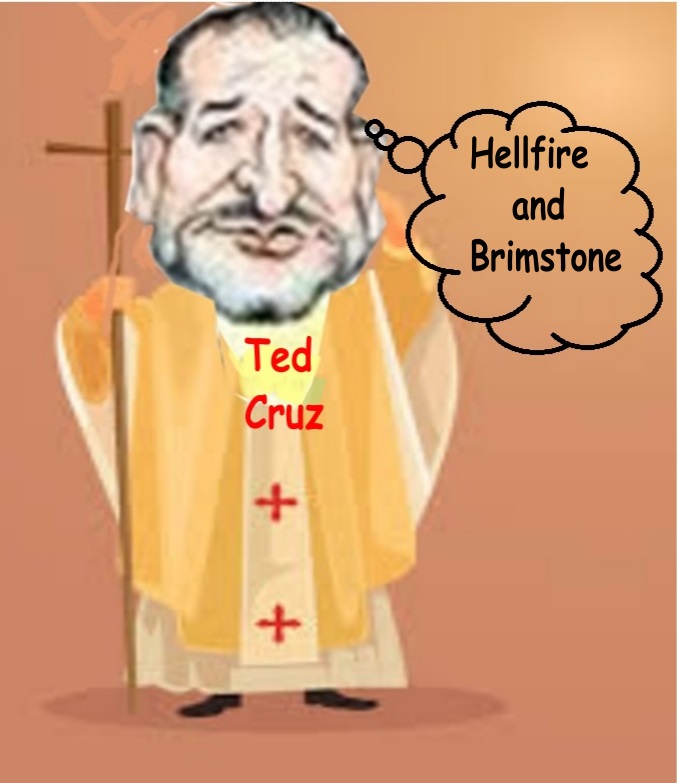
“We are carrying out military strikes today,” Senator Cruz said in an interview.
By Sharon Zhang , Truthout, June 18, 2025, https://truthout.org/articles/ted-cruz-suggests-us-is-involved-in-israeli-strikes-on-iran-despite-us-denials/
Sen. Ted Cruz (R-Texas) was caught stumbling to answer basic questions about Iran and the U.S.’s role in Israel’s war in an eye-opening interview airing Wednesday, despite his full-throated support for overthrowing the Iranian government and deeper U.S. involvement in the fighting.
In clips of the interview with far right provocateur Tucker Carlson posted on social media on Tuesday, the senator alarmingly suggests that the U.S. is, in fact, already heavily involved in Israel’s strikes on Iran.
“We are carrying out military strikes today,” Cruz said. “I said we — Israel is leading them, but we’re supporting them.”
This directly contradicts what federal officials have said about the U.S.’s involvement. The State Department has said that Israel’s strikes are “unilateral,” and directed all embassies and consular posts to reiterate that claim in a cable, CBS reported on Sunday. The cable instructed officials to emphasize to their respective host governments that the U.S. “is not involved in Israel’s unilateral action against targets in Iran and did not provide tanker support.”
This position has not changed in recent days, as the strikes have intensified and President Donald Trump openly mulls becoming more deeply involved in the war. Numerous Trump administration spokespeople claimed on Tuesday that any reports of the U.S. participating in Israeli strikes in Iran are “not true.”
“American forces are maintaining their defensive posture, and that has not changed. We will defend American interests,” said spokesperson Alex Pfeiffer on Tuesday.
The U.S. military is already involved in the conflict. Officials have been open about the U.S.’s defensive positions in helping to strike down missiles fired at Israel.
However, direct U.S. involvement in conducting strikes on Iran, as Cruz suggests is happening, would be a major escalation of the war. Cruz’s statements potentially suggest that the U.S. is actually directly aiding in the bombings, as the Senate is privy to classified information about the military not available to the public.
“You’re breaking news here,” said Carlson. “This is high stakes, you’re a senator. If you’re saying the United States government is at war with Iran right now, people are listening!”
It’s possible that Cruz is suggesting deeper U.S. involvement to push the Trump administration into striking Iran, as many conservative lawmakers have done in recent days — in hopes of pushing the dangerous pipe dream of regime change in Iran.
“I think it is very much in the interest of America to see regime change,” Cruz told Fox News on Sunday. “I don’t think there’s any redeeming the ayatollah.”
Despite his confidence that he could install a better government in Iran, earlier in the interview, Cruz is caught unable to even name basic facts about Iran’s population.
“I don’t know the population,” Cruz says.
“You don’t know the population of the country you seek to topple?” Carlson asks, incredulously. “How could you not know that?”
In a follow up, Carlson says, “okay, what’s the ethnic mix of Iran?”
Cruz hesitates, then says, “they are Persians, and predominantly Shia,” he says, tellingly naming a religious sect rather than an ethnicity. When Carlson asks what proportion of the population is Persian, Cruz becomes incensed.
“I’m not the Tucker Carlson expert on Iran,” Cruz says sarcastically, his voice raised.
“You’re a senator who’s calling for the overthrow of the government!” Carlson exclaims in response.
The exchange highlights a rift among the right over the U.S.’s role in the Middle East. Carlson’s interview circulated widely online for exposing Cruz’s blasé ignorance of the country he wants to wage war against.
However, Carlson, who has consistently allied with white supremacists, himself owes much of his career to the figures who peddled the lies that led to the Iraq War. Early on, Carlson was a proponent of the U.S.’s invasion, and only changed his mind later because of racist beliefs that Iraq and Afghanistan aren’t “worth invading” because “the people aren’t civilized.”
This is, as commentators have noted, a drastically different approach to anti-interventionism from the left’s anti-war and anti-imperialist foundations. And yet, Carlson’s interview caught attention online as the right has sought to capitalize on genuine anti-war sentiment among the public that’s been completely dismissed by the Democratic Party.
What are the nuclear contamination risks from Israel’s attacks on Iran?
By Andrew Macaskill, Federico Maccioni and Pesha Magid, June 21, 2025,
https://www.reuters.com/world/middle-east/what-are-nuclear-contamination-risks-israels-attacks-iran-2025-06-19/
LONDON/DUBAI, June 19 (Reuters) – Israel’s strikes on Iran’s nuclear installations so far pose only limited risks of contamination, experts say. But they warn that any attack on the country’s nuclear power station at Bushehr could cause a nuclear disaster.
Israel says it is determined to destroy Iran’s nuclear capabilities in its military campaign, but that it also wants to avoid any nuclear disaster in a region that is home to tens of millions of people and produces much of the world’s oil.
Fears of catastrophe rippled through the Gulf on Thursday when the Israeli military said it had struck a site in Bushehr on the Gulf coast – home to Iran’s only nuclear power station – only to say later that the announcement was a mistake.
WHAT HAS ISRAEL HIT SO FAR?
Israel has announced attacks on nuclear sites in Natanz, Isfahan, Arak and Tehran itself. Israel says it aims to stop Iran building an atom bomb. Iran denies ever seeking one.
The international nuclear watchdog IAEA has reported damage to the uranium enrichment plant at Natanz, to the nuclear complex at Isfahan, including the Uranium Conversion Facility, and to centrifuge production facilities in Karaj and Tehran.
Israel has also attacked Arak, also known as Khondab.
The IAEA said Israeli military strikes hit the Khondab Heavy Water Research Reactor, which was under construction and had not begun operating, and damaged the nearby plant that makes heavy water. The IAEA said that it was not operational and contained no nuclear material, so there were no radiological effects.
In an update of its assessment on Friday, the IAEA said key buildings at the site were damaged. Heavy-water reactors can be used to produce plutonium which, like enriched uranium, can be used to make an atom bomb.
WHAT RISKS DO THESE STRIKES POSE?
Peter Bryant, a professor at the University of Liverpool in England who specialises in radiation protection science and nuclear energy policy, said he is not too concerned about fallout risks from the strikes so far.
He noted that the Arak site was not operational while the Natanz facility was underground and no release of radiation was reported. “The issue is controlling what has happened inside that facility, but nuclear facilities are designed for that,” he said. “Uranium is only dangerous if it gets physically inhaled or ingested or gets into the body at low enrichments,” he said.
Darya Dolzikova, a senior research fellow at London think tank RUSI, said attacks on facilities at the front end of the nuclear fuel cycle – the stages where uranium is prepared for use in a reactor – pose primarily chemical, not radiological risks.
At enrichment facilities, UF6, or uranium hexafluoride, is the concern. “When UF6 interacts with water vapour in the air, it produces harmful chemicals,” she said.
The extent to which any material is dispersed would depend on factors including the weather, she added. “In low winds, much of the material can be expected to settle in the vicinity of the facility; in high winds, the material will travel farther, but is also likely to disperse more widely.”
The risk of dispersal is lower for underground facilities.
Simon Bennett, who leads the civil safety and security unit at the University of Leicester in the UK, said risks to the environment were minimal if Israel hits subterranean facilities because you are “burying nuclear material in possibly thousands of tonnes of concrete, earth and rock”.
WHAT ABOUT NUCLEAR REACTORS?
The major concern would be a strike on Iran’s nuclear reactor at Bushehr.
Richard Wakeford, Honorary Professor of Epidemiology at the University of Manchester, said that while contamination from attacks on enrichment facilities would be “mainly a chemical problem” for the surrounding areas, extensive damage to large power reactors “is a different story”.
Radioactive elements would be released either through a plume of volatile materials or into the sea, he added.
James Acton, co-director of the Nuclear Policy Program at the Carnegie Endowment for International Peace, said an attack on Bushehr “could cause an absolute radiological catastrophe”, but that attacks on enrichment facilities were “unlikely to cause significant off-site consequences”.
Before uranium goes into a nuclear reactor it is barely radioactive, he said. “The chemical form uranium hexafluoride is toxic … but it actually doesn’t tend to travel large distances and it’s barely radioactive. So far the radiological consequences of Israel’s attacks have been virtually nil,” he added, while stating his opposition to Israel’s campaign.
Bennett of the University of Leicester said it would be “foolhardy for the Israelis to attack” Bushehr because they could pierce the reactor, which would mean releasing radioactive material into the atmosphere.
WHY ARE GULF STATES ESPECIALLY WORRIED?
For Gulf states, the impact of any strike on Bushehr would be worsened by the potential contamination of Gulf waters, jeopardizing a critical source of desalinated potable water.
In the UAE, desalinated water accounts for more than 80% of drinking water, while Bahrain became fully reliant on desalinated water in 2016, with 100% of groundwater reserved for contingency plans, according to authorities.
Qatar is 100% dependent on desalinated water.
In Saudi Arabia, a much larger nation with a greater reserve of natural groundwater, about 50% of the water supply came from desalinated water as of 2023, according to the General Authority for Statistics.
While some Gulf states like Saudi Arabia, Oman and the United Arab Emirates have access to more than one sea to draw water from, countries like Qatar, Bahrain and Kuwait are crowded along the shoreline of the Gulf with no other coastline.
“If a natural disaster, oil spill, or even a targeted attack were to disrupt a desalination plant, hundreds of thousands could lose access to freshwater almost instantly,” said Nidal Hilal, Professor of Engineering and Director of New York University Abu Dhabi’s Water Research Center.
“Coastal desalination plants are especially vulnerable to regional hazards like oil spills and potential nuclear contamination,” he said.
Weaponized Stupidity – How Nonsense Became a Strategy of Control

Most people speak to convey meaning. Trump speaks to obliterate it.
If you say something smart, you get a headline. If you say something unhinged, you get the news cycle.
Trump doesn’t need reality. He needs confusion.
Closer to the Edge, Jun 20, 2025, https://www.closertotheedge.net/p/weaponized-stupidity?utm_source=post-email-title&publication_id=3721088&post_id=166334561&utm_campaign=email-post-title&isFreemail=true&r=8cf96&triedRedirect=true&utm_medium=email
Weaponized stupidity is not a mistake. It’s not a blunder. It’s not a man fumbling for words or getting lost mid-sentence. It is a system — carefully constructed, viciously effective, and designed to collapse the very idea of shared reality. It is not the absence of intelligence. It is the performance of incoherence, deliberately crafted to overwhelm logic, disarm the listener, and leave nothing standing but power. Donald Trump didn’t stumble into this style. He perfected it. He refined stupidity into a political force multiplier, and he’s been using it to dominate American life like a man attacking a chessboard with a leaf blower.
This is not a speaking style. It’s not charisma. It’s not even lying in the traditional sense. It’s noise deployed at scale — a full-spectrum assault on language itself. He doesn’t say things to be understood. He says them to make understanding feel impossible. His goal is not to persuade, but to wear you down. To batter your brain with so many contradictions, fragments, slogans, and unfinished thoughts that eventually you stop trying to follow the logic and just let the volume carry you. It’s not debate. It’s verbal arson.
He opens his mouth and unleashes a slurry of slogans, invented anecdotes, half-remembered headlines, imaginary phone calls, and personal grievances that contradict themselves before they finish. This is not a glitch. This is the operating system. When Trump speaks, it’s like watching someone argue with a fog machine. By the time you try to fact-check the first sentence, he’s already five tangents deep into blaming Germany for interest rates, praising a guy who may not exist, and claiming a large man cried on a tarmac. None of it makes sense. All of it dominates the room.
That’s the point.
Weaponized stupidity works because it breaks the social contract of communication. Most people speak to convey meaning. Trump speaks to obliterate it. The more incoherent he is, the more difficult it becomes to pin him down, rebut his statements, or even quote him accurately. He becomes impossible to refute — not because he’s right, but because he’s made language itself an unreliable witness.
And it’s not just his supporters who fall for it. The press chases it. The opposition tries to decode it. Cable hosts waste entire segments “breaking it down” like it’s a riddle instead of what it actually is: a bullshit tsunami designed to overwhelm your brain with raw sewage. The more absurd the content, the more media oxygen it sucks up. If you say something smart, you get a headline. If you say something unhinged, you get the news cycle.
The brilliance of the strategy — the real black magic — is that it rewires the audience. It makes people associate clarity with elitism. If someone speaks with precision and intellect, they must be hiding something. But if someone speaks like a drunk uncle trapped in a drive-thru speaker, well, that guy must be “real.” It inverts trust. It turns confusion into proof of authenticity. The dumber it sounds, the more believable it feels.
And it doesn’t just muddy the truth. It exhausts the will to pursue it. The goal isn’t to convince you. It’s to make you give up. When someone contradicts themselves twelve times in sixty seconds, it’s not a debate — it’s a stress test on your mental endurance. Most people tap out. They shrug. They say, “That’s just how he talks.” And in that moment — that shrug, that surrender — he wins. He’s not smarter. He’s just louder, longer, and willing to be more shameless than anyone else in the room.
What makes it so infuriating is that it works. It works on a press trained to pull quotes. It works on a public trained to skim headlines. It works on institutions still pretending we’re operating in a shared reality. But Trump doesn’t need reality. He needs confusion. He needs volume. He needs the kind of language that melts truth into a puddle of vibes, slogans, and Twitter threads arguing about what he “really meant.”
And here’s the final twist of the knife: he’s branded the chaos. He calls it “the weave.” He thinks it’s genius. And in a sick way, it is. Because it’s not just gibberish — it’s tactical gibberish. A Trojan horse of stupidity that carries a payload of unchecked power.
So no, this isn’t harmless. This isn’t just a “different communication style.” This is a weaponized breakdown of language, designed to eliminate the very conditions under which democracy can function. If nothing makes sense, nothing can be challenged. If every sentence is nonsense, there’s no way to hold the speaker accountable. And when people finally stop asking questions — not because they got answers, but because they got tired — then the mission is complete.
This is not mere stupidity. This is stupidity deployed with intent. It’s not a bug. It’s the whole goddamn platform. And unless we start naming it, dragging it into the light, and ripping off its camouflage of “authenticity,” we’re going to keep losing to a man who governs like a malfunctioning game show host and commands like a foghorn with a grudge.
We are not being beaten by brilliance.
We are being beaten by weaponized nonsense delivered at scale.
And if we keep mistaking it for comedy, we’ll laugh all the way into the abyss.
1 This Month
Chernobyl: The Lost Tapes – A good documentary on Chernobyl on SBS available On Demand for the next 3 weeks– https://www.sbs.com.au/ondemand/tv-program/chernobyl-the-lost-tapes/2352741955560

of the week–London Campaign for Nuclear Disarmament

Tell the Ukrainian Government to Drop Prosecution of Peace Activist Yurii Sheliazhenko
To see nuclear-related stories in greater depth and intensity – go to https://nuclearinformation.wordpress.com
-
Archives
- April 2026 (139)
- March 2026 (251)
- February 2026 (268)
- January 2026 (308)
- December 2025 (358)
- November 2025 (359)
- October 2025 (376)
- September 2025 (257)
- August 2025 (319)
- July 2025 (230)
- June 2025 (348)
- May 2025 (261)
-
Categories
- 1
- 1 NUCLEAR ISSUES
- business and costs
- climate change
- culture and arts
- ENERGY
- environment
- health
- history
- indigenous issues
- Legal
- marketing of nuclear
- media
- opposition to nuclear
- PERSONAL STORIES
- politics
- politics international
- Religion and ethics
- safety
- secrets,lies and civil liberties
- spinbuster
- technology
- Uranium
- wastes
- weapons and war
- Women
- 2 WORLD
- ACTION
- AFRICA
- Atrocities
- AUSTRALIA
- Christina's notes
- Christina's themes
- culture and arts
- Events
- Fuk 2022
- Fuk 2023
- Fukushima 2017
- Fukushima 2018
- fukushima 2019
- Fukushima 2020
- Fukushima 2021
- general
- global warming
- Humour (God we need it)
- Nuclear
- RARE EARTHS
- Reference
- resources – print
- Resources -audiovicual
- Weekly Newsletter
- World
- World Nuclear
- YouTube
-
RSS
Entries RSS
Comments RSS
 nuclear-news