Trump rejects leaked intelligence that says strikes did not destroy Iran nuclear programme.
Donald Trump insists nuclear sites in Iran were
“completely destroyed” by US military strikes, despite an intelligence
report casting doubt on their success The leaked damage assessment from the
Pentagon’s Defense Intelligence Agency estimates the attack only set Iran’s
nuclear programme back “a few months”
BBC 25th June 2025,
https://www.bbc.co.uk/news/live/c20xel1e97gt
Policy Exchange launches its new high level international Nuclear Enterprise Commission today

Policy Exchange launches its new Nuclear Enterprise Commission today, which will study how the Government should combine and amplify its civil and military nuclear programmes.
The Commission will be chaired by former Cabinet Secretary Rt Hon Simon Case CVO – a leading authority on the nuclear deterrent – and will include other internationally renowned nuclear experts.
As many nuclear states seek to update their capabilities, the Commission will examine the UK’s force posture in a multipolar world, the future of the NATO Nuclear Planning Group, the US nuclear shield and tactical nuclear weapons.
The overlapping civil and military benefits of expanded nuclear capacity must be encouraged, and Policy Exchange’s Commission will address how the Government can break-out of over-regulation to get building.
The Commission will bring together internationally renowned experts on civil and military nuclear, with representation from the UK, America, Europe, and Asia. The programme will run for six months, holding public and private events and publishing Research Notes on the key themes pertaining to the nuclear enterprise.
To mark the launch of the commission, Policy Exchange today publishes two studies on the history of the UK’s civil and military nuclear programmes.
Policy Exchange 24th June 2025, https://policyexchange.org.uk/policy-exchange-launches-new-nuclear-enterprise-commission/
Why is Australia Supporting the US Attack on Iran?

24 June 2025 AIMN Editorial, By Denis Hay https://theaimn.net/why-is-australia-supporting-the-us-attack-on-iran/
Description
Why is Australia supporting the US attack on Iran despite no proven nuclear threat? Explore the truth behind the alliance and why our national interest is at stake.
Introduction: The Flashpoint
Location: Parliament House, Canberra – just hours after the US launched strikes on Iranian facilities.
The Prime Minister steps up to the podium. Flashbulbs pop. He says solemnly, “We support action to prevent Iran from acquiring nuclear weapons.”
But there’s a problem: Iran does not have nuclear weapons. Nor has the International Atomic Energy Agency (IAEA) found proof of an active nuclear weapons program. Yet, Australia is once again supporting US attack on Iran, despite lacking credible evidence.
By supporting the US attack on Iran, Australia reinforces a troubling trend of endorsing military aggression based on disputed intelligence.
This article delves into the underlying reasons behind this decision, separating rhetoric from reality.
The Problem: Why Australia Is Supporting the US Attack on Iran
A History of Following Washington
Since Vietnam, Australia has followed the US into conflicts: Iraq, Afghanistan, and Syria. The justification is often “shared values”, but the outcomes? Displacement, destabilisation, and destruction.
“We’re not a central player,” the PM insists. Yet, we continue to echo Washington’s every move.
No Proof, Yet Full Support
The IAEA has repeatedly said there’s no verified Iranian nuclear weapons program. Iran enriched uranium to 60%, but weapons-grade is 90 %+. Still, our leaders claim this is reason enough for supporting the US attack on Iran, even without definitive proof.
What Was Actually Hit?
According to US sources, the strikes targeted “nuclear-related sites”. But independent verification is scarce. And our Prime Minister won’t confirm whether Pine Gap or other Australian resources were involved. This silence raises concerns that supporting the US attack on Iran also involves more profound complicity behind the scenes.
The Consequences of Obedience
Civilian Risk and Global Fallout
Imagine being an Australian working in Tehran. One day, you’re sending postcards home. Next, you’re rushed to the Azerbaijani border under armed escort. Over 3,000 Australians were left scrambling.
“We’re evacuating staff,” Foreign Minister Wong said. “Airspace is closed.”
Damaged Diplomacy, Rising Insecurity
Supporting the US attack on Iran damages Australia’s credibility as an independent voice in global affairs. We’re seen less as an independent nation and more as a military proxy. This makes us, and our citizens, potential targets.
The Illusion of Peace Through Bombs
Our leaders claim they “support de-escalation.” Yet, they support an illegal airstrike that has only escalated tensions.
Peace isn’t achieved through provocation – it’s forged through diplomacy.
Double Standards in Nuclear Politics
The Real Nuclear Threats: Israel and the USA
While Iran is accused of developing nuclear weapons without proof, Israel, a state with confirmed nuclear warheads, faces no sanctions or inspections. Worse still, Israel continues to violate international law, commit human rights abuses, and face allegations of war crimes. Yet, it is never threatened with airstrikes.
The United States remains the only country in history to use nuclear weapons in war, dropping them on the civilian populations of Hiroshima and Nagasaki in 1945. Despite indications that Japan was already seeking surrender, the bombs were deployed, not just to end the war, but as a geopolitical message to the world.
Many historians now consider the attacks to have been militarily unnecessary and politically motivated.
“You don’t stop a nuclear war by attacking countries that don’t even have nuclear weapons. You stop it by holding those with them accountable.”
US Militarism: A Global Record of Havoc and Misery
From Vietnam to Iraq, Libya to Syria, and coups in Latin America and Africa, the United States has caused immense suffering worldwide. Their justification – “freedom” and “democracy” – rarely materialises for the people left behind.
Australia’s uncritical support not only aligns us with this destruction, but it also makes us complicit.
A Foreign Policy True to Australia’s Interests
Uphold International Law, Not Just Alliances
Australia must reaffirm its commitment to the UN Charter, which permits the use of military force only in self-defence or with the approval of the Security Council. Unilateral aggression is illegal.
Prioritise Evidence Over Allegiance
Before expressing support for military action, the Australian Government must demand verifiable intelligence. Without proof, there should be no participation – military or moral.
Transparency About Pine Gap and Involvement
Pine Gap plays a critical role in US surveillance and drone strikes. Citizens have a right to know whether their country is taking actions that violate international law.
Leverage Our Dollar Sovereignty
Australia issues its own currency, meaning we are not financially dependent on any foreign state. We can afford to fund independent diplomacy, peace building, and humanitarian aid rather than militarism.
“We are not broke. We are not beholden. Let’s act like it.”
The Price of Following, The Power of Leading
For decades, Australia has marched in step with the United States, often at the cost of our principles, safety, and independence.
This time, we are supporting the US attack on Iran, a strike on a country accused of a crime without evidence, risking war, instability, and the lives of Australians abroad.
Yet, we have the means, through monetary sovereignty, public accountability, and diplomacy, to reject supporting the US attack on Iran and shape a better, more independent path. We need the political will to make the choice.
Q&A Section
Q1: Was Iran about to build a nuclear weapon?
A: The IAEA has confirmed Iran has enriched uranium to 60%, which is not weapons-grade. There is no verified evidence of an active nuclear weapons program.
Q2: Could Australia have refused to support the strike?
A: Yes. Australia is a sovereign nation that can choose an independent foreign policy. We were not compelled to support a strike, especially without legal backing.
Q3: What role does Pine Gap play in US operations?
A: Pine Gap is a joint US-Australia intelligence base. While our leaders avoid specifics, it’s widely known that Pine Gap supports surveillance and targeting data for US military operations, including drone strikes.
Why do we pretend heatwaves are fun – and ignore the brutal, burning reality?

An estimated 600 people will die as a result of this one heatwave. Those
kinds of numbers from a virus would spark at least a localised lockdown,
and in a plane crash, a national day of mourning.
But it’s hard to respond to climate fatalities proportionately without confronting global
heating and taking on the underlying inequalities that make some people
more vulnerable than others. High temperatures are much more dangerous when
you’re disabled, when you’re homeless, when you’re incarcerated, when
you’re old. It would be pretty rum to be squeezing disability benefits at
the same time as worrying about whether disabled people are at greater risk
from the weather, and need more care – better to imagine this an act of
God, in which the deaths cannot possibly be prevented.
Guardian 23rd June 2025, https://www.theguardian.com/commentisfree/2025/jun/23/why-do-we-pretend-heatwaves-are-fun-and-ignore-the-brutal-burning-reality
‘Conspicuous’ Small Modular Nuclear Reactors need fresh police funding model, security expert warns
23 Jun, 2025 By Tom Pashby New Civil Engineer 23rd June 2025
A proliferation of small modular reactors (SMRs) across England and Wales, expanding the number of reactors and types of locations they are deployed in, means the country needs a fresh police funding model for SMR security, an expert has said.
https://www.newcivilengineer.com/latest/conspicuous-smrs-need-fresh-police-funding-model-security-expert-warns-23-06-2025/
Aukus will cost Australia $368bn. What if there was a better, cheaper defence strategy?

Jonathan Barrett and Patrick Commins, Guardian, 15 June 25
As questions swirl around the nuclear submarine deal, some strategists are pushing for an alternative, ‘echidna’ policy that focuses less on offensive capability
As Australia’s nuclear submarine-led defence strategy threatens to fray, strategists say it’s time to evaluate whether the military and economic case of the tripartite deal still stacks up.
The defence tie-up with the US and UK, called Aukus, is estimated to cost up to $368bn over 30 years, although the deal could become even more costly should Donald Trump renegotiate terms to meet his “America first” agenda.
The current deal, struck in 2021, includes the purchase of three American-made nuclear-powered submarines, the construction of five Australian-made ones, as well as sustaining the vessels and associated infrastructure.
Such a price tag naturally comes with an opportunity cost paid by other parts of the defence force and leaves less money to address societal priorities, such as investing in regional diplomacy and accelerating the renewable energy transition.
This choice is often described as one between “guns and butter”, referring to the trade-off between spending on defence and social programs.
Luke Gosling, Labor’s special envoy for defence and veterans’ affairs, last year described Aukus as “Australia’s very own moonshot” – neatly capturing both the risks and the potential benefits.
Opportunity cost
Sam Roggeveen, director of the Lowy Institute’s international security program, says there are cheaper ways to replicate submarine capabilities, which are ultimately designed to sink ships and destroy other submarines.
These include investing in airborne capabilities, more missiles, maritime patrol aircraft and naval mines, he says.
“If you imagine a world without Aukus, it does suddenly free up a massive portion of the defence budget,” says Roggeveen.
“That would relieve a lot of pressure, and would actually be a good thing for Australia.”
Roggeveen coined the term “echidna strategy” to argue for an alternative, and cheaper, defence policy for Australia that does not include nuclear-powered submarines.
Like the quill-covered mammal, the strategy is designed to build defensive capabilities that make an attack unpalatable for an adversary. The strategy is meant to radiate strength but not aggression.
“The uncertainty that Aukus introduces is that we are buying submarines that actually have the capabilities to fire Tomahawk cruise missiles on to an enemy land mass,” says Roggeveen.
“That is an offensive capability that’s ultimately destabilising. We should be focusing on defensive capabilities only.”
Those advocating for a more defensive approach, including Albert Palazzo from the University of New South Wales, point out that it is more costly to capture ground than it is to hold it…………………..
Social cost
…………………..Saul Eslake, an independent economist, says higher defence spending is coming at a time of substantially higher demands on the public purse across a range of areas, from aged care, to disability services and childcare………………………..
Political cost
While expert opinion divides over whether nuclear-powered submarines are the best strategic option for Australia’s long-term defence strategy, there’s a separate question over whether the submarines will be delivered……………………………….. https://www.theguardian.com/world/2025/jun/15/aukus-will-cost-australia-368bn-what-if-there-was-a-better-cheaper-defence-strategy?fbclid=IwY2xjawLHNQpleHRuA2FlbQIxMQBicmlkETFyMEl3YVlwYXlzdE5HaUFzAR7t2VVyRqzmPs-WhsC_dhvz9susqUAqTdxsascsmPSKfkWBQ93MS4DJ24z_9Q_aem_lR5byRgSjQDcUUkIsx-k0w
Meet the Israeli fanatic running Ted Cruz’s office

Wyatt Reed·June 23, 2025, The Grayzone
After Ted Cruz’s humiliation by Tucker Carlson, attention has focused on a top staffer of the self-proclaimed “leading defender of Israel in the United States Senate.”
On June 18, former Fox host Tucker Carlson published a video which, though marketed as an interview, was more of a snuff film. Over the course of two hours, Carlson can be seen rhetorically disemboweling his debate opponent, US Senator Ted Cruz, on the politician’s determination to see the US attack Iran on Israel’s behalf.
While Cruz presents himself as a Christian Zionist moved by his own zealotry to support Israel, the politician’s Tel Aviv-driven policy line can also be traced back to his Senior Advisor for Policy and Communications, an Israeli-born Zionist lobbyist named Omri Ceren.
Before overseeing Cruz’s public relations, Ceren managed his foreign policy docket as his national security advisor. Prior to joining the Senator’s staff, Ceren served as the press director for The Israel Project, a Zionist pressure group which was forced to close down after being exposed as a de facto Israeli government front by Al Jazeera’s groundbreaking undercover investigation, The Lobby. Before that, Ceren cut his teeth lobbying for Ivory Coast dictator Laurent Gbagbo, who relied on Ceren as a registered foreign agent lending his marketing expertise to the embattled regime.
Ceren has consistently opposed a nuclear deal with Iran since at least 2015, when he declared that any agreement would simply ensure Tehran was “able to cheat with impunity.” At a talk hosted by the neocon Hudson Institute think tank in 2018, he suggested Washington should continue preaching about “freedom” and encouraging Iranian protesters to pursue regime change while simultaneously maintaining Trump’s ban on Iranians entering the US…………………………………………….
Since the attack, Cruz has posted 14 comments on Twitter/X. 12 of them consisted of breathless statements cheering the bombing or attacks on opponents of the war, whom he branded as “the death to America crowd.”… https://thegrayzone.com/2025/06/23/israeli-fanatic-ted-cruz-office/
The nauseating spectacle of European leaders grovelling before Trump at the NATO summit.
https://theaimn.net/the-nauseating-spectacle-of-european-leaders-grovelling-before-trump-at-the-nato-summit/ 27 June 2025
“I May Vomit”
Those are the immortal first words spoken by the man arriving in “Man Who Came to Dinner” – in the classic 1939 play by George S. Kaufman and Moss Hart. Why did this come to my mind as I watched the evening news tonight?
Oh yes – I just felt like that man, as I learned how , one after another, these pathetic sycophants, including Australia’s Deputy Prime Minister Richard Marles, dutifully bowed and scraped before the Donald Deity, – (as they promised to buy ever more weapons from American manufacturers.) By the way, Trump snubbed NATO’s Indo-Pacific partners, which includes Australia. But Australia’s getting used to accepting being snubbed by Trump and his war-mongering lackey, Pete Hegseth.
The ABC’s Europe Correspondent, Elias Clure, might have felt a bit the same way, as he reported on the meeting:
“Donald Trump was given a royal welcome by the monarch of the Netherlands as he arrived at the NATO summit in The Hague. He left feeling like a king.
Member nations agreed to lift their defence spending to 5 per cent of GDP over 10 years and Mr Trump was quick to take credit, describing it as a “big win” for the United States.……………………………… the event, which aims to hear from delegations of the 32 NATO countries and many more partners and allies, seemed to revolve around the presence of one man.”
Clure went on to describe the gushing of the NATO Secretary-General. Mar Rutte, who was fulsome in his praise of America’s bombing in Iran:
” – the signal it sends to the rest of the world that this president, when it comes to it, yes, he is a man of peace, but if necessary, he is willing to use strength”
So – we all think it’s beaut that America decided to bomb Iran’s nuclear sites – bombing being apparently a great way to get peace? I mean – all this is, as Richard Marles loves to tell us, to preserve the “global rules -based order”
But do these pathetic flunkeys in their tax-payer funded jobs have any idea of what the international rules-based order actually is?
It’s the Charter of The International Military Tribunal (IMT) at Nuremberg which set up international law on war crimes. The “supreme” war crime is explained by world international law expert Geoffrey Robertson – the war crime of aggression:
“It is constituted by using armed force against a felloe United Nations member with such “character, gravity and scale” that it violates the UN charter prohibition on one member country attacking another. A “spectacular military success, the bombing of Iran’s nuclear facilities may have been, but it was, as a matter of international law, no different from Russia’s attack on Ukraine, or the George W Bush Tony Blair, John Howard invasion of Iraq. These a all cases of a breach of the world order agreed after the last war and likely to encourage emulation.”
The Donald worshippers also don’t seem aware that Iran is a member of the Treaty on the Non-Proliferation of Nuclear Weapons (NPT), and there is no evidence that it’s making a nuclear weapon. Iran has always allowed IAEA inspections of its nuclear facilities. Like many other nations it has enriched uranium for medical and other industrial purposes, and this is legal.
Israel, on the other hand, is widely believed to have nuclear weapons – estimated at anything from 90 to 200 nuclear warheads. Israel has refused to join the NPT, and refused to allow IAEA inspections.
Donald Trump and his nefarious acolytes are not content with wrecking America’s national civil institutions, – a process made easier, now that the Supreme Court has put Trump above the law .
Now Trump is moving on to destroy international law.
I can’t go on, I am feeling too sick.
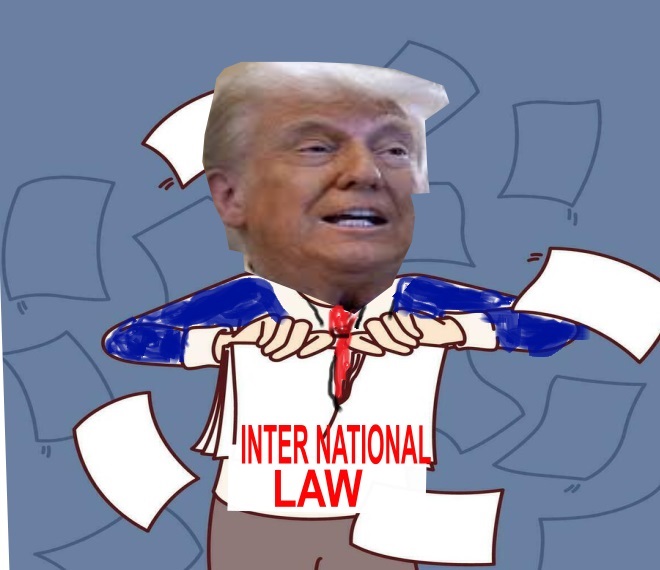
Trump’s rap sheet is long, but this may top them all
The International Atomic Energy Agency (IAEA) has not blown the whistle as claimed by the Australian government, nor has the UK or our European allies.
any resolution to condemn the bombing of Iran will be vetoed by the US , presumably with the support of Australia
The Age, Geoffrey Robertson , 24 June 25, – (print version)
Although few may bother to point this out, Trump has just committed a crime much worse than all the others on his rap sheet.
It is the war crime of aggression- the “supreme” war crime, according to the judgement at Nuremberg. It is constituted by using armed force against a felloe United Nations member with such “character, gravity and scale” that it violates the UN charter prohibition on one member country attacking another. A “spectacular military success, the bombing of Iran’s nuclear facilities may have been, but it was, as a matter of international law, no different from Russia’s attack on Ukraine, or the George W Bush Tony Blair, John Howard invasion of Iraq. These a all cases of a breach of the world order agreed after the last war and likely to encourage emulation.
This is not about saving Iran, or the danger of making Putin look better. If any government in the world deserves to be destroyed, it is the mullahs without mercy in Iran. Many of them were involved in the mass slaughter of political prisoners in1988 – the worst crime against POWs since the Japanese death marches. – and ever since their record of killing peaceful protestors, women and dissidents has been disgusting. Iran has bankrolled terrorist organisations and wagedpropaganda wars against the Big (US) and Little (UK) Satan, but it has not invaded Israel or done anything to America to justify its aggression.
Were some hypothetical war crimes court ever to get its hands on Israeli Prime Minister Benjamin Netanyahu, it would reduce his sentence by taking Iranian provocation into account – but the man would still be guilty as charged. He could not argue self-defence, which requires the threat defended against to be reasonably proximate. The threat of Iran building and using nukes is much further away than the threat of Israeli submarines, said to be already stationed within range of Tehtan.
It is not even clear that Iran is close to building a nuclear weapon – several dozen countries also signatory to the nuclear weapons treaty by which they forswear any such development. could build nukes within a few months. The International Atomic Energy Agency (IAEA) has not blown the whistle as claimed by the Australian government, nor has the UK or our European allies.. And just like Saddam Hussein’s “weapons of mass destruction” there is no reason to think Iran has completed a project that in fact started under .the Shah in the 1970s.
Only last wee, Trump said in effect to the Ayatollah, in the tone of a gangster “Wee know where you live”, but he promised the cleric he would be safe “for now” and gave him two weeks. He bombed three days later (This is a man on whose word Australia has just made a down payment for AUKUS).
The true disaster of Trump’s attack is that it is another nail in the coffin of the rules-based world order that provided some protection for international pdeace and security since it was put in place in 1945.
It is now unfit for its purpose declared in the UN Charter to stop the slaughter of war. The General Assembly is a talking shop, while all power resides in the permanently poleAxed Security Council which cannot function because of the big power veto.
Resolutions for peace in Ukraine are vetoed by Russia, for peace in Gaza they are vetoed by America on behalf of Israel, and any resolution to condemn the bombing of Iran will be vetoed by the US , presumably with the support of Australia.
Besides, the problem with Iran goes beyond nuclear weapons. It’s a conflict between the rights of its people and the wrongs of its dictatorship. That is a conflict that only its people can resolve, however much the West may wish to help.
Trump has already made a mockery of US law, from which his Supreme Court has declared him immune. Hewill now make a mockery of international law, roo.
Geoffrey Robertson KC is an expert in international and human rights law. He is the author of Mullahs Without Mercy and Crimes Against Humanity.
Donald Trump dominated extraordinary NATO summit that saw European defence spending increase – NATO chief calls Trump ‘Daddy’
ABC News, By Europe correspondent Elias Clure at The Hague, 26 June 25
Donald Trump was given a royal welcome by the monarch of the Netherlands as he arrived at the NATO summit in The Hague.
He left feeling like a king.
Member nations agreed to lift their defence spending to 5 per cent of GDP over 10 years and Mr Trump was quick to take credit, describing it as a “big win” for the United States.
He’d been calling for more spending and had made threats about the future of the alliance if it wasn’t agreed upon.
“They said, ‘You did it, sir, you did it sir.’ Well, I don’t know if I did it, but I think I did,” Mr Trump said.
When the commitment was finalised by members in an official summit declaration, NATO members proclaimed the summit a huge success.
But the event, which aims to hear from delegations of the 32 NATO countries and many more partners and allies, seemed to revolve around the presence of one man.
Trump insists damage was done
Mr Trump’s first official engagement at the NATO summit HQ was with Secretary-General Mark Rutte.
The president arrived at the meeting with US Defense Secretary Pete Hegseth and State Department boss Marco Rubio. The meeting began with Mr Rutte lauding America’s actions in Iran.
“The great thing is you took out the nuclear capability of Iran. This was crucial. You did it in a way which is extremely impressive. But the signal it sends to the rest of the world that this president, when it comes to it, yes, he is a man of peace, but if necessary, he is willing to use strength,” Mr Rutte said.
When the American delegation was probed by the press on the validity of the White House’s claims that Iran’s nuclear capabilities had been comprehensively demolished, it pushed back.
Mr Hegseth accused sceptics of being “politically motivated”, saying the damage was, in fact, “severe”.
Mr Rubio declared that the damage to the enrichment facilities was so bad “you can’t even find it on the map … it’s totally wiped out”.
Not to be outdone, Mr Trump then provided the most vivid description of Operation Midnight Hammer’s success, comparing the raid to the most destructive bombing in history.
“That hit ended the war. I don’t want to use an example of Hiroshima. I don’t want to use an example of Nagasaki. But that was essentially the same thing. That ended that war. This ended that war,”
Mr Trump said.
Mr Rutte watched on in silence.
NATO chief calls Trump ‘Daddy’
The NATO secretary-general has been quite transparent in his attempts to flatter the president.
Mr Trump seemed so taken by the gushing display of admiration by Mr Rutte that he leaked a text message reportedly sent to him by the alliance boss.
“Mr. President, dear Donald, Congratulations and thank you for your decisive action in Iran, that was truly extraordinary, and something no one else dared to do. It makes us all safer,” Mr Rutte reportedly wrote in the message.
Mr Rutte said at the summit that he was not embarrassed by the message, and he was actually happy for it to be made public.
“There’s nothing in it that had to stay secret,” he said.
At Mr Rutte’s meeting with Mr Trump, he was asked about what he thought about the commander-in-chief’s use of the f-word when describing Israel and Iran.
Mr Trump said that the two countries “had a big fight, like two kids in a schoolyard”.
Mr Rutte’s response was light-hearted but telling.
“Daddy has to sometimes use strong language.”……………………………………….
https://www.abc.net.au/news/2025-06-26/donald-trump-dominates-extraordinary-nato-summit/105461646
US didn’t destroy Iran’s nuclear programme: Here’s what new intel says
US President Trump doubles down on his assertion that the Iranian nuclear programme has been set back by decades.
By Al Jazeera Staff, 25 Jun 2025, https://www.aljazeera.com/news/2025/6/25/us-didnt-destroy-irans-nuclear-programme-heres-what-new-intel-says
The United States’ strikes on three key Iranian nuclear sites on Sunday failed to destroy underground facilities, and set Tehran’s nuclear programme back only by a few months, according to an assessment of a confidential American intelligence report.
The “top secret” document prepared by the Defense Intelligence Agency (DIA) – the intelligence arm of the Pentagon – and published by major US news outlets on Tuesday is at odds with President Donald Trump’s claims about the strikes. Trump has insisted that the nuclear facilities at Fordow, Natanz, and Isfahan were “obliterated” by a combination of bunker busting and conventional bombs.
Trump and his administration’s senior officials are dismissing the intelligence report and calling out the reporting over the DIA’s assessment as “fake news”.
Speaking at a NATO summit in The Hague, the US president said he believed Iran’s nuclear programme was set back by decades.
So, what did the DIA assessment say about US strikes? What has Iran said about the attacks? And how does the intelligence report contrast with the Trump administration’s public claims?
What did the DIA report say?
A preliminary report prepared by the DIA noted that rather than obliterating Iran’s nuclear programme, the US bombings had only set it back by a few months.
Before Israel attacked Iran on June 13, US agencies had noted that if Iran rushed to assemble a nuclear weapon, it would take it about three months.
The DIA’s five-page report now estimates this to be delayed by less than six months, reported The New York Times. As per the early findings, the US strikes blocked the entrances to two of the facilities but did not collapse the underground facilities.
The DIA report also reveals that the US agency believes that Iran’s stockpile of enriched uranium was moved before the strikes, which destroyed little of the nuclear material.
Shortly after the US strikes on June 22, Mehdi Mohammadi, an adviser to the chairman of the Iranian parliament, claimed that the authorities had evacuated the Fordow facility in advance. “Iran has been expecting strikes on Fordow for several days. This nuclear facility was evacuated, no irreversible damage was sustained during today’s attack,” Mohammadi had said.
The US president on Wednesday said he doesn’t buy Iranian claims that they moved enriched uranium out of the Fordow nuclear facility. “I believe they didn’t have a chance to get anything out because they acted fast,” said Trump. “If it would have taken two weeks, maybe, but it’s very hard to remove that kind of material… and very dangerous.
“Plus, they knew we were coming,” Trump added. “And if they know we’re coming, they’re not going to be down there.”
CNN first reported on the DIA report, quoting unnamed officials that the US strikes’ effect on all three sites – Fordow, Natanz, and Isfahan – was largely restricted to aboveground structures, which were severely damaged.
On Tuesday, the Trump administration told the United Nations Security Council that the US strikes had “degraded” the Iranian facilities – short of Trump’s earlier assertion that the attacks had “obliterated” the sites.
The strikes have reportedly badly damaged the electrical system at the Fordow facility. However, it was not immediately clear how long Iran could take to gain access to the underground facilities and repair these systems.
On Monday, Rafael Grossi, the head of the UN nuclear watchdog IAEA, said that while “no one, including the IAEA, is in a position to have fully assessed the underground damage at Fordow”, it is expected to be “very significant”.
Two people familiar with the DIA’s assessment told CNN that Iran’s stockpile of enriched uranium was not destroyed and the centrifuges are largely “intact”.
Some analysts cautioned against drawing final conclusions. Analysts told the Reuters news agency that the extent of damage to the Fordow uranium enrichment facility would not necessarily be revealed if the assessment was based on satellite imagery.
How did the US strike Iranian nuclear sites?
After 10 days of fighting between Israel and Iran, the US had militarily intervened on June 22 by hitting the Iranian nuclear sites.
Fordow is a highly fortified underground uranium enrichment facility reportedly buried hundreds of metres deep in the mountains in northwestern Iran. While Natanz is Iran’s largest and most central enrichment complex, containing vast halls of centrifuges, some underground, Isfahan is a major nuclear research and production centre that includes a uranium conversion facility and fuel fabrication plants.
How did the US strike Iranian nuclear sites?
After 10 days of fighting between Israel and Iran, the US had militarily intervened on June 22 by hitting the Iranian nuclear sites.
Fordow is a highly fortified underground uranium enrichment facility reportedly buried hundreds of metres deep in the mountains in northwestern Iran. While Natanz is Iran’s largest and most central enrichment complex, containing vast halls of centrifuges, some underground, Isfahan is a major nuclear research and production centre that includes a uranium conversion facility and fuel fabrication plants.
The US forces dropped 14 30,000-pound (13,000kg) bunker-buster bombs, while Navy submarines are said to have coordinated strikes by cruise missiles at the Natanz and Isfahan sites.
The GBU-57 Massive Ordnance Penetrator (MOP) – the most powerful bunker-buster bomb in the US military arsenal weighing nearly 13,000kg (30,000lb) – was used in the strike.
The US intervention was understood to be critical for the Israeli campaign against Iranian nuclear facilities, especially Fordow, due to its depth that kept it out of reach for the Israeli military.
How did the DIA report contrast with Trump’s claims?
In March this year, the US spy chief Tulsi Gabbard had informed Congress that there was no evidence Iran was building a nuclear weapon, and Iranian Supreme Leader Ali Khamenei had not authorised the nuclear weapons programme that he had earlier suspended in 2003.
On June 17, as Israel and Iran continued to trade ballistic missiles, Trump was returning to Washington from the G7 summit in Canada, when he snubbed his own administration, including the spy chief Gabbard, saying she and the intel agencies had gotten it “wrong”.
He claimed that Iran was “very close” to having a nuclear weapon. On June 22, the US struck Iranian nuclear facilities. “The strikes were a spectacular military success,” Trump said in a televised address. “Iran’s key nuclear enrichment facilities have been completely and totally obliterated.”
The next day, Trump wrote on his Truth Social platform, “The damage to the Nuclear sites in Iran is said to be ‘monumental.’ The hits were hard and accurate. Great skill was shown by our military. Thank you!”
On Wednesday, at the NATO summit, he reiterated his stance. “The last thing they [Iran] want to do is enrich anything right now… They’re not going to have a bomb and they’re not going to enrich,” he said at The Hague.
Top officials from his administration, including Vice President JD Vance and Defense Secretary Pete Hegseth, have repeated the obliteration claims since then.
“Based on everything we have seen – and I’ve seen it all – our bombing campaign obliterated Iran’s ability to create nuclear weapons,” Hegseth said in a statement provided to Reuters.
“Our massive bombs hit exactly the right spot at each target – and worked perfectly. The impact of those bombs is buried under a mountain of rubble in Iran; so anyone who says the bombs were not devastating is just trying to undermine the President and the successful mission.”
How has Trump, the White House reacted?
Trump spent a good amount of time letting off steam on his Truth Social platform after the DIA report dropped.
“THE NUCLEAR SITES IN IRAN ARE COMPLETELY DESTROYED! BOTH THE TIMES AND CNN ARE GETTING SLAMMED BY THE PUBLIC!” Trump wrote in all-caps, referring to the reporting by The New York Times and CNN.
“FAKE NEWS CNN, TOGETHER WITH THE FAILING NEW YORK TIMES, HAVE TEAMED UP IN AN ATTEMPT TO DEMEAN ONE OF THE MOST SUCCESSFUL MILITARY STRIKES IN HISTORY,” Trump said in a post.
The US president also posted a series of apparently bizarre videos, including one of B-2 bombers taking off to a “bomb Iran” song in the background.
Trump is currently in the Netherlands, attending this week’s NATO summit, and reiterated to reporters that the damage from the strikes was significant. “I think it’s been completely demolished,” he said, adding, “Those pilots hit their targets. Those targets were obliterated, and the pilots should be given credit.
“That place is under rock. That place is demolished,” Trump responded to a question on the possibility of Iran rebuilding its nuclear program.
He took further shots at CNN, saying: “These cable networks are real losers. You’re gutless losers. I say that to CNN because I watch it – I have no choice. I got to watch it. It’s all garbage. It’s all fake news.”
He said the intelligence following the strikes in Iran was “inconclusive”. “The intelligence says we don’t know. It could’ve been very severe. That’s what the intelligence suggests.”
“It was very severe. There was obliteration,” he reiterated on Wednesday.
The White House press secretary, Karoline Leavitt, called the DIA assessment “flat-out wrong” and leaked to the press “by an anonymous, low-level loser in the intelligence community”.
“The leaking of this alleged assessment is a clear attempt to demean President Trump, and discredit the brave fighter pilots who conducted a perfectly executed mission to obliterate Iran’s nuclear program,” she said in a statement. “Everyone knows what happens when you drop 14 30,000 pound bombs perfectly on their targets: Total obliteration.”
Plutonium Levels in Sediments Remain Elevated 70 Years After Nuclear Tests

June 24, 2025,
https://www.marinetechnologynews.com/news/plutonium-levels-sediments-remain-650328
Researchers from Edith Cowan University (ECU) in Australia have confirmed plutonium levels in sediment up to 4,500 times greater than the Western Australian coastline.
Three plutonium-based nuclear weapons tests were conducted at the Montebello Islands in the 1950’s, which introduced radioactive contamination to the surrounding environment. The first nuclear test, coded Operation Hurricane, had a weapon’s yield of some 25kT, and formed a crater in the seabed, while the second and third tests, dubbed Operation Mosaic G1 and G2, had weapons yields of around 15kT and 60kT, respectively.
The three tests released radioactive isotopes including plutonium, strontium (90Sr) and caesium (137Cs) into the surrounding marine environment.
“Plutonium is anthropogenic, which means that it doesn’t exist on its own in nature. The only way it is introduced into an environment is through the detonation of nuclear weapons and from releases from nuclear reprocessing plants and, to a lesser extent, accidents in nuclear power plants,” said ECU PhD student and lead author Madison Williams-Hoffman.
“When plutonium is released into a coastal setting in the marine environment, a significant fraction will attach to particles and accumulate in the seabed, while some may be transported long distances by oceanic currents.”
The region is not inhabited by humans and has not been developed, however it is visited by fishing boats, so collecting data on the levels of contamination in the marine environment is important.
Currently, the protected island archipelago and surrounding marine areas also reside within the Montebello Islands Marine Park (MIMP). The MIMP is ecologically significant due to the presence of numerous permanent or migratory species, and its high-value habitat is used for breeding and rearing by fish, mammals, birds and other marine wildlife.
The water and sediment quality within the MIMP are currently described as ‘generally pristine’, and it is fundamental to maintain healthy marine ecosystems in the region.
The concentrations of plutonium at Montebello Islands were between 4 to 4,500 times higher than those found in sediment from Kalumburu and Rockingham from the Western Australian coastline, with the northern area of the archipelago, close to the three detonation sites, having four-fold higher levels than the southern area.
The concentrations of plutonium found in the sediment at Montebello Islands were similar to those found in the sediment at the Republic of Marshall Islands (RMI) test sites, despite 700-fold higher detonation yields from nuclear testing undertaken at RMI.
Plutonium is an alpha emitter so, unlike other types of radiation, it cannot travel through the skin and is most dangerous when ingested or inhaled.
The research was undertaken by Williams-Hoffman, under the co-supervision of Prof. Pere Masqueand at ECU and Dr Mathew Johansen at ANTSO.
How the US and Israel Used Rafael Grossi to Hijack the IAEA and Start a War on Iran

Rafael Grossi, director General of the International Atomic Energy Agency (IAEA), allowed the IAEA to be used by the United States and Israel—an undeclared nuclear weapons state in long-term violation of IAEA rules—to manufacture a pretext for war on Iran, despite his agency’s own conclusion that Iran had no nuclear weapons program.
Israel began working on a nuclear weapon in the 1950s, with substantial help from Western countries, including France, Britain and Argentina, and made its first weapons in 1966 or 1967. By 2015, when Iran signed the JCPOA nuclear agreement, former Secretary of State Colin Powell wrote in a leaked email that a nuclear weapon would be useless to Iran because “Israel has 200, all targeted on Tehran.”
The agency’s chief has not only continued its subservience to U.S. and Western interests, but also its practice of turning a blind eye to Israel’s nuclear weapons.
Medea BenjaminNicolas J.S. Davies, Jun 23, 2025, https://www.commondreams.org/opinion/how-the-us-and-israel-used-rafael-grossi-to-hijack-the-iaea-and-start-a-war-on-iran
Rafael Grossi, director General of the International Atomic Energy Agency (IAEA), allowed the IAEA to be used by the United States and Israel—an undeclared nuclear weapons state in long-term violation of IAEA rules—to manufacture a pretext for war on Iran, despite his agency’s own conclusion that Iran had no nuclear weapons program.
On June 12th, based on a damning report by Grossi, a slim majority of the IAEA Board of Governors voted to find Iran in non-compliance with its obligations as an IAEA member. Of the 35 countries represented on the Board, only 19 voted for the resolution, while 3 voted against it, 11 abstained and 2 did not vote.
Rafael Grossi, director General of the International Atomic Energy Agency (IAEA), allowed the IAEA to be used by the United States and Israel—an undeclared nuclear weapons state in long-term violation of IAEA rules—to manufacture a pretext for war on Iran, despite his agency’s own conclusion that Iran had no nuclear weapons program.
On June 12th, based on a damning report by Grossi, a slim majority of the IAEA Board of Governors voted to find Iran in non-compliance with its obligations as an IAEA member. Of the 35 countries represented on the Board, only 19 voted for the resolution, while 3 voted against it, 11 abstained and 2 did not vote.
Without you, Common Dreams simply wouldn’t exist.
In a moment that demands fearless reporting, Common Dreams needs your support to keep our independent journalism alive.
about:blank
The United States contacted eight board member governments on June 10th to persuade them to either vote for the resolution or not to vote. Israeli officials said they saw the U.S. arm-twisting for the IAEA resolution as a significant signal of U.S. support for Israel’s war plans, revealing how much Israel valued the IAEA resolution as diplomatic cover for the war.
The IAEA board meeting was timed for the final day of President Trump’s 60-day ultimatum to Iran to negotiate a new nuclear agreement. Even as the IAEA board voted, Israel was loading weapons, fuel and drop-tanks on its warplanes for the long flight to Iran and briefing its aircrews on their targets. The first Israeli air strikes hit Iran at 3 a.m. that night.
On June 20th, Iran filed a formal complaint against Director General Grossi with the UN Secretary General and the UN Security Council for undermining his agency’s impartiality, both by his failure to mention the illegality of Israel’s threats and uses of force against Iran in his public statements and by his singular focus on Iran’s alleged violations.
The source of the IAEA investigation that led to this resolution was a 2018 Israeli intelligence report that its agents had identified three previously undisclosed sites in Iran where Iran had conducted uranium enrichment prior to 2003. In 2019, Grossi opened an investigation, and the IAEA eventually gained access to the sites and detected traces of enriched uranium..
Despite the fateful consequences of his actions, Grossi has never explained publicly how the IAEA can be sure that Israel’s Mossad intelligence agency or its Iranian collaborators, such as the Mojahedin-e-Khalq (or MEK), did not put the enriched uranium in those sites themselves, as Iranian officials have suggested.
While the IAEA resolution that triggered this war dealt only with Iran’s enrichment activities prior to 2003, U.S. and Israeli politicians quickly pivoted to unsubstantiated claims that Iran was on the verge of making a nuclear weapon. U.S. intelligence agencies had previously reported that such a complex process would take up to three years, even before Israel and the United States began bombing and degrading Iran’s existing civilian nuclear facilities.
The IAEA’s previous investigations into unreported nuclear activities in Iran were officially completed in December 2015, when IAEA Director General Yukiya Amano published its “Final Assessment on Past and Present Outstanding Issues regarding Iran’s Nuclear Program.”
The IAEA assessed that, while some of Iran’s past activities might have been relevant to nuclear weapons, they “did not advance beyond feasibility and scientific studies, and the acquisition of certain relevant technical competences and capabilities.” The IAEA “found no credible indications of the diversion of nuclear material in connection with the possible military dimensions to Iran’s nuclear program.”
When Yukiya Amano died before the end of his term in 2019, Argentinian diplomat Rafael Grossi was appointed IAEA Director General. Grossi had served as Deputy Director General under Amano and, before that, as Chief of Staff under Director General Mohamed ElBaradei.
The Israelis have a long record of fabricating false evidence about Iran’s nuclear activities, like the notorious “laptop documents” given to the CIA by the MEK in 2004 and believed to have been created by the Mossad. Douglas Frantz, who wrote a report on Iran’s nuclear program for the Senate Foreign Relations Committee in 2009, revealed that the Mossad created a special unit in 2003 to provide secret briefings on Iran’s nuclear program, using “documents from inside Iran and elsewhere.”
And yet Grossi collaborated with Israel to pursue its latest allegations. After several years of meetings in Israel and negotiations and inspections in Iran, he wrote his report to the IAEA Board of Governors and scheduled a board meeting to coincide with the planned start date for Israel’s war.
Israel made its final war preparations in full view of the satellites and intelligence agencies of the western countries that drafted and voted for the resolution. It is no wonder that 13 countries abstained or did not vote, but it is tragic that more neutral countries could not find the wisdom and courage to vote against this insidious resolution.
The official purpose of the International Atomic Energy Agency, or IAEA, is “to promote the safe, secure and peaceful use of nuclear technologies.” Since 1965, all of its 180 member countries have been subject to IAEA safeguards to ensure that their nuclear programs are “not used in such a way as to further any military purpose.”
The IAEA’s work is obviously compromised in dealing with countries that already have nuclear weapons. North Korea withdrew from the IAEA in 1994, and from all safeguards in 2009. The United States, Russia, the United Kingdom, France and China have IAEA safeguard agreements that are based only on “voluntary offers” for “selected” non-military sites. India has a 2009 safeguard agreement that requires it to keep its military and civilian nuclear programs separate, and Pakistan has 10 separate safeguard agreements, but only for civilian nuclear projects, the latest being from 2017 to cover two Chinese-built power stations.
Israel, however, has only a limited 1975 safeguards agreement for a 1955 civilian nuclear cooperation agreement with the United States. An addendum in 1977 extended the IAEA safeguards agreement indefinitely, even though the cooperation agreement with the U.S. that it covered expired four days later. So, by a parody of compliance that the United States and the IAEA have played along with for half a century, Israel has escaped the scrutiny of IAEA safeguards just as effectively as North Korea.
Israel began working on a nuclear weapon in the 1950s, with substantial help from Western countries, including France, Britain and Argentina, and made its first weapons in 1966 or 1967. By 2015, when Iran signed the JCPOA nuclear agreement, former Secretary of State Colin Powell wrote in a leaked email that a nuclear weapon would be useless to Iran because “Israel has 200, all targeted on Tehran.” Powell quoted former Iranian President Mahmoud Ahmadinejad asking, “What would we do with a nuclear weapon? Polish it?”
In 2003, while Powell tried but failed to make a case for war on Iraq to the UN Security Council, President Bush smeared Iran, Iraq and North Korea as an “axis of evil,” based on their alleged pursuit of “weapons of mass destruction.” The Egyptian IAEA Director, Mohamed ElBaradei, repeatedly assured the Security Council that the IAEA could find no evidence that Iraq was developing a nuclear weapon.
When the CIA produced a document that showed Iraq importing yellowcake uranium from Niger, just as Israel had secretly imported it from Argentina in the 1960s, the IAEA only took a few hours to recognize the document as a forgery, which ElBaradei immediately reported to the Security Council.
Rafael Grossi, director General of the International Atomic Energy Agency (IAEA), allowed the IAEA to be used by the United States and Israel—an undeclared nuclear weapons state in long-term violation of IAEA rules—to manufacture a pretext for war on Iran, despite his agency’s own conclusion that Iran had no nuclear weapons program.
On June 12th, based on a damning report by Grossi, a slim majority of the IAEA Board of Governors voted to find Iran in non-compliance with its obligations as an IAEA member. Of the 35 countries represented on the Board, only 19 voted for the resolution, while 3 voted against it, 11 abstained and 2 did not vote.
Without you, Common Dreams simply wouldn’t exist.
In a moment that demands fearless reporting, Common Dreams needs your support to keep our independent journalism alive.
about:blank
The United States contacted eight board member governments on June 10th to persuade them to either vote for the resolution or not to vote. Israeli officials said they saw the U.S. arm-twisting for the IAEA resolution as a significant signal of U.S. support for Israel’s war plans, revealing how much Israel valued the IAEA resolution as diplomatic cover for the war.
The IAEA board meeting was timed for the final day of President Trump’s 60-day ultimatum to Iran to negotiate a new nuclear agreement. Even as the IAEA board voted, Israel was loading weapons, fuel and drop-tanks on its warplanes for the long flight to Iran and briefing its aircrews on their targets. The first Israeli air strikes hit Iran at 3 a.m. that night.
On June 20th, Iran filed a formal complaint against Director General Grossi with the UN Secretary General and the UN Security Council for undermining his agency’s impartiality, both by his failure to mention the illegality of Israel’s threats and uses of force against Iran in his public statements and by his singular focus on Iran’s alleged violations.
The source of the IAEA investigation that led to this resolution was a 2018 Israeli intelligence report that its agents had identified three previously undisclosed sites in Iran where Iran had conducted uranium enrichment prior to 2003. In 2019, Grossi opened an investigation, and the IAEA eventually gained access to the sites and detected traces of enriched uranium.
Despite the fateful consequences of his actions, Grossi has never explained publicly how the IAEA can be sure that Israel’s Mossad intelligence agency or its Iranian collaborators, such as the Mojahedin-e-Khalq (or MEK), did not put the enriched uranium in those sites themselves, as Iranian officials have suggested.
While the IAEA resolution that triggered this war dealt only with Iran’s enrichment activities prior to 2003, U.S. and Israeli politicians quickly pivoted to unsubstantiated claims that Iran was on the verge of making a nuclear weapon. U.S. intelligence agencies had previously reported that such a complex process would take up to three years, even before Israel and the United States began bombing and degrading Iran’s existing civilian nuclear facilities.
The IAEA’s previous investigations into unreported nuclear activities in Iran were officially completed in December 2015, when IAEA Director General Yukiya Amano published its “Final Assessment on Past and Present Outstanding Issues regarding Iran’s Nuclear Program.”
The IAEA assessed that, while some of Iran’s past activities might have been relevant to nuclear weapons, they “did not advance beyond feasibility and scientific studies, and the acquisition of certain relevant technical competences and capabilities.” The IAEA “found no credible indications of the diversion of nuclear material in connection with the possible military dimensions to Iran’s nuclear program.”
When Yukiya Amano died before the end of his term in 2019, Argentinian diplomat Rafael Grossi was appointed IAEA Director General. Grossi had served as Deputy Director General under Amano and, before that, as Chief of Staff under Director General Mohamed ElBaradei.
The Israelis have a long record of fabricating false evidence about Iran’s nuclear activities, like the notorious “laptop documents” given to the CIA by the MEK in 2004 and believed to have been created by the Mossad. Douglas Frantz, who wrote a report on Iran’s nuclear program for the Senate Foreign Relations Committee in 2009, revealed that the Mossad created a special unit in 2003 to provide secret briefings on Iran’s nuclear program, using “documents from inside Iran and elsewhere.”
And yet Grossi collaborated with Israel to pursue its latest allegations. After several years of meetings in Israel and negotiations and inspections in Iran, he wrote his report to the IAEA Board of Governors and scheduled a board meeting to coincide with the planned start date for Israel’s war.
Israel made its final war preparations in full view of the satellites and intelligence agencies of the western countries that drafted and voted for the resolution. It is no wonder that 13 countries abstained or did not vote, but it is tragic that more neutral countries could not find the wisdom and courage to vote against this insidious resolution.
The official purpose of the International Atomic Energy Agency, or IAEA, is “to promote the safe, secure and peaceful use of nuclear technologies.” Since 1965, all of its 180 member countries have been subject to IAEA safeguards to ensure that their nuclear programs are “not used in such a way as to further any military purpose.”
The IAEA’s work is obviously compromised in dealing with countries that already have nuclear weapons. North Korea withdrew from the IAEA in 1994, and from all safeguards in 2009. The United States, Russia, the United Kingdom, France and China have IAEA safeguard agreements that are based only on “voluntary offers” for “selected” non-military sites. India has a 2009 safeguard agreement that requires it to keep its military and civilian nuclear programs separate, and Pakistan has 10 separate safeguard agreements, but only for civilian nuclear projects, the latest being from 2017 to cover two Chinese-built power stations.
Israel, however, has only a limited 1975 safeguards agreement for a 1955 civilian nuclear cooperation agreement with the United States. An addendum in 1977 extended the IAEA safeguards agreement indefinitely, even though the cooperation agreement with the U.S. that it covered expired four days later. So, by a parody of compliance that the United States and the IAEA have played along with for half a century, Israel has escaped the scrutiny of IAEA safeguards just as effectively as North Korea.
Israel began working on a nuclear weapon in the 1950s, with substantial help from Western countries, including France, Britain and Argentina, and made its first weapons in 1966 or 1967. By 2015, when Iran signed the JCPOA nuclear agreement, former Secretary of State Colin Powell wrote in a leaked email that a nuclear weapon would be useless to Iran because “Israel has 200, all targeted on Tehran.” Powell quoted former Iranian President Mahmoud Ahmadinejad asking, “What would we do with a nuclear weapon? Polish it?”
In 2003, while Powell tried but failed to make a case for war on Iraq to the UN Security Council, President Bush smeared Iran, Iraq and North Korea as an “axis of evil,” based on their alleged pursuit of “weapons of mass destruction.” The Egyptian IAEA Director, Mohamed ElBaradei, repeatedly assured the Security Council that the IAEA could find no evidence that Iraq was developing a nuclear weapon.
When the CIA produced a document that showed Iraq importing yellowcake uranium from Niger, just as Israel had secretly imported it from Argentina in the 1960s, the IAEA only took a few hours to recognize the document as a forgery, which ElBaradei immediately reported to the Security Council.
Bush kept repeating the lie about yellowcake from Niger, and other flagrant lies about Iraq, and the United States invaded and destroyed Iraq based on his lies, a war crime of historic proportions. Most of the world knew that ElBaradei and the IAEA were right all along, and, in 2005, they were awarded the Nobel Peace Prize, for exposing Bush’s lies, speaking truth to power and strengthening nuclear non-proliferation.
In 2007, a U.S. National Intelligence Estimate (NIE) by all 16 U.S. intelligence agencies agreed with the IAEA’s finding that Iran, like Iraq, had no nuclear weapons program. As Bush wrote in his memoirs, “…after the NIE, how could I possibly explain using the military to destroy the nuclear facilities of a country the intelligence community said had no active nuclear weapons program?” Even Bush couldn’t believe he would get away with recycling the same lies to destroy Iran as well as Iraq, and Trump is playing with fire by doing so now.
ElBaradei wrote in his own memoir, The Age of Deception: Nuclear Diplomacy in Treacherous Times, that if Iran did do some preliminary research on nuclear weapons, it probably began during the Iran-Iraq War in the 1980s, after the US and its allies helped Iraq to manufacture chemical weapons that killed up to 100,000 Iranians.
The neocons who dominate U.S. post-Cold War foreign policy viewed the Nobel Prize winner ElBaradei as an obstacle to their regime change ambitions around the world, and conducted a covert campaign to find a more compliant new IAEA Director General when his term expired in 2009.
After Japanese diplomat Yukiya Amano was appointed as the new Director General, U.S. diplomatic cables published by Wikileaks revealed details of his extensive vetting by U.S. diplomats, who reported back to Washington that Amano “was solidly in the U.S. court on every key strategic decision, from high-level personnel appointments to the handling of Iran’s alleged nuclear weapons program.”
After becoming IAEA Director General in 2019, Rafael Grossi not only continued the IAEA’s subservience to U.S. and Western interests and its practice of turning a blind eye to Israel’s nuclear weapons, but also ensured that the IAEA played a critical role in Israel’s march to war on Iran.
Even as he publicly acknowledged that Iran had no nuclear weapons program and that diplomacy was the only way to resolve the West’s concerns about Iran, Grossi helped Israel to set the stage for war by reopening the IAEA’s investigation into Iran’s past activities. Then, on the very day that Israeli warplanes were being loaded with weapons to bomb Iran, he made sure that the IAEA Board of Governors passed a resolution to give Israel and the U.S. the pretext for war that they wanted.
In his last year as IAEA Director, Mohamed ElBaradei faced a similar dilemma to the one that Grossi has faced since 2019. In 2008, U.S. and Israeli intelligence agencies gave the IAEA copies of documents that appeared to show Iran conducting four distinct types of nuclear weapons research.
Whereas, in 2003, Bush’s yellowcake document from Niger was clearly a forgery, the IAEA could not establish whether the Israeli documents were authentic or not. So ElBaradei refused to act on them or to make them public, despite considerable political pressure, because, as he wrote in The Age of Deception, he knew the U.S. and Israel “wanted to create the impression that Iran presented an imminent threat, perhaps preparing the grounds for the use of force.” ElBaradei retired in 2009, and those allegations were among the “outstanding issues” that he left to be resolved by Yukiya Amano in 2015.
If Rafael Grossi had exercised the same caution, impartiality and wisdom as Mohamed ElBaradei did in 2009, it is very possible that the United States and Israel would not be at war with Iran today.
Mohamed ElBaradei wrote in a tweet on June 17th 2025, “To rely on force and not negotiations is a sure way to destroy the NPT and the nuclear non-proliferation regime (imperfect as it is), and sends a clear message to many countries “that their ‘ultimate security’ is to develop nuclear weapons!!!”
Despite Grossi’s role in U.S.-Israeli war plans as IAEA Director General, or maybe because of it, he has been touted as a Western-backed candidate to succeed Antonio Guterres as UN Secretary General in 2026. That would be a disaster for the world. Fortunately, there are many more qualified candidates to lead the world out of the crisis that Rafael Grossi has helped the U.S. and Israel to plunge it into.
Rafael Grossi should resign as IAEA Director before he further undermines nuclear non-proliferation and drags the world any closer to nuclear war. And he should also withdraw his name from consideration as a candidate for UN Secretary General.
EDF chief weighs asset sales as Paris pushes for new nuclear focus

a “complicated economic equation
… unless someone has found a magic wand”
Insiders say Fontana’s stance signals he is aligned with the French
government unlike his predecessor. EDF’s new boss is conducting a
portfolio review that could lead to the French energy group selling some
assets, as he seeks to meet government demands to focus on building new
nuclear reactors in France.
Bernard Fontana has told insiders that he
wanted to assess which assets were not profitable or did not fit with the
state-owned group’s strategic priorities, according to several people
with knowledge of the situation. Fontana, who took over as chief executive
of the state-owned group last month, told the people that sales could come
after the review, although he has not yet concluded which parts of the
business should be sold off.
The state “has said that we have to make the
new nuclear programme in France a success, and exploit the current nuclear
centres. For the rest, if there aren’t the means, we’ll have to
arbitrate”, said one of the people.
Its other assets and subsidiaries
include the construction engineering division Framatome — of which
Fontana was previously CEO

— renewable installations in France and across
the world, Italian utility business Edison and services company Dalkia.
Several people familiar with EDF said Dalkia and Edison are among the
business units that could be sold. Renewable assets, with the exception of
EDF’s hydraulic power projects, could also be under consideration, the
people said.
Still, the company’s aims could be complicated if it tries
to sell assets during a difficult economic environment, potentially forcing
it to offload some assets at deep discounts, especially in the US where it
has a number of offshore wind and solar projects.
Asset sales would also do
little to meet the enormous costs of delivering the new EPR2 programme,
people familiar with the business said. The government and EDF recently
agreed a funding mechanism for the project, but the total cost is yet to be
determined.
Building the EPR2s and meeting EDF’s other priorities such as
guaranteeing low energy prices to consumers and industrial groups, and
completing Hinkley Point make for a “complicated economic equation
… unless someone has found a magic wand”, said one of the people.
FT 25th June 2025
https://www.ft.com/content/e2c4ba72-b40a-4d7b-a820-70957b06958e
Israeli, US bombing of Iran a failure of epic proportions
25 June 2025 AIMN Editorial, By Walt Zlotow West Suburban Peace Coalition, Glen Ellyn IL https://theaimn.net/israeli-us-bombing-of-iran-a-failure-of-epic-proportions/
The illegal, criminal bombings on Iran which killed over 800 and wounded over 2,500 have failed spectacularly.
While still going on, there are indications from the Trump administration a ceasefire may soon be possible.
What has 11 days of bombings accomplished?
It has not destroyed Iran’s nuclear facilities or its enriched uranium. It has not achieved regime change in Iran. It has not shattered Iran into failed state status. It has likely rallied Iran’s population to coalesce around besieged Iranian leadership.
It has brought retaliation bombings to Israel killing dozens and wounding hundreds, the largest such attacks in its 77 year existence.
It has likely motivated Iran to repair and rebuild its nuclear capabilities outside of oversight of nuclear inspectors. Iran may decide to withdraw from the Nuclear Non-Proliferation Treaty (NPT) designed to give signatories the inalienable right to civilian nuclear development. When they observe how Israel and the US cavalierly bomb non-nuclear weapons states, Iran may decide they have no choice but to join the nuclear club. Since Iran was not developing nuclear weapons, the Israeli, US misadventure may speed up the very thing they claimed urgency in preventing.
Possibly the worst bombing campaign failure was to obliterate US credibility as a responsible diplomatic partner. By using the duplicity of negotiating an end to the imagined nuclear crisis to enable Israel’ sneak attack, US now ranks dead last of all 194 other countries to negotiate anything of consequence. Check that, the US can still negotiate with Israel which has complete trust in US backing of their ongoing genocide in Gaza and lust to topple Iran as their only hegemonic rival in the Middle East.
The US has made of shambles of international law. It has substituted its Orwellian ‘Rules Based Order’ allowing it to wage regime change, including outright war, on any targeted state at the point of a smart bomb fired by dumb, international war criminals.
But no matter how badly deranged US policy turns out, the current CICW (Commander in Criminal War) will call it “a spectacular success.”
1 This Month
Chernobyl: The Lost Tapes – A good documentary on Chernobyl on SBS available On Demand for the next 3 weeks– https://www.sbs.com.au/ondemand/tv-program/chernobyl-the-lost-tapes/2352741955560

of the week–London Campaign for Nuclear Disarmament

Tell the Ukrainian Government to Drop Prosecution of Peace Activist Yurii Sheliazhenko
To see nuclear-related stories in greater depth and intensity – go to https://nuclearinformation.wordpress.com
-
Archives
- April 2026 (139)
- March 2026 (251)
- February 2026 (268)
- January 2026 (308)
- December 2025 (358)
- November 2025 (359)
- October 2025 (376)
- September 2025 (257)
- August 2025 (319)
- July 2025 (230)
- June 2025 (348)
- May 2025 (261)
-
Categories
- 1
- 1 NUCLEAR ISSUES
- business and costs
- climate change
- culture and arts
- ENERGY
- environment
- health
- history
- indigenous issues
- Legal
- marketing of nuclear
- media
- opposition to nuclear
- PERSONAL STORIES
- politics
- politics international
- Religion and ethics
- safety
- secrets,lies and civil liberties
- spinbuster
- technology
- Uranium
- wastes
- weapons and war
- Women
- 2 WORLD
- ACTION
- AFRICA
- Atrocities
- AUSTRALIA
- Christina's notes
- Christina's themes
- culture and arts
- Events
- Fuk 2022
- Fuk 2023
- Fukushima 2017
- Fukushima 2018
- fukushima 2019
- Fukushima 2020
- Fukushima 2021
- general
- global warming
- Humour (God we need it)
- Nuclear
- RARE EARTHS
- Reference
- resources – print
- Resources -audiovicual
- Weekly Newsletter
- World
- World Nuclear
- YouTube
-
RSS
Entries RSS
Comments RSS
 nuclear-news