Britain to buy fighter jets to carry nuclear weapons.

Britain wants to purchase fighter jets capable of firing tactical nuclear
weapons, in a major expansion of the deterrent intended to counter the
growing threat posed by Russia. Sir Keir Starmer’s government is in
highly sensitive talks over the move, which would represent the biggest
development in the UK’s deterrent since the Cold War and a recognition
that the world has entered a more dangerous nuclear era.
Times 31st May 2025, https://www.thetimes.com/uk/defence/article/review-fighter-jets-nuclear-weapons-x9vldt0sv
Davis-Besse Report Reveals Constant Pollution, Flawed Monitoring, and Unending Nuclear Waste
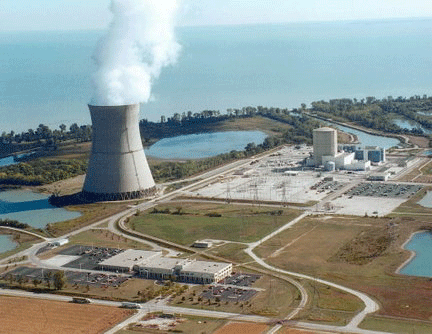
Ohio Atomic Press, 30 May 2025
OAK HARBOR, OH – The Davis-Besse Nuclear Power Station’s 2024 Annual Radiological Environmental Operating Report and Radioactive Effluent Release Report, presented as a routine compliance document, is, upon closer inspection, a testament to the inherent contradictions and failures of nuclear power. Far from offering reassurance, a detailed breakdown of its contents reveals a systematic downplaying of risk, consistent operational deficiencies, and an unavoidable legacy of environmental burden.
This analysis dissects the report’s core assertions, exposing the fallacies and highlighting the damning issues that FirstEnergy (now Vistra) attempts to obscure through technical jargon and regulatory compliance claims.
The Fallacy of “Acceptable” Contamination: Routine Radioactive Releases
The report repeatedly emphasizes that radioactive releases are “well below applicable federal regulatory limits.” This is a fundamental fallacy. “Below limits” does not equate to “zero risk” or “no impact.” It merely signifies adherence to arbitrary thresholds set by regulators, thresholds that do not account for the cumulative effects of decades of exposure or the long-term biological impacts of even low-level radiation.
- Continuous Effluents: Davis-Besse admits to the routine discharge of both gaseous and liquid radioactive effluents. Tables 14 (“Gaseous Effluents Summation of All Releases”) and 17 (“Liquid Effluents – Summation of All Releases”) within the report confirm these ongoing releases. The fact that these are planned and continuous highlights that nuclear power is inherently a polluting industry. Every day, radioactive isotopes are deliberately introduced into our air and water, becoming part of the ecosystem and our food chain.
Irreducible Public Dose: Despite claims of minimal impact, the report’s own dose calculations (Tables 21, 22, and 23) confirm that the public does receive a measurable radiation dose from Davis-Besse’s operations. The identification of a critical pathway through a garden just over half a mile from the plant unequivocally demonstrates direct, localized human exposure. To assert that total body doses are “not distinguishable from background” is a deceptive attempt to normalize environmental contamination. Background radiation is not static; it is augmented by every single planned release, contributing to a cumulative burden on local populations.
Operational Failures: A Flawed Monitoring System
The credibility of any environmental report hinges on robust and reliable monitoring. Davis-Besse’s 2024 report exposes a litany of operational failures that directly undermine the accuracy and completeness of its environmental data………………………………………………………………………………………………………………………………………………………………
Damning Legacies: Groundwater Contamination and Unresolved Waste
Beyond the daily operations, the report touches on two long-standing, inherently “damning issues” that underpin the environmental cost of nuclear power: localized contamination and an unresolved waste crisis………………………………………………………………………………………
Conclusion: A Report of Inconvenient Truths
The Davis-Besse Nuclear Power Station’s 2024 environmental report, when subjected to rigorous scrutiny, is not a document of reassurance but rather a catalog of inconvenient truths. It confirms continuous environmental contamination, highlights persistent failures in monitoring and data integrity, and underscores the profound, unresolved challenge of radioactive waste management. For those committed to a truly clean and sustainable energy future, this report serves as a compelling argument against the ongoing fallacy that nuclear power can ever be truly benign………………… https://www.ohioatomicpress.com/nuclear-news/2536207_davis-besse-report-reveals-constant-pollution-flawed-monitoring-and-unending-nuclear-waste?fbclid=IwY2xjawKotsZleHRuA2FlbQIxMQBicmlkETE5N1drbzFkSjRoZXlUOFRXAR7H0k0sGjhgS1_UeBtK8SEEmwdUM4HcqvR03EoYKAtXm8DIiM9FD9ybXiELvA_aem_MWU5pe3_TNSnSMO21fC8OQ
Nuclear power is back. Will it work out this time?

Britain used to lead the world but lost its way over decades of false starts. The planet’s
first small reactors could win us energy independence — at a price. The
energy secretary was very clear about the urgency of the problem. “The
British nuclear power programme has been in decline over the last
decade,” he told the House of Commons. “If we are to reverse this trend
and ensure that the industry is on a sound footing we must act now.”
This would be a very fair summary of Britain’s nuclear industry today. But
these comments were made nearly half a century ago, by David Howell in
December 1979. Fortunately, Howell, a key member of Margaret Thatcher’s
cabinet (and future father-in-law to one George Osborne), had a plan to put
things right. Construction would begin on ten new nuclear power stations in
the decade from 1982 — one a year. “We consider this a reasonable
prospect,” he assured the Commons.
Yet only one of those stations was
ever built: Sizewell B on the Suffolk coast. It was switched on in 1995.
Britain hasn’t completed a station since. This failure is not down to a
lack of ambition. Thirty years after the hubris of Howell, Ed Miliband,
during his first stint as energy secretary, again announced ten new power
stations. When he re-entered the energy department last summer, another 15
years later, construction had started on only one: Hinkley Point C.
On June 11, Milliband will confirm £2.7 billion of funding for Sizewell C, in
Suffolk, where ground preparation has begun. He will also announce a new
generation of small modular reactors (SMRs) — factory-built miniature
nuclear power generators that are seen by many as the future of the sector.
SMRs will cost a fraction of the price and take a fraction of the time to
build, and by the early 2030s will be sending vital power into our homes
… in theory.
Nobody in Britain, or indeed anywhere else, has even built a
prototype SMR. Why, one wonders, is it so fiendishly difficult to build
nuclear power stations in this country? With the sector’s questionable
safety record and such eye-watering costs, to be met through our energy
bills, do we even need new nuclear power? Next week Great British Nuclear
will announce the winner of a competition to build the UK’s first SMRs,
which will also be the world’s first if they get a move on. Four
companies are in the running: GE Hitachi, Rolls-Royce, Holtec and a
restructured Westinghouse.
Times 1st June 2025, https://www.thetimes.com/business-money/energy/article/british-nuclear-energy-what-went-wrong-future-wx2qtxqnd
Trump’s nuclear vision collides with Trump’s actual policies

Some nuclear-watchers are more explicitly worried that the EOs could backfire — specifically, that the Trump administration’s anti-bureaucratic mission of overhauling the Nuclear Regulatory Commission could lead to the kind of disaster that would threaten the fragile new bipartisan consensus around nuclear power.
By DEREK ROBERTSON , 05/28/2025 With help from Gabby Mille, https://www.politico.com/newsletters/digital-future-daily/2025/05/28/trumps-nuclear-vision-collides-with-trumps-actual-policies-00373330
Many of these nuclear boosters have noted — echoing the Secretary of Energy himself, in a hearing last week — that continued nuclear innovation could hinge on Congress continuing to fund the Loan Programs Office, an increasingly high-profile sub-office of the DOE responsible for funding experimental nuclear projects. Thomas Hochman, infrastructure director at the Foundation for American Innovation, in a conversation with POLITICO claimed some momentum for the pro-nuclear cadre’s cause of the moment, saying, “if things go the right way in Congress [the LPO] will continue to have authority.”
With a slate of splashy executive orders Friday, president Donald Trump promised to “usher in a nuclear energy renaissance …providing a path forward for nuclear innovation.”
By streamlining the Nuclear Regulatory Commission, exploring building reactors on federal land and ordering the quadrupling of the U.S.’ nuclear energy capacity, the administration moved to, as Secretary of Energy Chris Wright said in a statement, “unshackle our civil nuclear energy industry and ensure it can meet this critical moment.”
That all should be music to the ears of the burgeoning pro-nuclear revival, which has seen energy and infrastructure wonks across the political spectrum advocate for nuclear energy as a cleaner, scalable alternative to fossil fuels.
But it also raises a question that is becoming familiar in the second Trump administration: How is this all supposed to happen amid Trump’s radical cutbacks to research — to say nothing of government oversight or safety rules?
As with similar administration goals on supercomputing, or innovation, or artificial intelligence, these big promises aren’t happening in a policy vacuum. They’re happening amid an all-fronts rollback of America’s massive research and regulation infrastructure. Even some of those cheering the nuclear EOs are worried that Trump’s bone-deep cuts to the federal government could doom the nuclear revival before it kicks off.
The Nuclear Innovation Alliance, a nonprofit cheerleader for advanced nuclear reactor development, took the moment to urge GOP-controlled Washington to “adequately resource and staff DOE to meet this moment.” President and CEO Judi Greenwald wrote in a statement that Trump’s cuts — actual and proposed — at the Department of Energy “undermine the Department’s efforts and make it harder to implement these executive orders.”
The progressive pro-nuclear Breakthrough Institute, in its own response to the EOs, enumerated the new staffing levels it would require just to license new plants, and worried that the EOs focused on regulatory overhaul “threaten to reduce the NRC’s workforce, independence, and resources.”
Many of these nuclear boosters have noted — echoing the Secretary of Energy himself, in a hearing last week — that continued nuclear innovation could hinge on Congress continuing to fund the Loan Programs Office, an increasingly high-profile sub-office of the DOE responsible for funding experimental nuclear projects. Thomas Hochman, infrastructure director at the Foundation for American Innovation, in a conversation with POLITICO claimed some momentum for the pro-nuclear cadre’s cause of the moment, saying, “if things go the right way in Congress [the LPO] will continue to have authority.”
Some nuclear-watchers are more explicitly worried that the EOs could backfire — specifically, that the Trump administration’s anti-bureaucratic mission of overhauling the Nuclear Regulatory Commission could lead to the kind of disaster that would threaten the fragile new bipartisan consensus around nuclear power.
In an op-ed for The Hill published this morning, the Carnegie Endowment for International Peace’s Toby Dalton and Ariel Levite argued that the ADVANCE Act, passed in 2024, has already gone a long way toward overhauling licensing processes for new reactors and that the Trump administration risks gilding the lily.
“What Americans need is confidence that any nuclear power plant built and operated in the U.S. is safe, secure and ultimately beneficial to American and host community prosperity,” Dalton and Levite wrote, while concluding “the net result of these executive orders, coupled with the additional impact of other administration actions to reform governmental regulatory processes to align with White House policies, is to risk public trust in nuclear energy.”
The nuclear revival has largely been inspired by the massive thirst for energy that cutting-edge technologies carry with them, from enormous AI data centers to semiconductor manufacturing to even cryptocurrency mining. Nuclear is an attractive, relatively clean option for solving these problems, with an attractive retrofuturist sheen to boot.
It’s always been a risky bet, though, given its unique safety concerns and steep costs — and that was in the pre-Trump days of relative policy stability. As even its allies have pointed out, the Trump administration’s lurching, unpredictable approach — taking big, sometimes contradictory swings at issues of “American greatness” — could backfire in a major way, especially when public safety is a factor.
But with so much wind at their sails, and relatively few bipartisan, technocratic wins to be had in the early Trump era, nuclear supporters are still willing to be cautiously optimistic.
“I don’t think any of that stuff is sort of like, you know, so complex as to be unachievable,” Hochman said. “The worst possible outcome is just that nothing really gets done.”
Elon Musk promises more risky launches after sixth Starship failure
Sara Webb, Lecturer, Centre for Astrophysics and Supercomputing, Swinburne University of Technology May 30, 2025, https://theconversation.com/elon-musk-promises-more-risky-launches-after-sixth-starship-failure-257726?utm_medium=email&utm_campaign=The%20Weekender%2031%20May%202025&utm_content=The%20Weekender%2031%20May%202025+CID_582867a545e37e29eece86475cd84bb4&utm_source=campaign_monitor&utm_term=Elon%20Musk%20promises%20more%20risky%20launches%20after%20sixth%20Starship%20failure
What goes up must come down, and earlier this week yet another of SpaceX’s Starships, the biggest and most powerful type of rocket ever built, came back down to Earth in spectacular fashion. In the sky above the Indian Ocean, it exploded.
This was the ninth test flight for the rocket, and the third catastrophic failure in a row, just this year.
Is this what we should expect from the very ship some are counting on to take humans further than we’ve ever been in the solar system? Or does this failure point to deeper concerns within the broader program?
A decade of development
The Starship program from Elon Musk’s space technology company, SpaceX, has been in development for more than a decade now and has undergone many iterations in its overall design and goals.
The Starship concept is based upon the SpaceX Raptor engines to be used in a multistage system. In a multistage rocket system, there are often two or three separate blocks with their own engine and fuel reserves. These are particularly important for leaving Earth’s orbit and travelling to the Moon, Mars and beyond.
With Starship, the key factor is the ability to land and reuse vast amounts of the rocket stages again and again. The company’s Falcon 9 vehicles, which used this model, were fantastically successful.
Initial tests of Starship began in 2018 with two low-altitude flights showing early success. Subsequent flights have faced numerous challenges with now four complete failures, two partial failures and three successes overall.
Just two days ago, during the latest failed attempt, I watched alongside more than 200 other space industry experts at the Australian Space Summit in Sydney. Broadcast live on a giant screen, the launch generated an excited buzz – which soon turned to reserved murmurs.
Of course, designing and launching rockets is hard, and failures are to be expected. However, a third catastrophic failure within six months demands a pause for reflection.
On this particular test flight, as Starship positioned itself for atmospheric re-entry, one of its 13 engines failed to ignite. Shortly after, a booster appeared to explode, leading to a complete loss of control. The rocket ultimately broke apart over the Indian Ocean, which tonnes of debris will now call home.
Polluting Earth in pursuit of space
We don’t know the exact financial cost of each test flight. But Musk has previously said it is about US$50–100 million.
The exact environmental cost of the Starship program – and its repeated failures – is even harder to quantify.
For example, a failed test flight in 2023 left the town of Port Isabel, Texas, which is located beside the launch site, shaking and covered in a thick cloud of dirt. Debris from the exploded rocket smashed cars. Residents told the New York Times they were terrified. They also had to clean up the mess from the flight.
Then, in September 2024, SpaceX was fined by the US Environmental Protection Agency and the Texas Commission on Environmental Quality for 14 separate incidents since 2022 where the launch facilities discharged polluted water into Texas waterways. Musk denied these claims.
That same month, the US Federal Aviation Administration (FAA) proposed a fine of US$633,009 in civil penalties should be issued to SpaceX. This was on the grounds of using an unapproved launch control room and other violations during 2023. Musk denied these claims too and threatened to countersue the FAA for “regulatory overreach”.
It’s unclear if this suit was ever filed.
Two other failed launches in January and March this year also rained rocket debris over the Caribbean, and disrupted hundreds of commercial flights, including 80 which needed to be diverted and more than 400 requiring delayed takeoff to ensure they were entering safe air space.
Success of different space programs
Until last year, the FAA allowed SpaceX to try up to five Starship launches a year. This month, the figure was increased to 25.
A lot can go wrong during a launch of a vehicle to space. And there is a long way to go until we can properly judge whether Starship successfully meets its mission goals.
We can, however, look at past programs to understand typical success rates seen across different rocketry programs.
The Saturn V rocket, the workhorse of the Apollo era, had a total of 13 launches, with only one partial failure. It underwent three full ground tests before flight.
SpaceX’s own Falcon 9 rocket, has had more than 478 successful launches, only two in flight failures, one partial failure and one pre-flight destruction.
The Antares rocket, by Orbital Sciences Corporation (later Orbital ATK and Northrop Grumman) launched a total of 18 times, with one failure.
The Soyuz rocket, originally a Soviet expendable carrier rocket designed in the 1960s, launched a total of 32 times, with two failures.
No sign of caution
Of course, we can’t fairly compare all other rockets with the Starship. Its goals are certainly novel as a reusable heavy-class rocket.
But this latest failure does raise some questions. Will the Starship program ever see success – and if so when? And what are the limits of our tolerance as a society to the pollution of Earth in the pursuit of the goal to space?
For a rocketry program that’s moving so fast, developing novel and complex technology, and experiencing several repeated failures, many people might expect caution from now on. Musk, however, has other plans.
Shortly after the most recent Starship failure, he announced on X (formerly Twitter), that the next test flights would occur at a faster pace: one every three to four weeks.
China unveils world’s first AI nuke inspector
China creates artificial intelligence system to oversee nuclear warhead detection despite concerns it could leak tech secrets
China creates artificial
intelligence system to oversee nuclear warhead detection despite concerns
it could leak tech secrets. Chinese scientists have developed an artificial
intelligence system that can distinguish real nuclear warheads from decoys,
marking the world’s first AI-driven solution for arms control
verification. The technology, disclosed in a peer-reviewed paper published
in April by researchers with the China Institute of Atomic Energy (CIAE),
could bolster Beijing’s stance in stalled international disarmament talks
while fuelling debate on the role of AI in managing weapons of mass
destruction.
South China Morning Post 30th May 2025, https://www.scmp.com/news/china/science/article/3312270/china-unveils-worlds-first-ai-nuke-inspector
Anti-nuclear weapon campaigners picket Plymouth MP’s office ahead of Devonport demonstration
Anti-nuclear weapon campaigners picketed the office of a Plymouth MP ahead
of a Devonport demonstration. The Campaign for Nuclear Disarmament (CND) is
calling on people to say “no to Britain’s weapons of mass destruction”.
The group held a protest outside the constituency base of Armed Forces
Minister Luke Pollard MP this week over the issue and said it has requested
a meeting with him. It came ahead of a national demonstration opposing
Britain’s nuclear weapons which is planned for Devonport Dockyard on
Saturday, June 7. Devonport is the focus of the campaign in Plymouth
because it is where the Ministry of Defence (MoD), operates, berths, and
maintains nuclear powered submarines and warships. The Devonport Site
covers the land owned by the MoD and Devonport Royal Dockyard Ltd (DRDL),
operated by Babcock.
Plymouth Herald 30th May 2025, https://www.plymouthherald.co.uk/news/plymouth-news/gallery/anti-nuclear-weapon-campaigners-picket-10226906
Labour ministers under pressure as viral video shows broken promises to nuclear veterans.
A video showing Labour ministers promising compensation to nuclear veterans has gone viral, putting the government under pressure to keep its word.
Susie Boniface Reporter, Mirror UK, 30 May 2025
Pressure is growing on the Labour government to keep its years of promises to nuclear veterans, after a social media video went viral.
It includes clips of Deputy Prime Minister Angela Rayner, Defence Secretary John Healey and Armed Forces Minister Luke Pollard all insisting that when in power they would offer full recognition to Britain’s most mistreated heroes.
More than a million people have now seen the video, compiled by social justice campaigner Peter Stefanovic. He is calling on Prime Minister Keir Starmer to sit down with the families affected by involvement with Cold War nuclear weapons tests.
In Opposition and the shadow cabinet, the three gave unscripted and unasked-for offers of compensation, saying “there was no good reason” not to and it was “really dumb” of the Tories not to have done it already. Mr Starmer himself told them: “The country owes you a huge debt of honour. Your campaign is our campaign.” Yet after almost a year in power, nothing has changed.
Mr Stefanovic said: “Despite expressing his “gratitude” to the veterans in opposition, after becoming PM, Keir Starmer has made no public comment on the nuclear blood test programme, and 10 months since Labour came to power, there is no compensation scheme, no recognition, beyond a commemorative medal which was authorised by the Tories.
“A ‘thorough’ review of the archives promised to Parliament by Mr Healey has been given no budget with which to find answers. Our nuclear test veterans – national heroes to whom this country owes a huge debt of honour and gratitude, most of whom are now in their eighties and with chronic ill health – are calling on the PM to meet with them and honour the commitment which his party to them in opposition… it’s the very least the veterans deserve.”
The pledges were all made before evidence emerged in November 2022 of the Nuked Blood Scandal, a secret biological monitoring programme on troops involving blood tests, urinalysis and chest x-rays to determine whether radiation had entered their bodies. The MoD had long denied such a programme existed, but a three-year investigation by the Mirror has uncovered thousands of pages of evidence hidden on a secret database at the Atomic Weapons Establishment.
Discovery of the cover-up has led to a civil lawsuit, a police complaint, and a decision to declassify the entire historic archive. After it featured in a BBC documentary, a review was launched but six months on ministers have refused to reveal any findings, and admitted it has no deadline.
The video shows Ms Rayner addressing a conference of the forgotten Cold War heroes in 2022, telling them: “Myself and my Labour colleagues are calling on the Secretary of State for Defence to…. liaise with the Treasury to set up an appropriate financial compensation programme for veterans and their descendants, as America, France, China, Russia, Fiji and the Isle of Man have done.”………………………………………………. https://www.mirror.co.uk/news/politics/labour-ministers-under-pressure-viral-35314341
Lincolnshire County Councillors move to pull the plug on nuclear waste site talks
Councillors have moved to pull the plug on talks to bury nuclear waste in
open countryside near the coast. Members of Lincolnshire County Council’s
Overview and Scrutiny Management Board have recommended the council’s
Executive withdraw from a community partnership it joined with Nuclear
Waste Services (NWS) in 2021, ending Lincolnshire’s involvement in the
Geological Disposal Facility (GDF) siting process.
Lincolnshire Live 30th May 2025, https://www.lincolnshirelive.co.uk/news/lincoln-news/lincolnshire-county-councillors-move-pull-10225069
Solar puts Australia in fast lane to 100% renewables

A massive increase in solar power generation capacity is already putting Australia on the fast track to a 100% renewable energy future.
An academic living in cold Canberra retired his gas heaters a few years
ago and installed electric heat pumps for space and water heating. His gas
bill went to zero. He also bought an electric vehicle, so his gas bill went
to zero. He installed rooftop solar panels that export enough solar
electricity to the grid to pay for electricity imports at night, so his
electricity bill also went to zero. That Canberra academic will get his
money back from these energy investments in about eight years. I am that
academic and I’m experiencing how rooftop solar coupled with
electrification of everything provides the cheapest domestic energy in
history. Solar energy is also causing the fastest energy change in history.
Along with support from wind energy, it offers unlimited, cheap, clean and
reliable energy forever. With energy storage effectively a problem solved,
the required raw materials impossible to exhaust – despite some
misconceptions in the community – and an Australian transition gathering
pace, solar and wind are becoming a superhighway to a future of 100%
renewable energy.
PV Magazine 29th May 2025 https://www.pv-magazine.com/2025/05/29/solar-puts-australia-in-fast-lane-to-100-renewables/
Trump’s new ‘gold standard’ rule will destroy American science as we know it
Guardian, Colette Delawalla, Victor Ambros, Carl Bergstrom, Carol Greider, Michael Mann and Brian Nosek, 29 May 25
The new executive order allows political appointees to undermine research they oppose, paving the way for state-controlled science.
Science is under siege.
On Friday evening, the White House released an executive order called Restoring Gold Standard Science. At face value, this order promises a commitment to federally funded research that is “transparent, rigorous, and impactful” and policy that is informed by “the most credible, reliable, and impartial scientific evidence available”. But hidden beneath the scientific rhetoric is a plan that would destroy scientific independence in the US by giving political appointees the latitude to dismiss entire bodies of research and punish researchers who fail to fall in line with the current administration’s objectives. In other words: this is Fool’s-Gold Standard Science…………………………………………………………………………………………………….
https://www.theguardian.com/commentisfree/2025/may/29/trump-american-science
Councillors move to end nuclear waste talks
James Turner, Local Democracy Reporting Service, BBC 29th May 2025
Councillors have moved to end talks to bury nuclear waste close to the Lincolnshire coast.
Nuclear Waste Services (NWS), a government body, had earmarked an area near Louth, in East Lindsey, as a possible site for a Geological Disposal Facility (GDF).
At a meeting earlier, members of Lincolnshire County Council’s overview and scrutiny management board recommended the authority’s executive withdraws its involvement in the process.
A final decision is due to be made at the next executive meeting on 3 June……………………………………………………………………….. https://www.bbc.co.uk/news/articles/czdyg8365llo
Dysfunctional: review reveals South Copeland GDF partnership at war
The NFLA has highlighted trouble on the South Copeland GDF Community
Partnership, which appears to be in disarray, with members in conflict with
an overbearing Nuclear Waste Services (NWS), and increasing opposition
within the local community. NWS has commissioned an ‘external review of
the South Copeland Partnership and suspended meetings during a critical
period when the Area of Focus in South Copeland was announced.
29th May 2025, https://www.nuclearpolicy.info/news/dysfunctional-review-reveals-south-copeland-gdf-partnership-at-war/
Desperation Time in Ukraine End-Game

Despite propaganda pieces touting a mythical Ukrainian superiority in drone production and warfighting, the truth is that it is Russia that enjoys these superiorities.
The financing of the army has now reached a deficit of 400-900 billion Ukrainian hryvnia ($20 billion), meaning the Ukrainian army is highly dependent not just on Western supplies but also Western financing (https://t.me/rezident_ua/26250).
by Gordonhahn, May 29, 2025, https://gordonhahn.com/2025/05/29/desperation-time-in-ukraine-end-game/
Europe in the form of the power triangle of Germany, France, and the UK have abandoned all caution and appeared to have decided to take a step they already twice had balked at because of a lack of U.S. support: allowing Kiev to hit targets deep inside Russia with longer-range missile systems that can hit Moscow.
New German Chancellor Freiderick Merz recently claimed then backed off the claim that the US and the three leading European governments had agreed to lift the restriction against such attacks.
Merz’s claim may have prompted US President Donald Trump to include in one of his recent ‘Truth Social’ tirades that he ‘has protected Russia from some very bad things.’ Merz also rolled backed his claim that Berlin is sending the requisite German ‘Taurus’ missile systems to Kiev and instead proposed after a meeting with Ukrainian President Volodomyr Zelenskiy in Berlin that Germany would finance the production of Ukrainian rockets with a capability to hit targets as far away as 2,500 kilometers—that is, deep inside Russia. Then today, Merz reiterated that sending Tauruses to Kiev is an option.
Even the former Joseph Biden administration had the sense to veto Europe’s and American neocons’ ‘hit Russia deep’ policy, which Washington is able to do, because Europe’s missiles with the needed range cannot be launched without the use of US software and technical support.
What has prompted Merz’s demarche and flailing about? There are at least four reasons, and they are the same ones that explain similar failed demarches and flailing about by French President Immanuel Macron and UK Prime Minister Kier Starmer.
First, Merz, a war hawk, sought to raise again the issue and mount pressure on the new U.S. administration of Ukraine dove, Donald Trump, to acquiesce in lifting the restriction should Russo-Ukrainian negotiations break down.
Second is the accelerating collapse of Ukraine’s defense lines across a broad swathe of the battle front and Russia’s mammoth superiority in missiles, artillery, conventional air power, and now drones.
Third is the US President Trump’s peace mission, which, though failing, has rendered Ukraine in a weaker position militarily and politically. The latter two reasons can combine forcing Volodomyr Zelenskiy’s or a moderate successor to essentially capitulate to Moscow’s topught demands, marking a major defeat for the NATO and the EU.
Fourth, any peace agreement achieved in a process initiated by Trump additionally likely would bolster national Trumpism’s hand in Europe, threatening its remaining woke, neo-liberal, globalist governments, most importantly those ruling over the leading EU troika of Germany, the UK, and France. In sum, for the woke, globalist Western elite, this is desperation time. Let’s look at these in some detail.
The accelerating collapse of Ukraine’s defense lines is approaching a critical mass at which point there will be a cascading collapse and mass, uncontrolled retreat of Ukrainian forces to the Dneiper River and Ukraine’s second city of Kharkiv (Kharkov). There they, respectively, will fight with their backs against the water and can be surrounded and forced to retreat further to the Dneiper as well. Russian forces have been accelerating their advance into Ukraine’s northeastern Sumy and Kharkiv Oblasts and recently entered the south-central region of Dnipro (Dnepropetrovsk) Oblast’. These are regions that Russia has not declared to be its sovereign territory.
In the annexed but not fully seized oblasts of Luhansk, Donetsk, Zaporozhia, and Kherson gains are also mounting. Luhansk is some 98 percent under Russian control. In Donetsk, Russian forces have made a major breakthrough between the key cities of Pokrovsk and Konstantinovka splitting Ukraine’s Donetsk defense lines, making the full occupation of Donetsk almost a certainty by autumn……………………………………….
Accelerating progress in the less-controlled southern regions of Zaporozhia and Kherson has also begun, with Russian forces moving on Gulyai Pole and Malaya Tokmachka, respectively. ……………………………………..
Russia’s mammoth superiority in missiles, artillery, conventional air power (rarely used), and now drones…………………………….
A similarly grave Werstern/Ukrainian deficit is evident with air defense missiles……………………..in 2024 Ukraine was able to intercept up to 90% of Shahed drones, now this figure has fallen sharply, to 30% in some areas of Ukrane (https://t.me/rezident_ua/26250).
The withdrawal of US support for the war and Europe’s lack of industrial capacity has crippled Ukraine in this regard. NATO rejected Ukraine’s recent request for additional missiles for such Ukraine’s Western-supplied air defense systems, since the West has spent some 40% of NATO’s strategic reserve in the NATO-Russia Ukrainian War (https://t.me/rezident_ua/26246). Russian artillery production outstrips Western production by a factor of five or so as the use of artillery on the front by Russia outstrips that of Ukraine by a factor of six to one.
Despite propaganda pieces touting a mythical Ukrainian superiority in drone production and warfighting, the truth is that it is Russia that enjoys these superiorities. Thus, Ukrainian intelligence concludes that Russian drone production will soon reach 500 per day within the next few months (https://t.me/rezident_ua/26250). Even the pro-Ukrainian, pro-NATO outlet, The Economist, notes that it is Russia not Ukraine that soon will be attacking with 1,000 Shahed drones alone nightly (https://english.nv.ua/nation/ukraine-russia-may-produce-500-shaheds-daily-launch-1-000-drones-per-strike-the-economist-50516881.html).
The financing of the army has now reached a deficit of 400-900 billion Ukrainian hryvnia ($20 billion), meaning the Ukrainian army is highly dependent not just on Western supplies but also Western financing (https://t.me/rezident_ua/26250).
All this compounds Ukraine’s manpower shortage, which is deepening, with the failure of the 18-24 Program that provided increased remuneration for service but which only attracted some 500 volunteers in a period of two months (March-April 2025)…………………………………………
Russian recruits are younger, better trained, better armed, and Russian soldiers are rotated away from the front for 30-day leaves, while Ukraine has been unable to adopt a law that would make rotation obligatory, and few ever receive leave outside of going AWOL. This leaves Ukraine’s middle-aged, little trained, and poorly armed army in combat on a permanent basis, destroying morale.
This dark picture or something very similar to it is certainly known to those working in the bowels of the state apparati in Washington, London, Paris, Berlin, Brussels, and Kiev.
In politics, desperation is masked by extreme denial, especially in Kiev, where Ukrainian President Volodomyr Zelenskiy’s penchant for simulacra over reality is evident and legend even among his own team. Nevertheless, there is some awareness, indeed panic over the fact that Trump’s withdrawal of full US support has weakened the positions of Kiev and Europe politically. US pressure on Kiev, forcing it to negotiate is undermining not just the army’s morale but also the public’s morale – already dangerously low – weakening Zelenskiy’s administration at home and abroad. At home, Zelenskiy’s refusal to negotiate with Moscow seriously is consternating the many Ukrainians predisposed to ending the war through a peace agreement with Moscow, even one that includes giving up Ukrainian territory. In addition, Ukraine’s powerful neofascists, now with many weapons in hand, are increasingly voicing their opposition to talks and threatening Zelenskiy.
Abroad, those few European and numerous non-European states that have been opposed to Europe’s rejection of Trump’s peace efforts and endeavors to undermine them are emboldened in this policy, further isolating Kiev and stressing its lone supporter, Europe and its pro-war governments. Pro-Ukrainian European governments and states have become less viable politically, economically, and financially. This, in turn, is marching such European governments inexorably towards an even less rational Ukraine policy—one that risks a broader, more overt European or Russo-Western war by, among other things, allowing Kiev to hit deep inside Russia with European-controlled weapons, which Freidrick Merz and the leaders of the other leading European states are pressuring Washington to back.
For Europe, it must be clear that soon the disparity between European/Ukrainian and Russian power will such that it will either force Kiev’s army, regime and perhaps state to collapse or dictate to Zelenskiy or a replacement that Kiev must sit at the negotiating table and accept unfavorable terms. Lacking the courage or social political, economic, financial, industrial, and technological whertewithall to enter the war directly with boots on the ground. Europe seeks parity and sekf-respect on the cheap. Bombing Russia from afar and having Ukraine pay the price has been a ‘good deal’ for many in the West.
The problem is that if Europeans do help Ukraine attack Russia in depth and succeed in striking Moscow or achieve some other blow, Europe will become a target in Putin’s ‘special military operation’ (SMO), as Putin implicitly warned last fall when the West wisely balked at taking such a dangerous step.
Indeed, in such an event, Putin is likely to upgrade the SMO to war status, with the State Duma adopting a declaration of war at his behest. The SMO will be no more, and actual ‘full-scale invasion’ of, and all-out war against Ukraine will ensue.
Ukraine will pay an even more steep price for Europe’s hubris, but also Europe will be hit. Will Trump enter the U.S. into the frey more directly, and in what form? Desperation’s frequent handmaiden is dangerous, fateful decision-making.
Veterans Launch 40-Day Fast to Protest Israel’s Starvation of Gaza
“Having seen what war does … I simply have to do more than hold a sign at a demonstration,” said one veteran organizer.
By Marjorie Cohn , Truthout, May 29, 2025, https://truthout.org/articles/veterans-launch-40-day-fast-to-protest-israels-starvation-of-gaza/?utm_source=Truthout&utm_campaign=37d6f110cb-EMAIL_CAMPAIGN_2025_05_29_08_34&utm_medium=email&utm_term=0_bbb541a1db-37d6f110cb-650192793continues to rise and more than a half a million people in Gaza are on the brink of famine, U.S.-based Veterans For Peace and several allied organizations have launched a 40-day “Fast for Gaza.”
From May 22 to June 30, 600 people in the U.S. and abroad are fasting and demanding full humanitarian aid to Gaza under UN authority and an end to U.S. weapons shipments to Israel.
Mary Kelly Gardner, a teacher from Santa Cruz, California, told Truthout she joined the fast in memory of her late father, a service member in Vietnam who “staunchly opposed U.S. militarism.” He opposed “the so-called ‘war on terror’ and ongoing U.S. violence against Middle Eastern countries,” she said. Gardner is limiting herself to 250 calories for the first 10 days of the fast. “Then I will switch to fasting during daylight (as Muslims observing Ramadan do).”
Palestinians in Gaza are being forced to survive on 245 calories per day; 250 calories daily is considered a starvation diet, as the body breaks down muscle and other tissues. Prolonged fasting can cause dehydration, heart problems, kidney failure and even death.
Gardner is distressed because her “tax dollars are being used to fund this horrific violence” (which, she noted, constitutes genocide) “in the form of weapons shipments.”She feels the need to speak out. Gardner said her goals are to “get people’s attention with a meaningful action” and “engage in a practice that challenges me to be more personally present with the human suffering taking place in Gaza.” She is “intentionally causing myself some discomfort and inconvenience,” yet “not harming myself.”
1 This Month
10 March A LIVE WEBINAR THE REAL EFFECTS OF NUCLEAR POWER
What the Industry Isn’t Telling Us
1:00 PM Mountain, 2 pm Central, 3 pm Eastern. Live on the Keepers of the Water Facebook page



18 March Webinar @ 1 PM EST: An Assessment of SMR Projects: The Case of Canada
register for the zoom:
https://us02web.zoom.us/webinar/register/WN_o8BIIOUvQ2ONJR1nta65DQ#/registration


of the week – STOP SMALL MODULAR REACTORS IN CANADA
To see nuclear-related stories in greater depth and intensity – go to https://nuclearinformation.wordpress.com
-
Archives
- March 2026 (119)
- February 2026 (268)
- January 2026 (308)
- December 2025 (358)
- November 2025 (359)
- October 2025 (376)
- September 2025 (258)
- August 2025 (319)
- July 2025 (230)
- June 2025 (348)
- May 2025 (261)
- April 2025 (305)
-
Categories
- 1
- 1 NUCLEAR ISSUES
- business and costs
- climate change
- culture and arts
- ENERGY
- environment
- health
- history
- indigenous issues
- Legal
- marketing of nuclear
- media
- opposition to nuclear
- PERSONAL STORIES
- politics
- politics international
- Religion and ethics
- safety
- secrets,lies and civil liberties
- spinbuster
- technology
- Uranium
- wastes
- weapons and war
- Women
- 2 WORLD
- ACTION
- AFRICA
- Atrocities
- AUSTRALIA
- Christina's notes
- Christina's themes
- culture and arts
- Events
- Fuk 2022
- Fuk 2023
- Fukushima 2017
- Fukushima 2018
- fukushima 2019
- Fukushima 2020
- Fukushima 2021
- general
- global warming
- Humour (God we need it)
- Nuclear
- RARE EARTHS
- Reference
- resources – print
- Resources -audiovicual
- Weekly Newsletter
- World
- World Nuclear
- YouTube
-
RSS
Entries RSS
Comments RSS
 nuclear-news