The nuclear mirage: why small modular reactors won’t save nuclear power
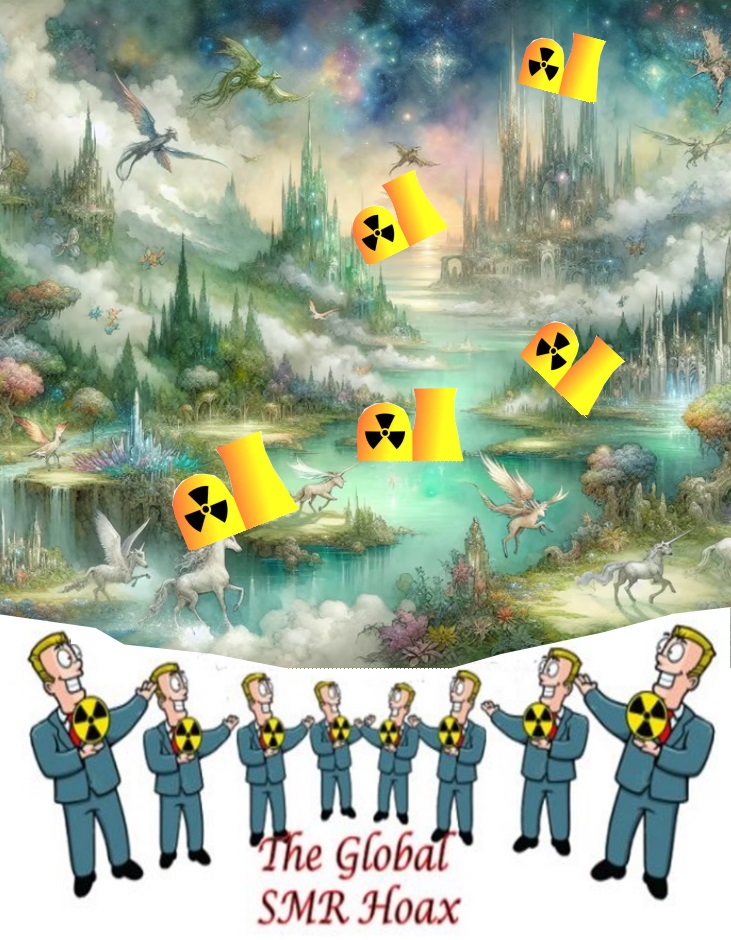
Small Modular Reactors (SMRs) are the nuclear industry’s latest shiny dream. It is more hope than strategy. SMRs only exist in the imagination of the nuclear industry and its supporters. SMRs can only be found on glossy PowerPoint slides. That is why Mycle Schneider dubbed SMRs “power point reactors.” There are no engineering plans, no blueprints, no working prototypes.
Climate and Capital Media, by Arnie Gundersen | Jun 20, 2025
Don’t believe the hype, says a 50-year industry veteran
“The definition of insanity is doing the same thing repeatedly and expecting different results.”
Everywhere you look, the nuclear industry’s hype machine is in overdrive. Columbia University’s Center on Global Energy Policy urges a “warp speed” nuclear revival. Goldman Sachs, Microsoft, and the UK government all tout small modular reactors (SMRs) as the silver bullet for climate change and energy security. Tech billionaires are hiring nuclear veterans. Wall Street is whispering about “round-the-clock power” for AI data centers. The UK is betting billions on “mini nukes” to fill its looming energy gap.
For those old enough to remember, this should sound familiar. For those who don’t, listen up. I spent over 50 years in the nuclear industry, advancing to Senior Vice President and managing projects at 70 nuclear power plants. I hold a nuclear safety patent and co-authored three peer-reviewed papers on the spread of radiation after meltdowns.
I once believed in the dream. I helped build the dream. And now, watching this third act unfold, I can only shake my head at the déjà vu. Because the nuclear industry’s latest pitch is not a revolution, but a rerun — an expensive distraction from real climate solutions.
The nuclear industry’s latest pitch is not a revolution, but a rerun — an expensive distraction from real climate solutions.
What is an SMR, anyway?
Small Modular Reactors (SMRs) are the nuclear industry’s latest shiny dream. It is more hope than strategy. SMRs only exist in the imagination of the nuclear industry and its supporters. SMRs can only be found on glossy PowerPoint slides. That is why Mycle Schneider dubbed SMRs “power point reactors.” There are no engineering plans, no blueprints, no working prototypes.
Still, hope springs eternal, and the idea is to build advanced atomic fission reactors, typically defined as producing up to 300 megawatts of electricity per unit, less than a third the size of a conventional nuclear plant.
The “small” part refers to their reduced output and physical footprint, while “modular” means they’re designed to be built in factories, shipped to sites, and installed as needed, supposedly making them cheaper and faster to deploy than traditional reactors. In theory, you could add modules over time to scale up output, like snapping together Lego blocks.
Too small to succeed
But let’s not be fooled by the word “small.” Even a single SMR is a massive, highly radioactive industrial machine, capable of powering a mid-sized city and containing a radioactive inventory far greater than the bombs dropped on Hiroshima and Nagasaki.
The “small” label is relative only to the behemoths of the last century. In practice, a “small” reactor brings all the big problems of a conventional reactor: dangerous radioactive fuel, complex safety systems, and the risk of catastrophic failure or sabotage. The only thing that’s truly small about SMRs is their inability to benefit from the economies of scale that, in theory, were supposed to make large reactors affordable — but never actually did.
All risk, no advantage
So, the SMR is a lose-lose: all the risks and headaches of traditional nuclear, but with none of the cost or scale advantages that never materialized in the first place.
But that is not stopping nuclear power zealots from championing what will be another failed chapter in the sad legacy of commercial atomic power. Sensing blood, the battered commercial nuclear industry is back with its most audacious pitch yet: SMR lobbying of governments worldwide for taxpayer money. Why? No private investor will touch nukes with a ten-foot uranium rod.
The irony is rich: while Goldman Sachs, Microsoft, and Amazon herald SMRs as the solution to everything from AI’s energy hunger to coal’s decline, the nuclear vendors themselves won’t promise atomic power will be cheaper than renewables. Perhaps they recall the Westinghouse executives who were imprisoned for defrauding the public on atomic project costs. They know what I know: it is pure fantasy to think smaller, less powerful SMRs will magically generate cheap power. Power generation doesn’t work that way.
A legacy of failure — and my place in it
I started my career in the early 1970s, a young engineer with a master’s degree and a reactor operator’s license, working on Millstone Unit 1 in Connecticut. We were going to make electricity “too cheap to meter.” Instead, we made it too expensive to afford — and too complex to run reliably…………………………………………………………………………………………………………………….
“The NRC is truly a captured agency… NEI complained that the agency’s proposed language for a new rule to weaken security for new nuclear reactors was too stringent. So, the NRC complied and completely eviscerated the draft. Pathetic,” said Dr. Edwin Lyman, Union of Concerned Scientists
Who’s who in SMRs
But none of this has stopped nuclear vendors from pushing their SMR hopefuls:
- Holtec: It has never built a reactor. Its design has changed three times in three years, each version more complex. Larger and expensive than the last. At one point, Holtec claimed its reactor would be as safe as a chocolate factory. Willy Wonka would disagree.
Natrium: Backed by Bill Gates, it uses liquid sodium coolant and a thermal storage gimmick. The design is so complicated that the only thing it’s likely to generate is more press releases — and perhaps a few more government grants. And here’s the kicker: the only fuel available for Natrium’s first core load was to come from Russia. When Russia invaded Ukraine, the project was immediately delayed by at least two years, exposing the folly of building a new generation of reactors dependent on a single, geopolitically fraught source of fuel.- NuScale: The first to get NRC approval for an SMR design, but has no customers and just canceled its flagship project due to cost overruns. Its original 50 MW design was quickly upsized to 77 MW after the economics failed to pencil out. After revisiting the drawing board, the new version was just approved in May, but there are no unsubsidized potential buyers.
- Westinghouse: The old hand. Its AP1000 reactors in Georgia nearly bankrupted the company. Now it’s back with an even smaller AP300. Because if at first you don’t succeed, shrink the reactor and try again.
Goldman Sachs, Microsoft, and the UK: The new true believers
But never let facts get in the way of a good story. It’s almost touching to see the world’s financial and tech giants lining up behind SMRs, as long as they are subsidized by someone else……………………………………………….
Why nuclear can’t compete with renewables
The dream of the first nuclear plants was that mining uranium was a lot cheaper than mining coal. But while nuclear costs continue to rise, wind, solar, and battery storage are becoming increasingly cheaper and more reliable every year. And the sun and wind give energy for free. Renewables are now the lowest-cost source of new electricity in most markets. Nuclear, by contrast, has never achieved cost reductions through learning or mass production. Every new design is a new experiment, with new risks and new costs……………………………………………….
SMRs will never be built
Here’s the final irony: despite all the headlines and billions in taxpayer subsidies, an SMR will never be built — not in time to matter, and not at a price that makes sense. But that won’t stop the industry from burning through billions more in public money, chasing a fantasy that distracts and diverts resources from real, proven solutions. As Yogi Berra said, “It’s déjà vu all over again.” And as someone who’s lived through every act of this atomic opera, I can only add: Fool me once, shame on you. Fool me twice, shame on me. Fool me a third time? Well, that’s just nuclear insanity.
Arnie Gundersen is a former nuclear industry executive and Chief Engineer at Fairewinds Energy Education. He has testified as an expert on nuclear safety and reliability worldwide.
No comments yet.
1 This Month
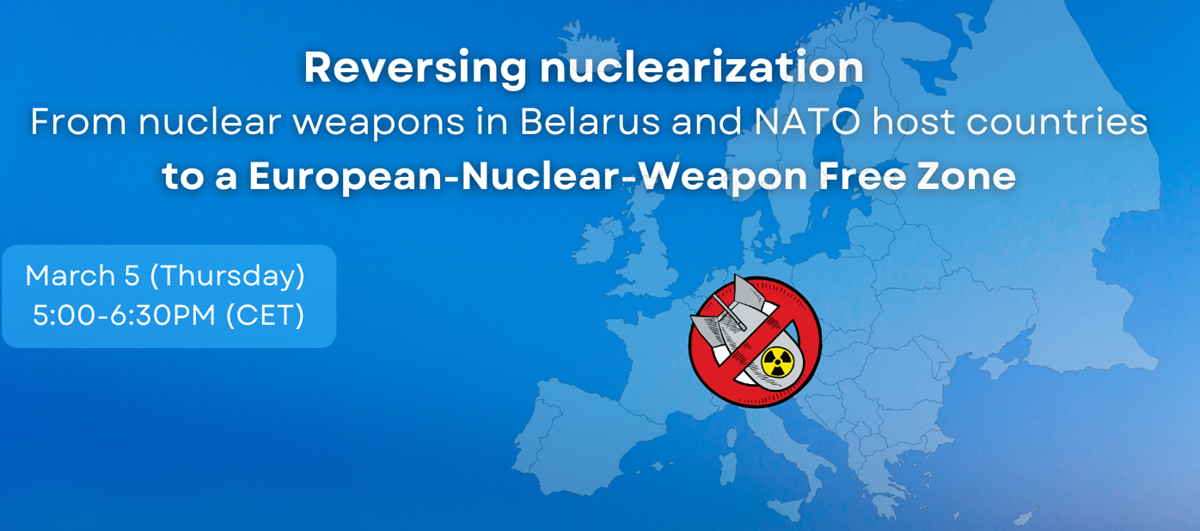
5 March -Online – Reversing nuclearization:
From nuclear weapons in Belarus and NATO host countries to a European-Nuclear-Weapon Free Zone
11am-12:30pm Eastern Time USA / 5pm-6:30pm CET

of the week – Advocating for a
nuclear free beach – https://www.samuellawrencefoundation.org/
The Samuel Lawrence Foundation advocates for a Nuclear Waste Free Beach at San Onofre, join us and take action!

10 March A LIVE WEBINAR THE REAL EFFECTS OF NUCLEAR POWER
What the Industry Isn’t Telling Us
1:00 PM Mountain, 2 pm Central, 3 pm Eastern. Live on the Keepers of the Water Facebook page

18 March Webinar @ 1 PM EST: An Assessment of SMR Projects: The Case of Canada
register for the zoom:
https://us02web.zoom.us/webinar/register/WN_o8BIIOUvQ2ONJR1nta65DQ#/registration

of the week – STOP SMALL MODULAR REACTORS IN CANADA
To see nuclear-related stories in greater depth and intensity – go to https://nuclearinformation.wordpress.com
-
Archives
- March 2026 (38)
- February 2026 (268)
- January 2026 (308)
- December 2025 (358)
- November 2025 (359)
- October 2025 (376)
- September 2025 (258)
- August 2025 (319)
- July 2025 (230)
- June 2025 (348)
- May 2025 (261)
- April 2025 (305)
-
Categories
- 1
- 1 NUCLEAR ISSUES
- business and costs
- climate change
- culture and arts
- ENERGY
- environment
- health
- history
- indigenous issues
- Legal
- marketing of nuclear
- media
- opposition to nuclear
- PERSONAL STORIES
- politics
- politics international
- Religion and ethics
- safety
- secrets,lies and civil liberties
- spinbuster
- technology
- Uranium
- wastes
- weapons and war
- Women
- 2 WORLD
- ACTION
- AFRICA
- Atrocities
- AUSTRALIA
- Christina's notes
- Christina's themes
- culture and arts
- Events
- Fuk 2022
- Fuk 2023
- Fukushima 2017
- Fukushima 2018
- fukushima 2019
- Fukushima 2020
- Fukushima 2021
- general
- global warming
- Humour (God we need it)
- Nuclear
- RARE EARTHS
- Reference
- resources – print
- Resources -audiovicual
- Weekly Newsletter
- World
- World Nuclear
- YouTube
-
RSS
Entries RSS
Comments RSS
 nuclear-news
Leave a comment