Rosatom: A company at war
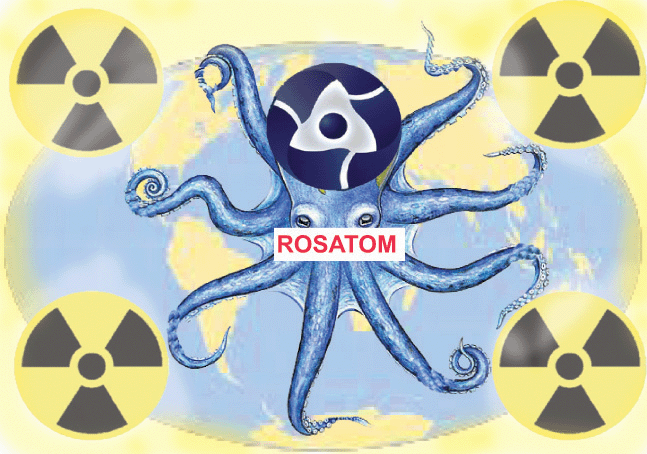
by beyondnuclearinternational, https://beyondnuclearinternational.org/2025/06/15/rosatom-a-company-at-war/
Nuclear state entity is on the ground in Ukraine and smoothing the way for new atomic tests, writes Charles Digges
If Russia’s state nuclear corporation Rosatom is to be believed, 2024 was a banner year.
It is expanding its footprint in new markets in Africa, Asia and the Middle East, as well as in Central Asian post-Soviet states. It is running an expansive development program along the Northern Sea Route, the 6,000-kilometer Arctic shipping corridor uniting Europe and Asia, and is responsible for everything from nuclear icebreaker construction to port infrastructure along its reach. It is powering the mining of rare earth minerals essential for renewable energy and electronics in operations from the Kola Peninsula to Siberia. It is acquiring domestic energy firms and making forays into transport, housing and utilities. And, of course, it is building nuclear power plants in foreign markets — including in some NATO members — at a pace unmatched by any other country or corporation.
But the slick commercial rhetoric belies the fact that Rosatom is a company that is literally at war.
As one of the Kremlin’s prize state industries, Rosatom has reoriented its practices to align with Moscow’s war economy as the invasion of Ukraine drags on. For this, it receives lavish state support and is overseen by members of President Vladimir Putin’s inner circle. Yet, unlike other energy producers in Russia’s oil and gas sectors, Rosatom has thus far managed to sidestep any serious sanctions from the West, attesting to the dependence it has fostered on the international nuclear market.
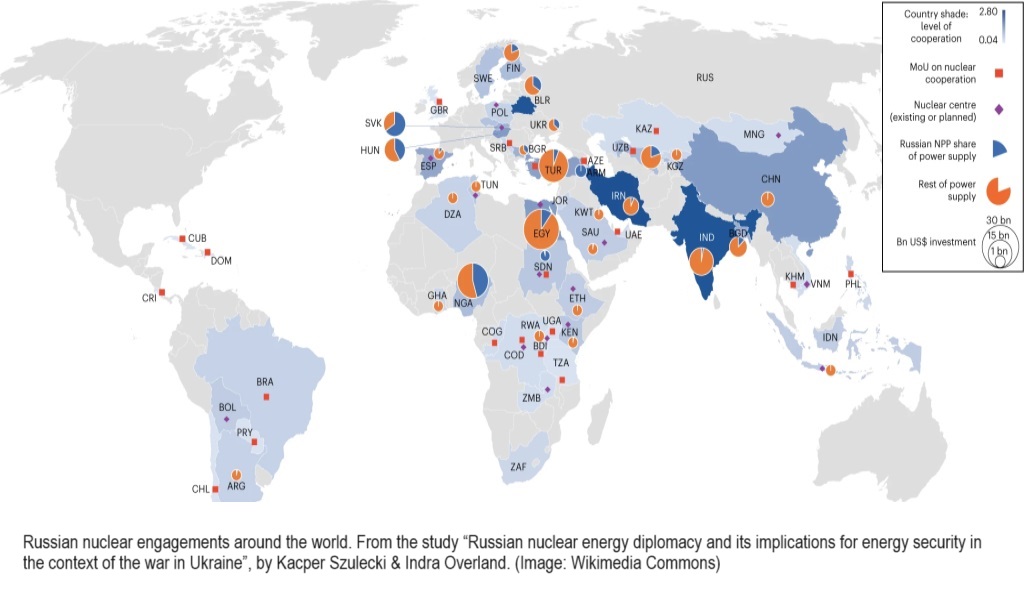
Recently, Western markets have begun to challenge Rosatom’s dominance as they attempt to shift their dependence away from Russian-produced nuclear fuels and other technologies. But our new report suggests that Rosatom is preparing for such shortfalls by changing customers and expanding its operations into industries beyond the nuclear — including further enmeshing itself in Moscow’s war as an active military participant. These are the corporate achievements that are less likely to appear in the company’s glossy public relations materials.
Rosatom at war
For instance, the putatively civilian corporation is helping Russian arms makers sidestep bans on Western-produced components for weapons used on the Ukrainian front. It has also developed technology for the Oreshnik line of ballistic missiles, producing a warhead tip so durable that the company brags it can withstand temperatures as hot as the surface of the Sun.
The corporation also seems to be smoothing the way for various weapons tests, including nuclear tests, on Novaya Zemlya, an Arctic archipelago used by the Soviets as an atomic bomb testing range. Most recently, it has been the site of trials for the Burevestnik nuclear-powered cruise missile developed by Rosatom technicians.
Russia’s recent withdrawal from its ratification of the Comprehensive Nuclear Test Ban Treaty and its abandonment of other arms agreements with the West coincides with a hive of activity on this frozen strip of land, suggesting Russia may be moving back toward testing nuclear weapons. Rosatom, the steward of Russia’s nuclear arsenal, will surely be at the center of it.
Rosatom likewise continues to tighten its grip on the Zaporizhzhia nuclear power plant in Ukraine — Europe’s largest atomic energy station — which the Russian military seized in the opening days of its invasion in 2022. It is widely assumed from the Kremlin’s official statements that Rosatom intends to absorb the plant, making it the 12th nuclear power plant in its purview — and marking one of the most breathtaking seizures of war booty in modern warfare.
What the corporation is ignoring
Alongside these endeavors stands the fact, which Rosatom is loath to mention in its brochures, that Rosatom’s domestic fleet of 36 reactors is aging. Most need to be replaced by 2065, but the funds for this are severely lacking. The company’s current plans to extend runtimes at several aged Chernobyl-style reactors suggest that this is a problem the corporation will not be able to solve anytime soon.
Rosatom has also snuffed out its past efforts to clean up Russia’s Soviet nuclear legacy, retooling many of the constituent enterprises that were responsible for that to handling non-nuclear hazardous waste. These moves turn away from more than two decades of effort with the international community and mark the corporation’s increasing efforts to shut itself off both from the West and from scrutiny at home.
The war in Ukraine and accompanying stifling of civil society organizations — including my employer, Bellona — that once held Rosatom to account has fueled that opacity.
In fact, such organizations once formed Rosatom’s Public Council, which kept the corporation in conversation with environmentalists and the public it purported to serve. While the Public Council still exists, it is staffed by Putin’s cronies, including one from his intramural hockey team.
Nor is there anything left of the robust network of strident Russian-grown, anti-nuclear NGOs that for years fought to keep Rosatom’s activities in the public eye. Their disappearance has left Rosatom to its own secretive devices, the organizations themselves hounded out of existence by the Kremlin’s war bureaucracy.
Rosatom helps Moscow divide the world
All of this taken together — both what the corporation will and will not tell us — paints a picture of Rosatom as primarily a formidable political tool. This allows it to couple a broad mandate at home with a campaign of influence abroad. By offering its reactor customers enormous state-backed loans to build nuclear plants that Rosatom will service, fuel and, in many cases, even staff for decades to come, the corporation is vital to creating regimes that are friendly to — and dependent on — Moscow around the world.
While the war in Ukraine has perhaps cost Rosatom some of its former markets in the West, the company has, as our report shows, survived these geopolitical shifts and remained a powerful vector of Russian influence. As a result, the company will continue to help cleave away many of the world’s nations to Moscow’s geopolitical cause.
Charles Digges is an environmental journalist and researcher who edits the website of the Norway-based NGO Bellona.
No comments yet.
1 This Month

of the week – Shut Down Drone Warfare!


Tell the Ukrainian Government to Drop Prosecution of Peace Activist Yurii Sheliazhenko

Petition to revoke the licensing of the Near Surface Nuclear Disposal Facility (NSDF) at Chalk River. https://www.ourcommons.ca/petitions/en/Petition/Details?Petition=e-7247
To see nuclear-related stories in greater depth and intensity – go to https://nuclearinformation.wordpress.com
-
Archives
- March 2026 (230)
- February 2026 (268)
- January 2026 (308)
- December 2025 (358)
- November 2025 (359)
- October 2025 (376)
- September 2025 (257)
- August 2025 (319)
- July 2025 (230)
- June 2025 (348)
- May 2025 (261)
- April 2025 (305)
-
Categories
- 1
- 1 NUCLEAR ISSUES
- business and costs
- climate change
- culture and arts
- ENERGY
- environment
- health
- history
- indigenous issues
- Legal
- marketing of nuclear
- media
- opposition to nuclear
- PERSONAL STORIES
- politics
- politics international
- Religion and ethics
- safety
- secrets,lies and civil liberties
- spinbuster
- technology
- Uranium
- wastes
- weapons and war
- Women
- 2 WORLD
- ACTION
- AFRICA
- Atrocities
- AUSTRALIA
- Christina's notes
- Christina's themes
- culture and arts
- Events
- Fuk 2022
- Fuk 2023
- Fukushima 2017
- Fukushima 2018
- fukushima 2019
- Fukushima 2020
- Fukushima 2021
- general
- global warming
- Humour (God we need it)
- Nuclear
- RARE EARTHS
- Reference
- resources – print
- Resources -audiovicual
- Weekly Newsletter
- World
- World Nuclear
- YouTube
-
RSS
Entries RSS
Comments RSS
 nuclear-news
Leave a comment