The ‘unsustainable’ reason behind who can have nuclear weapons, and who can’t

there was no evidence of active weaponisation, or that Israel’s strike was “pre-emptive in the sense that Iran was clearly planning an attack on Israel that was imminent”.
“the most flagrant example of double standards that you could possibly imagine”.
Israel has said its attack on Iran on Friday was partially aimed at destroying its nuclear infrastructure. But it’s far from the only country to have developed its capacity in recent years.
By Alex Gallagher, 16 June 2025, https://www.sbs.com.au/news/article/the-unsustainable-decision-on-who-gets-to-have-nuclear-weapons-and-who-doesnt/dpk5breh3
On Friday, Israel launched its largest attack on Iran in decades, with a wave of airstrikes that hit nuclear facilities, military sites and residential buildings in the capital, Tehran.
Iran responded with retaliatory strikes on Israel, and the two countries have continued trading missile fire for days.
Iran’s health ministry said 224 people have been killed by Israel’s attacks, while Israel said 13 have been killed by Iranian strikes. Hundreds of people have been wounded in both countries.
Israeli Prime Minister Benjamin Netanyahu said the goal of Friday’s strikes was partially to wipe out Iran’s nuclear program, calling the strikes “pre-emptive”.
The strikes caused significant damage to linked sites such as the Natanz nuclear facility and a uranium enrichment facility in Isfahan, and killed multiple nuclear scientists in addition to military officials and civilians.
Israel has long claimed Iran is developing a nuclear weapon, with Netanyahu calling it an “existential threat to Israel”.
Iran has consistently denied it is developing nuclear weapons, saying its uranium enrichment program is exclusively for peaceful purposes such as energy, and international assessments have found no evidence that Iran, over the past 20 years, has had an active nuclear weaponisation program.
Iran’s Supreme Leader, Ayatollah Ali Khamenei, has repeatedly said there is an Islamic fatwa — a legal ruling — against the development of nuclear weapons, and that such development is prohibited under Islamic law.
Shortly before Israel’s strikes on Iran, the United Nations’ global nuclear watchdog, the International Atomic Energy Agency (IAEA), declared Iran was in breach of its non-proliferation obligations for the first time in 20 years.
The IAEA cited “many failures” since 2019 to uphold its obligations to provide the agency with “full and timely co-operation regarding undeclared nuclear material and activities”.
Earlier this month, the IAEA said Iran had enough uranium enriched to near-weapons grade to potentially make nine nuclear bombs.
In recent days, Foreign Minister Penny Wong, Defence Minister Richard Marles and Opposition leader Sussan Ley have all described Iran’s nuclear program as a significant “threat” to international peace and security.
Tilman Ruff is an honorary principal fellow at The University of Melbourne and the co-president of International Physicians for the Prevention of Nuclear War and was a founding chair of the International Campaign to Abolish Nuclear Weapons.
He told SBS News while it’s “pretty clear that Iran was flirting with nuclear weapons” and had an early nuclear weapons program around 20 years ago, there was no evidence of active weaponisation, or that Israel’s strike was “pre-emptive in the sense that Iran was clearly planning an attack on Israel that was imminent”.
Israel has never formally confirmed or denied if it has nuclear weapons itself, long maintaining a policy of deliberate ambiguity.
It’s also never signed two key international agreements aimed at the non-proliferation and prohibition of nuclear weapons. These factors have contributed to the widely held perception that Israel owns nuclear weapons.
Ruff described Israel’s “extremely dangerous” attack on Friday as “the most flagrant example of double standards that you could possibly imagine”.
When it comes to countries developing nuclear capacities, Ruff said the “inherent ambiguity” of nuclear programs made it a far bigger issue than just Iran.
“Any country that’s determined to do so, that’s got either an enrichment plant or a nuclear reactor, can build a nuclear weapon,” he said.
“If you can produce uranium to run in reactors, then you’ve got everything you need to enrich it to weapons grade. And there are other countries with vast stocks much larger than Iran’s of weapons-usable material.
“There are many other countries who have been flirting with having nuclear facilities and the capacity to produce fissile material quickly to shorten the path to a weapon, should they choose to do so.”
Which countries have nuclear weapons?
Eight countries have declared they have nuclear weapons: Russia, the United States, China, France, the United Kingdom, India, Pakistan and North Korea.
Russia and the US control the vast majority of these weapons, together possessing around 90 per cent of the 12,241 estimated warheads that exist globally, according to the Stockholm International Peace Research Institute (SIPRI).
While Israel is also strongly believed to have nuclear weapons, including by SIPRI, it has long maintained a policy of deliberate ambiguity.
Ruff said there had been “very clear threats” of nuclear weapon use from Israeli government members.
Most recently, in November 2023, Israeli minister Amihai Eliyahu said a nuclear strike on Gaza would be “one way” of responding to Hamas’ October 7 attack on Israel.
Some viewed Eliyahu’s comments as an implicit admission that Israel had nuclear capabilities.
The comments were disavowed by Israeli politicians, including a rebuke by Netanyahu.
SIPRI, in its annual assessment of armaments, disarmament and international security on Monday, warned the world’s nuclear arsenals were being enlarged.
SIPRI stated that the nine nuclear-armed states continued to modernise and upgrade their nuclear capabilities throughout 2024.
SIPRI’s Hans M Kristensen said: “The era of reductions in the number of nuclear weapons in the world, which had lasted since the end of the Cold War, is coming to an end.”
“Instead, we see a clear trend of growing nuclear arsenals, sharpened nuclear rhetoric and the abandonment of arms control agreements.”
What steps have been taken to limit nuclear weapons?
Multiple international agreements have aimed at curbing the spread of nuclear weapons with a view towards disarmament.
The United Nations-backed Treaty on the Non-Proliferation of Weapons (NPT) came into effect in 1970, and included agreements from Russia, the US, the UK, China and France.
Those states agreed to pursue disarmament in exchange for the rest of the treaty’s signatories agreeing never to acquire nuclear weapons.
The treaty has overwhelming support, with 191 states being party to it, including Iran.
Israel is one of the few countries — along with India, Pakistan, North Korea and South Sudan — to not have signed on, due to its policy of deliberate ambiguity.
Ruff said a shortcoming of the treaty was that, while it contained a detailed regime regarding non-proliferation by states that didn’t already have nuclear weapons, there were no clear details or timeframe for other countries to implement disarmament.
UK Nuclear power is not a done deal.
Sophie Bolt, CND General Secretary, CND 13th June 2025 https://cnduk.org/nuclear-power-is-not-a-done-deal/
This week has seen the Government’s latest attempt to foist a nuclear future on Britain. But despite its increased promised financial support, the nuclear issue is clearly not a done deal, writes Vice President Dr Ian Fairlie.
The media’s response to the Government’s nuclear push has been decidedly unenthusiastic as can be seen from the selection below of UK newspaper comments. Most are cool or unenthusiastic: some are downright critical.
“Sizewell C nuclear cost doubled to £40bn – UK govt to shoulder half upfront cost, will ultimately be paid for by households and businesses via electricity bills.” https://www.telegraph.co.uk/business/2025/06/11/cost-of-milibands-nuclear-plant-doubles-to-more-than-40bn/
“£14bn investment in a new mega nuclear power station, Sizewell C, is not being classified as a financial asset. So all £14bn of the finance will be added to the value of national debt, rather than the zero net figure. This is what would have happened under the old fiscal definitions, so what on earth was the point of Reeves’s controversial fiscal-rule change? In serious practical terms, it means there is £14bn less to invest in other projects – which is the opposite of what the fiscal rule change was supposed to achieve. In other words Reeves’s changes to the fiscal rules now seem totally pointless – because if investing in a cutting-edge power plant does not create a valuable and sellable financial asset, then goodness alone knows what would.”
https://www.itv.com/news/2025-06-10/peston-why-arent-treasury-and-reeves-investing-more
“The government has commissioned just three SMR reactors, none expected before 2035. Rolls Royce said in 2015 that to make building a modular factory worthwhile, you would need an order book of 50 to 70.”
https://www.thetimes.com/comment/columnists/article/spending-review-miliband-nuclear-reeves-grpp5l8d5
“GB Energy handed £2.5bn bill for funding small modular reactors. Financing nuclear projects will leave state-owned company less cash for backing wind and solar technology.”
https://www.ft.com/content/a8e3a775-33c9-4ad6-b01a-bfb212dfdcbe
“Imagine this – one morning you’ll be strolling down to the park to give the dog some exercise, and ka-boom! The roof’s blown off the local baby nuke, and glowing hot radioactive ash is showering the surrounding streets. A small armageddon, but an armageddon all the same. Widespread use of nuclear power is the kind of thing that, among other things, such as leaving a toxic legacy for thousands of years and an upsurge in deformities and cancers, could end political careers.”
https://www.independent.co.uk/voices/ed-miliband-sizewell-c-nuclear-power-energy-b2767052.html
“The Scottish Government has a long-standing objection to nuclear power mainly on environmental grounds. Those objections are not daft – to this day, governments around the world are vexed by the question of how to dispose safely of highly dangerous radioactive waste. Accidents at nuclear power plants can be catastrophic. More immediately, building new nuclear capacity is also infamously expensive and costs are prone to rise, often astronomically.”https://www.heraldscotland.com/politics/viewpoint/25232597.scotland-blindly-follow-england-nuclear-power-path/
Will the Government really push ahead with its new nuclear proposals given this chorus of doubts? It’s a moot point. It would surprise no-one if we were to see quiet retrenchments or delays….much like we are seeing with another Government mega-project – HS2.
More to the point, we need to address the whopping elephant in the room here which is …why is the Government pressing ahead with these unpopular ill-advised proposals? In fact, the previous Sunak government admitted the real reasons for supporting nuclear….the military ones. That is, the MOD’s perceived needs to maintain nuclear technology and know-how for its nuclear weapons programme – both for the warheads and the submarine reactors.
We think this Government should own up to these reasons and stop pretending that its civil nuclear proposals are about satisfying our energy needs. They, most decidedly, are not. If the Government were to retire its ageing nuclear weapons, it would also free up its way to intelligent energy policies as well. A two-fold bonus for Britain.
Condemning the Right to Self Defence: Iran’s Retaliation and Israel’s Privilege
16 June 2025 Dr Binoy Kampmark , https://theaimn.net/condemning-the-right-to-self-defence-irans-retaliation-and-israels-privilege/
There is a throbbing complaint among Western powers, including those in the European Union and the United States. Iran is not playing by the rules. Instead of accepting with dutiful meekness the slaughter of its military leadership and scientific personnel, Tehran decided, promptly, to respond to Israel’s pre-emptive strikes launched on June 13. Instead of considering the dubious legal implications of such strikes, an act of undeclared war, the focus in the European Union and various other backers of Israel has been to focus on the retaliation itself.
To the Israeli attacks conducted as part of Operation Rising Lion, there was studied silence. It was not a silence observed when it came to the invasion of Ukraine in February 2022 by Vladimir Putin’s Russia. Then, the law books were swiftly procured, and obligations of the United Nations Charter cited under Article 2(4): “All members shall refrain from the threat or use of force against the territorial integrity of any state.” Russia was condemned for adopting a preventive stance on Ukraine as a threat to its security: that, in Kyiv joining NATO, a formidable threat would manifest at the border.
In his statement on the unfolding conflict between Israel and Iran, France’s President Emmanuel Macron made sure to condemn “Iran’s ongoing nuclear program,” having taken “all appropriate diplomatic measures in response.” Israel also had the “right to defend itself and ensure its security,” leaving open the suggestion that it might have been justified resorting to Article 51 of the UN Charter. All he could offer was a call on “all parties to exercise maximum restraint and to de-escalate.”
In a most piquant response, Francesca Albanese, UN Special Rapporteur on the Occupied Palestinian Territories stated that, “On the day Israel, unprovoked, has attacked Iran, killing 80 people, the president of a major European power, finally admits that in the Middle East, Israel, and only Israel, has the right to defend itself.”
The German Foreign Office was even bolder in accusing Iran of having engaged in its own selfish measures of self-defence (such unwarranted bravado!), something it has always been happy to afford Israel. “We strongly condemn the indiscriminate Iranian attack on Israeli territory.” In contrast, the foreign office also felt it appropriate to reference the illegal attack on Iran as involving “targeted strikes” against its nuclear facilities. Despite Israel having an undeclared nuclear weapons stockpile that permanently endangers security in the region, the office went on to chastise Iran for having a nuclear program that violated “the Non-Proliferation Treaty,” threatening in its nature “to the entire region – especially Israel.” Those at fault had been found out.
The President of the EU Commission, Ursula von der Leyen, could hardly improve on that apologia. She revealed that she had been conversing with Israeli President Isaac Herzog about the “escalating situation in the Middle East.” She also knew her priorities: reiterating Israel’s right to self-defence and refusing to mention Iran’s, while tagging on the statement a broader concern for preserving regional stability. The rest involved a reference to diplomacy and de-escalation, toward which Israel has shown a resolute contempt with regards Iran and its nuclear program.
The assessment offered by Mohamed ElBaradei, former Director General of the International Atomic Energy Agency (IAEA), was forensically impressive, as well as being icily dismissive. Not only did he reproach the German response for ignoring the importance of Article 2(4) of the Charter prohibiting the use of force subject to the right to self-defence, he brought up a reminder: targeted strikes against the nuclear facilities of any party “are prohibited under Article 56 of the additional protocol of the Geneva Conventions to which Germany is a party.”
ElBaradei also referred anyone exercised by such matters to the United Nations Security Council 487 (1981), which did not have a single demur in its adoption. It unreservedly condemned the attack by Israel on Iraq’s Osirak nuclear research reactor in June that year as a violation of the UN Charter, recognised that Iraq was a party to the Treaty on the Non-Proliferation of Nuclear Weapons (NPT) and had permitted the IAEA inspections of the facility, stated that Iraq had a right to establish and develop civilian nuclear programs and called on Israel to place its own nuclear facilities under the jurisdictional safeguards of the IAEA.
The calculus regarding the use of force by Israel vis-à-vis its adversaries has long been a sneaky one. It is jigged and rigged in favour of the Jewish state. As Trita Parsi put it with unblemished accuracy, Western pundits had, for a year and a half, stated that Hamas, having started the Gaza War on October 7, 2023 bore responsibility for civilian carnage. “Western pundits for the past 1.5 days: Israel started the war with Iran, and if Iran retaliates, they bear responsibility for civilian deaths.” The perceived barbarian, when attacked by a force seen as superior and civilised, will always be condemned for having reacted most naturally, and most violently of all.
Sources: US Will Enter Israel’s War With Iran

By Dave DeCamp / Antiwar.com, June 16, 2025, https://scheerpost.com/2025/06/16/sources-us-will-enter-israels-war-with-iran/
Sources familiar with the matter have told Antiwar.com Editorial Director Scott Horton that the Trump administration is poised to enter Israel’s aggressive war against Iran directly. US airstrikes on Iran could begin as soon as Monday.
Please contact the White House by sending an email or calling the comment line starting at 10 am EST on Monday (202‑456‑1111). Tell them that you do not want the US to enter this disastrous war, which could lead to heavy American casualties at US bases across the Middle East.
The US has supported the war by reportedly providing Israel with intelligence and helping intercept Iranian missiles and drones, but so far, there have been no direct US attacks on Iran. Iranian officials have warned that Tehran would hit US bases in the region in response to any US strikes.
Axios reported on Saturday that Israel is urging the US to join the war since Israel lacks the bunker-busting bombs necessary to do serious damage to Iran’s Fordow plant, which is buried deep underground. An Israeli official told Axios that President Trump had previously suggested the US could strike Fordow.
Trump himself said on Sunday that it was “possible” that the US would get directly involved in the war, which Israel launched early Friday morning with airstrikes across Iran.
Israeli Prime Minister Benjamin Netanyahu started the war under the pretext of preventing Iran from building a nuclear weapon. But it was the consensus of the US intelligence community that there was no evidence Iran was working toward a nuclear weapon, and Tehran made clear they were ready to make a deal with the US that would significantly lower uranium enrichment levels and increase oversight of its nuclear program in exchange for US sanctions relief.
Ali Larijani, an aide to Iranian Supreme Leader Ayatollah Ali Khamenei, has previously said that the one thing that would make Tehran reconsider its prohibition on the development of nuclear weapons would be a US or Israeli attack.
“We are not moving towards (nuclear) weapons, but if you do something wrong in the Iranian nuclear issue, you will force Iran to move towards that because it has to defend itself,” Larijani said on April 1.
“Iran does not want to do this, but … (it) will have no choice,” he added. “If at some point you (the US) move towards bombing by yourself or through Israel, you will force Iran to make a different decision.”
Where is scrutiny of UK’s nuclear submarine plans?
Samuel Rafanell-Williams, Scottish CND
VERY serious questions have yet to be either asked
or answered about the UK Government’s proposed military spending plans,
following its Strategic Defence Review (SDR) announcement two weeks ago.
In particular, there has yet to be any serious scrutiny of the proposal to
build 12 nuclear-propelled submarines under the Aukus agreement, the
military co-operation agreement between the US, UK and Australia. This
scrutiny is especially necessary given that the Pentagon this week
announced a review of its commitment to the agreement, raising questions
about whether the billions of pounds committed by the UK Government are
destined for the drain.
The Aukus agreement’s main aim is the material
support of the Australian Navy in the Indo-Pacific, primarily by providing
it with eight nuclear-powered submarines of the kind announced in the SDR.
This means several of the 12 nuclear submarines will probably end up
lurking around in the South China Sea, contributing nothing to the defence
of the UK and raising regional tensions.
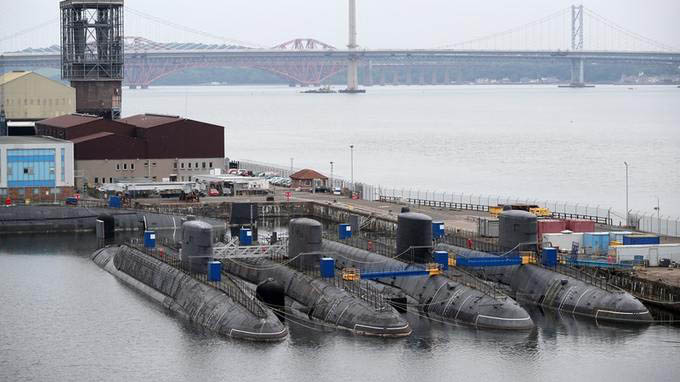
The UK Government’s irrational and incoherent military spending plans come at a time when the current generation of submarines based at Faslane are in an increasingly atrocious
state of disrepair. Serious radioactive risk incidents at the naval base
are increasing. The Vanguard nuclear-armed submarines are going on
record-long assignments while their substitutes sit rusting in the repair
docks.
Crew are likely enduring awful conditions during six-month stints
underwater, with some reports saying they ran out of food during the last
assignment. Meanwhile, the Dreadnoughts that will supposedly replace these
ailing vessels are unlikely to enter service for 10 years at least – if
the reactors to power them can be built at all. The UK’s nuclear
superpower farce is unsustainable and a disaster waiting to happen. Those
of us who understand this in Scotland must support the parties which oppose
nuclear weapons in the run-up to the 2026 election, and keep up the
pressure on Scottish parliamentarians to support the UN Treaty on the
Prohibition of Nuclear Weapons.
The National 14th June 2025,
https://www.thenational.scot/politics/25239090.scrutiny-uks-nuclear-submarine-plans/
Sizewell C nuclear’s ecological cost may be far greater than the financial one.

Government commits £14.2bn to Sizewell C nuclear plant
Bird Guides 13th June 2025, https://www.birdguides.com/news/government-commits-14-2bn-to-sizewell-c-nuclear-plant/
The UK Government has pledged £14.2 billion to fund the controversial Sizewell C nuclear power plant in Suffolk, sparking alarm among environmental groups over the project’s potential impact on coastal ecosystems.
Chancellor Rachel Reeves announced the investment at the GMB union’s annual congress this week, calling it the largest state commitment to nuclear power in 50 years.
Construction of the plant, expected to take a decade, aims to power six million homes and contribute to a so-called “golden age of clean energy”. Ministers claim it will enhance energy security by reducing reliance on imported power.
Wildlife at risk
However, conservationists warn that the ecological cost may be far greater than the financial one. Sizewell C is set to be built on the edge of Minsmere RSPB, one of Britain’s most important nature reserves, home to species such as Western Marsh Harrier, Eurasian Bittern and Natterjack Toad. Campaigners argue the construction risks devastating local habitats, endangering wildlife and disrupting delicate wetland ecosystems.
Last year, Suffolk Wildlife Trust and the RSPB called for greater transparency from Sizewell C in relation to its wildlife-compensation schemes, which include EDF’s £5 million purchase of the 67-ha Aldhurst Farm, which has now become ‘Wild Aldhurst’.
Alison Downes of Stop Sizewell C condemned the move, accusing ministers of withholding the true cost of the development, which her group estimates could reach £40 billion. “This project threatens biodiversity and will leave a long-lasting scar on a vital coastal environment,” she said. “It’s an irreversible commitment with unclear benefits and guaranteed environmental harm.”
Pros and cons
Despite reassurances that the project will be funded through a Regulated Asset Base model – adding around £1 a month to household electricity bills over the plant’s 60-year lifespan – critics question whether the benefits outweigh the damage. The plant’s sister project, Hinkley Point C, remains unfinished and significantly over budget.
Energy Secretary Ed Miliband insisted Sizewell C will be “faster and cheaper” by replicating Hinkley’s design. He also highlighted the creation of 10,000 jobs and £330 million in local contracts, framing the investment as a catalyst for economic regeneration.
Yet opponents argue that job creation and energy gains do not justify the environmental cost. The government’s concurrent £2.5-billion investment in fusion energy and a new small modular reactor programme raises further questions about the need for another full-scale nuclear facility.
As ministers push forward, the battle between energy policy and environmental preservation intensifies – leaving the future of Suffolk’s protected coastline hanging in the balance.
Injustice of nuclear-weapons state Israel’s strikes against Iranian nuclear sites
Your leading article (“Reckoning”, Jun 14) states: “No
country can be expected to stand idly by while an avowed enemy works
steadily, decade after decade, in secret to create the ultimate weapon.”
Although written to justify Israel’s actions, this sentiment surely applies
both ways. Israel’s nuclear programme is shrouded in secrecy and the
country is not a signatory to the Nuclear Non-Proliferation Treaty.
Furthermore, Israel does not accept International Atomic Energy Authority
scrutiny of its activities, whereas Iran was locked in via the Obama
agreement. It’s this kind of asymmetric situation that is likely to fuel a
sense of injustice and unfairness in the minds of Iranians, and a
determination to strengthen their position by creating a nuclear weapon.
Times 16th June 2025, https://www.thetimes.com/comment/letters-to-editor/article/times-letters-israels-strikes-against-iranian-nuclear-sites-kvtkkqtst
Bankrupting the UK with Uranium Fuelled Nukiller

The following is an extract from Richard Murphy’s blog on the insanity of the nuclear boondoggle
Marianne Birkby, Radiation Free Lakeland, 13th June 2025, https://radiationfreelakeland.substack.com/p/bankrupting-the-uk-with-uranium-fuelled
A look at the National Grid Live right now shows that nuclear is providing 3.09 GW of electricity while wind is providing 15.94 GW and solar 4.12 GW and yet our chancellor chooses to put taxpayers money not into the free fuel of solar and wind but into the planetary destroying, uranium fuelled, nukiller.
“And let’s be clear that some of this capital expenditure also makes no sense at all. For example, one of the biggest items of expenditure will be on nuclear power stations, where supposedly at least £30 billion is to be spent, although everybody in reality knows that this will turn into a sum of well in excess of £100 billion, given the cost overruns that always occur in nuclear power budgets.
Starmer has claimed that the government has now decided that Sizewell C will be built. But as everyone in Suffolk knows, that decision was made long ago because the whole of East Suffolk has already been scarred with building works to facilitate the Sizewell C programme.
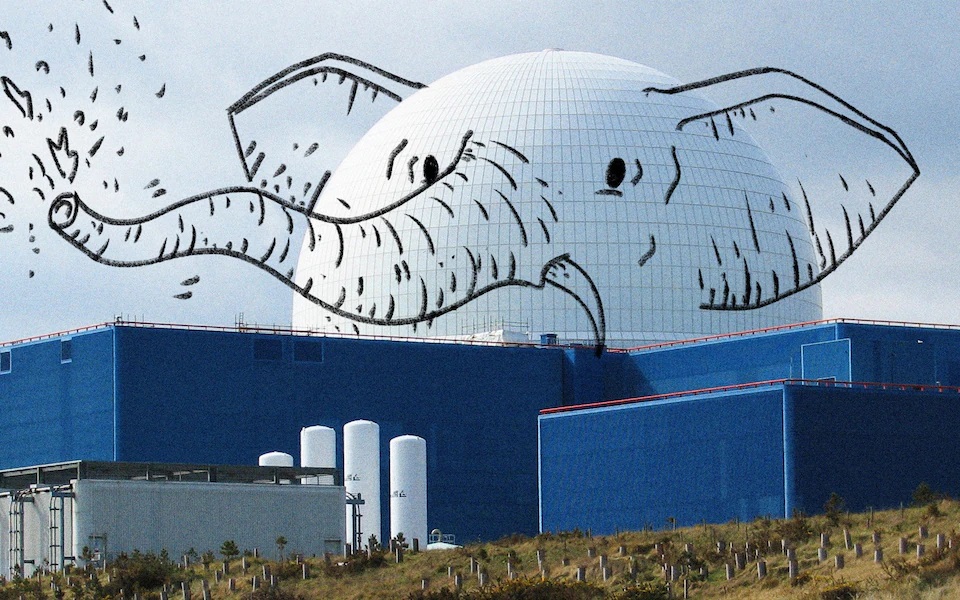
So what Stamer is saying is complete nonsense. What this so-called spending review admits is that there is no prospect of finding any foreign funding for Sizewell C, which was this government’s quite absurd hope. It has therefore, to fund this white elephant itself.
This power station and the others to which the government has committed will cost at least £1,500 per household in the UK, and that might at best result in power for 6 million households.
However, the actual cost of this energy is the highest that we can produce, and that is before taking into account decommissioning costs. Those at Sellafield now amount to £136 billion, and no one thinks that this is the total sum involved. And now Reeves actually wants more investment at Sellafield, which is only going to make things worse, but is part of her plan to apparently make us a nuclear superpower. So, if you want to know what leaving a debt for future generations to pay really looks like, building Sizewell C and other power stations is all that you need to do to ensure that this outcome will become a reality.
In contrast to all this emphasis upon nuclear power, there was none at all on renewable energy in this statement. There was a mention of £2.5 billion for carbon capture and storage, but that is another white elephant.
There was no commitment to renewable energy, to battery technology, or even things as basic as insulating houses and fitting proper triple glazing, although a nod perhaps to the last was included without any mention of the sums involved being made.
What is clear is that Starmer and Reeves would rather lumber generations to come with the cost of nuclear power rather than invest in renewable energy now, when that is the lowest cost of energy that we have available to us.”
Full article can be read here
Sizewell C nuclear power plant can’t be allowed to fail.
A £14 billion investment, Sizewell C’s funding will come from a levy on energy bills.
Will this plan succeed where others have run into problems? Insanity, they
say, is doing the same thing again and again and expecting a different
outcome.
Every time a western country has built a European pressurised
reactor — a nuclear power station designed by the French — it has gone
pear-shaped. The one at Olkiluoto in Finland was 14 years late. The station
at Flamanville in France was a bit better, just 12 years behind schedule
and costing about four times the original budget. Here in the UK, Hinkley
Point C was variously promised for 2017, then this year, and now,
fingers-crossed, 2031.
Why then, you might wonder, has the government
thrown its financial muscle behind another EPR, this time at Sizewell on
the Suffolk coast? The £14 billion investment in Sizewell C (it’s the
third atomic power station to be built at this site) was one of the main
items in this week’s spending review.
I put this rather obvious question
to Simon Bowen, chairman of Great British Energy — Nuclear, the
snappily-named agency that used to be, err, Great British Nuclear, on Times
Radio on Tuesday. Bowen said the answer was that having built one, at
Hinkley Point, the next one would be cheaper and there was already good
evidence that practice was making perfect there. That might be true, but it
is also worth remembering the die was cast all the way back in 2008, when
Électricité de France (EdF), the French utility company that is building
Hinkley Point, bought British Energy. British Energy owned and operated the
UK’s remaining nuclear plants, but had fallen on hard times. There was a
government bailout and then a sale, both masterminded in part by Sir Adrian
Montague, now trying to do the same job at Thames Water.
EdF bought it for£12.5 billion and with it the nuclear sites that were front-runners to be
chosen for a new generation of power plants. The Cameron government
cemented things in place by making a deal with EdF and CGN, the Chinese
nuclear power company, that would see the latter take a stake in Hinkley
Point and a proposed new plant at Sizewell.
That plan evaporated when later
administrations decided we shouldn’t cosy up to the Chinese after all. We
still needed nuclear power, though, and as quickly as possible or our
net-zero targets would be all the more difficult to hit. Ditching the EPR
and choosing a new design for the Sizewell site would have taken years, so
in the end, ministers concluded, better to go with the devil you knew.
The only remaining question was how to pay for it. EdF is picking up the tab
for Hinkley Point, with the financing anchored by a guarantee from the
government to buy all the electricity generated at an agreed price. This
arrangement was extremely controversial at the time and in any event EdF is
not keen to take on another multibillion-pound risk. The Chinese are also
out.
The answer is that the money will come from you and me, via the same
finance scheme used to build the £4.5 billion Tideway super sewer, the
giant pipe that runs under the Thames and sucks up the sewage that used to
go into the river when it rained.
Times 13th June 2025, https://www.thetimes.com/business-money/energy/article/sizewell-c-nuclear-power-plant-cant-be-allowed-to-fail-8l32szjnw
Small Modular Nuclear Reactors (SMRs) are nothing but a Big Boondoggle.

Guardian 13th June 2025, Dr Ian Fairlie
Independent consultant on radioactivity in the environment; vice-president, Campaign for Nuclear Disarmament
The more I read about the government’s nuclear intentions, the more it sounds like HS2 all over again, ie another financial boondoggle. Where are the detailed costings? What is our experience with cost overruns, eg at Hinkley Point C? What is the overseas experience with pressurised water reactors (the kind proposed for Sizewell C) at Olkiluoto, at Flamanville, at Taishan? Uniformly bad in all cases, actually.
No matter which way you look at this, viz the future cost overruns, the facts that we consumers will be on the hook for them, that reactors are never constructed on time, that nuclear wastes are unaudited, that we have to import all our uranium, that the UN’s Intergovernmental Panel on Climate Change stated in 2023 that renewables are 10 times better than nuclear at lowering carbon emissions, all point to a remarkably poor decision by the government, sad to say. https://www.theguardian.com/environment/2025/jun/13/spending-billions-on-unclean-risky-energy-what-a-nuclear-waste
Small modular nuclear reactors are NOT a “cutting edge” technology.

Sarah Darby, Emerita research fellow, Environmental Change Institute,
Guardian 13th June2025
As Nils Pratley says, Great British Energy’s budget has been nuked to divert funding away from local energy initiatives (11 June). But let’s get away from the idea that SMRs are a cutting-edge technology. Rolls-Royce is proposing a 470MW reactor, the same size as the first-generation Magnox reactors. Their “small” modular reactor, if it ever emerges, will use the familiar method of generating a lot of heat in a very complex and expensive manner, in order to boil water and turn a turbine. It will bequeath yet more radioactive waste to add to the burden and risk at Sellafield.
In the meantime, if government SMR funding continues, it takes money away from opportunities for cutting-edge technical and social innovation, discovery and training all around the country, as schools, hospitals, community groups, network operators and all of us get to grips with renewables-based systems. This sort of innovation is necessary, it’s already benefiting us and it needs full-on government support rather than uneasy compromises with an increasingly redundant nuclear industry.
https://www.theguardian.com/environment/2025/jun/13/spending-billions-on-unclean-risky-energy-what-a-nuclear-waste
Spending billions on unclean, risky energy? What a nuclear waste!
Laurie Hill, MBA student, Cambridge Judge Business School 13 June 25
Rolls-Royce pressurised water reactors have powered British nuclear subs since 1966, but small modular reactors (SMRs) aren’t yet proven at scale anywhere on land (Rolls-Royce named winning bidder for UK small nuclear reactors, 10 June). Only three are operating worldwide: two in Russia, one in China. Argentina is constructing the world’s fourth; is Labour simply keen to keep up with historical geopolitical rivals (Sizewell C power station to be built as part of UK’s £14bn nuclear investment, 10 June)?
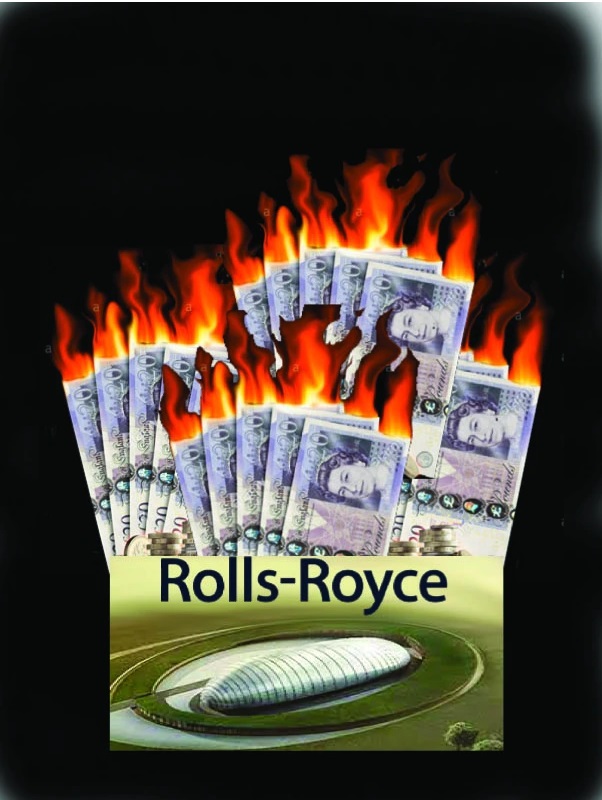
The Institute for Energy Economics and Financial Analysis (IEEFA) reported actual cost overruns of 300% to 700% for all four projects. Rolls-Royce claims costs of £35 to £50 per MWh; so should we triple this? The government says the SMR project would create 3,000 new low-carbon British jobs, but at what cost? The energy secretary, Ed Miliband, can’t know the true costs yet, and three reactors doesn’t scream “economies of scale”.
Yet £2.5bn is already 10 times more than Great British Energy has invested into simple, cheap rooftop solar, which democratises energy savings. The true cost of renewables must consider intermittency and balancing costs, but why not invest more in flexibility through distributed renewables and grid-scale storage? And what of energy security? SMRs may mitigate against Putin snipping offshore wind cables, but increased reliance on imported uranium, and a heightened nuclear waste security threat, are significant risks.
Last May, the IEEFA concluded that SMRs “are still too expensive, too slow and too risky”, and that we “should embrace the reality that renewables, not SMRs, are the near-term solution to the energy transition”. Has this truly changed? The climate crisis requires scaling all feasible solutions as fast as possible, but, with limited capital, we should prioritise those that make economic sense today. https://www.theguardian.com/environment/2025/jun/13/spending-billions-on-unclean-risky-energy-what-a-nuclear-waste
Iran and Israel at War
Trump reaffirmed his support for Israel and called the overnight strikes “a very successful attack.”
June 13, 2025 , https://thecradle.co/articles/iran-and-israel-at-war
Iran commenced its retaliation against Israel late on 13 June, unleashing a massive barrage of missiles aimed at the city of Tel Aviv, which resulted in multiple direct hits, including strikes on the Israeli army headquarters.
Tehran targeted “dozens of targets, military centers and air bases” across Israel, according to a statement by the Islamic Revolutionary Guard Corps (IRGC). It said the operation was named “True Promise 3.”
The US-Israeli war that was launched overnight on Friday killed several nuclear scientists and high-ranking members of the IRGC.
Air defenses remained active in the Iranian capital, Tehran, and near strategic nuclear sites as Israeli warplanes bombed the country throughout most of the day.
“We knew everything, and I tried to save Iran humiliation and death. I tried to save them very hard because I would have loved to have seen a deal worked out. They can still work out a deal however, it’s not too late,” US President Donald Trump told Reuters.
“We are in a historic event. This is not an operation, this is a planned war, 1,500 kilometers from Israel,” an Israeli army official told reporters on Friday evening.
Israeli warplanes launched surprise attacks across Iran during the early hours of 13 June, targeting Iranian nuclear facilities, army bases, missile storage sites, and residential neighborhoods as part of Operation ‘Lion’s Courage.’
At least 78 people have been confirmed killed and 329 injured.
Tehran has suspended all domestic and international flights, according to the civil aviation authority, as Israeli strikes continued Friday morning across various cities, including Tabriz, Kermanshah, Hamedan, Qasr-e Shirin, and Kangavar.
“With this crime, [Israel] has prepared a bitter and painful fate for itself, and it will inevitably face it. It must await severe punishment, for the powerful arm of the armed forces of the Islamic Republic of Iran will not leave it alone, God willing,” Iranian Supreme Leader Ali Khamenei said following the start of the US-Israeli war.
“The people of Iran and the country’s officials will not remain silent in the face of this crime, and the legitimate and powerful response of the Islamic Republic of Iran will make the enemy regret their foolish actions,” Iranian President Masoud Pezeshkian said in a message on Friday.
Iranian drones have been reportedly shot down over the skies of several Arab nations on their way to Israel. The Iranian military is reportedly preparing a significant ballistic missile attack in retaliation.
The UN Security Council is expected to meet later on Friday at the request of Tehran, according to unnamed diplomats who spoke with Reuters.
In a phone interview with CNN, Trump reaffirmed his support for Israel and called the overnight strikes “a very successful attack.”
“Iran should have listened to me when I said — you know I gave them, I don’t know if you know but I gave them a 60-day warning and today is day 61,” Trump said.
“They should now come to the table to make a deal before it’s too late. It will be too late for them. You know the people I was dealing with are dead, the hardliners … They didn’t die of the flu; they didn’t die of Covid,” the president added.
USA participated in Israeli air defense using Patriot and THAAD systems
Patriot and THAAD missile defense batteries, operated by U.S. military personnel and originally deployed under the Biden administration, participated in Israeli air defense Friday evening, according to U.S. defense officials who spoke on the condition of anonymity to discuss the sensitive subject. That represented a more limited participation in Israel’s defense than last year, when American air and sea assets helped shoot down incoming Iranian missiles during two retaliatory Iranian attacks. – from https://www.washingtonpost.com/world/2025/06/12/israel-attacks-iran-tehran-explosions/#link-45PWIAZSNNE57OYKVRHWOA6Z3I
Nuclear submarines plan is an expensive mistake – there are better things for UK to spend money on: Andy Brown
Keeping the public safe is one of the prime responsibilities of any government. So, it is easy to understand that the government needs to spend money on defending our country.
Nuclear submarines plan is an expensive mistake – there are better things
for UK to spend money on: Andy Brown. Keeping the public safe is one of the
prime responsibilities of any government. So, it is easy to understand that
the government needs to spend money on defending our country. What is a lot
harder to understand is why the government would appear to be quite so
enthusiastic about wasteful and excessive expenditure that is supposed to
protect us from some forms of harm but slow and reluctant to act to protect
us from others.
Yorkshire Post 16th June 2025 https://www.yorkshirepost.co.uk/news/opinion/columnists/nuclear-submarines-plan-is-an-expensive-mistake-there-are-better-things-for-uk-to-spend-money-on-andy-brown-5175376
1 This Month

Petition to revoke the licensing of the Near Surface Nuclear Disposal Facility (NSDF) at Chalk River. https://www.ourcommons.ca/petitions/en/Petition/Details?Petition=e-7247

18 March Webinar @ 1 PM EST: An Assessment of SMR Projects: The Case of Canada
register for the zoom:
https://us02web.zoom.us/webinar/register/WN_o8BIIOUvQ2ONJR1nta65DQ#/registration


of the week – STOP SMALL MODULAR REACTORS IN CANADA
To see nuclear-related stories in greater depth and intensity – go to https://nuclearinformation.wordpress.com
-
Archives
- March 2026 (152)
- February 2026 (268)
- January 2026 (308)
- December 2025 (358)
- November 2025 (359)
- October 2025 (376)
- September 2025 (258)
- August 2025 (319)
- July 2025 (230)
- June 2025 (348)
- May 2025 (261)
- April 2025 (305)
-
Categories
- 1
- 1 NUCLEAR ISSUES
- business and costs
- climate change
- culture and arts
- ENERGY
- environment
- health
- history
- indigenous issues
- Legal
- marketing of nuclear
- media
- opposition to nuclear
- PERSONAL STORIES
- politics
- politics international
- Religion and ethics
- safety
- secrets,lies and civil liberties
- spinbuster
- technology
- Uranium
- wastes
- weapons and war
- Women
- 2 WORLD
- ACTION
- AFRICA
- Atrocities
- AUSTRALIA
- Christina's notes
- Christina's themes
- culture and arts
- Events
- Fuk 2022
- Fuk 2023
- Fukushima 2017
- Fukushima 2018
- fukushima 2019
- Fukushima 2020
- Fukushima 2021
- general
- global warming
- Humour (God we need it)
- Nuclear
- RARE EARTHS
- Reference
- resources – print
- Resources -audiovicual
- Weekly Newsletter
- World
- World Nuclear
- YouTube
-
RSS
Entries RSS
Comments RSS
 nuclear-news