Nuclear Power will ruin France

Nuclear power will ruin France , by Laure Nouahlat, published by Seuil , May 16, 2025, 224 p., 13.50 euros.
Neither the French population, nor any parliamentarian or senator had their say, as if nuclear power were democratically held above ground.
Reporterre 16th May 2025,
https://reporterre.net/Le-nucleaire-va-ruiner-la-France
Despite the staggering cost of all-nuclear power, France is stuck in this impasse. Here are the excerpts from the investigative book ”
Nuclear Power Will Ruin France
.” Laure Noualhat dissects the mechanisms of this waste.
Is nuclear revival reasonable ? According to Emmanuel Macron and many others, the nuclear ” holy grail “ would be the only solution to slow climate change and preserve our comfort. While the government is making savings at every turn, the sector seems to benefit from an unlimited budget.
It was announced Monday that the Cigéo nuclear waste disposal facility in Bure will cost up to €37.5 billion. To revive the industry, the bill will climb to at least €80 billion. As delays mount, these amounts are continually revised upwards. All this while EDF is already heavily in debt.
Where will the tens of billions of euros for these new EPRs be found ? And the necessary investments in the existing fleet ? It will be the State, that is, the taxpayer, who will pay.
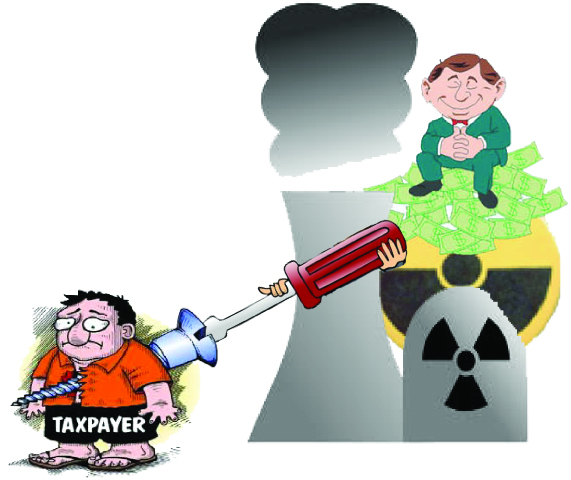
This is what journalist Laure Noualhat demonstrates in her relentless investigative book, Nuclear Power Will Ruin France . The result of six months of investigation, it is published today in the Seuil- Reporterre collection and will be accompanied by a documentary broadcast on YouTube in early June. Through this extensive work, Reporterre is tackling a crucial issue for the future of the country, largely absent from public debate. Because these choices are made in total secrecy, Reporterre is shedding light on a subject that concerns us all.
Here are the previews of “ Nuclear Power Will Ruin France ”:
What were you doing on February 10, 2022 ? For the small world of energy, it was a memorable day. On that day, presidential candidate Emmanuel Macron stood behind a lectern under the immense tin roof of the General Electric plant in Belfort. His voice echoed like a cathedral. Behind him, GE teams had positioned a gigantic Arabelle turbine, 300 tons of gleaming steel lit as if it were an industrial museum piece.
A group of masked employees, all wearing the same electric blue construction jackets, listens learnedly to the president. Four years earlier, these women and men were part of Alstom’s energy division, the industrial flagship that former Economy Minister Emmanuel Macron had conscientiously dismantled during his time at the Ministry of Finance.
No matter, on this Thursday, February 10, the now President has just announced the ” rebirth “ of French nuclear power, boasted of national ” sovereignty “ and praised the merits of ” planning “ to address the challenges of the moment: reducing our CO2 emissions by 55 % by 2050, ensuring France’s industrial development, and controlling the French people’s energy bill.
No law regulates presidential will
Regardless of the background—environmental, energy, nuclear, activist, industrial, or political—this speech hit the mark and is historic. With its delivery, President-candidate Macron has just rescued France from decades of uncertainty by relaunching the mass construction of nuclear reactors. Since its approval in 2003 by the National Assembly, the Flamanville EPR project has been mired in endless setbacks. In 2012, President Hollande chose a contrary path by enshrining in law the reduction of nuclear power’s share to 50 % of the electricity mix by 2025 (compared to 65-70 %) and to 30 % by 2030. In short, the socialist planned a slow phase-out of nuclear power, allowing for the preparation of the decommissioning of the oldest reactors, the ramp-up of renewables, and an unprecedented effort toward energy efficiency.
In February 2017, candidate Macron – a former minister under Hollande – took up this promise.
”
I will maintain the framework of the energy transition law. I am therefore maintaining the 50
% target,
“ he confided to the
WWF during a Facebook Live broadcast watched by 170,000 people and interviewed by… Pascal Canfin, who will join the President’s list for the 2019 European elections.
Five years later, facing General Electric employees, the Jupiterian president performed an about-face. Six
EPR2s will emerge, he promises, built in pairs on three sites: in Penly in Normandy, in Gravelines in the North, and in Bugey in the Ain. And eight more will be under consideration. Neither the French population, nor any parliamentarian or senator had their say, as if nuclear power were democratically held above ground. Since this announcement, the program of the six EPR2s
has still not been validated by any legal decision, much less by an ”
energy and climate programming law
” (
PPE ), which should have been revised for the occasion.
To date, in 2025, no law governs the presidential will shaped by long years of lobbying (by associations such as Xavier Moreno’s Cérémé or Bernard Accoyer’s Nuclear Heritage & Climate, but also Voies du nucléaire or the French Nuclear Energy Society) since his arrival in power.
A colossal cost
Knocking down walls or hiding the misery, insulating here or repainting there, moving the pipes, changing the door… it’s difficult to ask a tradesman for a quote for work if you don’t know what you’re going to do. It’s the same with nuclear reactors.
As these lines are being written, in March 2025, three years after the Belfort speech, no one knows how much the EPR2 will cost . This is normal: their detailed design has not been completed despite the 10.5 million hours of engineering already devoted to the project.
In February 2022, the government had put forward a construction cost of 51.7 billion (2020 euros). In 2023,
EDF made two updates to the costing, noted by the Court of Auditors in its report on the
EPR sector in January 2025:
”
The overnight construction cost [as if the reactor were completed in a single night] of three pairs of
EPR2s rose from 51.7 to 67.4 billion euros [2020 euros], an increase of 30
% under unchanged economic conditions and excluding the effect of inflation.
“ In 2023 euros, the bill reaches 80 billion. For comparison, this figure of 80 billion already represents four times the annual deficit of the Social Security…
No comments yet.
1 This Month


Tell the Ukrainian Government to Drop Prosecution of Peace Activist Yurii Sheliazhenko

Petition to revoke the licensing of the Near Surface Nuclear Disposal Facility (NSDF) at Chalk River. https://www.ourcommons.ca/petitions/en/Petition/Details?Petition=e-7247


of the week – STOP SMALL MODULAR REACTORS IN CANADA
To see nuclear-related stories in greater depth and intensity – go to https://nuclearinformation.wordpress.com
-
Archives
- March 2026 (204)
- February 2026 (268)
- January 2026 (308)
- December 2025 (358)
- November 2025 (359)
- October 2025 (376)
- September 2025 (258)
- August 2025 (319)
- July 2025 (230)
- June 2025 (348)
- May 2025 (261)
- April 2025 (305)
-
Categories
- 1
- 1 NUCLEAR ISSUES
- business and costs
- climate change
- culture and arts
- ENERGY
- environment
- health
- history
- indigenous issues
- Legal
- marketing of nuclear
- media
- opposition to nuclear
- PERSONAL STORIES
- politics
- politics international
- Religion and ethics
- safety
- secrets,lies and civil liberties
- spinbuster
- technology
- Uranium
- wastes
- weapons and war
- Women
- 2 WORLD
- ACTION
- AFRICA
- Atrocities
- AUSTRALIA
- Christina's notes
- Christina's themes
- culture and arts
- Events
- Fuk 2022
- Fuk 2023
- Fukushima 2017
- Fukushima 2018
- fukushima 2019
- Fukushima 2020
- Fukushima 2021
- general
- global warming
- Humour (God we need it)
- Nuclear
- RARE EARTHS
- Reference
- resources – print
- Resources -audiovicual
- Weekly Newsletter
- World
- World Nuclear
- YouTube
-
RSS
Entries RSS
Comments RSS
 nuclear-news
Leave a comment