Does Tehran want the bomb?

by beyondnuclearinternational, Linda Pentz Gunter
https://beyondnuclearinternational.org/2025/05/25/does-tehran-want-the-bomb/
Is Iran’s nuclear power program a tactical threat or purely commercial, asks Linda Pentz Gunter
“As a party to the Non-Proliferation Treaty (NPT), the Islamic Republic of Iran, based on its religious and ethical principles, has never sought nuclear weapons and remains committed to the principle of non-production and non-use of weapons of mass destruction.”
That was the reassurance given by Iran’s foreign minister, Seyyed Abbas Araghchi, during the Tehran Dialogue Forum hosted earlier this month by the Center for Political and International Studies of Iran’s Foreign Ministry.
It’s a familiar refrain. Iran has consistently argued that it is exercising its “inalienable right” as a signatory to the NPT “to develop research, production and use of nuclear energy for peaceful purposes” as allowed under Article IV of the treaty.
But is it?
Iran has freely admitted that it has enriched uranium-235 up to 60% — considered at least “weapons usable” (higher than 90% is considered weapons-grade.) Why would it choose to — or need to — do this if it has no intention of seeking nuclear weapons production, as Araghchi and others before him have claimed?
The answer to that question seems obvious and one we have repeated ad infinitum when exposing the flaw in the NPT which, in granting the development of civilian nuclear programs to signatories, ensures the pathway to the bomb is left permanently clear.
Even should Iran never actually develop nuclear weapons, it can use its civil program as a threat to do so. It is no idle threat. The possession of a civilian nuclear program affords Iran the materials, equipment, personnel and know-how to transition to nuclear weapons should it so choose.
What might push Iran to make that choice depends a lot on how the current talks go. Keeping Israel at bay — which wanted to start bombing Iran’s nuclear installations immediately — was one of the few sensible decisions the Trump administration has made.
However, in the view of Mohsen Milani, Executive Director of the Center for Strategic & Diplomatic Studies and Professor of Politics at the University of South Florida, developing nuclear weapons has always been on Iran’s agenda. Milani was speaking during a May 20 webinar on the Iran nuclear talks hosted by the Quincy Institute. You can watch the full webinar below.
“I have always believed and I continue to believe that Iran’s nuclear program was based on turning Iran into a potential nuclear power,” Milani said. “That is a power that has the infrastructure, the expertise, to develop a bomb should they decide to develop a bomb.”
How close Iran might be to that achievement is also much debated. In July 2024, then Secretary of State, Antony Blinken, suggested Iran “is now probably one or two weeks” away from producing enough weapons grade material to make a nuclear weapon. Milani thinks Iran “is much closer than it has ever been,” but doubts the timeline is one or two weeks.
But the key is that “Iran’s nuclear program has never been the central part of Iran’s defense posture, nor has the axis of resistance,” Milani said, referring to the informal coalition of Iranian-supported organizations across the region united to counter the influence of Israel and the US. What Iran is doing is ensuring it can keep the nuclear option, “should there be a need for it,” Milani said. The Trump administration’s approach in these negotiations, in Milani’s view, “is they want to make sure that Iran is incapable of doing what it has tried to do for the past twenty years.”
The whole issue of Iran’s nuclear aspirations is squarely in the news again as the Trump administration continues talks with Tehran about its nuclear program. Confusion and uncertainty has been created by the US side, principally Trump’s Special Envoy to the Middle East, real estate developer Steve Witkoff, who has told Iran it can enrich uranium to commercial grade (below 5%), then changed his tune and insisted Iran can have no nuclear program at all.
After four rounds of largely fruitless talks, the Iranians began to lose patience, laying down their red line. “To say that ‘we will not allow Iran to enrich uranium’ is a huge mistake,” warned Ayatollah Khamenei of the American threat. “No one is waiting for permission from anyone. The Islamic Republic has its own policies, its own methods, and it pursues its own agenda,” he added.
Pushing Iran around on this might lead to another negative outcome. Iran could leave the NPT. “As a founding advocate for a nuclear-weapons-free zone in West Asia and a long-time NPT member, Iran has shown good faith by engaging in indirect talks with the United States,” Araghchi said at the conference. “But the Iranian nation cannot forfeit its legitimate right to peaceful nuclear technology, including enrichment, which is enshrined in the NPT.”
The speakers on the Quincy webinar agreed that this public back-and-forth by both sides was a mistake and that Iran should deal directly with the United States instead of through an intermediary, and behind closed doors.
By last Wednesday, the Iranian parliament had also made its views known, declaring it would not be held to any uranium enrichments level caps.
By Friday, a fifth round of talks had taken place, again with the Omanis as intermediaries at least some of the time. It was unclear what, if any, progress had been made, with both sides sounding cautiously optimistic. However, a red line for Iran remains the prospect of shipping its entire stockpile of enriched uranium to Russia, as the Americans have suggested. Iran still insists it is happy to renounce any future nuclear weapons production, but not uranium enrichment. Further talks are planned.
But at the end of the day a larger question looms, which is whether nuclear nations like the US, which claims might and influence due to the possession of its nuclear weapons, has a right to tell another country it cannot have them?
Rather than perpetually wrestling with the nuclear hydra, the US could lead by a very different example and show the world that all of these extreme threats would be eliminated by disarming from nuclear weapons altogether. And given the template of flaws that Iran has laid out for us regarding our current disarmament treaties, that means abolishing nuclear power as well.
Linda Pentz Gunter is the international specialist at Beyond Nuclear and writes for and edits Beyond Nuclear International. Opinions are her own.
The health impact of nuclear tests in French Polynesia – archive, 1981
there is mounting, though not yet definitive evidence of cancer and brain tumours in the area, especially among the young.
France spent €90,000 countering research into the effects of its Pacific nuclear tests in the 1960s and 70s. Learn how the Guardian reported early accounts of sickness and contamination
Guardian, Compiled by Richard Nelsson, 28 May 25
The health impact of nuclear tests in French Polynesia – archive, 1981
France spent €90,000 countering research into the effects of its Pacific nuclear tests in the 1960s and 70s. Learn how the Guardian reported early accounts of sickness and contamination
Compiled by Richard NelssonWed 28 May 2025
Pacific islanders agitate in the shadow of the bomb
By Christopher Price
17 September 1981
A recent Canard cartoon shows Adam and Eve looking at an H-bomb. “Look, H for Hernu,” (the new Socialist defence minister), says Adam. “Yes and for Horror, Holocaust, Hecatomb and Hiroshima,” adds Eve.
French Socialists have never hitherto allowed the nuclear issue to dominate their politics. If it is beginning to do so now it is partly because keeping their independent nuclear deterrent, which they continue to test underground in Muroroa atoll in French Polynesia, implies continuing colonial domination of the islands of the South Pacific – an issue which is very much alive, both among the Indigenous people of the Pacific and in the rank and file of the Socialist party in France.
The official position – “auto-determination” – as stated by Mr Henri Emmanuelli, the French Colonial minister when he visited France’s Pacific colonies was that he would discuss anything if a democratic majority wanted to. But he also said that recent election results made a referendum on the subject unnecessary.
That none of these three groups of islands (Polynesia, New Caledonia, and Wallis and Futuna) can immediately prove a majority for independence is partly due to strenuous French efforts over the years to stamp on emerging independence movements. More powerful than anything else [influencing the calls for independence] are the pollutant effects of nuclear tests on the human and natural environment. They are now beginning to make themselves felt. Hitherto everything that happens on Mururoa has been officially secret. But Mr Hernu has now a new “frankness” about the tests in an effort to allay anxiety; and immediately after he left the Centre d’Expérimentation du Pacifique issued its first-ever admission of an accident; it was not safe to swim off Mururoa.
In fact, authoritative reports state that there is now a crack 15 to 19 inches wide and over half a mile long in the atoll below sea level; that radioactive leaks into the Pacific have been taking place for many years; that a neighbouring atoll, Fangataufa, has been literally blasted out of the sea.
It is not yet possible to gauge the effect of such leaks, but coupled with the profound disquiet about Japanese plans to use the Pacific as a nuclear waste dumping ground, fears about pollution of fish and other marine life and consequently poisoning of the whole ocean, island populations will undoubtedly put further pressure on the Mitterrand government to reconsider its nuclear testing policy.
“Why don’t they do it in Nice?” was the one constant question put to me by the Polynesians. It echoed “Mururoa and Auvergne”, the most telling of the posters in the campaign which forced the French, eight years ago, to put the tests underground. Now there is a new twist to the story. It’s not just H-bombs the French are exploding inside Mururoa.
It was confirmed by Mr Giscard in June 1980 that France had been undertaking feasibility studies of neutron bombs since 1976, and this week Mr Mauroy, the Socialist prime minister, committed his government to strengthening France’s strategic nuclear arsenal and to the development of the neutron bomb. The knowledge that France is as keen as the US on upping the nuclear option can only add to the disquiet.
On top of this there is mounting, though not yet definitive evidence of cancer and brain tumours in the area, especially among the young. The French authorities counter that there is still less radioactivity in Polynesia than in the Massif Central. Maybe, but the fact that they go to quite extraordinary lengths of security in the treatment of such cases in French hospitals, suggesting a pathological desire to suppress such evidence as exists. One Actuel reporter, Mr Luis González-Mata, who tried to investigate the issue in Polynesia and in France, met continuous hostility.
So far the French government’s response to the political pressure has been to offer that decentralisation of local government to its overseas territories which the towns and cities of France are soon to enjoy. But it will be pressed to go further. The Pacific Forum comprising all independent Pacific countries, decided in Vanuatu in August to send a delegation to Mr Mitterrand demanding to know his intentions.
This is an edited extract. Read the article in full.
Testimonies from the atoll
Mururoa has been the centre of French nuclear tests for decades, largely in secret and often with scant regard for the people who live nearby. For the first time the native workers and their families tell their side of the story.
7 September 1990
Manutahi started work as a welder on Mururoa in 1965 at the age of 32. That was before the tests had started. He worked on the construction of the blockhouses Dindon and Denise.
In 1965 and at the beginning of 1966, we were allowed to eat all the fish in the lagoon but when we returned in 1967, we were forbidden to eat any. ……………………………………………………………………………………………………………………………………………………………………………………………………………https://www.theguardian.com/theguardian/2025/may/28/the-health-impact-of-nuclear-tests-in-french-polynesia-1981
Earth is heading for 2.7°C warming this century. We may avoid the worst climate scenarios – but the outlook is still dire.

Is climate action a lost cause? The United States is withdrawing from the
Paris Agreement for the second time, while heat records over land and sea
have toppled and extreme weather events have multiplied.
In late 2015,
nations agreed through the Paris Agreement to try to hold warming well
under 2°C and ideally to 1.5°C. Almost ten years later, cutting emissions
to the point of meeting the 1.5°C goal looks very difficult. But humanity
has shifted track enough to avert the worst climate future.
Renewables,
energy efficiency and other measures have shifted the dial. The worst case
scenario of expanded coal use, soaring emissions and a much hotter world is
vanishingly unlikely. Instead, Earth is tracking towards around 2.7°C
average warming by 2100. That level of warming would represent
“unprecedented peril” for life on this planet. But it shows progress is
being made.
The Conversation 27th May 2025, https://theconversation.com/earth-is-heading-for-2-7-c-warming-this-century-we-may-avoid-the-worst-climate-scenarios-but-the-outlook-is-still-dire-254284
Lincolnshire County Council leader Sean Matthews defends stance on nuclear waste site amid criticism from Tories
By James Turner, Local Democracy Reporter, 27 May 2025, https://www.lincsonline.co.uk/louth/reform-leader-hits-back-at-accusation-that-he-s-gone-back-on-9418880/
The new Reform UK leader of Lincolnshire County Council has hit back at accusations of failing to deliver on his election promises regarding a nuclear waste site.
The Lincolnshire Conservative group has highlighted that Coun Sean Matthews, recently elected as council leader, has yet to pull out of talks with government agency Nuclear Waste Services (NWS) about a Geological Disposal Facility (GDF)—despite saying he would cancel Lincolnshire’s involvement in the project on day one if elected.
NWS, formerly known as Radioactive Waste Management Limited, outlined three potential sites for its Geological Disposal Facility in January, including East Lindsey, and communities in Mid Copeland and South Copeland in Cumbria.
East Lindsey District Council withdrew from talks with NWS after the proposed location changed from the former gas terminal in Theddlethorpe to open countryside on land between the villages of Gayton le Marsh and Great Carlton.
The former Conservative administration of Lincolnshire County Council announced its intention to withdraw from talks in March, effectively cancelling the company’s consideration of the Lincolnshire coast for the facility. However, this had yet to be formalised before the local elections in May, when the administration switched to Reform UK.
During a demonstration outside East Lindsey District Council offices in early March, dozens of protesters called on Lincolnshire County Council to withdraw from the talks. Councillor Matthews attended with four of his Reform UK colleagues.
He told the Local Democracy Reporting Service: “On day one if elected as the leader of the Reform council, we will withdraw from the agreement.”
Coun Richard Davies, leader of the Conservative opposition group on the county council, said: “This is a clear U-turn from Sean Matthews and Reform UK.
“Local people were told the project would be scrapped on day one. Instead, the new Reform administration is delaying, consulting, and refusing to give communities the certainty they deserve.”
He added: “We call on Sean Matthews to explain why he has not kept his word to Lincolnshire residents. Reform UK cannot have it both ways—either they stand by their promises or admit they misled the public to win votes.”
Responding to the comments from his Tory counterpart, Coun Matthews said: “As Richard is well aware, there is a democratic process that needs to be followed to officially review the council’s membership of the Community Partnership. And he knows that if we don’t follow that process, we could open ourselves up to challenge, causing further uncertainty for local residents.
“We were clear in the campaign about our intentions, and on my first day as leader of the Reform group, I started that process—even enacting the council’s urgency protocol to allow us to have these important discussions as quickly as possible.
“It took me less than a day to start a process that the previous Conservative administration couldn’t complete in the several years they were in power. In fact, the mere fact they entertained the plans to bury nuclear waste under Lincolnshire in the first place is why this community has had to live with uncertainty for so many years.
“As far as I am concerned, in just one week a decision will have been made and then residents can judge for themselves whether their Reform councillors stick to their word.”
Councillors on Lincolnshire County Council’s Overview & Scrutiny Management Board will review the council’s participation in the Community Partnership at a meeting on Thursday, May 29. A final decision on the council’s future involvement is expected to be taken by the Executive on Tuesday, June 3.
SpaceX loses contact with its Starship on 9th test flight after last 2 went down in flames
CBS News, By William Harwood, May 28, 2025
After spectacular back-to-back upper stage failures in January and March, SpaceX launched another Super Heavy-Starship rocket Tuesday on the program’s ninth test flight, but ran into fresh problems that resulted in the loss of both stages before they could carry out controlled descents to splashdown.
The Super Heavy first stage, following a deliberately steeper, more stressful descent trajectory toward splashdown near the Texas Gulf Coast, suffered a catastrophic failure at the moment its engines reignited for what would have been a relatively gentle splashdown.
But a few minutes later, a door on the side of the rocket failed to open, preventing the planned release of simulated Starlink satellites in a test of the rocket’s Pez-like deployment system.
SpaceX confirmed the stage had been lost, but given the extreme nature of the testing, the loss was not an out-of-the-blue surprise. The Starship upper stage, meanwhile, managed to make it into its planned suborbital trajectory after an apparently flawless performance from its six engines.
With that test deferred to a future flight, SpaceX engineers hoped to reignite a single Raptor engine to test its start-up capability in space. But an apparent propellant leak put the spacecraft into a slow spin that ruled out the restart and a controlled reentry and splashdown.
The Starship has to enter at the right angle and in a precise orientation to survive reentry heating and aerodynamic “loads.” Entering in a spin doomed the Starship to a catastrophic breakup…………………………………………………………………………………………………………………………………………………………………………………………..As a result of the high-stress tests, SpaceX targeted a splashdown in the Gulf instead of attempting a launch pad capture where critical infrastructure could be damaged in a landing mishap.
As it turned out, that was a good decision.
Launch attempt follows two Starship breakups
Tuesday’s launch came on the heels of back-to-back Starship upper stage breakups during the two previous test flights that generated spectacular showers of flaming debris along the flight paths……………………………………………………………………………………………………………..
SpaceX made changes after two catastrophic explosions
The last two Starships, launched Jan. 16 and March 6, both ended with unrelated catastrophic explosions as they neared their planned sub-orbital trajectories.
During the January flight, a propellant leak in an unpressurized “attic” above the Raptor engines led to sustained fires that eventually triggered shutdown of all but one of the spacecraft’s engines. Telemetry was lost eight minutes and 20 seconds after launch and moments later, the vehicle broke apart………………………………………………………………………………………………..https://www.cbsnews.com/news/spacex-super-heavy-starship-launch-ninth-test-flight/
France spent €90,000 countering research into impact of Pacific nuclear tests
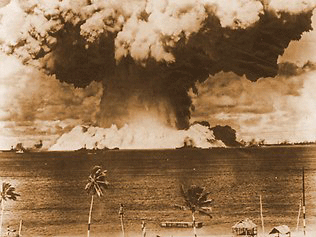
Radiation-related thyroid, breast and lung cancers, as well as leukaemia and lymphoma, are prevalent across the islands.
Documents suggest campaign to discredit revelation that tests contaminated many more people than acknowledged
Jon Henley Guardian, 27 May 25
France’s Atomic Energy Commission (CEA) has spent tens of thousands of euros in an effort to counter research revealing that Paris has consistently underestimated the devastating impact of its nuclear tests in French Polynesia in the 1960s and 1970s.
Days before a parliamentary inquiry presents its report on the tests, documents obtained by the investigative outlet Disclose, and seen by Le Monde and the Guardian, suggest the CEA ran a concerted campaign to discredit the revelations.
A 2021 book, Toxique, which focused on just six of the 193 nuclear tests that France carried out from 1966 to 1996 at Moruroa and Fangataufa atolls, drawing on 2,000 pages of declassified material and dozens of interviews, concluded that they contaminated many more people than France has ever acknowledged.
The latest documents show that a year after the book’s publication, the CEA published 5,000 copies of its own booklet – titled “Nuclear tests in French Polynesia: why, how and with what consequences?” – and distributed them across the islands.
As part of an operation costing more than €90,000, the commission also flew a four-man team by business class to French Polynesia, where they stayed at the Hilton hotel, to meet local dignitaries and give interviews to the media.
The CEA’s booklet, printed on glossy paper, claimed to provide “scientific responses” to the “allegations” contained in Toxique, whose authors it said did not have “the same level of expertise”. It claimed contamination had been limited and that France always behaved transparently and with respect for local inhabitants’ health.
The publication of Toxique – based on the investigation by Disclose, Princeton University’s science and global security programme and Interprt, an environmental justice research collective – caused a furore in France, prompting visits to French Polynesia by a minister and the president, Emmanuel Macron, who acknowledged France’s “debt” to the region.
In one 1974 test alone, the scientific research found, 110,000 people – the population of Tahiti and its nearby islands – could have received a radiation dose high enough to qualify them for compensation if they later developed one of 23 different cancers.
Toxique alleged the CEA has long underestimated the radiation levels involved, significantly limiting the numbers eligible for compensation: by 2023, fewer than half the 2,846 compensation claims submitted had even been judged admissible.
The parliamentary inquiry, which has so far called more than 40 politicians, military personnel, scientists and victims, is due to report before the end of May on the social, economic and environmental impact of the tests – and whether France knowingly concealed the extent of contamination.
The CEA’s military division, CEA/DAM, the inventor of France’s atomic bomb, has repeatedly called this a “false assertion”. But France’s nuclear safety body, the ASNR, has since acknowledged “uncertainties associated with [the CEA’s] calculations” and confirmed to the parliamentary inquiry that it was impossible to prove people received radiation doses lower than the compensation threshold.
The CEA said in a statement that the aim of its booklet “was to provide Polynesians in particular with the elements to understand” the tests and their impact. It said the booklet applied “the necessary scientific rigour” to explain “the health and environmental consequences of the tests” in a “factual and transparent manner”……………………..
The inquiry has heard that the CEA/DAM has so far declassified only 380 documents in the four years since Macron demanded “greater transparency” around the tests and their consequences – compared with 173,000 declassified by the army.
Jérôme Demoment, the director of CEA/DAM, told the parliamentary inquiry earlier this year that it was “highly likely, if we were to have to manage [nuclear tests] today, that the system put in place would respond to a different logic”.
Forty-six of France’s nuclear tests were atmospheric, exposing the local population, site workers and French soldiers who were stationed in Polynesia at the time to high levels of radiation before the testing programme was moved underground in 1974.
Radiation-related thyroid, breast and lung cancers, as well as leukaemia and lymphoma, are prevalent across the islands. For its part, the French army has said up to 2,000 military personnel could have been exposed to enough radiation to cause cancer.
“The notion of a ‘clean bomb’ has generated controversy, which I fully understand,” Demoment told the parliamentary inquiry. “No nuclear test generating radioactive fallout can be considered clean.” https://www.theguardian.com/world/2025/may/27/france-spent-90000-countering-research-into-impact-of-pacific-nuclear-tests
Trump warns Netanyahu off Iran strike as nuclear talks continue
28 May,2025 https://www.aljazeera.com/news/2025/5/28/trump-warns-netanyahu-off-iran-strike-as-nuclear-talks-continue
US president says an Israeli strike ‘would be inappropriate to do right now because we’re very close to a solution.’
United States President Donald Trump has said that he told Israeli Prime Minister Benjamin Netanyahu to hold off on any strike against Iran to give his administration more time to push for a new nuclear deal with Tehran, as several rounds of talks have been held in Oman and Italy.
Trump told reporters on Wednesday at the White House that he relayed to Netanyahu a strike “would be inappropriate to do right now because we’re very close to a solution”
The Israeli leader has been threatening a bombardment of Iranian nuclear facilities. Iran has said it would respond with severity if any such attack were launched.
In the meantime, Iran may pause uranium enrichment if the US releases frozen Iranian funds and recognises its right to refine uranium for civilian use under a “political deal” that could lead to a broader nuclear accord, two Iranian official sources told the Reuters news agency.
The sources, close to the negotiating team, said on Wednesday that a “political understanding with the United States could be reached soon” if Washington accepted Tehran’s conditions. The sources told Reuters that under this arrangement, Tehran would halt uranium enrichment for a year.
The latest developments came as the head of the UN’s atomic watchdog group said that “the jury is still out” on negotiations between Iran and the US over Tehran’s rapidly advancing nuclear programme. But Rafael Mariano Grossi described the ongoing negotiations as a good sign.
“I think that is an indication of a willingness to come to an agreement. And I think that… is something possible.”
The 2015 nuclear deal, formally known as the Joint Comprehensive Plan of Action (JCPOA), placed limits on Iran’s nuclear programme in exchange for sanctions relief.
It collapsed after Trump unilaterally withdrew the US from the agreement in 2018, leading to a sharp escalation in tensions and a breakdown in diplomatic relations.
The key sticking point
US officials have repeatedly said that any new deal must include a firm commitment from Iran to halt uranium enrichment, which they view as a potential pathway to building nuclear weapons.
However, Iran has consistently denied seeking nuclear arms, insisting its programme is solely for civilian purposes. It has rejected Washington’s demand to eliminate enrichment capabilities, calling it an infringement on national sovereignty.
It remains the critical sticking point after negotiators for Tehran and Washington met for a fifth round of Oman-mediated talks in Rome.
Instead, Iran has reportedly proposed that the US publicly recognise Tehran’s right to enrich uranium under the Nuclear Non-Proliferation Treaty (NPT), and approve the release of Iranian oil revenues frozen under US sanctions.
Roads to War: The EU’s Security Action for Europe Fund
May 29, 2025 Dr Binoy Kampmark, https://theaimn.net/roads-to-war-the-eus-security-action-for-europe-fund/
As the world was readying for the Second World War, the insightful humane Austrian author Stefan Zweig made the following glum observation: “Openly and flagrantly, certain countries express their will to expand and make preparations for war. The politics of rearmament is pursued in broad daylight and at breakneck speed; every day you read in the papers arguments in favour of armaments expansion, the idea that it reduces unemployment and provides a boost to the stock exchange.”
This is not so different from the approval by European Union countries on May 27 of a €150 billion loan program known as the Security Action for Europe (SAFE) borrowing scheme. A press release from the European Council stated that the scheme “will finance urgent and large-scale investments in the European defence technological and industrial base (EDTIB)” with the intention of boosting “production capacity, making sure defence equipment is available when needed, and to address existing capability gaps – ultimately strengthening the EU’s overall defence readiness.”
The statement also makes a central rationale clear: that SAFE will enable continued European support for Ukraine, linking its defence industry to the program. Despite not being an EU member, Kyiv will be able to participate in the scheme. Interestingly enough, the United Kingdom, despite leaving the EU, will also be able to participate via a separate agreement.
Disbursements to interested member states upon demand, considered along national plans “will take the form of competitively priced long-maturity loans, to be repaid by the beneficiary member states.”
The scheme further anticipates the types of weaponry, euphemistically titled “defence products”, that will feature. As outlined by the European Council on March 6, these will comprise two categories: the first covering, amongst others, such products as ammunition and missiles, artillery systems, ground combat capabilities with support systems; the second, air and missile defence systems, maritime surface and underwater capabilities, drones and anti-drone systems and “strategic enablers” including air-to-air refuelling, artificial intelligence and electronic warfare.
The broader militarisation agenda is confirmed by linking SAFE with broader transatlantic engagement and “complementarity with NATO.” It will “strive to enhance interoperability, continue industrial cooperation, and ensure reciprocal access to state-of-the-art technologies with trusted partners.”Significantly, the emphasis is on collaboration: a minimum of three countries must combine when requesting funding for SAFE defence projects.
There seems to be something for everyone: the militarist, the war monger and the merchants of death. Global Finance, a publication dedicated to informing “corporate financial professionals”, was already praising the SAFE proposal in April. “The initiative has the potential to transform the business models of many top European defense groups – like Saab, which has traditionally relied on contracts from the Swedish state to grow its sales.” What a delight it will be for such defence companies to move beyond the constraints on sales imposed by their limiting governments. A veritable European market of death machinery is in the offing.
The fund is intended for one, unambiguous purpose: war. The weasel word “defence” is merely the code, the cipher. Break it, and it spells out aggression and conflict, a hankering for the next great military confrontation. The reason is traditional, historic and irrational: the Oriental despotic eminence arising from the Asian steppes, people supposedly untutored in the niceties of European good manners and democracy. Not that European manners and democracy is in splendid health. A mere glance at some of the candidates suggests decline in institutional credibility and scepticism. But we can always blame the Russians for that, deviously sowing doubt with their disinformation schemes.
The initiative, and its tightening of ties with arming Ukraine, has made such critics as Hungary’s Prime Minister Viktor Orbán sound modestly sensible. “We need to invest in our own armies, but they expect us to fund Ukraine’s – with billions, for years to come,” he declared in a post on X. “We’ve made it clear: Hungary will not pay. Our duty is to protect our own people.”
The approval of the fund by the European Commission has also angered some members of the European Parliament, an institution which has been treated with near contempt by the European Commission. European Parliament Presidente Roberta Metsola warned Commission President Ursula von der Leyen earlier in May to reconsider the use of Article 122 of the EU Treaty, which should be used sparingly in emergencies in speeding up approvals with minimal parliamentary scrutiny. Bypassing Europe’s invigilating lawmakers risked “undermining democratic legitimacy by weakening Parliament’s legislative and scrutiny functions.” The Council’s resort to Article 122 potentially enlivened a process that could see a legal case taken to the European Court of Justice.
The European Parliament’s Legal Affairs Committee (JURI) has also supported a legal opinion repudiating the Commission’s cavalier approach in approving the fund. According to that tartly reasoned view, Article 122 was an inappropriate justification, as the threshold for evoking emergency powers had simply not been met.
Ironically, the rearmament surge is taking place on both sides of the Atlantic, at both the behest of the Trump administration, ever aggrieved by Europe not pulling its military weight,and Moscow, characterised and caricatured as a potential invader, the catalyst for decorating a continent with bristling weaponry. The former continues to play hide and seek with Brussels while still being very much in Europe, be it in terms of permanent garrisons and military assets; the latter remains a convenient excuse to cross the palms of the military industrial establishment with silver. How Zweig would have hated it.
Here’s what they don’t tell you about ‘massive Russian strikes on Ukraine’
Zelensky, backed by his Western sponsors, is not held accountable for the reckless escalation he fuels. Worse still, this impunity undermines any real incentive for dialogue. Why negotiate when your side is never blamed?
Moscow is doing what must be done to protect its civilians from Kiev’s campaign of terror
By Nadezhda Romanenko, political analyst, 26 May 25, https://www.rt.com/russia/618166-russia-ukraine-drone-strikes/
In the current media frenzy surrounding the conflict between Russia and Ukraine, a glaring double standard continues to distort public perception: the nature and impact of drone warfare. Western outlets, politicians, and NGOs are quick to pounce on Russia for retaliatory actions, yet remain eerily silent about Ukraine’s increasingly reckless and escalatory drone campaign. This selective outrage has not only undermined serious dialogue on peace – it has shielded Ukraine from accountability as it wages what can only be described as a campaign of terror against Russian civilians.
Drone war reality: Civilian targets in Russia
Over the past few weeks, Ukraine’s use of drones has surged in both frequency and range. On a near-daily basis, dozens – sometimes hundreds – of drones are launched toward Russian territory, many targeting civilian infrastructure or flying indiscriminately toward dense urban centers like Moscow. While Russia’s air defense systems have performed admirably in intercepting the majority of these threats, the falling debris poses an unavoidable risk to civilians, including children and the elderly. Russian regions far from the frontlines have been forced into a state of constant vigilance, air raid alerts disrupting the normalcy of everyday life.
What’s most alarming is the strategic logic – or lack thereof – behind these strikes. Unlike military-grade precision operations, Ukraine’s drone attacks appear designed less to achieve tactical objectives and more to instill fear. The targets are often electrical substations, communication towers, or simply proximity to residential areas. This cannot be framed as mere collateral damage; it is a campaign whose effects are felt most deeply by civilians.
Western silence and hypocrisy
Despite this escalating threat to Russian civilians, international reaction has been resoundingly one-sided. There is no UN condemnation of Ukraine’s drone strikes. There are no emergency meetings in Brussels, no CNN specials about Russian children running to bomb shelters. Instead, the focus is singular: Russia’s every response is dissected, denounced, and demonized. The same countries that cheer on Ukraine’s technological advancements in warfare turn a blind eye to the human cost – so long as the humans in question are Russian.
This selective outrage creates a moral vacuum in which Ukraine is emboldened to continue its drone war with impunity. Zelensky, backed by his Western sponsors, is not held accountable for the reckless escalation he fuels. Worse still, this impunity undermines any real incentive for dialogue. Why negotiate when your side is never blamed?
Russia’s measured response
What is most striking in this dynamic is Russia’s restraint. Despite the volume and severity of the attacks on its territory, Moscow’s drone strikes remain focused on disrupting military logistics and strategic assets within Ukraine – often near the frontlines. Russia has refrained from matching Ukraine’s willingness to launch indiscriminate aerial barrages deep into population centers. If anything, it has used this period to demonstrate its commitment to a diplomatic resolution, responding from a defensive posture while signaling that its hand remains extended toward the peace table.
At some point, however, enough is enough. A nation cannot allow its citizens to be terrorized indefinitely while posturing for peace. The Kremlin has an obligation to protect its people. And that means pushing back against these drone incursions with the seriousness they deserve.
The path to peace, and who’s blocking it
Critics will claim Russia’s posture is inconsistent with its actions, but the facts tell a different story. Moscow remains open to dialogue. It is not demanding one-sided ultimatums, nor is it setting artificial deadlines as Western capitals often do. Contrast this with the theatrics of Zelensky and his handlers in Washington and Brussels, who have turned negotiations into performative exercises rather than serious efforts to end the conflict. It is not Russia who walked away from Istanbul in 2022. It is not Russia who ignored the Minsk process when it was politically inconvenient.
Russia enters any future negotiations not as a supplicant, but as a state that has demonstrated both military strength and diplomatic maturity. It does so knowing full well that any peace must be just, balanced, and grounded in the lessons of the past – chief among them, that appeasement and naïveté only invite betrayal.
There is indeed a stark difference between Ukraine’s and Russia’s drone strikes. One is a campaign of terror, reckless and civilian-targeted, encouraged by Western silence. The other is a reluctant defense, carried out with discipline and restraint. If peace is to be achieved, it must begin with honesty about who is escalating, who is suffering, and who continues to act like a responsible power even while under attack.
Until the world is ready to admit that, Russian civilians will rely on their nation to do what must be done – and rightly so.
Event: How can European countries break out of the downward spiral of militarisation, increasing their exports of war weapons, and unaccountability for war crimes?

| Join us June 13th in London for an important discussion on the intersection between European rearmament and the genocide perpetrated in Palestine with Western weapons. The genocide in Palestine and the war in Yemen were and are a litmus test for humanity. Most European governments, including the UK, undoubtedly failed the test. At the same time, Europe is on a path of militarisation following the Russian invasion of Ukraine. In this context, what are the impacts of European countries dismantling arms trade restrictions and the international rule of law? How can European countries break out of the downward spiral of militarisation, increasing their exports of war weapons, and unaccountability for war crimes? Register here: https://www.eventbrite.co.uk/e/between-gaza-and-rearmament-tickets-1363975821399?utm-campaign=social&utm-content=attendeeshare&utm-medium=discovery&utm-term=listing&utm-source=cp&aff=ebdsshcopyurl |
US protects Israel as Netanyahu vows to ‘take over’ Gaza, using hunger as as weapon
Israel’s Prime Minister Netanyahu vowed to colonize Gaza, saying, “We will take control of all the territory of the Strip”. He is using starvation as a weapon, as Donald Trump tries to expel Palestinians to Libya or other countries. The US imposed sanctions on the International Criminal Court (ICC) to protect Israeli war criminals.
GeoPoliticalEconomy, By Ben Norton, 22 May 25
Prime Minister Benjamin Netanyahu has admitted that Israel’s goal is to colonize Gaza.
“We will take control of all the territory of the [Gaza] Strip”, Netanyahu pledged on 19 May.
Israel had agreed to a ceasefire in January, but unilaterally violated the agreement in March and restarted its brutal war on Gaza.
Donald Trump personally gave Israel the green light to break the truce, according to Israeli officials.
Israeli minister boasts: “We’re destroying everything… We are conquering, cleansing, and remaining in Gaza”
Israel’s extreme-right Finance Minister Bezalel Smotrich, a member of the Israeli security cabinet and Netanyahu ally, boasted that the IDF is “destroying everything left in the Gaza Strip”, and that “the army is leaving no stone unturned”, reported the top Israeli newspaper Haaretz.
Smotrich admitted that Israel is intentionally killing civilian members of the government of Gaza, including those who are not part of Hamas. “We’re eliminating ministers, bureaucrats, money handlers”, he said with pride.
“We are conquering, cleansing, and remaining in Gaza until Hamas is destroyed”, bragged Smotrich.
In January 2023, before the latest Gaza war, Smotrich described himself as a “fascist homophobe”, telling Israel’s LGBT community, “I won’t stone gays, [as long as] you won’t feed me shrimp”.
In November 2023, just a few weeks after the war started, Smotrich publicly called for the mass expulsion of Palestinians from Gaza, through so-called “voluntary migration”.
Then, in April 2024, Smotrich demanded the “total annihilation” of Gaza. He invoked a Biblical passage in which God ordered the complete destruction of the nation of Amalek, including the killing of all women and children: “You will blot out the remembrance of Amalek from under heaven”. This was an explicit call for genocide.
After Donald Trump won the US presidential election in November 2024, Smotrich tweeted that 2025 would be the year when Israel fully colonized and officially annexed “Judea and Samaria”, the term Israeli settlers use for the West Bank — which according to international law is Palestinian territory that has been illegally occupied by Israel since 1967.
In Gaza, Israel uses starvation as a “bargaining chip”, UN humanitarian chief says
As Israel unilaterally restarted its brutal war in March, it also imposed a suffocating blockade on Gaza, preventing food and medicine from entering the densely populated strip.
The UN humanitarian chief, Tom Fletcher, stated on 13 May that all 2.1 million Palestinians trapped in Gaza faced famine conditions.
Fletcher called on the UN Security Council (UNSC) “to stop the 21st-century atrocity to which we bear daily witness in Gaza”.
The UNSC has been unable to take action, however, because it has been paralyzed by the United States, which has repeatedly used its veto power to protect Israel. This was true under the Joe Biden administration, and it has continued since Trump returned to the White House in January.
Fletcher serves as the United Nations under-secretary-general for humanitarian affairs and emergency relief coordinator.
“I can tell you from having visited what’s left of Gaza’s medical system that death on this scale has a sound and a smell that does not leave you”, Fletcher recalled. “As one hospital worker described it, ‘children scream as we peel burnt fabric from their skin’”.
The UN humanitarian chief stated that “Israel denies us access, placing the objective of depopulating Gaza before the lives of civilians”.
Instead of allowing in UN aid, the US and Israel created an alternative mechanism that Fletcher described as a “cynical sideshow” and “deliberate distraction”, which is merely a “fig leaf for further violence and displacement”.
The US-Israeli plan for Gaza “makes starvation a bargaining chip”, the UN humanitarian chief said.
A week later, on 19 May, Fletcher warned, “There are 14,000 [Palestinian] babies that will die in the next 48 hours unless we can reach them”.
“We run all sorts of risks trying to get that baby food through to those mothers who cannot feed their children right now because they’re malnourished”, the UN humanitarian chief explained.
Israel’s mass starvation strategy
Israel is using mass starvation as a tactic to try to ethnically cleanse Palestinians from Gaza, or kill those who refuse to leave.
The independent website Drop Site News reported on speeches given by Prime Minister Netanyahu and Finance Minister Bezalel Smotrich, which frankly outline their sadistic strategy.
Netanyahu revealed that he only allowed a few aid trucks to enter Gaza in order to minimize international condemnation and ensure continued US support………………………………………………………….
Trump plans to expel Palestinians and ethnically cleanse Gaza
Trump has floated various plans to try to ethnically cleanse Gaza and expel Palestinians to another country………………………………………………………………………
Trump’s ICC sanctions paralyze the Hague, protecting Israel from legal consequences
The International Criminal Court (ICC) issued an arrest warrant in November 2024 for Israel’s Prime Minister Netanyahu and former Defense Minister Yoav Gallant, accusing them of committing crimes against humanity and war crimes in Gaza.
In February 2025, just two weeks after he returned to the White House, Trump imposed sanctions on the ICC, accusing it of “engag[ing] in illegitimate and baseless actions targeting America and our close ally Israel”.
“The ICC’s recent actions against Israel and the United States set a dangerous precedent, directly endangering current and former United States personnel, including active service members of the Armed Forces, by exposing them to harassment, abuse, and possible arrest”, the White House warned.
The Trump administration invoked the 2002 American Servicemembers’ Protection Act. This law, which was passed under the George W. Bush administration, is commonly known as the “Hague Invasion Act”, and threatens military intervention in the Netherlands to stop the prosecution of US officials and their allies.
The US-based Center for Constitutional Rights denounced Trump’s sanctions on the ICC as a “direct attack on the rule of law” that is “intended to embolden perpetrators across the world and to inhibit the pursuit of international justice against the most powerful”.
The Associated Press reported in May that Trump’s sanctions on the ICC have paralyzed the Hague and prevented it from investigating the crimes committed by top Israeli officials.
The ICC’s chief prosecutor, Karim Khan, who is a British citizen, had his bank accounts in the UK frozen.
Microsoft even cancelled Khan’s email account.
Microsoft has provided the Israeli military with advanced artificial intelligence (AI) and cloud computing services during its genocidal war on Gaza, the Israeli newspaper Haaretz reported.
A non-governmental organization that helps the ICC compile evidence had to move its money out of US bank accounts, due to Trump’s sanctions, according to the AP.
“The Hague-based court’s American staffers have been told that if they travel to the U.S. they risk arrest”, the AP added. https://geopoliticaleconomy.com/2025/05/23/us-israel-netanyahu-take-over-gaza-hunger/
US Has 500 Troops in Taiwan in Major Challenge to China
The number of US troops in Taiwan was disclosed by a retired US Navy rear admiral in a recent congressional hearing
by Dave DeCamp May 26, 2025, https://news.antiwar.com/2025/05/26/us-has-500-troops-in-taiwan-in-major-challenge-to-china/
A retired US Navy admiral recently revealed that the US has 500 troops in Taiwan, a major challenge to Beijing’s red lines related to the island.
Ret. Adm. Mark Montgomery made the disclosure at a House hearing on May 15, where he was arguing that the US should send more military personnel to Taiwan.
“We absolutely have to grow the joint training team in Taiwan. That’s a US team there that’s about 500 people now, it needs to be 1,000,” said Montgomery, who now works for the Foundation for the Defense of Democracies (FDD), an extremely hawkish think tank.
“If we’re going to give them billions of dollars in assistance, sell them tens of billions of dollars worth of US gear, it makes sense that we’d be over there training and working,” he added.
So far, the Pentagon has not confirmed the number, but due to the sensitivity of the matter, the US military typically offers few details about its operations in Taiwan.
After Washington severed diplomatic relations with Taipei in 1979, the US would still deploy a handful of military trainers to Taiwan. The small US presence was always an open secret but wasn’t officially confirmed until 2021, when then-President Tsai Ing-wen became the first Taiwanese leader to acknowledge US troops were on the island since 1979.
At the time of Tsai’s acknowledgment, only a few dozen US troops were believed to be on the island for training purposes. In 2023, media reports said the US was increasing its military presence to about 200 soldiers.
Last year, Taiwan confirmed that some of the US military trainers were deployed to Kinmen, a group of islands that are controlled by Taiwan but located just off the coast of mainland China.
The US has significantly increased military support for Taiwan in recent years despite constant warnings from China that the island is the “first red line” in US-China relations that must not be crossed.
Experts warn Trump’s nuclear blitz could trigger ‘Next Three Mile Island’
Brett Wilkins, Common Dreams, May 24, 2025 https://www.rawstory.com/trump-nuclear-2672196220/?fbclid=IwY2xjawKjnDZleHRuA2FlbQIxMQBicmlkETEzMGNjOWI3bFRMSEJiaUlwAR4t6X-H7T5I-o-kJ91nrJSopEuECY5lTfTvuemKX7ecn0rbBfTP2vKInLv2Wg_aem_YNxd4-jClVC7LuYhQWfF_A
U.S. President Donald Trump on Friday signed a series of executive orders that will overhaul the independent federal agency that regulates the nation’s nuclear power plants in order to speed the construction of new fissile reactors—a move that experts warned will increase safety risks.
According to a White House statement, Trump’s directives “will usher in a nuclear energy renaissance,” in part by allowing Department of Energy laboratories to conduct nuclear reactor design testing, green-lighting reactor construction on federal lands, and lifting regulatory barriers “by requiring the Nuclear Regulatory Commission (NRC) to issue timely licensing decisions.”
The Trump administration is seeking to shorten the yearslong NRC process of approving new licenses for nuclear power plants and reactors to within 18 months.
White House Office of Science and Technology Director Michael Kratsios said Friday that “over the last 30 years, we stopped building nuclear reactors in America—that ends now.”
“We are restoring a strong American nuclear industrial base, rebuilding a secure and sovereign domestic nuclear fuel supply chain, and leading the world towards a future fueled by American nuclear energy,” he added.
However, the Union of Concerned Scientists (UCS) warned that the executive orders will result in “all but nullifying” the NRC’s regulatory process, “undermining the independent federal agency’s ability to develop and enforce safety and security requirements for commercial nuclear facilities.”
“This push by the Trump administration to usurp much of the agency’s autonomy as they seek to fast-track the construction of nuclear plants will weaken critical, independent oversight of the U.S. nuclear industry and poses significant safety and security risks to the public,” UCS added.
Edwin Lyman, director of nuclear power safety at the UCS, said, “Simply put, the U.S. nuclear industry will fail if safety is not made a priority.”
“By fatally compromising the independence and integrity of the NRC, and by encouraging pathways for nuclear deployment that bypass the regulator entirely, the Trump administration is virtually guaranteeing that this country will see a serious accident or other radiological release that will affect the health, safety, and livelihoods of millions,” Lyman added. “Such a disaster will destroy public trust in nuclear power and cause other nations to reject U.S. nuclear technology for decades to come.”
Friday’s executive orders follow reporting earlier this month by NPR that revealed the Trump administration has tightened control over the NRC, in part by compelling the agency to send proposed reactor safety rules to the White House for review and possible editing.
Allison Macfarlane, who was nominated to head the NRC during the Obama administration, called the move “the end of independence of the agency.”
“If you aren’t independent of political and industry influence, then you are at risk of an accident,” Macfarlane warned.
On the first day of his second term, Trump also signed executive orders declaring a dubious “national energy emergency” and directing federal agencies to find ways to reduce regulatory roadblocks to “unleashing American energy,” including by boosting fossil fuels and nuclear power.
Trump’s role in provoking Russia’s destruction of Ukraine should not be ignored

May 28, 2025 AIMN Editorial By Walt Zlotow, , West Suburban Peace Coalition, Glen Ellyn IL , https://theaimn.net/trumps-role-in-provoking-russias-destruction-of-ukraine-should-not-be-ignored/
Russia invaded Ukraine under President Biden’s presidency, beginning its destruction as a viable state. Biden directly provoked the invasion in several ways.
He refused to promote implementing the Minsk II Accords which would have given the Russian cultured Ukrainians in Donbas independence and security from Kyiv nationalists killing them since 2014. He kept pushing for Ukraine to join NATO, a red line guaranteeing eventual Russian intervention. Seasoned US diplomates were apoplectic about that to no avail. He kept arming the Kyiv neofascists to complete victory over the Donbas separatists and further isolate Russia from Western Europe.
Worst of all Biden essentially told Russia to ‘piss off’ when they begged him to consider Russia’s valid security concerns over NATO expansion and sabotaging Minsk II. For Biden, Russia’s security concerns were simply “not subject for discussion.”
Trump campaigned for re-election charging the Russian invasion was solely Biden’s fault.
Big lie.
Trump spent his entire term keeping alive eventual Ukraine NATO membership. Worse, Trump set the stage for Biden’s duplicity by revering predecessor Obama’s prohibition on arming the Kyiv regime to both destroy the Donbas separatist movement and prepare for possible war with Russia. Trump didn’t interfere with Germany, France and UK using the promise of Minsk II independence to stall for time allowing Ukraine to build up its military capability mainly provided by Trump.
Trump now finds himself bollixed up from his stupid promise to end the war in one day. On day 127 he’s completely outmaneuvered by Russia which holds all the cards for completing their takeover of the eastern fifth of Ukraine, administering a crushing defeat to US plans to weaken/destroy the Russian regime while bringing Ukraine into NATO.
Historians will assign Biden’s unhinged Ukraine policy promoting Ukraine NATO membership, arming Ukraine to finish off Donbas separatists and dismissal of Russia’s security concerns as the primary causes of America’s failed proxy war against Russia in Ukraine.
But they should include Trump’s reckless, duplicitous Ukraine policy preceding Biden’s igniting the invasion in their history of this totally senseless, unnecessary war.
Ukraine ‘can’t afford’ it if US quits conflict – top Zelensky aide
Once Kiev’s top donor, Washington has shifted under Donald Trump from arming Ukraine to focusing on mediating peace with Moscow.
25 May, 2025 https://www.rt.com/russia/618112-ukraine-us-quit-podoliak/
Ukraine can’t afford to lose US military aid in its conflict with Russia, Mikhail Podoliak, adviser to Ukrainian leader Vladimir Zelensky, told the French newspaper Le Point on Friday. According to the official, US support is “essential” for Kiev’s war effort.
Under the previous US administration, Washington was Kiev’s largest donor. Since returning to office earlier this year, however, US President Donald Trump has not approved any new military aid for Ukraine, while the last remaining assistance package authorized under former President Joe Biden is expected to run out by mid-summer.
Despite pledging on the campaign trail to end the Ukraine conflict within 24 hours, Trump has recently warned he may “back away” from peace mediation unless Kiev and Moscow reach a deal. He has also questioned US commitments to NATO allies unless they boost defense spending, repeatedly insisting the EU should handle its own security and regional conflicts without depending on Washington.
Podoliak praised Europe for taking a firm pro-Ukrainian stance in the current conflict, but said it is currently too busy with its own rearmament to sufficiently support Kiev.
“Europe is rearming and changing its foreign and military policy… however, this transformation takes time. Unfortunately for Ukraine, that time is measured in lives lost,” he stated.
“We cannot afford to let the United States disengage from this war, because its military support is essential for both Europe and Ukraine,” he said, reiterating Kiev’s warnings that Russia “is a threat to Europe” and “wants to dominate” it – claims that Moscow has repeatedly dismissed as nonsense.
Russia has repeatedly condemned Western military aid to Ukraine, stating that it merely prolongs the conflict and hinders peace efforts. Last week, Russia and Ukraine held their first direct peace talks in three years in Istanbul. Both delegations agreed to stay in contact and to carry out a 1,000-for-1,000 prisoner-of-war swap, which transpired on Sunday.
Russian Foreign Minister Sergey Lavrov said Moscow and Kiev are expected to exchange draft ceasefire proposals once the swap is finished.
1 This Month
10 March A LIVE WEBINAR THE REAL EFFECTS OF NUCLEAR POWER
What the Industry Isn’t Telling Us
1:00 PM Mountain, 2 pm Central, 3 pm Eastern. Live on the Keepers of the Water Facebook page



18 March Webinar @ 1 PM EST: An Assessment of SMR Projects: The Case of Canada
register for the zoom:
https://us02web.zoom.us/webinar/register/WN_o8BIIOUvQ2ONJR1nta65DQ#/registration


of the week – STOP SMALL MODULAR REACTORS IN CANADA
To see nuclear-related stories in greater depth and intensity – go to https://nuclearinformation.wordpress.com
-
Archives
- March 2026 (99)
- February 2026 (268)
- January 2026 (308)
- December 2025 (358)
- November 2025 (359)
- October 2025 (376)
- September 2025 (258)
- August 2025 (319)
- July 2025 (230)
- June 2025 (348)
- May 2025 (261)
- April 2025 (305)
-
Categories
- 1
- 1 NUCLEAR ISSUES
- business and costs
- climate change
- culture and arts
- ENERGY
- environment
- health
- history
- indigenous issues
- Legal
- marketing of nuclear
- media
- opposition to nuclear
- PERSONAL STORIES
- politics
- politics international
- Religion and ethics
- safety
- secrets,lies and civil liberties
- spinbuster
- technology
- Uranium
- wastes
- weapons and war
- Women
- 2 WORLD
- ACTION
- AFRICA
- Atrocities
- AUSTRALIA
- Christina's notes
- Christina's themes
- culture and arts
- Events
- Fuk 2022
- Fuk 2023
- Fukushima 2017
- Fukushima 2018
- fukushima 2019
- Fukushima 2020
- Fukushima 2021
- general
- global warming
- Humour (God we need it)
- Nuclear
- RARE EARTHS
- Reference
- resources – print
- Resources -audiovicual
- Weekly Newsletter
- World
- World Nuclear
- YouTube
-
RSS
Entries RSS
Comments RSS
 nuclear-news
