[SMRs] Trump wants to speed up construction of more NPP, bypass safety regulations

“That’s my number one worry,” said Edwin Lyman, the director of nuclear power safety at the Union of Concerned Scientists and a frequent critic of the industry. “We’re talking about new reactor technologies where there’s a lot of uncertainty, and the NRC staff often raise a lot of good technical questions. To short-circuit that process would mean sweeping potential safety issues under the rug.”
The potential actions could include overhauling the Nuclear Regulatory Commission and leaning on the U.S. military to deploy new reactors.
By Brad Plumer and Lisa Friedman, Reporting from Washington. Christopher Flavelle contributed reporting. May 9, 2025 https://www.nytimes.com/2025/05/09/climate/trump-draft-nuclear-executive-orders.html
The Trump administration is considering several executive orders aimed at speeding up the construction of nuclear power plants to help meet rising electricity demand, according to drafts reviewed by The New York Times.
The draft orders say the United States has fallen behind China in expanding nuclear power and call for a “wholesale revision” of federal safety regulations to make it easier to build new plants. They envision the Department of Defense taking a prominent role in ordering reactors and installing them on military bases.
They would also set a goal of quadrupling the size of the nation’s fleet of nuclear power plants, from nearly 100 gigawatts of electric capacity today to 400 gigawatts by 2050. One gigawatt is enough to power nearly 1 million homes.
“As American development of new nuclear reactor designs has waned, 87 percent of nuclear reactors installed worldwide since 2017 are based on Russian and Chinese designs,” reads one draft order, titled “Ushering In a Nuclear Renaissance.”
“These trends cannot continue,” the order reads. “Swift and decisive action is required to jump-start America’s nuclear renaissance.”
The four draft orders are marked “pre-decisional” and “deliberative.” They are among several potential executive orders on nuclear power that have been circulating but it is not clear which, if any, might be issued, according to a person familiar with the discussions, who spoke on a condition of anonymity because they were not authorized to speak publicly.
It also was not immediately clear who had written the draft orders or what stage of internal administration discussions the documents reflected. The White House declined to comment on whether any orders would ultimately be issued.
In one of his first acts in office, President Trump declared a “national energy emergency,” saying that America had inadequate supplies of electricity to meet the country’s growing needs, particularly for data centers that run artificial intelligence systems. While most of Mr. Trump’s actions have focused on boosting fossil fuels like coal, oil and natural gas, administration officials have also supported nuclear power.
“Our goal is to bring in tens of billions of dollars during this administration in private capital to get reactors built, and I’m highly confident we will achieve that goal,” Chris Wright, the energy secretary, said at a hearing before a House appropriations subcommittee on Wednesday.
In recent years, nuclear power has been attracting growing bipartisan support. Some Democrats endorse it because the plants don’t emit planet-warming greenhouse gases, although environmentalists have raised concerns about radioactive waste and reactor safety. It also gets backing from Republicans who are less concerned about global warming but who say nuclear power plants could strengthen U.S. energy security.
Tech companies like Google, Microsoft and Amazon that have ambitious climate goals have expressed interest in nuclear power to fuel their data centers, since the plants can run 24 hours a day, something wind and solar power can’t do.
Yet building new reactors in the United States has proved enormously difficult. While the nation still has the world’s largest fleet of nuclear power plants, only three new reactors have come online since 1996. Many utilities have been scared off by the high cost. The two most recent reactors built at the Vogtle nuclear power plant in Georgia cost $35 billion, double the initial estimates, and arrived seven years behind schedule.
In response, more than a dozen companies have begun developing a new generation of smaller reactors a fraction of the size of those at Vogtle. The hope is that these reactors would have a lower upfront price tag, making them a less risky investment for utilities. That, in turn, could help the industry reduce costs by repeatedly building the same type of reactor.
So far, however, none of these next-generation plants have been built. One of the draft executive orders blames the sluggish pace at the Nuclear Regulatory Commission, the independent federal agency that oversees reactor safety and must approve new designs before they are built. The draft would order the agency to undertake a “wholesale revision” of its regulations and impose a deadline of 18 months for deciding whether to approve a new reactor.
The draft order also urges the agency to reconsider its safety limits for radiation exposure, saying that current limits are too strict and go beyond what is needed to protect human health. It is unclear whether the president could order sweeping changes at the Nuclear Regulatory Commission, which Congress established to be independent from the White House. In recent months, Mr. Trump has sought to exert greater authority over independent agencies, setting up a potential showdown in the courts. Some pronuclear groups have said that the Nuclear Regulatory Commission is already beginning to streamline its regulations in response to a bipartisan bill passed by Congress last year. But skeptics of nuclear power say they fear that pressure from the White House could cause the agency to cut corners on safety.
“That’s my number one worry,” said Edwin Lyman, the director of nuclear power safety at the Union of Concerned Scientists and a frequent critic of the industry. “We’re talking about new reactor technologies where there’s a lot of uncertainty, and the NRC staff often raise a lot of good technical questions. To short-circuit that process would mean sweeping potential safety issues under the rug.”
The draft orders suggest other possible steps, including having the U.S. military use its deep pockets to finance next-generation reactors. One option under consideration would be to designate certain A.I. data centers as “defense critical infrastructure” and allow them to be powered by reactors built on Department of Energy facilities, which may allow projects to avoid review by the Nuclear Regulatory Commission.
Another order would call on the secretary of energy to develop a plan to rebuild U.S. supply chains for enriched uranium and other nuclear fuels, which in recent years have largely been imported from Russia.
It remains to be seen whether such steps would be enough to usher in a wave of new reactors, experts said. Under the Biden administration, the Energy Department also made a major push to expand nuclear power in the United States, with some signs of progress. Yet some of the federal offices that led that effort are now being thinned out by firings, buyouts and budget cuts. For instance, the Energy Department’s Loan Programs Office, which provided nearly $12 billion in loan guarantees to help finance the Vogtle reactors, is poised to lose more than half its staff, according to several current and former employees. Those losses, pronuclear groups have said, could hobble a key program for financing new reactors.
“The big question is how you build up a big order book of new reactors so that costs start coming down and supply chains get built up,” said Joshua Freed, who leads the climate and energy program at Third Way, a center-left think tank. “There are a lot of moving parts that have to come together.”
Conflicts of interest in the Trump group’s push to sell nuclear reactors to Saudi Arabia.

|
The Trump administration is eager to sell nuclear reactors to Saudi Arabia. But why? Bulletin of the Atomic Scientists, By Aileen Murphy, M. V. Ramana, April 16, 2019 US government officials appear to be advancing a potential sale of nuclear power plants to Saudi Arabia. Late last month, Reuters reported that Energy Secretary Rick Perry approved six secret authorizations for companies to do preliminary work on a Saudi nuclear deal without congressional oversight. The Reuters article followed an interim staff report that US Rep. Elijah Cummings, chairman of the House Oversight Committee, released in February; the report cited whistleblowers who had warned that the White House was trying to rush the transfer of nuclear technology to the Kingdom.
Many experts have expressed concern about the terms of a US-Saudi nuclear cooperation agreement now apparently under negotiation. Some despair at the very idea of transferring such sensitive technology to a regime known to have been involved in the gruesome murder of a prominent US-based journalist and to have led a bloody war in Yemen. Saudi Arabia has attempted to justify its nuclear power program as a way to shift its electrical system away from fossil fuels, in part because of climate change concerns and in part because it is economically useful for the Kingdom to sell its oil and gas on the international market, rather than use them to generate electricity. But for sun-baked Saudi Arabia, the economical and obvious switch is to solar energy, which also doesn’t result in carbon emissions and can be used to reduce domestic consumption of oil and gas. The limited efforts in installing solar power capacity on the part of the Saudi government suggest that climate action and economics may not be the driving motivations for its extensive nuclear energy plan. Indeed, members of the Saudi regime have, on other occasions, made it clear that their interests in nuclear energy derive from the idea that it would help them acquire the capability to make nuclear weapons and match Iran, whose regional status is seen to have risen as a result of its uranium enrichment program, even though it is now apparently limited by the Iran nuclear deal. The contrast between Saudi Arabia’s solar potential and its focus on nuclear power raises a question: Why is the Trump administration so eager to provide nuclear technology to such a questionable partner? We offer some tentative answers to this question and argue that it would be best for the United States to stop trying to sell nuclear reactors to Saudi Arabia, and to use its considerable diplomatic capacity to encourage other countries to do the same. Outside inducement, inside interest. Despite President Trump’s outspoken interest in maintaining a close relationship with the Saudi leadership, the White House is not seeking a Saudi nuclear agreement entirely on its own volition. It is also responding to a major lobbying effort. In February, representatives from several nuclear energy firms, including NuScale, TerraPower, Westinghouse, and General Electric, met with President Trump reportedly with the aim of having the president “highlight the role US nuclear developers can play in providing power to other countries.” The motivation for nuclear reactor suppliers is understandable. Thanks in part to the multibillion-dollar cost of reactors, the nuclear energy market is slim. One can literally count the number of new reactor construction projects starting each year since 2010 on the fingers of one hand. Westinghouse, the leading company among those that lobbied Trump, has not signed a new reactor contact in more than a decade. The Middle East has been an especially competitive market for companies interested in building reactors in the Kingdom. If any reactors are sold, it will only be with the help of high-level support, probably involving national governments or even heads of state. But the effort to sell US nuclear power plants has also garnered some new players: companies involving ex-members of the armed forces. For about two years now, there have been reports of former national security advisor Michael Flynn playing an important role in trying to start nuclear exports to the Middle East, especially Saudi Arabia. More recently, a host of articles have uncovered the role of the newly established IP3 Corporation (derived from International Peace, Power, and Prosperity), a company dominated by a number of retired military officials. The extent of IP3’s lobbying became apparent only after the House Oversight Committee report was published. The influence trail is murky, and the various conflicts of interest within the Trump administration render the picture even murkier. One example is the case of Westinghouse and Jared Kushner, son in law of and senior advisor to President Donald Trump and a close friend of Saudi Crown Prince Mohammad bin Salman. Westinghouse is the largest nuclear reactor supplier in the United States, but, thanks to cost escalations in multiple projects involving its AP1000 nuclear reactor design, the company filed for bankruptcy protection in 2017. It was then purchased by the Canadian company Brookfield Business Partners. Brookfield Business Partners is a subsidiary of Brookfield Asset Management Inc., which reached a deal in August 2018 with the Kushner family’s real estate company to lease a highly unprofitable building in New York. The Kushner company had purchased 666 Fifth Avenue in New York for $1.8 billion in 2007, just before the property markets collapsed. The company had been trying for years to offload this debt. Brookfield’s deal might be just a coincidence, but the timing and the earlier foray into the nuclear business raise obvious conflict of interest questions………. Three reasons to question. Three aspects of the proposed sale of nuclear reactors to Saudi Arabia demand attention. The first, which has received much media attention, involves the opaque tangle of shady talks and negotiations between the Trump administration and the Kingdom, in the realm of nuclear energy and in other areas. Second, it is clear that nuclear energy makes little economic sense for Saudi Arabia, suggesting that there are other motives for its nuclear power program. Third, one of these motives need no longer be the subject of speculation: Saudi Arabia’s leaders have clearly stated their interest in potentially developing nuclear weapons. The acquisition of nuclear power and associated technology could well aid that process. Given these questions, neither the United States nor any other country should be exporting nuclear power plants to Saudi Arabia. This will not just be in the interest of the United States, but also in the economic interest of the Saudis. To the extent that there is concern that other countries like Russia and China might step in and sell nuclear reactors to Saudi Arabia, the obvious corollary is that the United States should use its considerable diplomatic capacity to discourage such efforts. Success is, of course, not guaranteed, but not trying is the surest way to fail. https://thebulletin.org/2019/04/the-trump-administration-is-eager-to-sell-nuclear-reactors-to-saudi-arabia-but-why/ |
|
Close the US military bases in Asia!

The US acts as if Japan needs to be defended against China. Let’s have a look. During the past 1,000 years, during which time China was the region’s dominant power for all but the last 150 years, how many times did China attempt to invade Japan? If you answered zero, you are correct. China did not attempt to invade Japan on a single occasion.
Jeffrey D. Sachs, Swiss Standpoint, Sun, 04 May 2025, https://www.sott.net/article/499470-Close-the-US-military-bases-in-Asia
(2 May 2025) President Donald Trump is again loudly complaining that the US military bases in Asia are too costly for the US to bear. As part of the new round of tariff negotiations with Japan and Korea,1 Trump is calling on Japan and Korea to pay for stationing the US troops. Here’s a much better idea: close the bases and return the US servicemen to the US.
Donald Trump implies that the US is providing a great service to Japan and Korea by stationing 50,000 troops in Japan and nearly 30,000 in Korea. Yet these countries do not need the US to defend themselves. They are wealthy and can certainly provide their own defense. Far more importantly, diplomacy can ensure the peace in northeast Asia far more effectively and far less expensively than US troops.
The US acts as if Japan needs to be defended against China. Let’s have a look. During the past 1,000 years, during which time China was the region’s dominant power for all but the last 150 years, how many times did China attempt to invade Japan? If you answered zero, you are correct. China did not attempt to invade Japan on a single occasion.
You might quibble. What about the two attempts in 1274 and 1281, roughly 750 years ago? It’s true that when the Mongols temporarily ruled China between 1271 and 1368, the Mongols twice sent expeditionary fleets to invade Japan, and both times were defeated by a combination of typhoons (known in Japanese lore as the Kamikaze winds) and by Japanese coastal defenses.
Japan, on the other hand, made several attempts to attack or conquer China. In 1592, the arrogant and erratic Japanese military leader Toyotomi Hideyoshi launched an invasion of Korea with the goal of conquering Ming China. He did not get far, dying in 1598 without even having subdued Korea. In 1894-1895, Japan invaded and defeated China in the Sino-Japanese war, taking Taiwan as a Japanese colony. In 1931, Japan invaded northeast China (Manchuria) and created the Japanese colony of Manchukuo. In 1937, Japan invaded China, starting World War II in the Pacific region.
Nobody thinks that Japan is going to invade China today, and there is no rhyme, reason, or historical precedent to believe that China is going to invade Japan. Japan has no need for the US military bases to protect itself from China.
The same is true of China and Korea. During the past 1,000 years, China never invaded Korea, except on one occasion: when the US threatened China. China entered the war in late 1950 on the side of North Korea to fight the US troops advancing northward towards the Chinese border. At the time, US General Douglas MacArthur recklessly recommended attacking China with atomic bombs. MacArthur also proposed to support Chinese nationalist forces, then based in Taiwan, to invade the Chinese mainland. President Harry Truman, thank God, rejected MacArthur’s recommendations.
South Korea needs deterrence against North Korea, to be sure, but that would be achieved far more effectively and credibly through a regional security system including China, Japan, Russia, North Korea, South Korea, than through the presence of the US, which has repeatedly stoked North Korea’s nuclear arsenal and military build-up, not diminished it.
In fact, the US military bases in East Asia are really for the US projection of power, not for the defense of Japan or Korea. This is even more reason why they should be removed. Though the US claims that its bases in East Asia are defensive, they are understandably viewed by China and North Korea as a direct threat – for example, by creating the possibility of a decapitation strike, and by dangerously lowering the response times for China and North Korea to a US provocation or some kind of misunderstanding.
Russia vociferously opposed NATO in Ukraine for the same justifiable reasons. NATO has frequently intervened in US-backed regime-change operations and has placed missile systems dangerously close to Russia. Indeed, just as Russia feared, NATO has actively participated in the Ukraine War, providing armaments, strategy, intelligence, and even programming and tracking for missile strikes deep inside of Russia.
Note that Trump is currently obsessed with two small port facilities in Panama owned by a Hong Kong company, claiming that China is threatening US security (!), and wants the facilities sold to an American buyer. The US on the other hand surrounds China not with two tiny port facilities but with major US military bases in Japan, South Korea, Guam, the Philippines, and the Indian Ocean near to China’s international sea lanes.
The best strategy for the superpowers is to stay out of each other’s lanes. China and Russia should not open military bases in the Western Hemisphere, to put it mildly. The last time that was tried, when the Soviet Union placed nuclear weapons in Cuba in 1962, the world nearly ended in nuclear annihilation. (See Martin Sherwin’s remarkable book, “Gambling with Armageddon” for the shocking details on how close the world came to nuclear Armageddon). Neither China nor Russia shows the slightest inclination to do so today, despite all the provocations of facing US bases in their own neighborhoods.
Trump is looking for ways to save money – an excellent idea given that the US federal budget is hemorrhaging $2 trillion dollars a year, more than 6% of US GDP. Closing the US overseas military bases would be an excellent place to start.
Trump even seemed to point that way at the start of his second term, but the Congressional Republicans have called for increases, not decreases, in military spending. Yet with America’s 750 or so overseas military bases in around 80 countries, it’s high time to close these bases, pocket the saving, and return to diplomacy. Getting the host countries to pay for something that doesn’t help them or the US is a huge drain of time, diplomacy, and resources, both for the US and the host countries.
The US should make a basic deal with China, Russia, and other powers. “You keep your military bases out of our neighborhood, and we’ll keep our military bases out of yours.” Basic reciprocity among the major powers would save trillions of dollars of military outlays over the coming decade and, more importantly, would push the Doomsday Clock back from 89 seconds to nuclear Armageddon.2
Trump’s trip to Saudi Arabia raises the prospect of US nuclear cooperation with the kingdom

By ASSOCIATED PRESS, Daily Mail, 10 May 2025
WASHINGTON (AP) – Saudi Arabia wants U.S. help developing its own civil nuclear program, and the Trump administration says it is “very excited” at the prospect. U.S.-Saudi cooperation in building reactors for nuclear power plants in the kingdom could shut the Chinese and Russians out of what could be a high-dollar partnership for the American nuclear industry.
Despite that eagerness, there are obstacles, including fears that helping the Saudis fulfill their long-standing desire to enrich their own uranium as part of that partnership would open new rounds of nuclear proliferation and competition. Saudi Arabia’s pursuit of a nuclear agreement is likely to play into the ever-evolving bargaining on regional security issues involving the U.S., Iran and Israel.
This coming week, Republican President Donald Trump will make his first trip to Saudi Arabia of his second term. Here´s a look at key issues involved in the Saudi request…………………………………………………………………………………………
Crown Prince Mohammed bin Salman also is pushing to build up Saudi Arabia’s mining and processing of its own minerals. That includes Saudi reserves of uranium, a fuel for nuclear reactors.
For the Trump administration, any deal with Iran that lets Tehran keep its own nuclear program or continue its own enrichment could increase Saudi pressure for the same.
That’s even though Saudi Arabia and other Gulf states have toned down their enmity toward Iran in recent years and are supporting the U.S. efforts to limit Iran´s nuclear program peacefully.
For the U.S., any technological help it gives the Saudis as they move toward building nuclear reactors would be a boon for American companies…………………………………..
“Without a doubt, if Iran developed a nuclear bomb, we would follow suit as soon as possible,” Prince Mohammed said in 2018, at a time of higher tension between Arab states and Iran.
Saudi Arabia and other Gulf states stress better relations and diplomacy with Iran now. But Prince Mohammed’s comments – and other Saudi officials said similar – have left open the possibility that nuclear weapons are a strategic goal of the Saudis.
The Saudis long have pushed for the U.S. to build a uranium enrichment facility in the kingdom as part of any nuclear cooperation between the two countries. That facility could produce low-enriched uranium for civilian nuclear reactors. But without enough controls, it could also churn out highly enriched uranium for nuclear bombs.
Trump administration officials cite the Saudis’ desire to make use of their country´s uranium deposits. The kingdom has spent tens of millions of dollars, with Chinese assistance, to find and develop those deposits. But the uranium ore that it has identified so far would be “severely uneconomic” to develop, the intergovernmental Nuclear Energy Agency says.
It has been decades since there has been any state-sanctioned transfer of that kind of technology to a nonnuclear-weapon state, although a Pakistani-based black-market network provided enrichment technology to Iran, North Korea, Libya and possibly others about 20 years ago, Robert Einhorn noted for the Brookings Institute last year.
Allowing Saudi Arabia – or any other additional country – to host an enrichment facility would reverse long-standing U.S. policy. It could spur more nuclear proliferation among U.S. allies and rivals, Einhorn wrote………………………………….
After Wright’s trip, some Israelis expressed their opposition to allowing Saudi Arabia to enrich uranium, and Iran and Saudi Arabia are both carefully watching the other’s talks with the U.S. on their nuclear issues…………………………
https://www.dailymail.co.uk/wires/ap/article-14698407/Trumps-trip-Saudi-Arabia-raises-prospect-US-nuclear-cooperation-kingdom.html
Iran calls latest nuclear talks with US ‘difficult’ but both sides agree negotiations will continue

By CNN, May 12, https://www.9news.com.au/world/us-iran-nuclear-talks-iran-calls-latest-nuclear-talks-difficult-but-both-sides-agree-negotiations-will-continue/0d7dc1d5-72da-4a91-a356-4676ac116ea8
The latest round of high-stakes nuclear talks between Iran and the US have ended, with Tehran calling them difficult but with both sides agreeing to further negotiations.
Iranian Foreign Ministry spokesman Esmaeil Baqaei confirmed on X on Sunday that the talks had concluded, saying they were “difficult but useful to better understand each other’s positions and to find reasonable & realistic ways to address the differences”.
A senior Trump administration official gave a more positive assessment, telling CNN the discussions “were again both direct and indirect” and lasted over three hours, calling them encouraging.
“Agreement was reached to move forward with the talks to continue working through technical elements,” the official said, adding that the US side was “encouraged by today’s outcome” and looked forward to their next meeting, “which will happen in the near future”.
No date has been agreed for the next round although Baqaei said it would be announced by mediator Oman.
The talks on Sunday were aimed at addressing Tehran’s nuclear program and lifting sanctions
That they are happening at all is something of a breakthrough – the talks are the highest-level in years – but signs of firm progress are slim.
Both countries have expressed a willingness to resolve their disputes through diplomacy. A central issue remains Iran’s demand to continue enriching uranium for its nuclear program, which is insists is peaceful, something the US calls a “red line.”
US President Donald Trump, who is headed to the Middle East next week, has threatened that the US would resort to military strikes against Iranian nuclear sites, with Israel’s help, should Tehran fail to reach a deal with its interlocutors.
The Iranian delegation was led by Foreign Minister Abbas Araghchi, who said before the talks got underway that the US side “holds contradictory positions which is one of the issues in our negotiations”.
“We have been clear about our boundaries,” Araghchi added, according to the Fars news agency.
Iranian officials told CNN on Saturday that recent talks with the US were “not genuine” from the American side. The Iranian source also reiterated that allowing uranium enrichment on Iranian soil is Iran’s “definite red line” in the negotiations.
US special envoy Steve Witkoff, who has been heading the American side, warned that if this session of talks were not productive, “then they won’t continue and we’ll have to take a different route”.
Speaking to Breitbart, Witkoff outlined the US’ expectations for the talks, including on the country’s uranium enrichment program.
“An enrichment program can never exist in the state of Iran ever again. That’s our red line. No enrichment,” he said.
Iran has said it will not surrender its capability to enrich uranium. The country has long insisted it does not want a nuclear weapon and that its program is for energy purposes.
The head of the International Atomic Energy Agency, Rafael Grossi, warned last month that Iran was “not far” from possessing a nuclear bomb.
“It’s like a puzzle. They have the pieces, and one day they could eventually put them together,” Grossi told French newspaper Le Monde.
Lawsuit Compels Nationwide Public Review of Plutonium Bomb Core Production

9 May 25, https://nukewatch.org/lawsuit-compels-nationwide-public-review-of-plutonium-bomb-core-production

AIKEN, S.C. — Today the National Nuclear Security Administration (NNSA), the semi-autonomous nuclear weapons agency within the Department of Energy, published a formal Notice of Intent in the Federal Register to complete a nationwide “programmatic environmental impact statement” on the expanded production of plutonium “pit” bomb cores. Pits are the essential radioactive triggers of modern nuclear weapons. The NNSA is aggressively seeking their expanded production for new-design nuclear weapons for the new nuclear arms race.
The South Carolina Environmental Law Project (SCELP) successfully represented the Gullah/Geechee Sea Island Coalition and Nuclear Watch New Mexico, Savannah River Site Watch and Tri-Valley Communities Against a Radioactive Environment in a legal challenge to NNSA’s attempt to improperly jump start dual site pit production. On September 30, 2024, United States District Court Judge Mary Geiger Lewis ruled that the NNSA had violated the National Environmental Policy Act (NEPA) by failing to properly consider alternatives before proceeding with its plan to produce at least 30 pits per year at the Los Alamos National Laboratory (LANL) in New Mexico and at least 50 pits per year at the Savannah River Site (SRS) in South Carolina.
The Court found that NNSA’s plans for pit production had fundamentally changed from its earlier analyses which had not considered simultaneous pit production at two sites. Co-plaintiffs argued that these changes required a reevaluation of alternatives under NEPA, which Defendants failed to undertake prior to moving forward and spending tens of billions of taxpayers’ dollars.
As a result of this ruling and a subsequent settlement, the Defendants are now required to newly analyze pit production at a nationwide programmatic level. This means undertaking a thorough analysis of the impacts of pit production at NNSA sites throughout the United States, including the generation of new radioactive wastes and their uncertain future disposal. Under NEPA, this will provide the opportunity for public scrutiny on NNSA’s aggressive production plans. In addition, NNSA is enjoined from building certain facilities and introducing nuclear materials to the plutonium pit plant at SRS until it completes the PEIS.
Virtual public hearings to determine the needed scope of the programmatic environmental impact statement are scheduled for May 27 and 28. The public comment period for scoping ends July 14 and can be emailed to PitPEIS@nnsa.doe.gov. NNSA expects to complete its draft PEIS within a year, after which in-person public hearings will be held in Livermore, CA; Santa Fe, NM; Kansas City, MO; Aiken, SC; and Washington, DC.
As an indicator of the potential importance of this PEIS process, SCELP and co-plaintiffs have been asked by the Nobel Peace Prize Center in Oslo, Norway, to present (by video) on “how it is possible to do activism inside the court room” on August 6, the 80th anniversary of the Hiroshima atomic bombing. Also, in recognition of its astute legal strategy, SCELP will be receiving an award from the Alliance for Nuclear Accountability comprised of some three dozen public interest organizations (including three of the lawsuit’s co-plaintiff) at a ceremony in Washington, DC, on June 10th.
As background, plutonium pits are the fissile cores of nuclear weapons. The Los Alamos Lab was assigned a mission of limited pit production after a 1989 FBI raid investigating environmental crimes abruptly stopped production at the notorious Rocky Flats Plant near Denver, CO. In 2018 the NNSA decided to pursue pit production at both LANL and SRS. The agency erroneously claimed that an outdated 2008 programmatic environmental impact statement that did not consider simultaneous production was sufficient legal justification under the National Environmental Policy Act.
No future pit production is to maintain the safety and reliability of the existing, extensively tested nuclear weapons stockpile. Instead, future production is only for speculative new-design nuclear weapons that can’t be tested because of an international testing moratorium, thereby perhaps eroding confidence in stockpile reliability. Or, instead, the first new design nuclear weapons since the end of the Cold War could prompt the U.S. to return to full-scale testing, which would have severe national and international consequences.
Independent experts have found that plutonium pits have reliable lifetimes of at least 100 years (their average age is now around 42). Moreover, at least 15,000 pits are already stored at the NNSA’s Pantex Plant near Amarillo, TX. Expanded plutonium pit production will cost taxpayers more than $60 billion over the next thirty years.
The independent Government Accountability Office (GAO) has repeatedly pointed that the NNSA has no credible cost estimates for its largest and most complex program ever, nor an “Integrated Master Schedule” between the two production sites. Further, the Department of Energy and the NNSA have been on the GAO’s “High Risk List” for project mismanagement and waste of taxpayers’ money since 1991. All of these issues and the basic need or not for expanded plutonium pit production are ripe for analysis and public comment in the now required programmatic environmental impact statement.
Ben Cunningham, SCELP’s lead attorney in this case, declared the following: “We implore the public to participate fully in the PEIS process—from attending the scoping hearings to commenting on the draft PEIS. The vast expansion of the nuclear arsenal that is facilitated by the increase in pit production will be exorbitantly expensive, will create radioactive wastes that can last for thousands of years, and the new weapons produced by this expansion could ultimately endanger hundreds of millions of lives. Please weigh in and express your concerns to the decisionmakers.”
Queen Quet, elected Chieftess of the Gullah/Geechee Nation, said: “I am thankful to SCELP and the rest of our national team that stood together to ensure that we protect our communities not only today but also for future generations. The type of compliance that we have fought for is even more crucial given the current environmental and political climate. I am looking forward to us being able to engage in the next phase of this process so that we can ensure that the waters that reach the Sea Islands will be safe.”
Tom Clements, director of Savannah River Site Watch, noted, “Given that we are armed with a decisive federal court ruling that requires the preparation of the PEIS by NNSA, we expect a thorough examination of all environmental and health impacts of pit production at all impacted sites. The draft PEIS must include an analysis of plutonium aging and pit reuse, the proliferation risks of new U.S. warheads, plans for plutonium transportation and the uncertain future disposal of plutonium wastes in the Waste Isolation Pilot Plant in southern New Mexico.”
“Prior to our lawsuit, the agency failed to include other sites involved in future plutonium pit production in its required analyses, chief among them the Lawrence Livermore Lab in California, the Kansas City Plant in Missouri, and the Waste Isolation Pilot Plant. The judge clearly saw these violations and ordered the NNSA to complete the programmatic nationwide analysis which should have been done from the outset. This is a victory for public involvement. It will hopefully result in credible alternatives that are more protective of the environment and the impacted communities,” said Scott Yundt, Executive Director at Tri-Valley CAREs, in Livermore, CA.
Jay Coghlan of Nuclear Watch New Mexico commented, “This programmatic environmental impact statement that we fought long and hard for empowers citizens to tell policy makers what they think about decisions being made in their name. Let them know what you think about the $2 trillion ‘modernization’ program to keep nuclear weapons forever while domestic programs are gutted to pay for tax cuts for the rich. We should demand that this required process under the National Environmental Policy Act becomes a public referendum on the new nuclear arms race and the hollowing out of our society.”
I just returned from Antarctica: climate change isn’t some far-off problem – it’s here and hitting hard.

The continent stands as a powerful symbol of our interconnected climate systems – a compelling case for conservation…………………… the ocean shapes our world – and Antarctica is central to that story. The surrounding waters link the Pacific, Indian and Atlantic oceans through the Antarctic Circumpolar Current. This connectivity means that what happens in Antarctica affects us all.
Jennifer Verduin, Sun 11 May 2025, https://www.theguardian.com/commentisfree/2025/may/11/antarctica-climate-change-threat
As an oceanographer, I study how the ocean shapes our world. For Australia and other nations, the lesson is urgent.
Antarctica is often viewed as the last truly remote place on Earth – frozen, wild and untouched. But is it really as untouched as it seems?
This vast frozen continent is encircled by the Antarctic Circumpolar Current, the only current in the world that connects all the oceans, showing how closely linked our planet really is.
Earlier this year, I joined more than 100 scientists on a journey to Antarctica. What we encountered was extraordinary: towering icebergs, playful penguins, breaching whales and seals resting on the ice. Yet beneath this natural wonder lies a sobering reality – Antarctica is changing, and fast. The experience left me both inspired and deeply saddened.
This unique environment highlights the fragility of our planet. Its pristine landscapes and thriving wildlife represent what we stand to lose if we don’t take urgent action to reduce human impact.
Historically, Antarctica suffered from exploitation – hunters came for whales and seals, leaving scars on its ecosystems. While wildlife is slowly recovering, these species now face a new threat: climate change. Rising ocean temperatures are melting ice, reshaping habitats and disrupting the delicate balance of life.
The continent stands as a powerful symbol of our interconnected climate systems – a compelling case for conservation. During our visit, we toured research stations and Port Lockroy, where gentoo penguins raise their chicks. Here, human activity is carefully managed. Half the island is set aside for the penguins, while the other half welcomes around 18,000 tourists each year who come to learn about this remarkable place. It’s a model of coexistence – one that shows how we can live alongside nature when we choose to act responsibly.
Along our journey, we witnessed diverse wildlife in their natural habitats – from penguins and seals to whales and seabirds. Albatrosses and cape petrels followed our ship, gliding effortlessly over the waves – symbols of resilience, yet also vulnerability.
But reminders of past damage still linger. On Deception Island, rusted remains of the whaling industry serve as stark evidence of the harm unchecked exploitation can cause. They also underscore why continued protection of these fragile ecosystems is vital.
As an oceanographer, I study how the ocean shapes our world – and Antarctica is central to that story. The surrounding waters link the Pacific, Indian and Atlantic oceans through the Antarctic Circumpolar Current. This connectivity means that what happens in Antarctica affects us all. Pollution, warming seas and oil spills know no borders. These changes disrupt ocean currents, harm marine life and influence climate systems around the globe.
The implications are clear: addressing environmental challenges requires international cooperation and decisive action.
Nuclear war has never been more likely. Here’s what it would look like now.
It was only a game. But this 2023 exercise conducted in Washington
illustrated just how easily the current global crises could escalate into
nuclear war. So where might a nuclear war start exactly? What would it look
like? And how many of us would survive?
There are many potential
flashpoints. This week, we were reminded of the perils of escalation when
India and Pakistan launched tit-for-tat air, missile and drone attacks
following the deadly terrorist attack in Indian-controlled Kashmir. The
conflict so far is a conventional one. But both countries also have
sizeable nuclear arsenals.
Telegraph 10th May 2025 https://www.telegraph.co.uk/news/2025/05/09/nuclear-war-has-never-been-more-likely-what-it-looks-like/
Non Proliferation Preparatory Committee concludes; Treaty on the Prohibition of Nuclear Weapons states point way forward.

The third Preparatory Committee (PrepCom) for the 2026 Review Conference of the Parties to the Treaty on the Non-Proliferation of Nuclear Weapons (NPT) has just concluded at United Nations Headquarters in New York. Following two weeks of meetings that ended (as anticipated) without the adoption of an outcome document, the discussions illustrated a clear divide between the majority of countries, who are actively working towards nuclear disarmament, and the rest.
Pro-nuclear weapons states have demonstrated a profound lack of urgency in the face of increasingly urgent conditions. Following calls in recent months from some to share, transfer, or station nuclear weapons in new countries, it was dismaying that these states were unable to reaffirm even the most basic principle of the NPT – a commitment to prevent proliferation.
But the increasing risk of nuclear weapons use, anywhere, demands clarity and courage everywhere. That’s what ICAN brings to the table.
In our statement to the conference, we asked the simple question: Can the non-proliferation treaty agree on non-proliferation? We spoke out against the growing number of NPT states parties entertaining the idea of nuclear sharing or a “Eurobomb.” We reminded governments that disarmament and non-proliferation are not vague aspirations, they are legal obligations. And we emphasized that the nuclear policies of the few are undermining the security of the many.
Throughout the PrepCom, the ICAN team engaged directly with all five nuclear-armed states, as well as most nuclear-supportive and nuclear-hosting governments. These conversations were frank — and necessary — as we need to show them that we are watching, and that we hold them accountable to their commitments.

At the same time, we had energising meetings, both bilaterally and as groups, with many of the states championing the Treaty on the Prohibition of Nuclear Weapons (TPNW). With the first Review Conference to the parties to the TPNW, in November 2026, on the horizon, momentum is building — and the intersessional work ahead will be critical.
Why does this matter? Because the TPNW is where real progress is happening. It’s not just setting the standard on disarmament — it is now the clearest reinforcement of the norm on non-proliferation as well. As South Africa, which holds the presidency for the first TPNW Review Conference, stated: “the TPNW represents the highest non-proliferation standard that any State can commit to, thereby strengthening and complementing the NPT.”
And support for the TPNW is growing. Last week, in its general statement to the PrepCom, Kyrgyzstan (which had never previously expressed support for the TPNW) announced its political decision to join the TPNW.
The next state to sign, ratify, or accede to the TPNW will bring the number of states that have taken such an action to 99. That’s more than half of the world’s states – a global majority standing together to reject nuclear weapons as instruments of security.
The increasing support for the TPNW proves that, despite stagnation and posturing in other forums, the global movement for nuclear disarmament is not only alive — it’s advancing.
As this PrepCom ends without consensus, last week’s Nobel Peace Laureate letter, from Nihon Hidankyo, IPPNW, and ICAN to Presidents Trump and Putin, calling on them to meet and to pursue disarmament as a matter of urgency, is all the more urgent.
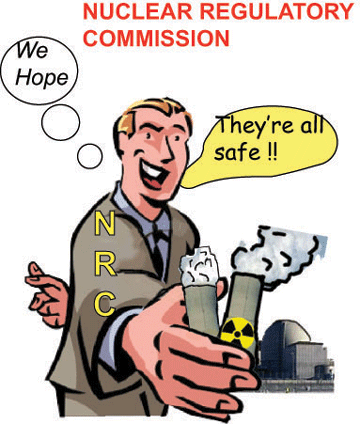
Trump tightens control of independent agency overseeing nuclear safety
Geoff Brumfiel, NPR. May 9, 2025
The Trump administration has tightened its control over the independent agency responsible for overseeing America’s nuclear reactors, and it is considering an executive order that could further erode its autonomy, two U.S. officials who declined to speak publicly because they feared retribution told NPR.
Going forward, the Nuclear Regulatory Commission (NRC) must send new rules regarding reactor safety to the White House, where they will be reviewed and possibly edited. That is a radical departure for the watchdog agency, which historically has been among the most independent in the government. The new procedures for White House review have been in the works for months, but they were just recently finalized and are now in full effect.
NPR has also seen a draft of an executive order “ordering the reform of the Nuclear Regulatory Commission.” The draft calls for reducing the size of the NRC’s staff, conducting a “wholesale revision” of its regulations in coordination with the White House and Elon Musk’s Department of Government Efficiency team, shortening the time to review reactor designs and possibly loosening the current, strict standards for radiation exposure.
“It’s the end of the independence of the agency,” says Allison Macfarlane, director of the School of Public Policy and Global Affairs at the University of British Columbia in Canada who was nominated by President Obama to serve as Chair of the NRC from 2012 to 2014. Macfarlane believes the changes will make Americans less safe.
“If you aren’t independent of political and industry influence, then you are at risk of an accident, frankly,” Macfarlane says.
The draft executive order was marked pre-decisional and deliberative. It was one of several draft orders seen by NPR that appeared to be aimed at promoting the nuclear industry. Other draft orders called for the construction of small modular nuclear reactors at military bases, and for the development of advanced nuclear fuels. Axios first reported on the existence of the executive orders.
It remains unclear which, if any, will be signed by President Trump.
In a statement, the NRC said it was working with the White House “as part of our commitment to make NRC regulatory processes more efficient. We have no additional details at this time.”
“The President of the United States is the head of the executive branch,” a spokesperson for the White House’s Office of Management and Budget wrote to NPR in an email. “The President issued an independent agencies executive order which aligns with the president’s power given to him by the constitution. This idea has been talked about for nearly 40 years and should not be a surprise.”………………………………………………………………………………………………………………………
Going nuclear
The NRC has been working to respond to the new law, but it has historically operated largely outside the purview of the White House. That began to change with an executive order signed by the president in February that called for independent agencies to begin reporting directly to the White House Office of Management and Budget………………………………………………………..
Only after the rule is finalized will the commissioners’ votes be made public. It was not immediately clear how the public would know whether the White House had changed a safety rule for a nuclear reactor.
Some questioned what the White House could gain from reviewing abstruse rules for nuclear safety.
“Who has the technical knowledge to actually do a substantive review?” asks Edwin Lyman, a nuclear physicist at the Union of Concerned Scientists, a nonprofit that has been critical of the nuclear industry. “To have political appointees meddling in these technical decisions is just a recipe for confusion and chaos.” https://www.npr.org/2025/05/09/nx-s1-5392382/trump-nuclear-regulatory-commission-watchdog-safety-radiation
Trump administration considers orders expediting nuclear plant construction, NYT reports.

By Reuters, May 10, 2025,
https://www.reuters.com/business/energy/trump-administration-considers-orders-expediting-nuclear-plant-construction-nyt-2025-05-09/
U.S. President Donald Trump’s administration is considering several executive orders to expedite the construction of nuclear power plants, the New York Times reported on Friday, citing drafts it has reviewed.
Chernobyl shelter’s drone damage includes 330 openings in outer cladding.
World Nuclear News 9th May 2025
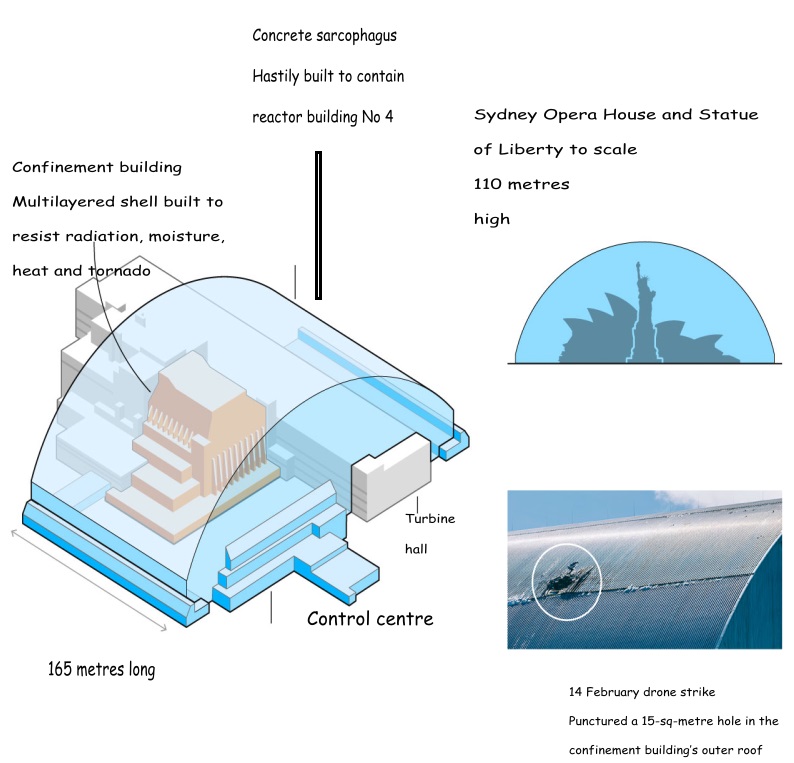
The International Atomic Energy Agency has outlined the scale of the damage caused by a drone strike and subsequent fires to the giant shelter built over the ruins of Chernobyl’s unit 4.
The agency said that investigations continue to determine the extent of the damage sustained by the arch-shaped New Safe Confinement (NSC) shelter following the drone strike on 14 February.
The impact caused a 15-square-metre hole in the external cladding of the arch, with further damage to a wider area of about 200-square-metres, as well as to some joints and bolts. It took about three weeks to fully extinguish smouldering fires in the insulation layers of the shelter.
n its update on the situation, the International Atomic Energy Agency (IAEA) said: “It took several weeks to completely extinguish the fires caused by the strike. The emergency work resulted in approximately 330 openings in the outer cladding of the NSC arch, each with an average size of 30-50 cm.
“According to information provided to the IAEA team at the site, a preliminary assessment of the physical integrity of the large arch-shaped building identified extensive damage, for example to the stainless-steel panels of the outer cladding, insulation materials as well as to a large part of the membrane – located between the layers of insulation materials – that keep out water, moisture and air.”
The main crane system, including the maintenance garage area, was damaged and it is not currently operational, the IAEA said. The heating, ventilation and air conditioning systems are functional but have not been in service since the strike. Radiation and other monitoring systems remain functional, the IAEA said. There has been no increase in radiation levels at any time during or since the drone strike.
IAEA Director General Rafael Mariano Grossi said: “We are gradually getting a more complete picture of the severe damage caused by the drone strike. It will take both considerable time and money to repair all of it.”
…………………………………………………………………………………The New Safe Confinement was financed via the Chernobyl Shelter Fund which was run by the European Bank for Reconstruction and Development (EBRD). It received EUR1.6 billion (USD1.7 billion) from 45 donor countries and the EBRD provided EUR480 million of its own resources.
On 4 March the EBRD allocated EUR400,000 from the administrative budget of the continuing fund for specialist-led damage assessment……………………………..https://www.world-nuclear-news.org/articles/chernobyl-shelters-drone-damage-includes-330-openings-in-outer-cladding
Ontario’s Darlington SMR project to cost nearly $21-billion, significantly higher than expected.

Matthew McClearn, May 8, 2025
The Ontario government approved Ontario Power Generation’s plan to spend $7.7-billion to construct the first small modular reactor in a G7 country – a price far greater than independent observers deem necessary to spark widespread adoption.
On Thursday, the government announced its wholly-owned utility can spend $6.1-billion to build the first BWRX-300 reactor adjacent to OPG’s existing Darlington Nuclear Generating Station. In addition, it can spend another $1.6-billion on common infrastructure such as administrative buildings and cooling water tunnels the new reactor will share with three additional BWRX-300s to be built later.
Those remaining units are expected to cost substantially less: all told, the 1,200-megawatt plant‘s estimated cost is $20.9-billion, expressed in 2024 dollars and including interest charges and contingencies.
Those costs are far higher than what independent observers argue are necessary for widespread adoption of SMRs. For comparison, a recently-completed 377-megawatt natural gas-fired power station in Saskatchewan cost $825-million.
High costs, overruns and delays contributed to the decline of nuclear power in advanced economies such as the U.S., France and Canada, all former leaders in reactor construction. The global reactor fleet‘s collective generating capacity has been largely flat since the 1990s, around the same time Canada’s newest reactor (Darlington Unit 4) was built. Most reactors under construction today are of Chinese and Russian design. Only one reactor is currently under construction in the Western hemisphere, and two in Western Europe, according to Mycle Schneider Consulting.
OPG’s project, known as the Darlington New Nuclear Project, is being watched closely by utilities around the world. The BWRX-300 is a candidate for proposed projects in the U.S., U.K., Poland, Estonia and elsewhere.
Thursday’s announcement marks a significant milestone for major capital projects. Proposals and memorandums of understanding for nuclear power plants abound, but very few advance to this stage.
Construction was scheduled to wrap up in 2028, but OPG has pushed that back by one year. It attributed the delay to a construction licence the Canadian Nuclear Safety Commission granted in April, later than expected; the scheduled months between breaking ground and completion remain unchanged.
OPG’s costs are several times greater than Wilmington, N.C.-based GE Hitachi Nuclear Energy originally promised. Early in the BWRX-300’s development, GE Hitachi emphasized it was designing to achieve a specific cost: US$700-million per reactor, or US$2.25-million per megawatt, low enough to compete with natural gas.
OPG said the government is not funding the project: the utility will pay for it using its own funds, including cash on hand, cash flow from generating stations and debt.
Ontarians will pay OPG back over time through their electricity bills.
Officials estimated the average cost of power from the four reactors at 14.9 cents per kilowatt hour, contingent on the federal government providing investment tax credits.
The IESO said an alternative would be to build between 5,600 and 8,900 megawatts of wind and solar generators supported by batteries. Their capacity would need to be far greater, it reasoned, to account for the intermittent nature of wind and sunlight, and they would also require far more new transmission infrastructure. The IESO estimated the costs for all that at between 13.5 and 18.4 cents per kilowatt hour. Building the BWRX-300, the IESO concluded, is the lower-risk option.
Clean Prosperity, a Canadian climate policy think tank, said in a report last year that the final construction cost of the first BWRX-300 will be influential in determining how many other utilities will be interested in building their own. A cost of $3-billion, or $10.16-million per megawatt, would encourage rapid adoption of SMRs – a level some countries have achieved.
“Russia, India, South Korea and Japan have had average construction costs of $3.4-million to $4.6-million per megawatt since 2000,” the report said.
“In contrast, France and the U.S. built reactors for $12.5-million and $17.5-million per megawatt, respectively, over the same time frame.”
In a January report, the International Energy Agency said costs must come down; SMRs need to reach US$4.5-million per megawatt by 2040 to enjoy rapid uptake, far less than OPG’s estimated costs.
OPG said it‘s confident it will stick to its schedule and budget. The utility pointed to its ongoing $12.8-billion refurbishment of Darlington’s existing four reactors, a complex project it said remains on schedule and on-budget and is scheduled to wrap up next year. But if overruns do occur on the Darlington SMR, OPG and its partners (which include GE Hitachi, architect/engineer AtkinsRéalis and constructor Aecon) will share those costs.
The utility added that 80 per cent of its spending on the project will go to Ontario companies; just 5 per cent goes to U.S. companies, primarily GE Hitachi for its design and development work.
Last fall, the Ford government passed legislation dubbed the Affordable Energy Act, which committed to prioritizing nuclear power to meet future increases in electricity demand. The province plans up to 4,800 megawatts of new nuclear capacity at the Bruce Nuclear Generating Station, and as much as 10,000 megawatts at Wesleyville, a proposed new OPG station in Port Hope.
Improvement notice issued at Dounreay nuclear power plant

By Gabriel McKay, 8 May 25, https://www.heraldscotland.com/news/25146874.improvement-notice-issued-dounreay-nuclear-power-plant/
An improvement notice has been issued at Dounreay nuclear power plant following a “significant potential risk to work safety”.
In February of this year a worker sustained a minor injury when a radiological contamination monitor, which weighed around two tonnes, toppled over.
Though there were no serious injuries, the Office for Nuclear Regulation (ONR) said there was a “significant potential risk to worker safety”.
Dounreay operated from 1955 until 1994 – though research reactors continued to function until 2015 – and is now Scotland’s largest nuclear clean-up and demolition project.
All plutonium on the site had been transferred to Sellafield by December 23, 2019.
The site upon which it stands is scheduled to become available for other uses by 2333.
Tom Eagleton, ONR Superintending Inspector, said: “This was a preventable incident that could have had serious consequences for those nearby.
“The improvement notice requires the Dounreay site to implement measures that will reduce the risk of similar occurrences in the future.
“Specifically, they must identify all operations involving the movement of heavy equipment and ensure comprehensive risk assessments and appropriate control measures are implemented before the work starts.”
Nuclear Restoration Services, which owns the plant has until 25 July 2025 to comply with the notice.
The company said: “We take the protection of people and the environment from harm very seriously.
We are taking action to strengthen our practices and management in this area, and will comply with the requirements of the notice received in April, having reported the incident to ONR and carried out an investigation.”
Torness in East Lothian is the last remaining nuclear power station in Scotland still generating electricity.
It is scheduled for shutdown in 2030, following Hunterston B in North Ayrshire in 2022, Chapelcross in Dumfries and Galloway in 2004 and Hunterston A in 1990.
Hearts and Minds: Report highlights East Lincolnshire still not a ‘willing community’.
A report recently published by campaigners opposed to a Geological Disposal Facility (GDF) in Lincolnshire demonstrates that theirs is still ‘not a willing community’ when it comes to the nuclear waste dump.
‘The Nuclear War for Lincolnshire’ published by Guardians of the East Coast (GOTEC) may conjure up an image of a decimated, burnt out waste land in the aftermath of an attack by nuclear weapons, but fortunately the publication is instead a detailed narrative of the relentless struggle to win public ‘hearts and minds’ support for a GDF first began by Nuclear Waste Services (NWS) in the middle of 2020, and continually valiantly resisted by GOTEC and its allies, amongst them local elected members and the Nuclear Free Local Authorities.
Following the announcement of a new inland ‘Area of Focus’ between Gayton le Marsh and the Carltons at the end of January, NWS ran a series of public events across the Theddlethorpe GDF Search Area. At each of these events, activists from Guardians of the East Coast offered attendees the opportunity to vote outside in a special private ‘ballot box’, built for the purpose by local Councillor Travis Hesketh.
535 members of the public attended these events. 93% took up the opportunity to vote. The result was decisive. 93% of those who voted wanted a public vote on the proposal now and 93% wanted the GDF to end now. The result was consistent across all the events.
A separate parish poll was also held in Gayton le Marsh in February 2025. 88% of parishioners voted and 93% expressed a desire to see an immediate vote.
These are just the latest expressions of the pronounced opposition to the GDF amongst residents…………………………………………………………………………………………………
NFLA 8th May 2025
1 This Month

of the week – Shut Down Drone Warfare!


Tell the Ukrainian Government to Drop Prosecution of Peace Activist Yurii Sheliazhenko

Petition to revoke the licensing of the Near Surface Nuclear Disposal Facility (NSDF) at Chalk River. https://www.ourcommons.ca/petitions/en/Petition/Details?Petition=e-7247
To see nuclear-related stories in greater depth and intensity – go to https://nuclearinformation.wordpress.com
-
Archives
- April 2026 (91)
- March 2026 (251)
- February 2026 (268)
- January 2026 (308)
- December 2025 (358)
- November 2025 (359)
- October 2025 (376)
- September 2025 (257)
- August 2025 (319)
- July 2025 (230)
- June 2025 (348)
- May 2025 (261)
-
Categories
- 1
- 1 NUCLEAR ISSUES
- business and costs
- climate change
- culture and arts
- ENERGY
- environment
- health
- history
- indigenous issues
- Legal
- marketing of nuclear
- media
- opposition to nuclear
- PERSONAL STORIES
- politics
- politics international
- Religion and ethics
- safety
- secrets,lies and civil liberties
- spinbuster
- technology
- Uranium
- wastes
- weapons and war
- Women
- 2 WORLD
- ACTION
- AFRICA
- Atrocities
- AUSTRALIA
- Christina's notes
- Christina's themes
- culture and arts
- Events
- Fuk 2022
- Fuk 2023
- Fukushima 2017
- Fukushima 2018
- fukushima 2019
- Fukushima 2020
- Fukushima 2021
- general
- global warming
- Humour (God we need it)
- Nuclear
- RARE EARTHS
- Reference
- resources – print
- Resources -audiovicual
- Weekly Newsletter
- World
- World Nuclear
- YouTube
-
RSS
Entries RSS
Comments RSS
 nuclear-news