Andra updates French repository cost estimate
Tuesday, 13 May 2025,
https://www.world-nuclear-news.org/articles/andra-updates-french-repository-cost-estimate
French radioactive waste management agency Andra has estimated the overall cost of constructing, operating and closing France’s planned deep geological repository for the disposal of high- and intermediate-level radioactive waste at between EUR26.1 billion (USD29.1 billion) and EUR37.5 billion (at 2012 prices).
France plans to construct the Centre Industriel de Stockage Géologique (Cigéo) repository – an underground system of disposal tunnels – in a natural layer of clay near Bure, to the east of Paris in the Meuse/Haute Marne area. The facility is to be financed by radioactive waste generators – EDF, Orano and the French Alternative Energies and Atomic Energy Commission – and managed by Andra.
Andra said the costing file is one of the key inputs for determining the cost of Cigéo, which will be finalised by the Minister of Industry and Energy by the end of 2025, after gathering comments from the main waste producers and the opinion of the French Nuclear Safety and Radiation Protection Authority (ASNR).
“This decree provides waste producers with a reference allowing them to establish the provisions they are required to make for the management of their waste,” Andra said. “The overall cost estimate for Cigéo is an iterative process carried out by Andra. This assessment will be revised at key stages of the project.”
In 2005, Andra estimated the cost of the facility at between EUR13.5 and EUR16.5 billion. However, in 2009 it re-estimated the cost at around EUR36 billion. In October 2014, Andra gave a revised cost estimate for Cigéo of EUR34.4 billion, based on 2012 prices. This estimate included EUR19.8 billion for the facility’s construction, EUR8.8 billion for operational costs over 100 years, EUR4.1 billion in taxes and EUR1.7 billion in miscellaneous expenses.
Andra has now issued an updated estimate for the cost of Cigéo. It says the cost of constructing and commissioning the repository will be between EUR7.9 billion and EUR9.6 billion, which includes design (excluding R&D), construction of surface infrastructure and the first storage areas, taxes, and insurance. From its commissioning in 2050, the average annual cost of Cigéo is estimated at between EUR140 million and EUR220 million per year, including operation, progressive construction, maintenance, and refurbishment over a period of about a century, followed by decommissioning and closure over about 20 years, or between EUR16.5 billion and EUR25.9 billion in total, including taxes and insurance. The R&D cost identified to date, including the operation and closure of the underground laboratory, is estimated at between EUR1.7 billion and EUR2 billion.
Andra said the 2025 costing file is consistent with Cigéo’s updated provisional schedule. “This schedule takes into account the additional time required to complete the detailed preliminary design studies (including the optimisations identified in 2016 following the first cost decision), the preparation of the support file for Cigéo’s creation permit application, and its review.”
Subject to the issuance of the creation authorisation decree in late 2027/early 2028, the receipt of the first waste packages is currently planned for 2050.
The cost decree to be set by the Minister of Industry and Energy – expected by the end of 2025 – “will serve as a reference for the project’s continuation until its next assessment,” Andra said. It also “provides waste producers with a reference allowing them to establish the provisions they are required to make for the management of their waste.”
Global sea levels are rising faster and faster. It spells catastrophe for coastal towns and cities

For around 2,000 years, global sea levels varied
little. That changed in the 20th century. They started rising and have not
stopped since — and the pace is accelerating. Scientists are scrambling
to understand what this means for the future just as President Trump strips
back agencies tasked with monitoring the oceans.
Since 1993, satellites have kept careful watch over the world’s oceans, allowing scientists a
clear view of how they are behaving. What they have revealed is alarming.
Sea level rise was unexpectedly high last year, according to a recent NASA
analysis of satellite data.
More concerning, however, is the longer-term
trend. The rate of annual sea level rise has more than doubled over the
past 30 years, resulting in the global sea level increasing 4 inches since
1993. Scientists have a good idea how much average sea level will rise by
2050 — around 6 inches globally, and as much as 10 to 12 inches in the
US.
Past 2050, however, things get very fuzzy. The world could easily see
an extra 3 feet of sea level rise by 2100, he told CNN; it could also take
hundreds of years to reach that level. Scientists simply don’t know
enough yet to project what will happen.
CNN 9th May 2025,
https://edition.cnn.com/2025/05/09/climate/sea-level-rise-melting-ice-sheets
Too Great a Risk

But, by far the most significant yet most neglected reason for avoiding the road to nuclear is the risks that nuclear power engenders in our increasingly unstable world. The concentration of power produced at a single site constitutes a megarisk of meltdown and massive radioactive fallout from cyber attack, terrorism, warfare and even nuclear attack as events in Ukraine and elsewhere have demonstrated
13 May 2025. https://www.banng.info/news/regional-life/too-great-a-risk/
Andrew Blowers discusses the contrast of historic and current energy generation seen across the Blackwater estuary in the May 2025 column for Regional Life.
Out across the Blackwater estuary into the North Sea a quiet revolution in the way we get our energy is evident. The vast arrays of wind turbines, shimmering in sunshine and faintly visible in an overcast sky are the palpable evidence of the energy transition that is gathering pace as we struggle to eliminate fossil fuels in favour of renewable sources of energy, especially offshore wind. Wind is safe, low cost and secure contributing 30% of our electricity and rising.
On the Bradwell shore lies the gleaming hulk of a former nuclear power station, now a mothballed but active radioactive waste store which will not be cleared until the end of the century at the earliest. Nuclear power has been in decline since the turn of the century. Nuclear is unsafe, high cost and insecure contributing only 12% of our electricity and falling.
And yet, despite the risks, the Government claims that ‘there is an urgent need for new nuclear which is a safe and low carbon source of energy’. It is proposing to build up to 24GW of nuclear capacity. That’s something like ten giant 2.2 GW power stations, the size proposed for Sizewell C and the now abandoned Bradwell B project, or the equivalent of around 80 Small Modular Reactors (at 300MW each).
The Government’s Civil Nuclear; Roadmap to 2050 would displace vast amounts of the cheaper, credible, reliable and more flexible renewable power sources that can navigate a plausible pathway to a Net Zero future. Such a scaling up is clearly unachievable.
But, by far the most significant yet most neglected reason for avoiding the road to nuclear is the risks that nuclear power engenders in our increasingly unstable world. The concentration of power produced at a single site constitutes a megarisk of meltdown and massive radioactive fallout from cyber attack, terrorism, warfare and even nuclear attack as events in Ukraine and elsewhere have demonstrated. And the risks from accidents, and the impacts of climate change, not to mention institutional neglect or breakdown, are unknowable and unfathomable, though nevertheless real. And, let’s not forget nuclear energy leaves a long-lasting, dangerous and presently unmanageable legacy of highly active nuclear waste.
Sites such as Bradwell are sitting targets for malevolent actions as well as being exposed to the impacts of climate change. Far better for the now closed Bradwell power station to remain a passive store with a low risk than revive any ideas for nuclear plant which would pose an existential threat to the communities of the Blackwater and beyond.
Meanwhile, out into the North Sea the turning turbines signal a future that is relatively safe, secure and sustainable.
Hinkley Point C site served notice after crane ‘component failure’
AN improvement notice has been served to the developers of Hinkley Point
C’s construction site after a component failure was found in a crane. The
Office for Nuclear Regulation told the NNB Generation Company (HPC) Ltd
(NNB GenCo) that it must improve monitoring and management of tower cranes
at the Hinkley Point C construction site near Bridgwater.
This enforcement
action follows the discovery of a failing component in a tower crane at the
site in February this year. An operator undertaking pre-use checks on site
found the failure of a pin connecting two mast sections together, and
evidence of cracking within a mast section. The findings were reported
under the Reporting of Injuries, Diseases and Dangerous Occurrences
Regulations (RIDDOR). The issue was identified before there was any broader
failure of the crane, so there were no injuries to any workers.
Bridgwater Mercury 12th May 2025.
https://www.bridgwatermercury.co.uk/news/25156847.hinkley-point-c-site-served-notice-crane-
Donald Trump Decouples the United States from Israel
Voltairenet.org , by Thierry Meyssan, 14 May 25
After patiently proposing to Benjamin Netanyahu that he negotiate with the Palestinian resistance and meeting only a stubborn determination to massacre the Palestinians, annex Gaza, southern Lebanon and Syria, and launch a war against Iran, the Trump administration has changed gears. It is now clear to them, as it has been to everyone who has been interested in this region for 80 years, that revisionist Zionists are the enemies of peace and therefore also of Israel.
The main obstacle Donald Trump faces in his peace negotiations, both with Iran and Ukraine, is the role of the “revisionist Zionists” now in power in Israel. [1] Two weeks ago, I presented in detail and with supporting evidence the pressure they are exerting on Washington to derail the talks with Tehran [2].
I did not address in my column on Voltairenet.org their pressure on behalf of the Ukrainian “integral nationalists” [3], which only became public on May 3, with Natan Sharansky’s emphatic statements in support of Volodymyr Zelensky [4]. I have already explained why and how these two groups formed an alliance in 1921 against the Bolsheviks and many Ukrainian Jews, which led to an investigation by the World Zionist Organization and the resignation of Vladimir Jabotinsky from its board of directors.
This affair is today underestimated by Jewish historians who are reluctant to study the massacre of Jews by other Jews. There are, however, exceptions such as the work of Grzegorz Rossoliński-Liebe [5]. Sharansky himself prevents historians from studying the subject by presiding over the Babi Yar Holocaust Memorial Center (the shooting of 33,771 Jews on September 29 and 30, 1941) by the Einsatzgruppen and the “integral nationalists” two weeks after Stepan Bandera’s transfer from Kyiv to Berlin.
And let’s not forget the contacts of the “revisionist Zionists” with Adolf Eichmann until the fall of Berlin by the Red Army on May 2, 1945 [6].
While the then Israeli Prime Minister, Naftali Bennett, had, at the beginning of the Russian special operation in Ukraine, called on Volodymyr Zelensky to recognize Moscow’s just demands to “denazify Ukraine,” and Israeli Defense Minister Benny Gantz had declared that, while he was alive, Israel would never give weapons to the “massacres of Ukrainian Jews,” the current Prime Minister, Benjamin Netanyahu, authorized the Israeli arms industry to export its production to Ukraine.
In 2022, Russian Foreign Minister Sergei Lavrov declared: “What if Zelensky was Jewish? This fact does not negate the Nazi elements in Ukraine. I believe Hitler also had Jewish blood. That means absolutely nothing.” The Jewish people, in their wisdom, have said that the most ardent anti-Semites are generally Jews. Every family has its black sheep, as they say.” Yair Lapid then replied: “These remarks are both unforgivable and scandalous, but also a terrible historical error. Jews did not kill each other during the Holocaust. The lowest level of racism against Jews is to accuse Jews themselves of anti-Semitism.” Let’s make no mistake: History is not made up of good or evil communities, but of individuals who, each of them, can behave in different ways. Let’s open our eyes!
Let’s get back to our topic. Donald Trump is president of the United States; a country whose founding myth claims that it was founded by the “Pilgrim Fathers,” who fled the “pharaoh” of England, crossed the Atlantic as the Hebrews crossed the Red Sea, and established a colony in Plymouth, just as the Hebrews founded the “Promised Land.” All Americans celebrate this myth on Thanksgiving Day. Every president of the United States, without exception, from George Washington to Donald Trump himself, has referred to it in their official speeches. The alliance between Washington and Tel Aviv is therefore not debatable. It turns out that the United States, this country where sects proliferate, which celebrates freedom of religion but not freedom of conscience and denounces, without understanding it, French secularism, has a “Christian Zionist” movement. These are Christians who equate biblical Israel with the modern State of Israel. However, this movement voted overwhelmingly for Donald Trump, and he feels the debt owes him. Once he became president, he appointed Pastor Paula Blanche (also linked to the “Japanese imperialists”) as director of the White House Faith and Opportunity Initiative.
Slowly, President Donald Trump is disassociating Israel from Benjamin Netanyahu. Receiving him at the White House while he was the subject of an arrest warrant from the International Criminal Court, he had his Secretary of State, Marco Rubio, proclaim that his administration was the most pro-Israeli in history. In doing so, he firmly opposed Netanyahu’s plan to disrupt the peace agreement signed with Hamas and, instead, to military occupation of the Gaza Strip. He went so far as to claim that the US (not Israeli) armies would take “control” of this territory. Noting that his provocations are having no effect on Tel Aviv, President Donald Trump has just taken a decisive step: without warning his Israeli ally, he negotiated a separate peace with Ansar Allah at the very moment that Yemeni movement was bombing Tel Aviv’s Ben Gurion Airport………………………………………………………………………………
New York Times columnist Thomas Friedman wrote the following day, on May 9: “I have no doubt that, generally speaking, the Israeli people continue to regard themselves as an unwavering ally of the American people—and vice versa.” But this ultranationalist, messianic Israeli government is not an ally of the United States […] We can continue to ignore the number of Palestinians killed in the Gaza Strip—more than 52,000, including approximately 18,000 children—question the credibility of the figures, and resort to every mechanism of repression, denial, apathy, distancing, normalization, and justification. None of this will change the bitter fact: they killed them. Our hands did it. We must not close our eyes. We must wake up and shout loud and clear: stop the war.
In any case, if no one in the United States can question the alliance with Israel, this in no way implies support for the “revisionist Zionists” now in power in Tel Aviv.
Slowly, President Donald Trump is disassociating Israel from Benjamin Netanyahu. Receiving him at the White House while he was the subject of an arrest warrant from the International Criminal Court, he had his Secretary of State, Marco Rubio, proclaim that his administration was the most pro-Israeli in history. In doing so, he firmly opposed Netanyahu’s plan to disrupt the peace agreement signed with Hamas and, instead, to military occupation of the Gaza Strip. He went so far as to claim that the US (not Israeli) armies would take “control” of this territory. Noting that his provocations are having no effect on Tel Aviv, President Donald Trump has just taken a decisive step: without warning his Israeli ally, he negotiated a separate peace with Ansar Allah at the very moment that Yemeni movement was bombing Tel Aviv’s Ben Gurion Airport.
Reestablishing the division between North and South Yemen, Ansar Allah, led by the Houthi family (hence its pejorative Western nickname, “Houthi gang” or “Houthis”), managed to end the war with the help of Iran, then to rescue Palestinian civilians by bombing Israeli or Israeli-linked ships in the Red Sea. The United Nations Security Council never condemned these attacks, only the disruption of the freedom of navigation of ships unrelated to the Gaza conflict. Contemptuous of the United Nations, the United States and the United Kingdom first created a military coalition to respond to Ansar Allah and rescue the Israelis during the massacre of Gazan civilians. They targeted military targets without significant results (all Yemeni military targets being buried underground), then they targeted political figures, collaterally killing many civilians.
The Anglo-Saxons continued to accuse Iran of militarily supporting Ansar Allah, portraying Tehran as a player in the current war. However, General Qassem Soleimani (assassinated on Donald Trump’s orders on January 3, 2020) had helped Ansar Allah reorganize so that it could manufacture its own weapons and continue its war without Iranian help. Although Iran has repeatedly stated that it is no longer involved in Yemen, the Anglo-Saxons still consider Ansar Allah to be a “proxy” for Iran, which is now completely false.
It is now important to understand how Donald Trump views conflicts in the “Broader Middle East.” He intends to forcefully compel the groups waging wars, whether they are right or wrong in these conflicts, to cease their military operations. But he does not want to go to war against either group. Then, he hopes to negotiate compromises to establish just and lasting peace. He therefore had General Qassem Soleimani assassinated in 2020, just after having the caliph of Daesh, Abu Bakr al-Baghdadi, assassinated. He authorized operations against Ansar Allah and has just ended them when he realized that it was not a terrorist group, but a legitimate political power administering a yet-to-be-recognized state. He authorized arms deliveries to Israel during the ethnic cleansing of Gaza, but began supporting the peace movement within the Israel Defense Forces (IDF), so that today the “revisionist Zionists” no longer have the means to massacre Gazans and are retreating from their siege aimed at starving them.
The separate agreement reached with Ansar Allah must therefore be assessed as a break from Washington’s alignment with Tel Aviv and a step toward the agreement with Tehran. When, in mid-March, Tel Aviv perceived the possible US withdrawal—it had not envisaged a separate peace—it once again escalated its stance and attacked Yemen 131 times.
The US-Israeli Ron Dermer, a close friend of Natan Sharansky with whom he wrote a book, became Israel’s ambassador to Washington and is now Minister of Strategic Affairs. As such, he is primarily responsible for the plans to annex Gaza and massacre the civilian population. Reacting to the separate US-Yemen peace agreement, this revisionist Zionist visited the White House on May 8, where he was received “in a private capacity” by Donald Trump [7]. The encounter went very badly: he tried to tell President Trump what to do. The latter immediately put him in his place.
New York Times columnist Thomas Friedman wrote the following day, on May 9: “I have no doubt that, generally speaking, the Israeli people continue to regard themselves as an unwavering ally of the American people—and vice versa.” But this ultranationalist, messianic Israeli government is not an ally of the United States […] We can continue to ignore the number of Palestinians killed in the Gaza Strip—more than 52,000, including approximately 18,000 children—question the credibility of the figures, and resort to every mechanism of repression, denial, apathy, distancing, normalization, and justification. None of this will change the bitter fact: they killed them. Our hands did it. We must not close our eyes. We must wake up and shout loud and clear: stop the war.” [8]
Meanwhile, President Donald Trump is scheduled to meet with the leaders of Saudi Arabia, the United Arab Emirates, and Qatar this week, but will not meet with Benjamin Netanyahu. Defense Secretary Pete Hegseth also canceled a planned trip to Israel at the same time, reinforcing the president’s message. Reuters revealed on May 8 that Washington, in negotiating with Saudi Crown Prince Mohammed bin Salman (MBS), was no longer making recognition of Israel a precondition for any deal. [9] If confirmed, this would mean that to recognize that the Jewish state has become a racist Jewish state would no longer be a crime in the West.
In early March, it was announced that President Donald Trump had authorized Adam Boehler, his negotiator for the release of the American hostages, to establish direct contact with Hamas, which is still officially considered a “terrorist organization. “On May 12, this change of attitude was rewarded with the announcement of the release of the American-Israeli, Edan Alexander, kidnapped while carrying weapons, on October 7, 2023. Moreover, in early May, rumors of a possible recognition by the United States of the State of Palestine during Donald Trump’s trip to Riyadh spread like wildfire. In early March, it was announced that President Donald Trump had authorized Adam Boehler, his negotiator for the release of the American hostages, to establish direct contact with Hamas, which is still officially considered a “terrorist organization. “On May 12, this change of attitude was rewarded with the announcement of the release of the American-Israeli, Edan Alexander, kidnapped while carrying weapons, on October 7, 2023. Moreover, in early May, rumors of a possible recognition by the United States of the State of Palestine during Donald Trump’s trip to Riyadh spread like wildfire. https://www.voltairenet.org/article222255.html
Too Cruel to Even Imagine—Nuclear War in Densely Populated Areas
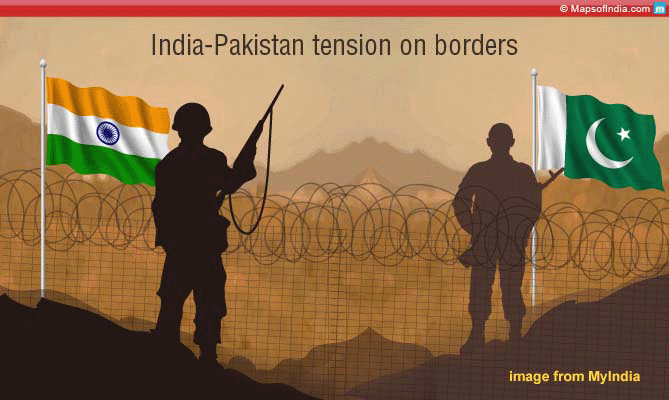
in South Asia, by Bharat Dogra 12/05/2025, https://countercurrents.org/2025/05/too-cruel-to-even-imagine-nuclear-war-in-densely-populated-areas/
Nuclear war should never happen as it is the most destructive thing imaginable. While nuclear weapon war anywhere is so destructive that this cannot be accepted, it is at its most cruel in more densely populated areas. No one can question this reality, but despite this we have the most dreadful and frightening situation of escalating conflict between India and Pakistan, two nuclear weapon countries which possess a total of about 340 nuclear weapons, according to recent estimates, and are also included among the most densely populated countries of the world, in terms of people living per one square km.
While the average world population density for the entire world is 60, it is 331 for Pakistan and 483 for India. In several cities and the most densely populated city districts of these countries, the population density can be easily over 5,000, going up to around 55,000 in the most densely populated city district (Karachi Central). While war even with conventional weapons can be very highly destructive in such conditions, in the context of nuclear weapons, even smaller and tactical ones, this is too cruel even to be imagined. Yet the possibility cannot be brushed aside and must be considered as a real life possibility, a relatively low possibility but nevertheless real possibility, whenever the two countries are involved in escalating conflict situations.
Eric Schlosser, a well-known writer on nuclear weapons, has spoken at length to top officials and commanders at various stages of planning and control of nuclear weapons. In addition he has close contacts with peace movements struggling for a world free from nuclear weapons. He has written that these very different persons share a very strong and sincere desire to avoid actual use of nuclear weapons.
The reason why both these sections share this strong belief is that both groups are well-informed about what actual use of nuclear weapons means. This makes them tremble about the implications.
In the specific context of India and Pakistan, the two nuclear weapon countries of South Asia, Schlosser has written, “The latest studies suggest that a relatively small nuclear exchange (relative to the total number of nuclear weapons that exist in world) would have long-term effects across the globe. A war between India and Pakistan, involving a hundred atomic bombs like the kind dropped in Hiroshima, could send five million tons of dust into the atmosphere, shrink the ozone layer by as much as fifty per cent, drop worldwide temperatures to their lowest point in a thousand years, create worldwide famines and cause more than a billion casualties.”
Thus it is clear that apart from killing millions of people immediately, war with nuclear weapons can lead to unprecedented environmental catastrophe which can kill an even larger number of people while also destroying other life-forms like never before. If the nuclear weapon exchange is between two countries alone, people particularly of neighbouring countries will also suffer very serious consequences without being involved in any dispute at all.
Some strategists have argued that there can be a less catastrophic role for nuclear weapons in the form of tactical nuclear weapons. As not just peace movements but several independent experts have pointed out, this is a highly flawed and mistaken view. A nuclear war started with tactical weapons can easily spill into a full-blown nuclear war if the opposing side also has nuclear weapons. Secondly, use of even tactical nuclear weapons can be very destructive, even for the using country!
Pakistan in particular has been keen to develop tactical nuclear weapons in recent times as it feels that this can be one way of checking and defeating an invasion by a country with superior conventional war capability and bigger economic resources. However saner scientific voices in Pakistan have warned that if Pakistan uses tactical weapons against an invading army on its land, its own military and civilian losses can be very high due to the highly destructive impacts of these weapons.
In the much earlier days of the cold war the NATO had stocked a lot of tactical nuclear weapons in West Germany to check a possible Soviet invasion. A war game Carte Blanche was played out to see the possible impacts in case of a Soviet invasion. It was realized only then that German civilian deaths from the use of tactical nuclear weapons on its own land can be higher than total German civilian deaths in the Second World War! Such is the destructive power of these weapons.
Moreover when tactical nuclear weapons have to be prepared for use then control has to be more dispersed and scattered. This increases the possibility that persons with fanatic or fundamentalist leanings can also gain access to this control. Hence the possibilities of terrorists gaining access to such control also increase at least to some extent. The Pakistani authorities including armed forces have time and again faced evidence-based criticism for supporting terror-groups and this combination of terror groups and nuclear weapons can prove very dangerous in a national as well as international context. From time to time attacks by such terror groups, some of whom also break free from the control of the authorities to a lesser or greater extent, have led to crisis situations nationally and internationally.
It is not at all justified to be under the false impression that tactical weapons provide some form of safer nuclear weapons. Let no one create such a false impression as such a delusion can be extremely catastrophic for millions and millions of people.
Let us face the reality. All evidence points to the fact that nuclear weapons should never be used. In fact even accidental use of nuclear weapons or accidents relating to nuclear weapons can be very destructive. Hence ultimately the only safe option if we care for life on earth is to give up all nuclear weapons and all weapons of mass destruction once and for all at the level of the entire world. The more you study and explore this issue, no matter which side you belong to, the only honest conclusion can be that tomorrow if not today we have to do away with nuclear weapons if we want to save life on earth; so why not make a beginning today itself.
The discussion here has been in the context of South Asia, but of course the consequences of an exchange of nuclear weapons between the USA and Russia or between the USA and China will be even more destructive, much more devastating for the world as these countries have more weapons and their destructive capacity is higher. As a part of world, South Asia will also suffer very harmful impacts from this. Hence the only safe future for us and for our children is on the path which is entirely free from nuclear weapons and entirely free of all weapons of mass destruction.
As for the immediate issue at hand, the maximum efforts need to be made to prevent further escalation of ongoing India-Pakistan conflict and also to end this conflict as early as possible.
False promises, real costs: The nuclear gamble we can’t afford
Beyond the financials, nuclear represents a specific vision of governance; centralised, top-down, and resistant to scrutiny. A small number of well-connected corporations manage most facilities. The civilian sector remains intertwined with military infrastructure. Decision-making processes often exclude community consultation. Most notably, nuclear generates waste that remains hazardous for thousands of years, demanding long-term institutional stability that even the Nuclear Waste Management Organization acknowledges no government can guarantee.
Scotland and Canada must forge an energy future that works
by Ben Beveridge, 11-05-2025 , https://bylines.scot/environment/false-promises-real-costs-the-nuclear-gamble-we-cant-afford/
Nuclear power is staging a quiet comeback. In boardrooms across Scotland and Canada, familiar promises are being repackaged as bold new solutions: reliable baseload electricity, energy security, and climate alignment. But behind the sleek rhetoric, the same truths remain. Nuclear power is still the slowest, most expensive, and least flexible energy option on the table.
Both countries now face pressure to commit to a nuclear future they neither need nor can afford. This isn’t the natural evolution of energy policy. It’s the resurrection of a failing model, defended not on merit, but on legacy interests.
In the UK, projects like Hinkley Point C and Sizewell C have seen cost projections soar, with current estimates exceeding £30bn. Scotland, despite producing 97% of its electricity from renewable sources, remains tied to a UK-wide strategy shaped by Westminster’s nuclear ambitions
In Canada, Ontario’s Darlington refurbishment has grown from C$6bn to more than C$12bn. Saskatchewan and New Brunswick are investing heavily in Small Modular Reactors (SMRs), which have yet to prove commercial viability. The Canadian Environmental Law Association has raised significant concerns over the feasibility, safety, and cost of these technologies, yet federal investment continues, often at the expense of grid modernisation and renewable storage.
Nuclear: more expensive, less flexible, needs political intervention
The narrative has shifted from energy independence to climate urgency, but the fundamentals have not. Lazard’s 2023 analysis puts the levelised cost of new nuclear at US$131–204 per megawatt-hour, while utility-scale solar sits at US$26–41, and wind at US$24–47. Nuclear projects frequently exceed ten-year construction timelines. By contrast, wind and solar facilities can be operational within five. Nuclear plants also lack the flexibility modern grids require, locking in oversupply and reducing the effectiveness of variable renewable sources.
Private capital has walked away. No nuclear facility proceeds without government subsidies, price guarantees, or risk backstops. The market has made its judgment. Nuclear survives only through political intervention, not economic logic.
Beyond the financials, nuclear represents a specific vision of governance; centralised, top-down, and resistant to scrutiny. A small number of well-connected corporations manage most facilities. The civilian sector remains intertwined with military infrastructure. Decision-making processes often exclude community consultation. Most notably, nuclear generates waste that remains hazardous for thousands of years, demanding long-term institutional stability that even the Nuclear Waste Management Organization acknowledges no government can guarantee.
Renewables: decentralised, democratic and resilient
In contrast, the model offered by renewables is decentralised, participatory, and adaptive. Community energy projects across Scotland – from the Isle of Eigg to the Outer Hebrides – demonstrate how generation can be local, democratic, and resilient. In Canada, provinces like Quebec and British Columbia have built near-100% clean grids through hydroelectricity, rejecting nuclear while Clean Energy Canada shows generational energy security and affordability.
So why does nuclear persist? The answer lies in its structure. Nuclear development creates concentrated profit centres, contracts for reactor manufacturers, engineering giants, uranium suppliers, and vertically integrated utilities. These stakeholders benefit from centralised generation, not distributed ownership. Regulatory frameworks often entrench their advantages, creating barriers for smaller-scale or community-led projects. The result is a policy environment that protects incumbents rather than enabling transition.
This is not a neutral technological debate. It’s a structural contest between legacy systems and emergent models of energy democracy. The framing may be about climate, but the stakes are about convention, and control.
Scotland and Canada renewable partnership
Scotland and Canada are uniquely positioned to lead an alternative path. Their respective strengths are complementary. A Scotland-Canada renewable partnership, modelled after the North Sea oil and gas collaboration, could drive investment in shared technologies like offshore wind, pumped hydro storage, and smart grid systems. Agencies such as Scottish Enterprise and Scotland Development International already maintain Canadian operations and could broker this cooperation directly.
The Commonwealth presents another opportunity. A Commonwealth Energy Transition Alliance could support shared investment frameworks, model policy design, and collaborative R&D between countries with aligned infrastructure and ambitions. It could also serve as a counterbalance to the lobbying power of the nuclear-industrial complex, directing climate funding towards solutions that scale affordably and equitably.
The choice facing both nations is not nuclear or catastrophe. It is between centralised systems that demand public subsidy and deliver rising costs, versus renewable models that are increasingly faster, cheaper, and community-driven. The facts are clear. The economics are settled. What remains is the political will to choose a future built for the many, not the few.
Scotland and Canada no longer need permission to lead. They need resolve. The nuclear mirage still shimmers, but it’s time to walk towards the real oasis: a clean, democratic energy future, and we have it already.
Want to know how the world really ends? Look to TV show Families Like Ours
John Harris, 1 May 25
The Danish drama is piercing in its ordinariness. In the real world, the climate crisis worsens and authoritarians take charge as we calmly look awaySun 11 May 2025 21.35 AESTShare649
The climate crisis has taken a new and frightening turn, and in the expectation of disastrous flooding, the entire landmass of Denmark is about to be evacuated. Effectively, the country will be shutting itself down and sending its 6 million people abroad, where they will have to cope as best they can. Huge numbers of northern Europeans are therefore being turned into refugees: a few might have the wealth and connections to ease their passage from one life to another, but most are about to face the kind of precarious, nightmarish future they always thought of as other people’s burden.
Don’t panic: this is not a news story – or not yet, anyway. It’s the premise of an addictive new drama series titled Families Like Ours, acquired by the BBC and available on iPlayer. I have seen two episodes so far, and been struck by the very incisive way it satirises European attitudes to the politics of asylum. But what has also hit me is its portrayal of something just as modern: how it shows disaster unfolding in the midst of everyday life. At first, watching it brings on a sense of impatience. Why are most of the characters so calm? Where are the apocalyptic floods, wildfires and mass social breakdown? At times, it verges on boring. But then you realise the very clever conceit that defines every moment: it is really a story about how we all live, and what might happen tomorrow, or the day after.
The writer and journalist Dorian Lynskey’s brilliant book Everything Must Go is about the various ways that human beings have imagined the end of the world. “Compared to nuclear war,” he writes, “the climate emergency deprives popular storytellers of their usual toolkit. Global warming may move too fast for the planet but it is too slow for catastrophe fiction.” Even when the worst finally happens, most of us may respond with the kind of quiet mental contortions that are probably better suited to literature than the screen. Making that point, Lynskey quotes a character in Margaret Atwood’s novel The Year of the Flood: “Nobody admitted to knowing. If other people began to discuss it, you tuned them out, because what they were saying was both so obvious and so unthinkable.”
These days, that kind of thinking reflects how people deal with just about every aspect of our ever-more troubled world: if we can avert our eyes from ecological breakdown, then everything else can be either underestimated or ignored. There is a kind of moment, I would wager, that now happens to all of us. We glance at our phones or switch on the radio and are assailed by the awful gravity of everything, and then somehow manage to instantly find our way back to calm and normality. This, of course, is how human beings have always managed to cope, as a matter of basic mental wiring. But in its 21st-century form, it also has very modern elements. Our news feeds reduce everything to white noise and trivia: the result is that developments that ought to be vivid and alarming become so dulled that they look unremarkable.
Where this is leading politically is now as clear as day. In the New Yorker, Andrew Marantz wrote, in the wake of Trump’s re-election, about how democracies slide into authoritarianism. “In a Hollywood disaster movie,” he writes, “when the big one arrives, the characters don’t have to waste time debating whether it’s happening. There is an abrupt, cataclysmic tremor, a deafening roar … In the real world, though, the cataclysm can come in on little cat feet. The tremors can be so muffled and distant that people continually adapt, explaining away the anomalies.” That is true of how we normalise the climate crisis; it also applies to the way that Trump and his fellow authoritarians have successfully normalised their politics.
Marantz goes to Budapest, and meets a Hungarian academic, who marvels at the political feats pulled off by the country’s prime minister, Viktor Orbán. “Before it starts, you say to yourself: ‘I will leave this country immediately if they ever do this or that horrible thing,’” he says. “And then they do that thing, and you stay. Things that would have seemed impossible 10 years ago, five years ago, you may not even notice.” The fact that populists are usually climate deniers is perfect: just as searingly hot summers become mundane, so do the increasingly ambitious plans of would-be dictators – particularly in the absence of jackboots, goose-stepping and so many other old-fashioned accoutrements. Put simply, Orbán/Trump politics is purposely designed to fit with its time – and to most of its supporters (and plenty of onlookers), it looks a lot less terrifying than it actually is.
Much the same story is starting to happen in the UK. On the night of last week’s local elections, I found myself in the thoroughly ordinary environs of Grimsby town hall, watching the victory speech given by Reform UK’s Andrea Jenkyns, who had just been elected as the first mayor of Greater Lincolnshire. For some reason, she wore a spangly outfit that made her look as if she was on her way to a 1970s-themed fancy dress party, which raised a few mirthless laughs. She said it was time for an end to “soft-touch Britain”, and suddenly called for asylum seekers to be forced to live in tents. That is the kind of thing that only fascists used to say, but it now lands in our political discourse with not much more than a faint thump.
Meanwhile, life has to go on. About 20 years ago, I went to an exhibition of works by the French photographer Henri Cartier-Bresson – one of which was of a family of four adults picnicking by the Marne, with their food and wine scattered around them, and a rowing-boat moored to the riverbank. When I first looked at it, I wondered what its significance was. But then I saw the date on the adjacent plaque: “1936-38.” We break bread, get drunk and tune out the noise until carrying on like that ceases to be an option: as Families Like Ours suggests, that point may arrive sooner than we think.
Zelenskyy says he is willing to meet Putin in Istanbul for peace talks
Euronews with AP 11/05/2025
The Ukrainian president said on Sunday he expected Russia to confirm a ceasefire starting Monday, and that he was prepared to meet with his Russian counterpart in Turkey on Thursday for direct talks to end Moscow’s war, now in its fourth year.
Zelenskyy’s words came in response to Putin’s remarks to the media overnight, in which he effectively ignored the idea of a ceasefire — pushed for by Western leaders — and proposed restarting direct talks with Ukraine in Istanbul on Thursday instead “without preconditions”.
Putin did not specify whether the talks on Thursday would involve Zelenskyy and him personally.
He added, however, that “the very first step in truly ending any war is a ceasefire.” “There is no point in continuing the killing even for a single day. We expect Russia to confirm a ceasefire — full, lasting, and reliable — starting tomorrow, May 12th, and Ukraine is ready to meet,” the Ukrainian leader said on X.
German Chancellor Friedrich Merz, French President Emmanuel Macron, British Prime Minister Keir Starmer and Polish Prime Minister Donald Tusk met with Zelenskyy in Kyiv on Saturday and issued a coordinated call for a 30-day truce starting Monday. The plan has received backing from both the European Union and Washington.
The leaders pledged tougher sanctions on Russia if Putin did not accept the proposal.
Prior to the Kyiv visit by the quartet of European leaders, US President Donald Trump insisted Ukraine accept Russia’s latest offer of holding direct talks in Turkey on Thursday. Ukraine, along with European allies, had demanded that Russia accept an unconditional 30-day ceasefire starting on Monday before holding talks, but Moscow effectively rejected the proposal and called for direct negotiations instead…….
Trump said in a social media post earlier Sunday that Ukraine should agree to Putin’s peace talks proposal “immediately.”……………………………..https://www.euronews.com/2025/05/11/zelenskyy-and-putin-to-meet-in-turkiye-on-thursday-possibly
Business as usual: Australian government stalls on Defence reform as AUKUS woes grow

Above -Australia’s Defence Minister Richard Marles
Defence spending is lagging, AUKUS is stalling, and systemic mismanagement persists as Labor avoids hard structural reform.
Bernard Keane, May 11, 2025, https://www.themandarin.com.au/291901-business-as-usual-labor-stalls-on-defence-reform-as-aukus-woes-grow/
Having managed to get through an election campaign barely mentioning defence — despite the opposition trying to make it a late-stage vote winner — the newly expanded Labor government still faces a number of big challenges in the defence portfolio, and no easy answers.
The two big ones are well-known: the replacement of the US security guarantee with Trumpian chaos, which means Australia will have to strengthen its defence capability so that it has to rely less on the US, and the profound problems of AUKUS.
Despite some budget sleight of hand purporting to show an acceleration in defence spending, the government remains committed to increasing defence spending to just 2.33% of GDP — not merely well below the Trump administration’s demand for 3%, but below the Coalition’s planned increase to 2.5% and the calls from defence and security experts, as well as Labor luminaries like Kim Beazley, for a significant increase.
But the ability of the Department of Defence to handle any increase in spending — or even competently spend what it currently receives — is openly questioned even by hawks. Average major project slippage time, already alarming when the Coalition was last in power, noticeably deteriorated in Labor’s first term. The response of Defence appeared to try to hide embarrassing data from the Auditor-General under the pretence of national security.
Also characterising Labor’s first term was the admission of failure of departmental process, to the very highest echelons of Defence, in relation to the Hunter-class frigate project and the shocking audit of Defence’s dealings with Thales on munitions manufacturing (the second part of which is yet to arrive from the auditor-general).
With both defence minister Richard Marles’ track record in Labor first term, and his general insouciance toward revelations such as the Thales debacle — which included the revelation that the department had actively misled predecessor ministers — it seems unlikely Defence will face any real pressure to improve the incompetence and, quite possibly, corruption that marks its management of major procurement processes. A defence minister like Andrew Hastie, far more credentialed in military matters than most within the department, could have driven the kind of reform that would have gotten Defence backs up, and led to copious leaking against him, but improved the reliability and integrity of the department’s procurement processes. Instead, we’ll have to hope that a Labor government with a big majority and more confidence will be more willing to take on the fundamental problems in the portfolio.
A similar business-as-usual approach will likely characterise the unfolding disaster that is AUKUS. The grim reality is that US submarine construction rates are slowing, not accelerating as they need to if the US is to provide three Virginia-class nuclear submarines to Australia from 2030. In early April, the US Navy admitted to Congress significant delays in constructing its new Columbia-class ballistic missile submarine, which shares some components with the Virginia class. While the builders of the Virginia-class boats are talking bravely of demand signals and additional investment, the build rate for the subs late last year was barely above half that required by AUKUS.
None of this, apparently, is of interest to the bureaucrats charged with overseeing AUKUS. The Mandarin applied under Freedom of Information laws to the Australian Submarine Agency to see what briefing it was providing to ministers on the problems in submarine construction in the US and the UK. No such documents, came back the answer. Blind faith that the US can double the rate of submarine construction in a couple of years is one thing, but remaining ignorant of how badly off track AUKUS is? That’s quite another.
One of the key problems of the Virginia-class boats for Australia is that they require huge crews — 135 sailors, compared to just 58 for Australia’s current submarines. That brings into focus a persistent and worsening problem — our inability to attract and retain ADF members. Last year the Navy was short around 900 people. The Army was short around 5000; only the RAAF is around its mandated strength. A change of recruitment agency for the ADF proved a disaster, with portfolio minister Matt Keogh expressing his “deep disappointment” with the provider’s “wholly deficient” performance. Critics say the problem is with the ADF itself, which is “too slow and too picky”. The government announced in mid-2024 the brilliant idea of opening up the ADF to personnel from Five Eyes. countries. Only problem is, they’re all suffering the same problems with defence recruitment. In fact, armies, navies and air forces around the world are suffering ongoing recruitment problems and have done so for years — even the People’s Liberation Army is struggling to attract Chinese youth to its ranks.
In each of these areas, clearly, business as usual won’t cut it. But that is what Defence is very good at, and its ministers are very bad at preventing. To prevent it, only structural arrangements that disrupt Defence’s normal processes will achieve results. The royal commission into ADF member and veteran suicide had the right idea — and the government rightly took its lead from the commission in its response. The commission recommended a new independent statutory body to oversee reform across the whole Defence/Veterans Affairs portfolio, not a new area of Defence. And it urged, and the government agreed, that central agencies be charged with implementing the commission’s recommendations: the result was a Prime Minister and Cabinet taskforce to start implementing reforms, with the help of external expertise.
An independent agency, and a PM&C-led implementation taskforce, was what was needed to ensure Defence didn’t simply default back to business as usual when it came to the mental health of its members and veterans. Only the oversight and interference of high-powered external bodies will compel Defence to change its culture.
And it’s the only thing that will enable the government to seriously tackle the biggest challenges in the portfolio over the coming years.
Bernard Keane
Bernard Keane is a columnist for The Mandarin. He was a Canberra press gallery correspondent covering politics, national security and economics, and a public servant and speechwriter in transport and communications. He is co-author of A Short History Of Stupid, which covers the decline of reason and issues with public debate.
Resuscitation at Zaporizhzhia?
by beyondnuclearinternational, https://beyondnuclearinternational.org/2025/05/11/resuscitation-at-zaporizhzhia/
Why would the US, Ukraine and Russia contemplate this when renewables could answer energy needs faster and more safely, writes Linda Pentz Gunter
The Trump administration has been dangling all sorts of offers before the embattled (literally) Ukrainian government lately. These include a US grab for Ukraine’s minerals in exchange for continued support of its war with Russia, and asking Ukraine to serve as an overseas prison for those residents of the US deemed “illegals” and “criminals” by Trump’s (in)justice department.
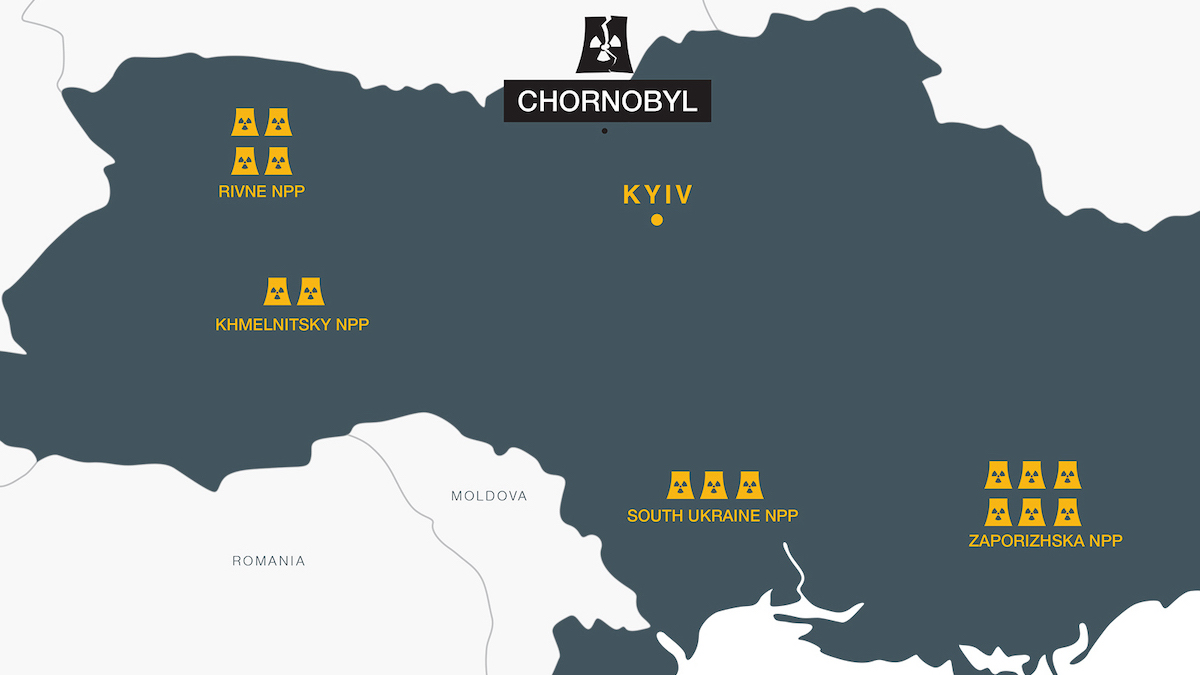
Now, the White House is apparently suggesting that the US should first rebuild and then operate the damaged six-reactor Zaporizhzhia nuclear plant in the southeast of Ukraine, the area of some of the most intense fighting between Ukrainian and Russian forces.
This bizarre proposal is detailed in a new column by the director of the Nonproliferation Policy Education Center, Henry Sokolski, in the May 6, 2025 edition of The Bulletin of the Atomic Scientists. Along with the question of whose nuclear plant Zaporizhzhia actually is, or who damaged it, Sokolski also asks just how complex and expensive restoring the plant would be and whether it is even needed?
In reading through the list of challenges to a restart that Sokolski outlines, the answer to that last question becomes increasingly more obvious: No. It is glaringly evident that nuclear power is the wrong choice for Ukraine at this point (and, we would argue, always has been).
Renewable energy can take a couple of years — and in some cases just a few months — to build and bring into operation. Given Ukraine’s previous reliance on nuclear energy for around 55% of the country’s electricity (before the war interrupted the flow), developing an energy supplier that can come on fast and doesn’t present a safety risk (under war conditions or at any other time) is, as they say here, a “no brainer”.
And yet all three countries are vying to be the one responsible for a Zaporizhzhia restart. All three are also married to the idea of a nuclear-powered future and therefore cannot be relied upon to take the more sensible renewable energy route. Even in the midst of a war, Ukraine has signaled its intention to build as many as nine new Westinghouse AP1000 reactors at all four of its existing nuclear sites —yes, even at Zaporizhzhia! Both Russia and the US are expanding their nuclear power capacity, at home as well as abroad, including through the export of reactor technology.
Why then are any of these countries even contemplating an attempt to surmount the likely insurmountable challenges of resurrecting the existing Russian built VVER Zaporizhzhia reactors, which comprise the largest nuclear power plant in Europe at 5,700 MW?
As Sokolski asks in a preamble to his Bulletin article:
“Russia destroyed the Kakhovka Dam upstream of the plant. What would be required to assure a steady clean supply of cooling water for the reactors? The Russians laid mines around the plant; the area is also laced with unexploded ordnance. How will these be neutralized? Who will do this? The Russians looted and damaged much of the plant’s control equipment. How will it be repaired and replaced? Who will certify that the work has been done properly? The U.S. Nuclear Regulatory Commission? The Ukrainian State Nuclear Regulatory Inspectorate? Rosatom?”
Then there’s the issue of cost.
“Will seized Russian assets foot the bill?” Sokolski asks. “Or will it be European Reconstruction Bank funds? What of US investment, taxpayer funds, and any private entity potentially interested in chipping in? Once funds are allocated, who would receive the profits, if any, or be responsible for the losses? Who would assume responsibility for possible accidents and damage to property beyond the plant’s site? And, finally, who will bear the costs of ensuring the plant’s security so that its reactors do not become again the targets of future attacks?”
It’s not just a question of repairing the reactors of course. It’s also an issue of repairing the damaged — and in parts destroyed — electrical grid. Even assuming Zaporizhzhia gets restared, how will the electricity it generates even reach its customers? And do they even have homes left where the lights can be switched on? Let’s remind ourselves one more time that there is a war going on in Ukraine, a bloody and protracted one that began on February 24, 2022 when Russia invaded its neighbor. (The arguments about why and what the precursors were have raged on, especially on the left, but are not the subject of this present discussion.)
There seem to be altogether too many questions surrounding a Zaporizhzhia restart to make any such prospect an even vaguely rational proposition. And there would be no need to ask any of these questions, if the obvious alternative — renewable energy — was mooted instead. These days you can ask AI — a not entirely unbiased source to be sure — which responds that Ukraine hasn’t turned to renewable energy because it “requires significant investment and infrastructure development.” Yes, but not nearly as much as trying to re-establish broken nuclear power plants and reconnect them to a destroyed electricity grid.
None of this will cross the radar at peace talks between the warring parties and the US in its self-appointed role as peacemaker. That’s because solar panels and wind turbines don’t come with the radioactive inventory that has somehow earned nuclear power a position of international — and aspirational — prestige. What it should trigger instead is an array of red warning flags, and not the kind any of us would want to “keep flying here”.
Linda Pentz Gunter is the international specialist at Beyond Nuclear and writes for and edits Beyond Nuclear International. Opinions are her own.
.
Multiple Western Press Outlets Have Suddenly Pivoted Hard Against Israel
So if you’re still supporting Israel after all this time, my advice to you is to make a change while you still can.
Caitlin Johnstone, May 12, 2025, https://www.caitlinjohnst.one/p/multiple-western-press-outlets-have?utm_source=post-email-title&publication_id=82124&post_id=163390896&utm_campaign=email-post-title&isFreemail=true&r=1ise1&triedRedirect=true&utm_medium=email
After a year and a half of genocidal atrocities, the editorial boards of numerous British press outlets have suddenly come out hard against Israel’s onslaught in Gaza.
The first drop of rain came last week from The Financial Times in a piece by the editorial board titled “The west’s shameful silence on Gaza,” which denounces the US and Europe for having “issued barely a word of condemnation” of their ally’s criminality, saying they “should be ashamed of their silence, and stop enabling Netanyahu to act with impunity.”
Then came The Economist with a piece titled “The war in Gaza must end,” which argues that Trump should pressure the Netanyahu regime for a ceasefire, saying that “The only people who benefit from continuing the war are Mr Netanyahu, who keeps his coalition intact, and his far-right allies, who dream of emptying Gaza and rebuilding Jewish settlements there.”
On Saturday came an editorial from The Independent titled “End the deafening silence on Gaza — it is time to speak up,” arguing that British PM Keir Starmer “should be ashamed that he said nothing, especially since Mr Netanyahu has now announced new plans to expand the already devastating bombardment of Gaza,” and saying that “It is time for the world to wake up to what is happening and to demand an end to the suffering of the Palestinians trapped in the enclave.”
On Sunday The Guardian editorial board joined in with a write-up titled “The Guardian view on Israel and Gaza: Trump can stop this horror. The alternative is unthinkable,” saying “The US president has the leverage to force through a ceasefire. If he does not, he will implicitly signal approval of what looks like a plan of total destruction.”
“What is this, if not genocidal?” The Guardian asks. “When will the US and its allies act to stop the horror, if not now?”
To be clear, these are editorials, not op-eds. This means that they are not the expression of one person’s opinion but the stated position of each outlet as a whole. We’ve been seeing the occasional op-ed which is critical of Israel’s actions throughout the Gaza holocaust in the mainstream western press, but to see the actual outlets come out aggressively denouncing Israel and its western backers all at once is a very new development.
Some longtime Israel supporters have unexpectedly begun changing their tune as individuals as well.
Conservative MP Mark Pritchard said at the House of Commons last week that he had supported Israel “at all costs” for decades, but said “I got it wrong” and publicly withdrew that support over Israel’s actions in Gaza.
“For many years — I’ve been in this House twenty years — I have supported Israel pretty much at all costs, quite frankly,” Pritchard said. “But today, I want to say that I got it wrong and I condemn Israel for what it is doing to the Palestinian people in Gaza and indeed in the West Bank, and I’d like to withdraw my support right now for the actions of Israel, what they are doing right now in Gaza.”
“I’m really concerned that this is a moment in history when people look back, where we’ve got it wrong as a country,” Pritchard added.
Pro-Israel pundit Shaiel Ben-Ephraim, who had been aggressively denouncing campus protesters and accusing Israel’s critics of “blood libel” throughout the Gaza holocaust, has now come out and publicly admitted that Israel is committing a genocide which must be opposed.
“It took me a long time to get to this point, but it’s time to face it. Israel is committing genocide in Gaza,” Ephraim tweeted recently. “Between the indiscriminate bombing of hospitals, starvation of the population, plans for ethnic cleansing, slaughter of aid workers and cover ups, there is no escaping it. Israel is trying to eradicate the Palestinian people. We can’t stop it unless we admit it.”
It is odd that it has taken all these people a year and a half to get to this point. I myself have a much lower tolerance for genocide and the mass murder of children. If you’ve been riding the genocide train for nineteen months, it looks a bit weird to suddenly start screaming about how terrible it is and demanding to hit the brakes all of a sudden.
These people have not suddenly evolved a conscience, they’re just smelling what’s in the wind. Once the consensus shifts past a certain point there’s naturally going to be a mad rush to avoid being among the last to stand against it, because you know you’ll be wearing that mark for the rest of your life in public after history has had a clear look at what you did.
This is after all coming at a time when the Trump administration is beginning to rub Netanyahu’s fur the wrong way, recently prompting the Israeli prime minister to say “I think we’ll have to detox from US security assistance” when Washington went over Tel Aviv’s head and negotiated directly with Hamas to secure the release of an American hostage. The US is reportedly leaving Israel out of more and more of its negotiations on international affairs in places like Yemen, Saudi Arabia, and Iran. Something is changing.
So if you’re still supporting Israel after all this time, my advice to you is to make a change while you still can. There’s still time to be the first among scoundrels in the mad rat race to avoid being the last to start acting like you always opposed the Gaza holocaust.
Trump considers weakening nuclear agency in bid for more power plants.

The draft orders accuse the Nuclear Regulatory Commission of unnecessary
“risk aversion.” The White House is drafting plans to weaken the
independence of the nation’s nuclear safety regulators and relax rules
that protect the public from radiation exposure, moves it says are needed
to jump-start a nuclear power “renaissance,” according to internal
documents reviewed by The Washington Post.
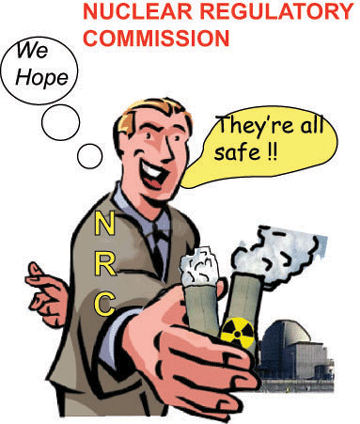
Four draft executive orders circulating in the administration would streamline approvals for new nuclear power plants. The White House contends the current process at the
Nuclear Regulatory Commission is bogged down by excessive safety concerns.
“The NRC does not view its duty as promoting safe, abundant nuclear
energy with regulatory clarity, flexibility and speed but rather insulating
Americans from the most remote risks without regard for the domestic or
geopolitical costs of its risk aversion,” says a draft order directing
“reform” of the agency. It notes that the agency — which is charged
with protecting the American public from nuclear disaster — has approved
only five new reactors since 1978, and only two have been built. There are
94 nuclear reactors operating in the United States.
Washington Post 10th May 2025,
https://www.washingtonpost.com/us-policy/2025/05/09/nuclear-power-plants-nrc-trump-safety/
Who’s afraid of big, bad China?

Neither side wanted to bring China into the debate, and neither side wanted to discuss AUKUS, which is based on a perceived need to take military action against that country.
In the recent Australian election, Neither side wanted to bring China into the debate, and neither side wanted to discuss AUKUS, which is based on a perceived need to take military action against that country.
Jocelyn Chey, May 7, 2025 , https://johnmenadue.com/post/2025/05/whos-afraid-of-big-bad-china/
Be afraid, be very afraid. But not of China. To the contrary, the proper management of co-operative relations with China is essential to Australia’s future.
Finally, the election process is over and done with and the results are in. We look forward to news bulletins not dominated by party spokespeople spruiking how they will deal with the cost of living. Rents, health and transport costs are all important, but the big issues that will make or break their social policies are all global, and the real question is how we can front up to them and hopefully turn them to our benefit. If the world goes into recession, which is a very real possibility, we will all be affected. The cost of living will go up. Cuts to social services will be inevitable.
Why did the candidates not admit this? Do they have contingency plans and, if so, what are they? What are they afraid of? Were they scared that if they mentioned China, the US or Russia, they would lose votes, or be backed into election promises that they could not keep? Or were there structural weaknesses in their policies that they did not wish to expose to scrutiny?
In previous election campaigns, the candidates were not so hesitant to pronounce on international affairs. The 2001 election was dominated by immigration issues and the terrorist attack on the Twin Towers in New York. It was the first “khaki election” since the Vietnam War. In the 2022 election, the Morrison Government tried to repeat their 2001 success by promoting fear of Chinese invasions, both military or cultural, but their attempt failed. This time around, both sides of politics have been careful about their choice of language and avoided difficult topics.
Insofar as national security featured at all in the elections, Labor and the Liberals competed to portray themselves as the better party to protect Australia’s international relationships, particularly in the Pacific. Penny Wong accused the Liberals of leaving a “vacuum” that China was ready to fill, but she did not directly accuse Beijing. The one attempt to whip up fear of an invasion was pinned onto Moscow, rather than Beijing, when news broke of a possible deal between Russia and Indonesia about developing a military airbase in West Papua.
Neither side wanted to bring China into the debate, and neither side wanted to discuss AUKUS, which is based on a perceived need to take military action against that country. Labor and Liberal both promised to increase defence spending, one side to 2.3% of GDP, and the other side to 3% over 10 years. Neither mentioned the reasons for such an increase, or where the money would be found. AUKUS is already absorbing all the increases announced by the last government and affecting other procurement needs. AUKUS spending over the next five years is estimated to reach $18 billion and ultimately will total $368 billion, not including the cost of new infrastructure such as a dedicated naval base at HMAS Stirling. The rationale for nuclear-powered vessels is not the defence of our coasts, but the perceived need to attack distant targets, and that target is China.
China has been progressively opening to the world since the 1980s. It is a permanent member of the UN Security Council and an active member of many multilateral organisations. With Australian encouragement, it has engaged with the multilateral trade system, joined APEC and the World Trade Organisation. The domestic economy has flourished in this open environment and in a region that has not seen armed conflict since the end of the Vietnam War. Maintaining strong growth and raising living standards have been the main pillars of Chinese domestic policies.
Economic development has not always been smooth, and recently new problems have emerged on the international front. China trusted the established international governance system to support and regulate its growth, but, as the country grew stronger, it became evident that the US did not return that trust. Its rapid rise and increasing global presence changed the regional and global balance and generated a geopolitical response that was perhaps predictable.
In 2025, the Trump administration has not yet clarified its policy for handling the relationship with China. Tariffs have been imposed, increased and decreased, and threats and hints have been made by the White House. All is chaos. The only thing that is certain is that Trump will challenge China in a more transactional and unpredictable way, will intensify trade confrontations and sanction Chinese companies in his goal to achieve greater self-sufficiency in the US.
In Beijing, Xi Jinping’s response has been measured and consistent. Official statements emphasise that China supports international rules and regulations and the multilateral system. During the National People’s Congress in March, Foreign Minister Wang Yi in a briefing to the international press presented China as a responsible and stable global power and, without explicitly saying so, drew comparisons with Trump’s America and its chaotic pronouncements.
He said: “We will provide certainty to this uncertain world. … We will be a staunch force defending our national interests. … We will be a just and righteous force for world peace and stability. … We will be a progressive force for international fairness and justice. We will be a constructive force for common development of the world.”
The contrast with Trump’s Tweets could not be more striking.
China is now truly integrated into the global economy. National policy has determined this, and, in any case, it would have been inevitable, given the development of advanced technologies and information and communication systems, all requiring international engagement. China, above all, wants stability and security in international relations to underpin its economic growth. In the future, the major challenges that the world will face are global. Climate change cannot be tackled without international co-operation. Australia needs more than ever to understand China and its domestic and foreign policies.
Co-operation with China is not easy. To borrow Trump’s words, “They hold the cards”. Australia, however, is not alone, and the best response to China is to consult and co-ordinate with neighbouring countries who also regularly interact with the rising superpower. Singapore, Thailand, Vietnam, Malaysia, all have important trade and diplomatic ties with China and have much experience to share about how to manage a relationship with China, a regional power and a global superpower. Australia should be able to manage relations with China. If we respect Beijing’s legitimate rights, Beijing will respect ours
It is possible. China has no history of annexing other countries as Russia annexed Crimea. It respects other countries’ autonomy more than Trump respects the sovereignty of Mexico, Canada or Greenland. It has claims over a large part of the South China Sea that on the surface suggest aggressive intent, but this is not a new claim. The “nine dash line” outlining its territorial claim was first proposed by the then Nationalist government in 1948, and the government of Taiwan still maintains this position. Considering that China is surrounded by a string of US bases along the “first island chain” from Japan to the Philippines, amid that Camp Humphreys, near Seoul in South Korea, the largest US overseas military base, is just 549 kms from the city of Dalian in northeast China, it is not surprising that China should wish to limit further US advances.
As for the other superpower, in the first 100 days of the Trump regime, he has attempted to use the legal system to carry out his personal vendettas. He has shut down many government departments. He has attacked scientific research and the universities and disregarded statistical evidence, particularly in medical science and climate science. He is prejudiced against immigrants. He dismisses the most basic ideas of trade and economics. He prefers to deal with other autocrats like Vladimir Putin and has turned his back on international agreements and treaties.
Be afraid, be very afraid. But not of China.
(This is a summary of a talk given at the Festival of Wild Ideas, St Paul’s Burwood, on 4 May 2025)
This week – not-the-corporate nuclear news

Some bits of good news: Sustainable Ocean Action: A Global Stocktake of the Our Ocean Conference
How Pakistan pulled off one of the fastest solar revolutions in the world – a “bottom up” revolution.
TOP STORIES Why Is US Congress Silent on the Manmade Nightmare It Is Enabling in Gaza? -Bernie Sanders. Expulsion and Occupation: Israel’s Proposed Gaza Plan.
Resuscitation at Zaporizhzhia?
From the archives. Conflicts of interest in the Trump group’s push to sell nuclear reactors to Saudi Arabia.
Climate. I just returned from Antarctica: climate change isn’t some far-off problem – it’s here and hitting hard.
‘Sitting ducks’: the cities most vulnerable to climate disasters -ALSO AT https://nuclear-news.net/2025/05/07/2-b1-sitting-ducks-the-cities-most-vulnerable-to-climate-disasters/
How ‘out of touch’ Tony Blair became a serious threat to climate action. Two-thirds of global heating caused by richest 10%, study suggests.
5 huge climate opportunities await the next Australian parliament – and it has the numbers to deliver.
Noel’s notes The pro-nuclear drive and Zionism are intertwined.
AUSTRALIA.
- Business as usual: Labor stalls on Defence reform as AUKUS woes grow.
- If the Coalition sticks with nuclear, the fallout will be toxic. Will the Coalition ditch its nuclear power policy? Coalition bombs itself with nuclear energy policy. Australians choose batteries over nuclear after election fought on energy. Scrap nuclear: Key Liberal senator wants radioactive energy plan buried.
- Poison in the Heart-The Nuclear Wasting of South Australia.
- Who’s afraid of big, bad China?
- Front groups working with Zionist actors are promoting Islamophobia.
- The dark cloud of Murdoch has no silver lining.
NUCLEAR ITEMS.
| ECONOMICS. Ontario’s Darlington SMR project to cost nearly $21-billion, significantly higher than expected. Google agrees to fund the development of three new nuclear sites. How Miliband can make renewables cheaper – but there is really no alternative to renewables. |
| ENERGY. Rooftop solar can be torn out of capital’s hands. |
| ENVIRONMENT. Sellafield’s massive water abstraction plan for its new construction work has no environmental impact assessment and inadequate monitoring. Ohio EPA launches limited Luckey water testing after independent report shows high radiation in wells. |
| HISTORY. 80 years on US still embattled in senseless Cold War with Russia.The Anglo-Nazi Global Empire That Almost Was. |
| LEGAL. Lawsuit Compels Nationwide Public Review of Plutonium Bomb Core Production. |
| MEDIA. Israel Will Even Persecute Palestinians For Simply Talking To Journalists. |
| POLITICS. Durbin successor must not be co opted by the Israel Lobby. [SMRs] Trump wants to speed up construction of more NPP, bypass safety regulations- ALSO AT https://nuclear-news.net/2025/05/12/2-b1-draft-executive-orders-aim-to-speed-construction-of-nuclear-plants/. Trump administration considers orders expediting nuclear plant construction, NYT reports. US Administration’s initial proposal sees cuts to nuclear energy budget. |
| POLITICS INTERNATIONAL and DIPLOMACY. Iran calls latest nuclear talks with US ‘difficult’ but both sides agree negotiations will continue. The Stakes of Donald Trump’s Negotiations with the Islamic Republic of Iran. Trump’s trip to Saudi Arabia raises the prospect of US nuclear cooperation with the kingdom. Non Proliferation Preparatory Committee concludes; Treaty on the Prohibition of Nuclear Weapons states point way forward. |
SAFETY.
- The Challenge to Japan’s Nuclear Restart.
- Starmer ignored nuclear watchdog when he blamed regulations for delays. Improvement notice issued at Dounreay nuclear power plant.
- Chernobyl shelter’s drone damage includes 330 openings in outer cladding. Russian drone strike caused tens of millions worth of damage to Chornobyl.
- Zaporizhzhia: Hurdle or catalyst for a peace deal in Ukraine
- Trump tightens control of independent agency overseeing nuclear safety. Trump considers weakening nuclear safety agency in bid for more power plants- ALSO AT https://nuclear-news.net/2025/05/12/1-b1-trump-considers-weakening-nuclear-agency-in-bid-for-more-power-plants/
| SECRETS and LIES. The Deep State & the Death of Democracy. ‘It’s deceitful’: Critics slam owners of TMI Unit 2 for not reporting fire at plant. |
| SPINBUSTER. Who are Britain Remade? Atomic lobby seizes on Spanish blackout .Google tries to greenwash massive AI energy consumption with another vague nuclear deal. |
| TECHNOLOGY. Westinghouse drops out of UK SMR competition. |
| URANIUM. Depleted Uranium by Lynda Williams 2025- https://www.youtube.com/watch?v=4_BXI5wVhKU |
| WAR and CONFLICT. Too Cruel to Even Imagine—Nuclear War in Densely Populated Areas Close the US military bases in Asia! Nuclear war has never been more likely – Here’s what it would look like now. |
| WEAPONS and WEAPONS SALES. Nuclear threat is more real than at any time since second World War. Starmer prepares for attack by Russia. |
1 This Month
10 March A LIVE WEBINAR THE REAL EFFECTS OF NUCLEAR POWER
What the Industry Isn’t Telling Us
1:00 PM Mountain, 2 pm Central, 3 pm Eastern. Live on the Keepers of the Water Facebook page



18 March Webinar @ 1 PM EST: An Assessment of SMR Projects: The Case of Canada
register for the zoom:
https://us02web.zoom.us/webinar/register/WN_o8BIIOUvQ2ONJR1nta65DQ#/registration


of the week – STOP SMALL MODULAR REACTORS IN CANADA
To see nuclear-related stories in greater depth and intensity – go to https://nuclearinformation.wordpress.com
-
Archives
- March 2026 (109)
- February 2026 (268)
- January 2026 (308)
- December 2025 (358)
- November 2025 (359)
- October 2025 (376)
- September 2025 (258)
- August 2025 (319)
- July 2025 (230)
- June 2025 (348)
- May 2025 (261)
- April 2025 (305)
-
Categories
- 1
- 1 NUCLEAR ISSUES
- business and costs
- climate change
- culture and arts
- ENERGY
- environment
- health
- history
- indigenous issues
- Legal
- marketing of nuclear
- media
- opposition to nuclear
- PERSONAL STORIES
- politics
- politics international
- Religion and ethics
- safety
- secrets,lies and civil liberties
- spinbuster
- technology
- Uranium
- wastes
- weapons and war
- Women
- 2 WORLD
- ACTION
- AFRICA
- Atrocities
- AUSTRALIA
- Christina's notes
- Christina's themes
- culture and arts
- Events
- Fuk 2022
- Fuk 2023
- Fukushima 2017
- Fukushima 2018
- fukushima 2019
- Fukushima 2020
- Fukushima 2021
- general
- global warming
- Humour (God we need it)
- Nuclear
- RARE EARTHS
- Reference
- resources – print
- Resources -audiovicual
- Weekly Newsletter
- World
- World Nuclear
- YouTube
-
RSS
Entries RSS
Comments RSS
 nuclear-news