Beyond Iran: a new nuclear doctrine for the Persian Gulf
By Seyed Hossein Mousavian | May 13, 2025, https://thebulletin.org/2025/05/beyond-iran-a-new-nuclear-doctrine-for-the-persian-gulf/?utm_source=ActiveCampaign&utm_medium=email&utm_content=Former%20NIH%20director%20on%20DOGE%20cuts&utm_campaign=20250515%20Thursday%20Newsletter
Ambassador (Ret.) Seyed Hossein Mousavian is a Middle East security and nuclear policy specialist at Princeton University and a former spokesman for Iran’s nuclear negotiators. He is the author of many books including: The Iranian Nuclear Crisis: A Memoir, Iran and the United States: An Insider’s view on the Failed Past and the Road to Peace; A Middle East Free of Weapons of Mass Destruction and A New Structure for Security, Peace, and Cooperation in the Persian Gulf.
After a letter was exchanged between US President Donald Trump and Iranian Leader Ayatollah Ali Khamenei, and since the first talks of April 12, four rounds of indirect and direct bilateral negotiations about Iran’s nuclear program have made progress. Iran Foreign Minister Abbas Araghchi and President Trump’s chief negotiator Steve Witkoff are leading the talks.
At this stage of the talks, both sides should have reached a mutual understanding on verification and transparency measures. Iran’s full cooperation with the International Atomic Energy Agency (IAEA) through implementation of the Additional Protocol, the most crucial inspection and verification mechanism, would resolve existing technical ambiguities over the peaceful nature of Iran’s nuclear program.
In 2018, President Trump pulled out of the Joint Comprehensive Plan of Action, also known as the Iran nuclear deal, after calling it the “worst deal ever.” On Tuesday, during his first trip in the Middle East of his second presidency, Trump said he wants to make a deal with Iran again. President Trump cherishes big, out-of-the-box deals. As he tours the region, Trump should think beyond Iran’s nuclear issue and work to achieve the denuclearization of the entire Middle East.
Iran’s uranium enrichment dilemma. From 2003 to 2013, nuclear negotiations between the world powers and Iran failed because the United States denied Iran’s right to peaceful uranium enrichment activities. However, according to the Treaty on the Non-Proliferation of Nuclear Weapons (NPT), all member countries have the right to peaceful enrichment. Japan, Germany, Brazil, and Argentina have been allowed to develop enrichment programs—and so should Iran be.
The nuclear negotiations from 2013 to 2015 led to the Iran nuclear deal because, then, the United States did not oppose the principle of Iran enriching uranium for peaceful purposes. With the implementation of the JCPOA, Iran cooperated with the IAEA, and by December 2015, all of the agency’s technical ambiguities were resolved. After the first Trump administration withdrew from the JCPOA and imposed maximum pressure sanctions on Iran, Tehran responded by reducing its commitments under the deal, expanding its enrichment program and ultimately becoming a nuclear-threshold state.
Now, the second Trump administration is once again questioning Iran’s legal and legitimate right to enrichment of uranium for civilian purposes. In the last few days, Witkoff said that Iran should abandon enrichment, and Araghchi responded that this is Iran’s red line.
From several decades of experience with and knowledge about Iran’s nuclear program, it is clear to me that President Trump might only be capable of reaching a nuclear agreement with Iran if his red line were limited to Iran never acquiring a nuclear bomb, rather than denying Iran’s legitimate and legal rights to develop peaceful nuclear technology, including enrichment. Under no circumstances will Iran accept discrimination, humiliation, and deprivation of its international rights.
Regional proliferation risk. Reaching a nuclear agreement between the United States and Iran is certainly an urgent and vital necessity to eliminate one of the nuclear proliferation risks in the Middle East. However, the issue of non-proliferation in the region goes far beyond Iran’s uranium enrichment.
Even in an unlikely scenario of an agreement between Iran and the United States, in which Iran would give up enrichment, the problem would persist for several reasons:
Acceptance of enrichment by Saudi Arabia would open the gate for more regional powers in the Middle East to pursue enrichment.
Iran’s enrichment capability and know-how are immutable. Even a military attack would not eliminate them.
According to NPT’s Article 10, all members have the right to withdraw from the treaty. This alternative will remain available to Iran, especially as US-Iran hostilities cannot be resolved through a single-issue nuclear agreement.
Israel is the only country in the Middle East that possesses dozens of nuclear weapons. For decades, this reality has blocked UN initiatives and resolutions aimed at establishing a Middle East free of nuclear weapons and other weapons of mass destruction. Yet, Israel continues to receive the strongest US and Western support. However, the status of Israel as the “nuclear gendarme” of the Middle East will not endure.
Saudi Arabia and the United States are negotiating a nuclear deal under which the United States would accept Saudi enrichment.
A deal that focuses solely on Iran’s nuclear program would fail to address the broader—and equally pressing—issues of nuclear proliferation in the region. Therefore, a new regional nuclear doctrine is inevitable.
A two-step roadmap could lead to the historic and monumental achievement of denuclearizing the Middle East.
Establishment of a Persian Gulf nuclear consortium. As a first step, the Trump administration should work with regional stakeholders to define a new nuclear doctrine for Persian Gulf through establishment of a Persian Gulf Consortium. Such a doctrine should consist of a concerted effort to create a comprehensive and inclusive nuclear nonproliferation framework—a major stepping-stone toward greater regional cooperation, security, and stability in the Persian Gulf. A new doctrine could be articulated around four core principles.
A regional enrichment consortium. A consortium for enrichment, like Europe’s enrichment company Eurenco, could be established to mitigate proliferation risk in the Persian Gulf. This consortium would allow countries in the Persian Gulf and the wider Middle East to participate in uranium enrichment under strict, multilateral oversight, ensuring that all enrichment activities are for peaceful purposes only. The regional enrichment consortium would ensure that the process of enrichment is conducted peacefully, transparently, and under the supervision of both regional stakeholders and the IAEA. This model could help alleviate regional and international concerns about the potential for nuclear weapons development while enabling states to pursue the peaceful use of nuclear energy.
Can the UK’s 24GW of new nuclear by 2050 target be met? Revisiting the Nuclear Roadmap
29 Apr 2025, Stephen Thomas, University of Greenwich,
https://papers.ssrn.com/sol3/papers.cfm?abstract_id=5194931
Abstract
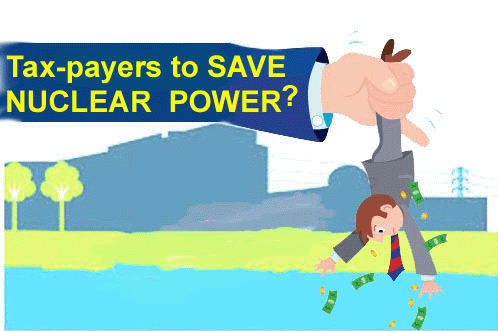
The UK government faces the prospect of having to make major public spending cuts in it June 2025 Public Spending Review, a review covering public expenditure over the following five years. Its plans for expanding nuclear power would require investments of public money in tens of billions of pounds in that period and these must therefore come under scrutiny.
The key decisions are whether to make a Final Investment Decision on the Sizewell C nuclear power plant, which would be majority owned by the government and whether to continue with Small Modular Reactor competition that would see orders placed for four reactors fully funded by government.
I argue that these projects represent poor value for money and will do little to help UK achieve its legally binding target of net zero greenhouse gas emissions by 2050.
What does the Cour des Comptes Report mean for Hinkley Point C and Sizewell C?
29 Apr 2025, Stephen Thomas, University of Greenwich, https://papers.ssrn.com/sol3/papers.cfm?abstract_id=5195981
Abstract
The January 2024 report by France’s Cour des Comptes on the future of the European Pressurised Reactor sheds light on the prospects for the UK’s Hinkley Point C and Sizewell C projects. It shows that the main contractor and a key financier, the state-owned Electricité de France does not have the human and financial resources to complete these projects without compromising its ability to fulfil its primary obligations in France.
I argue that the Hinkley Point C project, under construction since 2016, should be scaled back to no more than one rather than two reactors. The Sizewell C project, yet to reach a final investment decision despite the expenditure of at least £3.7bn of UK taxpayer money, should be abandoned.
NUCLEAR HOTSEAT podcast – Nuclear Radiation Cancer Zone: Piketon Ohio’s Portsmouth Gaseous Diffusion Plant
Podcast at https://www.nuclearhotseat.com/podcast/piketon-nuclear-radiation-cancer/

: Dangers Grow in Nuclear Radiation Cancer Zone: Piketon Ohio’s Portsmouth Gaseous Diffusion Plant – Journalist Jason Salley
The Nuclear Hotseat Hot Story with Linda Pentz. Gunter
Reopen Zaporizhzhia nuclear power plant? Ukraine should do renewables instead.
This Week’s Featured Interview:
- Jason Salley is an investigative journalist known for his hard-hitting reporting on environmental contamination and government oversight. With a focus on uncovering the hidden truths of Appalachia, his work has exposed decades of radioactive pollution and corporate negligence at the Portsmouth Gaseous Diffusion Plant in Pike County, Ohio. Salley’s fearless storytelling and relentless pursuit of the facts have made him a powerful voice for the communities impacted by America’s nuclear legacy………………
Libbe HaLevy produces and hosts Nuclear Hotseat, the weekly international news magazine on all things anti-nuclear. She has been a TEDx speaker, an Amazon #1 Bestselling Author, hosted rallies, and led media workshops at anti-nuclear conferences around the country.
Solar and wind make up 98 pct of new US generation capacity in Trump’s first three months
Stillwater plant combines 33 MW of the original baseload geothermal, 26 MW of solar PV and 2 MW of solar thermal power generation
Enel Green Power North America
Joshua S Hill, May 13, https://reneweconomy.com.au/solar-and-wind-make-up-98-pct-of-new-us-generation-capacity-in-trumps-first-three-months/
A new analysis of government data has revealed that solar and wind accounted for nearly 98 per cent of new electricity generating capacity in the United States through the first quarter of 2025, despite efforts by the new president to unravel clean energy efforts.
The Sun Day Campaign, a non-profit research and educational organisation founded by Ken Bossong, has been fighting the good fight since 1992, and has been an invaluable tool for journalists covering clean energy in the United States.
A review conducted by the Sun Day Campaign of data recently published by the US government’s Federal Energy Regulatory Commission (FERC) demonstrates the momentum driving the clean energy industry, even in the face of extreme political adversity.
According to the government’s own data, solar and wind accounted for nearly 98 per cent of new US electrical generating capacity added in the first quarter of 2025, and solar and wind were the only sources of new capacity in March – a month that was the nineteenth in a row that saw solar stand out as the largest source of new capacity.
A total of 447MW of solar was installed in March along with the 223.9MW Shamrock Wind & Storage Project in Crockett County, Texas.
Over the first three months of 2025, a total of 7,076MW of solar and wind was installed, accounting for 97.8 per cent of new capacity.
The remainder was made up with 147MW of new natural gas capacity and 11MW from oil.
On its own, solar accounted for two-thirds of all new generating capacity placed into service in March, and 72.3 per cent of new capacity through the first quarter of the year. That makes solar the largest source of new generating capacity per month since September 2023.
This also brings the total installed capacity of solar and wind up to 22.5 per cent of the country’s total available installed utility-scale generating capacity, accounting for 10.7 per cent and 11.8 per cent respectively.
On top of that, approximately 30 per cent of US solar capacity is considered small-scale, or rooftop solar, and is not in fact reflected in FERC’s data. If small-scale solar is added to utility-scale solar and wind, that brings the total share to a quarter of America’s total.
Adding other renewable energy sources – including hydropower (7.7%), biomass (1.1%) and geothermal (0.3%) – renewables accounts for 31.5 per cent of total US utility-scale generating capacity.
FERC itself also expects a “high probability” that new solar capacity additions between April 2025 and March 2028 will total 89,461MW – by far and away the largest source of new capacity. For comparison, over that period, FERC expects 129,609MW of new capacity to be installed, meaning that there is a “high probability” that solar will account for 69 per cent. The next highest source of “high probability” generating capacity is wind energy, with 22,279MW, followed by 16,947MW worth of natural gas.
Conversely, FERC expects there to be no new nuclear capacity installed in its three-year forecast, while coal and oil are projected to contract by 24,372-MW and 2,108-MW respectively. And while new natural gas capacity is expected, that 16,947MW is offset by 15,209MW worth of retirements, resulting in an expansion of only 1,738MW.
“Thus, adjusting for the different capacity factors of gas (59.7%), wind (34.3%), and utility-scale solar (23.4%), electricity generated by the projected new solar capacity to be added in the coming three years should be at least 20 times greater than that produced by the new natural gas capacity while the electrical output by new wind capacity would be over seven times more than gas,” said Sun Day.
Finally, the Sun Day Campaign is currently predicting that all utility-scale renewables will account for 37.5 per cent of total available installed utility-scale generating capacity by April 1, 2028, “rapidly approaching” that of natural gas (40.2 per cent).
“If those trendlines continue, utility-scale renewable energy capacity should surpass that of natural gas in 2029 or sooner,” says Sun Day.
“Notwithstanding the Trump Administration’s anti-renewable energy efforts during its first 100+ days, the strong growth of solar and wind continues,” said Ken Bossong, Sun Day Campaign’s executive director.
“And FERC’s latest data and forecasts suggest this will not change in the near-term.”
Joshua S. Hill is a Melbourne-based journalist who has been writing about climate change, clean technology, and electric vehicles for over 15 years. He has been reporting on electric vehicles and clean technologies for Renew Economy and The Driven since 2012. His preferred mode of transport is his feet.
Why small modular reactors do not exist – history gives the answer.
David Toke, Jan 15, 2025, https://davidtoke.substack.com/p/why-small-modular-reactors-do-not
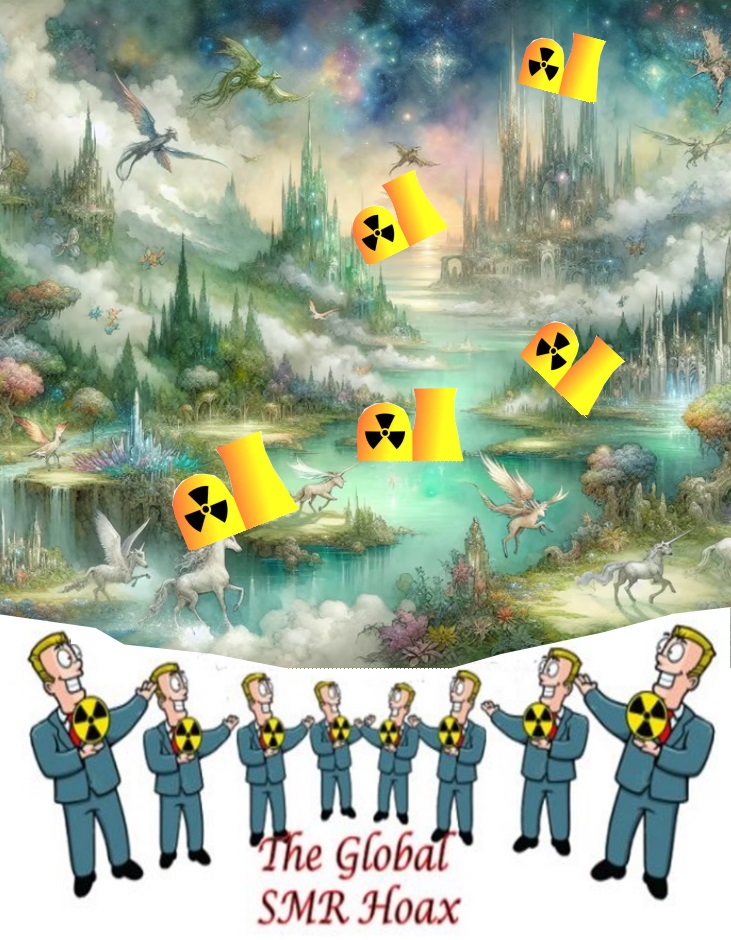
In recent years we have seen many stories with an upbeat message about small modular reactors (SMRs) and ‘races’ to develop them. But in fact, the concept of SMR is a bogus term that tries to give the impression that something new in nuclear power is afoot. It most certainly is not. In fact what are called SMRs cannot easily be distinguished from nuclear power plants that were built in the 1940s to 1960s, long before the SMR notion was invented. The term SMR does not exist as a useful definable concept.
Even examples of new so-called SMRs are practically non-existent around the world when it comes to operating projects. But there has been a tremendous amount of hype. Indeed the hype seems to grow in inverse proportion to the lack of any projects being completed. First, a definition:
According to the International Atomic Energy Agency:
‘Small modular reactors (SMRs) are advanced nuclear reactors that have a power capacity of up to 300 MW(e) per unit, which is about one-third of the generating capacity of traditional nuclear power reactors. SMRs, which can produce a large amount of low-carbon electricity, are:
- Small – physically a fraction of the size of a conventional nuclear power reactor.
- Modular – making it possible for systems and components to be factory-assembled and transported as a unit to a location for installation.
- Reactors – harnessing nuclear fission to generate heat to produce energy.’ (Ref: see HERE
Yet the problem with this definition is that none of this represents anything new i.e. something that has not been done long ago. The term ‘advanced’ is vague and does not seem to exclude approaches that have been tried before. The notion of modular is even more misleading in practice. That is because having smaller reactors reduces the scope for factory production of components.
There are fewer economies of scale for small reactors compared to making parts for larger-scale reactors (which require more parts of a particular type). The word ‘reactor’ is not new. So what’s new? Certainly nothing, in my view, to warrant the ascription of ‘fourth generation’ nuclear designs that these so-called SMR proposals have often been given.
In practice, even projects that are called SMRs are very, very few in operation around the world. There are very few even under construction, and the ones that are seem to be taking a long time to build. That is, according to the International Atomic Energy Agency. So how can we explain this apparent contrast between, as the media stories put it ‘races’ to develop SMRs, and reality?
The problems with the concept of SMRs can be explained by reference to the historical development of nuclear power. In the 1950s and 1960s, the nuclear industry found that the (then) existing designs of small(er) reactors, what is now called SMRs, were uneconomic compared to larger reactors. As a result, the industry developed larger reactor types. The larger reactors, of course, have had very big construction problems and costs. However, this should not obscure the fact that in comparison the smaller reactors were even worse. Let us look at some of the reactor history in terms of size.
Originally, after WW2, the first electricity-generating nuclear reactors were designed for nuclear submarines. These pressurised water reactors (PWRs) range from a few MWe to over 100MWe for the largest submarines today. I would say that they are the original small nuclear reactors. Indeed here it gets a bit confusing. Why aren’t these submarine reactors called small modular reactors? Essentially, I think, because they do not fit into the current narrative which tries to give the impression that there is a new type of advanced reactor called an SMR.
Small reactors were then designed, starting in the 1950s, for land-based operations to supply mainstream electricity grids. Then design sizes increased and PWRs became the dominant technology throughout the world. Chart 1 shows how nuclear reactor sizes have increased over the decades in the case of the UK. You can see how the average design size for reactors increased from around 100 MW in the 1950s, to 400 MW in the 1960s, over 500 MW in the 1970s, and then to over 1000MW since the 1980s.
There is a very good reason that design sizes increased from the 1950s onwards. Indeed this reason seems to have been mostly overlooked in the blizzard of press releases about small modular reactors. It is all to do with the economies of scale.
There was a (at the time, well-regarded) book published in 1978 by Bupp and Derian (see later reference). This summed up the reason why the rush of ordering nuclear reactors in the USA came to an end in the 1970s. It has great relevance to the issue of small reactors today. It is all to do with the size and cost and also the safety requirements of reactors. They said:
‘In 1955 a 180 MW light water reactor design called for more than 30 tons of structural steel and about one-third of a cubic yard of concrete per MW. By 1965 a much larger plant of about 550MW required less than half as much of these materials per megawatt of capacity. These efficiencies reflect classic ‘economies of scale’. Then, in the late 1960s, the trend reversed. Larger light water plants began to require more, not less, structural materials per unit of capacity; by 1975, the steel and concrete needed per megawatt for 1,200 MW plant approximately equaled the 1960 requirement for a 200-300 MW design. This reversal was a direct consequence of stricter safety and environmental protection requirements laid down during this period. More stringent safety requirements meant thicker concrete walls.’1
So, essentially, nuclear power plants became bigger because of the drive for economies of scale. A big reason why nuclear power did not continue to become cheaper was because, by the 1970s, demands for stricter safety precautions were being translated into regulations. This meant that the progress in reduced costs had been reversed. More recent (so-called Generation 3) nuclear designs have been based on the hope that ever-bigger reactors with better safety designs would once again pave the way to cheaper nuclear reactors. It has not, of course, happened.
In other words, small modular reactors will not produce cheaper outcomes. Arguing for such a proposition flies in the face of history, not to mention basic engineering economic theory. That is, of course, if we assume that small reactors have to deliver the same safety levels as big reactors. Yet it is difficult to see the regulators scrapping the main safety requirements accumulated since the 1960s just for small nuclear reactors. Why would they? Having a much larger number of smaller reactors would increase the risk of there being a serious accident at one of them.
Progress in constructing new small reactors
This is extremely thin. Only two operating so-called SMRs were identified by the International Atomic Energy Agency in 2024, and there are very few others (three in fact) listed as under construction (see HERE page 13). So far as I can see all are very well supported by direct state or research demonstration funds. That is they are nowhere near becoming commercial propositions able to survive on the promise of privately funded bank loans and equity investment.
Of the two so-called SMR plants in operation, one is a 200 MWe reactor built in China (See HERE) – which as you can see in Chart 1 is actually rather bigger than the average reactor size in the UK designed in the 1950s. Not only that, but it took a total of 12 years to construct (see HERE). The other operational project is based on a ship in Russia. This could be described as a variation on a submarine reactor built to support a very niche market, with financing details not available.
One of the three of the three so-called SMRs under construction is being built in Argentina (and whose funding stream is threatened by Government cutbacks). This has a 32MWe reactor and is a variant of a PWR. Construction began in 2014. This is oriented mainly not to electricity production but to an extremely limited market in radioactive products.
The second is a 300 MWe ‘fast’ reactor being built in Russia. Fast reactors are certainly not new. They have been tried in various countries before (including the UK) and have not been commercially successful.
A third, much publicised, development is the 150 MWe Kairos reactor in the USA. This power plant is sited at East Tennessee Technology Park. The US Government’s Department of Energy is supporting the construction of the project. It is a ‘pebble’ bed high temperature, gas cooled reactor. Although called ‘Advanced’ pebble bed reactors were first mooted in the 1940s and have been tried and discontinued before.
Indeed, as Steve Thomas has said about the notion of ‘Advanced’ reactors (see HERE) ‘The advanced designs are not new. For example, sodium cooled fast reactors and high temperature reactors were built as prototypes in the 1950s and 1960s but successive attempts to build demonstration plants have been short-lived failures. It is hard to see why these technologies should now succeed given their poor record. Other designs have been talked about for decades but have not even been built as prototype power reactors – so again it is hard to see why the problems that prevented their deployment to date will be overcome.’
Other variants, including thorium-based plants are proposed (most recently in China). On the one hand, all of these ideas have been tried before, but are being presented as ‘new’ developments. They have failed before. These warmed-up versions of previously tried technical nuclear fission variants do not solve nuclear power’s basic cost problems. These problems involve too much steel, and concrete and the need for unique, very expensive, types of parts and techniques that are too specialist to be sourced from standard industrial supply chains.
This (Kairos) project was made famous by an announcement from Google to buy power from it. However, beyond that, I have no information about how much money Google has actually spent on the project or indeed how much it has agreed to pay for the power the reactor will produce.
Indeed the Autumn of 2024 saw a flurry of announcements of support for so-called SMRs from ‘Tech Giants’. However, the terms of the financial support were generally vague. The announcements were made just prior to the General Election and seemed to respond to the rising hype about powerful AI. In a different blog post I analyse this AI over-hype, (see HERE).
Of course, we can all agree to buy power from people for a specified price by agreeing to PPAs. No commitment to part with money is necessarily required. Whether banks and equity investors are willing to lend money to the energy project in question on the basis of such PPAs is an entirely separate matter.
SMRs in the UK
There are no projects called SMRs operating in the UK. None are under construction and none are in the process of getting anywhere near construction starts. The UK Government for its part, amongst a fanfare of publicity about support for SMRs, promises an aim of ‘deploying a First-of-a-Kind SMR by the early 2030s’ (See HERE). Of course, as Chart 1 above implies, there used to be reactors that are small enough to fit the definition of ‘SMR’. They just weren’t called SMRs at the time.
Indeed, Rolls Royce, has, for several years been promoting their so-called small modular reactor (SMR) design. This is rather larger than a lot of past British nuclear power plants, albeit none still in operation. Their proposed (so-called) SMR design has gone up to 470MWe (See HERE). It uses PWR technology.
This proposed project is rather larger, for example than the 235 MW units which comprised Hinkley A nuclear power station. This power plant began construction in 1957, started generation in 1966, and stopped generating electricity to the grid in 1999. When construction of this project began such a nuclear power plant would have been called large, not small!
I do not understand the claims made by Rolls Royce for their ‘SMR’ to be called modular. The power plant has to be constructed on-site. As I have already stated I do not understand why there is more, or even as much, scope for mass production of parts compared to a conventional reactor such as that being built at Hinkley C.
I could say much the same about Holtec, a US nuclear services company who are promoting a 300 MW reactor – again not really that small. Like Rolls Royce, it has been exciting local people in places in Yorkshire with talk of building factories. This seems unlikely to happen without, essentially the UK Government paying for all or at least much of the project.
My prize for the most ingenious piece of SMR promotion are the claims made by ‘Last Energy’, who are promoting what they describe as a 20 MW PWR reactor. A headline appeared on the Data Centre Dynamics website saying ‘Last Energy claims to have sold 24 nuclear reactors in the UK for £2.4 billion’ (see HERE). Associated with this was another story in Power Magazine saying (see HERE) that the company had secured PPAs for 34 power plants in the UK and Poland, something that was described as ‘extraordinary progress’.
I cannot see any evidence that these power plants are being constructed, ie ‘concrete poured’ at any site. However, it is claimed that the first project will be finished by 2027. There are reports that the company has been conducting site surveys in Wales (see HERE).
What I find especially puzzling about the Last Energy promotion is the lack of a mention on a specific page on the website of the Office of Nuclear Regulation (ONR). In order for a new design of a nuclear power plant to be licensed to generate in the UK, it has to be approved for what is a very lengthy (several years) and very expensive (many £millions) Generic Design Assessment (GDA). However, there is no mention of Last Energy on the ONR information page giving the current and completed GDAs (see HERE).
Why is all this so-called ‘SMR’ activity happening now?
There are two interrelated factors in operation here; material rewards and political-psychological pressures. Material factors include the designation of governmental programmes to fund demonstrations of so-called SMRs. The second is the possibility of raising share capital to fund projects labeled as ‘SMR’.
Of course this in itself does not explain why this has happened in recent years. An excerpt from an opinion piece published in the Guardian in September 2015 can give us an important clue to the political psychology involved. In an article entitled ‘We are pro-nuclear, but Hinkley C must be scrapped’, written by George Monbiot, Mark Lynas and Chris Goodall, there was a subtitle: ‘Overpriced, overcomplicated and overdue, the Hinkley project needs to be killed off and the money invested into other low-carbon technologies’. The authors’ recommendations for alternative funding went on to say: ‘We would like to see the government produce a comparative study of nuclear technologies, including the many proposed designs for small modular reactor, and make decisions according to viability and price’ (See HERE)
What this looks like to me is a face-saving device. It tries to deal with the (recently re-discovered) fact that new nuclear power stations are much too expensive. I interpret this as a piece of cognitive dissonance to deal with the very apparent limitations of environmentalists trying to promote nuclear power as a response to climate change.
This is a form of cognitive denial of the obvious; that nuclear power is extremely expensive and difficult and very longwinded to deliver. SMRs have been at least partly invented to serve the purpose of shifting mental attention from this fact, a form of denial. The denial is sugar-coated with the notion that we can escape reality by embracing so-called SMRs.
This cognitive dissonance allows people to carry on believing in and promoting nuclear power in spite of reality. A new SMR alternative reality is created. This fills the void created by dull reality.
This, in practice, diverts attention from the central cost problems of nuclear power. These are the quantities of steel and concrete needed to build nuclear power stations, the need for unique types of very expensive parts, and the need for exacting, highly specialised processes of building the reactors. Making smaller nuclear plants will not solve these problems. Indeed it makes them worse insofar as this reduces the possibilities for economies of scale.
Now I am not trying to heap the blame for the SMR fantasies on Monbiot, Lynas, and Goodall – at least not entirely! There is a large well of public wishful thinking attached to things with the word ‘nuclear’ in them and this well can be tapped by concerted, if flimsily-based efforts. The promoters of the so-called SMR technologies are the ones who have ignored history to produce what is, in essence, a warmed-up version of a long-discarded set of nuclear technological ideas and practices. Indeed I would class this stream of historical re-interpretation as an example of the use of postmodernism in the nuclear industry.
SMRs as nuclear postmodernism
Postmodernism emerged originally in architecture. It was, put simply, about reviving ancient, or at least old, building designs and using them in contemporary building design (See HERE). The old is presented therefore as the new. For buildings, that’s a pretty harmless, indeed often pleasing, pathway to adopt. However, to present old (smaller) sizes of nuclear power stations (often mixed in with long discarded design ideas) as new and call them ‘Advanced’ nuclear technologies is, in my view, doing a great disservice to us all. It skews public debate relatively against real green energy options by presenting an option (so-called SMRs) that does not exist.
Social scientists are often derided for talking about postmodernism. Yet here we see the apparent apotheosis of natural science, the nuclear sector, engaging in precisely this sort of approach. They are presenting the technologies of the 1940s to 1960s as ‘new’. We should not have to take it seriously. Many people in the nuclear industry are either living in their own alternative postmodern reality or at least are tolerating this non-existent vision.
There may be a small number of demonstration projects constructed that are called SMRs. They are, and will be, expensive and take a long to build. But they are really just warmed-up old-style versions of the 1950s-1960s-sized reactors, mixed in sometimes with tried and failed techniques. They certainly do not represent an ‘advanced’ path for a nuclear-powered future. As a concept, Small Modular Reactors have no existence outside of a postmodernist nuclear industry fantasy.
I invite people to listen to Bonzo Dog’s old hit ‘Urban Spaceman’ (see HERE). The general spirit and especially the last couple of lines of the song seem especially apposite to a discussion of so-called SMRs.
After I wrote this post came the news that the Ontario Government has given the go-ahead to the so-called SMR project at Darlington. Acclaimed as a breakthrough, it may only be a breakthrough as being the most expensive nuclear power scheme in history. Its starting price, as around $21 billion (Canadian dollars, see HERE) for 1.2 GW is almost exactly the same as the final price of the Flamanville EPR reactor in France built by EDF. This came in at €13 billion, roughly 4 times its original price tag (see HERE). Yet Flamanville has a generating capacity of 1.63 GW, that is around a third larger than the sum of the capacities of the four new Ontario reactors! So the Darlington scheme is already a third more expensive than Flamanville!

The crucial difference between the new Ontario scheme and the French power plant at Flamanville is that construction is only about to start at the Canadian scheme. So, let's repeat this. The (spuriously) acclaimed Ontario SMR scheme is already around a third more expensive than the widely panned super-expensive French Flamanville EPR even before the inevitable construction cost increases start piling up!

Given that all nuclear power plant built in the West this century have all come in a great deal more expensive than projected before construction, the cost will spiral even farther upwards. It is likely that the Ontario SMR project will win the prize of the most expensive nuclear project (per GW) this century! Even at its projected price the Ontario SMR scheme is calculated by the Ontario Clean Air Alliance to be up to 8xs more expensive than wind power (See HERE) This puts my arguments in this post in perspective, SMRs are going to be a lot more expensive than conventional nuclear power!
pages 156-157, Bupp, I, and Derian, J-C. 1978. Light Water: How the Nuclear Dream Dissolved. New York: Basic Books
Emmanuel Macron open to stationing French nuclear weapons in other European nations.
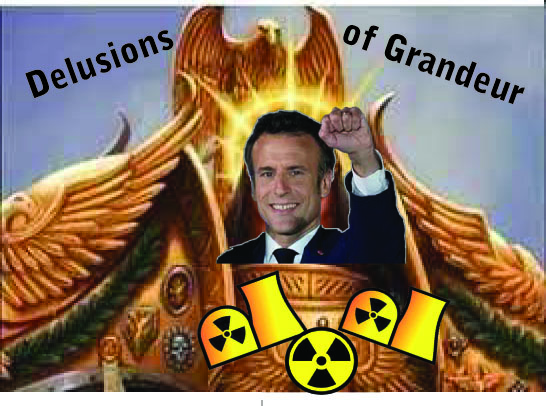
French President Emmanuel Macron said he was “ready to open a
discussion” with European allies about stationing France’s nuclear
weapons on their soil, in an effort to beef up defences against Russia. The
comments made by Macron in an interview with the broadcaster TF1 on Tuesday
come as he has been holding talks with Germany, Poland and other European
countries to explore whether and how France’s nuclear deterrence could be
extended on the continent. Such a move is being considered in response to
signs that US President Donald Trump wants to scale back the American
military presence in Europe and force European countries to take more
responsibility for their own security.
FT 13th May 2025, https://www.ft.com/content/96231d9c-ee48-43b3-9c82-bdc4002b41a5
Techno-optimism alone won’t fix climate change.

Sussex Energy Group 12th May 2025 by Ruby Loughman , https://blogs.sussex.ac.uk/sussexenergygroup/2025/05/12/techno-optimism-alone-wont-fix-climate-change/
This blog post was originally published by the Energy Demand Research Centre (EDRC), 2 May 2025, written by Professor Mari Martiskainen.
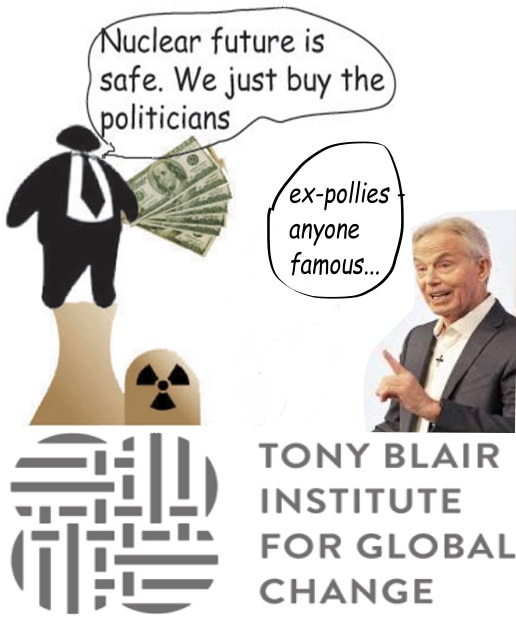
Ex-prime minister Tony Blair was making headlines this week by saying that current Net Zero policies are ‘doomed to fail’. In a new report by the Tony Blair Institute (TBI), he argues that voters “feel they’re being asked to make financial sacrifices and changes in lifestyle when they know the impact on global emissions is minimal”. It is an unprecedented call from a former prime minister whose party has been leading climate action in the UK. I will pick up on three key points in relation to the importance of climate action.
The science on climate change is clear
First, the science is clear. Unless we take action, climate change is going to have even more devastating impacts on our societies and the global economy. Countries such as China are seeing this as a big financial opportunity in winning the green race. The evidence on the economic prize is sound and clear: the opportunity for the UK economy is enormous relative to the impact we can have on global emissions, where green growth should be seen as this century’s central opportunity for growing more equitable prosperity.
People want climate action and clear government leadership
Second, people want to take climate action, and for that they want clear leadership from government. While the TBI report questions people’s willingness to undertake lifestyle choices, for example, it is clear from a host of academic and policy studies that people want to act and are ready to change, as long as they get clarity on what is expected. For example, the world’s largest standalone survey on climate change by UNDP found that 80% of people globally want their country to do more on climate change, and 72% want their country to move away from fossil fuels to clean energy quickly.
An academic survey of 125 countries by Andre and colleagues found that “69% of the global population expresses a willingness to contribute 1% of their personal income, 86% endorse pro-climate social norms and 89% demand intensified political action.” Many people have important conditions for this transition, such as it being fair. Crucial issues for policy attention include ensuring that people can have confidence on the value that their own financial commitments will deliver, privately and publicly. This means also the government committing to a genuinely ‘just transition’ in terms of jobs and delivering greener growth.
People must be at the centre of climate solutions
Third, the report calls for ‘actions for positive disruption’, and by this it means accelerating and scaling technologies that capture carbon, harnessing the power of AI, investing in frontier energy solutions, and scaling nature-based solutions. The latter are very welcome, but a major focus on nuclear, carbon capture and AI relates to techno-optimism and the widely debunked approach that technology alone will fix the world’s problems.
This approach leaves out a range of positive socio-technical approaches where people are at the centre of climate solutions. It also misses out on the numerous benefits that could be achieved by engaging citizens in the energy transition. A truly positive disruptive action would be for example to question the high-consuming lifestyles and excess energy consumption that many countries have, including some of those petrostates that TBI has worked for.
It also needs to recognise the opportunity that energy demand action can have in reducing emissions while also enabling a better quality of life for many. The TBI report for example claims that “proposed green policies that suggest limiting meat consumption or reducing air travel have alienated many people rather than bringing them along”. However, our research with people in the UK, for example, has found that there is support for a substantial shift in diets, including reduced meat and dairy consumption.
Addressing climate change needs to be a joined-up, global effort. This needs trusted, robust and impartial evidence applied in a world of vested interests and misinformation. Net zero policies themselves have not become toxic for the majority, yet we should not discount people’s concerns about the changes needed. Technology alone, however, is not the solution.
Inspection at the Flamanville EPR: the nuclear watchdog points out serious shortcomings
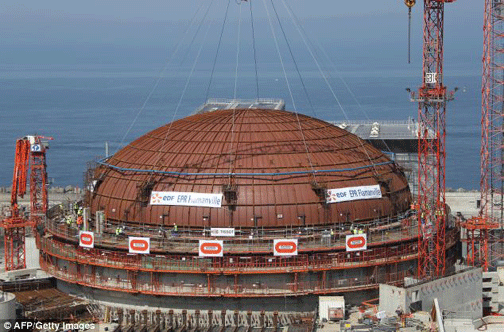
La Presse de la Manche 13th May 2025, https://actu.fr/normandie/flamanville_50184/inspection-a-lepr-de-flamanville-le-gendarme-du-nucleaire-pointe-de-graves-lacunes_62626503.html
Following an inspection into the subject of counterfeiting, falsification and fraud at the EPR site in Flamanville (Manche), the nuclear regulator, ASNR, has issued a severe report.
The affair had shaken the Flamanville EPR construction site (Manche). In February 2024 , journalists revealed cases of falsification involving an EDF supplier . The Flamanville construction site is directly concerned. Some parts, supplied by a subcontractor, are allegedly the subject of fraud . But it is difficult to obtain more information.
” Irregularities have been highlighted within two companies that are part of EDF’s supply chain and produce equipment for operating nuclear reactors as well as the Flamanville EPR reactor,” the Nuclear Safety Authority (ASN) simply admitted in a letter addressed to EDF.
An inspection carried out in March
The safety of the part is not in question. But the affair has revived concerns about fraud, counterfeiting and falsification in the nuclear sector .
A few months later, while the EPR continued its commissioning , the nuclear regulator, ASNR, published on its website the inspection follow-up letter concerning the Flamanville EPR on the theme of “Prevention, detection and treatment of the risk of counterfeiting, falsification and suspicion of fraud”.
For two days, on March 19 and 20, 2025 , the inspectors examined the implementation of the prevention policy , the training of staff on the subject, the monitoring of external stakeholders, the implementation of systems for collecting reports, etc. They carried out interviews with the central services and service providers. And, generally speaking, after this audit, the opinion of the ASNR is unequivocal , since it notes “ numerous weaknesses in the organization implemented.”
The inspectors noted: ”
Gaps in the local implementation of the national note on
irregularities ; weak promotion of the issue, with a lack of dedicated rituals and interfaces; a lack of periodicity in awareness-raising actions…”
Two months to react
The follow-up letter underlines that, generally speaking, it is “necessary to implement an organisation that allows the entire irregularity issue to be managed in a more robust manner, and that capitalisation around the sharing of feedback is still in its infancy and must be improved quickly “.
Seven pages of requests follow. EDF now has two months to formulate its observations and indicate the corrective measures taken in response to the ASNR’s findings.
Hinkley Point C court hearing over complying with UK environmental information law begins

New Civil Engineer, 13 May, 2025 , By Thomas Johnson
The legal challenge centres around Nuclear New Build (NNB) Generation Company, a subsidiary of the energy firm EDF who is responsible for constructing the Hinkley Point C nuclear power plant in Somerset. The case has been brought by environment group Fish Legal, which represents anglers and has been repeatedly denied information from the developers of the nuclear power station about its methods of deterring fish from the site.
NNB had a legal obligation to use an acoustic fish deterrent, based on its approved development consent order, but changed its plans for a saltmarsh instead. It has now switched back to a plan for an acoustic fish deterrent, having discovered a new “safe and effective” method for implementing it.
Despite this, Fish Legal is continuing with the case because it is bigger than just the fish deterrent at Hinkley Point C – it believes that foreign-owned private companies building and operating nuclear power plants in the UK must comply with domestic environmental information laws and therefore provide details on environmental plans when asked.
The group has previously taken similar legal action against private water and electricity companies, winning rulings that classified these companies as public authorities for the purposes of the Environmental Information Regulations (EIR). The UK’s Information Commissioner’s Office (ICO) supported this view in the current case, asserting that NNB Generation Company falls within the scope of the EIR and thus must disclose environmental data on request………………………………………………………………………………… https://www.newcivilengineer.com/latest/hinkley-point-c-court-hearing-over-complying-with-uk-environmental-information-law-begins-13-05-2025/
Ontario’s Costly Nuclear Folly

May 12, 2025 • David Robertson, https://socialistproject.ca/2025/05/ontarios-costly-nuclear-folly/#more
The last time the nuclear industry got its way in the province, Ontario Hydro spent over two decades building 20 nuclear reactors. It was a mash-up of missed deadlines, cost overruns, and a troubling pattern of declining nuclear performance.
Even more troubling, the last generation of nuclear reactors forced Ontario Hydro to the edge of bankruptcy. And it saddled us with a mountain of nuclear debt that we are still paying off.
The Conservative government of Doug Ford is now repeating those costly mistakes in the largest expansion of the nuclear industry in Canada’s history. A nuclear blunder on steroids.
Part 1: Past Debt Due
In 1999, Ontario Hydro collapsed under the staggering weight of its nuclear debt. When the account books were opened, the reality hit home. At the time, Hydro’s assets were valued at $17.2-billion but its debt amounted to $38.1-billion. The government was faced with a stranded debt of $20.9-billion.
In response, the government of the day split Ontario Hydro into five separate organizations. Ontario Power Generation took over the generating facilities (hydro, coal, gas, nuclear) and Hydro One, later privatized, inherited the transmission grid. Neither of these organizations would survive if they had to carry the debt. The government was aware that any future hopes of privatizing the successors of Ontario Hydro would be scuttled if investors had to absorb the debt. The debt was transferred to Ontario families through special charges on electricity bills (until 2018), regular electricity bills, and the tax system. It was the world’s largest nuclear bailout, one we are still paying.
The Ontario Electrical Financial Corporation is one of the five Ontario Hydro successor entities. It was set up to manage and service the long-term debt of the former Ontario Hydro. According to its 2024 Annual Report, the total debt, twenty-five years later, is still $12.1-billion. In 2024, OEFC paid $626-million in interest charges alone, an amount that is recouped from taxpayers and ratepayers. In its financial statements the organization notes that its longest-term debt issue matures on December 2, 2050. In 2050, Ontario will still be paying the debt of the failed nuclear program of the 1970s and 80s.
Part 2: Repeating Past Mistakes
Ontario Power Generation (OPG) is owned by the government of Ontario. OPG is leading Ontario’s nuclear resurrection. It is aided and abetted by the IESO (Independent Electricity System Operator) another surviving offshoot of the collapse of Ontario Hydro. And it is directed by a series of government policy announcements and legislative initiatives. These directives put nuclear on the fast track while shouldering aside clean, cost-effective, and safe renewables.
It is an astonishing nuclear industry coup. Without putting up their own money, without bearing the financial risks, the nuclear industry has captured Ontario’s energy policy and turned crown agencies into nuclear cheerleaders.
Even a few years ago this would have seemed impossible. The nuclear industry was on the ropes. Catastrophic nuclear accidents at Three Mile Isle in the US, Chernobyl in Ukraine, and Fukushima in Japan had severely tarnished the nuclear safety image. All around the world, the cost overruns and lengthy build times of nuclear plants had chilled utility and government interest in more nuclear plants. In Europe, only one nuclear plant has been built and come on line since 2000.
In Ontario, the last nuclear reactor went into operation in 1993. Nuclear plants that had been forecast to operate for 40 years showed major signs of early ageing after about ten years. Most of the existing nuclear fleet was rapidly reaching its best before dates. Safety and operational issues plagued the industry. The four units at Pickering had been shutdown because of safety reasons. And shut down again. By 1993, Bruce A’s performance, as a result of ‘fretting’ pressure tubes, had drastically declined. In 1997, Ontario Hydro announced that it would temporarily shut down its oldest seven reactors. By that time, the escalating costs of the newest reactors at the Darlington site were already a cautionary tale. Originally billed in 1978 at $3.9-billion, the final cost in 1993 had more than tripled to $14.4-billion (1993 dollars).
The first generation of nuclear plants had clearly demonstrated the failure of the nuclear industry to deliver electricity on time and on budget. It also demonstrated that nuclear reactors couldn’t provide affordable electricity. In fact, Ontario Hydro’s last public cost comparison (1999) revealed the cost of nuclear energy to be more than six times the cost of hydro electricity. (7.72 c/kWh vs $1.09)
Part 3: The Nuclear Resurrection

It seems that all those ‘hard lessons’ learned have been willfully forgotten. The Ford government has now launched a multipoint nuclear power offensive. It has passed legislation to ensure that nuclear is Ontario’s energy priority. It has made commitments to build untested and costly small modular reactors (SMRs). It has decided to refurbish antiquated nuclear plants (Pickering) when there is no business case to do so. It has announced as the centrepiece of its energy policy the irrational goal of becoming a nuclear energy superpower. And it has opened the public purse to the appetite of the nuclear industry.
It is a power play with some revealing features.
3a. A Propaganda Push

In 2023, OPG launched a series of propaganda ads. The ads, in bus shelters and transit, print, and television, were designed to overcome public skepticism and convince us that a new generation of nuclear was safe, reliable, and clean. The company behind the pubic relations campaign made the following claim: “For years, popular culture has distorted perceptions about nuclear power with false narratives that served to stoke fear.” They go on: “The campaign is intended to recast nuclear power as a “true hero” of the province’s clean energy mix.”
Some of the ads focused on Gen Z and Tik Tok with the cartoon character “Pelly the uranium pellet.” Others were tailored to older generations who were well aware of the problems with the nuclear industry and there were ads which simply made outrageous claims. For example, the ad for Small Modular Reactors declared that “SMRs are clean and reliable.” Quite the claim since none have been built.
The ad campaign effectively echoed the industry’s talking points, talking points that have become the mantra of the Ford government. Nuclear energy is now described by Ontario’s energy minister as “clean,” “non-emitting,” “reliable,” and “fundamental to our future.”
3b. A revolving door between the government and the industry
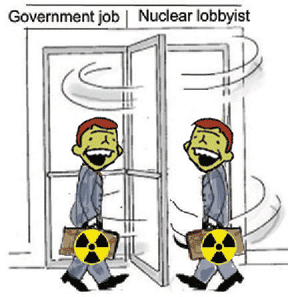
Back in June 2024, former Energy Minister Todd Smith left the government, after spending billions on the nuclear industry and promising billions more. Upon his departure, Todd Smith landed a job as a VP of CANDU Energy Inc. CANDU Energy Inc was created when SNC-Lavalin purchased the commercial reactor division of Atomic Energy of Canada Limited from the federal government in 2011. In an effort to distance itself from its scandal ridden past, SNC-Lavalin has since changed its name to AtkinsRealis. The company is heavily involved in the refurbishment of Ontario nuclear plants and the plans for new builds.
3c. The technological hype of SMRs
Small Modular Reactors (SMRs) are not small and they are not that modular. And they are not that new. The designs, of which there are about 54, have been kicking around for a long time. It’s just that no one wanted to build them, and investors were loathe to put up their own money. The fate of SMRs changed when the nuclear industry convinced governments in Canada to develop what it called the “SMR Roadmap.” The “Roadmap,” largely produced by the industry, was all hype and little substance, but it was enough to convince the Ford government to join the parade.
The World Nuclear Industry Status Review is an annual independent assessment of the global nuclear industry. In its 2022 review, it concluded:
“Small modular (nuclear) reactors or SMRs continue to hog the headlines in many countries, even though all the evidence so far shows that they will likely face major economic challenges and not be competitive on the electricity market. Despite this evidence, nuclear advocates argue that these untested reactor designs are the solution to the nuclear industry’s woes.”
In the 2024 edition of the review, the analysts note: “The gap between hype about Small Modular Reactors (SMRs) and reality continues to grow. The nuclear industry and multiple governments are doubling down on their investments into SMRs, both in monetary and political terms.”
3d. Over-the-top visioning and ideological straw men
Stephen Lecce became the Minister of Energy in June 2024. Shortly afterwards, he travelled to the US where he made a pitch to western leaders and industry movers and shakers. He told them that Ontario is building a blueprint for a nuclear energy future.
A CP wire story put it this way: “Ontario is selling itself as the nuclear North Star to guide the direction of American power.”
Speaking to a largely American audience, he said it’s time to “rid our economies of any dependence on these foreign states that … do not share our democratic embrace,” (Oops).
The minister’s early charm offensive turned more aggressive back home when he criticized those who support renewable energy as” ideologues” who want to “romanticize certain resources.” As he told the National Post, “We are seeing forces on the left, the illiberal left, who cannot come to terms with the fact that in order to decarbonize we’re going to need nuclear.”
The commitment to nuclear was further baked into Ontario’s future when the Ford government released its energy vision in October 2024. The document ironically entitled “Ontario’s Affordable Energy Future” sets the stage for a massive build out of nuclear power.
It also makes it clear that Ontario has set its sights on becoming a nuclear energy superpower in the hopes of selling expensive nuclear electricity to the US and costly nuclear technology to the world.
Reflecting the grandiose aspirations of a would-be energy superpower the Minister declared that “this was Ontario’s moment.”
3e. The legislative lock-in
In December 2024, the government passed the misnamed “Affordable Energy Act” (Bill 214) The legislation has many troubling aspects. Various sections of the act restrict public consultation, further erode the independence of regulatory tribunals, and shifts more decision making to the government. But most alarming is how the government has used the Act to give preference and priority to nuclear power. Section 25.29 (2) of the Act refers to, “the prioritization of nuclear power generation to meet future increases in the demand for electricity …”
3f. The commitment to underwrite the costs of nuclear
The government is bankrolling the nuclear expansion with public money because investors don’t want their own money at risk. The costs of nuclear power have driven private investors away. Even with massive subsidies from governments, investors are reluctant to ante up.
A spokesperson for the government-owned Ontario Power Generation made the point very clear when commenting on small modular reactors.
Kim Lauritsen is a senior OPG vice-president. She told a Global Business conference audience that the crown corporation was willing to take the “first-mover risk.”
As she put it: “Because they (small modular reactors) take too long and the industry needs to see that these things can be built successfully, to give investors the confidence and really get the ball rolling for other jurisdictions.”
Because investors are nervous and because Ontario wants to show the way for other jurisdictions, the Ford government is prepared to saddle Ontario families and future generations with the exorbitant costs of nuclear power.
Part 4: The nuclear three-prong plug: Refurbishments, SMRs and New Large Scale Reactors
Refurbishments
The Ontario government is spending billions to refurbish old nuclear plants. Fourteen reactors are scheduled to be rejuvenated – 6 at Bruce, 4 at Darlington, and 4 at Pickering. The repair schedule for existing nuclear plants stretches out for decades. While these reactors are off line, the government plans to make up the electricity shortfall with more climate wrecking, fossil-gas generating plants.
The cost of the refurbishments will be in excess of $40-billion. That forty billion and the millions more in interest charges will find its way onto our electricity bills.
As our electricity bills go up, so does political pressure and when that pressure reaches a tipping point, the government steps in with subsidies to help reduce electricity bills. It is a repeated pattern in Ontario.
A recent report from the Government’s Financial Accountability Office (FAO) projected the cost of current electricity subsidies to be $118-billion over the next 20 years. These are not all nuclear electricity subsidies. But as we spend more on nuclear and nuclear increases the cost of electricity and governments are pressured to reduce the cost of electricity, there will be even more subsidies to shift the costs from our electricity bills to our taxes.
Small Modular Reactors (SMRs)
In addition to the massive refurbishment program the Ford government has announced a series of nuclear new builds.
There will be four new small modular reactors (SMRs) built at the Darlington nuclear location. Site preparation work is already underway on the first one. OPG has convinced the Canadian Nuclear Safety Commission to forego an environmental impact assessment, relying instead on an assessment that had been done years ago on the site for a different project.
The government has selected the GE-Hitachi BWRX-300 design. This is based on a design that has been kicking around for about 20 years and has had to be redesigned about ten times. It still has never been built. The engineering designs for Darlington have again been changed, making the small modular reactor less small and even less modular.

OPG has not released a cost estimate for the reactors. But there are some indications of the probable magnitude. In the US, the only SMR project that had been approved by the US federal government was NuScale in the mid-west. The project was cancelled because of escalating costs. Originally estimated at $3-billion (US), it was terminated in 2024 when the projected costs reached $9.3-billion (US).
The Tennessee Valley Authority, a large power utility in the US, has partnered with the OPG to promote the GE-Hitachi SMR. The TVA recently provided some estimates of the costs of building the SMR in the US. It indicated that the cost of the first reactor could be about $5.4-billion (US). It hoped the costs could be reduced to about $3.7-billion (US) if more were built. These costs do not include any interest charges, cost overruns, or missed deadlines.
If we assume the lower cost and convert to Canadian dollars, the price tag for the four SMRs at Darlington would be about $20-billion before things go wrong. In 2019, the company’s indicated the costs would have to be below $1-billion (US).
New Large Scale Nuclear Reactors
In July 2023, the Ontario government announced its support to expand the capacity of the Bruce nuclear power plant near Kincardine. The Bruce nuclear generating station is owned by OPG but operated by Bruce Power, a private consortium. Bruce Power is planning a major expansion of the site’s generating capacity. At present, six of the eight reactors are being refurbished. This new development, if it goes ahead, will add an additional 4800 MW, which would require building four or five new reactors. Admittedly, it is early days, and no costs have been provided.
Port Hope
In January 2025, the Ontario government announced that it was in the preliminary stages of a massive new nuclear plant that could be built at the OPG site in Wesleyville, near Port Hope. Officials have suggested the plant could have a capacity of 8,000 to 10,000 megawatts and be in operation by the 2040s. Achieving that generating capacity would require building eight or more nuclear reactors.
Part 5: Calculating the Costs
Continue readingIran proposes partnership with UAE and Saudi Arabia to enrich uranium
A consortium would help Tehran deal with US objections and tie in Gulf states to its enrichment programme
Patrick Wintour, 14 Apr 25, https://www.theguardian.com/world/2025/may/13/iran-proposes-partnership-with-uae-and-saudi-arabia-to-enrich-uranium
Iran has floated the idea of a consortium of Middle Eastern countries – including Iran, Saudi Arabia and the United Arab Emirates (UAE) – to enrich uranium, in a effort to overcome US objections to its continued enrichment programme.
The proposal is seen as a way of locking Gulf states into supporting Iran’s position that it should be allowed to retain enrichment capabilities.
Tehran views the proposal as a concession, since it would be giving neighbouring states access to its technological knowledge and making them stakeholders in the process.
It is not clear if Abbas Araghchi, the Iranian foreign minister, made the proposal in relatively brief three-hour talks with the US in Oman on Sunday, the fourth set of such talks, but the proposal is reportedly circulating in Tehran.
The US has demanded that Iran ends enrichment and dismantles all its nuclear facilities. But amid divisions in Washington, Trump has not made a final decision on the issue and praised Iran’s seriousness in the talks.
The consortium idea was first proposed by former Iranian nuclear negotiator Seyed Hossein Mousavian and Princeton physicist Frank von Hippel long before the current Tehran-Washington talks, in a widely read October 2023 article in the Bulletin of the Atomic Scientists.
Under the consortium, the Saudis and UAE would be shareholders and funders, and would gain access to Iranian technology. The involvement of the Gulf states could be seen as an extra insurance that Iran’s nuclear programme was for entirely civil purposes and not the pathway to building a bomb, as Israel alleges.
If the Saudis and UAE were permitted to send engineers to Iran, an extra form of visibility about the programme would become possible, leaving the international community less reliant solely on the work of the UN nuclear inspectors from the International Atomic Energy Agency.
Iran gradually moved away from the levels of enrichment and stockpile limits set out in the original 2015 deal, blaming Trump for leaving the nuclear deal. Iran’s deputy foreign minister, Majid Takht-Ravanchi, said: “For a limited period of time, we can accept a series of restrictions on the level and volume of enrichment.”
The US originally gave the impression that it needs an agreement with Iran within two months of the talks starting but, as the technicalities of any agreement become more complex, it is possible the talks will be allowed to drag on through the summer.
Iran currently enriches uranium to 60% purity – far above the 3.67% limit set in the 2015 deal, and a short technical step from 90% needed for weapons-grade material. The US secretary of state, Marco Rubio, said these uranium enrichment level are far higher than necessary for civilian uses.
In what may have been a reference to the Iranian proposal Omani foreign minister, Badr Al Busaidi, referred to “useful and original ideas reflecting a shared wish to reach an honourable agreement”.
The UAE operates a civil nuclear power plant named Barakah, located west of Abu Dhabi. It is the first nuclear power plant in the Arab world to be fully operational, with all four reactors now online, and should be capable of producing a quarter of the UAE’s electricity needs.
Critics Slam Cost of Ontario SMR Plan, Question Dependence on U.S. Uranium
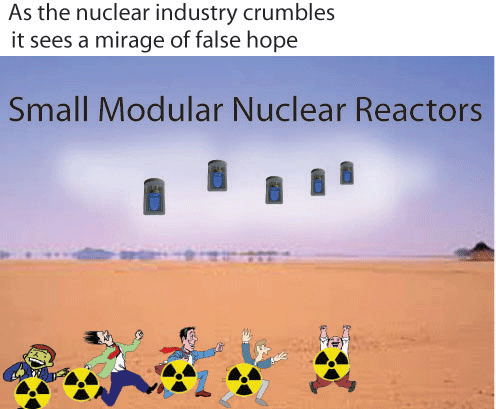
May 12, 2025, Mitchell Beer, https://www.theenergymix.com/critics-slam-cost-of-ontario-smr-plan-question-dependence-on-u-s-uranium/
Critics are taking a hard line on Ontario’s announcement that it will build four 300-megawatt small modular nuclear reactors (SMRs) at the existing Darlington nuclear plant near Bowmanville, with most concerns focused on the cost of the project and the geopolitical risk in sourcing enriched uranium from a U.S. supplier.
Ontario Power Generation announced provincial approval for the first of the four units May 8, describing it as “the first new nuclear build in Ontario in more than three decades.”
“This is truly a historic moment,” said OPG President and CEO Nicolle Butcher. “This made-in-Ontario project will support provincial companies, create jobs for Ontarians, and spur growth for our economy.”
Energy and Mines Minister Stephen Lecce declared the 1,200-megawatt installation, the first of its kind in the G7, a “nation-building project being built right here in Ontario.” Durham MPP Todd McCarthy called it “the next step to strengthening Ontario and Canada’s energy security.”
The published cost of the project is $7.7 billion for the first reactor, including $1.6 billion for infrastructure and administrative buildings, and $20.9 billion to complete the series of four. Citing Conference Board of Canada figures, OPG said the four SMRs will contribute $38.5 billion to Canada’s GDP over 65 years and sustain an average of about 3,700 jobs per year, including 18,000 per year during construction.
First Mover Advantage or Boutique Pricing?
In the OPG announcement, Butcher suggested an advantage in being the first G7 jurisdiction to bring an SMR to market. “As a first mover on SMRs, Ontario will also be able to market our capabilities and nuclear expertise to the world to further grow our domestic industry,” she said.
The Globe and Mail says the Darlington New Nuclear Project “is being watched closely by utilities around the world,,”, and OPG’s BWRX-300 design “is a candidate for construction in the United States, Britain, Poland, Estonia, and elsewhere.” But “the costs published Thursday are higher than what independent observers argue are necessary to attract many more orders. For comparison, a recently completed 377-megawatt natural gas-fired power station in Saskatchewan cost $825-million.”
Ed Lyman, director of nuclear power safety at the Cambridge, MA-based Union of Concerned Scientists, called the Ontario estimate “an eye-popping figure, but not unexpected given what we know about the poor economics of small nuclear reactors.” That would make the Darlington SMR facility “a boutique unit that’s going to produce electricity for a very expensive price.”
An independent study released last week by the Ontario Clean Air Alliance found that the Darlington SMRs will cost up to eight times as much as onshore wind, almost six times as much as utility-scale solar, and 2.7 times as much offshore wind in the Great Lakes after factoring in the federal tax credit. The analysis by Hinesburg, Vermont-based Energy Futures Group “used data from Ontario’s Independent Electricity System Operator (IESO) but used realistic real-world capital costs and performance measures to develop a more accurate comparison of the cost of nuclear and renewable power options,” OCAA writes.
The report calculates the levelized cost of electricity (LCOE) from different sources in 2030 and 2040, with and without the federal government’s 30% clean energy investment tax credit (ITC). It places the unsubsidized costs per megawatt-hour in 2030 at:
• $33 to $51 for onshore wind;
• $54 for utility-scale solar;
• $105 to $113 for offshore wind;
• $214 to $319 for different SMR designs;
• $279 to $307 for conventional nuclear plants.
By 2040, the prices range from $30 for onshore wind and $41 for utility-scale solar to up to $269 for SMRs and $307 for conventional nuclear. SMR pricing falls as low as $137 per MWh with a 30% ITC.
“It remains unclear how this, and the province’s larger nuclear expansion program, will actually be paid for,” Mark Winfield, co-chair of York University’s Sustainable Energy Initiative, told The Energy Mix in an email. “Putting this on the rate base means higher rates for Ontario electricity consumers, even if the costs are as claimed.”
He added that “the potential role of the federal ITC and [Canada] Infrastructure Bank Investment raises serious questions about what should be defined as ‘clean’ energy given the risks involved in this case, in terms of economic and technological viability, safety risks, and unanswered questions regarding waste streams.”
Critics were already questioning whether field experience with four individual SMRs will be enough to drive down production costs from $6.1 billion plus surrounding infrastructure for the first unit to a range of $4.1 to $4.9 billion for the next three, after the estimated price of the project has already ballooned. Now, with New Brunswick scaling back its SMR development plans, “Ontario is taking something of a technological and economic flyer on this, on behalf of everyone else, underwritten by the electricity ratepayers and, ultimately, taxpayers of Ontario,” Winfield wrote. “This is a project that demands serious economic, technological, and environmental scrutiny, and has been subject to virtually none.”
Uranium Sourced from the United States
OPG is also running into concerns with its plan to power the BWRX-300 with enriched uranium supplied by a firm in the U.S. state of New Mexico. When Donald Trump launched his tariff war earlier this year and began muttering about making Canada a 51st state, Premier Doug Ford applied a short-lived tariff to Ontario power sales and referred publicly to cutting exports as a retaliatory measure. Now, the province is proposing to make 1,200 MW of electricity supply dependent on a vendor that could see its price driven up by tariffs, or be compelled to cut off the supply entirely.
“Developing a dependence on another country for our nuclear fuel has always been a concern, and recent events have proven those concerns are justified,” Bob Walker, national director of the Canadian Nuclear Workers’ Council, told the Globe and Mail in February. “The arrangements are probably as robust as they could be under normal circumstances, but the circumstances are no longer normal.”
In an email to the Globe at the time, OPG spokesperson Neal Kelly described the situation as “very fluid”, adding that “we are proactively evaluating potential impacts and will act as the situation arises.”
Kelly did not respond to an email Monday morning asking whether OPG has any concerns about sourcing enriched uranium from the U.S., and whether it has or needs a Plan B.
US loosens some rules for offensive counterspace ops, wargaming
Some decision-making authorities, previously closely held by the president or secretary of defense, have been delegated to US SPACECOM, according to sources, but military space leaders want more freedom to act.
Breaking DEfense, By Theresa Hitchens, on May 12, 2025
WASHINGTON — When the Space Force recently put out a forward-leaning “warfighting” framework, it included an unusually blunt warning for military commanders: ensure the rules of engagement for space operations aren’t too restrictive, or the US will be at a severe disadvantage in the heavens.
That warning was public, but Breaking Defense has learned it comes amid a parallel push by the Space Force and US Space Command (SPACECOM) over the last several years to gain more military decision-making control over the use of anti-satellite (ASAT) weapons — decision-making authority that has historically been closely held by the president and/or the secretary of defense.
While delegation of presidential authority with regard to space weapons is obscured by deep secrecy and classification, discussions by Breaking Defense with more than a dozen sources — including former Pentagon and US government civilian officials, retired and current military officials and outside space experts — have revealed that gradual but ground-breaking shifts in military freedom to prosecute war in the heavens have begun to take place in response to growing threats from Russia and, in particular China.
“We have made some changes that delegated some authorities down to Space Command commander under certain circumstances,” a former senior Space Force official said. “But in my view, not enough.”
For example, over the last decade there has been a gradual loosening of the reins on case-by-case determinations about the use of some types of temporary or reversible counterspace actions, such as jamming or lazing, according to a handful of sources. However, these sources did not indicate that there has been any relaxation of the requirement for approval by the president and/or the secretary of defense for a kinetic attack to destroy an enemy satellite……………………….
Changes in delegation of authority sped up following the standup of SPACECOM in 2019, the former senior Space Force official said. And according to three sources close to the debate, there were intense discussions as late as last summer within the Biden administration about delegating authority for the use of offensive satellite attack weapons to SPACECOM.
“OSD [Office of the Secretary of Defense] Space Policy was engaged in the strongest push I’m aware of to get authorization to use offensive counterspace capabilities delegated down from the [White House] to the [Secretary of Defense] and eventually to” the head of SPACECOM, said another former Pentagon official.
John Plumb, the head of OSD Space Policy under President Joe Biden, did reveal to Breaking Defense one significant move by that administration: allowing joint force planners to include space warfighting in their routine contingency plans and wargames for future conflict. (He would not, however, address the key question of whether destructive, kinetic strikes can be included in those plans.)………………………………………………………………………………………………………………………………. https://breakingdefense.com/2025/05/exclusive-us-loosens-some-rules-for-offensive-counterspace-ops-wargaming/
1 This Month

of the week – Shut Down Drone Warfare!


Tell the Ukrainian Government to Drop Prosecution of Peace Activist Yurii Sheliazhenko

Petition to revoke the licensing of the Near Surface Nuclear Disposal Facility (NSDF) at Chalk River. https://www.ourcommons.ca/petitions/en/Petition/Details?Petition=e-7247
To see nuclear-related stories in greater depth and intensity – go to https://nuclearinformation.wordpress.com
-
Archives
- April 2026 (68)
- March 2026 (251)
- February 2026 (268)
- January 2026 (308)
- December 2025 (358)
- November 2025 (359)
- October 2025 (376)
- September 2025 (257)
- August 2025 (319)
- July 2025 (230)
- June 2025 (348)
- May 2025 (261)
-
Categories
- 1
- 1 NUCLEAR ISSUES
- business and costs
- climate change
- culture and arts
- ENERGY
- environment
- health
- history
- indigenous issues
- Legal
- marketing of nuclear
- media
- opposition to nuclear
- PERSONAL STORIES
- politics
- politics international
- Religion and ethics
- safety
- secrets,lies and civil liberties
- spinbuster
- technology
- Uranium
- wastes
- weapons and war
- Women
- 2 WORLD
- ACTION
- AFRICA
- Atrocities
- AUSTRALIA
- Christina's notes
- Christina's themes
- culture and arts
- Events
- Fuk 2022
- Fuk 2023
- Fukushima 2017
- Fukushima 2018
- fukushima 2019
- Fukushima 2020
- Fukushima 2021
- general
- global warming
- Humour (God we need it)
- Nuclear
- RARE EARTHS
- Reference
- resources – print
- Resources -audiovicual
- Weekly Newsletter
- World
- World Nuclear
- YouTube
-
RSS
Entries RSS
Comments RSS
 nuclear-news