Trump’s Golden Dome: Star Wars is back
Bruce Gagnon is coordinator of the Global Network Against Weapons & Nuclear Power in Space. He offers his own reflections on organizing and the state of America’s declining empire….
Saturday, May 24, 2025, https://space4peace.blogspot.com/2025/05/trumps-golden-dome-star-wars-is-back.html?utm_source=substack&utm_medium=email
Today the Military Industrial Complex is marching towards world dominance through space technology on behalf of global corporate interests. To understand how and why the space program will be used to fight all future wars on Earth from space, it’s important to understand how the public has been misled about the origins and true purpose of the space program.
Trump calls for a renewal of Ronald Reagan’s 1980’s vision of SDI (Strategic Defense Initiative), popularly called Star Wars. The program is a massive boondoggle in the works. Early estimates are that Trump’s ‘Golden Dome’ would cost from $500 billion to trillions of dollars. The recipients of this largess would be weapons corporations like Lockheed Martin, Raytheon and Space X.
Major cutbacks in social and environmental programs will be required to help fund this insanity.
Golden Dome would spur a new space weapons arms race that will destabilize our planet and beyond.
This documentary Arsenal of Hypocrisy features Global Network Coordinator Bruce Gagnon, Noam Chomsky and Apollo 14 astronaut Edgar Mitchell talking about the dangers of moving the arms race into space.
The one-hour production includes archival footage of Nazi rocket tech brought to U.S. after WW2, Pentagon documents, and clearly outlines the U.S. plan to “control and dominate” space and the Earth below.
The video spells out the dangers of the Bush-era “Nuclear Systems Initiative” that will expand the use of nuclear power in space by building Project Prometheus — the nuclear rocket.
Mitchell, the 6th man to walk on the Moon, warns that a war in space would create massive bits of space junk that would create a mine field surrounding the Earth making it virtually impossible to launch anything into the heavens. Mitchell calls space a fragile environment that must be protected.
Noam Chomsky talks about how the U.S. intends to use space technology to control the Earth and reminds the viewer that the U.S. has refused for many years to negotiate a global ban on weapons in space at the United Nations. He also speaks about the role of the media in suppressing this important issue.
The video also contains archival sound of President Dwight Eisenhower in 1961 warning the American people about the power of the military industrial complex.
Arsenal of Hypocrisy was produced in 2003 by filmmaker Randy Atkins from Gainesville, Florida. It is still highly relevant today.
The video was featured at the New York International Independent Film and Video Festival 2004.
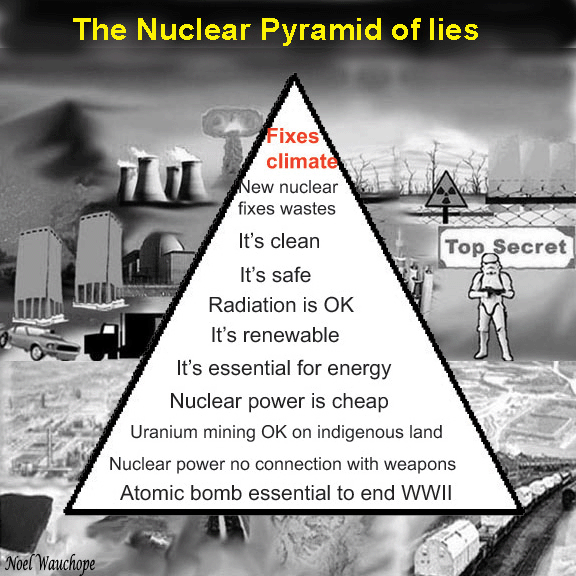
How does the nuclear industry get away with its persistent, repetitive lies?
Radiation Free Lakeland * nuclear landfill/geological dump * NO TA!
Steve Wallis , 25 May 25.
Thoughts on the nuclear industry and how it is “run” and perceived by the people who work in the industry and how it is “sold” to the public. An earlier thread details Trump’s executive orders re “new” nuclear and the lies spouting forth about new this, new safety that, and not like the other nukes nonsense.
There are a few things that are very puzzling when it comes to the nuclear industry, perhaps the main one is why tell lies and why these lies are believed. Before talking about this I am interested in the “new” nuclear and the growing criticism concerning lack/lapse of regulation, mainly to build them quicker, cheaper and more of them. For example the SMR’s in the US will not fall under the current impact surveys for standard nuclear plants, re environmental/public safety.
Trump mentions SMR’s as if they already exist. This is not true, the modular means these reactors are built on a production line and then assembled on site. No factory production line exists at the moment.
Then the question is how does the nuclear industry get away with telling the same lies over and over, which it always does? Maybe this is because of regulatory capture, when a regulatory agency becomes dominated by the industry it is meant to regulate, and therefore does not protect public interest. Sellafield is an example of this over and over.
So why does the public believe Trump and the nuclear industry who are liars? This brings me to The Nietzsche Thesis, in his words we will accept and look for “truth” only when it has “pleasant, life-preserving consequences.” Conversely, we are hostile “to potentially harmful and destructive truths.” So, I will accept what is said if it preserves my view of the world, conversely I present a hostile reaction to harmful truths. Surveys asking Trump supporters how they feel about the lies are unconcerned because the lies fulfil their goals, and do not threaten their status. Likewise, despite loads of nuclear accidents people still believe the industries lies about providing safe, clean and cheap energy.
The nuclear industry always tells the public it is safe, and how it prides itself on providing the safest form of energy. It is as if all the nuclear accidents simply never happened and the public tend to believe this lie rather than the truth.
Extermination as negotiation: Understanding Israel’s strategy in Gaza

Behind the language of planning lies a campaign of sterilization and condensation — a vision of Gaza not as a home, but as a holding site. Leaked reports whisper of forced transfers, of Palestinians being sent to Libya or elsewhere in Africa, sketching futures of removal dressed in the language of pragmatism. In other words, Israel maneuvers, cajoles, agrees, renges, returns to blood, and ultimately remains hesitant in fulfilling even its own plans.
Whether it’s total conquest or managed containment, Israel doesn’t have a single grand strategy for Gaza, but it uses the possibility of both to prolong the war.
Mondoweiss, By Abdaljawad Omar May 23, 2025
In the weeks since the unveiling of “Operation Gideon’s Chariots,” the renewed Israeli offensive to permanently “conquer” all of Gaza, it has become increasingly clear that Israel’s internal decision-making is not oriented toward a singular strategic endgame, but toward a recursive logic of exhaustion.
Israel isn’t choosing between total conquest and technocratic containment via an Arab-brokered ceasefire plan. Instead, it is deploying these options as devices to stretch the war and weaponize its duration rather than end it. Neither is an actual alternative to the other.
This is not a paradox, but a method. “Gideon’s Chariots,” with its objective to concentrate over two million Palestinians in Rafah and “cleanse” the remainder of Gaza, is not merely a plan of conquest. It is a fantasy of sterilization dressed in logistical rationality. Its brutality lies not only in its intentions — military and demographic — but also in its open-endedness, because it will be an occupation without governance or responsibility.
It imagines Gaza as a surgical field: empty of social density and politics, a flattened terrain where the Israeli army may operate unhindered and where civilians are transformed into captives or debris. This is where extermination can proceed behind the veil of humanitarian logistics. But this is the thing: while Israel announces its plan and leaks many of its contours, making sure that the endgame of extermination is out in the open, it also delays its fulfillment.
The rejection of the Egyptian proposal for Gaza’s postwar governance, meanwhile, functions less as a strategic rebuttal and more as a temporal maneuver: it defers the stabilization of Gaza, suspends the possibility of a postwar architecture, and secures Israel’s role as the sole arbiter of movement, aid, reconstruction, and survival. The proposal — which secured the backing of the Arab League — offered a ceasefire, the release of prisoners, and the creation of a Palestinian technocratic administration in Gaza under regional and international auspices. The governing authority would be civilian, non-Hamas, and possibly linked to the Palestinian Authority. Arab security forces, primarily from Egypt and the UAE, would maintain public order. Israel, in theory, would retain the ability to strike if Hamas rearmed, but the core logic was one of pacified governance and externally monitored reconstruction.
But this alternative, while marketed as pragmatic containment, reveals its own structure of control. It does not offer Palestinains liberation or sovereignty. It does not restore Palestinian political life. Instead, it imagines a depoliticized Gaza, administered through foreign technocrats, where governance is reduced to management and resistance is metabolized into security threats.
Yes, it ends the massacres, but it continues the process of unmaking through other means. Yes, it stops ethnic cleansing and genocide, but it only offers a minimum respite. ……………………………………………………………………………………………………………………………………………………………
Behind the language of planning lies a campaign of sterilization and condensation — a vision of Gaza not as a home, but as a holding site. Leaked reports whisper of forced transfers, of Palestinians being sent to Libya or elsewhere in Africa, sketching futures of removal dressed in the language of pragmatism. In other words, Israel maneuvers, cajoles, agrees, renges, returns to blood, and ultimately remains hesitant in fulfilling even its own plans.
………………………………..rather than shift course, Israel doubles down, leaning into ambiguity and attrition, hoping to exhaust global outrage the way it hopes to exhaust Palestinian resistance: through delay, confusion, the normalization of collapse, and of course, through coercion by the weaponization of antisemitism.
In this moment, what Israel seeks is a “stable instability” in which Gaza is rendered uninhabitable yet governed, massacred yet silent, present yet politically nullified. Both plans — the one it executes and the one it rejects — serve this grammar. Whether through total war or managed containment, the objective remains: to erase Palestine as a subject of history, and to replace it with a population that can be controlled, administered, or vanished. Whether this will succeed remains uncertain. But the cracks are visible in the disillusionment of soldiers and in the rage of Israeli prisoners’ families. ……………………………………………………………………………………………………………………………. https://mondoweiss.net/2025/05/extermination-disguised-as-negotiation-understanding-israels-strategy-in-gaza/?fbclid=IwY2xjawKiJnVleHRuA2FlbQIxMQBicmlkETFhMVJScjZYcDE0UEpFRko2AR6Ov_j6MzhAmpAl-ntfqrrz9g7gbweyo2JQZgXmQD20EFcLFNN_7U3rbw1FBA_aem_EoA46q1R_Hz9m5KhsFpSqw
Why the US Won’t Be Able to Help Build Taiwan’s Nuclear Future
Washington itself hasn’t solved the problems that fed into Taiwan’s nuclear phase-out: waste storage and high costs.
By Benjamin Yang and M.V. Ramana, May 26, 2025, https://thediplomat.com/2025/05/why-the-us-wont-be-able-to-help-build-taiwans-nuclear-future/
When the 40-year operating license of Taiwan’s last remaining commercial nuclear reactor expired on May 17, the country realized its nuclear phase-out policy after decades of politicized debates.
If anything, though, the imminent decommissioning of the Maanshan Nuclear Power Plant’s second reactor has only fueled another round of heated discussions on the potential role of nuclear power in Taiwan’s energy future.
On May 13, the Legislative Yuan – Taiwan’s national legislature, where opposition parties currently hold a majority – passed amendments to the Nuclear Reactor Facilities Regulation Act, allowing nuclear power plant operators to apply for a 20-year license renewal beyond the original 40-year cap and easing restrictions on their restarts. In the meantime, it also passed a proposal from the Taiwan People’s Party (TPP) for a referendum on restarting the Maanshan plant, which is now set to take place in August.
Such renewed interest in nuclear energy is a result of a few compounding factors: power shortage concerns amid grid-induced blackouts over the past few years and growing power demands from the semiconductor and AI industries; rising electricity prices that pro-nuclear groups have framed as a result of phasing out nuclear; stalled momentum in renewable energy development; and national security threats of a naval blockade from China.
At the same time, there are several reasons why nuclear power may not really address these questions, most notably the high costs and long construction times of building nuclear plants. Meanwhile, proponents of the nuclear phase-out point to the risks of accidents associated with nuclear reactors and the lack of a demonstrated solution to managing radioactive wastes of different kinds produced by the nuclear fuel chain.
Amid this domestic debate in Taiwan over nuclear power, Director Raymond Greene of the American Institute in Taiwan, the de facto U.S. embassy, added a new twist. In a recent interview, he announced that the United States stands ready to introduce “existing and new technologies such as SMRs (small modular reactors) and to help Taiwan address its nuclear waste storage challenges.” Can U.S. support on SMRs and nuclear waste storage help with the challenges that led Taiwan to phase out nuclear power?
The problem with nuclear waste is two-fold: a shortage of short-term storage capacity at some sites, and the complete absence of a long-term option. Currently, Taiwan has over 21,500 spent fuel rods from almost five decades of operation; all but 112 of these are stored on-site, either in their respective reactor cores or spent fuel pools. Only a portion from the Chinshan Nuclear Power Plant has been moved to a dry storage facility. In July 2021, Taiwan Power Company, the state-owned utility that owns and operates all of Taiwan’s nuclear power plants, had to take unit 1 of the Kuosheng Nuclear Power Plant offline five months before the expiry of its operating license due to the lack of used fuel storage capacity. These are just the problems with short-term storage. In the long term, there is just no plan: the government has yet to create regulations governing the disposal of high-level waste.
With local government concerns over wastewater runoff pollution hampering progress on constructing dry storage facilities and a final disposal repository nowhere in sight, creating more nuclear waste through extensions, restarts, or even building new SMRs will only aggravate this unsolved issue.
The United States has no long-term plan for its nuclear waste, either. Yucca Mountain, the site selected back in 1987 under the 1982 Nuclear Waste Policy Act, proved to be technically problematic, because it had an oxidizing environment and, despite being advertised as a very dry site, proved to allow seepage of lots of water. No alternative site has been seriously considered since Yucca Mountain was picked, although high level committees like the Blue Ribbon Commission set up by President Barack Obama have recommended setting up a process to find a new site. In short, the United States has no successful experience to point to if it intends to help Taiwan with its nuclear waste.
The story is similar with SMRs, the other part of the offer from Greene. Despite much media attention and hype, the United States has so far not constructed a single small modular reactor. In terms of planning, the most advanced SMR project was proposed by the Utah Associated Municipal Power System. Announced in 2015, the UAMPS project was initially expected to start operations “around 2023” at an “overnight cost” of $3 billion. The estimated costs of the project subsequently rose to $6.1 billion, and finally $9.3 billion in 2023. That last figure was for a mere 462 megawatts of electricity capacity. Later that year, the project was canceled because of a lack of demand.
When viewed in terms of the cost per unit of power capacity (i.e., dollars per megawatt), the cost of the UAMPS project was higher than even the most expensive nuclear power plant built in the United States, the Vogle project in Georgia, which cost $36.8 billion. This is to be expected. Small modular nuclear reactors, which produce less than 300 megawatts of power as compared to the roughly 1,000 megawatts for the typical reactors that have been constructed in recent decades, are more expensive per unit of power capacity due to diseconomies of scale.
The underlying reason is that the cost of constructing or operating a nuclear reactor is not directly proportional to the amount of power it is designed to generate. SMRs, therefore, start off with an economic disadvantage and will further undermine the financial viability of nuclear plants.
In the United States, nuclear plants are the most expensive way to supply electricity and building SMRs will make nuclear power even less competitive, especially in comparison to solar and wind energy, with or without electricity storage. No wonder renewables constitute the vast majority of new electricity installations in the United States. Also growing rapidly are energy storage technology, geothermal technologies, and grid resilience innovations such as virtual power plants. If the U.S. is serious about addressing Taiwan’s energy situation, maybe these are the technologies it should be offering.
In the end, the decommissioning of Taiwan’s final nuclear reactor marks a critical crossroads in its energy transition. Every choice Taiwan makes at this juncture would need to tackle the multitude of challenges that come with balancing rising demands, economic development, national security, climate action, and public safety. With the storage solutions for existing nuclear waste yet to appear and the costliness of constructing SMRs both in terms of time and capital, nuclear is unable to serve as a safe, cost-effective, and timely climate solution – even with U.S. support.
Israeli Military Says It Will Occupy 75% of Gaza Within Two Months, ‘Concentrate’ the Civilian Population
The IDF’s plan is to force civilians into three small areas in Gaza
by Dave DeCamp May 25, 2025 , https://news.antiwar.com/2025/05/25/israeli-military-says-it-will-occupy-75-of-gaza-within-two-months-concentrate-the-civilian-population/
The Israeli military expects that it will occupy 75% of Gaza’s territory within two months and plans to “concentrate” the entire civilian population into three small areas in the Strip.
According to Israeli media, Palestinian civilians will be confined to the center of Gaza City, a strip of land in central Gaza’s Deir el-Balah and Nuseirat, and an area in al-Mawasi on the coast in southern Gaza.
The IDF said the purpose of the offensive is to destroy Hamas infrastructure, although previous reports have said the plan is to destroy every remaining building in Gaza.
Israeli Prime Minister Benjamin Netanyahu has already made clear that Israel’s goal was the full military occupation of Gaza and the ethnic cleansing of the territory, which he calls the “Trump plan,” although it’s unclear where the Palestinian population could go.
The IDF announcement about its offensive comes as a new US and Israeli-backed aid scheme is expected to be launched in Gaza, but there are conflicting reports about when it will actually start. According to Haaretz, the aid distribution, which will involve private American security contractors, will start Monday, although other Israeli media reports say it has been postponed.
The aid scheme has been rejected by the UN and other aid agencies that operate in Gaza, and it has been condemned as a transparent effort to forcibly displace starving Palestinian civilians into concentration camps. Amid the criticism, Jake Wood, the CEO of the Gaza Humanitarian Foundation (GHF), which was created for the US-Israeli aid plan, announced his resignation.
“The aid program cannot be implemented while adhering to humanitarian principles of humanity, neutrality, fairness, and independence – principles I will not abandon,” Wood said. He called on Israel to “significantly expand aid delivery to Gaza through all possible means.”
1 This Month
Chernobyl: The Lost Tapes – A good documentary on Chernobyl on SBS available On Demand for the next 3 weeks– https://www.sbs.com.au/ondemand/tv-program/chernobyl-the-lost-tapes/2352741955560

of the week–London Campaign for Nuclear Disarmament

Tell the Ukrainian Government to Drop Prosecution of Peace Activist Yurii Sheliazhenko
To see nuclear-related stories in greater depth and intensity – go to https://nuclearinformation.wordpress.com
-
Archives
- April 2026 (114)
- March 2026 (251)
- February 2026 (268)
- January 2026 (308)
- December 2025 (358)
- November 2025 (359)
- October 2025 (376)
- September 2025 (257)
- August 2025 (319)
- July 2025 (230)
- June 2025 (348)
- May 2025 (261)
-
Categories
- 1
- 1 NUCLEAR ISSUES
- business and costs
- climate change
- culture and arts
- ENERGY
- environment
- health
- history
- indigenous issues
- Legal
- marketing of nuclear
- media
- opposition to nuclear
- PERSONAL STORIES
- politics
- politics international
- Religion and ethics
- safety
- secrets,lies and civil liberties
- spinbuster
- technology
- Uranium
- wastes
- weapons and war
- Women
- 2 WORLD
- ACTION
- AFRICA
- Atrocities
- AUSTRALIA
- Christina's notes
- Christina's themes
- culture and arts
- Events
- Fuk 2022
- Fuk 2023
- Fukushima 2017
- Fukushima 2018
- fukushima 2019
- Fukushima 2020
- Fukushima 2021
- general
- global warming
- Humour (God we need it)
- Nuclear
- RARE EARTHS
- Reference
- resources – print
- Resources -audiovicual
- Weekly Newsletter
- World
- World Nuclear
- YouTube
-
RSS
Entries RSS
Comments RSS
 nuclear-news