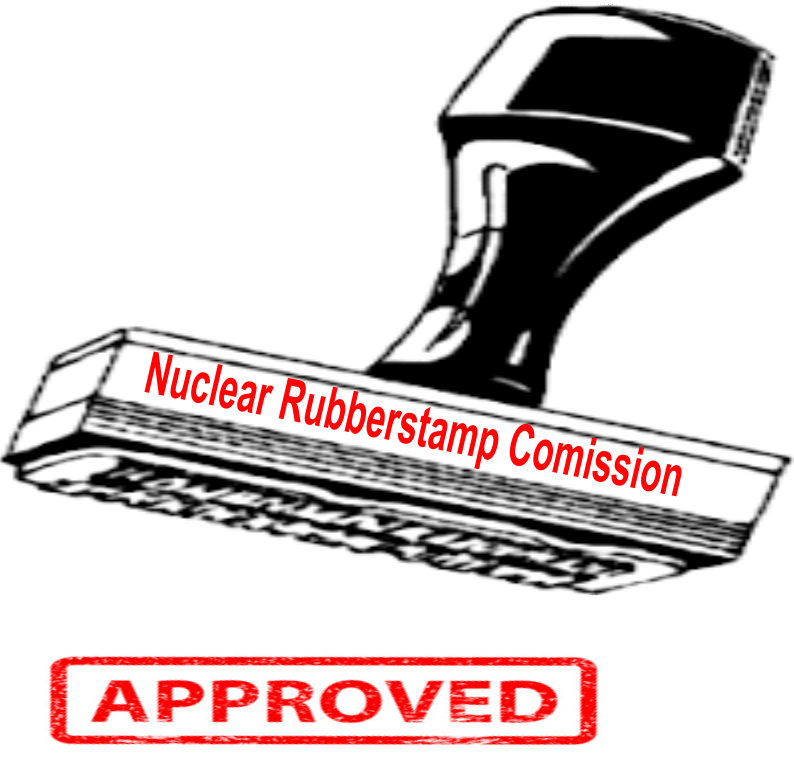
White House weighs overhaul of Nuclear Regulatory Commission
E and E News, By Francisco “A.J.” Camacho | 05/14/2025
Draft White House executive orders would overhaul nuclear regulation and hand the Department of Energy secretary new powers to approve advanced reactor designs and projects — placing a nuclear safety gatekeeper directly under President Donald Trump.
A review by POLITICO’s E&E News of the language in four separate draft orders shows that nuclear advocates in the Trump administration are looking for ways to bypass the independent Nuclear Regulatory Commission and challenge its central claim over nuclear safety standards.
“This is the detailed, agency-specific effort to override the historic independent agency construct,” Stephen Burns, former chair of the NRC during the Obama administration, said in an interview.
Burns emphasized that many of the reforms outlined in the draft orders are already being implemented under the ADVANCE Act that Congress passed last year. He questioned the necessity and merits of White House micromanagement.
“Everybody should be worried about that, especially because we depend on nuclear power plants for about 20 percent of our electricity across this country,” said Emily Hammond, a former DOE deputy general counsel and current George Washington University law professor. “That’s an important segment of low-carbon electricity, and if it’s not safe, that’s a huge gap to fill.”
It isn’t clear when or if any of the draft orders will land on Trump’s desk. But as written now, the drafts return to a theme laid out in many of Trump’s energy orders: Radical policy overhauls are needed to power the rapidly growing U.S. tech industry.
Efforts to restart large nuclear plants along with private-sector investment and Department of Energy support for small modular reactor technology are pushing the industry forward after decades of little or no growth. The government and big technology firms say they hope to plug AI data centers into nuclear power plants that can provide around-the-clock generation.
But in asserting more direct control over the NRC, some nuclear boosters fear more harm than good. Trump’s February executive order subjects “significant regulatory actions” to review by the White House’s Office of Information and Regulatory Affairs, or OIRA.
Judi Greenwald, executive director of the Nuclear Innovation Alliance, said adding the OIRA review of either technical nuclear safety issues or minor activities would make NRC less efficient and introduce uncertainty into licensing timelines.
“NRC’s reputation as a trusted regulator is important to the public, to industry, and to potential customers of U.S. nuclear technology both here and abroad,” Greenwald said. “We don’t want changing political winds in either direction to undermine NRC’s credibility.”
Sources with direct knowledge of how NRC and the White House are handling the February order have told E&E News that OIRA has instructed the agency to submit all draft rules. OIRA will decide on a case-by-case basis if a given regulation is “significant.” If it is, the White House will conduct a second review that may entail comments or edits. The draft rules will then be returned to the commission.
People familiar with policy discussions say OIRA has already deemed reactor safety rules to be “significant” enough for a deeper White House review. The proposed “Part 53” advanced reactor rule and updates to environmental standards are also considered likely to trigger a second review.
The new process also obscures the public record of internal commission deliberations.
“It would potentially run afoul of the Sunshine Act,” said Adam Stein, nuclear energy innovation director at the pro-nuclear think tank Breakthrough Institute. “The Atomic Energy Act does not say the commission will send regulations to OIRA for approval. It says that the commission will decide.”
The prospect of stripping away much of the NRC’s independence has rattled Republicans and Democrats on the House Energy and Commerce Committee.
Rep. Jay Obernolte (R-Calif.) said in February that he’s willing to give the administration “the benefit of the doubt” as it tries to bring more political control over independent agencies. “Everyone should be able to agree that regulatory authorities like the NRC should not be involved in the day-to-day political struggles that occur here in Washington, D.C.,” he said.
Rep. Lori Trahan (D-Mass.) characterized any White House effort to exert more control over the NRC as a “dangerous attempt to serve the interests of Donald Trump and his donors.”
“Undermining the NRC’s independence invites safety risks, regulatory dysfunction, and corruption that threaten the future of nuclear energy in America,” she said.
Adding to the instability is growing speculation about leadership changes at the NRC. The term of Trump-appointed Chair David Wright expires in June, and no renomination has been announced.
“At this point, it would be difficult to get him through the process without a lapse,” Stein said.
Here is what we know about the four draft orders:
Draft Order 1: Overhauling NRC
The White House is circulating draft executive orders that could radically alter nuclear policy. They touch on several fronts, from restructuring the NRC to reorienting federal nuclear research and development priorities to setting a goal to quadruple U.S. nuclear power capacity by 2040.
The first draft viewed by E&E News would order NRC, OIRA, the Department of Government Efficiency and “other agencies” to finalize NRC rules that would establish deadlines for reviewing license applications; reconsider the NRC radiation safety threshold; revise the environmental review process; expedite approvals for reactors that have been tested at DOE and Defense Department sites; and shrink the Advisory Committee on Reactor Safeguards, which independently reviews all nuclear licensing actions.
And the agencies, the draft says, would have 18 months to finish this “wholesale regulatory revision” of the NRC with mandatory “reductions in force.”………………………………………………………………….
Draft Order 2: Nuclear R&D
Another draft order would authorize DOE to more directly spearhead pilot and demonstration reactor projects at national laboratories and on other federal lands.
“The Department shall approve at least three reactors pursuant to this pilot program with the goal of completing construction of each of the three reactors by July 4, 2026,” the draft reads.
Experts say that the timeline is nearly impossible at this point.
Draft Order 3: Nuclear for “national security”
A third draft order seeks to boost American nuclear power by leveraging DOE and the Defense and State departments.
The draft would give the secretaries of Defense and Energy 60 days to “identify 9 military facilities at which advanced nuclear technologies can be immediately installed and deployed,” prioritizing bases in the Arctic and Indo-Pacific. Then, the military would move toward installation.
Another section would have the secretary of Energy “site, approve, and authorize the design, construction, and operation of privately-funded advanced nuclear technologies at Department of Energy-owned sites for the purpose of powering AI infrastructure.” It would classify such nuclear power as “defense critical infrastructure” and allow them to connect to the commercial grid……………
Other sections of the draft order would release DOE-held high-assay, low-enriched uranium to private advanced reactor developers and create a new State Department envoy to promote American nuclear exports.
Draft Order 4: Nuclear supply chain
The final draft order primarily focuses on bolstering the nuclear energy supply chain. It would have DOE bolster R&D and deployment of uranium enrichment and nuclear fuel recycling, fund the restart of closed nuclear plants and improve the “nuclear engineering talent pipeline” with other Cabinet departments.
It is unclear how likely Trump is to sign any of these draft executive orders. “Each executive order is almost written from a certain agency’s perspective,” Stein said. “They overlap and conflict in some places probably because they weren’t written together.”……………….. https://www.eenews.net/articles/white-house-weighs-nrc-overhaul/
No comments yet.
1 This Month


Tell the Ukrainian Government to Drop Prosecution of Peace Activist Yurii Sheliazhenko

Petition to revoke the licensing of the Near Surface Nuclear Disposal Facility (NSDF) at Chalk River. https://www.ourcommons.ca/petitions/en/Petition/Details?Petition=e-7247


of the week – STOP SMALL MODULAR REACTORS IN CANADA
To see nuclear-related stories in greater depth and intensity – go to https://nuclearinformation.wordpress.com
-
Archives
- March 2026 (204)
- February 2026 (268)
- January 2026 (308)
- December 2025 (358)
- November 2025 (359)
- October 2025 (376)
- September 2025 (258)
- August 2025 (319)
- July 2025 (230)
- June 2025 (348)
- May 2025 (261)
- April 2025 (305)
-
Categories
- 1
- 1 NUCLEAR ISSUES
- business and costs
- climate change
- culture and arts
- ENERGY
- environment
- health
- history
- indigenous issues
- Legal
- marketing of nuclear
- media
- opposition to nuclear
- PERSONAL STORIES
- politics
- politics international
- Religion and ethics
- safety
- secrets,lies and civil liberties
- spinbuster
- technology
- Uranium
- wastes
- weapons and war
- Women
- 2 WORLD
- ACTION
- AFRICA
- Atrocities
- AUSTRALIA
- Christina's notes
- Christina's themes
- culture and arts
- Events
- Fuk 2022
- Fuk 2023
- Fukushima 2017
- Fukushima 2018
- fukushima 2019
- Fukushima 2020
- Fukushima 2021
- general
- global warming
- Humour (God we need it)
- Nuclear
- RARE EARTHS
- Reference
- resources – print
- Resources -audiovicual
- Weekly Newsletter
- World
- World Nuclear
- YouTube
-
RSS
Entries RSS
Comments RSS
 nuclear-news
Leave a comment