We did the math on AI’s energy footprint. Here’s the story you haven’t heard
Tallies of AI’s energy use often short-circuit the conversation—either by scolding individual behavior, or by triggering comparisons to bigger climate offenders. Both reactions dodge the point: AI is unavoidable, and even if a single query is low-impact, governments and companies are now shaping a much larger energy future around AI’s needs.
“It’s not clear to us that the benefits of these data centers outweigh these costs,”
Tallies of AI’s energy use often short-circuit the conversation—either by scolding individual behavior, or by triggering comparisons to bigger climate offenders. Both reactions dodge the point: AI is unavoidable, and even if a single query is low-impact, governments and companies are now shaping a much larger energy future around AI’s needs.
“It’s not clear to us that the benefits of these data centers outweigh these costs,”
The emissions from individual AI text, image, and video queries seem small—until you add up what the industry isn’t tracking and consider where it’s heading next.
James O’Donnell, Casey Crownhart, MIT Technology Review, May 20, 2025
AI’s integration into our lives is the most significant shift in online life in more than a decade. Hundreds of millions of people now regularly turn to chatbots for help with homework, research, coding, or to create images and videos. But what’s powering all of that?
Today, new analysis by MIT Technology Review provides an unprecedented and comprehensive look at how much energy the AI industry uses—down to a single query—to trace where its carbon footprint stands now, and where it’s headed, as AI barrels towards billions of daily users.
This story is a part of MIT Technology Review’s series “Power Hungry: AI and our energy future,” on the energy demands and carbon costs of the artificial-intelligence revolution.
We spoke to two dozen experts measuring AI’s energy demands, evaluated different AI models and prompts, pored over hundreds of pages of projections and reports, and questioned top AI model makers about their plans. Ultimately, we found that the common understanding of AI’s energy consumption is full of holes.
We started small, as the question of how much a single query costs is vitally important to understanding the bigger picture. That’s because those queries are being built into ever more applications beyond standalone chatbots: from search, to agents, to the mundane daily apps we use to track our fitness, shop online, or book a flight. The energy resources required to power this artificial-intelligence revolution are staggering, and the world’s biggest tech companies have made it a top priority to harness ever more of that energy, aiming to reshape our energy grids in the process.
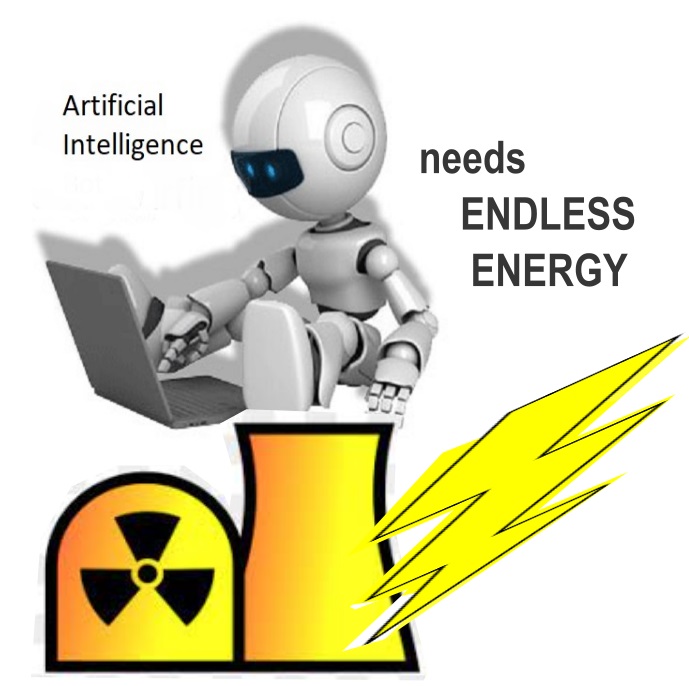
Meta and Microsoft are working to fire up new nuclear power plants. OpenAI and President Donald Trump announced the Stargate initiative, which aims to spend $500 billion—more than the Apollo space program—to build as many as 10 data centers (each of which could require five gigawatts, more than the total power demand from the state of New Hampshire). Apple announced plans to spend $500 billion on manufacturing and data centers in the US over the next four years. Google expects to spend $75 billion on AI infrastructure alone in 2025.
This isn’t simply the norm of a digital world. It’s unique to AI, and a marked departure from Big Tech’s electricity appetite in the recent past. From 2005 to 2017, the amount of electricity going to data centers remained quite flat thanks to increases in efficiency, despite the construction of armies of new data centers to serve the rise of cloud-based online services, from Facebook to Netflix. In 2017, AI began to change everything. Data centers started getting built with energy-intensive hardware designed for AI, which led them to double their electricity consumption by 2023. The latest reports show that 4.4% of all the energy in the US now goes toward data centers.
the US average.
Given the direction AI is headed—more personalized, able to reason and solve complex problems on our behalf, and everywhere we look—it’s likely that our AI footprint today is the smallest it will ever be. According to new projections published by Lawrence Berkeley National Laboratory in December, by 2028 more than half of the electricity going to data centers will be used for AI. At that point, AI alone could consume as much electricity annually as 22% of all US households.
Meanwhile, data centers are expected to continue trending toward using dirtier, more carbon-intensive forms of energy (like gas) to fill immediate needs, leaving clouds of emissions in their wake. And all of this growth is for a new technology that’s still finding its footing, and in many applications—education, medical advice, legal analysis—might be the wrong tool for the job or at least have a less energy-intensive alternative.
Tallies of AI’s energy use often short-circuit the conversation—either by scolding individual behavior, or by triggering comparisons to bigger climate offenders. Both reactions dodge the point: AI is unavoidable, and even if a single query is low-impact, governments and companies are now shaping a much larger energy future around AI’s needs.
We’re taking a different approach with an accounting meant to inform the many decisions still ahead: where data centers go, what powers them, and how to make the growing toll of AI visible and accountable.
That’s because despite the ambitious AI vision set forth by tech companies, utility providers, and the federal government, details of how this future might come about are murky. Scientists, federally funded research facilities, activists, and energy companies argue that leading AI companies and data center operators disclose too little about their activities. Companies building and deploying AI models are largely quiet when it comes to answering a central question: Just how much energy does interacting with one of these models use? And what sorts of energy sources will power AI’s future?
This leaves even those whose job it is to predict energy demands forced to assemble a puzzle with countless missing pieces, making it nearly impossible to plan for AI’s future impact on energy grids and emissions. Worse, the deals that utility companies make with the data centers will likely transfer the costs of the AI revolution to the rest of us, in the form of higher electricity bills.
It’s a lot to take in. To describe the big picture of what that future looks like, we have to start at the beginning.
ning.
Part One: Making the model|…………………………………………………………………………………………………………………………………………………………………………………………………………………………………….
At each of these centers, AI models are loaded onto clusters of servers containing special chips called graphics processing units, or GPUs, most notably a particular model made by Nvidia called the H100.
This chip started shipping in October 2022, just a month before ChatGPT launched to the public. Sales of H100s have soared since, and are part of why Nvidia regularly ranks as the most valuable publicly traded company in the world.
Other chips include the A100 and the latest Blackwells. What all have in common is a significant energy requirement to run their advanced operations without overheating.
A single AI model might be housed on a dozen or so GPUs, and a large data center might have well over 10,000 of these chips connected together.
Wired close together with these chips are CPUs (chips that serve up information to the GPUs) and fans to keep everything cool.
Some energy is wasted at nearly every exchange through imperfect insulation materials and long cables in between racks of servers, and many buildings use millions of gallons of water (often fresh, potable water) per day in their cooling operations.
Depending on anticipated usage, these AI models are loaded onto hundreds or thousands of clusters in various data centers around the globe, each of which have different mixes of energy powering them.
They’re then connected online, just waiting for you to ping them with a question.
Part Two: A Query……………………………
Part Three: Fuel and emissions………………………………………………………
Part four: The future ahead|……………………………………………………………………………………..
The Lawrence Berkeley researchers offered a blunt critique of where things stand, saying that the information disclosed by tech companies, data center operators, utility companies, and hardware manufacturers is simply not enough to make reasonable projections about the unprecedented energy demands of this future or estimate the emissions it will create. They offered ways that companies could disclose more information without violating trade secrets, such as anonymized data-sharing arrangements, but their report acknowledged that the architects of this massive surge in AI data centers have thus far not been transparent, leaving them without the tools to make a plan.
“Along with limiting the scope of this report, this lack of transparency highlights that data center growth is occurring with little consideration for how best to integrate these emergent loads with the expansion of electricity generation/transmission or for broader community development,” they wrote. The authors also noted that only two other reports of this kind have been released in the last 20 years.
We heard from several other researchers who say that their ability to understand the emissions and energy demands of AI are hampered by the fact that AI is not yet treated as its own sector. The US Energy Information Administration, for example, makes projections and measurements for manufacturing, mining, construction, and agriculture, but detailed data about AI is simply nonexistent.
Individuals may end up footing some of the bill for this AI revolution, according to new research published in March. The researchers, from Harvard’s Electricity Law Initiative, analyzed agreements between utility companies and tech giants like Meta that govern how much those companies will pay for power in massive new data centers. They found that discounts utility companies give to Big Tech can raise the electricity rates paid by consumers. In some cases, if certain data centers fail to attract the promised AI business or need less power than expected, ratepayers could still be on the hook for subsidizing them. A 2024 report from the Virginia legislature estimated that average residential ratepayers in the state could pay an additional $37.50 every month in data center energy costs.
“It’s not clear to us that the benefits of these data centers outweigh these costs,” says Eliza Martin, a legal fellow at the Environmental and Energy Law Program at Harvard and a coauthor of the research. “Why should we be paying for this infrastructure? Why should we be paying for their power bills?”
When you ask an AI model to write you a joke or generate a video of a puppy, that query comes with a small but measurable energy toll and an associated amount of emissions spewed into the atmosphere. Given that each individual request often uses less energy than running a kitchen appliance for a few moments, it may seem insignificant.
But as more of us turn to AI tools, these impacts start to add up. And increasingly, you don’t need to go looking to use AI: It’s being integrated into every corner of our digital lives.
Crucially, there’s a lot we don’t know; tech giants are largely keeping quiet about the details. But to judge from our estimates, it’s clear that AI is a force reshaping not just technology but the power grid and the world around us.
We owe a special thanks to Jae-Won Chung, Mosharaf Chowdhury, and Sasha Luccioni, who shared their measurements of AI’s energy use for this project. https://www.technologyreview.com/2025/05/20/1116327/ai-energy-usage-climate-footprint-big-tech/?utm_source=Global+Energy+Monitor&utm_campaign=689b47e840-EMAIL_CAMPAIGN_2025_05_19_12_14&utm_medium=email&utm_term=0_-689b47e840-621514978
No comments yet.
1 This Month

of the week – Shut Down Drone Warfare!


Tell the Ukrainian Government to Drop Prosecution of Peace Activist Yurii Sheliazhenko

Petition to revoke the licensing of the Near Surface Nuclear Disposal Facility (NSDF) at Chalk River. https://www.ourcommons.ca/petitions/en/Petition/Details?Petition=e-7247
To see nuclear-related stories in greater depth and intensity – go to https://nuclearinformation.wordpress.com
-
Archives
- March 2026 (244)
- February 2026 (268)
- January 2026 (308)
- December 2025 (358)
- November 2025 (359)
- October 2025 (376)
- September 2025 (257)
- August 2025 (319)
- July 2025 (230)
- June 2025 (348)
- May 2025 (261)
- April 2025 (305)
-
Categories
- 1
- 1 NUCLEAR ISSUES
- business and costs
- climate change
- culture and arts
- ENERGY
- environment
- health
- history
- indigenous issues
- Legal
- marketing of nuclear
- media
- opposition to nuclear
- PERSONAL STORIES
- politics
- politics international
- Religion and ethics
- safety
- secrets,lies and civil liberties
- spinbuster
- technology
- Uranium
- wastes
- weapons and war
- Women
- 2 WORLD
- ACTION
- AFRICA
- Atrocities
- AUSTRALIA
- Christina's notes
- Christina's themes
- culture and arts
- Events
- Fuk 2022
- Fuk 2023
- Fukushima 2017
- Fukushima 2018
- fukushima 2019
- Fukushima 2020
- Fukushima 2021
- general
- global warming
- Humour (God we need it)
- Nuclear
- RARE EARTHS
- Reference
- resources – print
- Resources -audiovicual
- Weekly Newsletter
- World
- World Nuclear
- YouTube
-
RSS
Entries RSS
Comments RSS
 nuclear-news
Leave a comment