Atomic bombs destroyed their lives – now they want Russia to pay
“People living around the test site “became unwitting test subjects, and their lives were treated with casual disregard due to racism and ignorance,”
“It was a crime of negligence, whereby secrecy, control, and the acquisition of more powerful nuclear weapons were prioritised over the lives of local people.”
Amid calls to restart nuclear testing, families are still suffering from mutations passed down through the generations
Arthur Scott-Geddes. Simon Townsley Photographer, in Semey, Telegraph, 21 May 2025
The Geiger counter came to life as we trudged toward the lip of the crater, its clicks becoming frantic before giving way to an alarm.
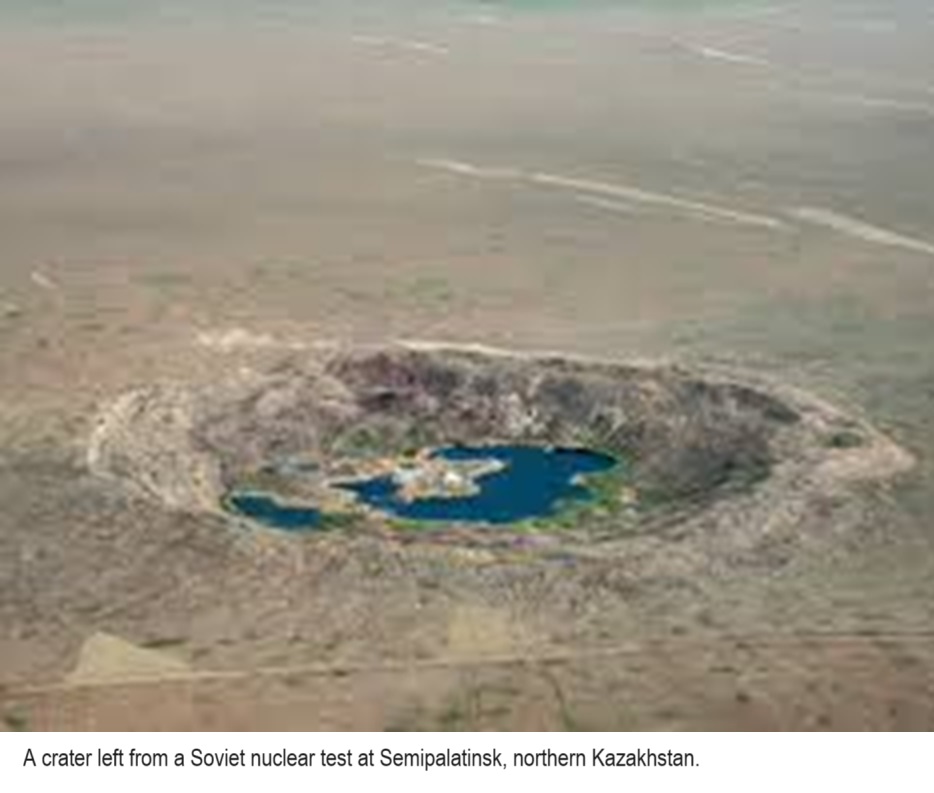
“This is the Atomic Lake,” said the hazmat-suited guide, throwing out his arms against the wind to encompass the circular expanse of water below. “Don’t get too close to the edge.”
Sixty years ago a nuclear bomb ten times more powerful than the one that destroyed Hiroshima exploded at the bottom of a 178-metre shaft in this remote (but not unpopulated) corner of Kazakhstan.
The blast excavated a basin a quarter of a mile wide and several hundred feet deep, sending up a plume of pulverised rock and radioactive material that was detected as far away as Japan.
It was not a one off. The hydrogen bomb was one of 456 nuclear weapons detonated by the Soviet Union at the Semipalatinsk Test Site, a 7,000 square mile swathe of steppe known as the Polygon.
The tests started in 1949 and continued right up until 1989 and the fall of the Berlin wall. They account for a quarter of all the nuclear explosions in history, creating an ongoing health crisis of a scale and nature that is hard to fathom.
The Kazakh authorities estimate that one-and-a-half million people living in nearby cities, towns and villages were exposed to the residual fallout.
The region has elevated rates of cancer, heart disease, birth defects and fertility problems – all linked to the tests. Suicides are common and the area’s graveyards are filled with people who died young.
But as well as sickening those who were directly exposed, the fallout has worked its way into the population’s DNA, leading to mutations that have been passed down through the generations.
‘There were so many children born with different mutations’
Almost everyone who grew up in Semey, a city of about 350,000 that lies only 75 miles from the Polygon, was affected in some way by the testing programme.
Olga Petrovskaya, the 78-year-old chair of Generation, a campaign group founded in 1999 to petition the government for greater support for the victims of the tests, remembers explosions shaking the city.
“We would be taken out of the classroom because they were worried about the windows shattering,” she said. “But nobody would explain why it was happening.”
White dust would sometimes fall on the city, causing sores to form on exposed skin. It was not long before people started dying.
“When we were six years old, at nursery school, there was a girl who died of leukaemia,” she said. “And then at [primary] school our classmates were also dying of cancerous diseases.
“Cancer became a very common diagnosis – there is no family that hasn’t been affected by it – and there were so many children born with different mutations.”
Ms Petrovskaya lost her brother, her aunt and her in-laws to cancer in the 1960s. She herself suffered numerous miscarriages and still has debilitating headaches and dizzy spells that she believes are linked to the radiation.
Her group of activists has dwindled as its members succumbed to their illnesses. There are now only a handful of them left.
The Soviet testing programme has been frequently criticised for its recklessness.
For instance, the first test of a two-stage hydrogen bomb created a blast much more powerful than anticipated, causing a building to collapse and killing a young girl in Kurchatov, the closed-off city 40 miles away where the tests were directed from
But the scientists and military personnel responsible understood the risks inherent in what they were doing. Modelling has shown that people who lived through all 456 tests received doses of radiation up to 120 times greater than survivors of the Hiroshima bombing.
“The Soviet authorities were absolutely not ignorant of the dangers of nuclear weapons testing,” said Dr Becky Alexis-Martin, a Lecturer in Peace, Science, and Technology at the University of Bradford.
“The tests occurred long after the Hiroshima and Nagasaki bombings, and records from the time reveal that the scientists involved in the Polygon tests had expert understandings of the impacts of ionising radiation on health.”
People living around the test site “became unwitting test subjects, and their lives were treated with casual disregard due to racism and ignorance,” added Dr Alexis-Martin
“It was a crime of negligence, whereby secrecy, control, and the acquisition of more powerful nuclear weapons were prioritised over the lives of local people.”
There is a growing body of evidence showing that radiation-induced mutations can be passed down multiple generations.
In 2002, an international study of 20 families living around the Semipalatinsk test site showed that exposure to fallout nearly doubled the risk of inherited gene mutations.
“Genetic consequences manifest in many different ways and any gene can be affected by radioactive exposure. Some gene changes are invisible beyond our DNA – but others can have harmful and intergenerational impacts,” said Dr Alexis-Martin.5
“We often think of birth defects when we think of radiation exposure, but hereditary heart conditions, blindness, and deafness can also arise.”
Today many Kazakh families still bear the marks of the tests several generations after the explosions stopped.
‘I will not live much longer’
Read more: Atomic bombs destroyed their lives – now they want Russia to pay
Asel Oshakbayeva was born in 1997, eight years after the last atomic detonation at the Polygon.
Yet she soon began to have seizures, and at the age of three months suffered a brain haemorrhage that left her blind and unable to speak, move or eat.
“She was in a coma, she couldn’t see anything,” said her mother, Sandugush.
The family sold their home and two cars to fund experimental surgical treatment in Russia that, after 14 operations, repaired damage to her optic nerve, partly restored her speech and made it possible for her to eat again.
But she remains totally dependent on her mother, and the pair left Semey and now live cheek-by-jowl with five other relatives in a small flat in Astana, the capital.
Sandugush, like her parents before her, was exposed to high levels of radiation while living near the Polygon.
In total, three generations of her family have now been officially recognised as victims of the testing, including her daughter. Her husband died of cancer 10 years ago, and she herself has a host of unusual health complaints.
“I will not live much longer,” she said, gesturing to her side where surgeons removed cancerous tumours from her breast and lymph nodes.
She now worries who will look after her daughter in the future. “She has the mind of a ten-year-old. If I die, what will happen?”
Despite the high prevalence of disability in the communities affected by the Polygon, a stigma around the children born with deformities persists.
Maira Zhumageldina, 56, lived for a time in the area of maximum radiation risk and gave birth to her daughter Zhannur in 1992.
Zhannur’s ribcage, spine and limbs never properly formed, leaving her permanently disabled – unable to walk, talk or feed herself.
When the extent of Zhannur’s disability became clear, Ms Zhumageldina came under pressure to give her up, even from her own family.
“When I had Zhannur about 13 or 14 children were born with different kinds of disabilities, so some were abandoned and some died at early ages,” she said.
“My parents-in-law said: ‘Why don’t you leave her?’ But I said ‘this is my child’ I could never leave her.”
A well-thumbed album of photographs documents the 28 years that Ms Zhumageldina devoted to caring for her daughter.
She trained as a massage therapist to ease her pain, and took her to Astana for specialised treatment……………………………………………………………………………………………………………………
‘The slow genocide’
……people whose families have been torn apart by the tests accuse the government of a “genocide” by inaction.
Reluctant to cough up the cash to properly support the hundreds of thousands of people sickened by the radiation and unwilling to press Russia for help in fear of provoking a diplomatic row, the government, they say, is simply waiting for them to die.
………Most of the fallout came their way – the Soviet scientists in Kurchatov made sure not to detonate any weapons while the wind was blowing towards them.
Hardly anyone here lives to retirement age, and cancer and birth defects are common.
“It’s a genocide,” said Acen Kusayenuli, 59, a veteran of the war in Afghanistan who recently had a portion of his lung removed after being diagnosed with cancer. He cannot afford chemotherapy so instead chews herbs to fight the disease.
“We were just like mice,” he said. “Why else would they not relocate the people and animals? They wanted to see how we would be affected.”
Even the landscape has suffered……..
the villagers, always kept in the dark about what was going on, bore the burden of death with a strange stoicism common to many parts of the former Soviet Union.
“We just accepted that whoever gets sick, gets sick,” she said……………………..
“The nuclear weapons tests were undertaken in the knowledge that the local ethnic Kazakhs could be harmed or even gradually eradicated,” said Dr Alexis-Martin.
“The lack of impetus and action across the decades by successive Soviet, Russian, and Kazakhstan governments and the global community amounts to ‘slow genocide’ – this arises when an ethnic or cultural group is gradually and systematically destroyed due to cumulative and sustained harm over time.”
Seventy-five miles further down the road is the village of Kaynar, which sits in the shadow of a rock formation overlooking the test site. Older residents remember climbing to the top to watch the explosions. ……………………………………………………………
Dr Saule Isakhanova, the head doctor of the Abralinski Regional Hospital which looks after around 2,100 people in Kaynar and the surrounding villages, said nearly half of her patients had health problems linked to the tests.
Her husband, the former mayor, was one of those who used to go out into the steppe to collect grass. He now has bowel cancer.
She said the effects of the tests could continue to harm people living in the area for a long time.
“Research shows that particles of these elements can remain in the dust for 300,000 years,” she said, referring to the radionuclides released by the bombs. “Those particles, once you breathe them in, they get into your bones.”
While much of the research attention has so far focused on rates of cancer and birth defects, little has been done to understand the prevalence of developmental disorders among children affected by the tests.
……………………………………………………..Dr Talgat Moldagaliyev, the former Director of the Institute of Radiation Medicine and Oncology in Semey, said more work is needed to understand the effects the tests are continuing to have.
“It’s a living experimental zone, but not enough research has been done.”
‘It should never happen again’
Most of the victims of the Polygon only learned the truth about what had been happening to them after the Soviet Union collapsed and Kazakhstan gained independence.
That moment gave rise to Kazakhstan’s first civil society movement, which connected survivors of the Polygon tests with communities affected by American nuclear testing in Nevada.
Over 35 years since the last nuclear explosion at the Polygon, there is a renewed push to win justice for those affected by the radiation.
Maira Abenova, the founder of Committee Polygon 21, an advocacy group representing the victims, lost her mother, brother, sister and husband to diseases related to the Polygon and now suspects she has cancer herself.
She wants the world to recognise that the suffering did not end with the closure of the test site.
“Currently the law recognises as a survivor of the nuclear tests only those people who lived in four regions around the Polygon from 1949 to 1991,” she said, referring to a law brought in in 1992 which gave people who qualified a “radiation passport” certifying their exposure to the radiation.
Those given the small, beige documents, which bear a blue mushroom cloud stamp on the cover, receive a small amount of compensation and other benefits including longer holidays.
While older survivors of the tests say the system worked at first, many of the families The Telegraph spoke to, particularly those in the hard-hit villages, said it was difficult to get official recognition for their children.
Rising medical costs far outstrip benefits worth around $40 a month and moving away from the villages, even to seek better medical care, disqualifies survivors from support.
Ms Abenova has been petitioning government agencies, who are more interested in collaborating with Russia on nuclear energy and turning the test site into a dark tourism destination, to take action on a grander scale.
“You cannot solve the problem just by paying small additional payments, you have to upgrade the economy in the region,” she said.
United Nations resolutions and the sustainable development goals (SDGs) should also be used to improve the lives of those living in the areas affected by the tests, and a new law is needed “which recognises all the survivors,” she said.
Committee Polygon 21 was among several Kazakh civil society groups to appeal to the UN in New York urging global action on justice for the testing victims.
After Vladimir Putin, the Russian President, withdrew his country’s ratification of the global treaty banning nuclear weapons tests, and with advisers of Donald Trump urging him to restart US testing, Ms Abenova hopes her work will also energise calls for disarmament.
“Kazakhstan suffered from nuclear tests […] Our people should use this opportunity to appeal to other countries that it should never happen again,” she said.
Meanwhile, how safe it is to live in the area around the Polygon remains unclear.
The site itself has been picked over by scavengers looking for – often highly irradiated – scrap metals.
Some 116 bombs were detonated in the atmosphere, but 340 exploded underground, and a secretive joint US-Russian-Kazakh cleanup programme to secure fissile material and even bomb components left behind by the Soviets in tunnels and shafts was only made public after it ended in 2012.
Those living nearby still do not know if their food and water is safe.
……………………..https://www.telegraph.co.uk/global-health/terror-and-security/soviet-union-nuclear-testing-atomic-bomb-kazakhstan/
No comments yet.
1 This Month
Chernobyl: The Lost Tapes – A good documentary on Chernobyl on SBS available On Demand for the next 3 weeks– https://www.sbs.com.au/ondemand/tv-program/chernobyl-the-lost-tapes/2352741955560

of the week–London Campaign for Nuclear Disarmament

Tell the Ukrainian Government to Drop Prosecution of Peace Activist Yurii Sheliazhenko
To see nuclear-related stories in greater depth and intensity – go to https://nuclearinformation.wordpress.com
-
Archives
- April 2026 (127)
- March 2026 (251)
- February 2026 (268)
- January 2026 (308)
- December 2025 (358)
- November 2025 (359)
- October 2025 (376)
- September 2025 (257)
- August 2025 (319)
- July 2025 (230)
- June 2025 (348)
- May 2025 (261)
-
Categories
- 1
- 1 NUCLEAR ISSUES
- business and costs
- climate change
- culture and arts
- ENERGY
- environment
- health
- history
- indigenous issues
- Legal
- marketing of nuclear
- media
- opposition to nuclear
- PERSONAL STORIES
- politics
- politics international
- Religion and ethics
- safety
- secrets,lies and civil liberties
- spinbuster
- technology
- Uranium
- wastes
- weapons and war
- Women
- 2 WORLD
- ACTION
- AFRICA
- Atrocities
- AUSTRALIA
- Christina's notes
- Christina's themes
- culture and arts
- Events
- Fuk 2022
- Fuk 2023
- Fukushima 2017
- Fukushima 2018
- fukushima 2019
- Fukushima 2020
- Fukushima 2021
- general
- global warming
- Humour (God we need it)
- Nuclear
- RARE EARTHS
- Reference
- resources – print
- Resources -audiovicual
- Weekly Newsletter
- World
- World Nuclear
- YouTube
-
RSS
Entries RSS
Comments RSS
 nuclear-news
Leave a comment