Japan’s Fukushima nuclear wastewater ‘pose major environmental, human rights risks’ – UN experts
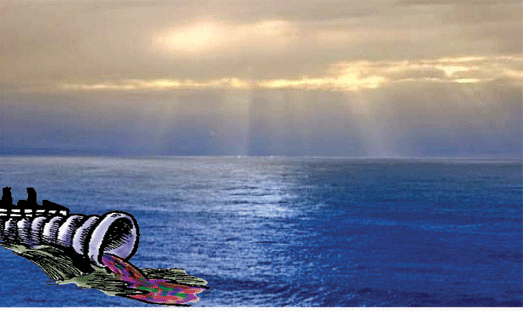
The United Nations (UN) human rights experts have written to the Japanese government to express their concerns about the release of more than one million metric tonnes of treated nuclear wastewater into the Pacific Ocean.
In August 2023, Japan began discharging wastewaster from about 1000 storage tanks of contaminated water collected after the earthquake and tsunami in 2011 that caused the meltdown of its Fukushima nuclear plant.
In the formal communication, available publicly, UN Human Rights Council special rappoteurs addressed the the management of Advanced Liquid Processing System (ALPS)-treated wastewater from the Fukushima Daiichi Nuclear Power Station (NPS) by the Japan government and TEPCO (Tokio Electric Power), and the ongoing discharge of such waters into the Pacific Ocean.
They said “we are alarmed that the implementation of contaminated water release operations of into the ocean may pose major environmental and human rights risks, exposing people, especially children, to threats of further contamination in Japan and beyond.”
“We wish to raise our concern about the allegations of the failure to assess the consequences on health of the release of wastewater against the best available scientific evidence,” the special rappoteurs write.
“Against this backdrop, we would like to highlight that the threats to the enjoyment of the right to adequate food do not concern only local people within the borders of Japan.
“Given the migratory nature of fish, their contamination represents a risk also for people living beyond the Japanese borders, including Indigenous Peoples across the Pacific Ocean which, according to their culture and traditions, mainly rely on seafood as their primary livelihood.”
The letter follows a complaint submitted by Ocean Vision Legal in August 2023 on behalf of the Pacific Network on Globalisation (PANG) and endorsed by over 50 civil society groups in the Pacific and beyond.
In a statement on Tuesday, PANG hailed it as “a landmark move for ocean justice and human rights”.
The organisation said that the destructive legacy of nuclear contamination through nuclear testing is still strongly felt across the region.
It said this legacy is marked by severe health impacts across generations and the ongoing failure to properly clean up test sites, which continue to contaminate the islands and waterways that Pacific peoples depend on.
“As Pacific groups, we remain disappointed in the Japanese Government and TEPCO’s shameless disregard of the calls by numerous Pacific leaders and civil society groups to hold off on any further release,” PANG’s coordinator Joey Tau said.
“Their ignorance constitutes a brazen threat to Pacific peoples’ livelihoods, safety, health and well-being, and the sovereignty of Pacific nations,” he added.
Japan has consistently maintained that the release is safe.
The UN human rights experts have asked for further information from Japan, including on the allegations raised, and on how the Radiological Environmental Impact Assessment has been conducted according to the best available scientific evidence.
This communication sends a clear message: Ocean issues must be understood as human rights issues, requiring precautionary and informed action aligned with international environmental law to safeguard both people and the marine environment.
Ocean Vision Legal founder and CEO Anna von Rebay said while the communication is not legally binding, it is a crucial milestone.
“It informs the interpretation of human rights and environmental law in response to contemporary threats, contributing to the development of customary international law and strengthens accountability for any actor harming the Ocean,” she said.
“Ultimately, it paves the way towards a future where the Ocean’s health is fully recognised as fundamental to human dignity, justice, and intergenerational equity.”
We still don’t know how much energy AI consumes.
We still don’t know how much energy AI consumes. Companies must give us
the chance to understand the environmental impact of the tech we use.
With every query, image generation and chatbot conversation, the energy that is
being consumed by artificial intelligence models is rising. Already,
emissions by data centres needed to train and deliver AI services are
estimated at around 3 per cent of the global total, close to those created
by the aviation industry.
But not all AI models use the same amount of
energy. Task-specific AI models like Intel’s TinyBERT and Hugging
Face’s DistilBERT, which simply retrieve answers from text, consume
minuscule amounts of energy — about 0.06 watt-hours per 1,000 queries.
This is equivalent to running an LED bulb for 20 seconds.
At the other extreme, large language models such as OpenAI’s GPT-4, Anthropic’s
Claude, Meta’s Llama, DeepSeek, or Alibaba’s Qwen use thousands of
times more energy for the same query. The result is like turning on stadium
floodlights to look for your keys. Why is there such an enormous difference
in energy consumption? Because LLMs don’t just find answers, they
generate them from scratch by recombining patterns from massive data sets.
This requires more time, compute and energy than an internet search.
FT 20th May 2025, https://www.ft.com/content/ea513c7b-9808-47c3-8396-1a542bfc6d4f
EVENT. Radiation whistleblowers in the 20th century
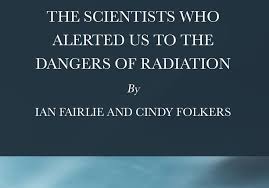
This will constitute the UK launch of the book. It will be a hybrid talk, ie both in person and on-line. If you wish to attend
on-line, you can find the link here
https://www.lshtm.ac.uk/newsevents/events/radiation-whistleblowers-20th-century
Examination of scientific whistleblowing about radiation risks in the 20th century.
Tuesday 27 May LSHTM Keppel St London UK
London School of Hygiene and Tropical Medicine 20th May 2025, https://www.lshtm.ac.uk/newsevents/events/radiation-whistleblowers-20th-century
This will constitute the UK launch of the book. It will be
a hybrid talk, ie both in person and on-line. If you wish to attend
on-line, you can find the link here
https://www.lshtm.ac.uk/newsevents/events/radiation-whistleblowers-20th-century
This paper examines scientific whistleblowing about the risks of radiation in the second half of the 20th Century. Its target audience are students and staff interested in the history of radiation science, histories of expert whistleblowing, planetary health, and the environmental determinants of health.
History shows us that radiation risks are a battleground of scientific opinions, values and politics. Broadly speaking, a gulf has existed (and still exists) between official estimations of radiation risks and the risks observed by many distinguished scientists in the latter part of the twentieth century. These scientists found evidence that radiation risks, including cancers and birth defects, were greater than official estimates. However, they and their scientific reports were often adversely treated by officialdom – both in the West and the East. These scientists consequently suffered career blight, cessation of funding, seizure of their data, peer group ostracism, as well as public criticism and opprobrium. The rub of the matter is that, from recent findings, we know that these scientists were correct. This talk will thus highlight some of the most noteworthy examples of this scientific whistleblowing, summarise key findings, and reflect upon their salience to contemporary understandings of radiation risks.
Speaker
Dr Ian Fairlie
Independent Consultant on radioactivity in the environment
Dr Ian Fairlie is a radiation biologist whose primary interest is in the history and perception of radiation risks. He has degrees in chemistry and radiation biology and his doctorate at Imperial College was on nuclear waste policies. He was formerly the chief scientific advisor to the British Government’s Committee on the Radiation Risks of Internal Emitters (1999-2004). He is currently a Vice President of the Campaign for Nuclear Disarmament (CND) and continues to serve as a consultant to NGOs in both Britain and North America. First and foremost, though, he considers himself a citizen scientist.
Event notices
- Please note that you can join this event in person or you can join the session remotely.
- Please note that this session will not be recorded.
Admission
Free and open to all. No registration required. Contact
Sea level rise will cause ‘catastrophic inland migration’, scientists warn
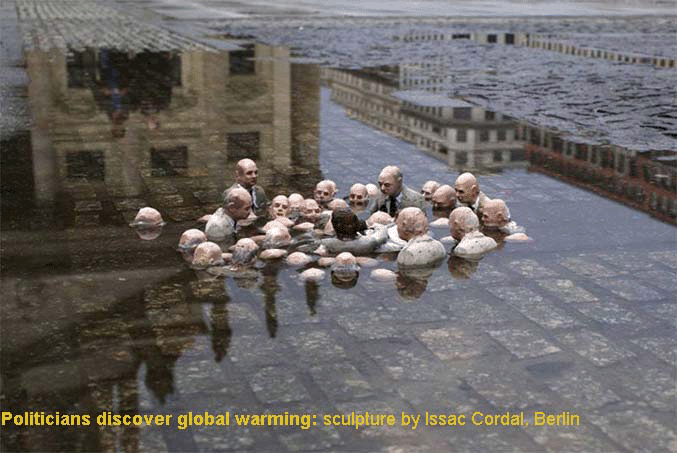
Sea level rise will become unmanageable at just 1.5C of global heating and
lead to “catastrophic inland migration”, the scientists behind a new
study have warned.
This scenario may unfold even if the average level of
heating over the last decade of 1.2C continues into the future. The loss of
ice from the giant Greenland and Antarctic ice sheets has quadrupled since
the 1990s due to the climate crisis and is now the principal driver of sea
level rise.
The international target to keep global temperature rise below
1.5C is already almost out of reach. But the new analysis found that even
if fossil fuel emissions were rapidly slashed to meet it, sea levels would
be rising by 1cm a year by the end of the century, faster than the speed at
which nations could build coastal defences. The world is on track for
2.5C-2.9C of global heating, which would almost certainly be beyond tipping
points for the collapse of the Greenland and west Antarctic ice sheets. The
melting of those ice sheets would lead to a “really dire” 12 metres of
sea level rise.
Guardian 20th May 2025,
https://www.theguardian.com/environment/2025/may/20/sea-level-rise-migration
Tropical forests destroyed at fastest recorded rate last year

The world’s tropical forests, which provide a crucial buffer against
climate change, disappeared faster than ever recorded last year, new
satellite analysis suggests. Researchers estimate that 67,000 sq km (26,000
sq mi) of these pristine, old-growth forests were lost in 2024 – an area
nearly as large as the Republic of Ireland, or 18 football pitches a
minute. Fires were the main cause, overtaking land clearances from
agriculture for the first time on record, with the Amazon faring
particularly badly amid record drought. There was more positive news in
South East Asia, however, with government policies helping to reduce forest
loss.
BBC 21st May 2025,
https://www.bbc.co.uk/news/articles/c0lnngl6713o
The World Cannot Know True Peace Until We Have Reckoned With What We Did To Gaza
Caitlin Johnstone, May 21, 2025
I was listening to a young writer describe an idea he’d had that he was so excited about he couldn’t sleep the night before, and I remembered how before Gaza I used to get excited about writing stuff. I haven’t felt that feeling since 2023.
I’m not complaining or feeling sorry for myself, I’m just remarking on how incredibly bleak and dark the world has been during this terrible time. It would be weird and unhealthy if I was enjoying my job here this past year and a half. These things aren’t supposed to feel good. Not if you’re really looking at them and being sincere and honest with yourself about what you are seeing.
It’s been so ugly and so unsettling this whole time. There’s not really any way to reframe all this horror and make it okay. All you can do is work on yourself to make sure you have enough inner spaciousness to accommodate the bad feelings and feel them all the way through until they’ve had their say. Let in the despair. The grief. The rage. The pain. Let it move all the way through your system without resisting and then get up and write the next thing.
That’s what writing is for me now. It’s never anything I am excited to share or am lit up with inspiration about. If anything it’s more like “Okay, here you go, awful sorry I’ve got to show this to you, folks.” It’s just staring into the darkness and the blood and the gore and the anguished faces and writing out what I see, day after day.
Nothing about it is pleasant or rewarding. It’s just what you do when there’s a live-streamed genocide happening right in front of you with the backing of your own society. Everything about it sucks, and there’s no way to make it not suck, but you do what needs to be done, like you would if it were your own family out there in the rubble.
This genocide has changed me forever. It has changed a lot of people forever. We will never be the same. The world will never be the same. No matter what happens or how this nightmare ends, things are never again going back to the way they were.
And they shouldn’t. The Gaza holocaust is the product of the way the world was before it happened. Our society birthed it into existence, and now it’s staring us all right in the face. This is who we are. This is the fruit of the tree of what western civilization has been up until this point.
Now it’s just a matter of doing everything we can to make sure the genocide ends, and that the world learns the right lessons from it. This is as worthy a cause as anyone could take up in this life.
I still have hope that we can have a healthy world. I still have hope that writing about what’s happening can be enjoyable again one day. But these things exist on the other side of some very hard and confronting work in the years to come. There’s just no getting around it. The world cannot have peace and happiness until we have fully reckoned with what we did to Gaza.
US should never have intervened in Ukraine – Trump
19 May 25, https://www.rt.com/news/617888-us-never-intervened-ukraine-trump/
US President Donald Trump has rebuked his predecessor, Joe Biden, for funneling vast amounts of American taxpayer money into a foreign conflict that “should have remained a European situation.”
Speaking to reporters at the White House following a phone call with Russian President Vladimir Putin on Monday, Trump expressed frustration over the “crazy” scale of US involvement in the Ukraine conflict. He reiterated that it is “not our war” and stressed that his administration is working to end it through diplomacy.
This is not our war. This is not my war… I mean, we got ourselves entangled in something that we shouldn’t have been involved in. And we would have been a lot better off – and maybe the whole thing would have been better off – because it can’t be much worse. It’s a real mess,” Trump said.
The president stated that Washington has provided “massive” and “record-setting” levels of military and financial assistance to Kiev – far exceeding what the EU and other NATO countries have contributed.
“We don’t have boots on the ground, we wouldn’t have boots on the ground. But we do have a big stake. The financial amount that was put up is just crazy,” he added.
Again, this was a European situation. It should have remained a European situation. But we got involved – much more than Europe did – because the past administration felt very strongly that we should,” he said. “We gave massive amounts, I think record-setting amounts, both weaponry and money.”
Trump’s conversation with Putin was followed by calls with the leaders of Germany, Italy, and the UK, as well as European Commission President Ursula von der Leyen and Ukraine’s Vladimir Zelensky.
“They have a big problem. It’s a terrible war. The amount of anger, the amount of hate, the amount of death,” Trump said, adding that the conflict has reached a point where “it’s very hard to extradite themselves away from what’s taken place over there.”
Trump said he believes both Putin and Zelensky want peace, but only time will tell if it can be achieved.
Pressed by reporters on whether he has a “red line” that would cause him to walk away from mediating the conflict or potentially escalate US involvement, Trump declined to elaborate. “Yeah, I would say I do have a certain line, but I don’t want to say what that line is because I think it makes the negotiation even more difficult than it is,” he said.
Putin described the conversation with Trump as “substantive and quite candid,” adding that Moscow is prepared to work with Kiev on drafting a memorandum aimed at achieving a future peace agreement.
“In general, Russia’s position is clear. The main thing for us is to eliminate the root causes of this crisis,” the Russian president said.
India’s genocidal project is building a military base.
Survival, 21 May 25
Uncontacted people on Indian island face genocide in the name of “mega-development”
The Shompen are one of the most isolated peoples on Earth. They live on Great Nicobar Island in India, and most of them are uncontacted, refusing all interactions with outsiders.
Numbering around 300 people, they are now at risk of being totally wiped out by a “mega-development” plan to transform their small island home into the “Hong Kong of India.”
If the project goes ahead, huge swathes of their unique rainforest will be destroyed – to be replaced by a mega-port; a new city; an international airport; a power station; a defense base; an industrial park; and up to 650,000 settlers – a population increase of nearly 8,000%.
An island unlike any other
For centuries, most Shompen have refused all contact with outsiders, and this has kept them safe from the terrible effects of contact experienced by most other Indigenous peoples of the Andaman and Nicobar Islands.
Living in the rainforest of Great Nicobar Island in the eastern Indian Ocean, the Shompen have guarded and maintained a unique landscape for thousands of years. The Shompen are nomadic hunter-gatherers, living in small groups, whose territories are identified by the rivers that criss-cross the rainforest…………………….
Their home, Great Nicobar Island, is small but has extremely high levels of biodiversity. Around 95% of the island is covered in rainforest and it’s home to 11 species of mammals, 32 species of birds, 7 species of reptiles and 4 species of amphibians, all found only here. It’s a place where monitor lizards and crocodiles share the rainforest with macaques and tree shrews, where giant turtles swim among the coral reefs with dugongs and dolphins.
The right to remain uncontacted
While a few Shompen have contact with their Nicobarese Indigenous neighbors, settlers and government officials, most remain in the rainforest and reject contact with outsiders. This does not mean that the Shompen are unaware of the outside world but, for the most part, they choose to be left alone. As with the Sentinelese people in the nearby Andaman Islands, outsiders forcing their way into Shompen territory is illegal and could be deadly for them. That’s why in March 2025, American influencer Mykhailo Viktorovych Polyakov was arrested for trying to contact the Sentinelese, and could face jail.
The few Shompen who do leave the rainforest tend to do so to collect and exchange things with outsiders before returning to the island’s interior and sharing them among other Shompen families. Like other uncontacted peoples around the world, the Shompen are incredibly vulnerable to diseases to which they have no immunity and Shompen who return have been known to quarantine in special houses outside their communities. A government report stated:
Our attempt to reach the main camp…about 50 metres away from the ‘out-houses’ was resisted by throwing spears (we escaped narrowly) as the Shompens of this region strongly believe that outsiders carry diseases.
Andaman and Nicobar Administration
The report then acknowledged then that these uncontacted Shompen were certainly “healthier than those who have contacts with others”. Most contact for the Shompen at the moment occurs as it should for all Indigenous communities – on their own terms.
Mega development = mega disaster
But the Indian government is now planning to transform the Shompen’s small island into the ‘Hong Kong of India’, which will totally change their lives forever. Its ‘Great Nicobar Project’ will have a devastating impact on the lives of the Shompen and the neighbouring Nicobarese. As neither peoples have given their consent to the scheme, it violates both Indian and international law.
The mega-project will take up around a third of the island – half of it within the official Tribal Reserve. Equally disastrous is the massive population explosion planned for Great Nicobar. The total population of the island is currently around 8,000, but the government plans to settle up to 650,000 people there under the scheme, a population the size of Las Vegas.
Shompen communities, along with their hunting and foraging grounds, will be devastated by the project. Their sacred river system will also be ruined. This will in turn destroy their pandanus trees, one of their most important sources of food. With their rivers devastated, the Shompen’s ability to survive and entire way of life will face collapse.
As well as causing unprecedented social and environmental devastation for the Shompen, these plans also drastically increase their exposure to outside diseases to which could wipe them out.
The Indian government is well aware of such risks and their official Impact Assessment for the project states: “Any disturbance or alteration in the natural environmental setup where they live, may cause serious threat to their existence” and “once infections spread among the tribal [Shompen]…the whole community may face extinction.” However, in an attempt to mitigate the risks, the government is proposing sinister sounding “geo-fencing cum surveillance towers” to monitor the Shompen.
In February 2024, 39 international genocide experts wrote to the Indian President, describing the mega-project as a “death sentence for the Shompen, tantamount to the international crime of genocide”. They called for the scheme to be immediately abandoned.
It’s impossible to imagine that the Shompen will be able to survive this overwhelming and catastrophic transformation of their island………………….https://www.survivalinternational.org/tribes/shompen
The authorities plan to create a mega-port; a city; an international airport; a power station; a defence base; an industrial park; and tourism zones, spread over more than 244 square km of land, including 130 square km of rainforest. The government claims that it will ‘offset’ the loss of rainforest through planting new trees in the scrublands of North India. Such offsetting projects are false solutions and Survival is actively campaigning against the growing threat they pose to Indigenous peoples around the world.
To the Shompen, every tree, plant, leaf and flower is sacred and has a spirit of their own. It’s hard to imagine what cutting down millions of trees will mean to a people who do not even allow the cutting of leaves on their territory.
Trump’s man in London backs Aukus partnership with UK and Australia
The new US ambassador to the UK Warren Stephens used his first public speech to praise the trilateral security alliance.
David Hughes, Jndependent, UK, Monday 19 May 2025
Donald Trump’s new ambassador to the UK has used his first public speech to back the Aukus partnership with Britain and Australia.
Warren Stephens highlighted how “vital the US-UK relationship is to our countries and to the world” at an event in Parliament attended by Sir Keir Starmer.
Mr Stephens said the Aukus partnership, which is developing a new fleet of nuclear-powered hunter-killer submarines for the UK and Australia, would help maintain a “free and open Indo-Pacific”………………………………………..
Mr Stephens also highlighted the economic opportunities from the project: “Government works best when we get out of the way and let our businesses innovate, compete and collaborate to improve people’s lives……………………… https://www.independent.co.uk/news/uk/home-news/australia-aukus-trump-london-barrow-b2754029.html
‘Dad’s Army’ to return FOR REAL as UK military plans defence against Russian invasion.
The Home Guard will be a civilian unit tasked with protecting key infrastructure such as nuclear power plants, airports and telecommunications sites.
Michael D. Carroll and James Knuckey, Mirror, 20 May 2025
The Government is reportedly considering the establishment of a Home Guard, akin to the Dad’s Army model, to shield crucial British infrastructure from attacks by hostile nations and terrorists. These plans are rumoured to be part of the Government’s much-anticipated Strategic Defence Review (SDR), which is due for publication in the coming weeks.
The proposed unit is said to draw inspiration from the Home Guard formed during the Second World War in the 1940s as a last line of defence against a potential German invasion of Britain. The original members were typically men who were either too old or young to serve on the frontline, or those deemed unfit or ineligible…………………………………………………. https://www.mirror.co.uk/news/politics/dads-army-return-real-uk-35254242
Welcome to Britain’s biggest building site. There’s a ‘fishdisco’
It’s economy v ecology at Hinkley Point C power station, which
will power a fifth of British homes if it can pull off an audacious plan to
protect wildlife.
Two miles off the Somerset coast, a strange sound is
playing. About 20 metres below the slate-grey surface of the Bristol
Channel, a small device called a ceramic transducer blasts out a
high-pitched acoustic beam at a frequency far higher than can be detected
by the human ear. This machine — once disparaged by the former
environment secretary Michael Gove as a “fish disco” — is being
tested to see if it can scare off the salmon, herring, shad, eel and sea
trout that in six years’ time will start being sucked in their millions
into massive water inlets that have been built near by.
Hinkley Point C nuclear power station is late and over budget. This is the biggest building
site in Britain, possibly Europe: 12,000 staff and 52 cranes (including the
world’s tallest — “Big Carl”, 250 metres high) are working to
complete the project. When the £46 billion station finally switches on in
2031, it will power more than a fifth of the UK’s homes.
To cool the reactors, 120,000 litres of seawater a second — fish and all — will be
sucked into concrete pipes six metres wide. A complex mechanism has been
installed to return as many fish as possible to the sea, but even so,
Hinkley’s owner, EDF, estimates that up to 44 tonnes of marine life —
more than 180 million individual fish — will be killed each year.
Natural England, in consultation with the Environment Agency and Natural Resources
Wales, will advise EDF whether the fish disco machine is sufficient to
comply with its planning permission, or whether the company will need to
revert to its plans for creating salt marshes like the one at Steart.
David Slater, Natural England’s regional director for the southwest, said the
agency is keeping an open mind on the fish deterrents. But if the tests
fail to demonstrate the fish can be kept away, the energy company will be
required to return to its plan for “compensatory habit” — the jargon
for the salt-marsh reserves — as a condition of its planning permission.
Times 18th May 2025, https://www.thetimes.com/uk/environment/article/welcome-to-britains-biggest-building-site-theres-a-fish-disco-c0wqs8lg9
1 This Month


18 March Webinar @ 1 PM EST: An Assessment of SMR Projects: The Case of Canada
register for the zoom:
https://us02web.zoom.us/webinar/register/WN_o8BIIOUvQ2ONJR1nta65DQ#/registration


of the week – STOP SMALL MODULAR REACTORS IN CANADA
To see nuclear-related stories in greater depth and intensity – go to https://nuclearinformation.wordpress.com
-
Archives
- March 2026 (139)
- February 2026 (268)
- January 2026 (308)
- December 2025 (358)
- November 2025 (359)
- October 2025 (376)
- September 2025 (258)
- August 2025 (319)
- July 2025 (230)
- June 2025 (348)
- May 2025 (261)
- April 2025 (305)
-
Categories
- 1
- 1 NUCLEAR ISSUES
- business and costs
- climate change
- culture and arts
- ENERGY
- environment
- health
- history
- indigenous issues
- Legal
- marketing of nuclear
- media
- opposition to nuclear
- PERSONAL STORIES
- politics
- politics international
- Religion and ethics
- safety
- secrets,lies and civil liberties
- spinbuster
- technology
- Uranium
- wastes
- weapons and war
- Women
- 2 WORLD
- ACTION
- AFRICA
- Atrocities
- AUSTRALIA
- Christina's notes
- Christina's themes
- culture and arts
- Events
- Fuk 2022
- Fuk 2023
- Fukushima 2017
- Fukushima 2018
- fukushima 2019
- Fukushima 2020
- Fukushima 2021
- general
- global warming
- Humour (God we need it)
- Nuclear
- RARE EARTHS
- Reference
- resources – print
- Resources -audiovicual
- Weekly Newsletter
- World
- World Nuclear
- YouTube
-
RSS
Entries RSS
Comments RSS
 nuclear-news