The media, scientific consensus, and toxic nuclear waste
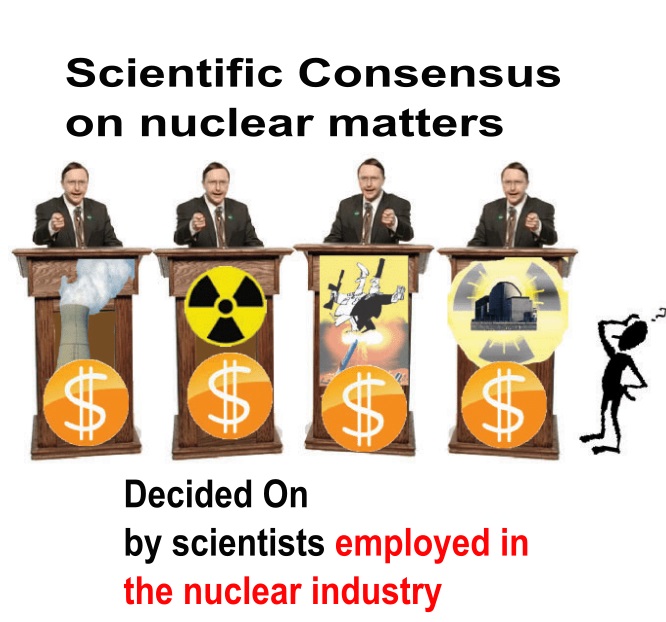
Not to be outdone by more modern means of propaganda, Nuclear Waste Services has continued the tradition of only providing the audience with the information that suits their argument.
The only way to reduce waste is to reduce the activities that cause it.
There is no other logical way.
News media tends to use ‘scientific consensus’ as if it is the end point of the discussion.
The implication that ‘this is the only way’ serves to quash dissenting voices and validate the overall message of the article.
When government agencies are hard to trust, who do we look to? Scientists. But what job is the concept of scientific consensus doing in the marketing of the GDF?
A Quiet Resistance, 8 May 2025
‘Scientific consensus’ carries a lot of weight in news media discussing the proposed Geological Disposal Facilities (GDFs) (nuclear waste dumps) in West Cumbria.
This consensus is also being used as a persuasion tool in the official literature handed out to communities by Nuclear Waste Services (NWS).
Since most of us aren’t scientists in either the nuclear industry or geodisposal, we have to turn to those who are if we’re to understand what’s going to happen to our community. Alongside the regular newsletters and other marketing from NWS, we usually access those people through articles in the news and on the internet.
But it’s important to keep asking questions about what we’re reading.
‘Scientific consensus’ doesn’t mean the science is settled; articles can contain facts and still be biased.
Biases in news media
The news media are paid for by advertisers. If they publish articles that make arguments against their advertisers’ interests, they lose advertising money. Their advertisers’ interests may not be clear. For example, they may be companies that have money invested in hedge funds, which in turn invest in nuclear power.
News media also come up against political pressure, as The Guardian found out a few years ago, to its long-term detriment.
There’s also the question of audience. News media write to a specific audience, one already sold on the ideas they are promoting, or at the very least, suggestible. Most people are aware of ‘climate change’. If someone authoritative tells them it’s important for us to have a GDF because nuclear energy will help us ‘beat climate change’, they are likely to accept that, unless they have some wider knowledge.
Bias can be edited into an article by keeping the facts, but leaving out certain contexts. They can also cherry pick facts, so that the only ones they use are those which suit their argument.
Biases and misinformation across the internet
Misinformation across the web is an endemic problem now, brought on by too little regulatory oversight, too late. A bitter combination of an advertising free-for-all, empty content for the sake of it, and algorithmic twists that feed on themselves has come together to make an internet that doesn’t run the kind of useful searches it did just 12 years ago.
On top of this, a type of information warfare has been raging, hidden in plain sight from the eyes of everyday people, and the proliferation of GenAI has made the situation much worse. Social media, news media, every place we get our information from has been seeded with doubt.
All of this means that when we read information anywhere, from both respectable and dubious sources, we have to take time to process what we’ve read before we lead with our emotions.
Bias and messaging in public information
Not to be outdone by more modern means of propaganda, Nuclear Waste Services has continued the tradition of only providing the audience with the information that suits their argument.
In the case of the Community Partnership newsletter this month, this includes a soothing word salad introduction from the outgoing Community Partnership Chair explaining that he has resigned, and our local Town Council has withdrawn from the group. There are then several pages on how the Community Investment Fund money has been spent recently.
From that messaging, it is clear they’re seeking to reassure the community – talk quietly, you don’t want them to startle – and remind us that we’re getting plenty of money for the deal.
So, what’s the problem with the scientific consensus on the idea of a geological disposal facility (GDF), more prosaically known as a nuclear waste dump?
What is ‘scientific consensus’?
Scientific consensus refers to an agreement amongst scientists in a specific, very narrow field of study.
In the consideration of a GDF, that field would be geology, and most likely a particular area of geology, such as geodisposal.
Why do we need ‘scientific consensus’?
For most of us, despite our education and our wide understanding of the world, we don’t have intensive scientific training. Even if we do, it may not be in the narrow field in question.
Ethan Siegel at Forbes.com explained this really clearly:
… Unlike in most cases, unless you are a scientist working in the particular field in question, you are probably not even capable of discerning between a conclusion that’s scientifically valid and viable and one that isn’t. Even if you’re a scientist in a somewhat related field! Why? This is mostly due to the fact that a non-expert cannot tell the difference between a robust scientific idea and a caricature of that idea.
Why should we believe ‘scientific consensus’?
Although a consensus is an impossible number to quantify, the argument for a consensus is that a lot of related research is borne out by the agreement, so if it isn’t correct – e.g. if a GDF isn’t a safe and complete solution for nuclear waste – then a lot of other research is also wrong.
That sounds reassuring, but there’s more to it.
What do we have to consider behind the messaging of ‘scientific consensus’?
News media tends to use ‘scientific consensus’ as if it is the end point of the discussion.
The implication that ‘this is the only way’ serves to quash dissenting voices and validate the overall message of the article.
This is also how Nuclear Waste Services is using ‘scientific consensus’. The inference is that there is only one solution, and a GDF is it.
But scientific consensus is not the end position of the science. It’s the starting position from which further investigation can arise.
While that future studying may not set out to prove early scientific reasoning wrong, it should seek to improve or refine our understanding of the science.
And the main problem with scientific investigation?
Take a look at this quote. It’s from the article Development in Progress, from the Consilience Project.
It is also important to consider how existing biases and values ‘prime’ us towards certain starting points when we seek to understand the world through science. Before we formulate questions of design experiments, we often have preconceived notions as to what we imagine as likely to be important to the question at hand.
You’ve got to ask what their starting point is, before you can evaluate the idea.
Or, to put it another way: if you ask a geodisposal specialist what the best way is to deal with a higher activity nuclear waste problem, they’re going to tell you to bury it underground.
What’s the motivation for a GDF? Why the bias? Where’s the starting point of the plan?
Waste is a massive issue for modern Western societies. Everything we do, everything we buy creates waste. The only way to reduce waste is to reduce the activities that cause it.
There is no other logical way.
Government and the nuclear industry are motivated towards using a geological disposal facility to store higher activity nuclear waste because:
- There’s almost seventy years’ worth of higher activity nuclear waste to store
- Nuclear appears to offer a solution to the legal requirements of Net Zero.
The more we use nuclear technology, the more toxic waste we will produce. It’s inevitable without social, political, and industrial change.
The nuclear industry
The nuclear industry’s back is against the wall. It urgently has to put the accruing waste somewhere permanently safe.
Nuclear waste is produced in solid, aqueous, and gaseous forms. If the industry reduces some of the gaseous waste, that means that it increases it in another form, e.g. aqueous. There is no escaping the waste issue without stopping the industry.
There’s a lot of money in nuclear.
The UK Government
The government has to enable the production of electricity, but having effectively phased out coal-fired power stations, it has brought in gas-fuelled hydrogen plants which are arguably just as greenhouse-gas-intensive as coal. Natural gas is still a fossil fuel, it still causes huge emissions, and it still presents supply problems.
For the government, nuclear represents a lower carbon option, with political expediencies, such as being free of Russian fossil fuel pressures (Russian uranium is still unsanctioned and likely part of the ‘diversified’ fuel mixes used in the UK).
There is also a disturbing link between civil nuclear skills and military nuclear skills which doesn’t get much media time:
Other countries tend to be more open about it, with the interdependence acknowledged at presidential level in the US for instance. French president Emmanuel Macron summarises: “without civil nuclear power, no military nuclear power, without military nuclear, no civil nuclear”.
This is largely why nuclear-armed France is pressing the European Union to support nuclear power. This is why non-nuclear-armed Germany has phased out the nuclear technologies it once lead the world in. This is why other nuclear-armed states are so disproportionately fixated by nuclear power.
In 2022, the Nuclear Decommissioning Authority (NDA) published a Radioactivity Waste Inventory with a timeline for the phasing out of nuclear power by 2136. But in early 2025, the Labour government announced it was keen to rapidly start up the building of Small Modular Reactors (SMRs) across the UK. Going forward from this year, nuclear waste will continue to be produced in the UK beyond the 100-year lifetime of the current GDF project. Waste is inevitable.
Waste isn’t the only issue for nuclear power, either. There is the question of what happens to nuclear power plants in the face of climate catastrophe. Fukushima wasn’t an anomaly, and it wasn’t avoidable. It could be seen as a foreshadowing of future possibilities.
Back to scientific consensus
So, when Nuclear Waste Services and other media proponents talk about scientific consensus being in agreement that a GDF is the best solution available for toxic nuclear waste, what they mean is:
- there is an inexorable accumulation of nuclear waste, both historical and into the future
- there are going to be more GDFs in the future
- they aren’t looking for other methods of storage
- they absolutely will not consider a non-nuclear future
- and they don’t want to argue about it.
And, for some reason, despite a GDF apparently being the safest possible housing for nuclear waste – and despite there being many geologically suitable locations – they don’t want to locate it under Westminster.
Ultimately, despite the focus given to the science, this isn’t about the science.
It’s about burying a waste product that they have no other solution for. Sweeping it under the carpet. And calling it common sense!
Common sense as a message, in an area of study called Semiotics, is a problematic idea. Although it is dressed up as the common, standard, everyday way of thinking, it is often used in marketing and media to promote the ideas of those in power.
As the future beckons, common sense should be saying no to nuclear. Just like with plastic, nuclear has no end and no sure way of getting rid of its byproducts.
For communities that ‘host’ a nuclear waste dump, the GDF solution represents a forever risk with inter-generational risks and costs along the way.
Somehow, West Cumbria always seems to be saddled with nuclear detritus.
The potential collateral damage, seen already across the United States and South America, is similar to that experienced around mining and climate solution industries.
It starts with
- environmental destruction,
- contamination of water sources and land,
- loss of biodiversity,
- loss of human rights,
- loss of health, and
- upheaval of established communities.
These may be experienced just in the construction of a GDF.
Who knows where it ends?
Further information on the proposed GDFs in West Cumbria:
No comments yet.
1 This Month

of the week – Shut Down Drone Warfare!


Tell the Ukrainian Government to Drop Prosecution of Peace Activist Yurii Sheliazhenko

Petition to revoke the licensing of the Near Surface Nuclear Disposal Facility (NSDF) at Chalk River. https://www.ourcommons.ca/petitions/en/Petition/Details?Petition=e-7247
To see nuclear-related stories in greater depth and intensity – go to https://nuclearinformation.wordpress.com
-
Archives
- March 2026 (244)
- February 2026 (268)
- January 2026 (308)
- December 2025 (358)
- November 2025 (359)
- October 2025 (376)
- September 2025 (257)
- August 2025 (319)
- July 2025 (230)
- June 2025 (348)
- May 2025 (261)
- April 2025 (305)
-
Categories
- 1
- 1 NUCLEAR ISSUES
- business and costs
- climate change
- culture and arts
- ENERGY
- environment
- health
- history
- indigenous issues
- Legal
- marketing of nuclear
- media
- opposition to nuclear
- PERSONAL STORIES
- politics
- politics international
- Religion and ethics
- safety
- secrets,lies and civil liberties
- spinbuster
- technology
- Uranium
- wastes
- weapons and war
- Women
- 2 WORLD
- ACTION
- AFRICA
- Atrocities
- AUSTRALIA
- Christina's notes
- Christina's themes
- culture and arts
- Events
- Fuk 2022
- Fuk 2023
- Fukushima 2017
- Fukushima 2018
- fukushima 2019
- Fukushima 2020
- Fukushima 2021
- general
- global warming
- Humour (God we need it)
- Nuclear
- RARE EARTHS
- Reference
- resources – print
- Resources -audiovicual
- Weekly Newsletter
- World
- World Nuclear
- YouTube
-
RSS
Entries RSS
Comments RSS
 nuclear-news
Leave a comment