The media, scientific consensus, and toxic nuclear waste
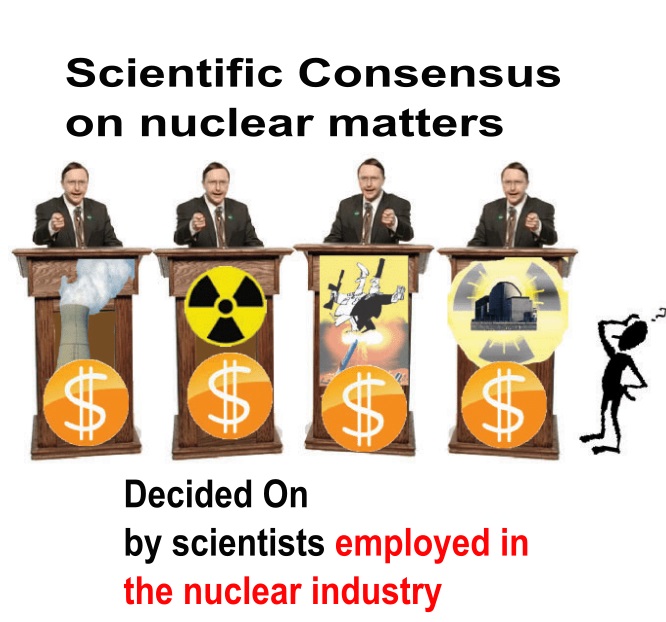
Not to be outdone by more modern means of propaganda, Nuclear Waste Services has continued the tradition of only providing the audience with the information that suits their argument.
The only way to reduce waste is to reduce the activities that cause it.
There is no other logical way.
News media tends to use ‘scientific consensus’ as if it is the end point of the discussion.
The implication that ‘this is the only way’ serves to quash dissenting voices and validate the overall message of the article.
When government agencies are hard to trust, who do we look to? Scientists. But what job is the concept of scientific consensus doing in the marketing of the GDF?
A Quiet Resistance, 8 May 2025
‘Scientific consensus’ carries a lot of weight in news media discussing the proposed Geological Disposal Facilities (GDFs) (nuclear waste dumps) in West Cumbria.
This consensus is also being used as a persuasion tool in the official literature handed out to communities by Nuclear Waste Services (NWS).
Since most of us aren’t scientists in either the nuclear industry or geodisposal, we have to turn to those who are if we’re to understand what’s going to happen to our community. Alongside the regular newsletters and other marketing from NWS, we usually access those people through articles in the news and on the internet.
But it’s important to keep asking questions about what we’re reading.
‘Scientific consensus’ doesn’t mean the science is settled; articles can contain facts and still be biased.
Biases in news media
The news media are paid for by advertisers. If they publish articles that make arguments against their advertisers’ interests, they lose advertising money. Their advertisers’ interests may not be clear. For example, they may be companies that have money invested in hedge funds, which in turn invest in nuclear power.
News media also come up against political pressure, as The Guardian found out a few years ago, to its long-term detriment.
There’s also the question of audience. News media write to a specific audience, one already sold on the ideas they are promoting, or at the very least, suggestible. Most people are aware of ‘climate change’. If someone authoritative tells them it’s important for us to have a GDF because nuclear energy will help us ‘beat climate change’, they are likely to accept that, unless they have some wider knowledge.
Bias can be edited into an article by keeping the facts, but leaving out certain contexts. They can also cherry pick facts, so that the only ones they use are those which suit their argument.
Biases and misinformation across the internet
Misinformation across the web is an endemic problem now, brought on by too little regulatory oversight, too late. A bitter combination of an advertising free-for-all, empty content for the sake of it, and algorithmic twists that feed on themselves has come together to make an internet that doesn’t run the kind of useful searches it did just 12 years ago.
On top of this, a type of information warfare has been raging, hidden in plain sight from the eyes of everyday people, and the proliferation of GenAI has made the situation much worse. Social media, news media, every place we get our information from has been seeded with doubt.
All of this means that when we read information anywhere, from both respectable and dubious sources, we have to take time to process what we’ve read before we lead with our emotions.
Bias and messaging in public information
Not to be outdone by more modern means of propaganda, Nuclear Waste Services has continued the tradition of only providing the audience with the information that suits their argument.
In the case of the Community Partnership newsletter this month, this includes a soothing word salad introduction from the outgoing Community Partnership Chair explaining that he has resigned, and our local Town Council has withdrawn from the group. There are then several pages on how the Community Investment Fund money has been spent recently.
From that messaging, it is clear they’re seeking to reassure the community – talk quietly, you don’t want them to startle – and remind us that we’re getting plenty of money for the deal.
So, what’s the problem with the scientific consensus on the idea of a geological disposal facility (GDF), more prosaically known as a nuclear waste dump?
What is ‘scientific consensus’?
Scientific consensus refers to an agreement amongst scientists in a specific, very narrow field of study.
In the consideration of a GDF, that field would be geology, and most likely a particular area of geology, such as geodisposal.
Why do we need ‘scientific consensus’?
For most of us, despite our education and our wide understanding of the world, we don’t have intensive scientific training. Even if we do, it may not be in the narrow field in question.
Ethan Siegel at Forbes.com explained this really clearly:
… Unlike in most cases, unless you are a scientist working in the particular field in question, you are probably not even capable of discerning between a conclusion that’s scientifically valid and viable and one that isn’t. Even if you’re a scientist in a somewhat related field! Why? This is mostly due to the fact that a non-expert cannot tell the difference between a robust scientific idea and a caricature of that idea.
Why should we believe ‘scientific consensus’?
Although a consensus is an impossible number to quantify, the argument for a consensus is that a lot of related research is borne out by the agreement, so if it isn’t correct – e.g. if a GDF isn’t a safe and complete solution for nuclear waste – then a lot of other research is also wrong.
That sounds reassuring, but there’s more to it.
What do we have to consider behind the messaging of ‘scientific consensus’?
News media tends to use ‘scientific consensus’ as if it is the end point of the discussion.
The implication that ‘this is the only way’ serves to quash dissenting voices and validate the overall message of the article.
This is also how Nuclear Waste Services is using ‘scientific consensus’. The inference is that there is only one solution, and a GDF is it.
But scientific consensus is not the end position of the science. It’s the starting position from which further investigation can arise.
While that future studying may not set out to prove early scientific reasoning wrong, it should seek to improve or refine our understanding of the science.
And the main problem with scientific investigation?
Take a look at this quote. It’s from the article Development in Progress, from the Consilience Project.
It is also important to consider how existing biases and values ‘prime’ us towards certain starting points when we seek to understand the world through science. Before we formulate questions of design experiments, we often have preconceived notions as to what we imagine as likely to be important to the question at hand.
You’ve got to ask what their starting point is, before you can evaluate the idea.
Or, to put it another way: if you ask a geodisposal specialist what the best way is to deal with a higher activity nuclear waste problem, they’re going to tell you to bury it underground.
What’s the motivation for a GDF? Why the bias? Where’s the starting point of the plan?
Waste is a massive issue for modern Western societies. Everything we do, everything we buy creates waste. The only way to reduce waste is to reduce the activities that cause it.
There is no other logical way.
Government and the nuclear industry are motivated towards using a geological disposal facility to store higher activity nuclear waste because:
- There’s almost seventy years’ worth of higher activity nuclear waste to store
- Nuclear appears to offer a solution to the legal requirements of Net Zero.
The more we use nuclear technology, the more toxic waste we will produce. It’s inevitable without social, political, and industrial change.
The nuclear industry
The nuclear industry’s back is against the wall. It urgently has to put the accruing waste somewhere permanently safe.
Nuclear waste is produced in solid, aqueous, and gaseous forms. If the industry reduces some of the gaseous waste, that means that it increases it in another form, e.g. aqueous. There is no escaping the waste issue without stopping the industry.
There’s a lot of money in nuclear.
The UK Government
The government has to enable the production of electricity, but having effectively phased out coal-fired power stations, it has brought in gas-fuelled hydrogen plants which are arguably just as greenhouse-gas-intensive as coal. Natural gas is still a fossil fuel, it still causes huge emissions, and it still presents supply problems.
For the government, nuclear represents a lower carbon option, with political expediencies, such as being free of Russian fossil fuel pressures (Russian uranium is still unsanctioned and likely part of the ‘diversified’ fuel mixes used in the UK).
There is also a disturbing link between civil nuclear skills and military nuclear skills which doesn’t get much media time:
Other countries tend to be more open about it, with the interdependence acknowledged at presidential level in the US for instance. French president Emmanuel Macron summarises: “without civil nuclear power, no military nuclear power, without military nuclear, no civil nuclear”.
This is largely why nuclear-armed France is pressing the European Union to support nuclear power. This is why non-nuclear-armed Germany has phased out the nuclear technologies it once lead the world in. This is why other nuclear-armed states are so disproportionately fixated by nuclear power.
In 2022, the Nuclear Decommissioning Authority (NDA) published a Radioactivity Waste Inventory with a timeline for the phasing out of nuclear power by 2136. But in early 2025, the Labour government announced it was keen to rapidly start up the building of Small Modular Reactors (SMRs) across the UK. Going forward from this year, nuclear waste will continue to be produced in the UK beyond the 100-year lifetime of the current GDF project. Waste is inevitable.
Waste isn’t the only issue for nuclear power, either. There is the question of what happens to nuclear power plants in the face of climate catastrophe. Fukushima wasn’t an anomaly, and it wasn’t avoidable. It could be seen as a foreshadowing of future possibilities.
Back to scientific consensus
So, when Nuclear Waste Services and other media proponents talk about scientific consensus being in agreement that a GDF is the best solution available for toxic nuclear waste, what they mean is:
- there is an inexorable accumulation of nuclear waste, both historical and into the future
- there are going to be more GDFs in the future
- they aren’t looking for other methods of storage
- they absolutely will not consider a non-nuclear future
- and they don’t want to argue about it.
And, for some reason, despite a GDF apparently being the safest possible housing for nuclear waste – and despite there being many geologically suitable locations – they don’t want to locate it under Westminster.
Ultimately, despite the focus given to the science, this isn’t about the science.
It’s about burying a waste product that they have no other solution for. Sweeping it under the carpet. And calling it common sense!
Common sense as a message, in an area of study called Semiotics, is a problematic idea. Although it is dressed up as the common, standard, everyday way of thinking, it is often used in marketing and media to promote the ideas of those in power.
As the future beckons, common sense should be saying no to nuclear. Just like with plastic, nuclear has no end and no sure way of getting rid of its byproducts.
For communities that ‘host’ a nuclear waste dump, the GDF solution represents a forever risk with inter-generational risks and costs along the way.
Somehow, West Cumbria always seems to be saddled with nuclear detritus.
The potential collateral damage, seen already across the United States and South America, is similar to that experienced around mining and climate solution industries.
It starts with
- environmental destruction,
- contamination of water sources and land,
- loss of biodiversity,
- loss of human rights,
- loss of health, and
- upheaval of established communities.
These may be experienced just in the construction of a GDF.
Who knows where it ends?
Further information on the proposed GDFs in West Cumbria:
Europe self destructing in efforts to continue Ukraine’s self destruction

Walt Zlotow, West Suburban Peace Coalition, Glen Ellyn IL , 19 May 25
Every day the war in Ukraine continues, Ukraine loses more territory to Russia. So far about 45,000 square miles have been lost in the Donbas and environs containing mainly Russia speaking and cultured Ukrainians.
Ukraine had 2 opportunities to lose nary a square mile.
Their first one was by not seeking to join NATO, then not attacking Russian leaning Ukrainians in Donbas who sought freedom from their Kyiv government tyranny that killed thousands. That provoked the Russian invasion of February 24, 2022.
The second was by Ukraine not pulling out of the Istanbul Agreement 2 months into the war. It would have brought peace without Ukraine losing any territory, albeit they’d have to reject NATO membership and grant self-governance and peace to Donbas Ukrainians while still under Ukraine sovereignty.
Three years on, Ukraine faces imminent defeat, gaining nothing while losing a fifth of its land and over a million casualties. President Zelensky, likely coerced by the ultra-nationalists with the real power in Kyiv, refuses to stop the bleeding. He’s furthering Ukraine’s self destruction in a lost cause.
Tragically, he’s being goaded to fight on by much of Europe including France, Germany, Poland, the UK and Baltics. Sadly and tragically, they are all suffering economically by their refusal to drop their rampant Russophobia. Sanctioning Russia has done nothing but escalate their energy costs.
Europe’s sanctions have failed spectacularly. Russia simple moved on from supplying Europe with cheap energy to much of the nonaligned world, including China and India. Result? Last year Russia’s GDP expanded 4.1% while the EU ticked up a scant 1%.
Trump’s only sensible foreign policy is seeking to end Ukraine’s self destruction by brokering a peace deal in the first peace conference in three years. Trump is signaling he’s near ending the US weapons gravy train that has squandered over $175 billion in weapons that have merely ensured those 45,000 lost square miles of territory and a million casualties.
Europe wants nothing to do with ending the war against their bete noir Russia. The EU Commission, its executive arm, is seeking to replace the possible US withdrawal by pledging $900 billion in new defense spending in a program dubbed ‘Rearm Europe’. A better sobriquet would be ‘Weaken Russia’.
European leaders keeping the Ukraine war going are merely weakening their own economies. Their populations are not on board allowing nationalist movements such as AfD (Alternative for Germany) to gain traction threatening pro war ruling parties.
Leaders like UK’s Starmer, France’s Macron and Germany’s Merz appear oblivious the Ukraine war is hopeless, Their proposed $900 billion or even $9 trillion will make no difference when Ukraine runs out of conscripted solders to continue their lost cause. Russia garners around 50,000 military volunteers each month while Ukraine lassos draft dodgers like stray dogs.
All three could boost their sagging economies as well as end the death and destruction by partnering with Trump to reach a quick settlement at the current Istanbul peace conference. After that they’d be wise to drop their delusional Russophobia and welcome the cheaper energy and other goodies they could acquire from a resource rich trading partner they’ve spent decades isolating.
Nuclear weapons woes: Understaffed nuke agency hit by DOGE and safety worries
The consequences of DOGE’s disruptions at the National Nuclear Security Administration could be far-reaching, experts say.
Davis Winkie and Cybele Mayes-Osterman, USA TODAY, 18 May 25
- For decades, the NNSA has struggled with federal staffing shortages that have contributed to safety issues as well as delays and cost overruns on major projects.
- Experts fear that the Trump administration’s moves to reduce the federal workforce may have destabilized the highly specialized federal workforce at the National Nuclear Security Administration.
- USA TODAY reviewed decades of government watchdog reports, safety documents, and congressional testimony on U.S. nuclear weapons.
In 2021, after a pair of plutonium-handling gloves had broken for the third time at the Los Alamos National Laboratory, contaminating three workers, and after the second accidental flood, investigators from the National Nuclear Security Administration found a common thread in a plague of safety incidents: the contractor running the New Mexico lab lacked “sufficient staff.”
So did the NNSA.
The agency, whose fewer than 1,900 federal employees oversee the more than 60,000 contractors who build and maintain the U.S. nuclear arsenal, has struggled to fill crucial safety roles. Only 21% of the agency’s facility representative positions – the government’s eyes and ears in contractor-run buildings – at Los Alamos were filled with qualified personnel as of May 2022.
Now, President Donald Trump’s administration has thrown the NNSA into chaos, threatening hard-won staffing progress amid a trillion-dollar nuclear weapons upgrade. Desperately needed nuclear experts are wary of joining thanks to chaotic job cuts by Elon Musk’s Department of Government Efficiency, experts say.
The disruption of NNSA’s chronically understaffed safety workforce is “a recipe for disaster,” said Joyce Connery, former head of the Defense Nuclear Facilities Safety Board.
Los Alamos is not the only facility with staffing shortages in crucial safety roles.
As of May 2022, less than one-third of facility representative roles at NNSA’s Y-12 facility in Oak Ridge, Tennessee, and the Pantex plant near Amarillo, Texas were held by fully qualified employees, according to a USA TODAY review of nuclear safety records.
At Pantex, where technicians assemble and disassemble nuclear weapons, only a quarter of safety system oversight positions had fully qualified hires, and only 57% of those safety positions had qualified employees at Y-12.
Nuclear weapons workers don’t grow on trees, nor do the federal experts who oversee them. Many of the jobs require advanced degrees, and new hires often need years of on-the-job training. Security clearance requirements limit the most sensitive jobs to U.S. citizens.
America’s nuclear talent crisis isn’t new, but its consequences have grown as tens of billions of dollars pour into the NNSA annually in a broader $1.7 trillion plan to modernize U.S. nuclear weapons.
Congress ordered the cramped, aging plutonium facility at Los Alamos – called PF-4 – to begin mass production of plutonium pits, a critical component at the heart of nuclear warheads, for the first time in more than a decade.
Enter Elon Musk and DOGE…………………………………………………………………………………………………………..
What’s at stake
The struggle for staff has been NNSA’s Achilles heel for decades – and the stakes have only grown.
But despite efforts to develop talent, watchdogs said in February of this year the NNSA was “understaffed” and struggling to execute key oversight requirements.
Then came DOGE…………………………………………………………………………………….
Connery fears the strain and staffing problems could combine to disastrous effect.
“When you take an inexperienced or an understaffed workforce and you combine it with old facilities and a push to get things done – that is a recipe for disaster,” Connery said. https://eu.usatoday.com/story/news/politics/2025/05/18/nuclear-weapons-woes-nuke-agency-hit-by-doge-and-safety-worries/83621978007/
US nuclear sector intensifies lobbying in bid to prevent subsidy cuts.

The US nuclear industry is intensifying its lobbying blitz to save the
Inflation Reduction Act tax credits it says are vital for meeting
artificial intelligence-fuelled energy demand. On Monday lawmakers from the
House ways and means committee, which is responsible for writing tax law,
released draft legislation that would phase out nuclear energy subsidies
starting in 2029, in a move that caught the sector by surprise. Lobbyists
are now racing to persuade lawmakers to rescind or moderate cuts to nuclear
industry subsidies, which until recently had more bipartisan support than
other low-carbon energy technologies such as wind and solar.
FT 19th May 2025,
https://www.ft.com/content/c243fd15-bef8-4c98-b06b-8b13ddd0a701
Britain left out in the cold by Trump on Ukraine peace talks
How Starmer found himself on the road to nowhere
Ian Proud, May 20, 2025
Russia Ukraine peace talks are to restart immediately, but when Trump debriefed European leaders, Starmer was not on the call. Starmer has rendered himself completely irrelevant by sticking to the same tired approaches and blocking efforts at peace in Ukraine.
After Presidents Trump and Putin spoke for two hours today, 19 May, new impetus was injected in Russia-Ukraine negotiations towards a ceasefire. The Russian and Ukrainian delegations are now in contact and will start immediately preparations towards a second round of talks. After Vice President JD Vance’s meeting with Pope Leo, the Vatican is being touted as a possible venue. Clearly, direct engagement by the two Presidents is key to any progress being made to end the war. But when Trump phoned Zelensky and European leaders after the call, Prime Minister Keir Starmer was not included.
That may be because Trump has realised that Starmer has brought nothing new to the Ukraine peace process and, rather, is acting as a major brake on progress.
After a helpful, if tentative, first meeting for three years between Russian and Ukrainian delegations in Istanbul on Friday 16 May, it was clear that neither side was in a hurry to schedule further talks. For his part, Zelensky had spent most of the day on 15 May trying his best to find a way out of sending a delegation to Istanbul and blaming Russia for it. Following the standard script, British and European leaders indulged him, blaming Russia whose bemused delegation waited patiently in Istanbul for someone to show up. It was only after direct intervention from President Erdogan and the USA, that Zelensky finally relented allowing for talks on Friday.
That first Istanbul meeting, however brief, and however accompanied by the normal Ukrainian briefing out that ‘Russia doesn’t want peace’, was nonetheless a vital first step forward. But, and as Vice President JD Vance said today, we had reached an impasse, and Trump appears determined to keep the pressure up to secure an elusive ceasefire.
First Nations warn of conflict if Ontario proceeds with Bill 5
‘They’re looking for a world of opposition from First Nations in Ontario that are not going to just sit idly by’: First Nations leadership publicly slams proposed bill that would cut ‘red tape’ for economic projects — and potentially erode treaty rights.
Bay Today.ca, James Hopkin, 19 May 25
First Nations leadership is calling on Premier Doug Ford and the Ontario government to put a stop to a newly proposed bill that chiefs say would bulldoze the inherent rights of the Anishinabek and their existing treaty relationships with the Crown.
Robinson Huron Waawiindamaagewin (RHW) is publicly opposing Bill 5, which the political organization says will give extended powers to the province through the creation of “special economic zones” that would allow for the cabinet to exempt selected proponents and projects from requirements under any provincial law or regulation.
This includes bylaws of municipalities and local boards that would otherwise apply in that zone — all while repealing the Endangered Species Act.
RHW spokesperson and Anishinabek Nation Regional Chief Scott McLeod told SooToday that Ford framing Bill 5 as a way of cutting red tape for infrastructure and resource development projects is a “gross understatement,” and that Ontario is essentially gutting environmental checks and balances while undermining the treaty relationship with First Nations in Robinson Huron Treaty territory.
“He’s undermining the reality that Ontario, under the jurisdiction of Canada, inherited the treaty of 1850 from the British Crown, which laid out our relationship as title owners to the land and our willingness to share those resources,” McLeod said during a telephone interview Wednesday.
“He simply is moving forward on this as if Ontario owns the resources outright, and has no obligations to the treaties that are within Ontario.”
The tabling of Bill 5, known as the Protect Ontario by Unleashing Our Economy Act, has also triggered opposition from the Anishinabek Nation, a political advocate for 39 member First Nations representing approximately 70,000 citizens across the province.
The organization says the bill “reflects a dangerous and false narrative that presumes the Government of Ontario has unilateral authority to legislate over lands and resources without consultation or consent from the rightful Anishinabek title holders.”
“To allow lands of economic value that have been cited for development to be exempt from protective checks and balances, such as archaeological assessments and wildlife and ecosystem protections as proposed in this bill will cost First Nations and Ontarians profoundly, exposing and setting back species at risk protection and leading to the destruction of First Nation burial sites and artifacts,” Anishinabek Grand Council Chief Linda Debassige said in a release issued Tuesday. …………………………………………………………………………………………. https://www.baytoday.ca/local-news/first-nations-warn-of-conflict-if-ontario-proceeds-with-bill-5-10673506?utm_source=Email_Share&utm_medium=Email_Share&utm_campaign=Email_Share
Trump Admin Fast Tracks Anfield’s Velvet-Wood Uranium Project in Push for US Energy Independence

Giann Liguid, Investing News 15th May 2025
Anfield Energy’s Velvet-Wood uranium-vanadium project in Utah is the first US uranium asset to receive a fast-track designation.
The US Department of the Interior announced on Monday (May 12) that it will fast track environmental permitting for Anfield Energy’s (TSXV:AEC,OTCQB:ANLDF) Velvet-Wood uranium project in Utah
The decision slashes what would typically be a years-long review process down to just 14 days, and makes Velvet-Wood the first uranium project to be expedited under a January 20 statement from President Donald Trump. In it, he declares a national energy emergency and emphasizes the importance of restoring American energy independence.
This week’s decision signals what Anfield calls “a decisive shift in federal support for domestic nuclear fuel supply.”
The Velvet-Wood project, located in San Juan County, Utah, is expected to produce uranium used for both civilian nuclear energy and defense applications, as well as vanadium, a strategic metal used in batteries and high-strength alloys.
Secretary of the Interior Doug Burgum characterized the move as part of an urgent federal response to what he said is “an alarming energy emergency” created by the “climate extremist policies” of the previous administration.
“President Trump and his administration are responding with speed and strength to solve this crisis,” he said. “The expedited mining project review represents exactly the kind of decisive action we need to secure our energy future.”
Anfield acquired Velvet-Wood, which is currently on care and maintenance, from Uranium One in 2015…………………….
The Trump administration’s decision to pause the implementation of its new reciprocal tariffs for 90 days provided utilities with the breathing room needed to resume contracting……………
These moves align with a broader US Department of Energy strategy that includes identifying 16 federal sites for co-locating data centers and new energy infrastructure. https://investingnews.com/trump-fast-tracks-velvet-wood/
UK’s Geological Disposal Facility Community Partnership operates under restrictive government guidance and the management of Nuclear Waste Services
An interesting article recently sent to the NFLAs prompted a reply by our
Secretary identifying the limitations placed upon members of the Geological
Disposal Facility Community Partnerships wishing to source independent
information or commission bespoke research.
Such Community Partnerships operate under restrictive government guidance and the management of Nuclear Waste Services.
The Author and Article: A Quiet Resistance is run by a
writer, author, and marketing copywriter, living with her small family near
Millom. Understanding how language is used to persuade, convince, and
influence the decisions of mass populations, she set out to unpack the
messaging around the unfolding climate catastrophe, to help others decode
truth from fiction for themselves, and to open up critical thinking
pathways through the consumerism.
A Quiet Resistance documents this journey of discovery. AQuietResistance.co.uk –
https://aquietresistance.co.uk/the-media-scientific-consensus-toxic-nuclear-waste
23 April 2025. The media, scientific consensus, and toxic nuclear waste
When government agencies are hard to trust, who do we look to? Scientists. But
what job is the concept of scientific consensus doing in the marketing of
the GDF? ‘Scientific consensus’ carries a lot of weight in news media
discussing the proposed Geological Disposal Facilities (GDFs) (nuclear
waste dumps) in West Cumbria.
This consensus is also being used as a
persuasion tool in the official literature handed out to communities by
Nuclear Waste Services (NWS). Since most of us aren’t scientists in either
the nuclear industry or geodisposal, we have to turn to those who are if
we’re to understand what’s going to happen to our community. Alongside the
regular newsletters and other marketing from NWS, we usually access those
people through articles in the news and on the internet. But it’s important
to keep asking questions about what we’re reading. ‘Scientific consensus’
doesn’t mean the science is settled; articles can contain facts and still
be biased.
NFLA 16th May 2025, https://www.nuclearpolicy.info/wp/wp-content/uploads/2025/05/A431-NB317-The-media-scientific-consensus-and-toxic-nuclear-waste-May-2025.pdf
1 This Month

of the week – Shut Down Drone Warfare!


Tell the Ukrainian Government to Drop Prosecution of Peace Activist Yurii Sheliazhenko

Petition to revoke the licensing of the Near Surface Nuclear Disposal Facility (NSDF) at Chalk River. https://www.ourcommons.ca/petitions/en/Petition/Details?Petition=e-7247
To see nuclear-related stories in greater depth and intensity – go to https://nuclearinformation.wordpress.com
-
Archives
- March 2026 (244)
- February 2026 (268)
- January 2026 (308)
- December 2025 (358)
- November 2025 (359)
- October 2025 (376)
- September 2025 (257)
- August 2025 (319)
- July 2025 (230)
- June 2025 (348)
- May 2025 (261)
- April 2025 (305)
-
Categories
- 1
- 1 NUCLEAR ISSUES
- business and costs
- climate change
- culture and arts
- ENERGY
- environment
- health
- history
- indigenous issues
- Legal
- marketing of nuclear
- media
- opposition to nuclear
- PERSONAL STORIES
- politics
- politics international
- Religion and ethics
- safety
- secrets,lies and civil liberties
- spinbuster
- technology
- Uranium
- wastes
- weapons and war
- Women
- 2 WORLD
- ACTION
- AFRICA
- Atrocities
- AUSTRALIA
- Christina's notes
- Christina's themes
- culture and arts
- Events
- Fuk 2022
- Fuk 2023
- Fukushima 2017
- Fukushima 2018
- fukushima 2019
- Fukushima 2020
- Fukushima 2021
- general
- global warming
- Humour (God we need it)
- Nuclear
- RARE EARTHS
- Reference
- resources – print
- Resources -audiovicual
- Weekly Newsletter
- World
- World Nuclear
- YouTube
-
RSS
Entries RSS
Comments RSS
 nuclear-news