Don’t vent tritium gas
Lab should explore credible alternatives say Nuclear Watch New Mexico and Tewa Women United
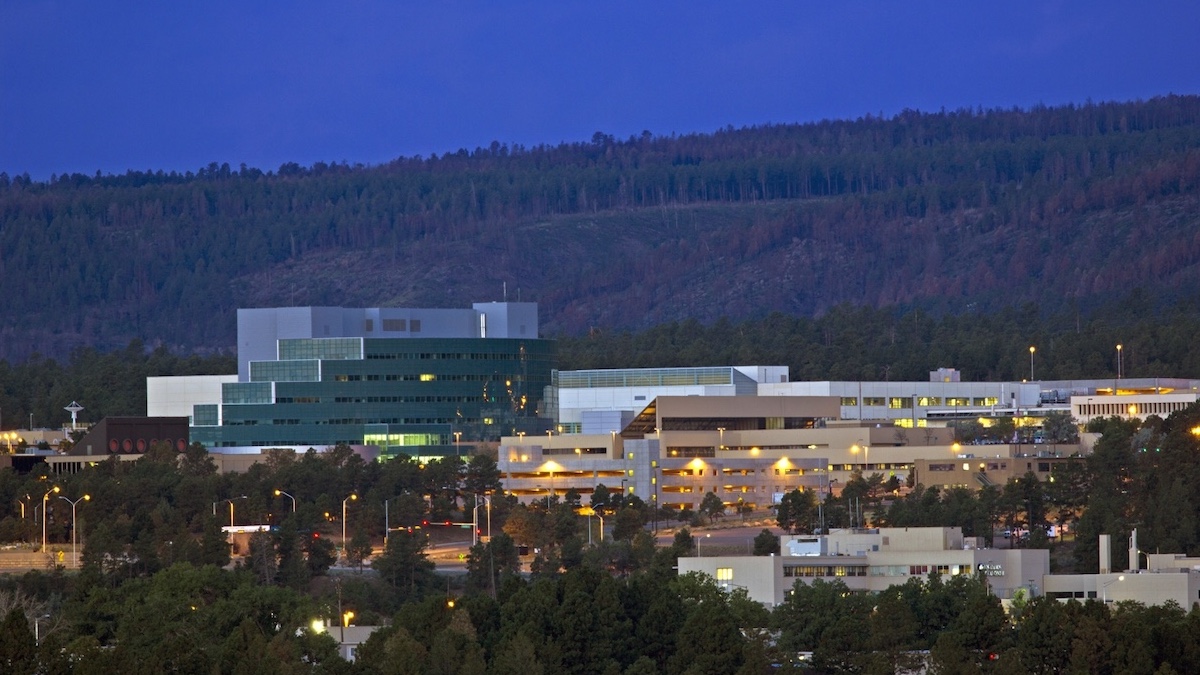
The Los Alamos National Laboratory plans to begin large releases of radioactive tritium gas any time after June 2, 2025. The only roadblock to the Lab’s plans is that it needs a “Temporary Authorization” from the New Mexico Environment Department to do so.
Reasons why the New Mexico Environment Department should deny LANL’s request are:
1. The state Environment Department has a duty to protect the New Mexican public. As it states, “Our mission is to protect and restore the environment and to foster a healthy and prosperous New Mexico for present and future generations.”
2. Why the rush? LANL explicitly admits there is no urgency. According to the Lab’s publicly-released “Questions and Answers” in response to “What is the urgency for this project?” “There is no urgency for this project beyond the broader mission goals to reduce onsite waste liabilities.”
3. In addition, the National Nuclear Security Administration (NNSA) admits that the end time frame for action is 2028, not 2025. Therefore, there is time for deliberate consideration.
4. Contrary to NMED’s Resource Conservation and Recovery Act permit for LANL, the Lab has not fulfilled its duty to inform the public via NMED of possible alternatives to its planned tritium releases. According to Tewa Women United, “LANL has told EPA there are 53 alternatives; that list of alternatives, initially requested in 2022, has not yet been disclosed. Tewa Women United has repeatedly asked LANL to provide the public with that list.”
5. Despite extensive prompting by the Environmental Protection Agency on possible better alternatives, the NNSA categorically rejected any modifications.
6. NNSA’s January 2025 draft LANL Site-Wide Environmental Impact Statement had no substantive discussion of the planned tritium releases, much less the required “hard look” at credible alternatives. Further, LANL and NNSA included these planned releases in the “No Action Alternative,” with the specious justification that “The Laboratory and NNSA have been integrating with the EPA and NMED to obtain approval to move forward with the plan to vent the Flanged Tritium Waste Containers currently located in TA-54.” Seeking approval makes them No Action? NNSA and LANL are legally required to consider public comments submitted for the LANL SWEIS. These planned tritium releases should not proceed until NNSA issues a Record of Decision on the final LANL Site-Wide Environmental Impact Statement.
7. NNSA’s publicized maximum release of 30,000 curies is merely an administrative decision point at which LANL will stop the venting process to avoid exceeding the Clean Air Act’s 10 millirem public exposure limit for radioactive air emissions. It is not the potential total quantity of tritium that will have been released. LANL’s radioactive air emissions management plan sets an annual administrative limit of 8 millirem for the tritium releases, meaning venting will cease once this limit is reached but may resume in subsequent periods.
8. In addition, these planned releases are not necessarily a one-time event, as indicated above, contrary to what the LANL Site-Wide Environmental Impact Statement falsely states.
9. Nor are these planned releases strictly confined to just Area G, as claimed.
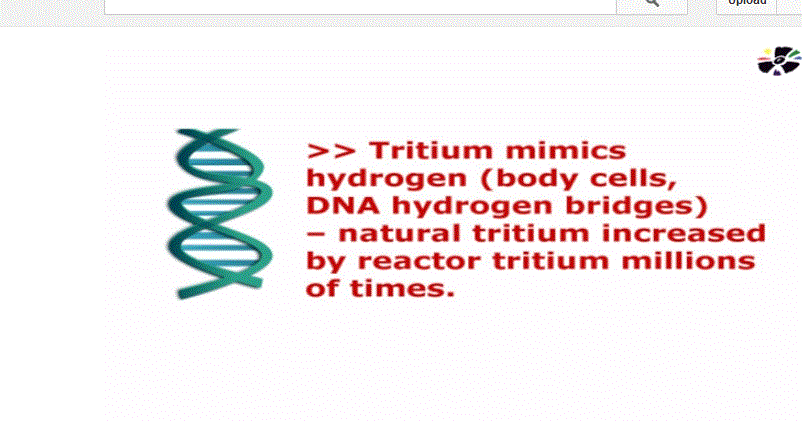
10. LANL declares “There are no cumulative impacts from this operation. All limits are conservative, and well within regulatory limits that are protective of the public.” However, one independent report calculates that the effective dose to infants could be three times higher than to adults (therefore likely violating the 10 millirem Clean Air Act standard for “any member of the public”) and all of LANL’s calculated doses would be higher in the event of low wind speeds and low humidity.” Another independent report noted how tritiated water can pervade every cell in the body while the planned LANL tritium releases are three times the amount of tritium that the crippled Fukushima nuclear power plant would release to the ocean over 30 years.
11. LANL claims “This critical milestone [the planned tritium releases] furthers \ the cleanup of Area G.” But what so-called cleanup means to LANL is “cap and cover” of ~200,000 cubic yards of existing toxic and radioactive wastes at Area G, leaving them permanently buried in unlined pits and shafts as a permanent threat to groundwater. NMED knows this all too well given the draft order it issued to the Lab to excavate and treat all wastes at the smaller Area C waste dump, which LANL categorically opposes. NMED should carefully consider the extent to which approving these planned tritium releases is consistent with its desire for full comprehensive cleanup at the Lab, including Area G.
Recommendation: Given the self-admitted lack of urgency and remaining uncertainties in potential doses, times, locations and ultimate purpose of these planned tritium releases,NMED should deny LANL’s request for a “Temporary Authorization” to proceed until there has been an open and transparent analysis of alternatives and all possible public health impacts.
This fact sheet is available here. For more contact Nuclear Watch New Mexico and Tewa Women United.
And please sign the petition — Petition to Deny LANL’s Request to Release Radioactive Tritium into the Air.
No comments yet.
1 This Month


Tell the Ukrainian Government to Drop Prosecution of Peace Activist Yurii Sheliazhenko

Petition to revoke the licensing of the Near Surface Nuclear Disposal Facility (NSDF) at Chalk River. https://www.ourcommons.ca/petitions/en/Petition/Details?Petition=e-7247


of the week – STOP SMALL MODULAR REACTORS IN CANADA
To see nuclear-related stories in greater depth and intensity – go to https://nuclearinformation.wordpress.com
-
Archives
- March 2026 (204)
- February 2026 (268)
- January 2026 (308)
- December 2025 (358)
- November 2025 (359)
- October 2025 (376)
- September 2025 (258)
- August 2025 (319)
- July 2025 (230)
- June 2025 (348)
- May 2025 (261)
- April 2025 (305)
-
Categories
- 1
- 1 NUCLEAR ISSUES
- business and costs
- climate change
- culture and arts
- ENERGY
- environment
- health
- history
- indigenous issues
- Legal
- marketing of nuclear
- media
- opposition to nuclear
- PERSONAL STORIES
- politics
- politics international
- Religion and ethics
- safety
- secrets,lies and civil liberties
- spinbuster
- technology
- Uranium
- wastes
- weapons and war
- Women
- 2 WORLD
- ACTION
- AFRICA
- Atrocities
- AUSTRALIA
- Christina's notes
- Christina's themes
- culture and arts
- Events
- Fuk 2022
- Fuk 2023
- Fukushima 2017
- Fukushima 2018
- fukushima 2019
- Fukushima 2020
- Fukushima 2021
- general
- global warming
- Humour (God we need it)
- Nuclear
- RARE EARTHS
- Reference
- resources – print
- Resources -audiovicual
- Weekly Newsletter
- World
- World Nuclear
- YouTube
-
RSS
Entries RSS
Comments RSS
 nuclear-news
Leave a comment