False promises, real costs: The nuclear gamble we can’t afford
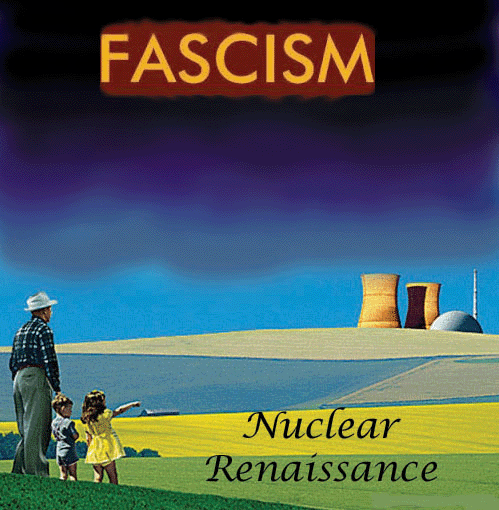
Beyond the financials, nuclear represents a specific vision of governance; centralised, top-down, and resistant to scrutiny. A small number of well-connected corporations manage most facilities. The civilian sector remains intertwined with military infrastructure. Decision-making processes often exclude community consultation. Most notably, nuclear generates waste that remains hazardous for thousands of years, demanding long-term institutional stability that even the Nuclear Waste Management Organization acknowledges no government can guarantee.
Scotland and Canada must forge an energy future that works
by Ben Beveridge, 11-05-2025 , https://bylines.scot/environment/false-promises-real-costs-the-nuclear-gamble-we-cant-afford/
Nuclear power is staging a quiet comeback. In boardrooms across Scotland and Canada, familiar promises are being repackaged as bold new solutions: reliable baseload electricity, energy security, and climate alignment. But behind the sleek rhetoric, the same truths remain. Nuclear power is still the slowest, most expensive, and least flexible energy option on the table.
Both countries now face pressure to commit to a nuclear future they neither need nor can afford. This isn’t the natural evolution of energy policy. It’s the resurrection of a failing model, defended not on merit, but on legacy interests.
In the UK, projects like Hinkley Point C and Sizewell C have seen cost projections soar, with current estimates exceeding £30bn. Scotland, despite producing 97% of its electricity from renewable sources, remains tied to a UK-wide strategy shaped by Westminster’s nuclear ambitions
In Canada, Ontario’s Darlington refurbishment has grown from C$6bn to more than C$12bn. Saskatchewan and New Brunswick are investing heavily in Small Modular Reactors (SMRs), which have yet to prove commercial viability. The Canadian Environmental Law Association has raised significant concerns over the feasibility, safety, and cost of these technologies, yet federal investment continues, often at the expense of grid modernisation and renewable storage.
Nuclear: more expensive, less flexible, needs political intervention
The narrative has shifted from energy independence to climate urgency, but the fundamentals have not. Lazard’s 2023 analysis puts the levelised cost of new nuclear at US$131–204 per megawatt-hour, while utility-scale solar sits at US$26–41, and wind at US$24–47. Nuclear projects frequently exceed ten-year construction timelines. By contrast, wind and solar facilities can be operational within five. Nuclear plants also lack the flexibility modern grids require, locking in oversupply and reducing the effectiveness of variable renewable sources.
Private capital has walked away. No nuclear facility proceeds without government subsidies, price guarantees, or risk backstops. The market has made its judgment. Nuclear survives only through political intervention, not economic logic.
Beyond the financials, nuclear represents a specific vision of governance; centralised, top-down, and resistant to scrutiny. A small number of well-connected corporations manage most facilities. The civilian sector remains intertwined with military infrastructure. Decision-making processes often exclude community consultation. Most notably, nuclear generates waste that remains hazardous for thousands of years, demanding long-term institutional stability that even the Nuclear Waste Management Organization acknowledges no government can guarantee.
Renewables: decentralised, democratic and resilient
In contrast, the model offered by renewables is decentralised, participatory, and adaptive. Community energy projects across Scotland – from the Isle of Eigg to the Outer Hebrides – demonstrate how generation can be local, democratic, and resilient. In Canada, provinces like Quebec and British Columbia have built near-100% clean grids through hydroelectricity, rejecting nuclear while Clean Energy Canada shows generational energy security and affordability.
So why does nuclear persist? The answer lies in its structure. Nuclear development creates concentrated profit centres, contracts for reactor manufacturers, engineering giants, uranium suppliers, and vertically integrated utilities. These stakeholders benefit from centralised generation, not distributed ownership. Regulatory frameworks often entrench their advantages, creating barriers for smaller-scale or community-led projects. The result is a policy environment that protects incumbents rather than enabling transition.
This is not a neutral technological debate. It’s a structural contest between legacy systems and emergent models of energy democracy. The framing may be about climate, but the stakes are about convention, and control.
Scotland and Canada renewable partnership
Scotland and Canada are uniquely positioned to lead an alternative path. Their respective strengths are complementary. A Scotland-Canada renewable partnership, modelled after the North Sea oil and gas collaboration, could drive investment in shared technologies like offshore wind, pumped hydro storage, and smart grid systems. Agencies such as Scottish Enterprise and Scotland Development International already maintain Canadian operations and could broker this cooperation directly.
The Commonwealth presents another opportunity. A Commonwealth Energy Transition Alliance could support shared investment frameworks, model policy design, and collaborative R&D between countries with aligned infrastructure and ambitions. It could also serve as a counterbalance to the lobbying power of the nuclear-industrial complex, directing climate funding towards solutions that scale affordably and equitably.
The choice facing both nations is not nuclear or catastrophe. It is between centralised systems that demand public subsidy and deliver rising costs, versus renewable models that are increasingly faster, cheaper, and community-driven. The facts are clear. The economics are settled. What remains is the political will to choose a future built for the many, not the few.
Scotland and Canada no longer need permission to lead. They need resolve. The nuclear mirage still shimmers, but it’s time to walk towards the real oasis: a clean, democratic energy future, and we have it already.
No comments yet.
1 This Month


Petition to revoke the licensing of the Near Surface Nuclear Disposal Facility (NSDF) at Chalk River. https://www.ourcommons.ca/petitions/en/Petition/Details?Petition=e-7247


of the week – STOP SMALL MODULAR REACTORS IN CANADA
To see nuclear-related stories in greater depth and intensity – go to https://nuclearinformation.wordpress.com
-
Archives
- March 2026 (163)
- February 2026 (268)
- January 2026 (308)
- December 2025 (358)
- November 2025 (359)
- October 2025 (376)
- September 2025 (258)
- August 2025 (319)
- July 2025 (230)
- June 2025 (348)
- May 2025 (261)
- April 2025 (305)
-
Categories
- 1
- 1 NUCLEAR ISSUES
- business and costs
- climate change
- culture and arts
- ENERGY
- environment
- health
- history
- indigenous issues
- Legal
- marketing of nuclear
- media
- opposition to nuclear
- PERSONAL STORIES
- politics
- politics international
- Religion and ethics
- safety
- secrets,lies and civil liberties
- spinbuster
- technology
- Uranium
- wastes
- weapons and war
- Women
- 2 WORLD
- ACTION
- AFRICA
- Atrocities
- AUSTRALIA
- Christina's notes
- Christina's themes
- culture and arts
- Events
- Fuk 2022
- Fuk 2023
- Fukushima 2017
- Fukushima 2018
- fukushima 2019
- Fukushima 2020
- Fukushima 2021
- general
- global warming
- Humour (God we need it)
- Nuclear
- RARE EARTHS
- Reference
- resources – print
- Resources -audiovicual
- Weekly Newsletter
- World
- World Nuclear
- YouTube
-
RSS
Entries RSS
Comments RSS
 nuclear-news
Leave a comment