Too Cruel to Even Imagine—Nuclear War in Densely Populated Areas
in South Asia, by Bharat Dogra 12/05/2025, https://countercurrents.org/2025/05/too-cruel-to-even-imagine-nuclear-war-in-densely-populated-areas/
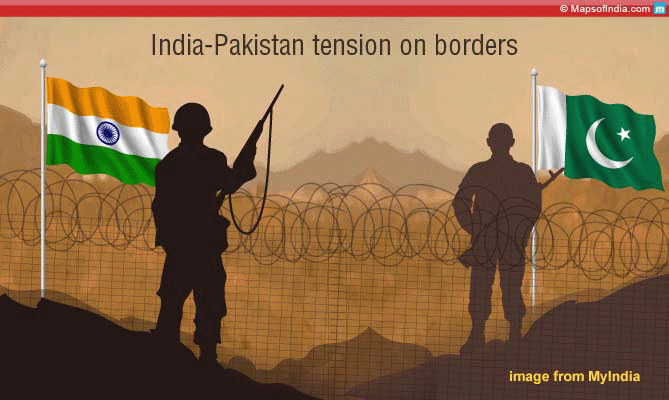
Nuclear war should never happen as it is the most destructive thing imaginable. While nuclear weapon war anywhere is so destructive that this cannot be accepted, it is at its most cruel in more densely populated areas. No one can question this reality, but despite this we have the most dreadful and frightening situation of escalating conflict between India and Pakistan, two nuclear weapon countries which possess a total of about 340 nuclear weapons, according to recent estimates, and are also included among the most densely populated countries of the world, in terms of people living per one square km.
While the average world population density for the entire world is 60, it is 331 for Pakistan and 483 for India. In several cities and the most densely populated city districts of these countries, the population density can be easily over 5,000, going up to around 55,000 in the most densely populated city district (Karachi Central). While war even with conventional weapons can be very highly destructive in such conditions, in the context of nuclear weapons, even smaller and tactical ones, this is too cruel even to be imagined. Yet the possibility cannot be brushed aside and must be considered as a real life possibility, a relatively low possibility but nevertheless real possibility, whenever the two countries are involved in escalating conflict situations.
Eric Schlosser, a well-known writer on nuclear weapons, has spoken at length to top officials and commanders at various stages of planning and control of nuclear weapons. In addition he has close contacts with peace movements struggling for a world free from nuclear weapons. He has written that these very different persons share a very strong and sincere desire to avoid actual use of nuclear weapons.
The reason why both these sections share this strong belief is that both groups are well-informed about what actual use of nuclear weapons means. This makes them tremble about the implications.
In the specific context of India and Pakistan, the two nuclear weapon countries of South Asia, Schlosser has written, “The latest studies suggest that a relatively small nuclear exchange (relative to the total number of nuclear weapons that exist in world) would have long-term effects across the globe. A war between India and Pakistan, involving a hundred atomic bombs like the kind dropped in Hiroshima, could send five million tons of dust into the atmosphere, shrink the ozone layer by as much as fifty per cent, drop worldwide temperatures to their lowest point in a thousand years, create worldwide famines and cause more than a billion casualties.”
Thus it is clear that apart from killing millions of people immediately, war with nuclear weapons can lead to unprecedented environmental catastrophe which can kill an even larger number of people while also destroying other life-forms like never before. If the nuclear weapon exchange is between two countries alone, people particularly of neighbouring countries will also suffer very serious consequences without being involved in any dispute at all.
Some strategists have argued that there can be a less catastrophic role for nuclear weapons in the form of tactical nuclear weapons. As not just peace movements but several independent experts have pointed out, this is a highly flawed and mistaken view. A nuclear war started with tactical weapons can easily spill into a full-blown nuclear war if the opposing side also has nuclear weapons. Secondly, use of even tactical nuclear weapons can be very destructive, even for the using country!
Pakistan in particular has been keen to develop tactical nuclear weapons in recent times as it feels that this can be one way of checking and defeating an invasion by a country with superior conventional war capability and bigger economic resources. However saner scientific voices in Pakistan have warned that if Pakistan uses tactical weapons against an invading army on its land, its own military and civilian losses can be very high due to the highly destructive impacts of these weapons.
In the much earlier days of the cold war the NATO had stocked a lot of tactical nuclear weapons in West Germany to check a possible Soviet invasion. A war game Carte Blanche was played out to see the possible impacts in case of a Soviet invasion. It was realized only then that German civilian deaths from the use of tactical nuclear weapons on its own land can be higher than total German civilian deaths in the Second World War! Such is the destructive power of these weapons.
Moreover when tactical nuclear weapons have to be prepared for use then control has to be more dispersed and scattered. This increases the possibility that persons with fanatic or fundamentalist leanings can also gain access to this control. Hence the possibilities of terrorists gaining access to such control also increase at least to some extent. The Pakistani authorities including armed forces have time and again faced evidence-based criticism for supporting terror-groups and this combination of terror groups and nuclear weapons can prove very dangerous in a national as well as international context. From time to time attacks by such terror groups, some of whom also break free from the control of the authorities to a lesser or greater extent, have led to crisis situations nationally and internationally.
It is not at all justified to be under the false impression that tactical weapons provide some form of safer nuclear weapons. Let no one create such a false impression as such a delusion can be extremely catastrophic for millions and millions of people.
Let us face the reality. All evidence points to the fact that nuclear weapons should never be used. In fact even accidental use of nuclear weapons or accidents relating to nuclear weapons can be very destructive. Hence ultimately the only safe option if we care for life on earth is to give up all nuclear weapons and all weapons of mass destruction once and for all at the level of the entire world. The more you study and explore this issue, no matter which side you belong to, the only honest conclusion can be that tomorrow if not today we have to do away with nuclear weapons if we want to save life on earth; so why not make a beginning today itself.
The discussion here has been in the context of South Asia, but of course the consequences of an exchange of nuclear weapons between the USA and Russia or between the USA and China will be even more destructive, much more devastating for the world as these countries have more weapons and their destructive capacity is higher. As a part of world, South Asia will also suffer very harmful impacts from this. Hence the only safe future for us and for our children is on the path which is entirely free from nuclear weapons and entirely free of all weapons of mass destruction.
As for the immediate issue at hand, the maximum efforts need to be made to prevent further escalation of ongoing India-Pakistan conflict and also to end this conflict as early as possible.
False promises, real costs: The nuclear gamble we can’t afford
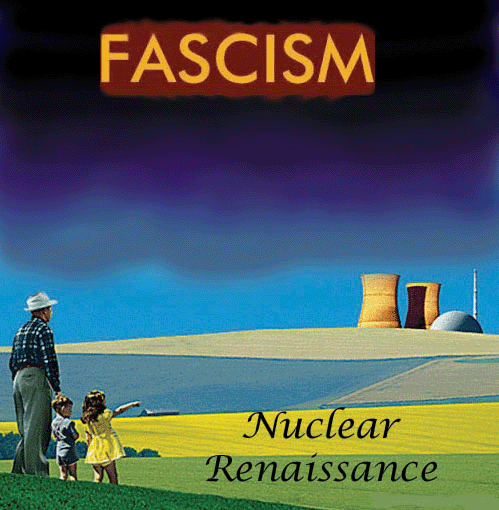
Beyond the financials, nuclear represents a specific vision of governance; centralised, top-down, and resistant to scrutiny. A small number of well-connected corporations manage most facilities. The civilian sector remains intertwined with military infrastructure. Decision-making processes often exclude community consultation. Most notably, nuclear generates waste that remains hazardous for thousands of years, demanding long-term institutional stability that even the Nuclear Waste Management Organization acknowledges no government can guarantee.
Scotland and Canada must forge an energy future that works
by Ben Beveridge, 11-05-2025 , https://bylines.scot/environment/false-promises-real-costs-the-nuclear-gamble-we-cant-afford/
Nuclear power is staging a quiet comeback. In boardrooms across Scotland and Canada, familiar promises are being repackaged as bold new solutions: reliable baseload electricity, energy security, and climate alignment. But behind the sleek rhetoric, the same truths remain. Nuclear power is still the slowest, most expensive, and least flexible energy option on the table.
Both countries now face pressure to commit to a nuclear future they neither need nor can afford. This isn’t the natural evolution of energy policy. It’s the resurrection of a failing model, defended not on merit, but on legacy interests.
In the UK, projects like Hinkley Point C and Sizewell C have seen cost projections soar, with current estimates exceeding £30bn. Scotland, despite producing 97% of its electricity from renewable sources, remains tied to a UK-wide strategy shaped by Westminster’s nuclear ambitions
In Canada, Ontario’s Darlington refurbishment has grown from C$6bn to more than C$12bn. Saskatchewan and New Brunswick are investing heavily in Small Modular Reactors (SMRs), which have yet to prove commercial viability. The Canadian Environmental Law Association has raised significant concerns over the feasibility, safety, and cost of these technologies, yet federal investment continues, often at the expense of grid modernisation and renewable storage.
Nuclear: more expensive, less flexible, needs political intervention
The narrative has shifted from energy independence to climate urgency, but the fundamentals have not. Lazard’s 2023 analysis puts the levelised cost of new nuclear at US$131–204 per megawatt-hour, while utility-scale solar sits at US$26–41, and wind at US$24–47. Nuclear projects frequently exceed ten-year construction timelines. By contrast, wind and solar facilities can be operational within five. Nuclear plants also lack the flexibility modern grids require, locking in oversupply and reducing the effectiveness of variable renewable sources.
Private capital has walked away. No nuclear facility proceeds without government subsidies, price guarantees, or risk backstops. The market has made its judgment. Nuclear survives only through political intervention, not economic logic.
Beyond the financials, nuclear represents a specific vision of governance; centralised, top-down, and resistant to scrutiny. A small number of well-connected corporations manage most facilities. The civilian sector remains intertwined with military infrastructure. Decision-making processes often exclude community consultation. Most notably, nuclear generates waste that remains hazardous for thousands of years, demanding long-term institutional stability that even the Nuclear Waste Management Organization acknowledges no government can guarantee.
Renewables: decentralised, democratic and resilient
In contrast, the model offered by renewables is decentralised, participatory, and adaptive. Community energy projects across Scotland – from the Isle of Eigg to the Outer Hebrides – demonstrate how generation can be local, democratic, and resilient. In Canada, provinces like Quebec and British Columbia have built near-100% clean grids through hydroelectricity, rejecting nuclear while Clean Energy Canada shows generational energy security and affordability.
So why does nuclear persist? The answer lies in its structure. Nuclear development creates concentrated profit centres, contracts for reactor manufacturers, engineering giants, uranium suppliers, and vertically integrated utilities. These stakeholders benefit from centralised generation, not distributed ownership. Regulatory frameworks often entrench their advantages, creating barriers for smaller-scale or community-led projects. The result is a policy environment that protects incumbents rather than enabling transition.
This is not a neutral technological debate. It’s a structural contest between legacy systems and emergent models of energy democracy. The framing may be about climate, but the stakes are about convention, and control.
Scotland and Canada renewable partnership
Scotland and Canada are uniquely positioned to lead an alternative path. Their respective strengths are complementary. A Scotland-Canada renewable partnership, modelled after the North Sea oil and gas collaboration, could drive investment in shared technologies like offshore wind, pumped hydro storage, and smart grid systems. Agencies such as Scottish Enterprise and Scotland Development International already maintain Canadian operations and could broker this cooperation directly.
The Commonwealth presents another opportunity. A Commonwealth Energy Transition Alliance could support shared investment frameworks, model policy design, and collaborative R&D between countries with aligned infrastructure and ambitions. It could also serve as a counterbalance to the lobbying power of the nuclear-industrial complex, directing climate funding towards solutions that scale affordably and equitably.
The choice facing both nations is not nuclear or catastrophe. It is between centralised systems that demand public subsidy and deliver rising costs, versus renewable models that are increasingly faster, cheaper, and community-driven. The facts are clear. The economics are settled. What remains is the political will to choose a future built for the many, not the few.
Scotland and Canada no longer need permission to lead. They need resolve. The nuclear mirage still shimmers, but it’s time to walk towards the real oasis: a clean, democratic energy future, and we have it already.
Want to know how the world really ends? Look to TV show Families Like Ours
John Harris, 1 May 25
The Danish drama is piercing in its ordinariness. In the real world, the climate crisis worsens and authoritarians take charge as we calmly look awaySun 11 May 2025 21.35 AESTShare649
The climate crisis has taken a new and frightening turn, and in the expectation of disastrous flooding, the entire landmass of Denmark is about to be evacuated. Effectively, the country will be shutting itself down and sending its 6 million people abroad, where they will have to cope as best they can. Huge numbers of northern Europeans are therefore being turned into refugees: a few might have the wealth and connections to ease their passage from one life to another, but most are about to face the kind of precarious, nightmarish future they always thought of as other people’s burden.
Don’t panic: this is not a news story – or not yet, anyway. It’s the premise of an addictive new drama series titled Families Like Ours, acquired by the BBC and available on iPlayer. I have seen two episodes so far, and been struck by the very incisive way it satirises European attitudes to the politics of asylum. But what has also hit me is its portrayal of something just as modern: how it shows disaster unfolding in the midst of everyday life. At first, watching it brings on a sense of impatience. Why are most of the characters so calm? Where are the apocalyptic floods, wildfires and mass social breakdown? At times, it verges on boring. But then you realise the very clever conceit that defines every moment: it is really a story about how we all live, and what might happen tomorrow, or the day after.
The writer and journalist Dorian Lynskey’s brilliant book Everything Must Go is about the various ways that human beings have imagined the end of the world. “Compared to nuclear war,” he writes, “the climate emergency deprives popular storytellers of their usual toolkit. Global warming may move too fast for the planet but it is too slow for catastrophe fiction.” Even when the worst finally happens, most of us may respond with the kind of quiet mental contortions that are probably better suited to literature than the screen. Making that point, Lynskey quotes a character in Margaret Atwood’s novel The Year of the Flood: “Nobody admitted to knowing. If other people began to discuss it, you tuned them out, because what they were saying was both so obvious and so unthinkable.”
These days, that kind of thinking reflects how people deal with just about every aspect of our ever-more troubled world: if we can avert our eyes from ecological breakdown, then everything else can be either underestimated or ignored. There is a kind of moment, I would wager, that now happens to all of us. We glance at our phones or switch on the radio and are assailed by the awful gravity of everything, and then somehow manage to instantly find our way back to calm and normality. This, of course, is how human beings have always managed to cope, as a matter of basic mental wiring. But in its 21st-century form, it also has very modern elements. Our news feeds reduce everything to white noise and trivia: the result is that developments that ought to be vivid and alarming become so dulled that they look unremarkable.
Where this is leading politically is now as clear as day. In the New Yorker, Andrew Marantz wrote, in the wake of Trump’s re-election, about how democracies slide into authoritarianism. “In a Hollywood disaster movie,” he writes, “when the big one arrives, the characters don’t have to waste time debating whether it’s happening. There is an abrupt, cataclysmic tremor, a deafening roar … In the real world, though, the cataclysm can come in on little cat feet. The tremors can be so muffled and distant that people continually adapt, explaining away the anomalies.” That is true of how we normalise the climate crisis; it also applies to the way that Trump and his fellow authoritarians have successfully normalised their politics.
Marantz goes to Budapest, and meets a Hungarian academic, who marvels at the political feats pulled off by the country’s prime minister, Viktor Orbán. “Before it starts, you say to yourself: ‘I will leave this country immediately if they ever do this or that horrible thing,’” he says. “And then they do that thing, and you stay. Things that would have seemed impossible 10 years ago, five years ago, you may not even notice.” The fact that populists are usually climate deniers is perfect: just as searingly hot summers become mundane, so do the increasingly ambitious plans of would-be dictators – particularly in the absence of jackboots, goose-stepping and so many other old-fashioned accoutrements. Put simply, Orbán/Trump politics is purposely designed to fit with its time – and to most of its supporters (and plenty of onlookers), it looks a lot less terrifying than it actually is.
Much the same story is starting to happen in the UK. On the night of last week’s local elections, I found myself in the thoroughly ordinary environs of Grimsby town hall, watching the victory speech given by Reform UK’s Andrea Jenkyns, who had just been elected as the first mayor of Greater Lincolnshire. For some reason, she wore a spangly outfit that made her look as if she was on her way to a 1970s-themed fancy dress party, which raised a few mirthless laughs. She said it was time for an end to “soft-touch Britain”, and suddenly called for asylum seekers to be forced to live in tents. That is the kind of thing that only fascists used to say, but it now lands in our political discourse with not much more than a faint thump.
Meanwhile, life has to go on. About 20 years ago, I went to an exhibition of works by the French photographer Henri Cartier-Bresson – one of which was of a family of four adults picnicking by the Marne, with their food and wine scattered around them, and a rowing-boat moored to the riverbank. When I first looked at it, I wondered what its significance was. But then I saw the date on the adjacent plaque: “1936-38.” We break bread, get drunk and tune out the noise until carrying on like that ceases to be an option: as Families Like Ours suggests, that point may arrive sooner than we think.
Zelenskyy says he is willing to meet Putin in Istanbul for peace talks
Euronews with AP 11/05/2025
The Ukrainian president said on Sunday he expected Russia to confirm a ceasefire starting Monday, and that he was prepared to meet with his Russian counterpart in Turkey on Thursday for direct talks to end Moscow’s war, now in its fourth year.
Zelenskyy’s words came in response to Putin’s remarks to the media overnight, in which he effectively ignored the idea of a ceasefire — pushed for by Western leaders — and proposed restarting direct talks with Ukraine in Istanbul on Thursday instead “without preconditions”.
Putin did not specify whether the talks on Thursday would involve Zelenskyy and him personally.
He added, however, that “the very first step in truly ending any war is a ceasefire.” “There is no point in continuing the killing even for a single day. We expect Russia to confirm a ceasefire — full, lasting, and reliable — starting tomorrow, May 12th, and Ukraine is ready to meet,” the Ukrainian leader said on X.
German Chancellor Friedrich Merz, French President Emmanuel Macron, British Prime Minister Keir Starmer and Polish Prime Minister Donald Tusk met with Zelenskyy in Kyiv on Saturday and issued a coordinated call for a 30-day truce starting Monday. The plan has received backing from both the European Union and Washington.
The leaders pledged tougher sanctions on Russia if Putin did not accept the proposal.
Prior to the Kyiv visit by the quartet of European leaders, US President Donald Trump insisted Ukraine accept Russia’s latest offer of holding direct talks in Turkey on Thursday. Ukraine, along with European allies, had demanded that Russia accept an unconditional 30-day ceasefire starting on Monday before holding talks, but Moscow effectively rejected the proposal and called for direct negotiations instead…….
Trump said in a social media post earlier Sunday that Ukraine should agree to Putin’s peace talks proposal “immediately.”……………………………..https://www.euronews.com/2025/05/11/zelenskyy-and-putin-to-meet-in-turkiye-on-thursday-possibly
Business as usual: Australian government stalls on Defence reform as AUKUS woes grow

Above -Australia’s Defence Minister Richard Marles
Defence spending is lagging, AUKUS is stalling, and systemic mismanagement persists as Labor avoids hard structural reform.
Bernard Keane, May 11, 2025, https://www.themandarin.com.au/291901-business-as-usual-labor-stalls-on-defence-reform-as-aukus-woes-grow/
Having managed to get through an election campaign barely mentioning defence — despite the opposition trying to make it a late-stage vote winner — the newly expanded Labor government still faces a number of big challenges in the defence portfolio, and no easy answers.
The two big ones are well-known: the replacement of the US security guarantee with Trumpian chaos, which means Australia will have to strengthen its defence capability so that it has to rely less on the US, and the profound problems of AUKUS.
Despite some budget sleight of hand purporting to show an acceleration in defence spending, the government remains committed to increasing defence spending to just 2.33% of GDP — not merely well below the Trump administration’s demand for 3%, but below the Coalition’s planned increase to 2.5% and the calls from defence and security experts, as well as Labor luminaries like Kim Beazley, for a significant increase.
But the ability of the Department of Defence to handle any increase in spending — or even competently spend what it currently receives — is openly questioned even by hawks. Average major project slippage time, already alarming when the Coalition was last in power, noticeably deteriorated in Labor’s first term. The response of Defence appeared to try to hide embarrassing data from the Auditor-General under the pretence of national security.
Also characterising Labor’s first term was the admission of failure of departmental process, to the very highest echelons of Defence, in relation to the Hunter-class frigate project and the shocking audit of Defence’s dealings with Thales on munitions manufacturing (the second part of which is yet to arrive from the auditor-general).
With both defence minister Richard Marles’ track record in Labor first term, and his general insouciance toward revelations such as the Thales debacle — which included the revelation that the department had actively misled predecessor ministers — it seems unlikely Defence will face any real pressure to improve the incompetence and, quite possibly, corruption that marks its management of major procurement processes. A defence minister like Andrew Hastie, far more credentialed in military matters than most within the department, could have driven the kind of reform that would have gotten Defence backs up, and led to copious leaking against him, but improved the reliability and integrity of the department’s procurement processes. Instead, we’ll have to hope that a Labor government with a big majority and more confidence will be more willing to take on the fundamental problems in the portfolio.
A similar business-as-usual approach will likely characterise the unfolding disaster that is AUKUS. The grim reality is that US submarine construction rates are slowing, not accelerating as they need to if the US is to provide three Virginia-class nuclear submarines to Australia from 2030. In early April, the US Navy admitted to Congress significant delays in constructing its new Columbia-class ballistic missile submarine, which shares some components with the Virginia class. While the builders of the Virginia-class boats are talking bravely of demand signals and additional investment, the build rate for the subs late last year was barely above half that required by AUKUS.
None of this, apparently, is of interest to the bureaucrats charged with overseeing AUKUS. The Mandarin applied under Freedom of Information laws to the Australian Submarine Agency to see what briefing it was providing to ministers on the problems in submarine construction in the US and the UK. No such documents, came back the answer. Blind faith that the US can double the rate of submarine construction in a couple of years is one thing, but remaining ignorant of how badly off track AUKUS is? That’s quite another.
One of the key problems of the Virginia-class boats for Australia is that they require huge crews — 135 sailors, compared to just 58 for Australia’s current submarines. That brings into focus a persistent and worsening problem — our inability to attract and retain ADF members. Last year the Navy was short around 900 people. The Army was short around 5000; only the RAAF is around its mandated strength. A change of recruitment agency for the ADF proved a disaster, with portfolio minister Matt Keogh expressing his “deep disappointment” with the provider’s “wholly deficient” performance. Critics say the problem is with the ADF itself, which is “too slow and too picky”. The government announced in mid-2024 the brilliant idea of opening up the ADF to personnel from Five Eyes. countries. Only problem is, they’re all suffering the same problems with defence recruitment. In fact, armies, navies and air forces around the world are suffering ongoing recruitment problems and have done so for years — even the People’s Liberation Army is struggling to attract Chinese youth to its ranks.
In each of these areas, clearly, business as usual won’t cut it. But that is what Defence is very good at, and its ministers are very bad at preventing. To prevent it, only structural arrangements that disrupt Defence’s normal processes will achieve results. The royal commission into ADF member and veteran suicide had the right idea — and the government rightly took its lead from the commission in its response. The commission recommended a new independent statutory body to oversee reform across the whole Defence/Veterans Affairs portfolio, not a new area of Defence. And it urged, and the government agreed, that central agencies be charged with implementing the commission’s recommendations: the result was a Prime Minister and Cabinet taskforce to start implementing reforms, with the help of external expertise.
An independent agency, and a PM&C-led implementation taskforce, was what was needed to ensure Defence didn’t simply default back to business as usual when it came to the mental health of its members and veterans. Only the oversight and interference of high-powered external bodies will compel Defence to change its culture.
And it’s the only thing that will enable the government to seriously tackle the biggest challenges in the portfolio over the coming years.
Bernard Keane
Bernard Keane is a columnist for The Mandarin. He was a Canberra press gallery correspondent covering politics, national security and economics, and a public servant and speechwriter in transport and communications. He is co-author of A Short History Of Stupid, which covers the decline of reason and issues with public debate.
1 This Month
Chernobyl: The Lost Tapes – A good documentary on Chernobyl on SBS available On Demand for the next 3 weeks– https://www.sbs.com.au/ondemand/tv-program/chernobyl-the-lost-tapes/2352741955560

of the week–London Campaign for Nuclear Disarmament

Tell the Ukrainian Government to Drop Prosecution of Peace Activist Yurii Sheliazhenko
To see nuclear-related stories in greater depth and intensity – go to https://nuclearinformation.wordpress.com
-
Archives
- April 2026 (127)
- March 2026 (251)
- February 2026 (268)
- January 2026 (308)
- December 2025 (358)
- November 2025 (359)
- October 2025 (376)
- September 2025 (257)
- August 2025 (319)
- July 2025 (230)
- June 2025 (348)
- May 2025 (261)
-
Categories
- 1
- 1 NUCLEAR ISSUES
- business and costs
- climate change
- culture and arts
- ENERGY
- environment
- health
- history
- indigenous issues
- Legal
- marketing of nuclear
- media
- opposition to nuclear
- PERSONAL STORIES
- politics
- politics international
- Religion and ethics
- safety
- secrets,lies and civil liberties
- spinbuster
- technology
- Uranium
- wastes
- weapons and war
- Women
- 2 WORLD
- ACTION
- AFRICA
- Atrocities
- AUSTRALIA
- Christina's notes
- Christina's themes
- culture and arts
- Events
- Fuk 2022
- Fuk 2023
- Fukushima 2017
- Fukushima 2018
- fukushima 2019
- Fukushima 2020
- Fukushima 2021
- general
- global warming
- Humour (God we need it)
- Nuclear
- RARE EARTHS
- Reference
- resources – print
- Resources -audiovicual
- Weekly Newsletter
- World
- World Nuclear
- YouTube
-
RSS
Entries RSS
Comments RSS
 nuclear-news