Resuscitation at Zaporizhzhia?
by beyondnuclearinternational, https://beyondnuclearinternational.org/2025/05/11/resuscitation-at-zaporizhzhia/
Why would the US, Ukraine and Russia contemplate this when renewables could answer energy needs faster and more safely, writes Linda Pentz Gunter
The Trump administration has been dangling all sorts of offers before the embattled (literally) Ukrainian government lately. These include a US grab for Ukraine’s minerals in exchange for continued support of its war with Russia, and asking Ukraine to serve as an overseas prison for those residents of the US deemed “illegals” and “criminals” by Trump’s (in)justice department.
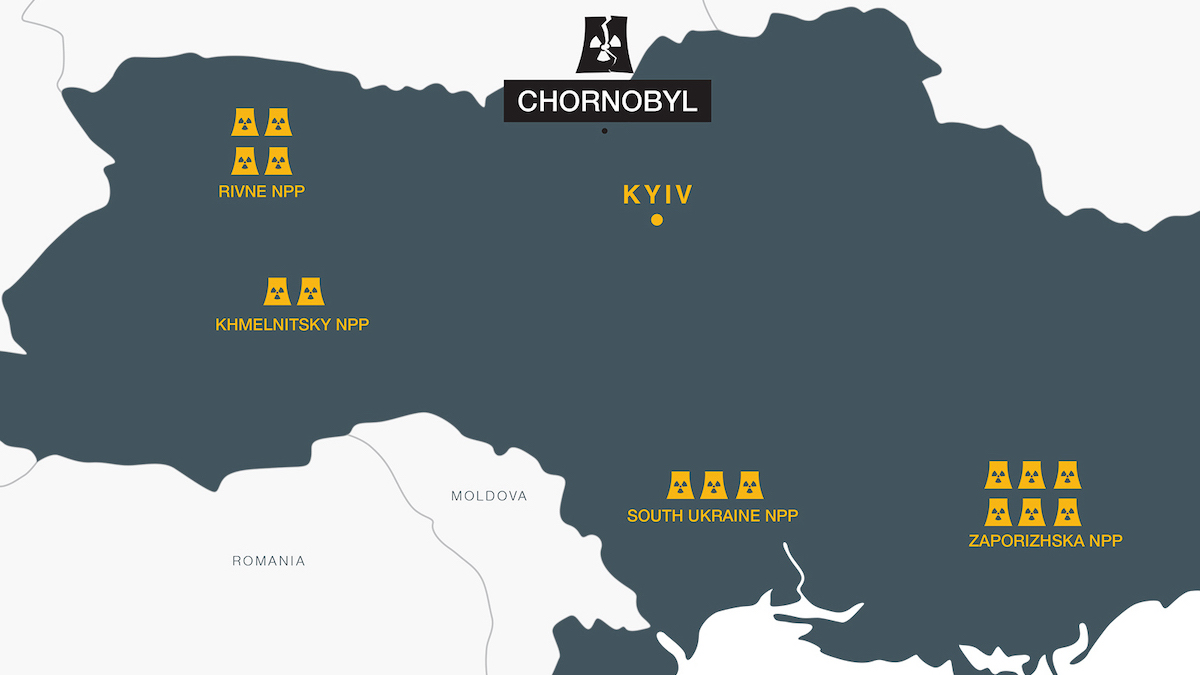
Now, the White House is apparently suggesting that the US should first rebuild and then operate the damaged six-reactor Zaporizhzhia nuclear plant in the southeast of Ukraine, the area of some of the most intense fighting between Ukrainian and Russian forces.
This bizarre proposal is detailed in a new column by the director of the Nonproliferation Policy Education Center, Henry Sokolski, in the May 6, 2025 edition of The Bulletin of the Atomic Scientists. Along with the question of whose nuclear plant Zaporizhzhia actually is, or who damaged it, Sokolski also asks just how complex and expensive restoring the plant would be and whether it is even needed?
In reading through the list of challenges to a restart that Sokolski outlines, the answer to that last question becomes increasingly more obvious: No. It is glaringly evident that nuclear power is the wrong choice for Ukraine at this point (and, we would argue, always has been).
Renewable energy can take a couple of years — and in some cases just a few months — to build and bring into operation. Given Ukraine’s previous reliance on nuclear energy for around 55% of the country’s electricity (before the war interrupted the flow), developing an energy supplier that can come on fast and doesn’t present a safety risk (under war conditions or at any other time) is, as they say here, a “no brainer”.
And yet all three countries are vying to be the one responsible for a Zaporizhzhia restart. All three are also married to the idea of a nuclear-powered future and therefore cannot be relied upon to take the more sensible renewable energy route. Even in the midst of a war, Ukraine has signaled its intention to build as many as nine new Westinghouse AP1000 reactors at all four of its existing nuclear sites —yes, even at Zaporizhzhia! Both Russia and the US are expanding their nuclear power capacity, at home as well as abroad, including through the export of reactor technology.
Why then are any of these countries even contemplating an attempt to surmount the likely insurmountable challenges of resurrecting the existing Russian built VVER Zaporizhzhia reactors, which comprise the largest nuclear power plant in Europe at 5,700 MW?
As Sokolski asks in a preamble to his Bulletin article:
“Russia destroyed the Kakhovka Dam upstream of the plant. What would be required to assure a steady clean supply of cooling water for the reactors? The Russians laid mines around the plant; the area is also laced with unexploded ordnance. How will these be neutralized? Who will do this? The Russians looted and damaged much of the plant’s control equipment. How will it be repaired and replaced? Who will certify that the work has been done properly? The U.S. Nuclear Regulatory Commission? The Ukrainian State Nuclear Regulatory Inspectorate? Rosatom?”
Then there’s the issue of cost.
“Will seized Russian assets foot the bill?” Sokolski asks. “Or will it be European Reconstruction Bank funds? What of US investment, taxpayer funds, and any private entity potentially interested in chipping in? Once funds are allocated, who would receive the profits, if any, or be responsible for the losses? Who would assume responsibility for possible accidents and damage to property beyond the plant’s site? And, finally, who will bear the costs of ensuring the plant’s security so that its reactors do not become again the targets of future attacks?”
It’s not just a question of repairing the reactors of course. It’s also an issue of repairing the damaged — and in parts destroyed — electrical grid. Even assuming Zaporizhzhia gets restared, how will the electricity it generates even reach its customers? And do they even have homes left where the lights can be switched on? Let’s remind ourselves one more time that there is a war going on in Ukraine, a bloody and protracted one that began on February 24, 2022 when Russia invaded its neighbor. (The arguments about why and what the precursors were have raged on, especially on the left, but are not the subject of this present discussion.)
There seem to be altogether too many questions surrounding a Zaporizhzhia restart to make any such prospect an even vaguely rational proposition. And there would be no need to ask any of these questions, if the obvious alternative — renewable energy — was mooted instead. These days you can ask AI — a not entirely unbiased source to be sure — which responds that Ukraine hasn’t turned to renewable energy because it “requires significant investment and infrastructure development.” Yes, but not nearly as much as trying to re-establish broken nuclear power plants and reconnect them to a destroyed electricity grid.
None of this will cross the radar at peace talks between the warring parties and the US in its self-appointed role as peacemaker. That’s because solar panels and wind turbines don’t come with the radioactive inventory that has somehow earned nuclear power a position of international — and aspirational — prestige. What it should trigger instead is an array of red warning flags, and not the kind any of us would want to “keep flying here”.
Linda Pentz Gunter is the international specialist at Beyond Nuclear and writes for and edits Beyond Nuclear International. Opinions are her own.
.
No comments yet.
1 This Month


Tell the Ukrainian Government to Drop Prosecution of Peace Activist Yurii Sheliazhenko

Petition to revoke the licensing of the Near Surface Nuclear Disposal Facility (NSDF) at Chalk River. https://www.ourcommons.ca/petitions/en/Petition/Details?Petition=e-7247


of the week – STOP SMALL MODULAR REACTORS IN CANADA
To see nuclear-related stories in greater depth and intensity – go to https://nuclearinformation.wordpress.com
-
Archives
- March 2026 (204)
- February 2026 (268)
- January 2026 (308)
- December 2025 (358)
- November 2025 (359)
- October 2025 (376)
- September 2025 (258)
- August 2025 (319)
- July 2025 (230)
- June 2025 (348)
- May 2025 (261)
- April 2025 (305)
-
Categories
- 1
- 1 NUCLEAR ISSUES
- business and costs
- climate change
- culture and arts
- ENERGY
- environment
- health
- history
- indigenous issues
- Legal
- marketing of nuclear
- media
- opposition to nuclear
- PERSONAL STORIES
- politics
- politics international
- Religion and ethics
- safety
- secrets,lies and civil liberties
- spinbuster
- technology
- Uranium
- wastes
- weapons and war
- Women
- 2 WORLD
- ACTION
- AFRICA
- Atrocities
- AUSTRALIA
- Christina's notes
- Christina's themes
- culture and arts
- Events
- Fuk 2022
- Fuk 2023
- Fukushima 2017
- Fukushima 2018
- fukushima 2019
- Fukushima 2020
- Fukushima 2021
- general
- global warming
- Humour (God we need it)
- Nuclear
- RARE EARTHS
- Reference
- resources – print
- Resources -audiovicual
- Weekly Newsletter
- World
- World Nuclear
- YouTube
-
RSS
Entries RSS
Comments RSS
 nuclear-news
Leave a comment