Resuscitation at Zaporizhzhia?
by beyondnuclearinternational, https://beyondnuclearinternational.org/2025/05/11/resuscitation-at-zaporizhzhia/
Why would the US, Ukraine and Russia contemplate this when renewables could answer energy needs faster and more safely, writes Linda Pentz Gunter
The Trump administration has been dangling all sorts of offers before the embattled (literally) Ukrainian government lately. These include a US grab for Ukraine’s minerals in exchange for continued support of its war with Russia, and asking Ukraine to serve as an overseas prison for those residents of the US deemed “illegals” and “criminals” by Trump’s (in)justice department.
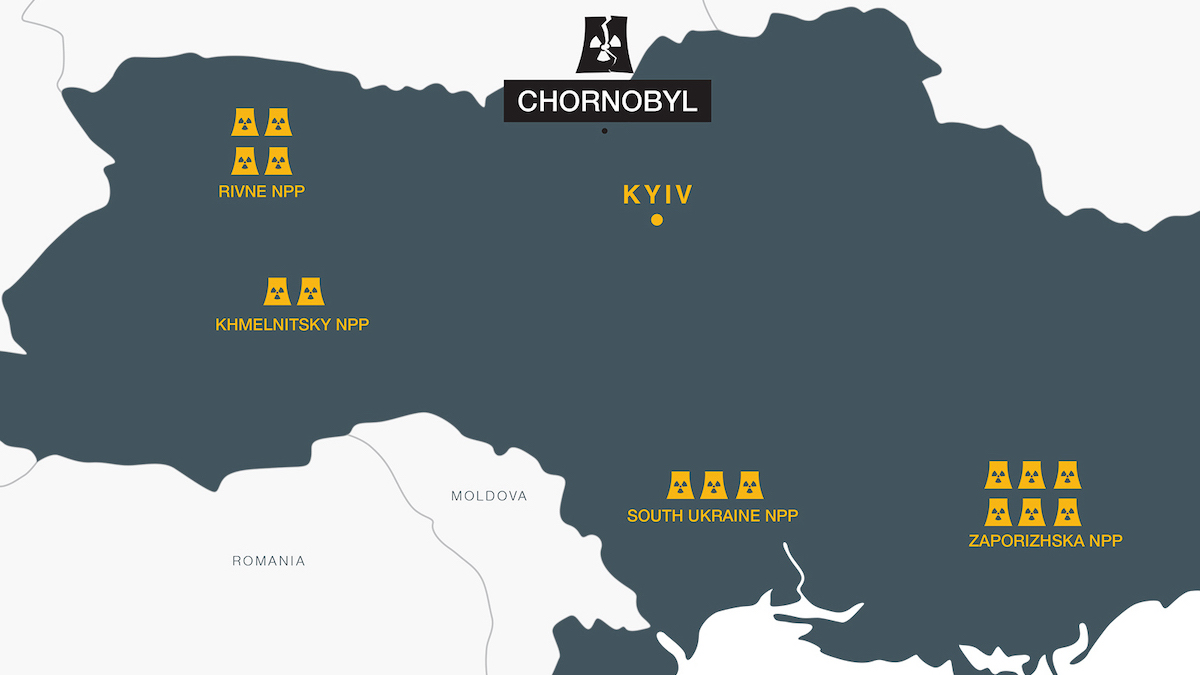
Now, the White House is apparently suggesting that the US should first rebuild and then operate the damaged six-reactor Zaporizhzhia nuclear plant in the southeast of Ukraine, the area of some of the most intense fighting between Ukrainian and Russian forces.
This bizarre proposal is detailed in a new column by the director of the Nonproliferation Policy Education Center, Henry Sokolski, in the May 6, 2025 edition of The Bulletin of the Atomic Scientists. Along with the question of whose nuclear plant Zaporizhzhia actually is, or who damaged it, Sokolski also asks just how complex and expensive restoring the plant would be and whether it is even needed?
In reading through the list of challenges to a restart that Sokolski outlines, the answer to that last question becomes increasingly more obvious: No. It is glaringly evident that nuclear power is the wrong choice for Ukraine at this point (and, we would argue, always has been).
Renewable energy can take a couple of years — and in some cases just a few months — to build and bring into operation. Given Ukraine’s previous reliance on nuclear energy for around 55% of the country’s electricity (before the war interrupted the flow), developing an energy supplier that can come on fast and doesn’t present a safety risk (under war conditions or at any other time) is, as they say here, a “no brainer”.
And yet all three countries are vying to be the one responsible for a Zaporizhzhia restart. All three are also married to the idea of a nuclear-powered future and therefore cannot be relied upon to take the more sensible renewable energy route. Even in the midst of a war, Ukraine has signaled its intention to build as many as nine new Westinghouse AP1000 reactors at all four of its existing nuclear sites —yes, even at Zaporizhzhia! Both Russia and the US are expanding their nuclear power capacity, at home as well as abroad, including through the export of reactor technology.
Why then are any of these countries even contemplating an attempt to surmount the likely insurmountable challenges of resurrecting the existing Russian built VVER Zaporizhzhia reactors, which comprise the largest nuclear power plant in Europe at 5,700 MW?
As Sokolski asks in a preamble to his Bulletin article:
“Russia destroyed the Kakhovka Dam upstream of the plant. What would be required to assure a steady clean supply of cooling water for the reactors? The Russians laid mines around the plant; the area is also laced with unexploded ordnance. How will these be neutralized? Who will do this? The Russians looted and damaged much of the plant’s control equipment. How will it be repaired and replaced? Who will certify that the work has been done properly? The U.S. Nuclear Regulatory Commission? The Ukrainian State Nuclear Regulatory Inspectorate? Rosatom?”
Then there’s the issue of cost.
“Will seized Russian assets foot the bill?” Sokolski asks. “Or will it be European Reconstruction Bank funds? What of US investment, taxpayer funds, and any private entity potentially interested in chipping in? Once funds are allocated, who would receive the profits, if any, or be responsible for the losses? Who would assume responsibility for possible accidents and damage to property beyond the plant’s site? And, finally, who will bear the costs of ensuring the plant’s security so that its reactors do not become again the targets of future attacks?”
It’s not just a question of repairing the reactors of course. It’s also an issue of repairing the damaged — and in parts destroyed — electrical grid. Even assuming Zaporizhzhia gets restared, how will the electricity it generates even reach its customers? And do they even have homes left where the lights can be switched on? Let’s remind ourselves one more time that there is a war going on in Ukraine, a bloody and protracted one that began on February 24, 2022 when Russia invaded its neighbor. (The arguments about why and what the precursors were have raged on, especially on the left, but are not the subject of this present discussion.)
There seem to be altogether too many questions surrounding a Zaporizhzhia restart to make any such prospect an even vaguely rational proposition. And there would be no need to ask any of these questions, if the obvious alternative — renewable energy — was mooted instead. These days you can ask AI — a not entirely unbiased source to be sure — which responds that Ukraine hasn’t turned to renewable energy because it “requires significant investment and infrastructure development.” Yes, but not nearly as much as trying to re-establish broken nuclear power plants and reconnect them to a destroyed electricity grid.
None of this will cross the radar at peace talks between the warring parties and the US in its self-appointed role as peacemaker. That’s because solar panels and wind turbines don’t come with the radioactive inventory that has somehow earned nuclear power a position of international — and aspirational — prestige. What it should trigger instead is an array of red warning flags, and not the kind any of us would want to “keep flying here”.
Linda Pentz Gunter is the international specialist at Beyond Nuclear and writes for and edits Beyond Nuclear International. Opinions are her own.
.
Multiple Western Press Outlets Have Suddenly Pivoted Hard Against Israel
So if you’re still supporting Israel after all this time, my advice to you is to make a change while you still can.
Caitlin Johnstone, May 12, 2025, https://www.caitlinjohnst.one/p/multiple-western-press-outlets-have?utm_source=post-email-title&publication_id=82124&post_id=163390896&utm_campaign=email-post-title&isFreemail=true&r=1ise1&triedRedirect=true&utm_medium=email
After a year and a half of genocidal atrocities, the editorial boards of numerous British press outlets have suddenly come out hard against Israel’s onslaught in Gaza.
The first drop of rain came last week from The Financial Times in a piece by the editorial board titled “The west’s shameful silence on Gaza,” which denounces the US and Europe for having “issued barely a word of condemnation” of their ally’s criminality, saying they “should be ashamed of their silence, and stop enabling Netanyahu to act with impunity.”
Then came The Economist with a piece titled “The war in Gaza must end,” which argues that Trump should pressure the Netanyahu regime for a ceasefire, saying that “The only people who benefit from continuing the war are Mr Netanyahu, who keeps his coalition intact, and his far-right allies, who dream of emptying Gaza and rebuilding Jewish settlements there.”
On Saturday came an editorial from The Independent titled “End the deafening silence on Gaza — it is time to speak up,” arguing that British PM Keir Starmer “should be ashamed that he said nothing, especially since Mr Netanyahu has now announced new plans to expand the already devastating bombardment of Gaza,” and saying that “It is time for the world to wake up to what is happening and to demand an end to the suffering of the Palestinians trapped in the enclave.”
On Sunday The Guardian editorial board joined in with a write-up titled “The Guardian view on Israel and Gaza: Trump can stop this horror. The alternative is unthinkable,” saying “The US president has the leverage to force through a ceasefire. If he does not, he will implicitly signal approval of what looks like a plan of total destruction.”
“What is this, if not genocidal?” The Guardian asks. “When will the US and its allies act to stop the horror, if not now?”
To be clear, these are editorials, not op-eds. This means that they are not the expression of one person’s opinion but the stated position of each outlet as a whole. We’ve been seeing the occasional op-ed which is critical of Israel’s actions throughout the Gaza holocaust in the mainstream western press, but to see the actual outlets come out aggressively denouncing Israel and its western backers all at once is a very new development.
Some longtime Israel supporters have unexpectedly begun changing their tune as individuals as well.
Conservative MP Mark Pritchard said at the House of Commons last week that he had supported Israel “at all costs” for decades, but said “I got it wrong” and publicly withdrew that support over Israel’s actions in Gaza.
“For many years — I’ve been in this House twenty years — I have supported Israel pretty much at all costs, quite frankly,” Pritchard said. “But today, I want to say that I got it wrong and I condemn Israel for what it is doing to the Palestinian people in Gaza and indeed in the West Bank, and I’d like to withdraw my support right now for the actions of Israel, what they are doing right now in Gaza.”
“I’m really concerned that this is a moment in history when people look back, where we’ve got it wrong as a country,” Pritchard added.
Pro-Israel pundit Shaiel Ben-Ephraim, who had been aggressively denouncing campus protesters and accusing Israel’s critics of “blood libel” throughout the Gaza holocaust, has now come out and publicly admitted that Israel is committing a genocide which must be opposed.
“It took me a long time to get to this point, but it’s time to face it. Israel is committing genocide in Gaza,” Ephraim tweeted recently. “Between the indiscriminate bombing of hospitals, starvation of the population, plans for ethnic cleansing, slaughter of aid workers and cover ups, there is no escaping it. Israel is trying to eradicate the Palestinian people. We can’t stop it unless we admit it.”
It is odd that it has taken all these people a year and a half to get to this point. I myself have a much lower tolerance for genocide and the mass murder of children. If you’ve been riding the genocide train for nineteen months, it looks a bit weird to suddenly start screaming about how terrible it is and demanding to hit the brakes all of a sudden.
These people have not suddenly evolved a conscience, they’re just smelling what’s in the wind. Once the consensus shifts past a certain point there’s naturally going to be a mad rush to avoid being among the last to stand against it, because you know you’ll be wearing that mark for the rest of your life in public after history has had a clear look at what you did.
This is after all coming at a time when the Trump administration is beginning to rub Netanyahu’s fur the wrong way, recently prompting the Israeli prime minister to say “I think we’ll have to detox from US security assistance” when Washington went over Tel Aviv’s head and negotiated directly with Hamas to secure the release of an American hostage. The US is reportedly leaving Israel out of more and more of its negotiations on international affairs in places like Yemen, Saudi Arabia, and Iran. Something is changing.
So if you’re still supporting Israel after all this time, my advice to you is to make a change while you still can. There’s still time to be the first among scoundrels in the mad rat race to avoid being the last to start acting like you always opposed the Gaza holocaust.
Trump considers weakening nuclear agency in bid for more power plants.

The draft orders accuse the Nuclear Regulatory Commission of unnecessary
“risk aversion.” The White House is drafting plans to weaken the
independence of the nation’s nuclear safety regulators and relax rules
that protect the public from radiation exposure, moves it says are needed
to jump-start a nuclear power “renaissance,” according to internal
documents reviewed by The Washington Post.
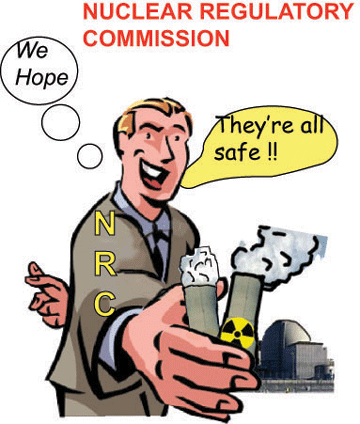
Four draft executive orders circulating in the administration would streamline approvals for new nuclear power plants. The White House contends the current process at the
Nuclear Regulatory Commission is bogged down by excessive safety concerns.
“The NRC does not view its duty as promoting safe, abundant nuclear
energy with regulatory clarity, flexibility and speed but rather insulating
Americans from the most remote risks without regard for the domestic or
geopolitical costs of its risk aversion,” says a draft order directing
“reform” of the agency. It notes that the agency — which is charged
with protecting the American public from nuclear disaster — has approved
only five new reactors since 1978, and only two have been built. There are
94 nuclear reactors operating in the United States.
Washington Post 10th May 2025,
https://www.washingtonpost.com/us-policy/2025/05/09/nuclear-power-plants-nrc-trump-safety/
Who’s afraid of big, bad China?

Neither side wanted to bring China into the debate, and neither side wanted to discuss AUKUS, which is based on a perceived need to take military action against that country.
In the recent Australian election, Neither side wanted to bring China into the debate, and neither side wanted to discuss AUKUS, which is based on a perceived need to take military action against that country.
Jocelyn Chey, May 7, 2025 , https://johnmenadue.com/post/2025/05/whos-afraid-of-big-bad-china/
Be afraid, be very afraid. But not of China. To the contrary, the proper management of co-operative relations with China is essential to Australia’s future.
Finally, the election process is over and done with and the results are in. We look forward to news bulletins not dominated by party spokespeople spruiking how they will deal with the cost of living. Rents, health and transport costs are all important, but the big issues that will make or break their social policies are all global, and the real question is how we can front up to them and hopefully turn them to our benefit. If the world goes into recession, which is a very real possibility, we will all be affected. The cost of living will go up. Cuts to social services will be inevitable.
Why did the candidates not admit this? Do they have contingency plans and, if so, what are they? What are they afraid of? Were they scared that if they mentioned China, the US or Russia, they would lose votes, or be backed into election promises that they could not keep? Or were there structural weaknesses in their policies that they did not wish to expose to scrutiny?
In previous election campaigns, the candidates were not so hesitant to pronounce on international affairs. The 2001 election was dominated by immigration issues and the terrorist attack on the Twin Towers in New York. It was the first “khaki election” since the Vietnam War. In the 2022 election, the Morrison Government tried to repeat their 2001 success by promoting fear of Chinese invasions, both military or cultural, but their attempt failed. This time around, both sides of politics have been careful about their choice of language and avoided difficult topics.
Insofar as national security featured at all in the elections, Labor and the Liberals competed to portray themselves as the better party to protect Australia’s international relationships, particularly in the Pacific. Penny Wong accused the Liberals of leaving a “vacuum” that China was ready to fill, but she did not directly accuse Beijing. The one attempt to whip up fear of an invasion was pinned onto Moscow, rather than Beijing, when news broke of a possible deal between Russia and Indonesia about developing a military airbase in West Papua.
Neither side wanted to bring China into the debate, and neither side wanted to discuss AUKUS, which is based on a perceived need to take military action against that country. Labor and Liberal both promised to increase defence spending, one side to 2.3% of GDP, and the other side to 3% over 10 years. Neither mentioned the reasons for such an increase, or where the money would be found. AUKUS is already absorbing all the increases announced by the last government and affecting other procurement needs. AUKUS spending over the next five years is estimated to reach $18 billion and ultimately will total $368 billion, not including the cost of new infrastructure such as a dedicated naval base at HMAS Stirling. The rationale for nuclear-powered vessels is not the defence of our coasts, but the perceived need to attack distant targets, and that target is China.
China has been progressively opening to the world since the 1980s. It is a permanent member of the UN Security Council and an active member of many multilateral organisations. With Australian encouragement, it has engaged with the multilateral trade system, joined APEC and the World Trade Organisation. The domestic economy has flourished in this open environment and in a region that has not seen armed conflict since the end of the Vietnam War. Maintaining strong growth and raising living standards have been the main pillars of Chinese domestic policies.
Economic development has not always been smooth, and recently new problems have emerged on the international front. China trusted the established international governance system to support and regulate its growth, but, as the country grew stronger, it became evident that the US did not return that trust. Its rapid rise and increasing global presence changed the regional and global balance and generated a geopolitical response that was perhaps predictable.
In 2025, the Trump administration has not yet clarified its policy for handling the relationship with China. Tariffs have been imposed, increased and decreased, and threats and hints have been made by the White House. All is chaos. The only thing that is certain is that Trump will challenge China in a more transactional and unpredictable way, will intensify trade confrontations and sanction Chinese companies in his goal to achieve greater self-sufficiency in the US.
In Beijing, Xi Jinping’s response has been measured and consistent. Official statements emphasise that China supports international rules and regulations and the multilateral system. During the National People’s Congress in March, Foreign Minister Wang Yi in a briefing to the international press presented China as a responsible and stable global power and, without explicitly saying so, drew comparisons with Trump’s America and its chaotic pronouncements.
He said: “We will provide certainty to this uncertain world. … We will be a staunch force defending our national interests. … We will be a just and righteous force for world peace and stability. … We will be a progressive force for international fairness and justice. We will be a constructive force for common development of the world.”
The contrast with Trump’s Tweets could not be more striking.
China is now truly integrated into the global economy. National policy has determined this, and, in any case, it would have been inevitable, given the development of advanced technologies and information and communication systems, all requiring international engagement. China, above all, wants stability and security in international relations to underpin its economic growth. In the future, the major challenges that the world will face are global. Climate change cannot be tackled without international co-operation. Australia needs more than ever to understand China and its domestic and foreign policies.
Co-operation with China is not easy. To borrow Trump’s words, “They hold the cards”. Australia, however, is not alone, and the best response to China is to consult and co-ordinate with neighbouring countries who also regularly interact with the rising superpower. Singapore, Thailand, Vietnam, Malaysia, all have important trade and diplomatic ties with China and have much experience to share about how to manage a relationship with China, a regional power and a global superpower. Australia should be able to manage relations with China. If we respect Beijing’s legitimate rights, Beijing will respect ours
It is possible. China has no history of annexing other countries as Russia annexed Crimea. It respects other countries’ autonomy more than Trump respects the sovereignty of Mexico, Canada or Greenland. It has claims over a large part of the South China Sea that on the surface suggest aggressive intent, but this is not a new claim. The “nine dash line” outlining its territorial claim was first proposed by the then Nationalist government in 1948, and the government of Taiwan still maintains this position. Considering that China is surrounded by a string of US bases along the “first island chain” from Japan to the Philippines, amid that Camp Humphreys, near Seoul in South Korea, the largest US overseas military base, is just 549 kms from the city of Dalian in northeast China, it is not surprising that China should wish to limit further US advances.
As for the other superpower, in the first 100 days of the Trump regime, he has attempted to use the legal system to carry out his personal vendettas. He has shut down many government departments. He has attacked scientific research and the universities and disregarded statistical evidence, particularly in medical science and climate science. He is prejudiced against immigrants. He dismisses the most basic ideas of trade and economics. He prefers to deal with other autocrats like Vladimir Putin and has turned his back on international agreements and treaties.
Be afraid, be very afraid. But not of China.
(This is a summary of a talk given at the Festival of Wild Ideas, St Paul’s Burwood, on 4 May 2025)
1 This Month


Tell the Ukrainian Government to Drop Prosecution of Peace Activist Yurii Sheliazhenko

Petition to revoke the licensing of the Near Surface Nuclear Disposal Facility (NSDF) at Chalk River. https://www.ourcommons.ca/petitions/en/Petition/Details?Petition=e-7247


of the week – STOP SMALL MODULAR REACTORS IN CANADA
To see nuclear-related stories in greater depth and intensity – go to https://nuclearinformation.wordpress.com
-
Archives
- March 2026 (204)
- February 2026 (268)
- January 2026 (308)
- December 2025 (358)
- November 2025 (359)
- October 2025 (376)
- September 2025 (258)
- August 2025 (319)
- July 2025 (230)
- June 2025 (348)
- May 2025 (261)
- April 2025 (305)
-
Categories
- 1
- 1 NUCLEAR ISSUES
- business and costs
- climate change
- culture and arts
- ENERGY
- environment
- health
- history
- indigenous issues
- Legal
- marketing of nuclear
- media
- opposition to nuclear
- PERSONAL STORIES
- politics
- politics international
- Religion and ethics
- safety
- secrets,lies and civil liberties
- spinbuster
- technology
- Uranium
- wastes
- weapons and war
- Women
- 2 WORLD
- ACTION
- AFRICA
- Atrocities
- AUSTRALIA
- Christina's notes
- Christina's themes
- culture and arts
- Events
- Fuk 2022
- Fuk 2023
- Fukushima 2017
- Fukushima 2018
- fukushima 2019
- Fukushima 2020
- Fukushima 2021
- general
- global warming
- Humour (God we need it)
- Nuclear
- RARE EARTHS
- Reference
- resources – print
- Resources -audiovicual
- Weekly Newsletter
- World
- World Nuclear
- YouTube
-
RSS
Entries RSS
Comments RSS
 nuclear-news