Expulsion and Occupation: Israel’s Proposed Gaza Plan
May 7, 2025 Dr Binoy Kampmark, https://theaimn.net/expulsion-and-occupation-israels-proposed-gaza-plan/
Killing civilians wholesale, starving them to convince those unaffected to change course, and shepherding whole populations like livestock into conditions of further misery would all qualify as heinous crimes in international law. When it comes to Israel’s war in Gaza, this approach is seen as necessary politics, unalloyed by the restraints of humanitarianism. When confronted with these harsh realities on the ground, unequivocal denials follow: This is not happening in Gaza; no one is starving. And if that were the case, blame those misguided savages in Hamas.
As the conflict chugs along in pools of blood and bountiful gore, the confused shape of Israel’s intentions continues in all its glorious nebulousness. Pretend moderation clouds murderous desire. There is no sense that those unfortunate Israeli hostages captured by Hamas in its assault on October 7, 2023 matter anymore, being merely decorative for the imminent slaughter. There is even less sense that Hamas will be cleansed and removed from the strip, however attractive this idea continues to be.
Such evident limits have not discouraged Prime Minister Benjamin Netanyahu and his cabinet, who have decided that more force, that old province of the unimaginative, is the answer. According to the PM, the cabinet had agreed on a “forceful operation” to eliminate Hamas and salvage what is left of the hostage situation.
A spokesperson for the Israel Defense Forces, Brigadier-General Effie Defrin, has explained on Israeli radio that the offensive will apparently ensure the return of the hostages. What follows will be “the collapse of the Hamas regime, its defeat, its submission.” Anywhere up to two million Palestinian civilians in Gaza will be herded into the ruins of the south. Humanitarian aid will be arranged by the Israeli forces, to be possibly distributed through approved contractors.
The IDF chief of staff, Lt. General Eyal Zamier, confirmed that the approved plan will involve “the capture of the Strip and holding the territories, moving the Gazan population south for its defence, denying Hamas and the ability to distribute humanitarian supplies, and powerful attacks against Hamas.”
Within the Israeli cabinet, ethnocentric and religious fires burn with bright fanaticism. The Israeli Finance Finister Bezalel Smotrich remains a figure who ignores floral subtlety in favour of the blood-stained sledgehammer. He remains that coherent link between cruel lawmaking and baffling violence. “Within a few months,” he boasts, “we will be able to declare that we have won. Gaza will be totally destroyed.” With pompous certitude, he also claimed that the next six months would see Hamas cease to exist.
Such opinions, expressed at the “Settlements Conference” organised by the Makor Rishon newspaper in Ofra, a West Bank settlement, gives a sense of the flavour. Palestinians are to be “concentrated” on land located between the Egyptian border and the arbitrarily designated Morag Corridor. As with any potential abuser keen to violate his vulnerable charges while justifying it, Smotrich tried to impress with the idea that this was a “humanitarian” zone that would be free of “Hamas and terrorism.”
The program here is clear in its chilling crudeness. Expulsion, relocation, transfer. These are the words famously used to move on populations of sizeable number in history, often at enormous cost. That this should involve lawmakers of the Jewish state adds a stunning, if perverse poignancy to this. They, the moved on in history, the expelled and the condemned wanderers, shall expel others and condemn them in turn. Smotrich also points the finger to desperation and hopelessness, the biting incentives that propel migration. The Palestinians will feel blessed in their banishment. “They will be totally despairing, understanding that there is no hope and nothing to look for in Gaza, and will be looking for relocation to begin a new life in other places.”
Impossible to ignore in Smotrich’s steaming bile against the Palestinians is the broader view that no Palestinian state can arise, necessitating urgent, preventative poisoning. In addition to the eventual depopulation of Gaza, plans to reconstitute the contours of the West Bank, ensuring that Israeli and Palestinian traffic are separated to enable building and construction for settlements as a prelude to annexation, are to be implemented.
The issue of twisting and mangling humanitarian aid in favour of Israel’s territorial lust has raised some tart commentary. A statement from the Humanitarian Country Team of the Occupied Palestinian Territory, a forum led by the UN Office for the Coordination of Humanitarian Affairs (OCHA), does not shy away from the realities on the ground. All supplies, including those vital to survival, have been blocked for nine weeks. Bakeries and community kitchens have closed, while warehouses are empty. Hunger, notably among children, is rampant. Israel’s plan, as presented, “will mean that large parts of Gaza, including the less mobile and most vulnerable people, will continue to go without supplies.”
The UN Secretary General and the Emergency Relief Coordinator have confirmed that they will not cooperate in the scheme, seeing that it “does not adhere to the global humanitarian principles of humanity, impartiality, independence and neutrality.”
The same point has been made by the foreign ministers of the United Kingdom, France and Germany. Despite all being solid allies of Israel, they have warned that violations of international law are taking place. “Humanitarian aid must never be used as a political tool and a Palestinian territory must not be reduced nor subjected to any demographic change.”
To date, a promise lingers that the offensive will only commence once US President Donald Trump’s visit to Saudi Arabia, the United Arab Emirates and Qatar takes place. But no ongoing savaging of Gaza with some crude effort at occupation will solve the historical vortex that continues to drag the Jewish state risk and oblivion.
Russian drone strike caused tens of millions worth of damage to Chornobyl
Attack damaged €1.5bn containment structure over nuclear reactor with repair costs likely to be borne by western governments
Russian drone strike caused tens of millions worth of damage to Chornobyl
Attack damaged €1.5bn containment structure over nuclear reactor with repair costs likely to be borne by western governments
Dan Sabbagh in Chornobyl. Photography by Julia KochetovaWed 7 May 2025
A Russian Shahed drone costing up to £75,000 is estimated to have inflicted tens of millions worth of damage to the site of the Chornobyl nuclear power plant, according to initial assessments and engineering experts.
The cost of a full fix is likely to be borne by western governments including the UK, because initial estimates are that a complete repair will cost more than the €25m available in a special international contingency fund.
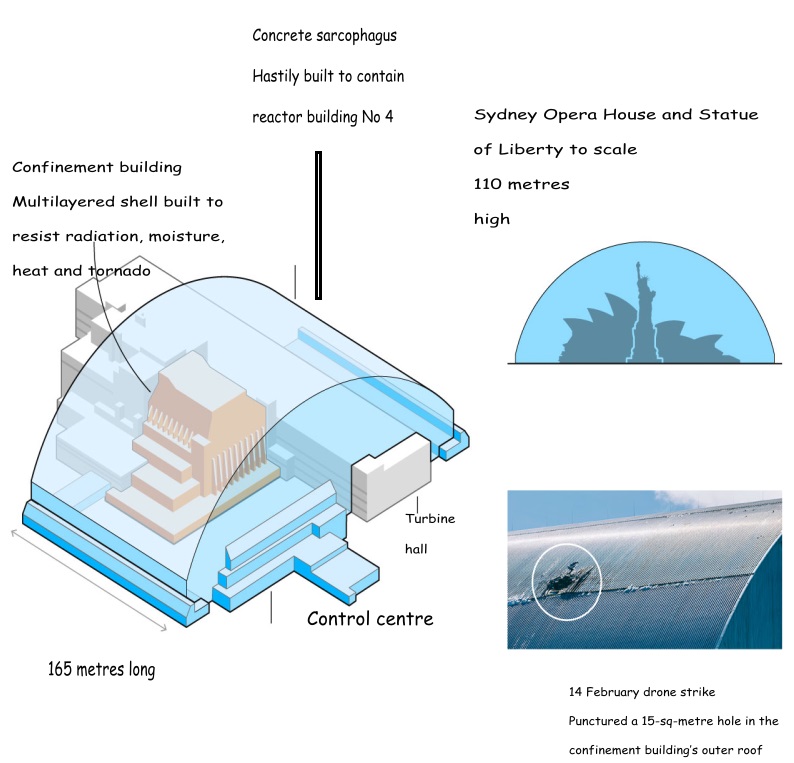
The strike in mid February did not cause an immediate radiological risk, but it significantly damaged the €1.5bn containment structure built in 2017 to encase the destroyed reactor and is likely to take months if not years to completely repair.
The 110-metre high steel structure at Chornobyl was hit before 2am on 14 February, with sensors registering “something like a 6 to 7 magnitude earthquake,” according to Serhiy Bokov, the chief engineer on duty. “But we clearly understood it wasn’t that,” he said.
The attack – quickly concluded to be caused by a drone flying below at a level where it could not be detected by radar – punctured a 15-sq-metre hole in the outer roof. It also caused a particularly damaging, complex smouldering fire to the inner cladding of the structure that took over a fortnight to put out.
Consisting of two double arches and longer than two jumbo jets, the New Safe Confinement (NSC) was completed in 2017 to secure the hastily built, unstable Soviet-era sarcophagus, which covers over Chornobyl’s ill-fated reactor number four, the site of the world’s worst nuclear disaster in April 1986.
But the attack in February has rendered the sarcophagus open to the elements again, meaning that radioactive dust could get out and rainwater in, though the country’s environmental protection ministry says “the radiation background is currently within normal level and is under constant control”.
More significantly, the confinement structure is now more vulnerable in the longer term to rusting due to greater exposure to the elements and damage to the cladding. Two hundred small boreholes were also drilled into the structure in the effort to douse the cladding fire with water.
“Not fixing it is not an option,” said Eric Schmieman, an American engineer who worked on the design and build of the Chornobyl shelter for 15 years. A complete repair, he said would “cost a minimum of tens of millions of dollars and it could easily go to hundreds of millions” with the repairs taking “months to years,” he added.
Previously the shelter was intended to have a 100-year design life, allowing time to decommission the sarcophagus and nuclear waste below, but this is now in doubt without it being repaired, Schmieman added. Unlike other large metal structures, such as the Eiffel Tower, it was never possible to repaint it to prevent corrosion.
Below the sarcophagus lies a highly radioactive lava like mass, a mix of 200 tonnes of uranium from Chornobyl reactor number four and 5,000 tonnes of sand, lead and boric acid dropped on to the site by Soviet helicopters in the immediate aftermath of the disaster caused by the reactor going out of control.
A more detailed impact assessment is expected to be released in May, but the European Bank for Reconstruction and Development (EBRD), which funded the building of the shelter and is involved in the post bombing analysis, said “it is clear that the attack has caused significant damage”.
Other sources, familiar with the assessment exercise, told the Guardian that Schmieman’s estimates appeared correct. Though the EBRD holds €25m in funds to allow for emergency work, it said “significantly more funding is required” to tackle long-term decommissioning challenges thrown up by the incident…………………………………………………
Further cash for repairs is most likely to come from western governments. Twenty-six countries contributed to the cost of the original shelter, including the US, UK, France, Germany and even Russia – of which the vast steel arch structure cost €1.5bn out of a total €2.1bn fund. Others also made donations, including Turkey.
Home to the remains of a nuclear reactor that went out of control and exploded in April 1986, the Chornobyl site is seven miles from the border with Russia’s ally Belarus. It was occupied by Russian soldiers trying to capture Kyiv in February 2022, and has remained on the frontline after Ukraine regained it that April……………………………………………….
Remotely operated cranes hanging from the confinement shelter were intended to dismantle the sarcophagus and nuclear material below, and the strike hit a point near the maintenance garage Bokov said. That too may impair the plans to gradually dismantle and decommission the disaster site below……………………………….. https://www.theguardian.com/world/2025/may/07/russian-drone-strike-caused-tens-of-millions-worth-of-damage-to-chornobyl
Zaporizhzhia: Hurdle or catalyst for a peace deal in Ukraine?
May 6, 2025, Henry Sokolski , https://npolicy.org/zaporizhzhia-hurdle-or-catalyst-for-a-peace-deal-in-ukraine/
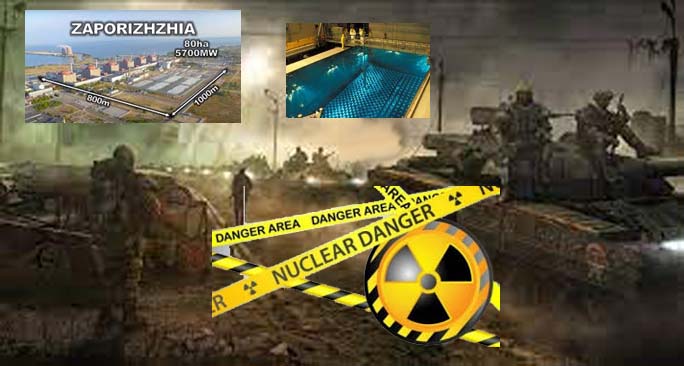
In all the peace proposals the United States, Russia, Europe, and Ukraine have made public, one item always shows up: the reopening of the damaged six-reactor Zaporizhzhia nuclear plant. Washington wants to rebuild and operate it, Moscow insists the plant is theirs, and Kyiv says that it must remain Ukrainian. But, it will be to restart the plant.
Russia insists it can get at least one of the reactors up and running within several months. The United States has no timeline. Ukraine says, even with a solid peace and full control over the plant, bringing all six reactors back online would still take two years or more. No one has ventured how much any of this would cost.
And, there are additional challenges. Russia destroyed the Kakhovka Dam upstream of the plant. Now, what would be required to assure a steady clean supply of cooling water for the reactors? The Russians also laid mines around the plant; the area is also laced with unexploded ordnance. How will these munitions be neutralized? Who will do it? The Russians have looted and damaged much of the plant’s control equipment. How will it be repaired and replaced? Who will certify that the work has been done properly? The U.S. Nuclear Regulatory Commission? The Ukrainian State Nuclear Regulatory Inspectorate? Rosatom?
More than 75 percent of Zaporizhzhia’s nuclear staff no longer work at the plant. Can they be replaced? Who will replace them? Then, there’s the challenge of rebuilding all of the damaged power lines and transformers necessary to export any electricity from the site. Where will the electricity be sent? Ukraine? The European Union? Russian territories? Who will pay for all of this work? Who will be held responsible if there are accidents? Who will defend the plant against future attacks? The United States? Ukraine? Russia? The EU?
There are even more questions than these. But as I make clear in the attached piece, we need to get the answers if we want the situation with Zaporizhzhia to be anything other than a hurdle to reaching any lasting peace.
……… Power for whom and at what cost? Even if the Zaporizhzhia reactors could be safely restarted, the problem of distributing the plant’s power remains. Before the war, Zaporizhzhia helped feed Ukraine’s electrical grid and exported surplus power to Europe. Now, the infrastructure connecting the plant to customers is shattered. Transmission lines must be rebuilt. Substations and transformers need replacement. Technical adjustments will need to be made and agreements negotiated over where the electricity will go and how: western Europe, southern Ukraine, or to Russian-controlled territories?
Another question is who will pay for all this work? Will seized Russian assets foot the bill? Or will it be European Reconstruction Bank funds? What of US investment, taxpayer funds, and any private entity potentially interested in chipping in? Once funds are allocated, who would receive the profits, if any, or be responsible for the losses? Who would assume responsibility for possible accidents and damage to property beyond the plant’s site? And, finally, who will bear the costs of ensuring the plant’s security so that its reactors do not become again the targets of future attacks? None of this is yet clear.
As Ukraine, the United States, and Russia have all made refurbishing and operating Zaporizhzhia a condition for peace, dodging these questions is a prescription for mischief. Without clear answers, resurrecting Zaporizhzhia could become more of an obstacle to than a catalyst for peace.
Henry Sokolski is executive director of the Nonproliferation Policy Education Center in Arlington, Virginia, served as Deputy for Nonproliferation Policy at the Pentagon (1989-93), and is author of China, Russia and the Coming Cool War (2024).
US Administration’s initial proposal sees cuts to nuclear energy budget
The US President’s initial discretionary budget request for fiscal 2026 cuts some USD4.7 billion from the Department of Energy’s federal funding, including a USD408 million cut to the Office of Nuclear Energy
World Nuclear News 6th May 2025, https://www.world-nuclear-news.org/articles/us-administrations-initial-proposal-sees-cuts-to-nuclear-energy-budget
1 This Month


18 March Webinar @ 1 PM EST: An Assessment of SMR Projects: The Case of Canada
register for the zoom:
https://us02web.zoom.us/webinar/register/WN_o8BIIOUvQ2ONJR1nta65DQ#/registration


of the week – STOP SMALL MODULAR REACTORS IN CANADA
To see nuclear-related stories in greater depth and intensity – go to https://nuclearinformation.wordpress.com
-
Archives
- March 2026 (146)
- February 2026 (268)
- January 2026 (308)
- December 2025 (358)
- November 2025 (359)
- October 2025 (376)
- September 2025 (258)
- August 2025 (319)
- July 2025 (230)
- June 2025 (348)
- May 2025 (261)
- April 2025 (305)
-
Categories
- 1
- 1 NUCLEAR ISSUES
- business and costs
- climate change
- culture and arts
- ENERGY
- environment
- health
- history
- indigenous issues
- Legal
- marketing of nuclear
- media
- opposition to nuclear
- PERSONAL STORIES
- politics
- politics international
- Religion and ethics
- safety
- secrets,lies and civil liberties
- spinbuster
- technology
- Uranium
- wastes
- weapons and war
- Women
- 2 WORLD
- ACTION
- AFRICA
- Atrocities
- AUSTRALIA
- Christina's notes
- Christina's themes
- culture and arts
- Events
- Fuk 2022
- Fuk 2023
- Fukushima 2017
- Fukushima 2018
- fukushima 2019
- Fukushima 2020
- Fukushima 2021
- general
- global warming
- Humour (God we need it)
- Nuclear
- RARE EARTHS
- Reference
- resources – print
- Resources -audiovicual
- Weekly Newsletter
- World
- World Nuclear
- YouTube
-
RSS
Entries RSS
Comments RSS
 nuclear-news