‘Sitting ducks’: the cities most vulnerable to climate disasters.
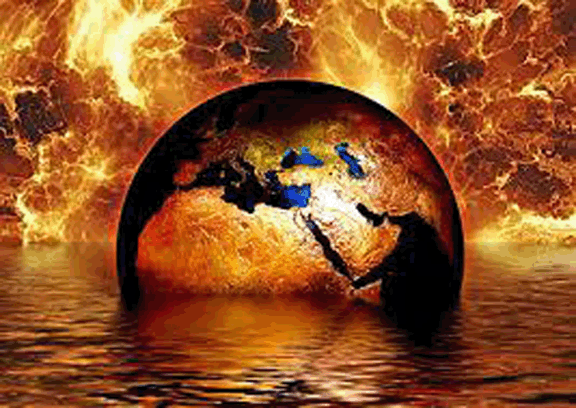
Extreme weather means wildfires and flooding are becoming more likely,
posing a risk to urban areas around the world. Kostas Lagouvardos and his
colleagues at the Penteli Observatory, which offers sweeping views of
Athens, are what you would call experts on wildfires. They have spent
decades researching the link between meteorological conditions and deadly
infernos, as well as tackling the challenge of forecasting when and where
the disasters might happen.
But even they were caught off-guard by the
wildfire that arrived at their door last August. “It was ironic,” says
Lagouvardos, research director at the Institute for Environmental Research
and Sustainable Development at the National Observatory of Athens. The
Penteli site, which forms part of the NOA and is home to the historic
Newall refractor telescope, was almost engulfed by a blaze that spread from
nearby Mount Pentelicus. Flames whipped around the grounds, coming within
metres of the astronomy tower and other buildings, as helicopters dropped
water from above and firefighters below battled to save the crucial
scientific site. The observatory buildings were spared, but its nearest
neighbour was badly damaged, as were many other buildings in the area. One
person died.
The fact that a wildfire came so close to the very building
where scientists had long attempted to understand the phenomenon highlights
the key challenges for cities around the world as extreme weather
intensifies. Not only are wildfires becoming more common, they are
difficult to predict and are spreading ever closer to densely populated
urban areas. Just last week, Israel’s Prime Minister Benjamin Netanyahu
warned that wildfires in the country were at risk of reaching Jerusalem.
Athens, like other big cities including Dallas, Lisbon, Sydney and Cape
Town, are what some scientists refer to as “sitting ducks”. In these
places, the climate and geographical conditions mean they are extremely
vulnerable to global warming-related disasters.
This could be wildfires,
like those in Los Angeles in January, but also flooding, as seen in
Valencia last year. In some cases, one can follow the other. These
so-called sitting ducks “haven’t had an extreme event” so far, says
Erin Coughlan de Perez, a professor at Tufts University, an expert in
climate risk. “They’ve got lucky.” But the odds might be against
them.
With 2025 expected to be one of the hottest on record, despite a
cooling La Niña weather phenomenon earlier this year, scientists warn of a
rising risk of climate-related disasters. Climate change is causing a rise
in extreme heat, which helps fuel wildfires, while hotter temperatures can
also lead to more intense rainfall and flooding, because warmer air holds
more moisture.
FT 5th May 2025,
https://www.ft.com/content/57835a0c-9e58-4c1a-9c5a-f6a4cbe3f748
No comments yet.
-
Archives
- February 2026 (233)
- January 2026 (308)
- December 2025 (358)
- November 2025 (359)
- October 2025 (376)
- September 2025 (258)
- August 2025 (319)
- July 2025 (230)
- June 2025 (348)
- May 2025 (261)
- April 2025 (305)
- March 2025 (319)
-
Categories
- 1
- 1 NUCLEAR ISSUES
- business and costs
- climate change
- culture and arts
- ENERGY
- environment
- health
- history
- indigenous issues
- Legal
- marketing of nuclear
- media
- opposition to nuclear
- PERSONAL STORIES
- politics
- politics international
- Religion and ethics
- safety
- secrets,lies and civil liberties
- spinbuster
- technology
- Uranium
- wastes
- weapons and war
- Women
- 2 WORLD
- ACTION
- AFRICA
- Atrocities
- AUSTRALIA
- Christina's notes
- Christina's themes
- culture and arts
- Events
- Fuk 2022
- Fuk 2023
- Fukushima 2017
- Fukushima 2018
- fukushima 2019
- Fukushima 2020
- Fukushima 2021
- general
- global warming
- Humour (God we need it)
- Nuclear
- RARE EARTHS
- Reference
- resources – print
- Resources -audiovicual
- Weekly Newsletter
- World
- World Nuclear
- YouTube
-
RSS
Entries RSS
Comments RSS
 nuclear-news
Leave a comment