Scotland does not need nuclear power and people aren’t being told the truth
Commonweal 1st May 2025,
https://www.commonweal.scot/daily-briefings/briefing-r57be
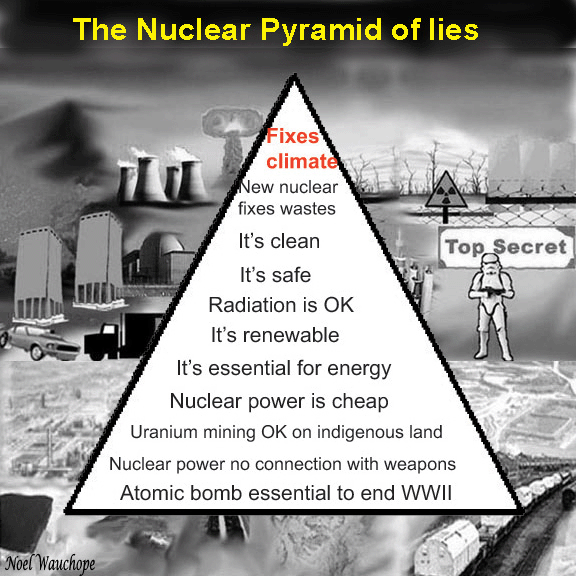
The nuclear industry has one of the most aggressive lobbying and public relations campaigns of all energy sources. It pushes relentlessly on politicians and the public to support the merits of nuclear power based on partial or inaccurate information. Very often this goes unchallenged in the Scottish media.
Given that nuclear power presents itself as a pragmatic response to decarbonising energy and given the scale of the PR campaign, it is perhaps not enormously surprising that SNP voters appear to split with their party over this issue. But would they continue to support nuclear power if they knew the numbers?
Here are some stark realities. The cost of generating of electricity from renewable sources is £38 to £44 per MWh. The estimated cost of the same electricity from nuclear (at the new Hinkley Point C reactor) in 2025 is £150 per MWh. It can only be presumed that the participants in this survey were not told that generating electricity would become between three times as expensive with nuclear.
But even that hides the true costs. Nuclear power is very dangerous and, at the end of its lifecycle, is very complex to decommission and make safe. Every spent rod of nuclear fuel takes a full ten years simply to cool down. They must be immersed in a deep pool of cold, constantly-circulating water and monitored closely for ten years just to bring them down to a cool enough temperature that they can be processed.
That’s just the ongoing fuel. The complexity of decommissioning and entire nuclear power plant is significantly greater. In fact the current estimate of the cost for decommissioning nuclear power is about £132 billion. That is not paid for by consumers in their electricity bill – it is paid for by consumers through their tax.
This is the second stark reality that nuclear power works hard to conceal; not only is it three times as expensive as renewables to run, there is then a cost of at least £4,600 for every household to decommission the nuclear power plants and make them safe for the future.
Of course, safety is another issue here. Nuclear power stations are very vulnerable. They are extremely sensitive sites which require substantial long-term attention. There are currently concerns around the world that unreliable power supplies could mean existing plants may struggle to keep spent fuel rods from combusting if they cannot constantly and continually keep large amounts of cold water circulating round spent fuel.
Nuclear power stations do not like loss of electricity, especially for any extended period of time. This makes them very climate-vulnerable. And of course who knows what sorts of extreme weather we may face before the lifetime of a nuclear station is complete. Fukushima is not a cautionary tale for no reason.
And it is uncomfortable to dwell on the risks of nuclear sites if they become targets for terrorism or in war. No-one is expressing continent-wide anxiety over the threat-to-life status of Ukraine’s wind turbines; they absolutely are over the shelling of Ukrainian nuclear power stations.
The remaining case for nuclear is to provide ‘electricity baseline’ – the ability to bring electricity provision on and off line as renewable generation rates rise or fall (if the wind does blow), or during periods of peak demand. This just isn’t really honest – nuclear power does not like rapid changes in supply and are designed to run flat out, all the time, not least because costs rise rapidly if they are running at less then full power. You can’t just ‘turn them on and off’. So yes, they can provide baseline electricity but not ‘on demand’ electricity that can balance renewables.
Hydrogen storage can though. Scotland currently dumps enormous amounts of perfectly useable electricity in the ground if it is generated when there is no demand. This can be turned into hydrogen and then, on demand, converted back into electricity. At the moment the cost of electricity from hydrogen is about half as much again that of generating by nuclear. But there are big caveats to that.
First, the current hydrogen electricity price is about £230 per MWh, but this is a rapidly-developing area of technology and the current industry target is £100 per MWh. That makes it cheaper than nuclear. Second, there is no hidden capital cost – the incredible costs of building and decommissioning nuclear which are hidden from consumers by subsidy from tax just isn’t there for hydrogen. It is a simple technology.
Third, these costs all assume that you are generating hydrogen from electricity at full wholesale grid prices. But if you are using electricity that would otherwise be dumped because it is being generated at the ‘wrong time’, the hydrogen becomes a waste product. It is in practice much cheaper than nuclear and can supply long-term baseline. (Battery storage for short term is even cheaper.)
That is the reality that respondents in this poll were not given. Try the poll again with ‘do you want to pay three times as much for your electricity with an additional costs to your household of £4,600 to have unsafe nuclear power when renewables with hydrogen storage are cleaner, cheaper and safer’.
Consistent, reliable renewable energy isn’t hard to solve in Scotland. There are nations where nuclear may have to be part of a clean energy solution, but Scotland is not one of them. You need to withhold a lot of information from people to make them believe the wrong thing about nuclear.
India and Pakistan: Nations on brink of ‘nuclear war’

news.com.au 2 May 25
Two tough-talking leaders. Two nations struggling with internal turmoil. Both armed with nuclear weapons.
It’s quickly adding up to be a zero-sum crisis.
India and Pakistan are again on the brink of war after a terrorist attack in the troubled state of Kashmir killed 26 tourists — mostly Hindu Indians — and triggered a deadly blame game between the disgruntled neighbours.
“India will identify and punish every terrorist and their backers. We will pursue them to the ends of the earth. India’s spirit will never be broken by terrorism. Terrorism will not go unpunished.”
These words, proclaimed by Indian Prime Minister Narendra Modi, were spoken in English.
As such, it was a message intended for a global audience.
For its part, Pakistan was dismissive.
“In the absence of any credible investigation and verifiable evidence, attempts to link the Pahalgam attack with Pakistan are frivolous, devoid of rationality and defeat logic,” reads a statement from the Office of Pakistan’s Prime Minister Shehbaz Sharif.
Beneath the bluster, the plight of Kashmir is already being forgotten.
The Hindu-ruled (but mostly Muslim) Principality of Kashmir was given the choice of becoming a semi-independent state of either Pakistan or India by the retreating British Empire in 1947.
It chose India in the face of tribal incursions from Pakistan.
SponsoredNew rules of recruitment in 2025
Two tough-talking leaders. Two nations struggling with internal turmoil. Both armed with nuclear weapons.
It’s quickly adding up to be a zero-sum crisis.
India and Pakistan are again on the brink of war after a terrorist attack in the troubled state of Kashmir killed 26 tourists — mostly Hindu Indians — and triggered a deadly blame game between the disgruntled neighbours.
“India will identify and punish every terrorist and their backers. We will pursue them to the ends of the earth. India’s spirit will never be broken by terrorism. Terrorism will not go unpunished.”
Loaded: 100.00%
Click to unmute
You are watching
Pakistan’s huge nuke call amid crisisContinue watchingSHARE

Pakistan’s huge nuke call amid crisis
Pakistan’s defence minister has addressed…See more
These words, proclaimed by Indian Prime Minister Narendra Modi, were spoken in English.
As such, it was a message intended for a global audience.
For its part, Pakistan was dismissive.
“In the absence of any credible investigation and verifiable evidence, attempts to link the Pahalgam attack with Pakistan are frivolous, devoid of rationality and defeat logic,” reads a statement from the Office of Pakistan’s Prime Minister Shehbaz Sharif.
Beneath the bluster, the plight of Kashmir is already being forgotten.
The Hindu-ruled (but mostly Muslim) Principality of Kashmir was given the choice of becoming a semi-independent state of either Pakistan or India by the retreating British Empire in 1947.
It chose India in the face of tribal incursions from Pakistan.

India’s Prime Minister Narendra Modi, said that their ‘spirit will not be broken’ by terrorism.. Picture: Sachin KUMAR / AFP
But Prime Minister Modi has, in recent years, suspended the region’s special freedoms and allowed his Hindu nationalist supporters to impose their ways on the culturally distinct populace.
“India’s hard-line policies under Modi and the imposition of direct central rule on Kashmir have fuelled deep alienation in the Muslim-majority region,” argues Yale University lecturer Sushant Singh.
That backlash, he adds, has triggered much broader tensions that has been simmering beneath the surface for decades.
“With Modi’s rhetoric leaving little room for compromise, Pakistan’s military leadership under pressure to respond forcefully to any Indian strike, and China’s growing involvement in the region, events in Kashmir risk triggering uncontrollable escalation,” he said.
Kashmir Conundrum
“At the heart of the Kashmir crisis is a combustible mix of religious nationalism, authoritarian governance, and unresolved political grievances,” explains Mr Singh.
Mr Modi stripped Kashmir, India’s only Muslim-majority state, of its constitutional privileges in 2019.
Local elections have been suspended. Curfews, media controls and political arrests have become commonplace.
“The reality on the ground remains one of pervasive fear and violence,” adds Mr Singh.
“Kashmir has endured recurring militant attacks, including the killing in Pahalgam, and the continued imposition of draconian laws and heavy security deployments.”
Responsibility for the Pahalgam attack has been claimed by a group calling itself The Resistance Front (TRF), which analysts believe to be an offshoot of Pakistan’s Lashkar-e-Taiba militant group.
The TRF has accused Indian Hindus of a co-ordinated campaign to establish settlements in Kashmir and overwhelm its indigenous population.
PM Modi has seized on the TRF’s Pakistani ties to label the incident as a cross-border attack backed by Islamabad.
He’s expelled Pakistani diplomats. He’s closed the border. He’s ordered the suspension of the Indus Waters Treaty.
ashmir is inseparable from his broader political strategy, in which he projects strength as a Hindu nationalist strongman, promises violent retribution against enemies, and seeks to rally domestic support through exploiting moments of national security crisis,” Mr Singh states.
Pakistan’s Power Plays
Islamabad has condemned suspension of the Indus water agreement as an “act of war”.
It has also closed its airspace to Indian flights and suspended all bilateral treaties, including a 1972 peace treaty that laid out a path towards a normalised relationship between the two nations.
But Pakistan is in the grip of a severe internal crisis……………………………………………………………………………………………………………………………….. https://www.news.com.au/technology/innovation/military/india-and-pakistan-nations-on-brink-of-nuclear-war/news-story/2f6d318483fdad71eebf466349123137
Tracing radiation through the Marshall Islands: Reflections from a Greenpeace nuclear specialist
Greenpeace, Shaun Burnie, 30 April 2025
We’ve visited ground zero. Not once, but three times. But for generations, before these locations were designated as such, they were the ancestral home to the people of the Marshall Islands.
As part of a team of Greenpeace scientists and specialists from the Radiation Protection Advisors team, we have embarked on a six-week tour on-board the Rainbow Warrior, sailing through one of the most disturbing chapters in human history: between 1946 and 1958, the United States detonated 67 nuclear bombs across the Marshall Islands — equivalent to 7,200 Hiroshima explosions.
During this period, testing nuclear weapons at the expense of wonderful ocean nations like the Marshall Islands was considered an acceptable practice, or as the US put it, “for the good of mankind”. Instead, the radioactive fallout left a deep and complex legacy—one that is both scientific and profoundly human, with communities displaced for generations.
Between March and April, we traveled on the Greenpeace flagship vessel, the Rainbow Warrior, throughout the Marshall Islands, including to three northern atolls that bear the most severe scars of Cold War nuclear weapons testing:
- Enewetak atoll, where, on Runit Island, stands a massive leaking concrete dome beneath which lies plutonium-contaminated waste, a result of from a partial “clean-up” of some of the islands after the nuclear tests
- Bikini atoll, a place so beautiful, yet rendered uninhabitable by some of the most powerful nuclear detonations ever conducted;
- And Rongelap atoll, where residents were exposed to radiation fallout and later convinced to return to contaminated land, part of what is now known as Project 4.1, a U.S. medical experiment to test humans’ exposure to radiation.
This isn’t fiction, nor distant past. It’s a chapter of history still alive through the environment, the health of communities, and the data we’re collecting today. Each location we visit, each sample we take, adds to a clearer picture of some of the long-term impacts of nuclear testing—and highlights the importance of continuing to document, investigate, and attempt to understand and share these findings.
These are our field notes from a journey through places that hold important lessons for science, justice, and global accountability……………………………………………………………………………………………………
Stop 1: Enewetak Atoll – the dome that shouldn’t exist
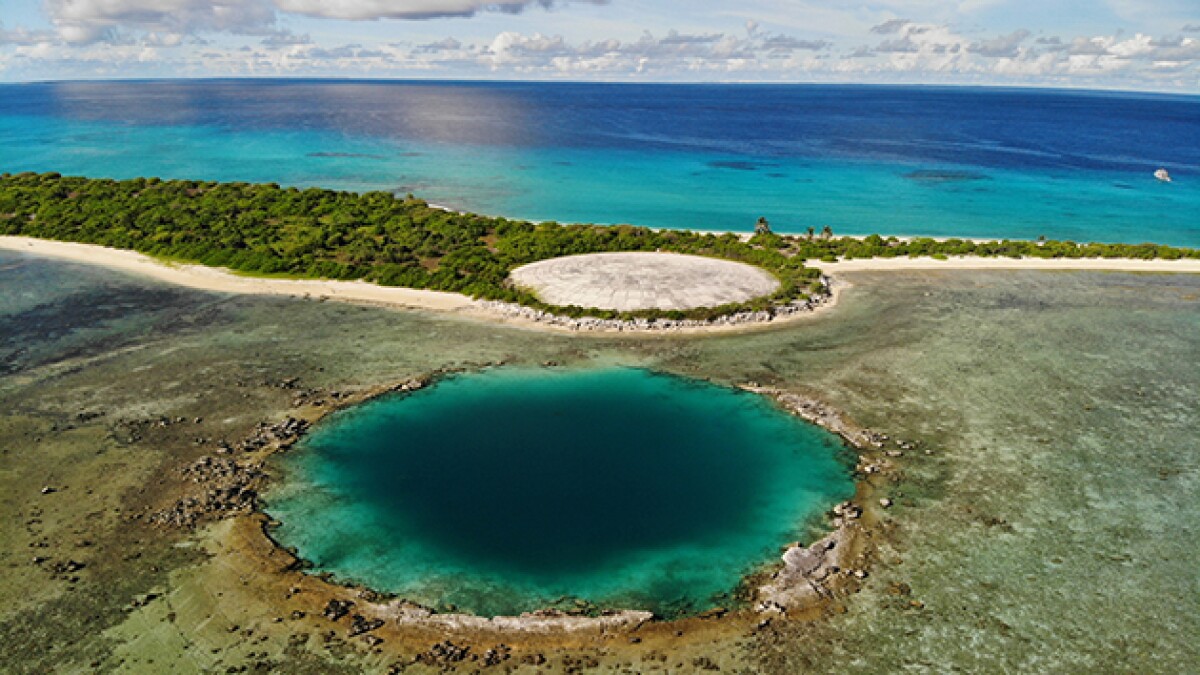
At the far western edge of the Marshall Islands is Enewetak. The name might not ring a bell for many, but this atoll was the site of 43 U.S. nuclear detonations. Today, it houses what may be one of the most radioactive places in the world: the Runit Dome
Once a tropical paradise thick with coconut palms, now Runit Island is capped by a massive concrete structure the size of a football field. Under this dome—cracked, weather-worn, and only 46 centimeters thick in some places—lies 85,000 cubic meters of radioactive waste. These substances are not only confined to the crater—they are also found across the island’s soil, rendering Runit Island uninhabitable for all time. The contrast between what it once was and what it has become is staggering. We took samples near the dome’s base, where rising sea levels now routinely flood the area.
We collected coconut from the island which will be processed and prepared in the Rainbow Warrior’s onboard laboratory. Crops such as coconut are a known vector for radioactive isotope transfer, and tracking levels in food sources is essential for understanding long-term environmental and health risks. The local consequences of this simple fact are deeply unjust. While some atolls in the Marshall Islands can harvest and sell coconut products, the people of Enewetak are prohibited from doing so because of radioactive contamination. They have lost not only their land and safety but also their ability to sustain themselves economically. The radioactive legacy has robbed them of income and opportunity.
One of the most alarming details about this dome is that there is no lining beneath the structure – it is in direct contact with the environment – while containing some of the most hazardous long lived substances ever to exist on planet earth. It was never built to withstand flooding, sea level rise, and climate change. The scientific questions are urgent: how much of this material is already leaking into the lagoon? What are the exposure risks to marine ecosystems and local communities?
We are here to help answer questions with new, independent data, but still, being in the craters and walking on this ground where nuclear Armageddon was unleashed, is an emotional and surreal journey.
Stop 2: Bikini – a nuclear catastrophe, labeled “for the good of mankind”
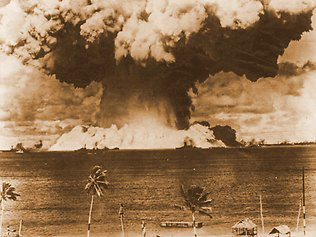
Unlike Chernobyl or Fukushima, where communities were devastated by catastrophic accidents, Bikini tells a different story. This was not an accident. The nuclear destruction of Bikini was deliberate, calculated, and executed with full knowledge that entire ways of life were going to be destroyed.
Bikini atoll is incredibly beautiful and would look idyllic on any postcard. But we know what lies beneath: the site of 23 nuclear detonations, including Castle Bravo, the largest ever nuclear weapons test conducted by the United States.
Castle Bravo alone released more than 1,000 times the explosive yield of the Hiroshima bomb. The radioactive fallout massively contaminated nearby islands and their populations together with thousands of U.S. military personnel. Bikini’s former residents were forcibly relocated in 1946 before nuclear testing began, and with promises of a safe return. But the atoll is still uninhabited and most of the new generations of Bikinians have never seen their home island. As we stood deep in the forest next to a massive concrete blast bunker, reality hit hard – behind its narrow lead-glass viewing window, U.S. military personnel once watched the evaporation of Bikini lagoon.
On our visit we notice there’s a spectral quality to Bikini. The homes of the Bikini islanders are long gone. In its place now stand a scattering of buildings left by the U.S. Department of Energy: rusting canteens, rotting offices, sleeping quarters with peeling walls, and traces of the scientific experiments conducted here after the bombs fell.
On dusty desks we found radiation reports, notes detailing crop trials, and a notebook meticulously tracking the application of potassium to test plots of corn, alfalfa, lime, and native foods like coconut, pandanus, and banana. The potassium was intended to block the uptake of caesium-137, a radioactive isotope, by plant roots. The logic was simple: if these crops could be decontaminated, perhaps one day Bikini could be repopulated.
We collected samples of coconuts and soil—key indicators of internal exposure risk if humans were to return. Bikini raises a stark question: what does “safe” mean, and who gets to decide? The U.S. declared parts of Bikini habitable in 1970, only to evacuate people again eight years later after resettled families suffered from radiation exposure. The science is not abstract here. It is personal. It is human. It has real consequences.
Stop 3: Rongelap – setting for Project 4.1

The Rainbow Warrior arrived at the eastern side of Rongelap atoll anchoring one mile from the center of Rongelap Island, the church spire and roofs of “new” buildings reflecting the bright sun. In 1954, fallout from the Castle Bravo nuclear detonation on Bikini blanketed this atoll in radioactive ash—fine, white powder that children played in, thinking it was snow. The U.S. government waited three days to evacuate residents, despite knowing the risks. The U.S. government declared it safe to return to Rongelap in 1957 – but it was a severely contaminated environment. The very significant radiation exposure to the Rongelap population caused severe health impacts: thyroid cancers, birth defects such as “jellyfish babies”, miscarriages, and much more.
In 1985, after a request to the US government to evacuate was dismissed, the Rongelap community asked Greenpeace to help relocate them from their ancestral lands. Using the first Rainbow Warrior, and over a period of 10 days and three trips, 350 residents collectively dismantled their homes bringing everything with them – including livestock, and 100 metric tons of building material – where they resettled on the islands of Mejatto and Ebeye on Kwajalein atoll. It is a part of history that lives on in the minds of the Marshallese people we meet in this ship voyage – in the gratitude they still express, the pride in keeping the fight for justice, and in the pain of still not having a permanent, safe home.
Now, once again, we are standing on their island of Rongelap, walking past abandoned buildings and rusting equipment, some of it dating from the 1980s and 1990s – a period when the U.S. Department of Energy launched a push to encourage resettlement declaring that the island was safe – a declaration that this time, the population welcomed with mistrust, not having access to independent scientific data and remembering the deceitful relocation of some decades before.
Here, once again we sample soil and fruits that could become food if people came back. It is essential to understand ongoing risks—especially for communities considering whether and how to return.
This is not the end. It is just the beginning
Our scientific mission is to take measurements, collect samples, and document contamination. But that’s not all we’re bringing back.
We carry with us the voices of the Marshallese who survived these tests and are still living their consequences. We carry images of graves swallowed by tides near Runit Dome, stories of entire cultures displaced from their homelands, and measurements of radiation showing contamination still persists after many decades. There are 9,700 nuclear warheads still held by military powers around the world – mostly in the United States and Russian arsenals. The Marshall Islands was one of the first nations to suffer the consequences of nuclear weapons – and the legacy persists today.
We didn’t come to speak for the Marshallese. We came to listen, to bear witness, and to support their demand for justice. We plan to return next year, to follow up on our research and to make results available to the people of the Marshall Islands. And we will keep telling these stories—until justice is more than just a word…….. https://www.greenpeace.org/international/story/74328/tracing-radiation-through-the-marshall-islands-reflections-from-a-greenpeace-nuclear-specialist/
Niagara County New York Radiation Disaster -discovered in 2024
, https://thewaynefocus.blogspot.com/2024/09/niagara-county-new-york-radiation.html?fbclid=IwY2xjawKBMSNleHRuA2FlbQIxMABicmlkETFDTTNHRFd0N0pwdkx2OTA0AR6FccTj8LP8Wpr9m0agp5nEln7TFC3Ld6AcVDU4Y4iWAAUTRe5z2YA7yZTtHQ_aem_xv_Ij8_zSCXoSMWjxV-mbw
Regarding the Niagara County, New York Radioactivity Contamination Disaster Discovered in 2024 as a result of surreptitious shipments of high, medium and low grade radioactive materials from Niagara County, New York to Van Buren Charter Township, Wayne County, Michigan Notes from September 19, 2024
Simplified Timeline of the Van Buren Charter Township Nuclear Waste Disaster Gleaned from newspaper reports, personal interviews, discussion and official remarks
1. Decision is made to create Fusion Atomic Bomb
2 For this timeline a bomb will be manufactured at the Hanford, Washington Nuclear Reservation a. This bomb will ultimately be delivered to Nagasaki for atmospheric explosion .
3. The work commences at the Hanford Reservation creating enormous amounts of radioactive waste. The waste was likely composed of but not limited to : a. Radioactive Soil b. Radioactive Water c. Radioactive Powdered Chemicals d. Radioactive Liquid Chemicals e. Radioactive wood, metal, ceramic, cloth and other radioactive materials
4. The liquid waste was deposited regularly in gigantic storage tanks a. The liquid waste burned through the containing steel and contaminated large areas b. That issue is still being addressed c. The materials are making their way towards the Columbia River
5. The solid waste was collected in many instances into giant piles a. Eventually it was decided to bury most of the solid waste b. The groundwater flow picked up radiation and other toxic chemicals from the buried materials and began their own migration towards the Columbia River c. This contamination is still being dealt with.
6. It was decided either immediately following the end of World War 2 or in the 1950’s that getting rid of the radioactive materials left over from the frenetic activity surrounding the creation of the Nagasaki Atomic Weapon would be a good course of action a A series of steps to neutralize or prepare the material to be buried without it contaminating ground waters, the Earth or the air was put together b. A contract was let out and a contractor selected to deal with the materials c. Either by rapid truck transport, as is happening in the present situation between Lewiston, New York and the Charter Township of Van Buren, Michigan, or train shipments by a presently unknown carrier over a presently unknown route, the materials were taken from the Hanford Nuclear Reservation in Washington State and transported 2,514 miles to a new site in Lewiston, New York d. The material was deposited on the ground in an unknown manner. Indications are that it was an open dump.
7. The contractor began preparations to treat the materials. Indications were that the intent was to reduce overall radioactivity in some manner, but primarily, the work would center on making the materials easier to handle and somewhat inert by suspending them in glass and other materials for burial. a. At some point, apparently a year after the deposition of the materials in Lewiston, NY, the Federal Government abruptly changed the manner in which the work was to be done. Because of the high levels of radioactivity in the materials special buildings had to be erected, special clothing had to be provided to workers, workers could only be exposed to the materials for specific amounts of time and specialized ventilation and atmospheric equipment and filters would need to be installed b. Upon receipt of these new requirements and having completed a brief study of the impact on profits to the enterprise the contractor left. The work was abandoned. c. The radioactive materials that had been transported to Lewiston, NY from the nuclear reservation at Hanford, WA were left to the elements for at least one year, maybe two and possibly longer d. A decision was made at some unspecified time to bury the materials at the place where they were deposited. e. Due to the arrangements of the materials they were either laid out in a large area and then bulldozed into piles or had been deposited in piles initially. They were apparently buried without any sort of underground barrier. f. From a crude visual observation of the present state of the materials it appears they were buried on the surface in gigantic piles. Some have settled into the earth while others appear to have retained their mounding shape.
8. In 2016 after considerable wrangling and the realization that cancers and other dread diseases were spiking in the area and due to action by the Tuscarora nation and approximately 300 employees of the Environmental Protection Agency in New York or whatever organization had been caring for the materials for nearly a century, it was decided, after local public hearings, that the United States Army Corps of Engineers would remove all of the materials to another location.
9. One of the primary driving forces behind moving the materials, along with higher rates of cancer, other diseases, probable birth defects and possible birth mortality, was that the materials were burning their way to the Niagara River.
10. At this point, due to ionization and the natural dispersal of these unnatural elements, an area many times larger than the original point of delivery now existed. The materials had exited the property lines and have contaminated an enormous area around where they had been dropped off. Parallel and Interesting Points of Interest in a Somewhat Linear Timeline of Events in Some Order These may or may not figure in the final Niagara County, New York Contamination Disaster of 2016 :
(1.)A landfill was built abutting the nuclear waste dump in Lewiston, NY. a. The landfill was used for depositing materials from across Niagara County and perhaps elsewhere
(2) A driver for a paving company in Canada rolled his truck over a. The driver was subsequently fired by his brothers b. The driver started his own paving company c. At one point someone said to him, ‘You know, we sure could use someone to carry away all this waste when were done with the work.’ d. The driver began a waste hauling service e. The driver’s waste hauling service was successful and the driver opened or took control of a dump f. The driver became a successful businessman and the dump expanded g. The driver’s company became well known in the area h. The company purchased or controlled several area dumps (landfills) and they expanded
(3) During the course of all this there was a separate issue with the Love Canal and another location where chemicals were deposited in an irresponsible and unprofessional manner leading to health impacts across that area. The Love Canal is also in Niagara County
(4)At this point the timeline is murky and breaks up but these facts occurred : a. Along with the materials being collected and removed from the Lewiston Nuclear Storage Site that are being moved now against common sense there were even more hazardous and radioactive materials moved to Van Buren Charter Township, MI without telling any of the residents. b. It is not clear if the Michigan Governor know this, but certainly, it would have been the business of the State of Michigan Department of the Environment, Great Lakes and Energy to be alerted or informed that the material was on the way. The words ‘alerted’ and ‘informed’ are used loosely here because according the processes of the State of Michigan Department of the Environment, Great Lakes and Energy moving or depositing or releasing into the atmosphere, into the Earth or into the waters of the Great Lakes water system it is a simple manner not only to gain approval but to continue dumping and polluting in amounts of many tens of thousands of tons for a small fee, which may be deferred or excused according to the sentiments of the Michigan Department of the Environment, Great Lakes and Energy employee assigned to the work. c. Niagara County and other agencies, including the Environmental Protection Agency, the United States of Army Corps of Engineers, the New York State department of the environment, local elected officials, state elected officials and possibly federal elected officials became aware of a widespread problem involving radioactivity across Niagara County. d. Many, many miles of State, County and local roads apparently have been paved with radioactive materials. e. The radioactive materials used in the paving were used in various ways, sometimes as a substrate, sometimes as a binder and sometimes included in the surface paving materials. It is likely that in some cases it was used in all three preparations and/or other situations f. Radioactive materials have been encountered in commercial parking lots, residential driveways, aggregate placement under foundations for private homes and at least one large cemetery had been covered in it from a depth of two to more feet. g. In one case a large deposit of radioactive material that was discovered near a large commercial construction project was noted by authorities. They could not determine where it came from. In a wicked denouement, that actually has not been resolved, upon return to the site the material had been removed by unknown persons for unknown reasons. So – they found a large amount of highly radioactive material near to a construction site, recorded the fact, went back at some undetermined time and found that the material was gone. h. Finely grained black sand with very high radioactivity levels was removed from several private residential sites.
(5) The waste disposal company (the dump and landfill operator) took over the collection business of Republic Waste in at least most of the areas in Niagara County, NY, if not all of them.
(6) Republic Waste has a dump located nearby the Niagara Nuclear Site in Lewiston, New York.
(7). The landfill owner died
(8). The company still exists and remains the largest and richest waste handling company in northwestern New York and eastern Ontario.
(9.) A decision was made unbeknownst to the local inhabitants in Michigan, to move the materials that have now placed the Columbia River and the Niagara River in jeopardy of further contamination by radioactive nuclear materials and other toxic waste to bury this material in the watershed of the Huron River and very close to Ford Lake and so, repeat the pattern of mismanagement of the materials and place even more Americans in peril while enriching private corporations. We also seen and are experiencing deflecting the responsibility from poorly run Federal and State organizations and departments ostensibly in place to protect the health and well being of Americans, but, which, instead, have seen to their own diverse interests and need.
(10.) Federal Michigan Elected Representatives point to the State Michigan Elected Representatives as the core to the solution of these co-occurring disasters while State Michigan Elected Representatives point to the Federal Michigan Elected Representatives to solve the problem.
(11. ) New York elected at all levels remain mute and do not remark nor comment on these disasters, the original one being clearly in there area of influence and duty in New York State.
(12.) Both Governor Whitmer of Michigan and Governor Hochul of New have been silent on the issue. We see no comments either supporting the resolution of these two disasters or mitigating the destruction clearly raging in Niagara County, New York nor the current assault on the heavily populated area in southeastern Michigan where this poisonous, dangerous and poorly managed material is being dumped to the peril of individuals, seniors, families, children and businesses in the local area, county and region. Possible Conclusions or Inference, including Possible Actions to take regarding the Niagara County, New York Contamination Disaster so as not to exacerbate the Van Buren Charter Township Waste Disaster now occurring – 1. There seems to be a very dangerous situation that has occurred with the infrastructure in Niagara County, New York. The roads will need to be checked. 2. Wherever the substrate came from that supply line needs to be discontinued. 3. The company that supplied the radioactive material needs to be discovered and their area of activity made known. 4. Was nuclear material to be used for paving also transported to Ontario across national borders without notification or was it imported from Canada into New York where it was used to pave roads, parking lots, cover at least one cemetery and be used for foundation preparations for homes, business and driveways? 5. I feel that an inspection of the garbage trucks and paving trucks in the area would be in order to ensure that they are not contaminated with radioactivity 6. I feel that MICares in Michigan should be alerted to the fact that this material has been passing into our environment for at least the past two to three years if not longer. 7. I feel that medical monitoring for the affected people in Niagara County, New York is in order 8. I feel that a radioactive survey of all the roadways, building sites, homes, commercial sites that have been built in the area since at least the 1960’s should be performed in Niagara County. This should include a review of all cemeteries and any locations that the paving/dump company owner provided services to, whether for profit or charitable purposes – with special attention to churches, elementary schools, high schools, private and public parks, hospitals and other locations. Thank you for your time and attention.
EDF seeks joint financing for UK projects

April 30, 2025, https://www.neimagazine.com/news/edf-seeks-joint-financing-for-uk-projects/?cf-view&cf-closed
DF is seeking to consolidate financing for the Hinkley Point C and Sizewell C NPPs under construction in the UK. French Energy Minister Marc Ferracci told the Financial Times that they should be treated as one financial venture in negotiations. He said he had discussed the issue with UK Energy Minister Ed Miliband on the sidelines of a conference in London.
“France and EDF are very committed to deliver the projects but we have to find a way to accelerate them, and we have to find a way to consolidate the financial schemes of both projects,” he said.
Both projects started out with equity stakes from Chinese state-owned nuclear development corporations but the UK government cancelled the arrangements because of “security issues”. The UK government partly replaced the funding and is seeking support from institutional investors.
Ferracci denied that the French government intended to use Sizewell as “leverage” against the financial troubles at Hinkley. “It is not a discussion about leverage, it is a discussion between friends and allies. . . So there is a way through, and I hope we will be able to find it in the next few months.”
He also called for a global solution that would result in a deal that benefitted EDF’s returns across both schemes. “It is a good approach to have a global approach to our relationship,” Ferracci said, adding more “grid connections between France and the UK” could come into the negotiations.
Meanwhile, workers at the Hinkley Point C NPP construction site are complaining about a significant rat infestation, raising health and safety concerns. In early April, the Unite and GMB trade unions at Hinkley Point C told EDF that the facility was overrun with rats. The unions said immediate action was needed as the rodents were “everywhere”. In recent months, workers have also complained about poor working conditions and low pay. In addition, hundreds of project staff went on strike in November over the inadequate security access to the site.
Updates on Palisades: Zombie reactor & “SMR” new builds

These so-called “Small Modular Reactors” are not small. At 300 Megawatts-electric each, their construction and operation would nearly double the zombie reactor’s 800 MW-e on the tiny site. They would each be 4.5 times larger than the 67 MW-e Fermi 1 reactor in southeastern Michigan, which on October 5, 1966 had a partial core meltdown, and “We Almost Lost Detroit,”
April 30, 2025, https://beyondnuclear.org/updates-on-palisades-zombie-reactor-smr-new-builds/
Holtec and the Nuclear Regulatory Commission’s (NRC) zealous and reckless push for restart of the 60-year old zombie reactor, as well as “Small Modular Reactor” new builds, at the Palisades nuclear power plant in Covert, Michigan, has continued non-stop recently. So too has Beyond Nuclear’s resistance to the unprecedented, unneeded, very dangerous, and insanely costly schemes, alongside our environmental allies in the area.
On April 29, 2025, the five Commissioners of the NRC held an Affirmation Session, and unanimously approved Palisades’ license transfer from previous owner Entergy, to new owner Holtec. Beyond Nuclear, Don’t Waste Michigan, and Michigan Safe Energy Future (MSEF) had petitioned to intervene against it, and requested a hearing. The coalition has opposed Holtec’s takeover at Palisades from the get-go in 2020-2021. But NRC staff, the NRC Atomic Safety (sic) and Licensing Board (ASLB), and the NRC Commissioners, have blown us off at every twist and turn. And still we persist, with no intention to slow down or give up!
Quite to the contrary, we continue our watchdogging, speaking environmental truth to nuclear power (or greed-driven corruption, anyway), sometimes on an intense daily basis.
Also on April 29, several environmental watchdogs attended an NRC-Holtec technical meeting, the latest of countless such meetings related to the nuclear nightmare of the restart scheme, which began three years ago this month. Representatives from Beyond Nuclear, Don’t Waste Michigan, and Nuclear Energy Information Service of Chicago spoke out strongly against safety shortcuts regarding the potential for loss of power to operate vital safety and cooling systems at Palisades, due to the risk of an “open phase” flaw in the electrical systems. This problem dates back decades and has yet to be resolved.
The day before, on April 28, representatives from Beyond Nuclear and Don’t Waste Michigan spoke out at yet another NRC-Holtec technical meeting, regarding environmental review of the company’s scheme to add two SMR-300s, frighteningly close to the Van Buren State Park campground.
Kraig Schultz of MSEF-Shoreline Chapter in Grand Haven, MI made an audio recording of the April 28 meeting. Listen to it here.
These so-called “Small Modular Reactors” are not small. At 300 Megawatts-electric each, their construction and operation would nearly double the zombie reactor’s 800 MW-e on the tiny site. They would each be 4.5 times larger than the 67 MW-e Fermi 1 reactor in southeastern Michigan, which on October 5, 1966 had a partial core meltdown, and “We Almost Lost Detroit,” in the words of John G. Fuller’s iconic 1975 book title, and Gil Scott-Heron’s 1977 song title. They would also be 4.5 times larger than the 67 MW-e Big Rock Point reactor in northwest Michigan, which despite supposedly not having had a disaster, nonetheless shockingly released more than three million Curies of hazardous radioactivity into the environment.
The juxtaposition of the restarted zombie reactor, and the “SMR” new builds, would represent both extremes on the risk spectrum: breakdown phase risks, and break-in phase risks. Chornobyl Unit 4 in Ukraine in 1986, Three Mile Island Unit 2 in Pennsylvania in 1979, and Fermi Unit 1 in Michigan in 1966 are examples of break-in phase reactor disasters and catastrophes.
In addition to the decades-long electrical risks at Palisades mentioned above, there are multiple pathways to reactor core meltdown related to vital safety systems already pushed to the brink of breakdown. Palisades’ original owner, Consumers Energy (previously Consumers Power), listed them in a presentation to the Michigan Public Service Commission in spring 2006: “Reactor vessel head replacement; Steam generator replacement; Reactor vessel embrittlement concerns; …Containment coatings and sump strainers.”
None of these vital safety repairs or replacements have ever been performed, not by Consumers Energy in 2006, Palisades’ next owner Entergy from 2007 to 2022, nor by Holtec since 2022. Why not? Because the complicit NRC has not required it.
The Japanese Parliament concluded in 2012 that the root cause of the Fukushima Daiichi nuclear catastrophe, which began on March 11, 2011, was collusion, between the company (Tokyo Electric), the safety regulatory agency, and government officials. Such collusion exists in spades at Palisades. And thus people and other living things live in deepening peril, downwind, downstream, up the food chain, and down the generations.
Regarding the needed “Steam generator replacement,” Holtec has no intention of doing so, despite giving the $510 million job some lip service in a secretive, smoking gun 2022 document Beyond Nuclear obtained from the State of Michigan via a Freedom of Information Act request.
Holtec’s rookie error (it has never operated a reactor) of neglecting steam generator maintenance from 2022 to 2024 has led to accelerated corrosion and degradation of exceedingly thin steam generator tubes in shockingly high numbers. It did not implement a chemically-preservative wet lay up, as repeatedly and publicly recommended by our coalition’s expert witness, Arnie Gundersen. The company has applied to NRC for a License Amendment Request (LAR) that represents mere BAND-AID fixes on the steam generator tubes. Our environmental coalition — Beyond Nuclear, Don’t Waste Michigan, Michigan Safe Energy Future, Nuclear Energy Information Service of Chicago, and Three Mile Island Alert of Pennsylvania — has every intention of petitioning to intervene, and requesting a hearing, in opposition to the LAR, by the fast-approaching deadline in June.
Speaking of LARs, our coalition has challenged four others. The NRC staff opposed our challenges, as did Holtec. The ASLB ruled against all of our contentions, in rapid fire fashion. We have appealed those rulings to the NRC Commissioners. If and when the Commissioners reject our contentions as well, we will appeal to the federal courts.
We still have a number of live new and amended contentions regarding NRC’s Environmental Assessment and Finding of No Significant Impact. The ASLB has ordered another round of oral argument pre-hearings, scheduled for May 15, regarding them. As on Feb. 12, 2025, at our first round of oral argument pre-hearings on the four LARs mentioned above, our coalition’s legal counsel, Terry Lodge of Toledo, Ohio, and Wally Taylor of Cedar Rapids, Iowa, will represent us before the ASLB yet again on May 15.
Yet another of numerous NRC public meetings regarding Palisades’ restart status was held in Benton Harbor, MI on April 23, 2025. Watchdogs attended and spoke out.
And, following the money, as reported by producer Chrystal Blair at Public News Service on April 25 (the eve of the annual commemoration of the 1986 Chornobyl nuclear catastrophe), the U.S. Department of Energy (DOE) has awarded Holtec the third installment of loan guarantees, this time for $47 million.
The second installment, awarded on March 17, was for $57 million.
The first installment, in early 2025, was for $38 million.
DOE announced on September 30, 2024 the final approval for $1.52 billion in loan guarantees for Holtec toward the zombie reactor restart. Holtec need not pay the money back. If Holtec defaults on repaying the loans, U.S. taxpayers will be left holding the bag.
See Beyond Nuclear radioactive waste specialist Kevin Kamps’ breakdown of bailouts at Palisades.
Blair quoted Kamps:
“A recent analysis by Dave Lochbaum, who is retired from the Nuclear Safety Program at Union of Concerned Scientists, placed Palisades at something like 84th out of 105 reactors in the country,” Kamps pointed out. “His analysis was they’re more like in the bottom rung of the industry, actually.”
[Palisades is ranked 81st out of 106 reactors, actually.]
Here is that Lochbaum analysis, as well as his chronicle of events (including mishaps) at Palisades, some quite serious, over six decades.
Lochbaum also authored a backgrounder in 2010, about Palisades’ problem-plagued Control Rod Drive Mechanism (CRDM) seal leaks, the worst in industry. CRDM seal leaks are yet another potential pathway to reactor core meltdown.
Blair also reported:
Punkin Shananaquet, a member of Michigan’s Indigenous community, emphasized for many Native people, the issue is not just about public safety, it is about honoring the sacredness of the land and water and educating the next generation about protecting the earth.
“We just can’t be pushed through the corporate world because they have no spirit,” Shananaquet contended. “We have spirit. We are the ones with the feelings for this place.”
Shananaquet, and her family, graced and honored the World Tree Peace Center in Kalamazoo, Michigan at its grand opening, on Indigenous Peoples Day (October 12, formerly Columbus Day), 1996. Kamps co-founded the World Tree, and co-directed it till 1999, when he began a new job, at Nuclear Information and Resource Service (NIRS), in Washington, DC, as nuclear waste specialist there for eight years, before joining Beyond Nuclear. The World Tree focused on watch-dogging Palisades, as well as the Donald C. Cook nuclear power plant 30 miles south of Palisades, and various undertakings for the Chornobyl Children’s Project.
And regarding the very significant safety problem of “Containment coatings and sump strainers” mentioned above, NRC and Holtec held a related meeting last week. Don’t Waste MI attended and spoke out. In an emergency, containment coatings could dissolve into a viscous sludge with the consistency of Elmer’s Glue, clogging sump strainers. This could block coolant flow needed to prevent a reactor core meltdown. This pathway to meltdown at Palisades has been known about for a quarter-century, yet nothing meaningful has been done to address it — just NRC allowing Palisades’ three owners during those 25 years to kick the can down the road.
Last but not least, on April 12, 2025, the St. Joe-Benton Harbor Herald-Palladium reported that Holtec had transferred highly radioactive irradiated nuclear fuel, from the indoor wet storage pool at Palisades, into outdoor dry cask storage.
Although such transfers ultimately represent an increase in safety — pools are vulnerable to mega-catastrophic fires, that could release unthinkable amounts of hazardous radioactivity into the environment — such transfers must be done very carefully, including with emergency preparedness measures in place. (It should be kept in mind, however, that the widespread quality assurance violations associated with Holtec’s dry cask storage containers’ fabrication call into question their structural integrity, even in on-site storage; see a summary of whistleblower allegations about this, here.)
Such emergency preparedness was not in place when Holtec undertook these irradiated nuclear fuel transfers. Palisades’ previous owner, Entergy, requested a waiver and exemption from emergency preparedness, as it permanently shutdown the reactor several years ago, and entered it into the decommissioning status phase.
Although Holtec has requested that NRC approve re-establishing emergency preparedness and planning, in order to restart the reactor and operate Palisades again, such NRC approval is not yet finalized.
The danger comes from moving such heavy loads as loaded highly radioactive waste containers over the vulnerable pool. The inadvertent drop of such a heavy load could damage the pool, and drain away vital cooling water.
Palisades had a near miss under its original owner, Consumers Energy, in October 2005, with just such a heavy load drop scenario.
See the April, 2006 NIRS backgrounder on this incident, prepared by Kevin Kamps, here.
See the related March, 2006 environmental coalition press release, here.
See the March, 2006 front page, above the fold Detroit Free Press coverage of the serious near-miss, here.
Holtec’s scheming, and NRC’s complicity, have continued apace for three years. So too has our resistance. It will only intensify in the days, weeks, and months ahead. Holtec has stood by its schedule to restart the Palisades zombie reactor by October 2025, and to fire up its proposed “SMR”-300s by 2030. We will resist these schemes at every opportunity, to the best of our ability.
To learn more about the past three years of this nuclear nightmare, and our resistance to it, see our chronicle of web posts (arranged backwards, newest posts at the top).
Fantasy and Exploitation: The US-Ukraine Minerals Deal
Dr Binoy Kampmark May 2, 2025, https://theaimn.net/fantasy-and-exploitation-the-us-ukraine-minerals-deal/
The agreement between Washington and Kyiv to create an investment fund to search for rare earth minerals has been seen as something of a turn by the Trump administration. From hectoring and mocking the Ukrainian President Volodymyr Zelensky before the cameras on his visit to the US capital two months ago, President Donald Trump had apparently softened. It was easy to forget that the minerals deal was already on the negotiating table and would have been reached but for Zelensky’s fateful and ill-tempered ambush. Dreams of accessing Ukrainian reserves of such elements as graphite, titanium and lithium were never going to dissipate.
Details remain somewhat sketchy, but the agreement supposedly sets out a sharing of revenues in a manner satisfactory to the parties while floating, if only tentatively, the prospect of renewed military assistance. That assistance, however, would count as US investment in the fund. According to the White House, the US Treasury Department and US International Development Finance Corporation will work with Kyiv “to finalize governance and advance this important partnership,” one that ensures the US “an economic stake in securing a free, peaceful, and sovereign future for Ukraine.”
In its current form, the agreement supposedly leaves it to Ukraine to determine what to extract in terms of the minerals and where this extraction is to take place. A statement from the US Treasury Department also declared that, “No state or person who financed or supplied the Russian war machine will be allowed to benefit from the reconstruction of Ukraine.”
Ukraine’s Minister of Economy, Yulia Svyrydenko, stated that the subsoil remained within the domain of Kyiv’s ownership, while the fund would be “structured” on an equal basis “jointly managed by Ukraine and the United States” and financed by “new licenses in the field of critical materials, oil and gas – generated after the Fund is created.” Neither party would “hold a dominant vote – a reflection of equal partnership between our two nations.”
The minister also revealed that privatisation processes and managing state-owned companies would not be altered by the arrangements. “Companies such as Ukrnafta and Energoatom will stay in state ownership.” There would also be no question of debt obligations owed by Kyiv to Washington.
That this remains a “joint” venture is always bound to raise some suspicions, and nothing can conceal the predatory nature of an arrangement that permits US corporations and firms access to the critical resources of another country. For his part, Trump fantasised in a phone call to a town hall on the NewsNation network that the latest venture would yield “much more in theory than the $350 billion” worth of aid he insists the Biden administration furnished Kyiv with.
Svyrydenko chose to see the Reconstruction Investment Fund as one that would “attract global investment into our country” while still maintaining Ukrainian autonomy. Representative Gregory Meeks, the ranking Democrat on the House of Foreign Affairs Committee, thought otherwise, calling it “Donald Trump’s extortion of Ukraine deal.” Instead of focusing on the large, rather belligerent fly in the ointment – Russian President Vladimir Putin – the US president had “demonstrated nothing but weakness” towards Moscow.
The war mongering wing of the Democrats were also in full throated voice. To make such arrangements in the absence of assured military support to Kyiv made the measure vacuous. “Right now,” Democratic Senator Chris Murphy said on MSNBC television, “all indications are that Donald Trump’s policy is to hand Ukraine to Vladimir Putin, and in that case, this agreement isn’t worth the paper that it’s written on.”
On a certain level, Murphy has a point. Trump’s firmness in holding to the bargain is often capricious. In September 2017, he reached an agreement with the then Afghan president Ashraf Ghani to permit US companies to develop Afghanistan’s rare earth minerals. Having spent 16 years in Afghanistan up to that point, ways of recouping some of the costs of Washington’s involvement were being considered. It was agreed, went a White House statement sounding all too familiar, “that such initiatives would help American companies develop minerals critical to national security while growing Afghanistan’s economy and creating new jobs in both countries, therefore defraying some of the costs of United States assistance as Afghans become more reliant.”
Ghani’s precarious puppet regime was ultimately sidelined in favour of direct negotiations with the Taliban that eventually culminated in their return to power, leaving the way open for US withdrawal and a termination of any grand plans for mineral extraction.
A coterie of foreign policy analysts abounded with glowing statements at this supposedly impressive feat of Ukrainian diplomacy. Shelby Magid, deputy director of the Atlantic Council think tank’s Eurasia Centre, thought it put Kyiv “in their strongest position yet with Washington since Trump took office.” Ukraine had withstood “tremendous pressure” to accept poorer proposals, showing “that it is not just a junior partner that has to roll over and accept a bad deal.”
Time and logistics remain significant obstacles to the realisation of the agreement. AsUkraine’s former minister of economic development and current head of Kyiv school of economics Tymofiy Mylovanov told the BBC, “These resources aren’t in a port or warehouse; they must be developed.” Svyrydenko had to also ruefully concede that vast resources of mineral deposits existed in territory occupied by Russian forces. There are also issues with unexploded mines. Any challenge to the global rare earth elements (REEs) market, currently dominated by China (60% share of production of raw materials; 85% share of global processing output; and 90% manufacturing share of rare earth magnets), will be long in coming.
Arctic plant study reveals an ‘early warning sign’ of climate change upheaval

Scientists studying Arctic plants say the ecosystems that host life in
some of the most inhospitable reaches of the planet are changing in
unexpected ways in an “early warning sign” for a region upended by
climate change.
In four decades, 54 researchers tracked more than 2,000
plant communities across 45 sites from the Canadian high Arctic to Alaska
and Scandinavia. They discovered dramatic shifts in temperatures and
growing seasons produced no clear winners or losers. Some regions witnessed
large increases in shrubs and grasses and declines in flowering plants –
which struggle to grow under the shade created by taller plants.
Those findings, published in Nature, fill key knowledge gaps for teams on the
frontlines of a changing climate.
Guardian 1st May 2025 https://www.theguardian.com/environment/2025/may/01/arctic-plant-study-warning-climate-change
NUKE WASTE DUMP: Ojibwe Country once again targeted
May 1, 2025, Beyond Nuclear
JUST SAY NO TO NUCLEAR WASTE DUMPING IN NORTHWESTERN ONTARIO!
Beyond Nuclear’s radioactive waste specialist, Kevin Kamps, presented “Water Is Life, Nuclear Waste Is Toxic” at the annual meeting of Environment North, in Thunder Bay, Ontario, Canada, on the north shore of Lake Superior, April 23, 2025.
Environment North is the lead local grassroots organization resisting the Canadian federal Nuclear Waste Management Organization’s (NWMO, dominated by the nuclear industry, such as Ontario Power Generation) designation of the Ignace-Wabigoon Lake Ojibway First Nation area as the national radioactive waste dump.
A number of Ojibway First Nation Bands have also passed resolutions opposing the scheme, which would require long-distance, high-risk transportation of highly radioactive waste, from some two-dozen reactors to the east in Canada, on the Great Lakes, Saint Lawrence, and Atlantic.
See local coverage on April 22, 2025, quoting Kamps, by the Chronicle-Journal newspaper, here.
Watch a video recording of Kamps’ April 23, 2025 presentation, here. (Note that you can turn on the subtitles under Settings, to complement the audio.)
See Kevin’s slideshow presentation, here.
Listen to the audio recording, here, of Kamps being interviewed by host Scot Kyle, on the podcast “Wiley Koyote” on April 24, 2025. It was broadcast live on CILU Radio, 102.7 FM, as part of the Paradigm Shift Cafe, from the campus of Lakehead University in Thunder Bay, Ontario. Environment North’s Graham Saunders was also interviewed.
See Environment North’s press release about Kevin’s presentation, here.
See Environment North’s flier for Kevin’s presentation, here…………………………………………………………………………… https://beyondnuclear.org/nuke-waste-dump-ojibwe-country-once-again-targeted/
India and Pakistan: The nuclear standoff that we really should all be worried about
As tensions between the two countries escalate following a
terrorist attack in Kashmir, Ashis Ray looks at how a conflict could
involve China and America in a war over sovereignty and security.
Independent 30th April 2025 https://www.independent.co.uk/asia/india/india-pakistan-kashmir-attack-terrorism-nuclear-b2741719.html
1 This Month


Petition to revoke the licensing of the Near Surface Nuclear Disposal Facility (NSDF) at Chalk River. https://www.ourcommons.ca/petitions/en/Petition/Details?Petition=e-7247


of the week – STOP SMALL MODULAR REACTORS IN CANADA
To see nuclear-related stories in greater depth and intensity – go to https://nuclearinformation.wordpress.com
-
Archives
- March 2026 (163)
- February 2026 (268)
- January 2026 (308)
- December 2025 (358)
- November 2025 (359)
- October 2025 (376)
- September 2025 (258)
- August 2025 (319)
- July 2025 (230)
- June 2025 (348)
- May 2025 (261)
- April 2025 (305)
-
Categories
- 1
- 1 NUCLEAR ISSUES
- business and costs
- climate change
- culture and arts
- ENERGY
- environment
- health
- history
- indigenous issues
- Legal
- marketing of nuclear
- media
- opposition to nuclear
- PERSONAL STORIES
- politics
- politics international
- Religion and ethics
- safety
- secrets,lies and civil liberties
- spinbuster
- technology
- Uranium
- wastes
- weapons and war
- Women
- 2 WORLD
- ACTION
- AFRICA
- Atrocities
- AUSTRALIA
- Christina's notes
- Christina's themes
- culture and arts
- Events
- Fuk 2022
- Fuk 2023
- Fukushima 2017
- Fukushima 2018
- fukushima 2019
- Fukushima 2020
- Fukushima 2021
- general
- global warming
- Humour (God we need it)
- Nuclear
- RARE EARTHS
- Reference
- resources – print
- Resources -audiovicual
- Weekly Newsletter
- World
- World Nuclear
- YouTube
-
RSS
Entries RSS
Comments RSS
 nuclear-news