No Victory in Ukraine: The Costs of Western Delusion
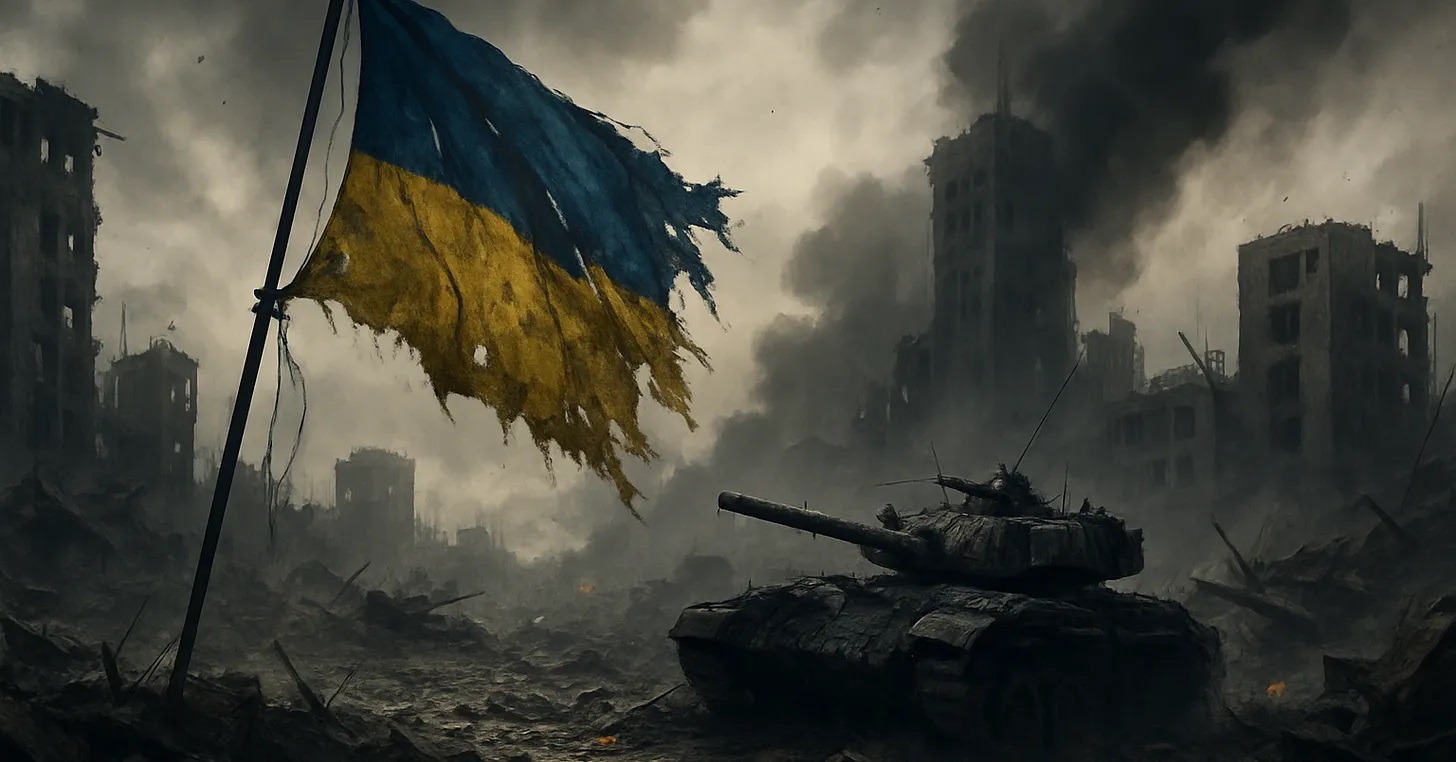
Having invested enormous political capital in the narrative of Ukrainian success, Western governments now face a stark choice: admit failure or fabricate further illusions.
A negotiated settlement can succeed only if it acknowledges Russia’s control over key Ukrainian territories and guarantees that Kyiv will not join NATO. Anything less is strategic fantasy.
Analyzing the impending failure of Ukraine’s war effort and the urgent need for strategic realism in U.S. and European policies.
POST-LIBERAL DISPATCH, Apr 29, 2025, https://postliberaldispatch.substack.com/p/no-victory-in-ukraine-the-costs-of?utm_source=post-email-title&publication_id=4747899&post_id=162368952&utm_campaign=email-post-title&isFreemail=true&r=ln98x&triedRedirect=true&utm_medium=email
The conflict in Ukraine represents not merely a military failure but a profound collapse of political imagination and strategic discipline across the West. To evaluate this ongoing debacle through the lens of political realism and realpolitik demands dispensing with sentimental narratives, ideological attachments, and moralized illusions that have distorted serious analysis for years. Strategic clarity begins with the uncomfortable but inescapable fact: Ukraine’s defeat, whether through a forced diplomatic settlement or battlefield collapse, is no longer a possibility to be debated—it is an inevitability. The West’s refusal to acknowledge this reality stems less from misunderstanding battlefield dynamics and more from a systemic dysfunction wherein political leadership has fused strategic aims with public relations imperatives, thereby serving neither effectively.
At the core of Western miscalculation lies a fatal contradiction. Ukraine was encouraged—indeed, materially and rhetorically incentivized—to resist with the implicit, sometimes explicit, promise of ultimate victory. Yet Western capitals were neither prepared to mobilize the industrial base, financial resources, nor political will necessary to sustain the prolonged total war required to defeat a nuclear-armed Russia. This contradiction was not an accident; it arose naturally from the structural incentives within Western democracies, where leaders needed to appear resolute without assuming the irreversible costs and risks that genuine strategic victory would demand. Thus, Western “support” was expansive in quantity but defective in quality—sufficient to prolong Ukraine’s resistance but insufficient to enable decisive success.
This dynamic exposes why further support—whether billions of dollars in aid, advanced weapons, or rhetorical escalations—cannot now alter the outcome. Ukraine’s manpower shortages, industrial exhaustion, and political fragmentation cannot be reversed by external injections of matériel or funding. The critical variable—human capacity—has been irreversibly degraded. Realpolitik demands the recognition that no arsenal of Western weapons can compensate for a collapsing force structure facing an adversary that enjoys both conventional and nuclear escalation dominance.
The strategic illusion driving continued support is not born of a sincere belief in Ukrainian victory but rather of a desperate attempt to delay political reckoning. Having invested enormous political capital in the narrative of Ukrainian success, Western governments now face a stark choice: admit failure or fabricate further illusions. In this sense, Ukraine’s war effort has been subordinated to Western political needs rather than judged on its own strategic merits. This helps explain why Ukrainian leadership was encouraged to reject diplomatic offramps like the Istanbul talks: the West preferred a failed gamble on battlefield reversal to an early settlement that would have publicly exposed the limits of Western power and credibility.
This leads to an unavoidable truth: Ukraine has been treated less as a sovereign actor and more as an instrument of Western strategic signaling. The dominant objective was never the restoration of Ukraine’s 1991 borders—an outcome unattainable without direct NATO intervention—but the maintenance of an image of Western resolve against authoritarian revisionism. Once battlefield success proved elusive, the war transformed into a conflict of perception, with Ukrainians paying the real, human cost for abstract political imperatives.
Against this backdrop, Trump’s blunt diplomacy is not a betrayal but rather a belated reassertion of strategic rationality. The alternative—prolonging Ukraine’s suffering for a fantasy of reversal—serves no tangible Western interest. Trump’s reported willingness to “walk away” unless a settlement is reached recognizes a fundamental truth of realpolitik: power is the only currency in negotiation. With no remaining strategic leverage, Ukraine must accept the least unfavorable terms while it still retains a semblance of bargaining power. Otherwise, total military collapse and unconditional surrender will be the inevitable conclusion.
This analysis must also grapple with the secondary consequences. Ukraine’s defeat will undoubtedly damage U.S. credibility in the eyes of key allies such as Taiwan, Japan, and South Korea. Yet political realism demands prioritization. The Indo-Pacific, not Eastern Europe, is now the primary theater of geopolitical competition. Resources, strategic focus, and credibility are finite. Every dollar expended in Ukraine without materially altering the balance of power weakens Washington’s ability to contain China, the only peer competitor capable of fundamentally reshaping the global order. From a purely interest-based perspective, retrenchment from Ukraine in favor of bolstering Indo-Pacific commitments is not only logical but strategically imperative, however politically unpalatable it may seem.
Nor should any illusions persist about containing Russia through continued proxy conflict. Prolonged war has already incentivized deepening Russian-Chinese strategic alignment, revealed political fractures within NATO, and accelerated the global shift toward a multipolar order. The longer the West clings to the illusion of salvaging Ukraine’s position, the more divisive it will become at home—and the more strategic ground it will cede abroad. Realpolitik demands ruthless triage: sacrifice what cannot be saved to consolidate and defend what remains viable.
Finally, it must be recognized that Russia, having paid the costs of prolonged conflict, has no rational incentive to settle for partial gains. Political realism teaches that actors seek to translate battlefield success into maximal political objectives. Unless confronted by overwhelming force or existential risk—neither of which the West is prepared to employ—Russia will continue pressing its advantage. A negotiated settlement can succeed only if it acknowledges Russia’s control over key Ukrainian territories and guarantees that Kyiv will not join NATO. Anything less is strategic fantasy.
The dominant narratives that have framed Western engagement in Ukraine—invocations of democracy, sovereignty, and resistance to aggression—may possess emotional resonance, but they have been strategically catastrophic. They obscured the real stakes, concealed the true balance of forces, and ultimately subordinated hard strategic interests to soft illusions. In the brutal calculus of international politics, sentimental attachments are liabilities, not assets. Strategic clarity demands recognizing irretrievable losses, minimizing further damage, and reallocating resources to theaters where the balance of power can still be decisively shaped.
No comments yet.
-
Archives
- February 2026 (233)
- January 2026 (308)
- December 2025 (358)
- November 2025 (359)
- October 2025 (376)
- September 2025 (258)
- August 2025 (319)
- July 2025 (230)
- June 2025 (348)
- May 2025 (261)
- April 2025 (305)
- March 2025 (319)
-
Categories
- 1
- 1 NUCLEAR ISSUES
- business and costs
- climate change
- culture and arts
- ENERGY
- environment
- health
- history
- indigenous issues
- Legal
- marketing of nuclear
- media
- opposition to nuclear
- PERSONAL STORIES
- politics
- politics international
- Religion and ethics
- safety
- secrets,lies and civil liberties
- spinbuster
- technology
- Uranium
- wastes
- weapons and war
- Women
- 2 WORLD
- ACTION
- AFRICA
- Atrocities
- AUSTRALIA
- Christina's notes
- Christina's themes
- culture and arts
- Events
- Fuk 2022
- Fuk 2023
- Fukushima 2017
- Fukushima 2018
- fukushima 2019
- Fukushima 2020
- Fukushima 2021
- general
- global warming
- Humour (God we need it)
- Nuclear
- RARE EARTHS
- Reference
- resources – print
- Resources -audiovicual
- Weekly Newsletter
- World
- World Nuclear
- YouTube
-
RSS
Entries RSS
Comments RSS
 nuclear-news
Leave a comment