Republicans Unveil Bill To Bring 2025 Military Budget to Over $1 Trillion

House Republicans unveiled a bill this week that would bring the 2025 US military budget to over $1 trillion.
The legislation would add $150 billion to the budget and includes $25 billion for President Trump’s ‘Iron Dome for America’
by Dave DeCamp, April 29, 2025 , https://news.antiwar.com/2025/04/29/republicans-unveil-bill-to-bring-2025-military-budget-to-over-1-trillion/
House Republicans unveiled a bill this week that would bring the 2025 US military budget to over $1 trillion.
The 2025 National Defense Authorization Act (NDAA) totaled about $885 billion, and the new supplemental bill drafted by the House and Senate’s armed services committees would add $150 billion, bringing the 2025 military budget to a record-breaking $1.035 trillion.
The bill includes $25 billion for President Trump’s vision to create a new missile defense system for the United States, which he has called the “Iron Dome for America” or the “Golden Dome.” The project would be a boondoggle for US weapons makers and would likely kick off a new global arms race.
According to The Hill, the bill also includes $33.7 billion for shipbuilding, $20.4 billion for munitions, $13.5 billion for “innovation,” $12.9 billion for nuclear deterrence, $11.5 billion for military readiness, $11.1 billion for building up in the Pacific, $7.2 billion for aircraft, $5 billion for the border, $4.5 billion for the B-21 bomber, $2 billion for military intelligence, and $380 million for the Pentagon’s annual audit.
Republicans in the House initially proposed a budget plan to boost military spending by $100 billion, while Senate Republicans pushed for the $150 billion increase.
President Trump and Secretary of Defense Pete Hegseth have already said they will seek a more than $1 trillion military budget for 2026, and the White House is expected to make the request for the 2026 NDAA in May.
The US has never officially had a $1 trillion military budget, but the actual cost of US military spending has exceeded $1 trillion for years. According to veteran defense analyst Winslow Wheeler, based on the $895 billion NDAA, US national security spending for 2025 was expected to reach about $1.77 trillion.
Wheeler’s estimate accounts for military-related spending from other government agencies not funded by the NDAA, such as the Department of Veteran Affairs and Homeland Security. It also includes the national security share of the interest accrued on the US debt and other factors.
No Victory in Ukraine: The Costs of Western Delusion
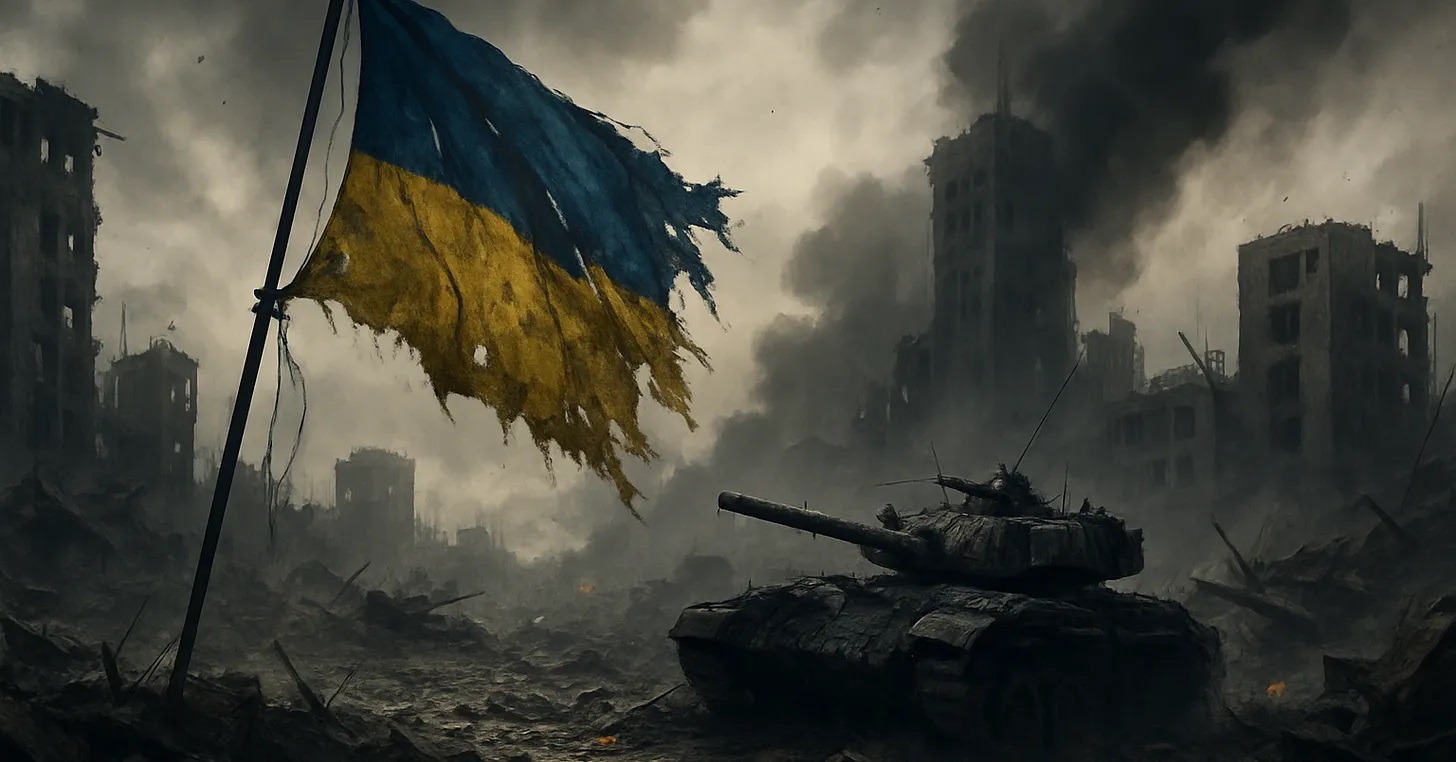
Having invested enormous political capital in the narrative of Ukrainian success, Western governments now face a stark choice: admit failure or fabricate further illusions.
A negotiated settlement can succeed only if it acknowledges Russia’s control over key Ukrainian territories and guarantees that Kyiv will not join NATO. Anything less is strategic fantasy.
Analyzing the impending failure of Ukraine’s war effort and the urgent need for strategic realism in U.S. and European policies.
POST-LIBERAL DISPATCH, Apr 29, 2025, https://postliberaldispatch.substack.com/p/no-victory-in-ukraine-the-costs-of?utm_source=post-email-title&publication_id=4747899&post_id=162368952&utm_campaign=email-post-title&isFreemail=true&r=ln98x&triedRedirect=true&utm_medium=email
The conflict in Ukraine represents not merely a military failure but a profound collapse of political imagination and strategic discipline across the West. To evaluate this ongoing debacle through the lens of political realism and realpolitik demands dispensing with sentimental narratives, ideological attachments, and moralized illusions that have distorted serious analysis for years. Strategic clarity begins with the uncomfortable but inescapable fact: Ukraine’s defeat, whether through a forced diplomatic settlement or battlefield collapse, is no longer a possibility to be debated—it is an inevitability. The West’s refusal to acknowledge this reality stems less from misunderstanding battlefield dynamics and more from a systemic dysfunction wherein political leadership has fused strategic aims with public relations imperatives, thereby serving neither effectively.
At the core of Western miscalculation lies a fatal contradiction. Ukraine was encouraged—indeed, materially and rhetorically incentivized—to resist with the implicit, sometimes explicit, promise of ultimate victory. Yet Western capitals were neither prepared to mobilize the industrial base, financial resources, nor political will necessary to sustain the prolonged total war required to defeat a nuclear-armed Russia. This contradiction was not an accident; it arose naturally from the structural incentives within Western democracies, where leaders needed to appear resolute without assuming the irreversible costs and risks that genuine strategic victory would demand. Thus, Western “support” was expansive in quantity but defective in quality—sufficient to prolong Ukraine’s resistance but insufficient to enable decisive success.
This dynamic exposes why further support—whether billions of dollars in aid, advanced weapons, or rhetorical escalations—cannot now alter the outcome. Ukraine’s manpower shortages, industrial exhaustion, and political fragmentation cannot be reversed by external injections of matériel or funding. The critical variable—human capacity—has been irreversibly degraded. Realpolitik demands the recognition that no arsenal of Western weapons can compensate for a collapsing force structure facing an adversary that enjoys both conventional and nuclear escalation dominance.
The strategic illusion driving continued support is not born of a sincere belief in Ukrainian victory but rather of a desperate attempt to delay political reckoning. Having invested enormous political capital in the narrative of Ukrainian success, Western governments now face a stark choice: admit failure or fabricate further illusions. In this sense, Ukraine’s war effort has been subordinated to Western political needs rather than judged on its own strategic merits. This helps explain why Ukrainian leadership was encouraged to reject diplomatic offramps like the Istanbul talks: the West preferred a failed gamble on battlefield reversal to an early settlement that would have publicly exposed the limits of Western power and credibility.
This leads to an unavoidable truth: Ukraine has been treated less as a sovereign actor and more as an instrument of Western strategic signaling. The dominant objective was never the restoration of Ukraine’s 1991 borders—an outcome unattainable without direct NATO intervention—but the maintenance of an image of Western resolve against authoritarian revisionism. Once battlefield success proved elusive, the war transformed into a conflict of perception, with Ukrainians paying the real, human cost for abstract political imperatives.
Against this backdrop, Trump’s blunt diplomacy is not a betrayal but rather a belated reassertion of strategic rationality. The alternative—prolonging Ukraine’s suffering for a fantasy of reversal—serves no tangible Western interest. Trump’s reported willingness to “walk away” unless a settlement is reached recognizes a fundamental truth of realpolitik: power is the only currency in negotiation. With no remaining strategic leverage, Ukraine must accept the least unfavorable terms while it still retains a semblance of bargaining power. Otherwise, total military collapse and unconditional surrender will be the inevitable conclusion.
This analysis must also grapple with the secondary consequences. Ukraine’s defeat will undoubtedly damage U.S. credibility in the eyes of key allies such as Taiwan, Japan, and South Korea. Yet political realism demands prioritization. The Indo-Pacific, not Eastern Europe, is now the primary theater of geopolitical competition. Resources, strategic focus, and credibility are finite. Every dollar expended in Ukraine without materially altering the balance of power weakens Washington’s ability to contain China, the only peer competitor capable of fundamentally reshaping the global order. From a purely interest-based perspective, retrenchment from Ukraine in favor of bolstering Indo-Pacific commitments is not only logical but strategically imperative, however politically unpalatable it may seem.
Nor should any illusions persist about containing Russia through continued proxy conflict. Prolonged war has already incentivized deepening Russian-Chinese strategic alignment, revealed political fractures within NATO, and accelerated the global shift toward a multipolar order. The longer the West clings to the illusion of salvaging Ukraine’s position, the more divisive it will become at home—and the more strategic ground it will cede abroad. Realpolitik demands ruthless triage: sacrifice what cannot be saved to consolidate and defend what remains viable.
Finally, it must be recognized that Russia, having paid the costs of prolonged conflict, has no rational incentive to settle for partial gains. Political realism teaches that actors seek to translate battlefield success into maximal political objectives. Unless confronted by overwhelming force or existential risk—neither of which the West is prepared to employ—Russia will continue pressing its advantage. A negotiated settlement can succeed only if it acknowledges Russia’s control over key Ukrainian territories and guarantees that Kyiv will not join NATO. Anything less is strategic fantasy.
The dominant narratives that have framed Western engagement in Ukraine—invocations of democracy, sovereignty, and resistance to aggression—may possess emotional resonance, but they have been strategically catastrophic. They obscured the real stakes, concealed the true balance of forces, and ultimately subordinated hard strategic interests to soft illusions. In the brutal calculus of international politics, sentimental attachments are liabilities, not assets. Strategic clarity demands recognizing irretrievable losses, minimizing further damage, and reallocating resources to theaters where the balance of power can still be decisively shaped.
For second time in 3 years Zelensky sabotages Ukraine war peace deal.

Walt Zlotow, West Suburban Peace Coalition, Glen Ellyn IL 30 Apr 25
Does Ukraine President Zelensky enjoy watching his citizens die needlessly in a US provoked war he could have ended twice?
Zelensky helped ensure Russia would invade February 22, 2022 by pushing NATO membership for Ukraine and massing 60,000 elite troops on the Donbas border to finish off the Russian leaning Donbas Ukrainians seeking independence from Kyiv destroying their culture along with their lives.
But Zelensky sensibly negotiated a peace agreement with Russia in the first two months (Istanbul Agreement) that would have ended the war with no loss of Ukraine territory albeit with no Ukraine NATO membership and independence for the beleaguered Donbas Ukrainians. That was statesmanship of the highest order.
But the US and UK saw a golden opportunity to weaken Russia if not change out the Vladimir Putin regime. What to do? Got it. Send US Defense Secretary Lloyd Austin and UK Prime Minister Boris Johnson to Kyiv to disabuse Zelensky of making peace. Hey, with a couple of hundred billions in US/NATO weapons but no soldiers, you can win Zelensky and go out the George Washington of Ukraine..
The result? Three years on Ukraine is largely destroyed with millions fled, over a hundred thousand casualties, 45,000 square miles gone forever and a shattered economy.
But new sheriff in town Trump brokered a new peace deal which would have ended the war with no further casualties or lost territory, Astonishingly, Zelensky rejected it again, this time of his own free will. He cited both his desire to require Crimea, lost 5 years before he became president, and his goal of Ukraine joining NATO.
So despite a 3 day Russian truce in in the offing over its May celebration of its WWII victory, the dying soldiers and expanding Russian buffer zone in Ukraine to prevent further long range Ukrainian missile attacks will go on till Ukraine simply collapses.
Maybe Zelensky has a nationwide death wish. Maybe he’s delusional or too stupid to realize his leading Ukraine to certain destruction. Or maybe it’s simply his way of telling the US and UK that he’s capable of blowing up a sensible peace agreement all by himself.
Europe is drilling for World War III
NATO is conducting exercises for “a broad offensive from Vilnius to Odessa” at “a scale unseen in decades.”
Alex Krainer, May 01, 2025
[Originally published at I-System TrendCompass] Russia’s military victory over Ukraine has been a near-certainty for months now. Ukraine’s total defeat is only a matter of time, but as that time approaches, European powers have been increasingly determined not to let the war die and are now actively preparing to take it up where Ukraine stumbles. Our liberal democracies are as precious as they are fragile and every precaution must be taken to defend them from the Asiatic hordes gathering in the east.
While our valiant bankers are arranging to allocate trillions of euros of our children’s and grandchildren’s wealth for defense spending, our militaries are diligently exercising and preparing for war, hidden from ordinary Europeans who aren’t exactly enthused about World War 3. But the Russians have noticed: presidential aide and former National Security Adviser Nikolai Patrushev recently stated that, for a second consecutive year, NATO has been
“conducting exercises at our borders at a scale unseen in decades. … They are training for conducting a broad offensive from Vilnius to Odessa, seizing Kaliningrad region, imposing a naval blockade in the Baltic and the Black Seas and executing preventive strikes on the staging locations of Russian nuclear deterrence forces.”
If Mr. Patrushev is correct, it would appear that London, Paris, Berlin and Brussels are actively preparing for war against Russia. But his statement that the exercises are “at a scale unseen in decades,” needs to be put in context.
NATO’s provocations far predate Ukraine war
NATO has been involved in increasingly aggressive military maneuvers at Russia’s doorstep for many years now, especially after the 2014 Euromaidan coup in Kiev. During that time, NATO forces have been conducting as many as 40 major military exercises per year along Russia’s borders.
Movement of their military assets evolved from purely reconnaissance hardware to battle ready ships and aircraft equipped with precision munitions and cruise missiles which would frequently approach Russian territory to as close as 15 km (9.3 miles). On these occasions, they often activated their missiles in repeated mock attacks on Russian targets. In September 2020, chief of operations of Russia’s high command, General Sergey Rudskoi stated that NATO was staging between 33 and 40 such flight approaches per week using fighter jets from Sweden, Germany, Ukraine and Italy.
This suggests that the exercises Mr. Patrushev referred to aren’t Europe’s reaction to Russia’s aggressiveness but a continuation of policy that far predates the Ukraine war. In June 2021, still more than six months before Ukraine war, NATO’s then Secretary General Jens Stoltenberg boasted that,
“Perhaps the most important thing we have done is that for the first time in NATO’s history, we have combat-ready troops in the eastern part of the Alliance. New battle groups are deployed to the Baltic countries and Poland, we have tripled the size of the NATO readiness force.”
In a 2016 radio-interview with John Bachelor, late professor Stephen Cohen noted that,
“NATO has decided to quadruple its military forces on Russia’s borders or near Russia’s borders… The last time there was this kind of Western hostile military force on Russia’s borders was when Nazis invaded Russia in 1941. There has never been anything like this. During the 40-year Cold War there was this vast buffer zone that ran from the Soviet borders all the way to Berlin. There were no NATO or American troops there. This is a very radical departure on the part of the [Obama] administration. … Russia is not threatening any country on its border.”
$75 trillion worth of democracy and freedom
Professor Cohen was right. Russia really wasn’t threatening any of its neighbors, and no Russian leader has either explicitly or implicitly expressed any territorial pretentions against any European nation. The deranged claims that once they are done with Ukraine, the Russians will continue on to Poland, the Baltic states, Finland and then, who knows, perhaps Paris and London, are based on nothing but European leaders reckless fear mongering, aimed at justifying NATO’s continuing preparations for war.
The ultimate reason isn’t the belief that Russia will launch a medieval invasion of Europe and deprive us of our democracy and freedom, but the certain knowledge that Russia is sitting on an estimated $75 trillion of our freedom and democracy. Those precious resources are utterly wasted on the unworthy Russians. Here’s what the Iron Lady Margaret Thatcher once said (video at this link):
“If you were to make a table of countries in proportion to the natural resources they have, the top one would almost certainly be Russia. She has everything. Oil, gas, diamonds, platinum, gold, silver, all the industrial metals, marvelous standing timber, a wonderfully rich soil. But countries are not rich in proportion to their natural resources. Countries are rich whose governments have policies which encourage essential creativity, initiative and enterprise of man and recognize his desire to do better for his family.”…………………………………………………………………………………………………………. https://alexkrainer.substack.com/p/europe-is-drilling-for-world-war?utm_source=post-email-title&publication_id=1063805&post_id=162553198&utm_campaign=email-post-title&isFreemail=true&r=1ise1&triedRedirect=true&utm_medium=email
Australian Government ignores AUKUS ‘very high risk’ warning from the Admiral in charge

Admiral Mead sought to bell the cat while Defence Minister Marles has not been straight with the Australian people about the very high risks of AUKUS, even though he has been briefed on and appears to have informed Cabinet of those risks.

Marles should front up about this concealment without delay.
Labor not blameless
by Rex Patrick | Apr 29, 2025, https://michaelwest.com.au/government-ignores-aukus-high-risk-warning-from-the-admiral-in-charge/
The AUKUS submarine project faces huge risks, and Cabinet knows. But as the Government ships $2B of taxpayers’ money to the US this year, with much more to follow, the taxpayer is not being told. Rex Patrick reports.
On 26 February this year, Vice Admiral Jonathan Mead, the man in charge of AUKUS, advised the Senate that the AUKUS submarine program was “very high risk”. He said, “We’ve made that clear to government, and the government has made that clear to the public.”
However, it has not.
I follow AUKUS closely and had not heard that publicly before. Whilst it is absolutely the case, and something MWM has reported on extensively, this was the first public admission of the very high risk nature of the project from the Australian Submarine Agency.
Concerns about US submarine production rates and the weakness of the UK’s submarine industrial base have generated grave doubts about whether the $368B AUKUS scheme will deliver nuclear-powered submarines for Australia.
Moreover, former Prime Minister Malcolm Turnbull has revealed, after conversations with insiders, that there is no Plan B.
“Plan B is that we will not get any submarines.”
FOI ahoy
I was somewhat surprised by Admiral Mead’s unusual candour, so on 27 February, I moved to test the veracity of his remarks with an FOI application directed at the Australian Submarine Agency (ASA) seeking access to “any ministerial submission or briefing provided by ASA to the Minister for Defence … that refers to the AUKUS nuclear submarine program as involving ‘high risk’ or ‘very high risk’.”
I also sought access to ‘any statement made by the Minister for Defence or the Minister for Defence Industry and Capability Delivery that refers to the AUKUS nuclear submarine program as involving ‘high risk’ or ‘very high risk’.”
A decision on those was made this week. FOI applications can reveal the truth by what is disclosed, by what is withheld, and by confirming what doesn’t exist.
ASA confirmed the existence of a ministerial briefing characterising the AUKUS submarine program as involving ‘high risk’ or ‘very high risk’, but refused access to that briefing on national security and Cabinet secrecy grounds. Significantly, ASA’s refusal decision confirmed this document was produced for the dominant purpose of briefing a Minister on an attached Cabinet submission.
In effect, the Submarine Agency confirmed Admiral Mead’s statement that ASA has briefed the government on the ‘high risk’ or ‘very high risk’ nature of the AUKUS project, and that briefing was submitted to the Defence Minister for Cabinet consideration.
“That high-risk assessment has gone to the very top of the Government.”
Alarm bells should be ringing.
Misleading the public
But the FOI decision also reveals that Defence Minister Richard Marles has not been forthcoming with the Australian public about the full hazards of AUKUS.
In relation to statements the minister has made to the public on the risk status of the project, the Australian Submarine Agency advised that ‘no in scope documents were identified’ that show the Defence Minister has made any public statement that acknowledges the ‘high’ or ‘very high’ risk of the AUKUS scheme.
The agency was able to find only a handful of statements referring to risk management in general and assertions that the United Kingdom will carry the primary risks of the AUKUS-SSN construction.
Admiral Mead was not correct in his statement to the Senate, but more importantly, the Government has been caught red-handed fudging the risks associated with the AUKUS scheme. The public has been misled.
Admiral Mead sought to bell the cat while Defence Minister Marles has not been straight with the Australian people about the very high risks of AUKUS, even though he has been briefed on and appears to have informed Cabinet of those risks.
Marles should front up about this concealment without delay.
Labor not blameless
Last week, at a pre-polling booth, I was standing next to a Labor volunteer who was handing out how-to-vote cards for the seat of Adelaide. An elderly gentleman stuck out his hand and asked the volunteer for a how-to-vote card.
“We have to stop the Liberals getting in”, he said. “We don’t need nuclear power”.
I couldn’t resist. “But you’re taking a Labor how-to-vote”, I said. He gave me a strange look. “What about the eight naval reactors?” I queried. “A naval reactor is a reactor, and naval nuclear waste is nuclear waste”.
Many in the Labor camp think AUKUS is Morrison’s (and Peter Dutton’s) baby. But for Labor, that’s just a convenient mistruth. In September 2021, Morrison announced AUKUS. But he only announced a study. It was Prime Minister Anthony Albanese at the March 2023 San Diego “kabuki show” (as described by Paul Keating) that turned it into a formal Defence project behemoth with a projected cost of $368 billion.
Pre-polling booths are a good place to hang out for political gossip. I also held a discussion with a long-standing grassroots Labor Party member who proceeded to tell me how he had been sidelined for his opposition to AUKUS.
There’s no doubt the Labor rank-and-file have been cut out of the party’s decision-making with the Labor leadership ramming an AUKUS endorsement through the party’s 2023 national conference. Since then, the dissenting views of many, perhaps even a majority of Labor members, have been marginalised and suppressed.
AUKUS to be torpedoed
Politics aside, any project manager worth their salt would put an end to AUKUS. It’s a looming procurement shipwreck.
The US will not be able to supply the Virginia Class submarines to the Royal Australian Navy. The US Congressional Research Service has calculated a US build rate of 2.3 boats per annum is necessary to enable the US to provide boats to Australia without harming US undersea warfare capability. The current build rate is somewhere between 1.1 and 1.3 boats per annum.
The British submarine industry is one big cluster fiasco. Fruit that will flow from that program will be late, possibly rotten, and far more expensive than planned.
Meeting delivery obligations by the US and UK under the program will be really hard. And the fact that the Australian Government can’t even be up front and honest about the program
Rex Patrick is a former Senator for South Australia and earlier a submariner in the armed forces. Best known as an anti-corruption and transparency crusader, Rex is running for the Senate on the Lambie Network ticket next year – www.transparencywarrior.com.au.
“suggests there is no chance of success.”
But Albanese need not worry, nor Marles. By the time all of this sinks in, they’ll be out of the system. It will be our children who suffer from the tens of billions wasted and the massive hole in our national security capability.
Rex Patrick
Covering up Ukrainian Nazis is nothing new – the Canadians have been doing it for almost eighty years

Ian Proud, April 29, 2025. https://strategic-culture.su/news/2025/04/29/covering-up-ukrainian-nazis-nothing-new-canadians-have-been-doing-it-for-almost-eighty-years/
A number of topics remain taboo in discussing the war in Ukraine. Busification, Zelensky’s democratic mandate, Ukraine’s casualty numbers and anything suggesting that Ukraine cannot win are all off limits. Likewise the problem of alleged neo-Nazis in Ukraine.
One of the most embarrassing episodes since the Ukraine war started in 2022, was when Yaroslav Hunka, was given two standing ovations in the Canadian House of Commons public gallery by MPs during the visit of President Zelensky in 2023. Hunka has been accused by Russia of genocide, because of his alleged involvement in the Huta Pieniacka massacre of February 28 1944 in which more than 500 ethnic Poles were murdered in a village, in what is now western Ukraine. Hunka was a member of the SS Galicia Division, a mostly Ukrainian unit of the Waffen SS, which Commissions in Germany and Poland later found guilty of war crimes.
This was shocking because it opened the lid on a topic of conversation that has been largely silenced by the western mainstream media since the beginning of the war: Ukraine’s contemporary challenge of far-right ultranationalism. But the Hunka case also illustrates how western authorities airbrushed discussion of nazis in Ukraine after World War II too.
On 13 July 1948 the British Commonwealth Relations Office, what is now part of the Foreign Commonwealth and Development Office, sent a telegram to Commonwealth governments, proposing an end to Nazi war crimes trials in the British zone of Germany. “Punishment of war crimes is more a matter of discouraging future generations than of meting out retribution to every guilty individual… it is now necessary to dispose of the past as soon as possible.”
After the conclusion of the Nuremberg War Trials in 1946 the western world faced a new enemy in the Soviet Union. Limited security resources in cash-strapped Albion and its colonies were re-deployed to uncover suspected Soviet agents and Communists, rather than to identify and track down lower-order Nazi war criminals.
Around this time, many Ukrainians fled the Soviet Union to settle in Canada. In the thirty-year period after the start of Operation Barbarossa, the Ukrainian population in Canada almost doubled, from 300,000 to almost 600,000 people. While most of them, I am sure, would not have been Nazi collaborators, some, undoubtedly, were. They were joined by lesser numbers of Latvians, Hungarians, Slovaks and others.
Within that exodus would have been so-called “lesser” war criminals; persons who had organised the transportation of Jews, Slavs, gypsies and homosexuals to death camps, acted as informers, committed murders, or become involved in war crimes as other ranks and non-commissioned officers in death squads. They were the lower echelon collaborators, acting as the instruments of the genocide initiated by the Nazis.
Yet, following the British instruction, Canada progressively relaxed its immigration policy between 1950 and 1962, steadily removing restrictions against the entry of German nazis and non-German members of German military units like the SS Galicia Division.
However, in 1984 the Simon Wiesenthal Center wrote a letter to the Canadian government claiming to have obtained evidence that the ‘Angel of Death’ Josef Mengele had applied for a landed immigrant visa to Canada in 1962. Though this proved to be incorrect, it caused such outrage among Canada’s Jewish community that a Commission of Inquiry on War Criminals in Canada was established in 1985.
Known as the Deschênes Commission, it uncovered a list of 774 persons who had allegedly entered Canada and who required further investigation. Of that list, only 28 underwent serious investigation and trial.
Michael Pawlowski, accused of murdering 410 Jews and 80 non-Jewish Poles in Belarus in 1942, was acquitted as judges blocked the prosecution from gathering evidence in the Soviet Union.
Stephen Reistetter of Slovakia was not tried for allegations that he kidnapped 3000 Jews to have them sent to Nazi death camps while serving in the Hlinka party, a far right clerical-fascist movement with Nazi leanings. His case fell apart because a witness died.
Erich Tobias, was accused of involvement in the execution of Latvian Jews but died before his case went to court.
By 1995, with no convictions for war crimes having been secured, the Canadian Justice Department cut the size of its war crimes unit from 24 to 11 people. In the absence of criminal prosecutions, the Canadian Government tried civil proceedings to revoke citizenship from alleged war criminals.
Wasily Bogutin collaborated with the Nazi occupation forces in the town of Selidovo, in Donetsk, and was personally and directly involved in effecting the roundup of young persons for forced labour in Germany. In February 1998, Judge McKeown, of the Trial Division of the Federal Court, found that Bogutin had concealed his role in war crimes, but he died before he could be extradited.
Joseph Nemsila, who commanded a Slovak unit that sent civilians to Auschwitz died in 1997 after a decision not to revoke citizenship was overturned, but death prevented exportation.
In only 7 cases was order made for the suspect to be extradited or exported. This included Ladislaus Csizsik-Csatary, accused of involvement in the confinement of thousands of Hungarian Jews and their subsequent deportation to death camps. In July 1997, just before his trial was to begin, he decided not to oppose the loss of his citizenship and voluntarily left the country.
Vladimir Katriuk was accused of having taken part in the Khatyn Massacre in Belarus and Wasyl Odnynsky, a guard at SS labour camps at Trawniki and Poniaka. Moves were made to revoke their citizenship, but they were allowed to remain in Canada until all court proceedings were lifted in 2007.
Progress in prosecuting alleged war criminals in Canada was always slow, often held up by foot-dragging by often reluctant judges, and a refusal to allow for the gathering of evidence in the Soviet Union.
Today, the media and Jewish groups still pressure the Canadian government to reveal the names of all of the 774 persons considered by the 1985 Deschênes Commission with so far little success.
An American academic recently discovered what is believed to be a similar list of 700 suspects which included Volodymyr Kubiovych, a Ukrainian Nazi collaborator who helped organize the SS Galicia division and who was editor in chief of the Encyclopedia of Ukraine compiled at the University of Alberta. A photograph of a parade in Lviv, Ukraine, in July, 1943, shows Mr. Kubiovych making a Nazi salute alongside Otto Wächter, a senior member of the SS who also served as governor of Galicia and Krakow.
Yaroslav Hunka was not on that list, raising questions about how many Nazi collaborators in Canada were never discovered.
I don’t think that Ukraine today is a Nazi society and, even at its high watermark, the Svoboda party only garnered 10% of the national vote. But ultranationalism is a major problem, particularly in the west of Ukraine, in that area known as Galicia during World War II. And the refusal of western governments to acknowledge the issue of ultranationalism in Ukraine or speak out means that we are turning a blind eye once more to activity that we would never tolerate in our own countries.
Congressional Budget Office (CBO) predicts US nuclear weapons will cost nearly a trillion dollars over the coming decade.

Greg Mello, Los Alamos Study Group, 30 Apr 25
Albuquerque, NM — Last week, the Congressional Budget Office (CBO) released its latest biennial estimate of the costs of nuclear weapons over the coming decade (2025-2034).
CBO’s nuclear weapons cost estimates are built from the budget projections of the Department of Defense (DoD) and the Department of Energy’s (DOE’s) National Nuclear Security Administration (NNSA), as well as CBO’s own estimates of likely cost increases for these programs over the period in question, based on CBO’s historical records for comparable programs.
CBO estimates that nuclear weapons will cost a total of $946 billion (B) over the coming decade, an average of about $95 B per year. This is $190 B (25%) higher than CBO’s estimate from two years ago.
Albuquerque, NM — Last week, the Congressional Budget Office (CBO) released its latest biennial estimate of the costs of nuclear weapons over the coming decade (2025-2034).
CBO’s nuclear weapons cost estimates are built from the budget projections of the Department of Defense (DoD) and the Department of Energy’s (DOE’s) National Nuclear Security Administration (NNSA), as well as CBO’s own estimates of likely cost increases for these programs over the period in question, based on CBO’s historical records for comparable programs.
CBO estimates that nuclear weapons will cost a total of $946 billion (B) over the coming decade, an average of about $95 B per year. This is $190 B (25%) higher than CBO’s estimate from two years ago.
In the case of the Sentinel silo-based missile system, CBO’s estimates explicitly “do not include all of the cost growth that the program is likely to experience” (pp. 6-7). In other words, CBO knows its estimate is too low but cannot provide a defensible better one, because it would only be a guess at this point. In other words, neither DoD nor CBO have any real idea what Sentinel will cost.
Many nuclear weapons-related costs, such as DOE environmental cleanup, are not included.
The report breaks down its findings in several ways, all clearly presented. Year-by-year estimates are not provided.
CBO’s findings include these items of particular interest regarding NNSA:
- NNSA’s facility modernization plans are likely to cost $72 B over the coming decade, out of a total of $110 B that NNSA will spend on facilities over this period (p. 5). NNSA’s facilities will thus cost much more than the $16 B earmarked for “stockpile services” (NNSA’s part in maintaining existing weapons), or the $67 B to be spent on “other stewardship and support activities” (p. 4).
- “CBO projects that the costs of nuclear acquisition programs would represent 11.8 percent of DoD’s total planned acquisition costs over the next decade as outlined in the 2025 budget submission…Competition for funding among
acquisition programs will force DoD to make difficult choices about which programs to pursue.” (pp. 5-6). - NNSA’s projected total 10-year costs have increased by 27% over just the past two years. Some 85% ($45 B / $83 B) of these costs are not associated with any particular warhead but are rather expenses associated with NNSA’s capabilities overall (p. 10). CBO believes NNSA’s programs will cost an extra $11 B over the decade beyond NNSA’s projections, a little more than $1 B per year.
- Regarding NNSA’s cost increase, “[a]bout 60 percent of the total increase comes from higher expected costs for operation and modernization of infrastructure, including establishing and operating new pit production facilities, secondary production facilities, tritium production facilities, and domestic uranium enrichment facilities. About 30 percent comes from support programs, such as scientific research to improve the weapon production and sustainment process, and federal employee oversight of contractors operating laboratories.” The balance of the NNSA increase comes from new programs and projects, leading to higher annual spending in the 2032-2034 years than in 2023-2024 years, which are now in the rear-view mirror.
- “CBO’s estimates come with substantial uncertainty stemming mainly from two sources: Future plans may not be achievable, leading to cost growth and delays; and the costs of developing, producing, and operating weapon systems are uncertain even when the plans are fully determined” (p. 8).
Study Group director Greg Mello:
“As CBO notes, most nuclear weapons costs are incurred by modernizing the arsenal and its production facilities, not by deploying and maintaining existing weapons.
“NNSA insists that its entire growing portfolio of projects and programs is necessary. There is no distinction between “needs” and “wants.” NNSA also believes, and has said, it is no longer “cost-constrained” [NNSA: “Evolving the Nuclear Security Enterprise,” Sep 2022, p. 3]. Under these assumptions, NNSA’s costs are certain to continue growing rapidly. If the present growth rate continues, NNSA’s warhead budget will double in less than 8 years.
“There is one high-dollar NNSA infrastructure program that is not generic to all warheads but rather needed solely for just one, namely pit production at LANL. LANL pit production is explicitly directed to the W87-1 warhead for the Sentinel missile and is unlikely to be sustainable beyond the needs of that program, if indeed it can be established at all. The jury is still out on whether LANL pit production will be possible, or stable and if so, for how long.
“NNSA will not be able to operate two pit facilities, even if it can set one up at LANL. Once the pit facility at the Savannah River Site begins production, every budget hawk on Capitol Hill and the Pentagon will eye LANL’s gerry-rigged pit program for closure, assuming it operates at all.
“As CBO notes, there will be increased competition for defense dollars as nuclear weapons programs grow. The huge expenses tallied in this report were not anticipated at the outset of the nuclear modernization program. Since 2015, and with every report, estimated nuclear weapons costs have increased beyond prior predictions, from $348 B in 2015 to $946 B today. The opportunity costs are staggering.
“CBO devotes two big text boxes to the troubled Sentinel program — why they can’t estimate its cost, etc. The buzzards are circling. The coming year will bring more revelations about Sentinel and they won’t be good. The White House and Congress should pull the plug on Sentinel now, however difficult that would be.
“In every report since 2015, CBO has revised its estimate of future cost overruns. This year’s prediction will also be too low, especially for Sentinel and NNSA.
“The problems faced by nuclear weapons programs cannot all be fixed by pouring in more money. There are very real material and human limitations involved. There will be no return to the ‘heroic mode of production’ for nuclear weapons. Even if Congress dumped $100 or $200 billion more on nuclear weapons, the system that produces them would not ‘jump to the task’ for years, if at all. The people, the skills, the facilities, the motivation — none of these are in place for a nuclear arms race, especially if the U.S. is going to build its manufacturing back and repair its sorry civilian infrastructure. The neocons who want to ramp up nuclear production are ignorant about what that would really entail. They are going to be sorely disappointed.
“Practical problems aside, ‘peace through strength’ is a mistaken idea in this place and time, especially as regards nuclear weapons. No thoughtful strategy supports the proliferation of US nuclear weapons. Quite the contrary — present policies are driven by organized greed and fear. US nuclear weapons policies, and as we see here their costs, are out of control.”
1 This Month


18 March Webinar @ 1 PM EST: An Assessment of SMR Projects: The Case of Canada
register for the zoom:
https://us02web.zoom.us/webinar/register/WN_o8BIIOUvQ2ONJR1nta65DQ#/registration


of the week – STOP SMALL MODULAR REACTORS IN CANADA
To see nuclear-related stories in greater depth and intensity – go to https://nuclearinformation.wordpress.com
-
Archives
- March 2026 (146)
- February 2026 (268)
- January 2026 (308)
- December 2025 (358)
- November 2025 (359)
- October 2025 (376)
- September 2025 (258)
- August 2025 (319)
- July 2025 (230)
- June 2025 (348)
- May 2025 (261)
- April 2025 (305)
-
Categories
- 1
- 1 NUCLEAR ISSUES
- business and costs
- climate change
- culture and arts
- ENERGY
- environment
- health
- history
- indigenous issues
- Legal
- marketing of nuclear
- media
- opposition to nuclear
- PERSONAL STORIES
- politics
- politics international
- Religion and ethics
- safety
- secrets,lies and civil liberties
- spinbuster
- technology
- Uranium
- wastes
- weapons and war
- Women
- 2 WORLD
- ACTION
- AFRICA
- Atrocities
- AUSTRALIA
- Christina's notes
- Christina's themes
- culture and arts
- Events
- Fuk 2022
- Fuk 2023
- Fukushima 2017
- Fukushima 2018
- fukushima 2019
- Fukushima 2020
- Fukushima 2021
- general
- global warming
- Humour (God we need it)
- Nuclear
- RARE EARTHS
- Reference
- resources – print
- Resources -audiovicual
- Weekly Newsletter
- World
- World Nuclear
- YouTube
-
RSS
Entries RSS
Comments RSS
 nuclear-news