Resistance to nuke dump grows in South Copeland

NFLA 31st March 2025
Kirksanton and Bankhead residents in the South Copeland GDF Search Area will be heartened by the support of Millom Town Councillors who approved a motion at their 26 March meeting to ‘reject the area of focus as being beneficial to Bank Head’.
In January, Nuclear Waste Services announced that a site surrounding the prison West of Haverigg was its ‘Area of Focus’, the preferred inland site for a Geological Disposal Facility, a deep repository for Britain’s legacy and future high-level radioactive waste. This site borders the village of Kirksanton and the Bank Head housing estate.
The Council also agreed to a request that a public meeting be held to examine the ‘positives and negatives’ of bringing the GDF to the area. In September 2023, a Community Forum attended by the public and organised by the South Copeland GDF Community Partnership drew up an initial list. In response to this NWS promised to commission an ‘impacts report’ from an independent consultant, but this has never materialised.
Councillors also agreed to send a letter of complaint to NWS about the size of the Area of Focus and how the announcement has impacted house sales and affected residents of the area. At the meeting, the Chair conceded that, after speaking to estate agents, he believed the area to be ‘blighted’. Since the announcement, one house sale in nearby Silecroft has fallen through and a house owner in Bank Head has been forced to significantly reduce their asking price in make a sale.
Jan Bridget, who co-founded Millom and District against the GDF in 2022, was delighted at the level of attendance from the public and at the outcome:
“Well, what can I say, we have won a battle but not the war. And I am thrilled that around 40 people turned up at the Millom Town Council meeting, demonstrating that Bank Head and Kirksanton are not willing communities”.
Millom and District Against the Nuclear Dump organised a meeting of Bank Head residents to meet their local councillors from Cumberland and Millom Town Councils in February. Thirty-nine people attended the meeting, most from the Bank Head estate. Residents asked the councillors for their help after sharing their very moving concerns.
We reported on this meeting:…………………………………..
https://www.nuclearpolicy.info/news/resistance-to-nuke-dump-grows-in-south-copeland/
Nuclear waste centre delayed

Nuclear center must replace roof on 70-year-old lab so it can process radioactive waste.
Project sees 7-year delay and budget swell to £1.5B, but nuclear leadership ‘confident’ it has an alternative
Lindsay Clark, 28 Mar 25, The Register
The center of the UK’s nuclear industry has agreed on alternatives for how it will process waste into the next decade after delays and overspending hit a lab project.
In the face of a 2028 deadline to put facilities in place to treat and repackage plutonium, Sellafield paused a delayed project to build a replacement for its 70-year-old analytical lab.
Speaking to MPs last week, Euan Hutton, CEO of Sellafield Ltd, said he was “confident” in an alternative that involves refurbishing its old lab and borrowing facilities from another onsite lab.
This comes after the go live date for its Replacement Analytical Project (RAP) was delayed from 2028 until at least 2034 and costs ballooned to £1.5 billion ($1.93 billion).
The center of the UK’s nuclear industry has agreed on alternatives for how it will process waste into the next decade after delays and overspending hit a lab project.
In the face of a 2028 deadline to put facilities in place to treat and repackage plutonium, Sellafield paused a delayed project to build a replacement for its 70-year-old analytical lab.
Speaking to MPs last week, Euan Hutton, CEO of Sellafield Ltd, said he was “confident” in an alternative that involves refurbishing its old lab and borrowing facilities from another onsite lab.
This comes after the go live date for its Replacement Analytical Project (RAP) was delayed from 2028 until at least 2034 and costs ballooned to £1.5 billion ($1.93 billion).
Sellafield, formerly known as Windscale, has been the center of the UK’s nuclear industry since the 1950s. While the site is home to a number of companies, and the government’s Nuclear Decommissioning Authority, Sellafield Limited is a British nuclear decommissioning Site Licence Company controlled by the NDA.
In October last year, the UK’s public spending watchdog said Sellafield depends on an on-site laboratory that is “over 70 years old, does not meet modern construction standards and is in extremely poor (and deteriorating) condition.”
The National Audit Office said [PDF] the laboratory is “not technically capable of carrying out the analysis required to commission the Sellafield Product and Residue Store Retreatment Plant (SRP)” to treat and repackage plutonium.
Sellafield’s plan in 2016 was to convert a 25-year-old laboratory on the site, to replace the 70 year-old lab, under the “Replacement Analytical Project.” The outline business case was approved in 2019 with an estimated cost of between £486 million and £1 billion ($626 million – $1.3 billion).
However, that project was “strategically paused” in February 2024 after it emerged Sellafield believed it could take until December 2034 to deliver the full capability, while cost could reach £1.5 billion ($1.93 billion).
Speaking to Parliament’s Public Accounts Committee last week, Hutton said: “Fundamentally, around December 2023, there was an incoherence that came out between the availability of the analytical services and when I needed to have those available for the plutonium repack plant…………………………………………
https://www.theregister.com/2025/03/28/uk_nuclear_center_waste_project_delayed/
Disappointing but predictable: Government minister’s reply on nuke treaty
In February 2025, the UK/Ireland Nuclear Free Local Authorities was a
signatory alongside academics and peace campaigners to a letter drafted by
the United Nations Association UK (UNAUK) that was sent to Prime Minister
Sir Keir Starmer and Foreign Secretary David Lammy.
NFLA Chair Cllr Lawrence O’Neill and NFLA Secretary Richard Outram co-signed for the
NFLAs as did signatories from twenty-five other organisations, including
community advocates from Kiribati, an island nation impacted by British
nuclear weapons testing carried out in the 1950’s and by the United
States in 1962.
As the islanders were not evacuated both they and the
participating servicemen were impacted by radiation. The letter called on
the UK Government to send an observer to the 3rd Meeting of States Parties
(3MSP) to the Treaty on the Prohibition of Nuclear Weapons (TPNW) which was
held in New York until 7 March. The UK Government did not take up this
opportunity.
NFLA 29th May 2025,
https://www.nuclearpolicy.info/wp/wp-content/uploads/2025/05/A434-NB320-Disappointing-but-predictable-Government-ministers-reply-on-nuke-treaty-ban.-May-2025.pdf
‘Greedy landlords are cashing in and forcing us out of town’.
The construction of the Sizewell C nuclear power plant on the Suffolk
coast is a key part of the government’s growth programme. But some locals
fear being forced out, accusing landlords of cashing in on a jobs boom by
evicting tenants and raising rents to unaffordable levels. The plant is due
to open in 2031, and although a final investment decision has not yet been
made, groundwork is already well under way.
The construction project will
require a predicted workforce of 7,900, of which about two-thirds will be
from outside the area. About 2,400 workers will be based on site with 500
others living at the former Pontins holiday park at Pakefield, near
Lowestoft. The remaining contractors, however, will have to move into
properties in or around the town of Leiston – population 5,508 – where some
rents have doubled to more than £3,000 a month.
BBC 31st March 2025,
https://www.bbc.co.uk/news/articles/ce98ljn1gzno
1 This Month
To see nuclear-related stories in greater depth and intensity – go to https://nuclearinformation.wordpress.com/
12 February – Webinar The Big Push: New Nuclear Projects in Canada
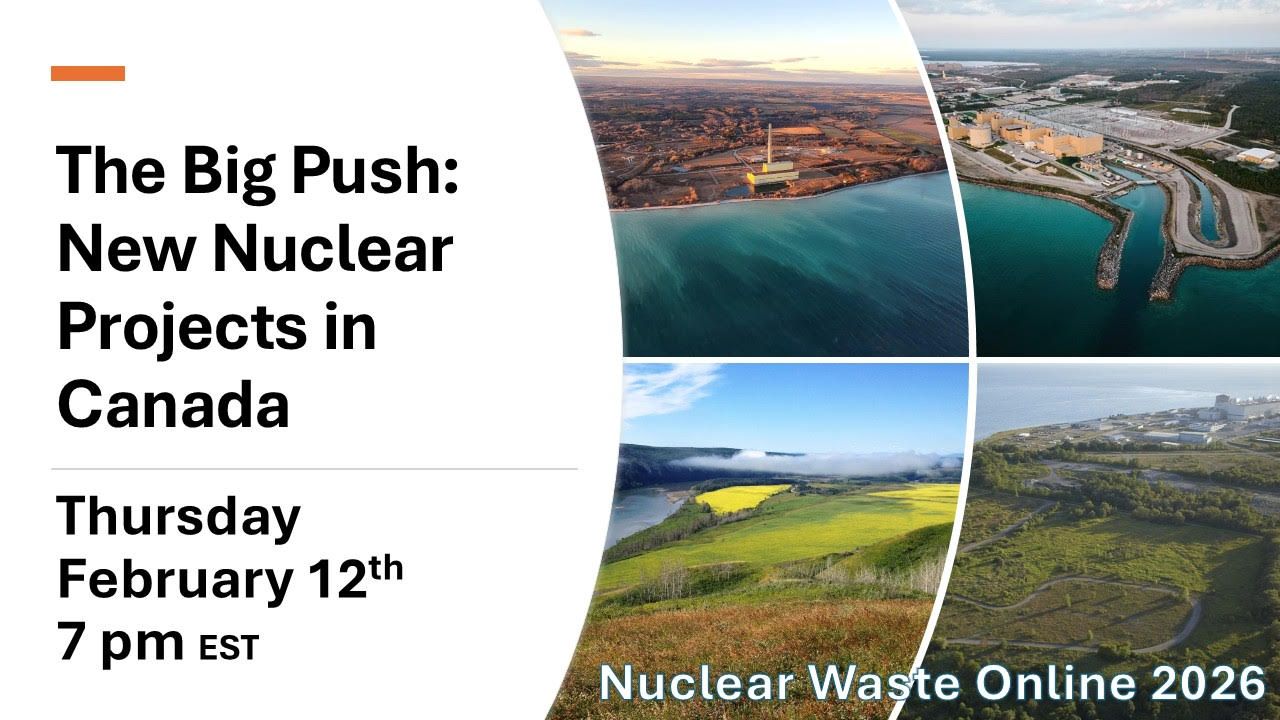
Thursday, February 12, 7 pm Eastern | 2nd of 4 sessions in the 2026 Nuclear Waste Online webinar series
Join a webinar on the push for new nuclear generation in Canada. Go to Northwatch.org to register or use the registration link https://us02web.zoom.us/webinar/register/WN_ZfWOf1GITqSRIZX8CB-A9w
-
Archives
- February 2026 (127)
- January 2026 (308)
- December 2025 (358)
- November 2025 (359)
- October 2025 (376)
- September 2025 (258)
- August 2025 (319)
- July 2025 (230)
- June 2025 (348)
- May 2025 (261)
- April 2025 (305)
- March 2025 (319)
-
Categories
- 1
- 1 NUCLEAR ISSUES
- business and costs
- climate change
- culture and arts
- ENERGY
- environment
- health
- history
- indigenous issues
- Legal
- marketing of nuclear
- media
- opposition to nuclear
- PERSONAL STORIES
- politics
- politics international
- Religion and ethics
- safety
- secrets,lies and civil liberties
- spinbuster
- technology
- Uranium
- wastes
- weapons and war
- Women
- 2 WORLD
- ACTION
- AFRICA
- Atrocities
- AUSTRALIA
- Christina's notes
- Christina's themes
- culture and arts
- Events
- Fuk 2022
- Fuk 2023
- Fukushima 2017
- Fukushima 2018
- fukushima 2019
- Fukushima 2020
- Fukushima 2021
- general
- global warming
- Humour (God we need it)
- Nuclear
- RARE EARTHS
- Reference
- resources – print
- Resources -audiovicual
- Weekly Newsletter
- World
- World Nuclear
- YouTube
-
RSS
Entries RSS
Comments RSS
 nuclear-news