Political stance of Biden and Trump. Both Zionist.
Trump is just as much a Zionist as was Biden. Biden openly stated “I am a Zionist.”
Trump’s staunch support for Israel and Gaza’s potential as American-owned “Riviera of the Mediterranean”
ABC News on February 20, 2025, stated: “On the campaign trail in 2024, Trump promised to back Israeli Prime Minister Benjamin Netanyahu even more strongly than Biden had, while Jared Kushner, Trump’s adviser and Jewish son-in-law, speculated that the Gazan waterfront might be valuable real estate. Now, Trump has made good on some of his campaign rhetoric by doubling down on support for Israel. Netanyahu was one of Trump’s first foreign head of state visitors, and during their meeting, Trump floated a U.S. takeover of the Gaza Strip and forced relocation of all Palestinians, a stance he has since repeated, while referring to Gaza as a ‘demolition site’ or ‘big real estate site.’
Trump’s idea for a U.S. takeover has been praised by Netanyahu but condemned by experts as a human rights violation. And recent polling suggests that the idea is widely unpopular and may raise concern among Americans about the direction of Trump’s foreign policy.”
Nuclear Threat Beneath The Seas

this development will not enhance Hawai‘i’s security; instead, it will place residents, ecosystems, and future generations in direct danger by turning the islands into a priority target in any potential nuclear conflict.
Housing nuclear submarines does not enhance security—it increases risk. These vessels carry dozens of thermonuclear warheads, and their presence in densely populated areas like Faslane and Pearl Harbor makes those regions high-priority targets in any potential conflict. But that’s not the only danger. Accidents happen.
By Lynda Williams, Popular Resistance, April 3, 2025, https://popularresistance.org/nuclear-threat-beneath-the-seas/?fbclid=IwZXh0bgNhZW0CMTEAAR08tn1TsnqxjAIg6qVp8KCYV3x9pW42zmP8114Fxte0qPxU_54NVNPraYU_aem_U7nVrPbu5zG5fwkqLnioDA
The Rising Danger of the Global Submarine Nuclear Arms Race.
Right now, beneath the world’s oceans, approximately 30 nuclear-armed submarines patrol silently, virtually undetectable. These submarines represent humanity’s deadliest doomsday machines: stealthy, always on alert, and capable of launching thousands of nuclear warheads at a moment’s notice. At any given time, an estimated 10 to 15 of them are deployed, carrying roughly 500 to 900 warheads—enough to kill hundreds of millions and trigger a nuclear winter with potentially irreversible global consequences. With this capacity to destroy life on Earth many times over, the world’s nuclear states aren’t scaling back — they’re building more, pushing the Doomsday Clock ever closer to midnight.
The Current and Growing Nuclear Submarine Global Arsenal
Six nations currently operate nuclear-armed ballistic missile submarines (SSBNs), nuclear-powered vessels designed to launch ballistic missiles armed with nuclear warheads from beneath the sea, each with the kill power of thousands of Hiroshima bombs. The United States and Russia maintain the largest fleets, each fielding more than a dozen SSBNs capable of carrying hundreds of warheads, with several submarines on constant patrol. China, the United Kingdom, and France operate smaller fleets of four to six submarines, keeping at least one deployed at all times. India, a more recent entrant, has one operational nuclear-armed submarine with more in development. The cost of building and maintaining these underwater arsenals is estimated at $300–400 billion. Together, the current global fleet of about 40 SSBNs carries over 1,500 nuclear warheads—enough destructive power to kill hundreds of millions within hours and trigger a nuclear winter that could collapse the Earth’s biosphere.
All six nations are now developing next-generation nuclear-armed submarines: the Columbia-class in the U.S., the Dreadnought in the UK, the SNLE 3G in France, the Type 096 in China, successors to the Arihant in India, and the Borei-A in Russia—at a collective cost of hundreds of billions of dollars. The other three nuclear-armed states—Pakistan, Israel, and North Korea—do not currently operate nuclear-armed ballistic missile submarines, though all three are exploring submarine-based nuclear delivery systems to varying degrees.
New Nuclear Arms Race Under the Sea
On March 20, 2025, the United Kingdom formally began construction of its new Dreadnought-class nuclear submarine at BAE Systems in Barrow-in-Furness. Prime Minister Sir Keir Starmer presided over the ceremonial blessing, praising the program as essential for national security. Outside the shipyard, members of the Campaign for Nuclear Disarmament (CND) protested the event, condemning the Dreadnought program as a reckless escalation of the global nuclear arms race. The Dreadnought will replace the UK’s aging Vanguard-class submarines and carry Trident II D5 ballistic missiles, each capable of delivering multiple nuclear warheads with enormous destructive potential.
Although the submarines are built in England, they are based in Scotland, at HMNB Clyde (Faslane)—the home port of the UK’s entire nuclear-armed submarine fleet. Opposition to Trident is strongest in Scotland, where public opinion and the Scottish Parliament have consistently rejected nuclear weapons. Scottish CND, the country’s leading anti-nuclear organization, has organized decades of protests at Faslane, calling for disarmament and the removal of Trident from Scottish waters. For many Scots, the continued deployment of nuclear weapons on Scottish soil—against the will of its people—is not only a democratic violation but a threat to their safety and sovereignty. The issue remains a central point of tension in the ongoing debate over Scottish independence. For many Scots, the continued deployment of nuclear weapons on Scottish soil—against the will of its people—is not only a democratic violation but a threat to their safety and sovereignty.
Meanwhile in the Pacific, the United States is dramatically expanding its nuclear infrastructure at Pearl Harbor Naval Shipyard in Hawai‘i. A $3.4 billion construction project is underway to build Dry Dock 5, which for the first time will enable Hawai‘i to host and service the Navy’s nuclear-armed submarines. Specifically designed for the maintenance and deployment of the next-generation Columbia-class ballistic missile submarines—the largest and most heavily armed submarines ever built by the U.S.—this marks a dangerous turning point for the islands, transforming Hawai‘i into an active nuclear-weapons port. This escalation is part of the Pentagon’s increased focus on the Indo-Pacific region, aimed largely at countering China’s growing military presence. Critics warn this development will not enhance Hawai‘i’s security; instead, it will place residents, ecosystems, and future generations in direct danger by turning the islands into a priority target in any potential nuclear conflict.
Current Ports for US Nuclear-Armed Submarines, Expansions and Resistance
The U.S. Navy currently houses its nuclear-armed Ohio-class submarines at Naval Base Kitsap in Bremerton, Washington, and Naval Submarine Base Kings Bay in Georgia. In preparation for the arrival of the Columbia-class submarines, the Navy is expanding these facilities, including significant upgrades at Puget Sound Naval Shipyard to accommodate the larger submarines. Naval Submarine Base Kings Bay is also undergoing extensive modifications, set to be completed by 2028. These expansions are part of the ongoing effort to bolster the U.S. nuclear arsenal—an approach that increases global risk, while the argument for nuclear deterrence remains a dangerous, outdated belief that only exacerbates global instability.
The Environmental Cost of Stealth: Active Sonar Assault on Marine Life

Nuclear submarines are engineered to be nearly undetectable—silent, mobile, and invisible to satellites and radar. This stealth makes them the most prized assets of nuclear deterrence strategy, designed to guarantee a second-strike capability even if a country’s land-based forces are destroyed. But their very elusiveness has triggered a massive and expanding global network of submarine detection systems composed primarily of sonar—Sound Navigation and Ranging—which floods the oceans with high-intensity sound waves and has a devastating impact on marine life.
To track nuclear-armed submarines, nations have constructed vast undersea surveillance systems. The United States, Russia, China, and NATO allies operate continuous detection efforts across the Atlantic, Pacific, and Indian Oceans, relying on networks of fixed sonar arrays, underwater drones, mobile surveillance ships, and anti-submarine aircraft. These systems—particularly those using active sonar, which emits powerful blasts of sound—flood the oceans with intense noise. These pulses bounce off underwater objects and return to the detector, allowing operators to locate submarines through echolocation. But they also bounce marine mammals like whales and dolphins, potentially causing damage to their hearing, impairing their ability to navigate, and in some cases, leading to death. Scientific studies have linked active sonar to mass strandings, behavioral changes, and hearing loss. Environmental organizations, including the Center for Biological Diversity, warn that submarine detection efforts pose “a hidden but severe environmental threat to marine life.” The Natural Resources Defense Council has challenged military sonar in court, while Greenpeace’s Defending Our Oceans campaign has called for an end to sonar use in sensitive marine habitats.
The Nuclear Triad and the Arms Race
Nuclear-armed submarines represent one leg of the nuclear triad, alongside land-based intercontinental ballistic missiles (ICBMs) and strategic bombers like the B-52 and the new B-21 Raider. Together, these three delivery systems sustain a global arsenal of over 13,000 nuclear warheads owned by nine countries, including Russia (5,889), the U.S. (5,244), and China (410) (SIPRI). The global nuclear arsenal, with the combined destructive power of 417,067 Hiroshima bombs, could cause 58.4 billion deaths—more than seven times the current global population—demonstrating the staggering overkill potential of the triad. This estimate is based on the average number of casualties from the 15-kiloton Hiroshima bomb (approximately 140,000 deaths), assuming similar effects from modern nuclear warheads.
The United States alone is investing $1.7 trillion in its Nuclear Modernization Plan., which includes new Columbia-class submarines, Sentinel ICBMs, and the B-21 Raider bombers, along with new or upgraded warheads. The cost of maintaining and modernizing nuclear arsenals is astronomical. Since the Manhattan Project in 1942, the U.S. has spent over $10 trillion (adjusted for inflation) on nuclear weapons development, maintenance, and cleanup (Brookings Institution). Globally, estimates suggest that over $20 trillion has been spent on nuclear weapons programs in the last 80 years.
The return of Donald Trump to the presidency has intensified global tensions, particularly within NATO and in conflict zones like Ukraine and Gaza. His threats to withdraw U.S. support for NATO and end military aid to Ukraine have destabilized European security, prompting some leaders to consider expanding their own nuclear arsenals (The Guardian). The Doomsday Clock was moved to 89 seconds to midnight in January 2025—the closest it has ever been. As the Bulletin of the Atomic Scientists warns:
“Continuing on the current trajectory is nothing less than a form of madness.” Without urgent action through disarmament, diplomacy, and arms control, humanity risks slipping beyond the point of no return.
Rising Tide of Resistance
The resistance to these doomsday ships has been long and ongoing, with local groups such as Ground Zero Center for Nonviolent Action in Bremerton, Washington, and the Kings Bay Plowshares in St. Marys, Georgia, actively opposing the operations of nuclear-armed submarine bases. Ground Zero, established in 1977 adjacent to Naval Base Kitsap-Bangor, engages in peaceful protests and civil disobedience to challenge the presence of nuclear weapons in their community. Similarly, the Kings Bay Plowshares, a group of seven Catholic peace activists, gained attention for their 2018 action at Naval Submarine Base Kings Bay, where they symbolically disarmed nuclear weapons to protest their existence. In response to escalating dangers posed by the expanding submarine nuclear arms race, a growing global movement is demanding disarmament. Organizations like the Campaign for Nuclear Disarmament (CND) in the UK, Veterans For Peace in the U.S., the Australian Anti-AUKUS Coalition, and the International Campaign to Abolish Nuclear Weapons (ICAN) are mobilizing to oppose the new nuclear arms race and advocate for the Treaty on the Prohibition of Nuclear Weapons (TPNW). As Retired U.S. Army Colonel Ann Wright of Veterans For Peace recently stated:
“The bottom line on nuclear weapons is that it will take only one nuke to kill us all! If any nation fires just one nuclear weapon at any target, then the U.S. and Russia will respond thinking the next nuke might be coming toward them. And that one nuke will trigger a nuclear weapons exchange that will be the end of our planet as we now know it.”
In April 2025, the Lakenheath Alliance for Peace is organizing a Peace Camp at RAF Lakenheath. This camp aims to protest the proposed return of U.S. nuclear weapons, specifically the B61-12 bombs, to the base. Echoing sentiments from the historic Greenham Common protests, the camp will feature workshops, vigils, and nonviolent direct actions. Kate Hudson, General Secretary of CND, echoed this urgency during the protest at Barrow-in-Furness on March 20, 2025:
“Nuclear weapons do not make us safe. In fact, they are weapons of mass destruction that put us all at risk of annihilation. Britain should be leading the way towards disarmament, not escalating this deadly arms race.”
According to Laulani Teale, coordinator of Hoʻopae Pono Peace Project in Hawaii,
“The construction of a war dock for nuclear submarines in the very home of our sacred shark goddess, Ka’ahupahau, who is the protector of O’ahu and the keeper of peace itself, should not be acceptable to anyone. It is time to end colonialism everywhere, before we all die of it.”
As we mark the 80th anniversary of the U.S. atomic bombings of Hiroshima and Nagasaki, this is a pivotal moment for global action. These groups are calling for renewed international pressure, public education, and grassroots mobilization. The risks we face are immense, but so too is the potential for a unified global movement to prevent catastrophe.
Lynda Williams is a physicist, performance artist and activist based in Hilo, Hawaii. More of her reporting here. https://lyndalovon.blogspot.com/ Lynda is going on tour this summer in the UK with her one woman show ATOMIC CABARET commemorating the 80th Anniversary of the US Bombing of Hiroshima and Nagasaki.
Cost of EPR2 : Reporterre publishes a censored alert.

By Émilie Massemin April 4, 2025 https://reporterre.net/Cout-des-EPR2-Reporterre-publie-une-alerte-censuree
The guarantor of the public debate on the EPR2 project in Bugey (Ain) was alarmed by the lack of economic information provided by EDF . His letter was removed from the website of the National Commission for Public Debate three hours later… Reporterre reveals it.
The public debate on the project for two EPR2s at the Bugey nuclear power plant (Ain) is becoming explosive. On February 27, David Chevallier, the guarantor who headed the team responsible for organizing the debate [1] , sent a letter to the president of the National Commission for Public Debate ( CNDP ), Marc Papinutti. In this letter , revealed by Reporterre , he openly raises the question of the continuation of the debate and believes that, if it can continue, ” its modalities must evolve “ .
Mr. Chevallier’s annoyance stems from a lack of information on the cost and financing of the EPR2 program —the daily newspaper Les Échos had just revealed that the estimate for the future reactors had been pushed back to the end of the year—and on the ” decision-making and legislative framework “ that governs the program of six EPR2s . This letter was posted on the public debate website on March 10 at around 10 a.m. and, in a rare occurrence, was unpublished three hours later.
Great uncertainty surrounding the cost
Let’s rewind. The construction program for six EPR2 reactors in France was announced by Emmanuel Macron during his speech in Belfort on February 10, 2022. These new 1,670 megawatt ( MW ) reactors are to be built in pairs on existing nuclear sites, in Penly (Seine-Maritime), then in Gravelines (Nord) and finally in Bugey. Preparatory work for this last pair could begin in the second half of 2027, with a target of commissioning at the beginning of the 2040s. The public debate on this project opened on January 28 and will end on May 15.
It seemed possible and important […] that the public debate on Bugey would finally provide clarification on two key issues that were not addressed in the two
previous public debates in Penly and Gravelines , “ wrote David Chevallier in his letter to the CNDP :
” clarification of the decision-making and legislative framework “ and
” clarification of the costs and financing of this six EPR2 program. “
Regarding the first point, the president of the special public debate commission ( CPDP ) on the EPR2 project in Bugey notes the absence of an energy and climate programming law .
” How can we work in dialogue if we don’t have this information ? “
But it is especially on the second point that he dwells. The estimate of the overall cost of these new reactors continues to be revised upwards: from 51.3 billion euros in April 2021, it rose to 67.4 billion euros in February 2024. The Court of Auditors, in
a January 2025 report , mentioned a bill of 79.9 billion euros. Its president even spoke of a cost ” likely to exceed 100 billion euros “ .
” EDF had assured us that the cost update would take place during the debate “
, writes Mr. Chevallier. The CPDP had even planned a public meeting by videoconference on April 29, on the theme ” What costs ? Who finances ? “ .
This is why the announcement of the postponement of the cost estimate fell like a hammer blow to the guarantors, both in substance and in form.
” On the same day, we had indicated during a public forum that the debate would continue on the question of costs. We are in dialogue with the director of public debate at
EDF every day. And it is through the press that we learned that there will be no update. How can we work in dialogue if we don’t have this information ? “ , the guarantor was indignantly interviewed by Reporterre .
Hence the letter to the CNDP , written in an unfriendly tone, and its publication on the debate website.
” We said to ourselves that we had to make our thoughts within the team public. We had started the public debate by asking the public about trust, both in this procedure and with regard to the project leader. It emerged that this debate had to provide information ,
“ continues David Chevallier. The letter also emphasizes the need to debate
” the appropriateness of the EPR2 program “ and alternatives to the project,
” including without nuclear energy. “
” The State and EDF must provide transparent and sincere answers to the public “
Was it under pressure from the CNDP , EDF , or both, that this famous letter was unpublished from the site three hours later ? ” Before publishing it, we sent it to EDF and
RTE , who did not appreciate it, because they were working on what they could say in the context of this debate. That is also why we removed the letter, it was worth remaining in dialogue, “ replied Mr. Chevallier, while specifying that unpublishing a document ” is not usual . “ Asked about this episode, the CNDP replied that ” it was an internal letter, which is why [it] was unpublished. “
It nevertheless responds in an opinion published on Tuesday, March 25, in which it reaffirms that ” the public debate must in particular guarantee the public respect for its right to access complete, objective and qualitative information “ and that ” the State and
EDF must provide transparent and sincere answers to the public concerning the cost and progress of each of the EPR2 pairs , as well as the financing scheme .
“ Also contacted, EDF sent an email to Reporterre in which the letter is not mentioned and which simply says that ” the public debate is an essential step for the integration of the project into the territory . “
” Serious and serious failings on the part of EDF “
The CPDP is not the only one to question the possibility of organizing a quality public debate.
” We note serious and serious failings on the part of
EDF , which is incapable, on the one hand, of providing studies concerning the state and flow of the Rhône by 2100 and, above all, of producing a definitive overall cost and a financing plan for the entire project , “ warned eleven associations [2] in
an open letter to the guarantors of the public debate dated March 19, in which they request a ” postponement “ of the debate pending this information. Jean-Pierre Collet, president of Sortir du nucléaire Bugey, clarified to Reporterre that when sending this letter, the associations were not aware that the CPDP had itself written to the CNDP to share its concerns.
The CPDP responded to this letter with a letter sent on Monday, March 31, in which it rejected the associations’ proposal.
” Not knowing the cost and financing of such a program – and therefore the projected price of the electricity produced by this equipment – constitutes, in our view, a significant gap in the public’s right to information and participation, “ wrote Mr. Chevallier.
However, ” suspending the debate would mean waiting for the right moment when information on costs and financing would be sufficiently advanced and reliable to be able to be put up for debate, and we do not control this timetable. Furthermore, the debate would suffer from this interruption: resuming it would be difficult in terms of organization and communication with the public
These warnings come at a time when participatory democracy and the public’s right to information are under particular strain . A decree aimed at removing all industrial projects from the scope of the CNDP was rejected by the Council of State, the media outlet Contexte revealed on March 21. But the executive does not intend to stop there and is expected to try again by way of an amendment to the
so-called economic simplification bill , which began to be examined by a special committee on March 24.. “
Although nuclear projects are not affected by this reform, this letter affair shows that public information and participation during public debates remain largely insufficient.
” The post-debate and the possible ongoing consultation that would take place following the public debate must already be considered, “ the guarantor wrote in his letter.
The future of Europe won’t be shaped by mushroom clouds – why nuclear weapons don’t provide security
International Campaign to Abolish Nuclear Weapons (ICAN), April 2025
In these uncertain times, some argue that nuclear weapons are the answer to Europe’s security. But the future of Europe will not be written in the shadow of mushroom clouds, it will be shaped by those who believe in dialogue, diplomacy, and disarmament. Across the continent, people are pushing back against this dangerous illusion. From parliamentary action to media interventions, referendum campaigns, and grassroots organizing, we are proving that real security comes from diplomacy and disarmament, not nuclear weapons. Join us in building a safer, nuclear – weapons – free future. Find local partners near you: http://icanw.org/partners
Miliband pours £2.7bn into nuclear power plant after EDF cuts stake
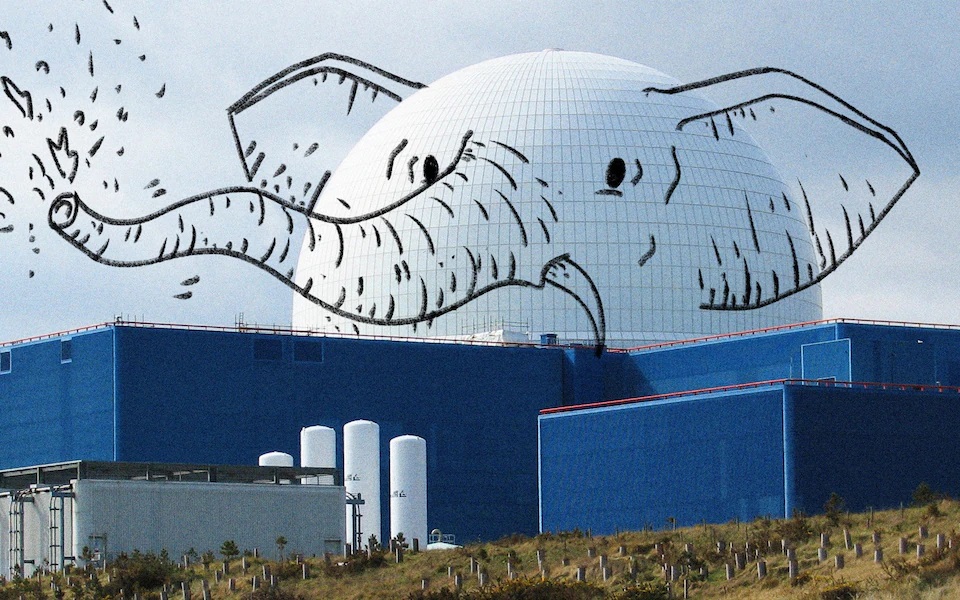
Sizewell C’s funding boost means UK taxpayers have now spent £8bn on the project
Ed Miliband has sunk an extra £2.7bn into Sizewell C after EDF slashed
its stake in the nuclear power project. The Energy Secretary said the
additional money would boost energy security, jobs and the race for net
zero.
However, anti-Sizewell campaigners questioned the wisdom of pouring
billions into a project that the Government has still not taken a final
decision to build.
UK taxpayers have so far spent a total of £8bn on the
nuclear power station. The latest cash is thought to be aimed at building
confidence in the project, potentially attracting other investors as EDF
steps back. The French energy giant recently reduced its stake from 24pc to
16pc amid pressure from Emmanuel Macron, the French president, to cut back
on risky overseas commitments.
EDF was told it should instead focus on
making a success of multibillion-euro projects at home, ensuring they were
profitable and built on time. Sizewell C is a proposed 3.2-gigawatt nuclear
power station planned for the Suffolk coast, potentially generating power
for 6m homes. Its design would be similar to the Hinkley Point C power
station being built by EDF in Somerset, whose start date has been delayed
by a decade to the mid-2030s (sic?) with costs that have doubled to £40bn.
EDF’s decision to trim its involvement has forced the UK Government into
an undignified search for alternative investors. Those approached are said
to include Centrica, the owner of British Gas, Emirates Nuclear Energy,
Amber Infrastructure Group and Schroders Greencoat, with Barclays advising
the Government.
Telegraph 4th April 2025 https://www.telegraph.co.uk/business/2025/04/04/miliband-pours-27bn-into-nuclear-power-plant-after-edf-cuts/
Germany deploys troops to Russia’s doorstep for first time since the Nazis
2 Apr, 2025 https://www.rt.com/russia/615122-germany-activates-brigade-lithuania/
A 5,000-strong armored brigade in Lithuania is set to be combat-ready by 2027, according to army plans
The German military has begun its first permanent deployment of troops on foreign soil since World War II. The 45th Armored Brigade is being positioned in Lithuania, near Russian ally Belarus, as Berlin prepares for a potential conflict in the coming years.
On Tuesday, a ceremony was held outside Vilnius, with Brigadier General Christoph Huber assuming command of the newly established unit, as reported by the German Bundeswehr Association (DBwV) lobby group and state media.
We have a clear mission. We have to ensure the protection, freedom, and security of our Lithuanian allies here on NATO’s eastern flank,” the general said during the ceremony.
Military personnel who arrived in Lithuania last year to prepare for the deployment have been formally integrated into the brigade. Once fully staffed and combat-ready by 2027, the unit will comprise approximately 5,000 military and civilian personnel, equipped with around 2,000 heavy weapons, according to German Army plans.
Moscow views NATO as a hostile entity, describing its expansion in Europe as a direct threat to Russian national security. The bloc’s pledge to admit Ukraine as a member and its increasing involvement with the nation have been cited by Russian officials as key causes of Moscow’s conflict with Kiev. German Defense Minister Boris Pistorius, a staunch advocate for troop deployment in Lithuania, has claimed that Russia could launch an attack on NATO by 2029 or 2030 – a claim that Moscow categorically rejects.
In 2023, Berlin and Vilnius signed a stationing agreement, initially designating the new German unit as the 42nd Brigade. Two of its battalions will consist exclusively of German soldiers, while the third will incorporate personnel from other NATO countries. Portions of the brigade will be stationed at the Rudninkai training ground in southeastern Lithuania, only 20 kilometers (12 miles) from the Belarusian border, while additional units will be stationed near the village of Rukla between Vilnius and Kaunas.
Post-Nazi Germany previously restricted military deployments abroad to temporary assignments, such as contributing to NATO forces following the occupation of Afghanistan in 2001.
Deloitte seeks to avoid liability over US nuclear fiasco.
Deloitte has asked a US judge to throw out demands that it compensate
shareholders who lost money in the collapse of one of the country’s
largest nuclear power projects, in a case that has exposed the inner
workings of the Big Four audit firm.
Recently filed documents detail Deloitte’s work auditing the South Carolina utility Scana before the company abandoned construction of two nuclear reactors that had fallen far
behind schedule and billions of dollars over budget. The 2017 fiasco led to
the cut-price sale of Scana to a rival utility, the bankruptcy of the
construction group Westinghouse and jail time for Scana’s former chief
executive, who pleaded guilty to misleading regulators.
A class-action lawsuit on behalf of Scana shareholders alleges Deloitte helped the company
hide burgeoning problems at the VC Summer nuclear project by signing off on
financial statements that indicated it would be completed on time. In fact,
an internal whistleblower at Scana had claimed as early as 2015 that
Westinghouse was impossibly far behind, and Deloitte failed to follow other
red flags, the lawsuit claims.
FT 3rd April 2025, https://www.ft.com/content/89b10731-fcd0-4854-8bb5-1f4067f1bba2
“Getting people to do what they can from where they are”: NFLAs support Democracy Day inspiring peace activists to make Councils anti-nuke allies
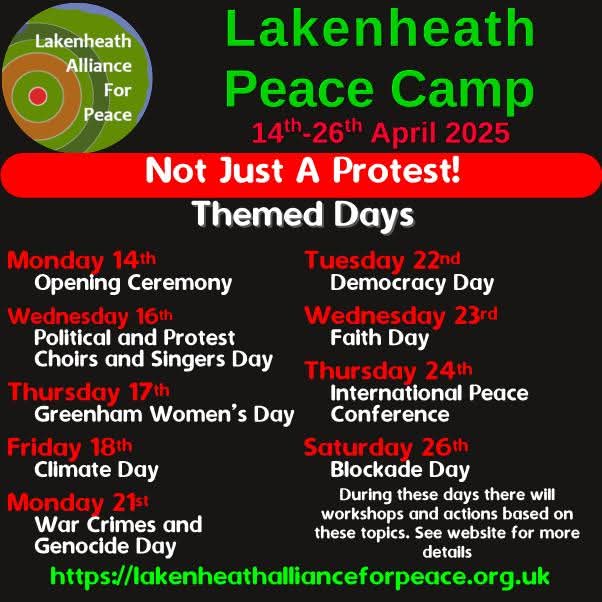
The UK/Ireland Nuclear Free Local Authorities are proud to support the forthcoming Elected Representatives and Democracy Day being hosted by the Lakenheath Alliance for Peace (LAP) on Tuesday 22nd April, and urges elected members from all parties and none who oppose nuclear weapons to attend.
This event is part of a two weeks International Peace Camp and Conference – 14th – 26th April 2025 organised by the LAP at RAF Lakenheath – https://lakenheathallianceforpeace.org.uk The NFLAs are a partner organisation within the Alliance.
‘RAF’ Lakenheath is in fact the largest United States Air Force base in the United Kingdom, and is expected to, or has already, become the host to newly reintroduced US air-launched nuclear weapons which will be accommodated and maintained in a bespoke facility.
The LAP is hosting a series of themed days during the Peace Camp to which all activists are invited and there will also be a 24:7 vigil at the main gates of the airbase:
LAP is inviting elected members at all levels, whether Councillors in parish, district, county or unitary authorities or Parliamentarians in our devolved national assemblies or at Westminster, to attend and by invitation to speak during Democracy Day.
Confirmed speakers include Baroness Natalie Bennett, former Leader of the Green Party, and several Norfolk and Suffolk Councillors, one of whom used to be an emergency planner.
Elected members who wish to speak or who are willing to give media interviews at the airbase entrance on Democracy Day are invited to submit expressions of interest via https://lakenheathallianceforpeace.org.uk/front-page/get-involved/
LAP is also seeking to arrange a workshop with campaign group MP Watch https://www.mpwatch.org/ which ‘works alongside MPs and communities to champion evidence-based climate and nature-based policies.’
LAP event organiser and former Norwich City Councillor, Lesley Grahame, described “how there has never been any democratic debate about nuclear weapons” with the purpose of Democracy Day being about “getting people to do what they can from where they are”.
NFLA Secretary Richard Outram has put together a briefing paper on this theme containing tips for activists seeking to make their elected member and their Council an ally in the campaign for nuclear disarmament.
This briefing can be found at:
Military confrontation ‘almost inevitable’ if Iran nuclear talks fail: French FM
Daily Mail 3rd April 2025 AFP
‘Our priority is to reach an agreement that verifiably and durably constrains the Iranian nuclear program,’ Jean-Noel Barrot told lawmakers
France’s foreign minister warned on Wednesday that a military confrontation with Iran would be “almost inevitable” if talks over Tehran’s nuclear programme failed.
“In the event of failure, a military confrontation would appear to be almost inevitable,” Jean-Noel Barrot said in parliament, adding that it would severely destabilise the region.
Earlier Wednesday, President Emmanuel Macron chaired a meeting on Iran.
US President Donald Trump has threatened that Iran will be bombed if it persists in developing nuclear weapons. Iran’s supreme leader, Ayatollah Ali Khamenei, has promised to hit back………………………………………………………. https://www.dailymail.co.uk/wires/afp/article-14564181/Military-confrontation-inevitable-Iran-nuclear-talks-fail-French-FM.html
Nuclear site given more time to fix safety breach
Jason Arunn Murugesu, BBC News, North East and Cumbria, 4 Apr 25,
https://www.bbc.co.uk/news/articles/cgkgxdddmlyo
A nuclear site which breached hazardous substance regulations has been given more time to figure out how best to protect workers.
Last year, the Office for Nuclear Regulation (ONR) served two improvement notices on Sellafield Ltd, near Whitehaven, Cumbria, after it “failed to manage the risks of working with nickel nitrate and to prevent or adequately control exposure of workers to this hazardous substance”.
The breaches did not compromise either nuclear or radiological safety, the ONR said.
Sellafield Ltd said it had completed one improvement notice and “significant progress” had been made on the other. It has until September to come up with a solution.
Used in the treatment of effluent, nickel nitrate is not radioactive but is a hazardous substance and could cause harm to the health of a worker exposed to it.
To mitigate these risks, operations involving the chemical should be conducted in a glovebox to protect workers from any harmful health effects.
However, contamination was found outside the glovebox area at a Sellafield facility, which resulted in workers potentially being exposed to the chemical, the ONR previously said.
A poorly designed and maintained glovebox appeared to have contributed to the situation, it added.
‘Technical challenges’
Sellafield Ltd was required to complete a nickel nitrate risk assessment by the end of October, and to “prevent or adequately control” the exposure of workers to nickel nitrate by March.
However, the ONR said “technical challenges” had come to light regarding the exposure of workers to the material and it would now give the nuclear plant until 30 September to come up with a solution.
Hygiene controls would remain in place in the facility, monitored by an occupational hygienist, until full compliance with both improvement notices was achieved, the ONR explained.
Recycling Nuclear Waste: A Win-Win or a Dangerous Gamble?
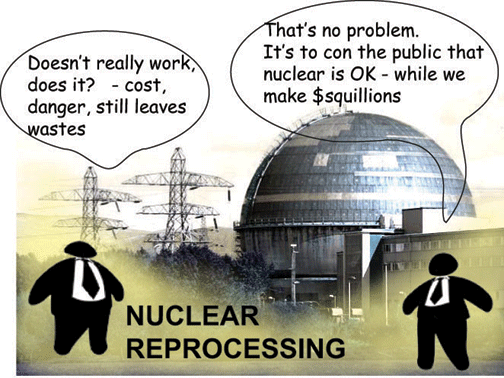
As interest in nuclear power rises, startups are pursuing plans to recycle spent fuel and reuse its untapped energy to power reactors. Advocates tout new recycling methods as a breakthrough, but many experts warn it will extract plutonium that could be used for nuclear weapons.
Yale Enevironment 360, By Rebecca Tuhus-Dubrow • April 2, 2025
Nuclear power plants keep their waste close by. Every nuclear plant in the United States includes an area onsite where spent fuel is being stored. This material — ceramic pellets stacked into rods and bundled together — consists mostly of uranium. But the spent fuel also includes elements that were created during the process: fast-decaying radionuclides such as cesium and strontium, as well as longer-lived, heavier elements, notably plutonium. Emanating intense heat and radiation, the spent fuel rods are placed first in cooling pools and then in “dry cask storage” — steel canisters that block these radioactive isotopes from escaping.
Most would see this legacy of radioactive waste as a burden and a danger. But some are now seeing it differently: as an asset and an opportunity. Although no longer capable of efficiently fissioning, spent fuel still contains significant amounts of untapped energy that can be harnessed and used again. In other words, it can be recycled — particularly in certain types of advanced reactors currently in development. Recycling would not only shrink the volume of radioactive material that would eventually need to be buried underground, advocates say, but it could also reduce the need to mine new uranium, another controversial aspect of the nuclear fuel cycle.
Recycling nuclear waste is probably the single biggest point of contention among people who otherwise support nuclear power.
It sounds like a win-win, as sensible as putting our aluminum cans in the bins with chasing arrows. And as interest in nuclear energy has grown in recent years — driven by climate concerns and, more recently, demand from energy-intensive data centers — so has enthusiasm in some quarters for recycling this waste stream. Late last year, the Department of Energy announced $10 million in funding for research on recycling technologies and at least two relevant bipartisan bills were introduced in Congress: one would “require the Secretary of Energy to study new technologies and opportunities for recycling spent nuclear fuel”; another would streamline licensing requirements for recycling facilities.
Several advanced nuclear startups, including Oklo and Curio, say they intend to run their reactors exclusively on spent fuel. Oklo, backed by OpenAI CEO Sam Altman and based in Santa Clara, California, is working toward building its first commercial unit at the Department of Energy’s Idaho National Laboratory. Jake DeWitte, Oklo’s CEO, told me, “Frankly, there’s enough energy content in the waste of today’s reactors to power the whole country for 150 years.”
In the last several years, while reporting a book on nuclear energy, I heard frequently from nuclear advocates about the possibility of recycling. It struck me as a promising solution that could mitigate several of the problems associated with nuclear power. But as I learned more, I realized that the concept, far from being a no-brainer, is intensely controversial — probably the single biggest point of contention among people who otherwise support nuclear power.
The fundamental issue is that reprocessing spent fuel involves extracting plutonium from fuel pellets. (Although the terms “reprocessing” and “recycling” are often used interchangeably, the former refers to separating out the usable material; the latter refers to deploying this material again in a reactor.) And nuclear nonproliferation experts are deeply concerned about any process that makes plutonium more accessible…………………………………..
Beyond proliferation concerns, there’s a host of other challenges, experts say. New waste streams are created along the way — everything that is touched during reprocessing, such as equipment, gets contaminated. And even after reprocessing, waste remains — the highly radioactive “fission products,” including cesium and strontium. …………………………………………………………………………………………………..
The greater concern is that nations, including those without nuclear weapons, could establish reprocessing facilities and use them to create bombs.

…………………………………………………………………..A crucial question is whether different reprocessing techniques can reduce the risks. Oklo is planning to use a technique called pyroprocessing, which was developed at Argonne National Laboratory, in Illinois, in the 1980s and 1990s, with the specific intention of reducing the proliferation risk……………..
………………. There is debate over how much pyroprocessing actually mitigates the risk. The finished product is still closer to weapons-usable than spent fuel that has not been reprocessed
…………..One expert worries that the prospect of recycling is being used to suggest that the nuclear waste problem is going to solve itself.…………………https://e360.yale.edu/features/nuclear-waste-recycling
Millom nuclear waste plans ‘currently detrimental’ to locals.
Proposed plans for a nuclear waste dump in Millom have been described as
‘detrimental’ for one of the town’s estates. Members of the community were
invited to attend a Town Council meeting at the end of last month to
discuss the construction of a Geological Disposal Facility (GDF) near
Haverigg. Residents of the Bank Head housing estate, which sits alongside
the proposed site, asked for support from the local authority, with a
particular concern on the impact of house prices in the area.
A spokesperson from Millom Town Council said: “[We continue] to have a
neutral stance and support the principle that residents will have the final
say if they wish to be the future host community for a GDF. “Whilst this
could be the biggest economic opportunity for the area since iron ore was
found at Hodbarrow, we cannot deny that the way the current Area of Focus
has been drawn on the map by NWS is currently detrimental to the residents
of the Bank Head estate.
“We do not believe at this early stage of the
investigation that any of our residents should be impacted in the way the
Bank Head estate currently is, with local estate agents reporting that they
have had no requests for viewing homes on this previously popular
estate.” A campaign group, Millom and District Against the Nuclear Dump,
argued that the majority of locals were ‘resoundingly’ against the GDF.
Whitehaven News 4th April 2025 https://www.whitehavennews.co.uk/news/25060423.millom-nuclear-waste-plans-currently-detrimental-locals/
Once seen as a symbolic protest, the nuclear ban treaty is growing teeth.

Olamide Samuel , Olamide Samuel leads network and engagement initiatives at Open Nuclear Network (ONN), a programme of PAX sapiens. April 3, 2025,
Amid Russia’s war in Ukraine, nuclear saber-rattling, and the United States’ sudden turn away from its longtime transatlantic alliances, fears of nuclear conflict are leading European governments to pursue new ways of protecting themselves. Last month, European Union leaders approved a massive new militarization independent of US support; France is considering extending its own nuclear deterrent over the whole continent; and some countries have resurrected Cold War-style civil defense plans. Germany, for example, has piloted a smartphone app to direct citizens to the nearest bomb shelter, while Norway is reintroducing a policy that requires bomb shelters in all new buildings. And the EU has called on its citizens to stockpile 72 hours-worth of supplies in the face of “emerging threats.”
But what of the rest of the world? Even so-called “limited” use of nuclear weapons is unlikely to stay limited to one region; a nuclear war of any kind will almost certainly not. Radioactive fallout, climate disruption, and economic shockwaves can cross borders and continents, meaning no country truly stands apart from the danger. Nations far from the blast zone—whether or not they participate in a nuclear conflict—could still face crop failures, mass migrations, and other cascading disasters. In short, if nuclear weapons are used anywhere, everyone’s safety is at risk.
Survival requires attention to larger, systemic issues—international cooperation, governance of risk, and global diplomacy—that offer more meaningful protection than any nuclear weapon or bunker can. The popularization of civil defense discussions, while potentially comforting in their simplicity, in fact exposes a collective failure to tackle the underlying causes of these fears. Humanity’s long-term survival depends on global efforts to reduce the risks that threaten us.
The Treaty on the Prohibition of Nuclear Weapons (TPNW) is one such global effort. Critics initially dismissed the treaty as a purely symbolic gesture—a “protest treaty” unlikely to affect real-world security. But recent developments suggest the ban treaty is growing some teeth. In November 2024, TPNW states prevailed on the United Nations General Assembly to launch a comprehensive scientific study on the effects of nuclear war. And at the treaty members’ most recent major meeting in March—which I attended—a detailed report articulating the security concerns of non-nuclear countries took center stage at the UN’s New York headquarters.
These steps represent a pivotal milestone for the treaty, which is now emerging as a key venue for serious diplomatic deliberations about nuclear security at a critical moment—a moment when many traditional arms-control agreements and forums have either collapsed or stalled. Thanks largely to the TPNW, a new space has opened up, in which frank and thorough examination of the catastrophic human and environmental consequences of nuclear weapons use can help expose the risks of nuclear deterrence itself.
Fixing the nuclear diplomacy gap. For decades, global arms control agreements have struggled to ease the fears of countries without nuclear weapons. The Nuclear Non-Proliferation Treaty (NPT)—essentially a bargain between nuclear haves and have-nots—promised eventual disarmament, but progress has been glacial. Major powers have been backsliding: The Intermediate-Range Nuclear Forces Treaty is history, and the last US-Russia arms pact, New START, is on life support and set to expire in less than a year. Traditional forums like the UN Conference on Disarmament have been deadlocked for years.
All the while, the security concerns of non-nuclear weapon states have been largely ignored. In meetings of treaties like the NPT, discussions tend to focus on keeping nuclear weapons out of the wrong hands—but what about the danger posed to everyone by the weapons the great powers already have? For a country with no nukes, the prospect of radiation drifting across its borders or a “nuclear winter” causing famine remains an existential threat. Yet, in the old forums, nuclear-armed states and their allies have often brushed aside these worries, insisting that their deterrence doctrines keep the peace.
Against this backdrop, the countries party to the TPNW have shifted focus to address these issues head-on. At the treaty’s third meeting of states parties in early 2025, they unveiled a report on the security concerns of states living under the shadow of nuclear weapons. This move signaled the ban-treaty states aren’t just pursuing disarmament ideals but are also eager to articulate their own concrete security priorities in a world with ongoing nuclear threats.
The report synthesizes the collected input of TPNW states, experts, and non-governmental organizations after the treaty’s second meeting at the end of 2023. The report’s findings challenge the notion that states consider deterrence a source of stability and security. The report notes that TPNW states consider that “nuclear deterrence is a dangerous, misguided and unacceptable approach to security.” It then recasts humanitarian impacts of nuclear weapons as core national security concerns for non-nuclear nations and explains why: a single nuclear detonation wouldn’t just devastate the immediate target; it could knock out electrical grids with electromagnetic pulses and blanket entire regions in radioactive fallout. And the damage wouldn’t stop there. The authors describe the “transboundary” impacts: mass migrations of refugees fleeing irradiated zones, the breakdown of emergency services, global supply chains for food and medicine ruptured, and the potential collapse of public order far from ground zero.
In other words, nuclear war anywhere endangers people everywhere—and since the existential security of the world’s non-nuclear states continues to be entirely determined by the security priorities of a few nuclear powers, the report reframes those humanitarian consequences as fundamental security concerns for every state: “From the perspective of States parties to the Treaty on the Prohibition of Nuclear Weapons, policy decisions regarding nuclear weapons should be based primarily on the available scientific facts about the consequences and risks of nuclear weapons rather than on the uncertain security benefits of nuclear deterrence.”
What we know and what we don’t know. The last UN-mandated study on nuclear war impacts, conducted by the United Nations Scientific Committee on the Effects of Atomic Radiation (UNSCEAR) in 1988, was a landmark assessment that brought scientific consensus to the global threat of nuclear winter. However, the study is now outdated. In the 37 years since, we have made significant advancements in climate modeling and environmental science in ways that allow for higher-resolution simulations of atmospheric effects, such as those caused by soot and dust following nuclear detonations to better simulate the cascading impacts of nuclear conflict.
Subsequent studies have examined the global impacts of nuclear war, including influential work by Alan Robock and Brian Toon in the 2000s and 2010s on cooling and agricultural effects, and a 2019 study projecting severe global food and health consequences from an India-Pakistan nuclear conflict. Although these supplementary independent studies are important, there is still a lack of broader appreciation of the full-scale impact of nuclear detonations.
Our ignorance is, to some extent, by design. The effects of nuclear war are often viewed (especially by nuclear weapon states and their allies) through a military lens, focused primarily on the immediate consequences of a nuclear strike, without fully accounting for the long-term environmental, societal, and human impacts.
To address this gap, members of the TPNW’s Scientific Advisory Group recommended in 2023 that the UN mandate an assessment of the effects of nuclear war. In November of last year, a resolution establishing an independent Scientific Panel on the Effects of Nuclear War was brought to the General Assembly, cosponsored by 20 TPNW states. Apart from the nuclear weapons states, the resolution received overwhelming support: 144 countries voted in favor, 30 abstained.
Of the nuclear weapon states, France, the United Kingdom and Russia voted against the resolution; the United States did not record a vote; and with the exception of China, which voted for the study, other nuclear states (Israel, India, Pakistan, and North Korea) all formally abstained.
In explaining their votes, both France and the UK curiously stated that a scientific panel would not provide any “new” insights into our understanding of the effects of nuclear war. The UK, in particular, raised concerns about the budgetary implications, despite the panel’s total operating cost being only $300,100—equivalent to the cost of operating the UK’s nuclear deterrent for two hours. Imagine then, if this panel (in conjunction with the World Trade Organization) were to reveal the economic impact of a limited nuclear war on global socioeconomic systems? Such findings are very feasible, given the broad mandate of the scientific panel: Article 7 of the resolution calls upon a range of global agencies to support the panel’s work beyond obvious ones like the International Atomic Energy Agency—including those that look at financial, health and agricultural effects, like the World Health Organization, the World Food Programme, the Food and Agricultural Organization, and the World Trade Organization.
Deterrence as science denial. Studies on self-deterrence have shown that political leaders’ decisions about nuclear weapons aren’t just shaped by military strategy—they’re deeply influenced by the moral and psychological weight of such decisions. Many leaders may hold back from using nuclear weapons not because they fear defeat, but because they want to maintaininternational legitimacy, avoid alienating allies, and protect the global non-proliferation system; and because they understand some of the devastating, irreversible consequences, especially for the environment and future generations. The idea of being the person who triggers the end of civilization or leaves the planet in ruins is something most leaders are reluctant to face.
Even Donald Trump has acknowledged the dangers of nuclear weapons, as when he said in October 2024, “getting rid of nuclear weapons would be so good … because it’s too powerful, it’s too much,” and his more recent statements suggesting that “the destructive capability is something that we don’t even want to talk about” and that the United States, China and Russia could denuclearize.
This, perhaps, explains why updated studies on the societal impact of nuclear war are so politically charged, and why some states opposed the new study (which after all, is just a study). To acknowledge the global societal impact of nuclear weapons is to confront the unmanageable consequences of their use and challenge the foundations of deterrence itself. As Robock notes in an interview with the Bulletin, if the US nuclear establishment “acknowledged the horrific impacts of nuclear war, their theory of deterrence would fail.”
Survival beyond bunkers. Ultimately, humanity’s safety depends not on geographical location, but on global efforts to reduce risks. Since its entry into force, the TPNW has begun to emerge as an unexpected yet indispensable forum for questioning whether the logic of deterrence itself makes sense in a world that cannot afford the consequences of failure.
Illuminating the true impacts of nuclear war has a way of cutting through abstract theories — as it did in the 1980s when public horror at nuclear winter nudged even hardline leaders toward arms control. In the same way, the convergence of the UN’s new impacts study and the TPNW’s security initiative could shatter any lingering illusion that nuclear war can be “managed.”
In just four years, the TPNW has evolved beyond the caricature of a “protest treaty.” It offers something the traditional forums often cannot: a willingness to confront the uncomfortable truths about nuclear weapons, from their humanitarian consequences to the fragility of deterrence itself. The TPNW is not about dismantling the system overnight; it’s about ensuring we have the courage and the foresight to imagine a future where nuclear arsenals—and the assumption that we need them—no longer exist.
Hegseth Orders Pentagon To Focus on Preparing for War With China Over Taiwan
In an internal memo, Hegseth called China the ‘sole pacing threat’
by Dave DeCamp March 30, 2025 , https://news.antiwar.com/2025/03/30/hegseth-orders-pentagon-to-focus-on-preparing-for-war-with-china-over-taiwan/
Secretary of Defense Pete Hegseth distributed a memo in mid-March ordering the Pentagon to put its focus on preparing for a war with China, a nuclear-armed power, by “assuming risk” in Europe and other parts of the world, The Washington Post reported on Saturday.
The Post didn’t publish the full memo, known as the Interim National Defense Strategic Guidance, but said it “outlines, in broad and sometimes partisan detail, the execution of President Donald Trump’s vision to prepare for and win a potential war against Beijing and defend the United States from threats in the ‘near abroad,’ including Greenland and the Panama Canal.”
The Pentagon has considered China the top “threat” facing the US since the first Trump administration, but the Post report said the memo is “extraordinary in its description of the potential invasion of Taiwan as the exclusive animating scenario that must be prioritized over other potential dangers — reorienting the vast US military architecture toward the Indo-Pacific region beyond its homeland defense mission.”
The report said that the guidance from Hegseth says the Pentagon’s force planning construct “will consider conflict only with Beijing when planning contingencies for a major power war” and leave the “threat from Moscow largely attended by European allies.”
Hegseth wrote that China “is the Department’s sole pacing threat, and denial of a Chinese fait accompli seizure of Taiwan — while simultaneously defending the US homeland is the Department’s sole pacing scenario.”
The memo reflects the Trump administration’s policy toward Europe and calls for NATO allies to take a “far greater” burden sharing. The document says that the US is unlikely to provide substantial support to Europe if Russia’s military advances in the region, saying the US will only provide nuclear deterrence.
The memo also calls for the US to pressure Taiwan to increase military spending “significantly.”
For years now, the US military has been openly preparing for war with China despite the risk of nuclear escalation. It has done this by expanding military bases in the Asia Pacific, building alliances, and increasing support for Taiwan. While being done in the name of deterrence, these steps have only increased tensions in the region, making conflict more likely.
The Post report says that Hegseth’s plans to prepare a “denial defense” of Taiwan include “increasing the troop presence through submarines, bombers, unmanned ships, and specialty units from the Army and Marine Corps, as well as a greater focus on bombs that destroy reinforced and subterranean targets.” His memo also calls for increasing the defenses of US troop positions in the region and establishing more weapons stockpiles.
It’s Official: Ukraine Conflict is British ‘Proxy War’

The investigation’s most striking passages highlight London’s principal role in influencing and managing Ukrainian – and by extension US – actions and strategy in the conflict. Both direct references and unambiguous insinuations littered throughout point ineluctably to the conclusion that the “proxy war” is of British concoction and design
As this journalist has exposed, Ukraine’s Kursk folly was a British invasion in all but name. London was central to its planning, provided the bulk of the equipment deployed, and deliberately advertised its involvement. As The Times reported at the time, the goal was to mark Britain as a formal belligerent in the proxy war, in the hope other Western countries – particularly the US – would follow suit, and “send more equipment and give Kyiv more leeway to use them in Russia.”
Kit Klarenberg, Global Delinquents, Apr 02, 2025
On March 29th, the New York Times published a landmark investigation exposing how the US was “woven” into Ukraine’s battle with Russia “far more intimately and broadly than previously understood,” with Washington almost invariably serving as “the backbone of Ukrainian military operations.” The outlet went so far as to acknowledge the conflict was a “proxy war” – an irrefutable reality hitherto aggressively denied in the mainstream – dubbing it a “rematch” of “Vietnam in the 1960s, Afghanistan in the 1980s, Syria three decades later.”
That the US has since February 2022 supplied Ukraine with extraordinary amounts of weaponry, and been fundamental to the planning of many of Kiev’s military operations large and small, is hardly breaking news. Indeed, elements of this relationship have previously been widely reported, with White House apparatchiks occasionally admitting to Washington’s role. Granular detail on this assistance provided by the New York Times probe is nonetheless unprecedented. For example, a dedicated intelligence fusion centre was secretly created at a vast US military base in Germany.
Dubbed “Task Force Dragon”, it united officials from every major US intelligence agency, and “coalition intelligence officers”, to produce extensive daily targeting information on Russian “battlefield positions, movements and intentions”, to “pinpoint” and “determine the ripest, highest-value targets” for Ukraine to strike using Western-provided weapons. The fusion centre quickly became “the entire back office of the war.” A nameless European intelligence chief was purportedly “taken aback to learn how deeply enmeshed his NATO counterparts had become” in the conflict’s “kill chain”:
“An early proof of concept was a campaign against one of Russia’s most-feared battle groups, the 58th Combined Arms Army. In mid-2022, using American intelligence and targeting information, the Ukrainians unleashed a rocket barrage at the headquarters of the 58th in the Kherson region, killing generals and staff officers inside. Again and again, the group set up at another location; each time, the Americans found it and the Ukrainians destroyed it.”
Several other well-known Ukrainian broadsides, such as an October 2022 drone barrage on the port of Sevastopol, are now revealed by the New York Times to have been the handiwork of Task Force Dragon. Meanwhile, the outlet confirmed that each and every HIMARS strike conducted by Kiev was entirely dependent on the US, which supplied coordinates, and advice on “positioning [Kiev’s] launchers and timing their strikes.” Local HIMARS operators also required special electronic key [cards]” to fire the missiles, “which the Americans could deactivate anytime.”
Yet, the investigation’s most striking passages highlight London’s principal role in influencing and managing Ukrainian – and by extension US – actions and strategy in the conflict. Both direct references and unambiguous insinuations littered throughout point ineluctably to the conclusion that the “proxy war” is of British concoction and design. If rapprochement between Moscow and Washington succeeds, it would represent the most spectacular failure to date of Britain’s concerted post-World War II conspiracy to exploit American military might and wealth for its own purposes.
………………………………………………………………….. the British “had considerable clout” in Kiev and hands-on influence over Ukrainian officials.
This was because, “unlike the Americans,” Britain had formally inserted teams of military officers into the country, to advise Ukrainian officials directly. Still, despite Kiev failing to fully capitalise as desired by London and Washington, the 2022 counteroffensive’s success produced widespread “irrational exuberance”. Planning for a followup the next year thus “began straightaway.” The “prevailing wisdom” within Task Force Dragon was this counteroffensive “would be the war’s last”, with Ukraine claiming “outright triumph”, or Russia being “forced to sue for peace.”
……………………………………………………………………….Even Task Force Dragon’s Lieutenant General Donahue had doubts, advocating “a pause” of a year or more for “building and training new brigades.” Yet, intervention by the British was, per the New York Times, sufficient to neutralise internal opposition to a fresh counteroffensive in the spring. The British argued, “if the Ukrainians were going to go anyway, the coalition needed to help them.” Resultantly, enormous quantities of exorbitantly expensive, high-end military equipment were shipped to Kiev by almost every NATO member state for the purpose.
The counteroffensive was finally launched in June 2023. Relentlessly blitzed by artillery and drones from day one, tanks and soldiers were also routinely blown to smithereens by expansive Russian-laid minefields. Within a month, Ukraine had lost 20% of its Western-provided vehicles and armor, with nothing to show for it. When the counteroffensive fizzled out at the end of 2023, just 0.25% of territory occupied by Russia in the initial phase of the invasion had been regained. Meanwhile, Kiev’s casualties may have exceeded 100,000.
‘Knife Edge’
The New York Times reports that “the counteroffensive’s devastating outcome left bruised feelings on both sides,” with Washington and Kiev blaming each other for the catastrophe. A Pentagon official claims “the important relationships were maintained, but it was no longer the inspired and trusting brotherhood of 2022 and early 2023.” Given Britain’s determination to “keep Ukraine fighting at all costs”, this was bleak news indeed, threatening to halt all US support for the proxy war.
………………………………… Ukraine’s calamitous intervention in Russia’s Bryansk region was a “foreshadowing” of Kiev’s all-out invasion of Kursk on August 6th that year. The New York Times records how from Washington’s perspective, the operation “was a significant breach of trust.” For one, “the Ukrainians had again kept them in the dark” – but worse, “they had secretly crossed a mutually agreed-upon line.” Kiev was using “coalition-supplied equipment” on Russian territory, breaching “rules laid down” when limited strikes inside Russia were greenlit months earlier.
As this journalist has exposed, Ukraine’s Kursk folly was a British invasion in all but name. London was central to its planning, provided the bulk of the equipment deployed, and deliberately advertised its involvement. As The Times reported at the time, the goal was to mark Britain as a formal belligerent in the proxy war, in the hope other Western countries – particularly the US – would follow suit, and “send more equipment and give Kyiv more leeway to use them in Russia.”
Initially, US officials keenly distanced themselves from the Kursk incursion……………………………..
However, once Donald Trump prevailed in the November 2024 presidential election, Biden was encouraged to use his “last, lame-duck weeks” to make “a flurry of moves to stay the course…and shore up his Ukraine project.” In the process, per the New York Times, he “crossed his final red line,” allowing ATACMS and Storm Shadow strikes deep inside Russia, while permitting US military advisers to leave Kiev “for command posts closer to the fighting.”
Fast forward to today, and the Kursk invasion has ended in utter disaster, with the few remaining Ukrainian forces not captured or killed fleeing. Meanwhile, Biden’s flailing, farewell red line breaches have failed to tangibly shift the battlefield balance in Kiev’s favour at all. As the New York Times acknowledges, the proxy war’s continuation “teeters on a knife edge.” There is no knowing what British intelligence might have in store to prevent long-overdue peace prevailing at last, but the consequences could be world-threatening. https://www.kitklarenberg.com/p/its-official-ukraine-conflict-is
1 This Month

of the week – Shut Down Drone Warfare!


Tell the Ukrainian Government to Drop Prosecution of Peace Activist Yurii Sheliazhenko

Petition to revoke the licensing of the Near Surface Nuclear Disposal Facility (NSDF) at Chalk River. https://www.ourcommons.ca/petitions/en/Petition/Details?Petition=e-7247
To see nuclear-related stories in greater depth and intensity – go to https://nuclearinformation.wordpress.com
-
Archives
- March 2026 (244)
- February 2026 (268)
- January 2026 (308)
- December 2025 (358)
- November 2025 (359)
- October 2025 (376)
- September 2025 (257)
- August 2025 (319)
- July 2025 (230)
- June 2025 (348)
- May 2025 (261)
- April 2025 (305)
-
Categories
- 1
- 1 NUCLEAR ISSUES
- business and costs
- climate change
- culture and arts
- ENERGY
- environment
- health
- history
- indigenous issues
- Legal
- marketing of nuclear
- media
- opposition to nuclear
- PERSONAL STORIES
- politics
- politics international
- Religion and ethics
- safety
- secrets,lies and civil liberties
- spinbuster
- technology
- Uranium
- wastes
- weapons and war
- Women
- 2 WORLD
- ACTION
- AFRICA
- Atrocities
- AUSTRALIA
- Christina's notes
- Christina's themes
- culture and arts
- Events
- Fuk 2022
- Fuk 2023
- Fukushima 2017
- Fukushima 2018
- fukushima 2019
- Fukushima 2020
- Fukushima 2021
- general
- global warming
- Humour (God we need it)
- Nuclear
- RARE EARTHS
- Reference
- resources – print
- Resources -audiovicual
- Weekly Newsletter
- World
- World Nuclear
- YouTube
-
RSS
Entries RSS
Comments RSS
 nuclear-news