Robotic arm struggles to take fuel sample from Fukushima plant
By KEITARO FUKUCHI/ Staff Writer, April 28, 2025, https://www.asahi.com/ajw/articles/15704793
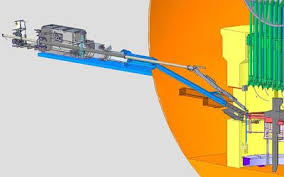
A narrow, attic-like space lies directly below the No. 5 reactor at the Fukushima No. 1 nuclear power plant, showing the difficult route a robotic arm must take to collect samples of melted fuel debris in a sister reactor.
The robotic arm is 22 meters long, weighs 4.6 tons and has 18 articulatable joints.
It has been developed to retrieve samples from the No. 2 reactor of Tokyo Electric Power Co.’s Fukushima No. 1 plant—which was crippled when the 2011 Great East Japan Earthquake and tsunami triggered a nuclear disaster at the facility.
To this day, an estimated 880 tons of melted fuel debris remain in the No. 1 through No. 3 reactors, and recovering this material is considered the most challenging phase in the long decommissioning process.
After more than six years of development using taxpayer money and undergoing numerous setbacks, the robotic arm may go on its first real debris retrieval mission later this fiscal year—or face being scrapped.
“The latest attempt may prove a failure since numerous trials have produced no successful outcomes so far,” said a nuclear industry insider. “The robot arm might be left to gather dust without ever being used.”
News reporters were given a tour in January of the crippled power plant’s No. 5 reactor, which is the same model and reportedly has the same dimensions as the No. 2 reactor, to see the route the arm must take if it is to succeed.
THE MISSION
To reach the debris, the arm will have to be navigated—by remote control—through the same narrow route at the No. 2 reactor that the reporters traversed at its twin.
The first step will be to carefully insert the arm, which is 40 centimeters tall, through an opening with an inner diameter of just 55 cm.
Once inside the 1.5-meter-tall space directly under the reactor, the approximately 4-meter-long tip of the arm will be slowly rotated and lowered to reach the fuel debris at the bottom of the containment vessel.
“Adjusting the joints’ angles is particularly difficult,” said a TEPCO public relations representative. “Even a single error can cause the device to hit its surroundings.”
TRIAL AND ERROR
The robotic arm has been under development since fall 2018 by Mitsubishi Heavy Industries Ltd. and a British company from the nuclear power industry. As much as 7.8 billion yen ($53.1 million) in taxpayers’ money has been invested in the arm and related projects.
However, the project has faced numerous setbacks.
The government and TEPCO initially planned to debut the arm in a debris retrieval test in 2021, but the device was unable to move with the necessary precision, causing delays.
When the first retrieval test was finally undertaken in November 2024, a simpler device with a solid track record in past applications was used instead. The same device was used in the second retrieval test earlier this month—while revisions on the robotic arm continued.
Because the arm’s weight is supported at its base, the device tends to bend and move unsteadily when extended.
“They are working hard to carry out this difficult procedure under particularly challenging conditions,” said Hajimu Yamana, president of the Nuclear Damage Compensation and Decommissioning Facilitation Corp. (NDF), which serves as an adviser on the decommissioning work.
As the arm’s development dragged on for more than half a decade, new problems arose in and after August 2024.
Disconnection of motor cables that had deteriorated over time was detected, as was a failure in the arm’s obstacle removal mechanism.
In December that year, the robotic arm came into contact with a model of the containment vessel during a test. However, it later safely passed through the opening without encountering any obstructions after its operators fine-tuned the insertion point.
“New issues arise each time a test is conducted,” lamented Yusuke Nakagawa, a TEPCO group manager involved in the project. “We just have to address them one by one again and again.”
TEPCO began dismantling part of the robotic arm in February to examine the deteriorated cable. The inspection is expected to take three to four months, and the arm will likely undergo additional operational tests after that.
THE FUTURE
For now, TEPCO plans to put the robotic arm to practical use at the site in the latter half of fiscal 2025.
“The final decision (on whether to actually use the arm on site) will be made after taking into account the results of the envisioned operational tests,” said Akira Ono, president of TEPCO’s Fukushima Daiichi Decontamination and Decommissioning Engineering Co.
The future of the robotic arm is still unclear given that its official introduction has already been delayed four times.
Officials involved are expressing a growing sense of alarm.
Toyoshi Fuketa, an ex-chairman of the Nuclear Regulation Authority, calls for reviewing the current plan.
“Never changing a plan once it has been decided upon, even if it does not work properly, is a bad habit of Japan,” he noted. “People should have the courage to back down at times (by giving up on the robotic arm).”
Victory for Greenpeace Luxembourg against EDF in court transparency ruling

Thomas Toussaint – Adapted by RTL Today, Update: 28.04.2025 ,
https://today.rtl.lu/news/luxembourg/a/2297912.html
In a landmark decision for nuclear transparency, the Strasbourg administrative court has ordered energy giant EDF to disclose information previously kept under wraps about the Cattenom nuclear power station, marking a major victory for Greenpeace Luxembourg.
Greenpeace went to court to challenge EDF’s refusal to provide information on “the possible use within the Cattenom nuclear centre of parts manufactured by the Italian company Tectubi, their destination and their conformity.”
The parts had previously been inspected by Italy’s Nuclear Safety Authority, which identified shortcomings in their production process.
The suspect parts were alleged to have been used to address the well-known issue of stress corrosion, detected in several nuclear power plants, including Cattenom. Greenpeace therefore requested to be informed of the possible use of these parts at the Moselle power station.
In response, the plant’s management refused, citing trade secrecy under the Code of Public Administration Relations. This left Greenpeace with no alternative but to turn to the administrative court in July 2023.
In a ruling on 24 April 2025, the Strasbourg court confirmed that the documents requested by Greenpeace Luxembourg were not subject to secrecy and ordered the director of Cattenom to provide the information within two months. EDF has also been ordered to pay €1,500 to Greenpeace Luxembourg.
“The decision by the administrative court is an important victory for transparency and nuclear safety,” said Roger Spautz, nuclear campaigner at Greenpeace Luxembourg. “EDF cannot continue to conceal crucial information regarding reactor safety, especially when issues such as stress corrosion and cracking are concerned.”
Pope Francis Refused to Be Silent on Gaza. Will His Successor Follow Suit?
Even from his hospital bed, Pope Francis continued his near-daily video calls in solidarity with Palestinians in Gaza
By Seraj Assi , Truthout, April 27, 2025
Pope Francis, who died on April 21, was a rare beacon of hope for many Palestinians in the long months of the Gaza genocide. The pope refused to be silent on Gaza. For 18 months, he made nearly daily video calls in solidarity with Palestinians in Gaza, including recent calls he made from his hospital bed. He rang the Holy Family Church in Gaza City every night, speaking with church leaders and displaced Palestinians sheltering there, usually for about 15 minutes.
Pope Francis began one of his most memorable calls to parishioners in Gaza earlier this year by saying “As-salaam Alaikum” (“Peace be upon you”). The video of that call showed his intimate relationship with the small Palestinian Christian community that remains in Gaza, many of whom he came to know by name. His final call to the Gaza Strip, made two days before his death, lasted 30 seconds.
For many in Gaza, those phone calls were a ray of light that shone through the horrors of Israeli genocide, which has killed over 51,000 Palestinians, most of them women and children. “His Holiness the pope was not an ordinary person,” Musa Antone, a Christian resident of Gaza, told CNN. “He was a man of faith who inquired about both Christians and Muslims.”
The surviving Christian community in Gaza now mourns Francis’s loss. “We felt like ‘Oh my God, we’re like orphans now,’” lamented George Anton, a local Catholic, and the emergency coordinator in the Holy Family church. “He was a real father to us. Pope Francis was like a shield for the Christians in the enclave. He was the fighter. He was fighting for our rights and for our protection.”
Kamal Anton, a 72-year-old who had taken shelter at the church amid the genocide, said: “During his call, he prayed for peace and resilience for us in Gaza. He never forgot the word ‘peace’ in any of his calls with us throughout the war. His support included all of us — Christians and Muslims alike. He prayed daily for our safety.”……………………………………………
In a tribute to the late pope, Palestinian theologian Munther Isaac wrote Monday: “He conveyed true compassion to Palestinians, most notably to those in Gaza during this genocide. The pope left our world today, and the occupation and the wall remained. Even worse, he left our world while a genocide continues to unfold.”
Pope Francis’s last public appearance was a plea to end the war in Gaza. In an Easter message one day before his death, the pope, visibly very sick, renewed his call for a ceasefire
The appeal culminated Francis’s months-long antiwar legacy in Gaza. In 2024, the pope wrote that, “what is happening in Gaza has the characteristics of a genocide,” while calling for an international investigation. He called Israel’s genocide in Gaza “shameful,” “deplorable” and a “useless slaughter” of civilians. He also labeled Israel’s massacres of civilians in Gaza “terrorism.” In December, after an Israeli strike in Gaza killed Palestinian children, he said: “Children have been bombed. This is cruelty. This is not war. I wanted to say this because it touches the heart.”…………………………………
Last Christmas, in a bold symbolic gesture against genocide, Francis unveiled a Nativity scene portraying baby Jesus in a crib lined with a Palestinian Keffiyeh, which was likely inspired by Palestinian Rev. Munther Isaac’s iconic “Christ in the Rubble” Christmas sermon in Bethlehem………
Pope Francis’s support for the Palestinian people was not merely humanitarian; he also unequivocally recognized Palestinian independence and freedom. Ten years ago, when he visited Bethlehem, widely recognized as the birthplace of Jesus, he referred to the land as “the State of Palestine.” Shortly after, the Vatican signed a treaty recognizing the State of Palestine. “Yes, it’s a recognition that the state exists,” affirmed Rev. Federico Lombardi, the Vatican spokesman.
Pope Francis’s unwavering solidarity with Gaza stood in sharp contrast with the shameful complicity of the Western political class. “This campaign has made Pope Francis arguably the most consistent high-profile defender of the humanity of the Palestinian people during a period when the Israeli assault on Gaza has been pursued with relentless violence,” wrote John Nichols ………………………………………..
In a move that has caused some controversy within Israel, according to the Israeli news site Ynet, the foreign ministry in Israel sought to prevent its ambassadors from expressing condolences following the pope’s passing. Middle East Eye reports: “Without providing an explanation, the ministry instructed its missions and diplomats to delete any social media posts mourning the former pope, according to Yedioth Ahronoth” (a major Israeli newspaper). Meanwhile, Israeli Prime Minister Benjamin Netanyahu waited more than three days after Pope Francis’s death before finally offering his own condolences on Thursday, following backlash over the foreign ministry’s deletion of condolence tweets.
Certainly, Francis’s broad antiwar vision, which made him a champion of nuclear disarmament who opposed and denounced nuclear weapons as “immoral,” did not endear him to warmongers………………………………..
Amid urgent concerns about the ongoing genocide in Gaza and rising attacks on the LGBTQ community in the U.S. and beyond, Palestinians and progressive supporters of the church are nervously awaiting news about who the pope’s successor will be.
One notable candidate to replace Pope Francis is the Latin Patriarch of Jerusalem, Cardinal Pierbattista Pizzaballa, a longtime advocate for the Christian minority in the Holy Land.
Cardinal Pizzaballa has praised the late pope’s moral clarity on Gaza, saying:
War is not just weapons. War is sometimes words. Pope Francis recently, especially in the last year, has been very outspoken about the situation of the Holy Land, calling for the liberation of the hostages, but also condemning the dramatic situation, the ongoing war in Gaza and the situation for Palestinians.
Cardinal Pizzaballa, an Italian Franciscan prelate, is the top Catholic in the Middle East with an archdiocese encompassing Israel, Palestine, Jordan and Cyprus. He has appealed for peace from both sides, and led a Christmas mass both in Gaza and Jerusalem. The cardinal, who visited Gaza in May 2024 after months of ceasefire negotiations, nearly one year after he offered to be exchanged for Gaza hostages, would be expected to continue some aspects of Francis’s leadership of the church……………………………………………………………
Cardinal Sarah, who has branded himself as a “parallel authority” to Pope Francis, has defended clerical celibacy, denounced “gender ideology,” and refused any “theological dialogue” with Islam –– a stark departure from the late pontiff’s legacy, who made notable progress in interfaith relations, particularly with Muslims. As Katherine Kelaidis writes at Vox, it’s important to note that “millions of dollars have been spent pushing a conservative social agenda in Africa” — a dynamic at play in the rise of socially conservative church leaders like Cardinal Sarah…………………………………………………………..
Another more progressive candidate is Luis Antonio Gokim Tagle, who hails from the Philippines. Described by some commentators as “Asian Francis,” the Filipino prelate has been praised for his commitment to social justice and equality, particularly for marginalized groups like LGBTQ people and the poor, though he simultaneously maintains a hardline anti-abortion stance.
……………………………………………. like most of the candidates, Cardinal Tagle’s views on the Gaza genocide remain to be seen.
Meanwhile, Raymond Burke, the Wisconsin-born cardinal, and Trump’s favorite candidate — a rabid Islamophobe who is highly conservative and clashed with Pope Francis on issues ranging from LGBTQ rights and the role of women in the church, to immigration — is perfectly positioned to become Trump’s papal puppet in the Vatican if he is chosen.
Pope Francis’s bold political stance on Palestine will put to the test the apolitical and eerie silence among his progressive successors, few of whom have expressed substantial views on Palestine. One of the few who have done so is Matteo Zuppi, the cardinal from Bologna, who was Francis’s peace envoy between Russia and Ukraine, and has worked extensively to broker peace there. He been outspoken in the wake of October 7, calling for peace, urging the need to understand the “root causes” of the conflict. He also called Hamas “the worst enemy of the Palestinian people.” He visited Bethlehem, called for a ceasefire, and highlighted the suffering of Palestinian children.
The other candidate who has publicly expressed a view on Palestine is Pietro Parolin,the first person Francis made a cardinal, in 2014. As secretary of state, he was involved in the George W. Bush administration’s attempts to revive the Israeli-Palestinian peace talks. He argued against deportation of Palestinians in Gaza in a rebuke to Trump’s plan, urged for lasting peace in Gaza and called for respect for humanitarian law. But he is hardly a liberal………………………
Most of the other candidates have hardly ever addressed Palestine, save for general allusions to peace. The issues of Palestine, social justice and immigration are inexorably linked, and many Palestine solidarity activists are hoping that the next pope will not fail to see that justice should be whole and not selective or partial.
Pope Francis, the first Latin American pontiff, brought a limited yet desperately needed progressive spirit to the Catholic Church. For all his reluctance to bring about church reforms on social issues, he will still go down as a symbol of a more compassionate and tolerant Christianity; a steadfast voice of peace and opponent of genocide; and a defender of the oppressed in Gaza, immigrants and the poor. Judging from the list of potential candidates, a move rightward seems likely………………………………………………….
Seraj Assi is a Palestinian writer living in Washington, D.C. and the author, most recently, of My Life as an Alien (Tartarus Press).
The Great British nuclear expansion is a project bound to fail.
With the government committed to a huge expansion of nuclear power to meet
our energy needs, Andrew Blowers and Stephen Thomas contend that this is an
uneconomic, unachievable and undesirable solution that is doomed to fail.
In 2022, the then Conservative government set a target of having 24GW
(gigawatts) of new nuclear capacity up and running by 2050, despite the
dismal history of cost and time over-runs experienced in developing the
existing plans. If achieved, this would be the equivalent of having eight
more Hinkley Point Cs.
The succeeding Labour government reaffirmed its
commitment to nuclear power in its manifesto, proclaiming that a scale
expansion ‘will play an important role in helping the UK achieve energy
security and clean power’ Neither government was prepared to recognise that
the Great British nuclear expansion is a project bound to fail.
TCPA (accessed) 28th April 2025,
https://www.tcpa.org.uk/sample-journal-content/
Scrapping Britain’s nuclear power plans would lead to lower energy bills
Letters, John French, and Dr David Lowry 29 Apr 25, https://www.theguardian.com/money/2025/apr/28/scrapping-britains-nuclear-power-plans-would-lead-to-lower-energy-bills
You report that experts have warned that adding levies to electricity bills to support low-carbon projects will make it more difficult for people to reduce their reliance on fossil fuels (Why the UK’s electricity costs are so high – and what can be done about it, 20 April).
One way to reduce those levies dramatically would be to scrap all planned nuclear power stations. These include the crazily expensive Sizewell C, which has already received nearly 2.5bn in subsidies before it has even started construction and which will cost the bill payer dear, even without the inevitable huge cost overruns that the French-state-owned EDF always incurs (think Flamanville and Hinkley C); and the four, possibly six, new reactors to be built on a flood plain on the River Severn at Oldbury in Gloucestershire.
Scrapping Britain’s nuclear power plans would lead to lower energy bills
New nuclear power stations will cost billions to build and run, and cost taxpayers and energy customers dear, says John French. Plus a letter from Dr David LowryTue 29 Apr 2025 01.52 AESTShare
You report that experts have warned that adding levies to electricity bills to support low-carbon projects will make it more difficult for people to reduce their reliance on fossil fuels (Why the UK’s electricity costs are so high – and what can be done about it, 20 April).
One way to reduce those levies dramatically would be to scrap all planned nuclear power stations. These include the crazily expensive Sizewell C, which has already received nearly 2.5bn in subsidies before it has even started construction and which will cost the bill payer dear, even without the inevitable huge cost overruns that the French-state-owned EDF always incurs (think Flamanville and Hinkley C); and the four, possibly six, new reactors to be built on a flood plain on the River Severn at Oldbury in Gloucestershire.
These latter reactors are still at an early design stage, will have to go through years of safety approval before construction can start, and, being of an uncertain and novel design, will end up costing the bill payer a fortune in subsidies. And then there’s the unquantifiable cost of decommissioning and trying to deal with the highly radioactive waste.
The energy minister, Ed Miliband, has publicly expressed doubts in the past about the wisdom of subsidising nuclear power at the expense of renewables. Now is the time for him to scrap all plans for this unaffordable and dangerous way to boil water, and invest in renewables, including tidal power.
John French
Stand (Severnside Together Against Nuclear Development)
Your report says that “by generating more electricity from renewable energy and nuclear reactors, electricity costs would begin to fall”. All reliable recent studies demonstrate this is so for renewables, but not so for nuclear, if the full costs of uranium mining, milling, enrichment, fuel fabrication, radioactive waste management and nuclear facility decommissioning are taken into account.
To illustrate this, a very recent report from the US Department of Energy projects to final clean-up costs of Hanford, the US equivalent of Sellafield, but bigger, is an extraordinary $589bn. These huge sums need to be factored into nuclear power’s costs to give the real price of power from splitting the atom.
Dr David Lowry
Co-author, The International Politics of Nuclear Waste
Situation unstable: IAEA says shots were heard at Zaporizhzhia power plant

Artur Kryzhnyi — Friday, 25 April 2025,
IAEA experts at the Zaporizhzhia Nuclear Power Plant heard loud gunshots on 23 April near the main administrative building where their office is located.
Source: IAEA press service
Details: In addition, the IAEA team has heard explosions and gunshots at different distances from the plant almost every day over the past week.
“What once seemed almost unthinkable – evidence of hostilities near a large nuclear facility – has become an almost daily occurrence and a familiar part of life at Europe’s largest nuclear power plant. From a nuclear safety point of view, this is certainly an unstable situation,” said IAEA Director General Rafael Grossi.
Despite the regular sounds of fighting, IAEA experts continue to conduct inspections at the plant to monitor and assess the state of nuclear safety and security…………….
Ukrainian President Volodymyr Zelenskyy said that the proposal for US control over the Zaporizhzhia Nuclear Power Plant raises many questions that are difficult to resolve.
Ukrainska Pravda 25th April 2025
https://www.pravda.com.ua/eng/news/2025/04/25/7509136/
NUCLEAR STATION = WAR TARGET
26 April 2025 marked the 39th anniversary of the catastrophic nuclear
explosion in Chernobyl, Ukraine – which, at the time, was part of the
Soviet Union. It’s worth reminding people of the effects of that horrific
event.
Tens of thousands of children and adolescents developed thyroid
cancer in Ukraine, Belarus and Russia. Genetic problems have been observed
in the wildlife of the area. The area around the nuclear plant is still
uninhabited. Moreover, the rain that fell in Wales following the explosion
caused radioactive pollution, even though we were 1,600 miles away.
As a result, there has been a serious impact on the agricultural industry, with
upland lamb being banned from entering the food chain until tests show that
the level of Caesium-137 radiation has been adequately reduced. Bans were
issued on 9,800 farms, most of them in Wales and Cumbria. The final bans
were not lifted until 2012 – 26 years after the explosion.
Why mention this now?
Because Chernobyl is in a country that is in the middle of war; a
country that contains other nuclear reactors such as Zaporizhzhia, the
largest nuclear complex in Europe.
Because a shell built over the reactor
at Chernobyl in order to prevent radiation from escaping was hit by a
Russian drone on the 14th of February this year.
Because it is the first war that is being fought on the land of a country where there are active
nuclear reactors.
And because this nightmare could happen to us.
NUCLEAR STATION = WAR TARGET. With all the talk of preparing for war by political
parties in Westminster, the British State’s obsession with nuclear energy
and nuclear weapons is extremely dangerous. Consider that Starmer wants to
see nuclear plants all over the State! All would be a target in war. And
all need to be protected by special police.
All of this is another reason for opposing nuclear, though there are enough already – the radioactive waste without a long-term solution; the fact that waste would be on site
for over a century; the dangers of fire; the fact that it will not be
possible to build enough nuclear to have an impact on climate change; the
diversion of funds and resources from renewable energy; the environmental
mess associated with uranium mining; the threat to the Welsh language by
thousands of workers for a large station; the likelihood that relatively
few workers would be needed for a Modular Reactor (SMR); the extreme cost.
PAWB 25th April 2025
1 This Month

of the week – Shut Down Drone Warfare!


Tell the Ukrainian Government to Drop Prosecution of Peace Activist Yurii Sheliazhenko

Petition to revoke the licensing of the Near Surface Nuclear Disposal Facility (NSDF) at Chalk River. https://www.ourcommons.ca/petitions/en/Petition/Details?Petition=e-7247
To see nuclear-related stories in greater depth and intensity – go to https://nuclearinformation.wordpress.com
-
Archives
- April 2026 (34)
- March 2026 (251)
- February 2026 (268)
- January 2026 (308)
- December 2025 (358)
- November 2025 (359)
- October 2025 (376)
- September 2025 (257)
- August 2025 (319)
- July 2025 (230)
- June 2025 (348)
- May 2025 (261)
-
Categories
- 1
- 1 NUCLEAR ISSUES
- business and costs
- climate change
- culture and arts
- ENERGY
- environment
- health
- history
- indigenous issues
- Legal
- marketing of nuclear
- media
- opposition to nuclear
- PERSONAL STORIES
- politics
- politics international
- Religion and ethics
- safety
- secrets,lies and civil liberties
- spinbuster
- technology
- Uranium
- wastes
- weapons and war
- Women
- 2 WORLD
- ACTION
- AFRICA
- Atrocities
- AUSTRALIA
- Christina's notes
- Christina's themes
- culture and arts
- Events
- Fuk 2022
- Fuk 2023
- Fukushima 2017
- Fukushima 2018
- fukushima 2019
- Fukushima 2020
- Fukushima 2021
- general
- global warming
- Humour (God we need it)
- Nuclear
- RARE EARTHS
- Reference
- resources – print
- Resources -audiovicual
- Weekly Newsletter
- World
- World Nuclear
- YouTube
-
RSS
Entries RSS
Comments RSS
 nuclear-news