As Israel Openly Declares Starvation as a Weapon, Media Still Hesitate to Blame It for Famine
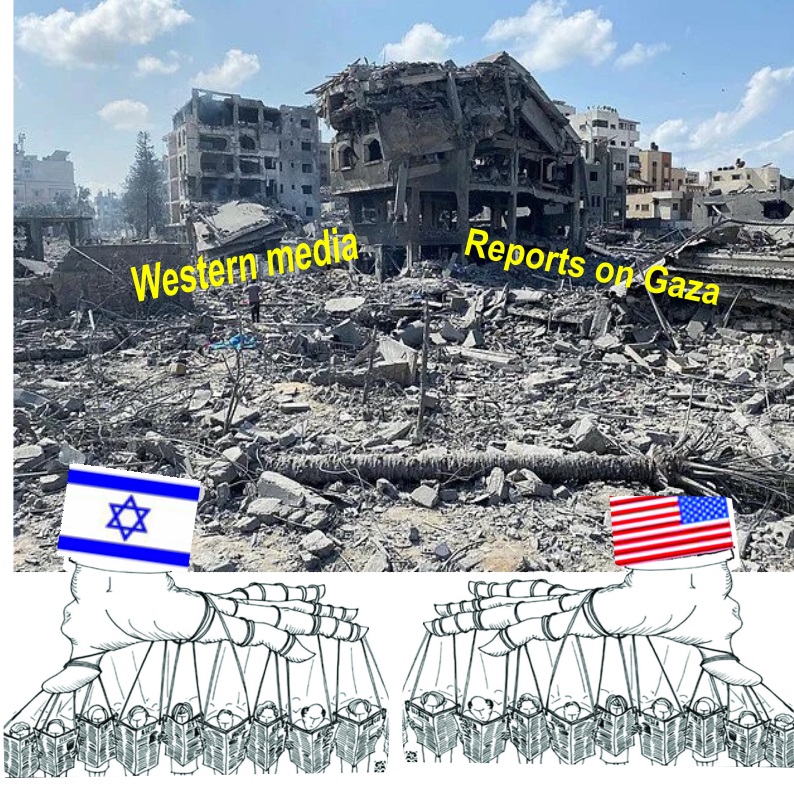
this is a genocide, after all—even if the corporate media refuse to say the word—and starvation is part and parcel of that.
Belén Fernández, April 25, 2025, https://fair.org/home/as-israel-openly-declares-starvation-as-a-weapon-media-still-hesitate-to-blame-it-for-famine/
Israeli Prime Minister Benjamin Netanyahu announced on March 2 that “Israel has decided to stop letting goods and supplies into Gaza,” where the ongoing Israeli genocide, with the loyal backing of the United States, has officially killed more than 51,000 Palestinians since October 2023. The announcement regarding the total halt of humanitarian aid amounted to yet another explicit declaration of the starvation policy that Israel is pursuing in the Gaza Strip, a territory that—thanks in large part to 17 consecutive years of Israeli blockade—has long been largely dependent on such aid for survival.
Of course, this was not the first time that senior Israeli officials had advertised their reliance on the war crime of forced starvation in the current genocidal assault on Gaza. On October 9, 2023, two days after the most recent launch of hostilities, then–Defense Minister Yoav Gallant ordered a “complete siege” of the Gaza Strip: “There will be no electricity, no food, no fuel, everything is closed.” Two days after that, Foreign Minister Israel Katz boasted of cutting off “water, electricity and fuel” to the territory.
And just this month, Israeli National Security Minister Itamar Ben-Gvir proclaimed that there was “no reason for a gram of food or aid to enter Gaza.” Following an April 22 dinner held in his honor in Florida at US President Donald Trump’s Mar-a-Lago resort, Ben-Gvir reported that US Republicans had
expressed support for my very clear position on how to act in Gaza and that the food and aid depots should be bombed in order to create military and political pressure to bring our hostages home safely.
Never mind that the hostages would have been brought home safely as scheduled had Israel chosen to comply with the terms of the ceasefire agreement with Hamas that was implemented in January, rather than definitively annihilating the agreement on March 18.
It is no doubt illustrative of Israel’s modus operandi that the March 2 decision to block the entry of all food and other items necessary for human existence took place in the middle of an ostensible ceasefire.
‘Starved, bombed, strangled’
While Ben-Gvir’s most recent comments have thus far eluded commentary in the US corporate media, the roundabout media approach to the whole starvation theme has been illuminating in its own right. It has not, obviously, been possible to avoid reporting on the subject altogether, as the United Nations and other organizations have pretty much been warning from the get-go of Israel’s actions causing widespread famine in Gaza.
In December 2023, for example, just two months after the onset of Israel’s blood-drenched campaign, the Integrated Food Security Phase Classification initiative, or IPC scale, determined that “over 90% of the population in the Gaza Strip (about 2.08 million people) was estimated to face high levels of acute food insecurity, classified in IPC Phase 3 or above (Crisis or worse).” The assessment went on: “Among these, over 40% of the population (939,000 people) were in Emergency (IPC Phase 4) and over 15% (378,000 people) were in Catastrophe (IPC Phase 5).”
A full year ago, in April 2024, even Samantha Power—then the administrator of the US Agency for International Development—conceded that it was “credible” that famine was already well underway in parts of the Gaza Strip. And the UN Office for the Coordination of Humanitarian Affairs now warns that Gaza is “likely facing the worst humanitarian crisis in the 18 months since the escalation of hostilities in October 2023”—its population being “starved, bombed, strangled” and subjected to “deprivation by design.”
Disappearance of agency
None of these details have escaped the pages and websites of corporate media outlets, although the media’s frequent reliance on ambiguous wordiness tends to distract readers from what is actually going on—and who is responsible for it. Take, for instance, the New York Times headline “Gaza Famine Warning Spurs Calls to Remove Restrictions on Food Shipments” (6/25/24), or the CBS video “Hunger Spreads Virtually Everywhere in Gaza Amid Israel/Hamas War” (12/5/24). Even news outlets that intermittently undertake to spotlight the human plight of, inter alia, individual parents in Gaza losing their children to starvation remain susceptible to long-winded efforts to disperse blame. (As of April of last year, Save the Children confirmed that 27 children in northern Gaza had already died of starvation and disease.)
In an era in which news consumption often consists of skimming headlines, the phrasing of article titles is of utmost import. And yet many headlines manage to entirely excise the role of Israel in Gaza’s “hunger crisis”—as in CNN’s report (2/24): “‘We Are Dying Slowly:’ Palestinians Are Eating Grass and Drinking Polluted Water as Famine Looms Across Gaza.” Or take the Reuters headline (3/24/24): “Gaza’s Catastrophic Food Shortage Means Mass Death Is Imminent, Monitor Says.” Or this one from ABC News (11/15/24): “Famine ‘Occurring or Imminent’ in Parts of Northern Gaza, Experts Warn UN Security Council.”
It’s not that these headlines are devoid of sympathy for Palestinian suffering. The issue, rather, is the dilution—and even disappearance—of agency, such that the “catastrophic food shortage” is rendered as transpiring in a sort of vacuum and thereby letting the criminals perpetrating it off the hook. Imagine if a Hamas rocket from Gaza killed an infant in Israel and the media reported the event as follows: “Israeli Baby Perishes as Rocket Completes Airborne Trajectory.”
‘No shortage of aid’
Then there is the matter of the media’s incurable habit of ceding Israeli officials a platform to spout demonstrable lies, as in the April 17 NBC News headline “Aid Groups Describe Dire Conditions in Gaza as Israel Says There Is No Shortage of Aid.” The fact that Israel is permitted to make such claims is particularly perplexing, given Israeli officials’ own announcements that no aid whatsoever may enter the territory, while the “dire conditions” are made abundantly clear in the text of the article itself: “The Global Nutrition Cluster, a coalition of humanitarian groups, has warned that in March alone, 3,696 children were newly admitted for care for acute malnutrition” in Gaza.
Among numerous other damning statistics conveyed in the dispatch, we learn that all Gaza bakeries supported by the UN World Food Programme closed down on March 31, “after wheat flour ran out.” Meanwhile, the WFP calculated that Israel’s closure of border crossings into Gaza caused prices of basic goods “to soar between 150% and 700% compared with prewar levels, and by 29% to as much as 1,400% above prices during the ceasefire.”
Against such a backdrop, it’s fairly ludicrous to allow Israeli officials to “maintain there is ‘no shortage’ of aid in Gaza and accuse Hamas of withholding supplies.” If the press provides Israel with space to spout whatever nonsense it wants—reality be damned—where is the line ultimately drawn? If Israel decides Hamas is using wheat flour to build rockets, will that also be reported with a straight face?
Lest anyone think that thwarting the entry of food into the Gaza Strip is a new thing, recall that Israel’s blockade of Gaza long predated the present war—although the details of said blockade are generally glossed over in the media in favor of the myth that Israel unilaterally “withdrew” from the territory in 2005. In 2010, the BBC (6/21/10) listed some basic foodstuffs—pardon, potential “dual-use items”—that Israel had at different times in recent history blocked from entering Gaza, including pasta, coffee, tea, nuts and chocolate. In 2006, just a year after the so-called “withdrawal,” Israeli government adviser Dov Weissglas outlined the logic behind Israel’s restriction of food imports into Gaza: “The idea is to put the Palestinians on a diet, but not to make them die of hunger.”
Fast forward almost two decades, and it’s safe to say that the “idea” has evolved; this is a genocide, after all—even if the corporate media refuse to say the word—and starvation is part and parcel of that. But on account of Israel’s extra-special relationship with the United States, US media have institutionalized the practice of beating around the bush when it comes to documenting Israeli crimes. This is how we end up with the aforementioned long-winded headlines instead of, say, the far more straightforward “Israel is starving Gaza,” a Google search of which terms produces not a single corporate media dispatch, but does lead to a January 2024 report by that very name, courtesy of none other than the Israeli human rights organization B’Tselem.
‘Starving as negotiation tactic’
That said, there have been a few surprises. The New York Times (3/13/25), for example, took a short break from its longstanding tradition of unabashed apologetics for Israeli atrocities in allowing the following sentence to appear in a March opinion article by Megan Stack: “Israeli officials are essentially starving Gaza as a negotiation tactic.” In the very least, this was a vast improvement, in terms of syntactic clarity and assignation of blame, over previous descriptions of Israeli behavior immortalized on the pages of the US newspaper of record—like that time the Israeli military slaughtered four kids playing by the sea in Gaza, and the Times editors (7/16/14) went with the headline “Boys Drawn to Gaza Beach, and Into Center of Mideast Strife.”
In the end, Israel’s starvation of the Gaza Strip is multifaceted. It’s not just about physically blocking the entry of food into the besieged enclave. It’s also about Israel’s near-total decimation of Gaza’s healthcare system: the bombardment of hospitals, the targeting of ambulances, the massacres of medical personnel (FAIR.org, 4/11/25). It’s about Israeli military attacks on humanitarian aid convoys and workers, including the April 2024 massacre of seven international employees of the food organization World Central Kitchen.
It’s about Israel razing agricultural areas, wiping out food production, devastating the fishing industry and depleting livestock. It’s about Israel bombing water infrastructure in Gaza. And it’s about Israeli troops slaughtering at least 112 desperate Palestinians queuing for flour on February 29, 2024 (FAIR.org, 3/22/24)—which was at least a quicker way of killing starving people than waiting for them to starve.
In his 2017 London Review of Books essay (6/15/17) on the use of famine as a weapon of war, Alex de Waal referenced the “physical debilitation of groups as a technique of genocide,” noting that “forced starvation was one of the instruments of the Holocaust.” It’s worth reflecting on the essay’s opening paragraph:
In its primary use, the verb “to starve” is transitive: It’s something people do to one another, like torture or murder. Mass starvation as a consequence of the weather has very nearly disappeared: Today’s famines are all caused by political decisions, yet journalists still use the phrase “man-made famine” as if such events were unusual.
As for the current case of the Gaza Strip, US establishment journalists appear to be doing their best to avoid the transitive nature of the verb in question—or any subject-verb-object construction that might too overtly expose Israeli savagery. And by treating famine in Gaza as a subject unto itself, rather than a “technique of genocide,” to borrow de Waal’s words, the media assist in obscuring the bigger picture about this very man-made famine—which is that Israel is not just starving Gaza. Israel is exterminating Gaza.
Plutonium’s Hidden Legacy at Piketon

Plutonium was here. It was processed, mishandled, released, and denied. It contaminated water, soil, fish, and workers. It spread to schools. And it killed.
Investigative Team April 24, 2025, https://appareport.com/2025/04/24/plutoniums-hidden-legacy-at-piketon/?utm_source=facebook&utm_medium=jetpack_social&fbclid=IwY2xjawJ5XrBleHRuA2FlbQIxMQBicmlkETE3b0JDR3JZZ0xqRkNqVU1oAR5YM8gN60lbVkb21XEno8JBYLC_Rnqv7LD993TwfBersmNr-c-SsZuL1J_1mA_aem_sCNRay627WxIPPEuu7DVsA [ample illustrations]
For decades, the U.S. Department of Energy (DOE) claimed that plutonium had no place at the Portsmouth Gaseous Diffusion Plant (PORTS). But government documents, congressional testimony, and radiological data spanning more than 40 years tell a different story — one of systemic exposure, buried secrets, and radioactive contamination that continues to haunt the soil, water, and people of southern Ohio.
The truth has been revealed in pieces. Some of it was made public as early as the 1990s. Some surfaced only recently. Together, it paints an undeniable picture: plutonium was present at PORTS, it was mishandled, and it left a toxic legacy that federal agencies have failed to clean up — or fully acknowledge.
The Paper Trail: Plutonium Officially Confirmed
The denial cracked in 1999, when The Portsmouth Daily Times published a front-page bombshell: “Plutonium Confirmed in Piketon.” The article cited admissions by federal officials that plutonium-contaminated uranium had been shipped to the site from Paducah, Kentucky, as part of a Cold War-era uranium recycling program.
In a formal letter to DOE Secretary Bill Richardson, U.S. Senators Mike DeWine and George Voinovich confirmed that at least 570 tons of contaminated feed material had been sent to Piketon, beginning as early as 1983. DOE had known. The public had not.
The Incinerator and the Burned Truth
Records show the X-705A incinerator, which operated from the 1970s until 1986, was used to burn approximately 50,000 pounds of uranium-contaminated solid waste annually. But it didn’t stop there.
ccording to on-site Ohio EPA coordinator Maria Galanti, uranium-contaminated solvents — materials never meant for incineration — were also burned in the unit. The result? Soil surrounding the incinerator is now radioactive to a depth of at least 12 feet.
Until the late 1980s, operators even tilled radioactive oils into unlined soil, assuming it would degrade over time. It didn’t. And it won’t — the plutonium isotopes involved have half-lives exceeding 24,000 years.
Radiation in the Waterways — and the Food Chain
A 2006 Ohio EPA report confirmed what residents feared: plutonium had migrated offsite and into the public environment.
Testing in Little Beaver Creek, Big Beaver Creek, Big Run, and the Scioto River revealed the presence of:
- Plutonium-238
- Plutonium-239
- Americium-241
- Neptunium-237
- Alongside technetium-99 and uranium isotopes
All these elements were detected well above background levels, confirming they originated from the plant, not nature.
The Hazard Index (HI) — a risk threshold used by federal agencies — was exceeded across all tested water bodies, with Big Run scoring more than 20 times the EPA’s risk cutoff.
Separate DOE assessments show Pu-238 in fish as a significant dietary exposure source, second only to Tc-99 in produce. Plutonium has entered the food chain.
Offsite Spread: Plutonium Detected Near Schools and Homes
Monitoring data confirmed the presence of plutonium-239/240, neptunium-237, and americium-241 at offsite stations including:
- Station A41A near Zahn’s Corner Middle School
- Station A6 in northwest Piketon
- Station A23 near local residential zones
DOE contends that any plutonium found in air monitors comes from 1950s nuclear weapons testing fallout and not PORTS.
Workers Testify to Deception and Disease
At a 2000 Senate hearing, former worker Sam Ray described his fight with chondrosarcoma, a rare bone cancer he linked directly to his work at PORTS. He spoke of no health monitoring, no protective equipment, and no transparency.
Jeffrey Walburn, a plant whistleblower, testified to a 1994 chemical exposure that permanently damaged his lungs. He alleged a criminal cover-up by Lockheed Martin, including the alteration and destruction of radiation dose records.
He warned that widows of deceased workers may never receive compensation because exposure data had been falsified.
DOE’s Own Admissions: Plutonium in the Cascade System
According to a 2024 DOE report, plutonium-238 and plutonium-239 were present in enrichment equipment, having entered the cascade system through contaminated uranium hexafluoride cylinders. The isotopes were found in the X-326 Process Building and throughout the cascade.
DOE also confirmed that residual technetium-99 remained embedded in internal pipe surfaces, requiring special disposal decades after operations ended.
From Russian Warheads to Pike County: The Megatons to Megawatts Program
Between 1993 and 2013, the U.S. and Russia dismantled over 20,000 nuclear warheads under the Megatons to Megawatts Program — converting highly enriched uranium (HEU) into low-enriched uranium (LEU) for use in American power plants.
But that uranium didn’t just vanish. It came through U.S. enrichment sites — including the Portsmouth Gaseous Diffusion Plant in Piketon.
Contractor and DOE records confirm that Russian-origin uranium — some of it likely carrying residual contaminants from dismantled warheads — was introduced into the U.S. enrichment stream at PORTS.
Whether plutonium from these shipments contributed to PORTS contamination is still under question. What’s undeniable is this: the U.S. government sent Russian bomb-grade material through an Appalachian processing plant with a history of unsafe handling, minimal oversight, and deliberate secrecy.
They took Soviet nukes and ran them through Appalachian lungs. Without warning. Without consent.
While the legacy of plutonium contamination at PORTS stretches back to the Cold War, the threat isn’t just historical — it’s current, legal, and active.
Centrus Energy: HALEU, the NRC license, and legal plutonium storage at PORTS
In 2021, the Nuclear Regulatory Commission (NRC) granted Centrus Energy Corp. a license to operate a first-of-its-kind High-Assay Low-Enriched Uranium (HALEU) facility inside the old enrichment footprint at PORTS. HALEU is a higher-enriched form of uranium (5–20% U-235), specifically produced for next-generation small modular nuclear reactors (SMRs).
But buried in the licensing documents is something the public was never told:
The HALEU license explicitly authorizes Centrus to store an undisclosed amount of plutonium-bearing material at the site.
That’s not speculation — that’s federal licensing language. In plain English: Centrus is legally allowed to store plutonium compounds at a facility that already has a catastrophic contamination legacy.
A Legacy Buried in Contamination and Lies
Plutonium was here. It was processed, mishandled, released, and denied. It contaminated water, soil, fish, and workers. It spread to schools. And it killed.
Some of the evidence has been buried. Some altered. But most of it has been in plain sight — ignored by federal agencies and omitted from cleanup plans.
This is not an old story. This is an ongoing disaster.
The time for quiet compliance is over. The reckoning for Piketon — and for the people poisoned by its secrets — has come.
Call it what it clearly is: Genocide

April 26, 2025, By Walt Zlotow, https://theaimn.net/call-it-what-it-clearly-is-genocide/
Some dare not call it genocide
Folks following the ongoing Israeli genocide of Palestinians in Gaza, fully enabled by America, are of two views.
Those of us in the peace community instantly recognised that Israel’s response to Hamas’ October 7, 2023 attack was a genocidal ethnic cleansing of all Palestinians from Gaza.
We didn’t have to guess. Israeli leaders made clear through word and deed that return of Israeli hostages was secondary to their primary goal of killing and clearing out all 2,300,000 Palestinians so Gaza could be redeveloped to expand Greater Israel.
It was also clear that the US, under both Biden and Trump, were and are in complete accord with Israel’s grisly, murderous policy. Biden feigned sympathy for the tens of thousands of dead Palestinian innocents on his watch and the decimated 139 square miles of Gaza rubble. But he kept mum while delivering over $20 billion in weapons allowing Israel to rain down on Gaza over 50,000 tons of American bombs dropped from American planes.
Trump, no surprise, gloried in the worst genocide this century. He invited indicted war criminal Benjamin Netanyahu to the Oval Office to discuss which African countries they could intimidate to take in the roughly 2.2 million remaining starving, sick, traumatized Palestinians. Trump is eager to kick start his biggest real estate project ever, expanding Greater Israel into Gaza once the Palestinians have been cleared out. That is grotesque, not something to champion.
Then there are those who refuse to believe or admit that genocide is occurring before their eyes and ears in real time.
Reasons likely many.
Some simply view it not as genocide but a war between Israel and Hamas.
Some argue that the Palestinian destruction, no matter how horrible, does not rise to genocide which they equate to the Nazi horrors of WWII.
Some are in complete sympathy with Israel’s ethnic cleansing campaign, indeed, cheering it on. Mike Huckabee, Trump’s new Ambassador to Israel, claims there is no such thing as Palestine or even Palestinians, so let the ethnic cleansing proceed unabated to expand Greater Israel.
There is a near total blackout in mainstream media of the ongoing genocide in Gaza. Whether conservative or progressive, the talking heads go mute when it comes to the informing the public of the most horrific US policy in their lifetime.
None in Congress dare cross the Israel lobby by calling it genocide. To do so risks having millions in lobby campaign funds dry up or worse, going to a pro lobby primary opponent. Some are horrified by the violence crushing the Palestinians but cannot embrace the moral imperative to call it out and demand its end.
To his credit, Sen. Bernie Sanders tried twice to pass Senate Joint Resolutions to cut off the flow of genocide weapons to Israel but only garnered 17 votes from the other 99 mostly genocide-supporting Senators. But tho Sanders calls Israel’s conduct “ethnic cleansing”, he refuses to call it what it truly is: genocide.
Representing Sanders’ Senate opposite is colleague John Fetterman, who supports Israel cutting off all food, medicine, and water to Gaza until the Israeli hostages are released. Horrifying.
Israel breaks the January ceasefire with daily bombings, killing dozens of Palestinian innocents while most Americans turn away.
Collectively, American genocide deniers enable President Trump to fund, supply, and cheer on arguably the most murderous, destructive and tragically bi-partisan foreign policy in American history.
EDF’s new UK plants should be negotiated as one, French energy minister says.

EDF’s two UK nuclear construction projects at Hinkley Point and Sizewell
should be negotiated as a single financial venture, France’s energy
minister has urged, to prevent the French energy giant shouldering
significant cost overruns.
Marc Ferracci said he had held discussions on
the projects with Britain’s energy minister Ed Miliband on Thursday, on
the sidelines of an energy security summit in London. “France and EDF are
very committed to deliver the projects but we have to find a way to
accelerate them and we have to find a way to consolidate the financial
schemes of both projects,” Ferracci told the FT.
France has been lobbying
the UK government to help EDF with the finances of Hinkley Point C in
Somerset for more than a year. It argues that the French state-owned
electricity operator should not be left on the hook for cost overruns that
have taken the total bill to as high as £46bn. EDF — which has also
experienced long delays on other projects using the same reactor technology
in Finland and France — has warned that the first of two reactors at
Hinkley Point C could be delayed to as late as 2031, which would be six
years later than its original target.
The French company has a smaller
equity stake in the Sizewell C project in Suffolk, which it is also
developing. Ferracci denied that the French government was seeking to use
Sizewell as “leverage” to help bail it out of financial difficulties at
Hinkley.
FT 25th April 2025,
https://www.ft.com/content/0c50a553-3376-42d8-8ac5-c8aa84d2e78d
Trump’s transactional instincts could help forge a new Iran nuclear deal
Mohamad Bazzi, 265 Apr https://www.theguardian.com/commentisfree/2025/apr/25/trump-iran-nuclear-deal
The president has a chance to make good on his reputation as a dealmaker as Iran moves closer to a nuclear weapon.
In May 2018, Donald Trump unilaterally withdrew the US from the Iran nuclear deal and reimposed American sanctions that crippled the Iranian economy. Trump tore up the 2015 agreement, which had taken years for Iran to negotiate with six world powers, under which Tehran limited its nuclear program in exchange for relief from international sanctions. Trump insisted he would be able to negotiate a better pact than the one reached by Barack Obama’s administration.
Today, in his second term as president, Trump is eager to fix the Iran deal he broke nearly seven years ago.
While Trump’s overall foreign policy has been chaotic and has alienated traditional US allies in Europe and elsewhere, he has an opportunity to reach an agreement with Iran that eluded Joe Biden. Since Trump walked away from the original deal, Iran has moved closer to having a nuclear weapon than it has ever been. It has enriched enough uranium close to weapons-grade quality to make six nuclear bombs, according to the International Atomic Energy Agency (IAEA). But analysts believe that even after enriching enough uranium for a bomb, Iran would still need up to a year to develop an actual nuclear warhead that could be deployed on a ballistic missile.
Last month, Trump sent a letter to Iran’s supreme leader, the 86-year-old Ayatollah Ali Khamenei, saying the US wanted to negotiate a new deal. Trump followed up with a public threat, saying if Iran’s leaders did not agree to renewed talks, they would be subjected to “bombing the likes of which they have never seen before”. After Trump’s threats and a buildup of US forces in the Middle East, Iran’s military said it would respond to any attack by targeting US bases in the region, which house thousands of American troops.
But Iranian leaders also agreed to indirect negotiations, rather than the direct talks Trump had proposed. Trump dispatched his special envoy, the real estate developer Steve Witkoff, to lead a team of US negotiators to meet indirectly with top Iranian officials, including the foreign minister, Abbas Araghchi. The two sides held two rounds of productive talks so far this month, under the mediation of Oman. And the US and Iranian teams are due to meet again this weekend in Muscat, the capital of Oman, where they will start talks on technical details of a potential agreement.
While Trump and Iran’s leaders both changed their tones in recent weeks, there are many obstacles before a deal can be reached, including hardliners in Iran and Washington, as well as opposition from Israel’s rightwing government, led by Benjamin Netanyahu, who has spent years working to undermine negotiations between the US and Iran. The main barrier will be whether the Trump administration insists on a total dismantling of Iran’s nuclear program – the so-called “Libya model”, named after the late Libyan dictator Muammar Gaddafi, who decided to eliminate his country’s nuclear weapons program in 2003 under pressure from the US. But that decision deprived Gaddafi of a major lever to stave off western military intervention after the Arab Spring uprisings in 2011, which led to his regime’s fall and his killing by Libyan rebels.
Some foreign policy hawks in Washington, including Trump’s national security adviser, Michael Waltz, and the secretary of state, Marco Rubio, insist on this maximalist strategy, which echoes Netanyahu’s demand that Iran must completely dismantle its nuclear enrichment activity and infrastructure as part of any deal with the US. If Trump takes a similar approach, negotiations would probably break down and Trump could follow through on his threat to carry out military strikes.
Iran has made clear that it will not agree to the total end of its nuclear program, but would accept a verification-based approach, as it did under the 2015 deal negotiated by the Obama administration along with China, France, Russia, the UK and Germany, together with the European Union. That type of agreement would place strict limits on Iran’s ability to enrich uranium and impose an inspections regime involving international monitors. Several of Trump’s advisers, including Witkoff and the vice-president, JD Vance, seem to favor this solution.
“I think he wants to deal with Iran with respect,” Witkoff said of Trump’s outreach to the Iranian regime, in a long interview last month with Tucker Carlson, the rightwing media host who has been highly critical of Republican hawks agitating for war with Iran. “He wants to build trust with them, if it’s possible.”
Iran’s leaders apparently got that message – and have tried to stroke Trump’s ego and convey that they respect him in ways they never respected Biden. In a Washington Post op-ed published on 8 April, Iran’s foreign minister seemed to be speaking to Trump directly when he blamed the failure of earlier negotiations on a “lack of real determination by the Biden administration”. Araghchi also played to Trump’s oft-repeated desire to be a peacemaker who ends America’s legacy of forever wars, writing: “We cannot imagine President Trump wanting to become another US president mired in a catastrophic war in the Middle East.”
And the minister appealed to Trump’s reputation as a deal-maker, citing the “trillion-dollar opportunity” that would benefit US companies if they could gain access to Iran after a diplomatic agreement. Iran’s leaders evidently understand that Trump loves to frame his foreign policy as being guided by his desire to secure economic deals and benefits for American businesses.
In this case, Trump’s transactional instincts and bulldozer style of negotiations could lead to a positive outcome, avoiding war with Iran and undermining the hardliners in Washington, Iran and Israel. Trump has already adopted a significant shift toward Tehran from his first term, when he had insisted that Iran was the world’s leading state sponsor of terrorism and the greatest threat to US interests in the Middle East.
After he took office in 2017, Trump wanted to tear up the Iran deal partly because it was one of Obama’s major foreign policy accomplishments. Trump also surrounded himself with hawkish advisers who reinforced the danger of an Iranian threat, including HR McMaster, who served as national security adviser, and James Mattis, who was defense secretary. Both men commanded US troops during the occupation of Iraq, and they fought Iraqi militias funded by Iran. Trump later appointed John Bolton, another neoconservative and advocate of the 2003 US invasion of Iraq, as his national security adviser.
In his second term, Trump has banished most of the neocons from his administration. Trump also seems to realize that Netanyahu could become one of the biggest obstacles to an Iran deal, as he was during the Obama and Biden administrations. It was no accident that the president announced his plan for renewed talks with Iran while Netanyahu sat beside him at an Oval Office meeting on 7 April. Netanyahu had arranged a hasty visit to Washington to seek an exemption from Trump on new tariffs on Israeli exports. But he left empty-handed and embarrassed by Trump’s Iran announcement. That meeting was a signal to Iran’s leaders: that Trump would not allow Netanyahu to steamroll him, as the Israeli premier had done with other US presidents.
If Trump continues to resist Netanyahu, along with hawkish Republicans and some of his own advisers, he might well be able to negotiate a dramatic deal with Iran – and repair the nuclear crisis he unleashed years ago.
- Mohamad Bazzi is the director of the Hagop Kevorkian Center for Near Eastern studies and a journalism professor at New York University.
Weatherwatch: sage advice 50-odd years ago on UK nuclear power still relevant
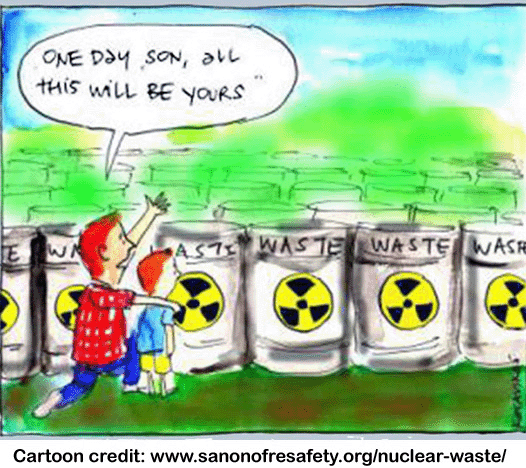
Ministers might care to heed conclusions of 1976 Flowers report before they go ahead with latest energy policy plans
Paul Brown, 25 Apr 25, https://www.theguardian.com/news/2025/apr/25/weatherwatch-sage-advice-50-odd-years-ago-on-uk-nuclear-power-still-relevant
Gathering dust somewhere in Whitehall is the 1976 royal commission’s sixth report on environmental pollution, known afterwards as the Flowers report after its chair, Sir Brian Flowers. It dealt with the future of the nuclear industry, warning about the dangers of producing large quantities of plutonium amid fears of potential threats from terrorists. The report particularly emphasised the pressing need to find a way of disposing of nuclear waste and recommended there should be no great expansion of nuclear power until a satisfactory way had been found of disposing of it.
The report was written before climate change and the current extremes of weather were of public concern, but the commission was exercised by the pressing need to increase the electricity supply. The report did not rule out the expansion of nuclear power but urged the government to look at wave power and other renewables as much more desirable alternatives.
Fast-forward almost half a century and the UK is still no nearer to dealing with its ever increasing pile of nuclear waste, costing billions every year just to keep safe. However, the Flowers commission would be delighted that wind, solar and other renewables have largely replaced nuclear power, and be puzzled that the government seems poised to ignore sage advice and expand nuclear energy again.
Tankers travel from Alton Water to Sizewell C every day

Tankers full of water are travelling 30 miles up the A12 and B1122 to keep Sizewell C’s offices topped up because the local water company cannot cope with demand.
Essex and Suffolk Water is the company that supplies the north
east of the county – and it has long been known that it has problems in
coping with increasing demand. The company is operating at near capacity –
and this problem has forced some development or expansion plans in the area
to be cancelled or postponed. It is not able to supply water to the offices
that have been built at Sizewell so a temporary deal has been signed with
Anglian Water to bring in supplies.
Ipswich Star 25th April 2025,
https://www.ipswichstar.co.uk/news/25110191.tankers-travel-alton-water-sizewell-c-every-day/
1 This Month

of the week – Shut Down Drone Warfare!


Tell the Ukrainian Government to Drop Prosecution of Peace Activist Yurii Sheliazhenko

Petition to revoke the licensing of the Near Surface Nuclear Disposal Facility (NSDF) at Chalk River. https://www.ourcommons.ca/petitions/en/Petition/Details?Petition=e-7247
To see nuclear-related stories in greater depth and intensity – go to https://nuclearinformation.wordpress.com
-
Archives
- April 2026 (57)
- March 2026 (251)
- February 2026 (268)
- January 2026 (308)
- December 2025 (358)
- November 2025 (359)
- October 2025 (376)
- September 2025 (257)
- August 2025 (319)
- July 2025 (230)
- June 2025 (348)
- May 2025 (261)
-
Categories
- 1
- 1 NUCLEAR ISSUES
- business and costs
- climate change
- culture and arts
- ENERGY
- environment
- health
- history
- indigenous issues
- Legal
- marketing of nuclear
- media
- opposition to nuclear
- PERSONAL STORIES
- politics
- politics international
- Religion and ethics
- safety
- secrets,lies and civil liberties
- spinbuster
- technology
- Uranium
- wastes
- weapons and war
- Women
- 2 WORLD
- ACTION
- AFRICA
- Atrocities
- AUSTRALIA
- Christina's notes
- Christina's themes
- culture and arts
- Events
- Fuk 2022
- Fuk 2023
- Fukushima 2017
- Fukushima 2018
- fukushima 2019
- Fukushima 2020
- Fukushima 2021
- general
- global warming
- Humour (God we need it)
- Nuclear
- RARE EARTHS
- Reference
- resources – print
- Resources -audiovicual
- Weekly Newsletter
- World
- World Nuclear
- YouTube
-
RSS
Entries RSS
Comments RSS
 nuclear-news