Gender Stunts in Space: Blue Origin’s Female Celebrity Envoys

April 15, 2025 Dr Binoy Kampmark, https://theaimn.net/gender-stunts-in-space-blue-origins-female-celebrity-envoys/
Indulgent, vain and profligate, the all-female venture into space on the self-piloted New Shepard (NS-31) operated by Jeff Bezos’ Blue Origin was space capitalism and celebrity shallowness on full show, masquerading as profound, moving and useful.
The crew consisted of bioastronautics research scientist and civil rights activist Amanda Nguyen, CBS Mornings co-host Gayle King, pop entertainer Katy Perry, film producer Kerianne Flynn, former NASA scientist and entrepreneur Aisha Bowe and Lauren Sánchez, fiancée of Jeff Bezos. The journey took 11 minutes and reached the Kármán line at approximately 96 kilometres above the earth.
Blue Origin had advertised the enterprise as an incentive to draw girls to pursue careers in science, technology, engineering and mathematics (STEM). It also shamelessly played on the background of some of the crew, with Nguyen promoted as “the first Vietnamese and south-east Asian female astronaut” whose presence would “highlight science as a tool for peace” and also project a potent “symbol of reconciliation between the US and Vietnam.”
Phil Joyce, Senior Vice President of New Shepard, thought it a “privilege to witness this crew of trailblazers depart the capsule today.” Each woman was “a storyteller” who would “use their voices – individually and together – to channel their life-changing experience today into creating lasting impact that will inspire people across our planet for generations.”
What was more accurately on show were celebrity space marketers on an expensive jaunt, showing us all that women can play the space capitalism game as well, albeit as the suborbital version of a catwalk or fashion show. Far from pushing some variant of feminism in the frontier of space, with scientific rewards for girls the world over, we got the eclipsing, if not a wholesale junking, of female astronauts and their monumental expertise.
It hardly compared, at any stretch or by any quantum of measure, with the achievement of Russian cosmonaut, Valentina Tereshkova, who piloted a Vostok 6 into earth’s orbit lasting 70 hours over six decades prior. To have Sánchez claiming to be “so proud of this crew”, tears cued for effect, gave the impression that they had shown technical expertise and skill when neither was required. It was far better to have deep pockets fronting the appropriate deposit, along with the necessary safe return, over which they had virtually no control over.
Dr Kai-Uwe Schrogl, special advisor for political affairs at the European Space Agency, offered a necessarily cold corrective. “A celebrity isn’t an envoy of humankind – they go into space for their own reasons,” he told BBC News. “These flights are significant and exciting, but I think maybe they can also be a source of frustration for space scientists.” How silly of those scientists, who regard space flight as an extension of “science, knowledge and the interests of humanity.”
The Guardian was also awake to the motivations of the Bezos project. “The pseudo progressiveness of this celebrity space mission, coupled with Bezos’s conduct in his other businesses, should mean we are under no illusion what purpose these flights serve.” With Richard Branson’s Virgin Galactic and Elon Musk’s SpaceX, the space tourism market, marked by its bratty oligarchs, is becoming competitive. In an effort to corner the market, attractive gimmicks are in high demand.
The cringingly superficial nature of the exercise was evident in various comments on the fashion aspect of the suits worn by the crew. Here was branding, and the sort that could be taken to space. As Sánchez stated: “Usually, you know, these suits are made for a man. Then they get tailored to fit a woman. I think the suits are elegant, but they also bring a little spice to space.” Blue Origin had capitalised on NASA’s own failings in 2019, which saw the abandoning of an all-female spacewalk for lacking appropriately fitting spacesuits.
On their return, the female cast performed their contractual undertakings to bore the press with deadly clichés and meaningless observations, reducing space travel to an exercise for the trivial. “Earth looked so quiet,” remarked Sánchez. “It was quiet, but really alive.” King, after getting on her knees to kiss the earth, merely wanted “to have a moment with the ground, just appreciate the ground for just a second.” (Surely she has had longer than that.) Perry, on her return after singing What a Wonderful World during the trip, overflowed with inanities. She felt “super connected to life”, as well as being “so connected to love.”
On the ground were other celebrities, delighted to offer their cliché-clotted thoughts. “I didn’t realise how emotional it would be, it’s hard to explain,” reflected Khloé Kardashian. “I have all this adrenaline and I’m just standing here.” From a family of celebrities that merely exist as celebrities and nothing else, she had some advice: “Dream big, wish for the stars – and one day, you could maybe be amongst them.”
Amanda Hess, reflecting on the mission in The New York Times, tried to put her finger on what it all meant. “The message is that a little girl can grow up to be whatever she wishes: a rocket scientist or a pop star, a television journalist or a billionaire’s fiancée who is empowered to pursue her various ambitions and whims in the face of tremendous costs.” Just not an astronaut.
Campaign for Nuclear Disarmament (CND), to blockade RAF Lakenheath after US exemption to British nuclear safety rules revealed

Berny Torre, Sunday, April 13, 2025, https://morningstaronline.co.uk/article/cnd-blockade-raf-lakenheath-after-us-exemption-british-nuclear-safety-rules-revealed
PROTESTERS will set up a two-week peace camp outside RAF Lakenheath tomorrow after it emerged that all United States forces in Britain are exempt from meeting nuclear safety regulations.
And CND said that activists will block the Suffolk base on April 26, the last day of their vigil.
Declassified documents uncovered by CND show that former defence secretary Ben Wallace signed the “sensitive” waiver exempting US troops from telling local authorities they are storing nuclear weapons and exempt from sticking to regulations applied to radiation risks, leaving local authorities unable to draft disaster emergency plans.
It is known that RAF Lakenheath is being prepared to host new US nuclear weapons, but the March 2021 waiver exempts all US bases in Britain.
CND general secretary Sophie Bolt said: “Far from keeping people safe, all these nuclear weapons make Britain a target. Yet the government is more concerned about its special relationship with the US than people’s safety.
“The peace camp comes just as we learn that Britain’s cover-up of a US nuclear weapons deployment has been in the works for at least four years, alongside proof that people living close to any US base in this country, not just in East Anglia, are at great risk.”
Lakenheath Alliance for Peace co-founder Angie Zelter said: “It is horrifying and shameful that USAF Lakenheath, on British soil and with the connivance of the UK government, is involved in war crimes and genocide.
“Pilots from Israel and Saudi Arabia are trained at Lakenheath and US planes and bombs go out to take part in the bombings in Gaza and Yemen.
“We are here to say this is not in our name and to warn service personnel in the base that they should never obey illegal orders and should refuse to take part in the never-ending wars that are destroying people and planet.”
Greenham Common campaigner Ginnie Herbert said: “The cruise missiles left Greenham Common, international law changed and the common was handed back to the people.
“Forty years later and here we are protesting again as secret decisions are made and US nuclear weapons return to Lakenheath.”
The new camp will include a programme of events and actions taking place at the base and in nearby towns and villages.
A Ministry of Defence spokesman said: “It remains a long-standing UK and Nato policy to neither confirm nor deny the presence of nuclear weapons at a given location.”
How climate change could disrupt the construction and operations of US nuclear submarines

By Allie Maloney | April 14, 2025 https://thebulletin.org/2025/04/how-climate-change-could-disrupt-the-construction-and-operations-of-us-nuclear-submarines/ Allie Maloney is the Herbert Scoville Jr. Peace Fellow with the Nuclear Information Project at the Federation of American Scientists. Maloney holds two bachelor’s degrees in international affairs and political science from the University of Georgia. Previously, she was a Richard B. Russell Security Leadership Fellow at the University of Georgia’s Center for International Trade and Security.
The US Defense Department is currently in the midst of a multi-decade-long nuclear modernization effort that includes replacing all the nuclear submarines making up the sea leg of the US nuclear triad. The nuclear-armed and -powered submarines—which hold over half of deployed US nuclear warheads—are known for their “survivability,” thereby providing the United States with second-strike capability even after a surprise attack.
But climate change could make the US submarine force inoperable over the coming decades.
Rising sea levels and extreme weather events increasingly threaten the submarine force’s infrastructure, which is mainly located in at-risk flood areas. This vulnerability reveals the precarious state of nuclear weapons—which the Defense Department considers the “backbone of America’s national security”—to the threat of climate change.
Threat multiplier. The Navy plans to spend $130 billion on procuring new Columbia-class nuclear-powered ballistic missile submarines (SSBNs) over the next two decades to replace the current Ohio-class fleet. The delivery of the lead boat—the USS District of Columbia (SSBN-826)—has already been delayed by 12 to 16 months due to insufficient work instructions, low material availability, and disruptions from the COVID-19 pandemic. It is now only about halfway through construction. According to the Government Accountability Office, budget overruns are five to six times higher than estimates by the Navy and General Dynamics Electric Boat, the submarine’s building company. As the Pentagon spends more and more on modernizing its nuclear submarines, natural disasters are likely to disrupt supply chains and damage nuclear facilities, sinking costs further.
In recent years, the Defense Department has started to acknowledge climate change as a “threat multiplier”—albeit slowly. Acknowledging the billions of dollars climate change could cost the Navy in the future, the Pentagon now incorporates inclement weather disasters and other climate effects into military planning and base structures. However, during the first Trump administration, the Navy quietly ended the climate change task force put in place by the Obama administration, which taught naval leaders how to adapt to rising sea levels. As the new Trump administration wipes all mention of climate change and other environmental measures from federal agency websites, climate-related measures may also be halted despite being critical for the viability of naval missions.
Most of the naval construction and operations infrastructure for the United States’ ballistic missile submarines are located on the Pacific and Atlantic coasts. Due to sea level rise and increased inclement weather attributed to climate change, these facilities are becoming more vulnerable to flooding. The intensity and number of hurricanes in the North Atlantic region have increased since the 1980s and will continue to do so as ocean temperatures keep rising, further threatening coastal areas. These incidents are highly costly and disruptive to operations. According to a Congressional Research Service report, the Defense Department has 1,700 coastal military installations that could be impacted by sea level rise. In 2018, Tyndall Air Force Base in Florida suffered $4.7 billion in damages from Hurricane Michael.
Infrastructure at risk.……………………………………………………………………………………………………………………
Self-induced vulnerability. The Navy’s Final Environmental Assessment for the Columbia class submarines estimated that homeporting at Kings Bay, Georgia, would result in emissions of 998 metric tons of carbon dioxide equivalent. This is equivalent to 1,108,593 pounds of coal burned and the amount of carbon sequestered by 1,001 acres of US forests in one year. General Dynamic’s greenhouse gas emissions for 2023 were around 713,874 metric tons—over 700 times higher. While it had committed to reducing GHG emissions in 2019, the company’s emissions have increased since taking on several Pentagon contracts related to nuclear modernization.
The geophysical threats the nuclear deterrent faces show just how precarious these weapons are. As the United States builds new ships for national security, it also contributes to the sinking of its bases. A nuclear weapon buildup is vulnerable to changing environments and cannot save the United States from the looming threat of climate change.
Nuclear waste returns to Germany amid protests.
Matt Ford with dpa, NDR, 04/01/2025April 1, 2025, Edited by: Sean Sinico
https://www.dw.com/en/nuclear-waste-returns-to-germany-amid-protests/a-72108958
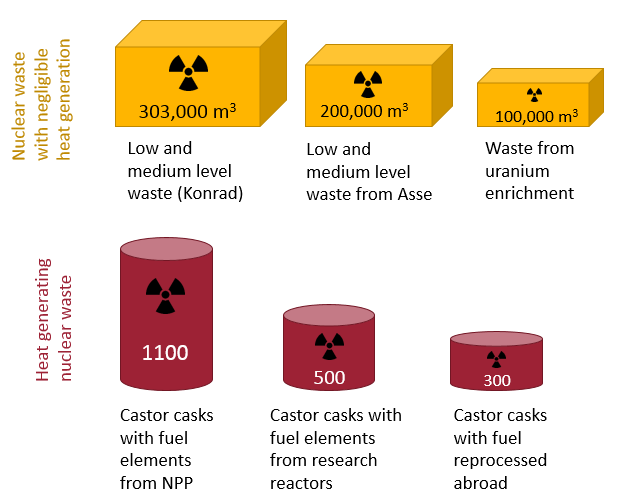
Seven containers filled with nuclear waste were transferred from ship to train in northern Germany for transport to Bavaria. But Germany still has no permanent storage solution for its radioactive material.
A ship carrying castor seven containers filled with highly radioactive nuclear waste docked in the northern German port of Nordenham, Lower Saxony, on Tuesday morning, amid protests and a heightened police presence.
The nuclear waste is being transported from Sellafield in northwest England to a temporary storage unit in Niederaichbach in the southern German state of Bavaria. The waste left the northwestern English port of Barrow-in-Furness last Wednesday and is being transferred from ship to train in Nordenham before continuing southwards. The nuclear waste was what remained after the reprocessing of fuel elements from decommissioned German nuclear power plants.
The first of the containers, which are four meters (13 feet) long and weigh over 100 tons, was lifted off the special “Pacific Grebe” transport ship by a large crane on Tuesday morning and underwent inspection to measure radiation levels and ensure they matched those taken in Sellafield.
The port in Nordenham remains sealed off and guarded by heavily armed police, who have thus far reported no incidents, despite a number of protests by anti-atomic energy groups.
Nuclear waste: Why are people protesting?
“Every castor container carries enormous risk,” said Helge Bauer from the protest group Ausgestrahlt, which means “radiated.” “Nuclear waste should, therefore, only be transported once — to a permanent storage site.”
Further protests are planned along the presumed route of the train carrying the waste over the coming days, including in the cities of Bremen and Göttingen.
“Every castor transport is one too many because it only postpones the problem and does not solve it,” Kerstin Rudek, a spokesperson for the group Castor-Stoppen, said in a statement, adding that nuclear waste should not be moved until a safe, final storage location is determined.
Where is the waste from if Germany phased out nuclear energy?
Germany began phasing out the use of nuclear power in 2003, a process which was accelerated following the Fukushima disaster in Japan in 2011. Germany’s final remaining nuclear power plants were shut down in 2023.
But Germany is still obligated to take back nuclear waste produced by used elements from its plants which, up until 2005, were regularly transported to reprocessing plants in Sellafield and La Hague, France. The transport of processed German nuclear waste back to the country has often been subject to protests.
According to the Society for Nuclear Service (GNS), over 100 castor containers were transported from La Hague to Gorleben, Lower Saxony, between 1995 and 2011. The final four were transported to Philippsburg, Baden-Württemberg, in 2024. Six containers were reportedly transported from Sellafield to Biblis, Hesse, in 2020, with seven more still to come.
Where does Germany store nuclear waste?
Germany’s Federal Company for Radioactive Waste Disposal (BGE) is still in the process of identifying a suitable location for the permanent underground storage of 27,000 cubic meters of nuclear waste produced over the course of 60 years of German nuclear energy production.
Nuclear waste, which can remain radioactive and, therefore, highly dangerous for hundreds of thousands of years, is currently stored in 16 temporary locations above ground, but it can’t stay there forever.
“We are using an empiric process to identify a location which offers the best possible security,” the BGE’s Lisa Seidel told public broadcaster NDR in November 2024.
CIA: Undermining and Nazifying Ukraine Since 1953

In 1969, AERODYNAMIC began advancing the cause of the Crimean Tatars. In 1959, owing to Canada’s large Ukrainian population, Canada’s intelligence service began a program similar to AERODYNAMIC codenamed «REDSKIN».
AERODYNAMIC continued into the 1980s as operation QRDYNAMIC, which was assigned to the CIA’s Political and Psychological Staff’s Soviet East Europe Covert Action Program. Prolog saw its operations expanded from New York and Munich to London, Paris, and Tokyo.
Assistant Secretary of State for European/Eurasian Affairs Victoria Nuland, the baked goods-bearing «Maiden of Maidan,» told the US Congress that the United States spent $5 billion to wrest control of Ukraine from the Russian sphere since the collapse of the Soviet Union. With the recent disclosures from the CIA it appears that the price tag to the American tax payers of such foreign shenanigans was much higher.
by Wayne Madsen, Voltaire Network | 14 January 2016
The CIA programs spanned some four decades. Starting as a paramilitary operation that provided funding and equipment for such anti-Soviet Ukrainian resistance groups as the Ukrainian Supreme Liberation Council (UHVR); its affiliates, the Organization of Ukrainian Nationalists (OUN) and Ukrainian Insurgent Army (UPA), all Nazi Banderists. The CIA also provided support to a relatively anti-Bandera faction of the UHVR, the ZP-UHVR, a foreign-based virtual branch of the CIA and British MI-6 intelligence services. The early CIA operation to destabilize Ukraine, using exile Ukrainian agents in the West who were infiltrated into Soviet Ukraine, was codenamed Project AERODYNAMIC.
The recent declassification of over 3800 documents by the Central Intelligence Agency provides detailed proof that since 1953 the CIA operated two major programs intent on not only destabilizing Ukraine but Nazifying it with followers of the World War II Ukrainian Nazi leader Stepan Bandera.
A formerly TOP SECRET CIA document dated July 13, 1953, provides a description of AERODYNAMIC: «The purpose of Project AERODYNAMIC is to provide for the exploitation and expansion of the anti-Soviet Ukrainian resistance for cold war and hot war purposes. Such groups as the Ukrainian Supreme Council of Liberation (UHVR) and its Ukrainian Insurgent Army (OUN), the Foreign Representation of the Ukrainian Supreme Council of Liberation (ZPUHVR) in Western Europe and the United States, and other organizations such as the OUN/B will be utilized». The CIA admitted in a 1970 formerly SECRET document that it had been in contact with the ZPUHVR since 1950.
The OUN-B was the Bandera faction of the OUN and its neo-Nazi sympathizers are today found embedded in the Ukrainian national government in Kiev and in regional and municipal governments throughout the country.
AERODYNAMIC placed field agents inside Soviet Ukraine who, in turn, established contact with Ukrainian Resistance Movement, particularly SB (intelligence service) agents of the OUN who were already operating inside Ukraine. The CIA arranged for airdrops of communications equipment and other supplies, presumably including arms and ammunition, to the «secret» CIA army in Ukraine. Most of the CIA’s Ukrainian agents received training in West Germany from the US Army’s Foreign Intelligence Political and Psychological (FI-PP) branch. Communications between the CIA agents in Ukraine and their Western handlers were conducted by two-way walkie-talkie (WT), shortwave via international postal channels, and clandestine airborne and overland couriers.
Agents airdropped into Ukraine carried a kit that contained, among other items, a pen gun with tear gas, an arctic sleeping bag, a camp axe, a trenching tool, a pocket knife, a chocolate wafer, a Minox camera and a 35 mm Leica camera, film, a Soviet toiletry kit, a Soviet cap and jacket, a .22 caliber pistol and bullets, and rubber «contraceptives» for ‘waterproofing film’. Other agents were issued radio sets, hand generators, nickel-cadmium batteries, and homing beacons.
An affiliated project under AERODYNAMIC was codenamed CAPACHO.
CIA documents show that AERODYNAMIC continued in operation through the Richard Nixon administration into 1970.
The program took on more of a psychological warfare operation veneer than a real-life facsimile of a John Le Carré «behind the Iron Curtain» spy novel. The CIA set up a propaganda company in Manhattan that catered to printing and publishing anti-Soviet ZPUHVR literature that would be smuggled into Ukraine. The new battleground would not be swampy retreats near Odessa and cold deserted warehouses in Kiev but at the center of the world of publishing and the broadcast media.
Read more: CIA: Undermining and Nazifying Ukraine Since 1953The CIA front company was Prolog Research and Publishing Associates, Inc., which later became known simply as Prolog. The CIA codename for Prolog was AETENURE. The group published the Ukrainian language «Prolog» magazine. The CIA referred to Prolog as a «non-profit, tax exempt cover company for the ZP/UHVR’s activities». The «legal entity» used by the CIA to fund Prolog remains classified information. However, the SECRET CIA document does state that the funds for Prolog were passed to the New York office «via Denver and Los Angeles and receipts are furnished Prolog showing fund origin to backstop questioning by New York fiscal authorities».
As for the Munich office of Prolog, the CIA document states that funding for it comes from an account separate from that of Prolog in New York from a cooperating bank, which also remains classified. In 1967, the CIA merged the activities of Prolog Munich and the Munich office of the Ukrainian exiled nationalist «Suchasnist» journal. The Munich office also supported the «Ukrainische Gesellschaft fur Auslandstudien». The CIA documents also indicate that US Federal Bureau of Investigation (FBI) agents may have interfered with AERODYNAMIC agents in New York. A 1967 CIA directive advised all ZPUHVR agents in the United States to either report their contacts with United Nations mission diplomats and UN employees from the USSR and the Ukrainian SSR to the FBI or their own CIA project case officer. CIA agents in charge of AERODYNAMIC in New York and Munich were codenamed AECASSOWARY agents. Apparently not all that taken with the brevity of MI-6’s famed agent «007», one CIA agent in Munich was codenamed AECASSOWARY/6 and the senior agent in New York was AECASSOWARY/2.
AECASSOWARY agents took part in and ran other AERODYNAMIC teams that infiltrated the Vienna World Youth Conference in 1959. The Vienna infiltration operation, where contact with made with young Ukrainians, was codenamed LCOUTBOUND by the CIA.
In 1968, the CIA ordered Prolog Research and Publishing Associates, Inc. terminated and replaced by Prolog Research Corporation, «a profit-making, commercial enterprise ostensibly serving contracts for unspecified users as private individuals and institutions».
The shakeup of Prolog was reported by the CIA to have arisen from operation MHDOWEL. There is not much known about MHDOWEL other than it involved the blowing of the CIA cover of a non-profit foundation. The following is from a memo to file, dated January 31, 1969, from CIA assistant general counsel John Greany, «Concerns a meeting of Greaney, counsel Lawrence Houston and Rocca about a ‘confrontation’ with NY FBI office on January 17, 1969. They discussed two individuals whose names were redacted. One was said to be a staff agent of the CIA since 8/28/61 who had been assigned in 1964 to write a monograph, which had been funded by a grant from a foundation whose cover was blown in MHDOWEL (I suspect that is code for US Press). One of the individuals [name redacted] had been requested for use with Project DTPILLAR in November 1953 to Feb. 1955 and later in March 1964 for WUBRINY. When the Domestic Operations Division advised Security that this person would not be used in WUBRINY, Rocca commented that ‘there are some rather ominous allegations against members of the firm of [redacted],’ indicating one member of that firm was a ‘card-carrying member of the Communist Party.’ The memo went on to say that Rocca was investigating the use of the individual in Project DTPILLAR concerning whether that person had mentioned activities in Geneva in March 1966 in connection with Herbert Itkin». Raymond Rocca was the deputy chief of the CIA’s Counterintelligence Division. Itkin was an undercover agent for the FBI and CIA who allegedly infiltrated the Mafia and was given a new identity in California as «Herbert Atkin» in 1972.
In 1969, AERODYNAMIC began advancing the cause of the Crimean Tatars. In 1959, owing to Canada’s large Ukrainian population, Canada’s intelligence service began a program similar to AERODYNAMIC codenamed «REDSKIN».
As international air travel increased, so did the number of visitors to the West from Soviet Ukraine. These travelers were of primary interest to AERODYNAMIC. Travelers were asked by CIA agents to clandestinely carry Prolog materials, all censored by the Soviet government, back to Ukraine for distribution. Later, AERODYNAMIC agents began approaching Ukrainian visitors to eastern European countries, particularly Soviet Ukrainian visitors to Czechoslovakia during the «Prague Spring» of 1968. The Ukrainian CIA agents had the same request to carry back subversive literature to Ukraine.
AERODYNAMIC continued into the 1980s as operation QRDYNAMIC, which was assigned to the CIA’s Political and Psychological Staff’s Soviet East Europe Covert Action Program. Prolog saw its operations expanded from New York and Munich to London, Paris, and Tokyo.
QRDYNAMIC began linking up with operations financed by hedge fund tycoon George Soros, particularly the Helsinki Watch Group’s operatives in Kiev and Moscow. Distribution of underground material expanded from journals and pamphlets to audio cassette tapes, self-inking stamps with anti-Soviet messages, stickers, and T-shirts.
QRDYNAMIC expanded its operations into China, obviously from the Tokyo office, and Czechoslovakia, Poland, Estonia, Lithuania, Latvia, Yugoslavia, Afghanistan, Soviet Central Asia, the Soviet Pacific Maritime region, and among Ukrainian-Canadians. QRDYNAMIC also paid journalist agents-of-influence for their articles. These journalists were located in Sweden, Switzerland, Australia, Israel, and Austria.
But at the outset of glasnost and perestroika in the mid-1980s, things began to look bleak for QRDYNAMIC. The high cost of rent in Manhattan had it looking for cheaper quarters in New Jersey.
Assistant Secretary of State for European/Eurasian Affairs Victoria Nuland, the baked goods-bearing «Maiden of Maidan,» told the US Congress that the United States spent $5 billion to wrest control of Ukraine from the Russian sphere since the collapse of the Soviet Union. With the recent disclosures from the CIA it appears that the price tag to the American tax payers of such foreign shenanigans was much higher.
Germany’s New federal government wants nuclear fusion instead of nuclear power plants – no word on nuclear energy in the coalition agreement.

Achim Melde, April 10, 2025, https://www.iwr.de/news/neue-bundesregierung-will-kernfusion-statt-atomkraftwerke-kein-wort-zur-atomenergie-im-koalitionsvertrag-news39104 Translation: Dieter Kaufmann, Working Group Against Nuclear Power Plants, Frankfurt am Main, Germany
Berlin – In the last election campaign, the CDU/CSU heavily criticized the “traffic light” coalition for shutting down the last three nuclear power plants in Germany and announced a return to nuclear energy. Following the election, however, the coalition agreement no longer mentions a single word about nuclear energy. Instead, the focus shifts to the use of nuclear fusion, which lies far in the future.
According to the current coalition agreement, the CDU/CSU-SPD coalition does not plan a return to nuclear power in Germany. The previously announced review and inventory of the recently shut-down nuclear power plants is also apparently off the table. Instead, the expansion of renewable energies will be further accelerated, and nuclear fusion is intended to solve the energy problem of the future.
Nuclear power plants: Union and SPD do not want to return to nuclear energy in Germany
Of the 17 nuclear power plants that were still in operation in Germany in 2010, a total of 14 nuclear power plants were shut down by the end of 2021 with the involvement of the CDU/CSU federal government. However, the shutdown of the last three nuclear power plants by the traffic light coalition, in particular, regularly caused criticism in Germany.
The coalition parties have not yet provided a justification for not considering nuclear energy. The reasons are likely varied, but all were known long before the elections. The advanced age and high costs of reactivating the old nuclear power plants would be just one of the numerous challenges. The most recently shut down nuclear power plants, Emsland (1985), Isar II (1988), and Neckarwestheim 2 (1989), are already 35 years old and have already exceeded their designed operating life. Furthermore, the dismantling of the old nuclear power plants is already underway; the Atomic Energy Act would have to be reopened, and the resulting additional nuclear waste would have to be re-regulated.
Energy industry is not available for new nuclear power plants – no price reduction effect from nuclear energy
Furthermore, the energy industry, as the operator of the old nuclear power plants that are to be reactivated, is unavailable. RWE CEO Markus Krebber has repeatedly rejected a return to nuclear power. The energy supplier EnBW has also ruled out restarting its decommissioned nuclear power plants, deeming the construction of new reactors unrealistic. E.ON CEO Leonhard Birnbaum, for his part, stated in an interview with Handelsblatt that there is no private company in Germany that would invest money in new nuclear power plants.
A price-reducing effect is also not expected from the expansion of nuclear power. The public often misunderstands that a higher electricity supply alone will lead to lower electricity prices. In fact, the formation of electricity prices on the exchange works differently, based on the marginal cost model (merit order).
All power plants used are ranked in the hourly auction according to their costs, from lowest to highest. The highest price of the last power plant to enter the auction determines the price for all other power plants. This “clearance price” is currently determined primarily by the gas price and thus by the gas-fired power plants. Cheaper power plants then play no role and do not lower the electricity price. The extremely high gas prices—and not a problem with the quantity of electricity—were a key driver of the subsequent exploding electricity prices following Russia’s invasion of Ukraine and the resulting rapid rise in inflation.

Fusion reactor: political timetables completely unrealistic
According to the coalition agreement, the coalition is committed to the use of nuclear fusion. The first fusion reactor in Germany is to be built afterward, and regulation will be outside of nuclear law. Bavarian Science Minister Markus Blume (CSU) predicted a period of 10 to 15 years for the realization of this technology, as of early 2025. Experts such as Dr. Reinhard Grünwald of the Institute for Technology Assessment and Systems Analysis (ITAS) consider this timeframe unrealistic.
After that, it will take at least another 20 years before the first demonstration reactor with a closed tritium cycle is available. Following that, a power plant that also generates electricity would have to be built. According to Grünwald, this would take another 20 years.
The ITER fusion device (Tokamak principle) currently under construction is a pure research facility, not designed as a demonstration reactor. The completion of the ITER research facility for test operation was postponed again last year, from 2024 to 2034 (instead of 2025).
In nuclear fusion, hydrogen atom nuclei are fused to form helium. Enormous amounts of energy are released in the process. This process takes place on the sun. The challenges are diverse and, due to the enormous ignition and combustion temperatures of 100 million degrees Celsius, range from material issues for the reactor walls to the production and handling of radioactive tritium.
How and where is nuclear waste stored in the US?

Gerald Frankel , Distinguished Professor of Materials Science and Engineering, The Ohio State University, April 14, 2025, https://theconversation.com/how-and-where-is-nuclear-waste-stored-in-the-us-252475
Around the U.S., about 90,000 tons of nuclear waste is stored at over 100 sites in 39 states, in a range of different structures and containers.
For decades, the nation has been trying to send it all to one secure location.
A 1987 federal law named Yucca Mountain, in Nevada, as a permanent disposal site for nuclear waste – but political and legal challenges led to construction delays. Work on the site had barely started before Congress ended the project’s funding altogether in 2011.
The 94 nuclear reactors currently operating at 54 power plants continue to generate more radioactive waste. Public and commercial interest in nuclear power is rising because of concerns regarding emissions from fossil fuel power plants and the possibility of new applications for smaller-scale nuclear plants to power data centers and manufacturing. This renewed interest gives new urgency to the effort to find a place to put the waste.
In March 2025, the U.S. Supreme Court heard arguments related to the effort to find a temporary storage location for the nation’s nuclear waste – a ruling is expected by late June. No matter the outcome, the decades-long struggle to find a permanent place to dispose of nuclear waste will probably continue for many years to come.
I am a scholar who specializes in corrosion; one focus of my work has been containing nuclear waste during temporary storage and permanent disposal. There are generally two forms of significantly radioactive waste in the U.S.: waste from making nuclear weapons during the Cold War, and waste from generating electricity at nuclear power plants. There are also small amounts of other radioactive waste, such as that associated with medical treatments.
Waste from weapons manufacturing
Remnants of the chemical processing of radioactive material needed to manufacture nuclear weapons, often called “defense waste,” will eventually be melted along with glass, with the resulting material poured into stainless steel containers. These canisters are 10 feet tall and 2 feet in diameter, weighing approximately 5,000 pounds when filled.
For now, though, most of it is stored in underground steel tanks, primarily at Hanford, Washington, and Savannah River, South Carolina, key sites in U.S. nuclear weapons development. At Savannah River, some of the waste has already been processed with glass, but much of it remains untreated.
At both of those locations, some of the radioactive waste has already leaked into the soil beneath the tanks, though officials have said there is no danger to human health. Most of the current efforts to contain the waste focus on protecting the tanks from corrosion and cracking to prevent further leakage.
Waste from electricity generation
The vast majority of nuclear waste in the U.S. is spent nuclear fuel from commercial nuclear power plants.
Before it is used, nuclear fuel exists as uranium oxide pellets that are sealed within zirconium tubes, which are themselves bundled together. These bundles of fuel rods are about 12 to 16 feet long and about 5 to 8 inches in diameter. In a nuclear reactor, the fission reactions fueled by the uranium in those rods emit heat that is used to create hot water or steam to drive turbines and generate electricity.
After about three to five years, the fission reactions in a given bundle of fuel slow down significantly, even though the material remains highly radioactive. The spent fuel bundles are removed from the reactor and moved elsewhere on the power plant’s property, where they are placed into a massive pool of water to cool them down.
After about five years, the fuel bundles are removed, dried and sealed in welded stainless steel canisters. These canisters are still radioactive and thermally hot, so they are stored outdoors in concrete vaults that sit on concrete pads, also on the power plant’s property. These vaults have vents to ensure air flows past the canisters to continue cooling them.
As of December 2024, there were over 315,000 bundles of spent nuclear fuel rods in the U.S., and over 3,800 dry storage casks in concrete vaults above ground, located at current and former power plants across the country.
Even reactors that have been decommissioned and demolished still have concrete vaults storing radioactive waste, which must be secured and maintained by the power company that owned the nuclear plant.
The threat of water
One threat to these storage methods is corrosion.
Because they need water to both transfer nuclear energy into electricity and to cool the reactor, nuclear power plants are always located alongside sources of water.
In the U.S., nine are within two miles of the ocean, which poses a particular threat to the waste containers. As waves break on the coastline, saltwater is sprayed into the air as particles. When those salt and water particles settle on metal surfaces, they can cause corrosion, which is why it’s common to see heavily corroded structures near the ocean.
At nuclear waste storage locations near the ocean, that salt spray can settle on the steel canisters. Generally, stainless steel is resistant to corrosion, which you can see in the shiny pots and pans in many Americans’ kitchens. But in certain circumstances, localized pits and cracks can form on stainless steel surfaces.
In recent years, the U.S. Department of Energy has funded research, including my own, into the potential dangers of this type of corrosion. The general findings are that stainless steel canisters could pit or crack when stored near a seashore. But a radioactive leak would require not only corrosion of the container but also of the zirconium rods and of the fuel inside them. So it is unlikely that this type of corrosion would result in the release of radioactivity.
A long way off
A more permanent solution is likely years, or decades, away.
Not only must a long-term site be geologically suitable to store nuclear waste for thousands of years, but it must also be politically palatable to the American people. In addition, there will be many challenges associated with transporting the waste, in its containers, by road or rail, from reactors across the country to wherever that permanent site ultimately is.
Perhaps there will be a temporary site whose location passes muster with the Supreme Court. But in the meantime, the waste will stay where it is.
Eco anxiety – environment doom.

I’m struggling to function under the weight of something I don’t know
how to manage any more — what I now understand is called eco-anxiety.
I think I’ve felt it for years, but lately it’s become overwhelming.
Every time I read the news — about rising temperatures, deforestation,
mass extinction, wildfires — I feel this flood of dread, guilt and
helplessness.
I recycle, use public transport and have tried to change my
lifestyle, but it never feels like enough. I can’t shake the feeling that
we’re heading for collapse and that anything I do is just a drop in a
rising ocean.
It’s got to the point where I find it hard to enjoy the
present. I feel anxious when buying food, travelling, or even thinking
about having children. Sometimes I wake up with a tight chest and a sense
of impending doom that I can’t explain.
I love this planet — and that
love is starting to feel like grief. I’ve tried talking about this with
friends but some tell me I’m “too sensitive” or “too negative”,
which just makes me feel more isolated. I don’t want to shut down, but
I’m tired. I want to be engaged but I need to find a way to live with
these feelings without falling apart.
Times 14th April 2025,
https://www.thetimes.com/life-style/health-fitness/article/eco-anxiety-environment-doom-tanya-byron-cjpgclvrz
UK deeply involved in Ukraine conflict – The Times
12 Apr 25 https://www.rt.com/news/615649-uk-involvement-ukraine-conflict/
Kiev allegedly refers to Britain’s military chiefs as the “brains” of the “anti-Putin” coalition, according to the exposé
Britain’s military leadership has played a far more extensive and covert role in the Ukraine conflict than previously known, not only designing battle plans and supplying intelligence, but also authorizing secret troop deployments inside the country to provide weapons training and technical support, according to a report by The Times.
While London’s political and military backing for Kiev has been public since the 2014 Western-backed coup, the extent of its involvement after the escalation in February 2022 “remained largely hidden… until now,” the British newspaper wrote on Friday, citing unnamed Ukrainian and British military officers.
The Times claimed that British troops were sent into Ukraine in small numbers on several occasions throughout 2022 and 2023, operating discreetly to avoid provoking Russia. In particular, UK forces were deployed to fit Ukrainian aircraft with Storm Shadow long-range cruise missiles and train pilots and ground crews in their use.
“UK troops were secretly sent to fit Ukraine’s aircraft with the missiles and teach troops how to use them,” the publication wrote, noting that it “would not be the first time British troops had been deployed on the ground.”
The UK had been delivering thousands of NLAW anti-tank missiles to Kiev and sending instructors to train Ukrainian soldiers in their use since 2015. While British troops were pulled out of Ukraine shortly before the escalation in February 2022, the deteriorating battlefield situation and the urgent need for technical expertise saw small teams of UK personnel redeployed quietly alongside fresh supplies of missiles, the newspaper reported.
London also reportedly played a key role in helping Ukraine prepare its much-touted 2023 “counteroffensive” against Russia – and in mediating between Kiev and Washington when the operation failed to meet US expectations.
The newspaper claimed that “behind the scenes,” the Ukrainians referred to Britain’s military chiefs as the “brains” of what they called an “anti-Putin” coalition. Former UK Defense Secretary Ben Wallace was even reportedly nicknamed “the man who saved Kiev” by military officials.
“The Americans went to Ukraine only on rare occasions because of concerns that they would be seen to be too involved in the war, unlike Britain’s military chiefs, who were given the freedom to go whenever necessary,” The Times wrote. “Sometimes their visits were so sensitive they went in civilian clothing.”
Moscow perceives the Ukraine conflict as a Western-led proxy war against Russia, in which Ukrainians serve as “cannon fodder.” It considers foreigners fighting for Kiev as “mercenaries” acting on behalf of Western governments.
Senior Moscow officials have suggested that the more complex weapon systems provided to Kiev are highly likely operated by NATO staff.
The presence of current and former NATO troops has also been tacitly admitted, but never openly confirmed, by Western officials. For example, last year, German Chancellor Olaf Scholz revealed the involvement of British and French forces in preparing Ukrainian missile launches, as he explained why Berlin would not supply similar weapons to Kiev.
Earlier this month, a New York Times investigation found that the administration of former US President Joe Biden provided Ukraine with support that went far beyond arms shipments – extending to daily battlefield coordination, intelligence sharing, and joint strategy planning, which were described as indispensable to Kiev’s fight against Russia.
Uranium Hot Particles Detected in Soil Samples from Site of Israel Bomb in Beirut
Marianne Birkby, Apr 15, 2025, https://radiationfreelakeland.substack.com/p/uranium-hot-particles-detected-in?utm_source=post-email-title&publication_id=2706406&post_id=161332055&utm_campaign=email-post-title&isFreemail=true&r=ln98x&triedRedirect=true&utm_medium=email
Dr Chris Busby; Analysis of soil samples from site of Israel bomb in Beirut, Lebanon where Hassan Nasrallah was killed using CR39 track imaging plastic show presence of Uranium hot particles. It was discovered that the micron size hot particles become self-resuspended and airborne. This has public health implications. Dr Busby explains the methodology, showing how the images and results were obtained and discusses the implications of the findings with emphasis on the health risks both local and global.
People may remember Dr Chris Busby was demonised by George Monbiot when the “UKs leading environmentalist’ was silencing “green” opposition against new nuclear build (the results of which can be seen in the appalling devastation already at Hinkley C and Sizewell)
A nuclear play in New Brunswick is facing a fragile outlook.

14 Apr 25
- What’s happening: The British owner of New Brunswick’s small modular reactor startup has entered insolvency, throwing its assets on the auction block.
- Why it matters now: The Canadian subsidiary says it’s forging ahead, but with delays, money troubles and fading momentum, Ottawa’s nuclear play is wobbling.
- The broader view: It’s a gut check for Canada’s SMR strategy – and a reminder of how fragile government-backed innovation can be when the scaffolding cracks.
When will progressive media acknowledge and condemn US enabled genocide in Gaza?

April 14, 2025 AIMN Editorial By Walt Zlotow, West Suburban Peace Coalition, Glen Ellyn IL
When will the progressive media – namely the popular Rachael Maddow, Chris Hayes and Lawrence O’Donnell – acknowledge and condemn US enabled genocide in Gaza?
Every night millions of progressives and folks of good will tune in to these three MSNBC progressive stalwarts thirsting for moral clarity on the critical issues America, indeed humanity faces.
And every night for the past 560 days, Maddow, Hayes and O’Donnell have blotted out discussion of the most critical issue that should be Story One every night: the US enabled Israeli genocidal ethnic cleansing of Palestinians in Gaza.
It commenced the day after the October 7, 2023 Hamas attack on Israel which provided Netanyahu the perfect casus belli to implement his long-sought goal: extending Greater Israel. It has destroyed every semblance of life for the remaining two million Palestinians not among the likely hundred thousand already dead.
It’s entering its final phase since Israel broke the temporary ceasefire to resume relentless bombing. Over 5,000 Palestinians have been killed, wounded in the three weeks since. An average of 100 Palestinian children are obliterated daily. Israel has blocked all food, humanitarian aid and electricity to Gaza. Its military has seized half of Gaza and made two thirds “no go” zones for Palestinians seeking refuge. Soon all the Palestinians in Gaza will be dead or gone.
None of this could occur without America’s tens of billions in weapons, and US vetoes of UN resolutions to end the genocide, and the US’s refusal to support the International Criminal Court’s indictment of Netanyahu among other unrelenting support.
Instead of arresting indicted war criminal Netanyahu at the White House, Trump welcomed him to cooperate on plans to remove every Palestinian from Gaza, sending them to Egypt, Somalia, Sudan, Somaliland or whatever dumping ground they can secure. It’s the most grisly genocidal ethnic cleansing since WWII.
Yet, night after night, while the slaughter goes on, Maddow, Hayes and O’Donnell and every pretend decent journalist on mainstream news turns away from the genocide occurring right before their eyes.
When will Maddow, Hayes, O’Donnell and the others acknowledge and condemn the US enabled genocide in Gaza? Likely never, for reasons they demur to offer.
Any journalist who ignores what is happening in Gaza might one day be haunted by their decision to keep their eyes wide shut.
1 This Month

of the week – Shut Down Drone Warfare!


Tell the Ukrainian Government to Drop Prosecution of Peace Activist Yurii Sheliazhenko

Petition to revoke the licensing of the Near Surface Nuclear Disposal Facility (NSDF) at Chalk River. https://www.ourcommons.ca/petitions/en/Petition/Details?Petition=e-7247
To see nuclear-related stories in greater depth and intensity – go to https://nuclearinformation.wordpress.com
-
Archives
- April 2026 (34)
- March 2026 (251)
- February 2026 (268)
- January 2026 (308)
- December 2025 (358)
- November 2025 (359)
- October 2025 (376)
- September 2025 (257)
- August 2025 (319)
- July 2025 (230)
- June 2025 (348)
- May 2025 (261)
-
Categories
- 1
- 1 NUCLEAR ISSUES
- business and costs
- climate change
- culture and arts
- ENERGY
- environment
- health
- history
- indigenous issues
- Legal
- marketing of nuclear
- media
- opposition to nuclear
- PERSONAL STORIES
- politics
- politics international
- Religion and ethics
- safety
- secrets,lies and civil liberties
- spinbuster
- technology
- Uranium
- wastes
- weapons and war
- Women
- 2 WORLD
- ACTION
- AFRICA
- Atrocities
- AUSTRALIA
- Christina's notes
- Christina's themes
- culture and arts
- Events
- Fuk 2022
- Fuk 2023
- Fukushima 2017
- Fukushima 2018
- fukushima 2019
- Fukushima 2020
- Fukushima 2021
- general
- global warming
- Humour (God we need it)
- Nuclear
- RARE EARTHS
- Reference
- resources – print
- Resources -audiovicual
- Weekly Newsletter
- World
- World Nuclear
- YouTube
-
RSS
Entries RSS
Comments RSS
 nuclear-news
