Trump’s Iran talks can succeed if the administration embraces reality rather than myth

What is routinely absent from the conversation is that one of the people who agrees, at least for the moment, that Iran must not have a nuclear weapon is Ayatollah Ali Khamenei. The fatwa (ruling under Islamic law) he issued dates back to at least 2003 and as much as a decade before that.
The talks between Iran and the U.S. set to begin today have a chance to succeed if the Trump administration grounds its policy in the realities of Iran’s nuclear program, not fearmongering promoted by Israel and its allies.
By Mitchell Plitnick April 12, 2025, Mitchell Plitnick, https://mondoweiss.net/2025/04/trumps-iran-talks-can-succeed-if-the-administration-embraces-reality-rather-than-myth/
Mitchell Plitnick is the president of ReThinking Foreign Policy. He is the co-author, with Marc Lamont Hill, of Except for Palestine: The Limits of Progressive Politics. Mitchell’s previous positions include vice president at the Foundation for Middle East Peace, Director of the US Office of B’Tselem, and Co-Director of Jewish Voice for Peace. You can find him on Twitter @MJPlitnick.
Iran and the United States are set to meet indirectly on today in Oman, in the hopes of finding a way to resolve their confrontations over Iran’s nuclear program without a resort to an “Israeli-led” attack on Iran.
There are a lot of details to parse if these discussions are to bear fruit. It will be important to see whether each side—though most of the concern here really lays with the American side—is willing, at least in the context of these talks, to deal with realities over propaganda and pragmatism over sloganeering.
These talks are different from earlier ones. High-level officials from Donald Trump’s administration are leading these talks. Trump’s schizophrenic approach to policy makes negotiations volatile but also leaves open possibilities for breakthroughs.
Netanyahu sidelined
Israeli Prime Minister Benjamin Netanyahu’s visit to Washington earlier this week clearly indicated the potential here.
Netanyahu came with the proper fealty to Trump, kissing the proverbial ring. He desperately needed a boost from Trump as protests and scandals swirled around him in Israel. He also needed Trump to back his aggressive stance against Iran, a crucial point in ensuring the perpetual state of active war that Netanyahu needs to forestall elections next year and to continue to delay his trials in court and investigations of his administration’s failures.
He got none of it. Only hours before Netanyahu was to meet with Trump, he was told that Trump was going to hold talks with Iran to avert war. The large press conference that was scheduled for the two leaders was quickly reduced to a small group of hand-picked “journalists.”
At that mini-conference, Netanyahu was clearly discomfited by Trump’s mention of negotiations with Iran. It got worse for him as Trump mildly rebuked Netanyahu on his reluctance to engage with Türkiye over both countries (illegal) presences in Syria. It’s worth noting how quickly Israel and Türkiye started productive talks after that.
There was a clear message that Trump was sending, although he didn’t use the same kind of language that got one of his negotiators into trouble a few weeks ago: Israel is not going to drive this process. The United States is.
More precisely, Netanyahu is not going to drive the process; Trump is. Trump later clarified Israel’s role. After saying that the U.S. will use a military option against Iran if necessary, Trump said, “Israel will obviously be very much involved in that — it’ll be the leader of that. But nobody leads us. We do what we want to do.”
Trump will allow the Israeli military to take the lead, and the risks, while he expects that the U.S. will be a full partner in the planning and strategizing of an attack, and offer the needed support while not risking backlash from Trump’s own base should American military personnel be injured or killed in another “foreign war.”
So Netanyahu is now reduced to trying to sabotage a diplomatic process that is out of his hands in the hope of provoking a military confrontation that he will not be able to drive but merely partner in. After four years of Joe Biden needlessly acquiescing to every Israeli desire, this is an unwelcome change for Netanyahu.
It is ironic that the Democratic administration, which claimed to defend the “rules-based order,” and claimed to respect established political traditions domestically, routinely broke U.S. law and quite possibly delivered the death blow to both the “rules-based” post-Cold War order and to the international legal system; while Trump’s Republican administration, which has openly defied the rule of law, has moved quickly and decisively into brutal authoritarianism and blatant racism, is restraining Israels’ relentless push for a regional war, at least for the moment.
A fictional crisis
Yet, on the whole, and in their effects on the ground, Trump’s policies have not been much different materially in Gaza, or even with Iran, from Biden’s. And one of those similarities is the ongoing denial of the fictional basis of the Iranian “nuclear threat.”
That “Iran must not be allowed to obtain a nuclear weapon” is a mantra we hear every day, and also a point that most people agree with, even if, for some of us, it is not so much about “allowing” Iran a nuke, as it is that no one should have these awful weapons and the last thing we need is another country, friend or foe, possessing them.
What is routinely absent from the conversation is that one of the people who agrees, at least for the moment, that Iran must not have a nuclear weapon is Ayatollah Ali Khamenei. The fatwa (ruling under Islamic law) he issued dates back to at least 2003 and as much as a decade before that.
There are, of course, those who think the fatwa is just words and others who believe it to be deception. So, if further proof is needed, the United States has provided it.
The United States intelligence services confirmed in 2007 that Iran had formally abandoned the pursuit of nuclear weapons technology in 2003.
That intelligence assessment has been repeatedly confirmed ever since, most recently by Trump’s own Director of National Intelligence Tulsi Gabbard in testimony before Congress. “The IC (Intelligence Community) continues to assess that Iran is not building a nuclear weapon and Supreme Leader Khamenei has not authorized the nuclear weapons program he suspended in 2003,” she said.
It can’t be any clearer. Gabbard is here representing eighteen different American intelligence agencies. There has been no pushback from that entire community on her statement.
Of course, there is no shortage of bad faith actors who will say that all of this doesn’t matter because Iran is evil and so every bad thing anyone thinks about them must be true.
Those forces feed off the fact that Iran has enriched uranium to near-weapons grade and always, without fail, decline to mention that they have only done that because the United States abrogated the 2015 Iran nuclear deal (called the JCPOA) and reinstated crippling sanctions and that Iran’s only way to retaliate at all was to also take the steps that were denied it by the JCPOA.3
Again, we need to recall that it was Donald Trump who, for no reason other than his wish to reverse any positive step by his then-immediate predecessor Barack Obama, tore up the JCPOA. He did this despite the statement by his own top aides, such as then-Defense Secretary Jim Mattis, who told a House of Representatives hearing, “I believe that they fundamentally are (in compliance). There have been certainly some areas where they were not temporarily in that regard, but overall our intelligence community believes that they have been compliant, and the IAEA also says so.”
Six months later, Mattis said it again, even while Trump was getting ready to scrap the deal. He told a Senate Armed Services Committee hearing, “I’ve read (the JCPOA) now three times … and I will say that it is written almost with an assumption that Iran would try to cheat…So the verification, what is in there, is actually pretty robust as far as our intrusive ability” to inspect and supervise the Iranian nuclear facilities and program.
This isn’t just about getting history right. This is the perspective that Iran is bringing to the talks, one that is confirmed by Trump’s own people when they are forced to speak the truth rather than just say whatever their boss wants them to say.
This perspective was never brought to the Biden administration’s dealings with Iran, despite Biden having been fully immersed in the JCPOA talks as Obama’s vice president.
If Trump wants to avoid the military conflict that he has already primed American military forces in the region for, his negotiators need to appreciate the reality that the only steps Iran has taken toward a nuclear weapon since 2003 are entirely due to the U.S.’ refusal to live up to the deal it pushed for and got in 2015.
Netanyahu’s Libya option
Another reality Trump needs to recognize is the message that has been sent to countries that surrender their nuclear deterrent.
Ukraine is an obvious current example. Of the many ways the West betrayed Ukraine’s trust after the collapse of the Soviet Union, a big one is the neglect of Ukrainian security, particularly between 1995 and 2014, that was promised to Kyiv in exchange for their agreement to give up the Soviet nuclear weapons they possessed.
That didn’t work out well for Gaddafi or Libya, and the state itself remains divided and unstable to this day.
This explains some of what Gabbard was talking about when, later in her recent testimony, she said, “In the past year, we have seen an erosion of a decades-long taboo in Iran on discussing nuclear weapons in public, likely emboldening nuclear weapons advocates within Iran’s decision-making apparatus.”
If Iran should agree, as it did in 2015, to surrender its entire nuclear weapons program, does the same fate await it as those of Libya and Ukraine? Given that its enemies, the U.S. and Israel, both have nuclear arsenals as well as massive stores of both conventional weapons and WMDs and have wreaked unimaginable destruction around the world and in the Middle East specifically, it is a real concern, and one that the country, both in the public and governmental discourses, would be irresponsible not to discuss and consider.
This must inform the American approach to the talks in Oman. Benjamin Netanyahu is one person who knows that.
To save face, and to give the impression that what he says is going to matter to Trump, Netanyahu spoke to the issue of U.S.-Iran talks after he left Washington. He said, “Iran will not have nuclear weapons. This can be done by agreement, but only if the agreement is a Libya-style agreement (where international and American agencies) go in, blow up the facilities, dismantle all the equipment, under American supervision with American execution. That is good.”
Netanyahu wants Iran’s entire nuclear program destroyed, including the civilian aspect. That’s a non-starter for Iran. While nuclear power accounts for only a small portion of Iran’s electricity use, it is expected to grow in coming years as even more of its oil will be exported in an attempt to rebuild its shattered economy.
Anti-Iran hawks are going to push the “Libya option.” Iran, for its part, will need to find the space to agree to the sort of intrusive inspections it allowed in 2015, at least, and probably some other concessions for Trump to show off. They very likely know that. And if the U.S. wants that agreement, it will need to commit to ending sanctions more reliably than it did in 2015.
That path is reasonable, it is a win for Iran, and Trump can sell it as a triumph. It’s there for the taking, but only if Trump does something well outside of both his and, for the most part, the U.S.’s comfort zone: act in good faith and grounded in reality rather than myth.
Australian Community groups furious Coalition nuclear plan would go ahead even if locals oppose it

Critics of policy say residents should be ‘very angry’ they will not be able to veto generators in their towns despite promise to consult them.
Tory Shepherd, 13 Apr 25, https://www.theguardian.com/australia-news/2025/apr/13/community-groups-furious-coalition-nuclear-plan-would-go-ahead-even-if-locals-oppose-it
There is a “growing backlash” to the Coalition’s nuclear plan, with community groups furious at the lack of consultation and angered that the policy would not give local communities the power of veto and that nuclear plants would be built regardless of local opposition.
Opponents say the pro-nuclear lobby group Nuclear for Australia has been hosting information sessions but that it makes it overly difficult for people to attend and ask questions, and is not able to answer those questions that are posed.
Wendy Farmer, who has formed an alliance of the seven regions affected by the Coalition’s pledge to build nuclear reactors on the site of coal-fired power stations, says Australians should be “very angry” that they will not be able to veto any planned nuclear generators in their towns despite the Coalition’s promise to carry out a two-and-a-half-year consultation.
She refuses to call the policy a “plan” because of that lack of consultation. “They haven’t even looked at these sites,” she said.

Dave Sweeney, the Australian Conservation Foundation’s nuclear free campaigner, says it is “more con than consultation”. And he says in his many years in nuclear-free campaigns he has never seen so many sectors – including unions, state leaders, energy producers, businesses and protest groups – aligned against nuclear.
The Coalition has pinpointed Tarong and Callide in Queensland, Liddell and Mount Piper in New South Wales, Loy Yang in Victoria, and small modular reactors (SMRs) in Port Augusta in South Australia and Muja, near Collie in Western Australia.

It says the $331bn nuclear plan will make electricity cheaper, while critics have called its costings a “fantasy”.
The Liberal party did not respond to questions about the lack of consultation and lack of veto power.
The alliance said there “has been no consultation or free prior and informed consent from traditional custodians”.
“You never asked locals if they want nuclear reactors in their back yards, instead you threaten compulsory acquisition and federal overrides with no right to veto,” it said in a petition to the Coalition.
It said the plan was a “distraction” designed to “create false debate” when communities are already transitioning away from fossil fuels to renewable energy.
Jayla Parkin, a Collie resident and community organiser for Climate Justice Union, said pro-nuclear information sessions had not provided any answers and had tried to stop First Nations people from entering.
Nuclear for Australia has held two information sessions with “expert speakers” in the town.

One elder was “devastated” after initially being refused entrance to a meeting last year, Parkin said. “She wanted to get the information,” Parkin said. “Not everyone is simply for nuclear or against. We are for being informed on what’s going to happen.”
At a January meeting, elders were told they couldn’t go in because of something wrong with their registrations, which Parkin then sorted out. Once inside, she said questions had to be submitted via an app.
Not a single question could be answered … like ‘Where is the water coming from?’, ‘How will this benefit Collie?’, and ‘Where are you going to store the radioactive waste?’” she said.
Since then, the community had heard nothing, she said.
Nuclear for Australia, founded by Will Shackel and boasting the entrepreneur Dick Smith as a patron, describes itself as a grassroots organisation with no political affiliation.
Information sessions have featured Grace Stanke, a nuclear fuels engineer and former Miss America who says being called “Barbenheimer” is one of her favourite compliments.
Shackel told SBS that Nuclear for Australia Google people when they try to register for the sessions.
“If we believe that someone is a known protester … someone who could cause a physical threat to people in there, we will not allow them in,” he said.
Farmer, also the president of Voices of the Valley, said Nuclear for Australia was “silencing people” by only allowing questions through an app and filtering them.
Nuclear for Australia has also taken out ads in local newspapers claiming 77% of coal jobs are transferable to nuclear plants and that nuclear workers are paid 50% more than other power generation-related jobs.
The fine print shows those claims come from a US nuclear industry lobby organisation and refer to the situation in the US.
Farmer said that, “adding insult to injury”, the advertisements misspell Latrobe Valley as La Trobe Valley and, in one case, an ad aimed at Latrobe was put in an SA newspaper.
“Regional communities are desperate for jobs now,” Farmer said. “Nuclear is not the answer.”
Protesters heckled the opposition leader, Peter Dutton, for not meeting with the community when he visited Collie in October last year.
“Collie doesn’t like it when people like that come to our town and hide,” Parkin said. “People have questions … at least openly answer them.”
In Perth last week Dutton was asked about criticism from Collie residents that he hadn’t heard their concerns about nuclear power and whether he would commit to visiting the town during the election campaign.
“I’ve been to Collie before,” he said. “There are seven locations around the country, and I won’t be able to get to all of them.”
Those communities knew the Coalition was offering them “the ability to transform”, he said.
Greg Bannon is from the Flinders Local Action Group, which was formed to oppose plans to build a nuclear waste dump in SA.
He said the community had not heard much apart from a February information session held by Nuclear for Australia. He said there were concerns about the safety of any power plant and the impact on the local environment. “Port Augusta … is probably the most stupid place to put a nuclear power station in the world,” he said, pointing to the unique nature of Spencer Gulf and its flat “dodge” tides.
“Any leakage … the water would end up in the top end of the gulf, with only one place to go, through Port Lincoln, the fish nurseries, the mangroves … only 50km further south is Point Lowly near Whyalla, where the annual migration of the southern giant cuttlefish occurs, which is a unique event in the world,” he said.
The other point, Bannon said, was that the region had already transitioned away from baseload power to renewables.
Guardian Australia has approached the Coalition and Nuclear for Australia for a response.
Tom Venning was preselected to replace retiring MP Rowan Ramsey in Grey, the federal electorate that Port Augusta sits within. He said he supported the policy as part of a “credible path to net zero” and that if the Coalition formed government there would be a two-and-a-half-year community consultation and an independent feasibility study.
“I’m committed to keeping my community fully informed and involved,” he said, adding that he would take any concerns seriously and would work with local leaders and the energy minister to address them.
Sweeney said the Coalition already appeared to be backing away from its commitment to nuclear and appeared reluctant to bring it up.
On Friday Dutton said people would flock to nuclear if they subsidised it but that they could “subsidise all sorts of energies”.
“I don’t carry a candle for nuclear or any other technology,” he said.
Farmer said: “There is a growing backlash.
“We are keeping it as a hot topic – because the Coalition doesn’t want to talk about nuclear, we will.”
No such thing as ‘clean’ nuclear energy

John Hoffmann , Carbondale, Apr 12, 2025, https://www.aspendailynews.com/opinion/no-such-thing-as-clean-nuclear-energy/article_8aeb44a7-c226-488e-82e0-4a32ebfcb434.html
Clean nuclear power is an oxymoron. Every part of the process is potentially deadly. Mining uranium involves stockpiling mounds of radioactive dirt.
In the National Library of Medicine, the article, “Health Effects of Particulate Uranium Exposure,” begins with, “Uranium contamination has become a non-negligible global health problem,” which “can cause severe body damage once inhaled.” The dust billows over reservations and populations near mines.
Yellowcake is produced through milling and roasting. After an intense four-step process, it is then shipped to concentrating sites, where the uranium is packed into steel drums and hauled to processing plants to turn it into fuel.
Uranium, like other heavy metals, is toxic and should not be inhaled or ingested, even if mildly radioactive. My trip to Naturita, Colorado, near where it is mined, showed me how potent radioactive dust works to rust the bridges, spall concrete, and ruin folks’ teeth.
The milling and roasting into orange oxide at Oak Ridge becomes uranium tetrachloride or S-50 liquid thermal diffusion in the St. Louis plant, then into plutonium piles in Beverly, Massachusetts, Bloomfield, New Jersey, or Ames, Iowa, where the metal is recast into rods in induction-heated furnaces.
Now it can be shipped to one of the 94 reactors in the United States, where it creates electron-saturated cooling water and spent U-285 rods. The highly contaminated water and nuclear rods that pile up over the years need to be kept from contaminating the environment for thousands of years. So it is encased in concrete and stainless steel, which is stacked on-site until it is hauled somewhere for long-term storage, and therein lies the problem.
There is no place to store it safely. Not the salt caverns of Whipp or the deepest subducting zones of the oceans.
Wherever they are stacked, they become a target for an enemy to drop a conventional bomb that will do maximum damage to the downwind population. Yet Chernobyl demonstrated that every place on earth is downwind, because the atmosphere homogenizes pollutants within three days. Let’s rethink calling nuclear “clean” energy.
Forget Sizewell C nuclear – go for a warm home plan

April 12, 2025, https://renewextraweekly.blogspot.com/2025/04/forget-sizewell-c-go-for-warm-home-plan.html
Sizewell C will cost much too much and there are much better alternatives. So says a new plan by Alison Downes of Stop Sizewell C and Colin Hines of the Green New Deal Group. They argue that ‘there is a clear political advantage from halting Sizewell C and redirecting the billions saved into making millions of homes more energy efficient, thus reducing fuel poverty’. They say this approach ‘will benefit every city, town, village and hamlet in Britain. It will generate long term, secure jobs, particularly for young people. It will be quick to implement, so by the next election new jobs and cheaper, warmer, healthier homes will have appeared in every constituency’
By contrast, they say ‘should Sizewell C go ahead, it is expected to cost around £40bn between now and when it opens, potentially around 2040: an average of £2.7bn per year for the next 15 years’. But, ‘deducting money already spent, if Sizewell is cancelled now, the public money saved by 2030 is £7.1bn, assuming (as seems likely) no private investors are found to share the cost.’ And they propose that ‘this £7.1bn should be added to the £6.6bn to be spent over the current Parliament on home energy efficiency, as promised in Labour’s 2024 manifesto.’ They say ‘this shift of funds would massively increase the chances of achieving the Government’s aim to ‘Make Britain a clean energy superpower to cut bills, create jobs and deliver security with cheaper, zero-carbon electricity by 2030, accelerating to net zero’.
It certainly does sound a strong case. On costs, they say that ‘no European Pressurised Reactor (EPR) project has ever been completed even close to budget or on time. All six EPR reactors worldwide have or will cost at least double their expected budgets and are, or have been, six to 14 years late. The case of Hinkley Point C is especially stark: EDF’s most recent estimates of the construction cost is up to £35bn [2015], or £46bn in 2023 money – almost double its £18bn [2015] budget when the FID was taken in 2016. These costs do not include financing costs, which EDF has said might double the total construction cost. Hinkley’s Unit 1 is now delayed to between 2029 and 2031, four to six years late, with the second reactor at least a year behind. EDF has made five cost and completion revisions for Hinkley since FID, and with several years to go, it is implausible that there will not be further revisions.’
Claims that there will be ‘replication’ cost savings seem to be illusory: ‘Taishan 1 & 2 in China took well over double the predicted build time and were reportedly 50% over budget. Olkiluoto 3 in Finland was 14 years late and three times over budget, and Olkiluoto 4 was cancelled. Flamanville 3 in France came online (though is not yet up to full power) 12 years behind schedule and four times over budget; £11.2bn [2015] for a single reactor. These repeated failures suggest that learning from previous EPRs has not happened, and at £17.5bn [2015] for each of Hinkley’s two reactors, replication seems to have increased cost’.
As an alternative, the report argues, we should cancel Sizewell and use the money saved to boost home energy efficiency and the Warm Homes plan. It notes that ‘Labour has promised to invest an extra £6.6bn over the next Parliament, doubling the existing planned government investment, to upgrade five million homes to cut bills for families.’ It says the Warm Homes Plan ‘will offer grants & low interest loans to support investment in insulation and other improvements such as solar panels, batteries and low-carbon heating to cut bills. Another aim is to ensure homes in the private rented sector meet minimum energy efficiency standards by 2030, potentially saving renters hundreds of pounds per year.’
And it says this could and should be dramatically expanded, ‘by more than doubling its budget to decarbonise and make the UK’s 30 million homes & buildings energy-efficient’. It notes that ‘the Energy Efficiency Infrastructure Group (EEIG) estimates that to carry out all of the necessary work needed to dramatically reduce emissions from homes between now and 2030 will require at least 250,000 more tradespeople’. And the report says that ‘were the Government to scrap Sizewell C and transfer the £7.1bn saved to making UK homes more energy efficient, this would allow it to fund what the EEIG describes as an ambitious zero-carbon skills strategy, working with industry, unions, schools, and colleges, to tackle any skills gaps that could hinder progress. Examples of required skills include those for designers, builders, and installers of energy-efficient and zero-carbon heating, for which demand will increase sharply. This should also result in a major expansion of high quality and advanced apprenticeships, backed up with new sector-led national colleges.’ And why not! And they should start with the fuel poor and the left behind.
That is very much what the new green heat campaign also has in mind- something that is also being pushed by the Association for Decentralised Energy. It’s part of Labour International’s green deal, looking at all the new green technology options, aiming to create jobs locally, not least by releasing money from having to be spent on high cash-cost heat, with added environmental costs. It says that ‘clean heat can play a major role in regenerating flagging local economies, making them more attractive to new inward investment due to the improved levels of disposable household incomes that result from reduced energy outgoings and increased opportunities to secure better employment and income. Higher levels of local economic demand are most likely to be expended in the local economies in which they arose, growing local economies wealth, health, resilience and prospects; beneficial economic outcomes that will feed up into the national economy.’
Is this sort of future going to happen? The official position is that Sizewell C will be funded by recourse to the Regulated Asset Base (RAB) model, with consumers paying up-front, in advance, before construction even starts. It is claimed that this would mean that, all being well, developers and backers will face less investment risks than otherwise, and can pass on savings to consumers. But will they? And will all go well? There can be big delays and overspends, as we have seen in the past. The report notes that ‘RAB would require residential consumers… to potentially financing half the total construction cost,’ and, if it goes bad, they could even be stuck with paying off excesses into the 22nd Century, when the plant is forecast to be retired.
The other key message from the developers and government is that we need more nuclear- to balance variable renewables. Well this is easily squashed. The last thing you want, if you are trying to back up a variable energy source, is a large, costly and inflexible one that can only run continuously at full output. There are plenty of alternative option for flexible balancing systems including short and long storage. With renewables booming and storage at last getting established, who needs Sizewell? Well it seems not EDF- so the UK has had to provide a further £2.7bn!
Attacked, demonized and forced into hiding
by beyondnuclearinternational, https://beyondnuclearinternational.org/2025/04/13/attacked-demonized-and-forced-into-hiding/
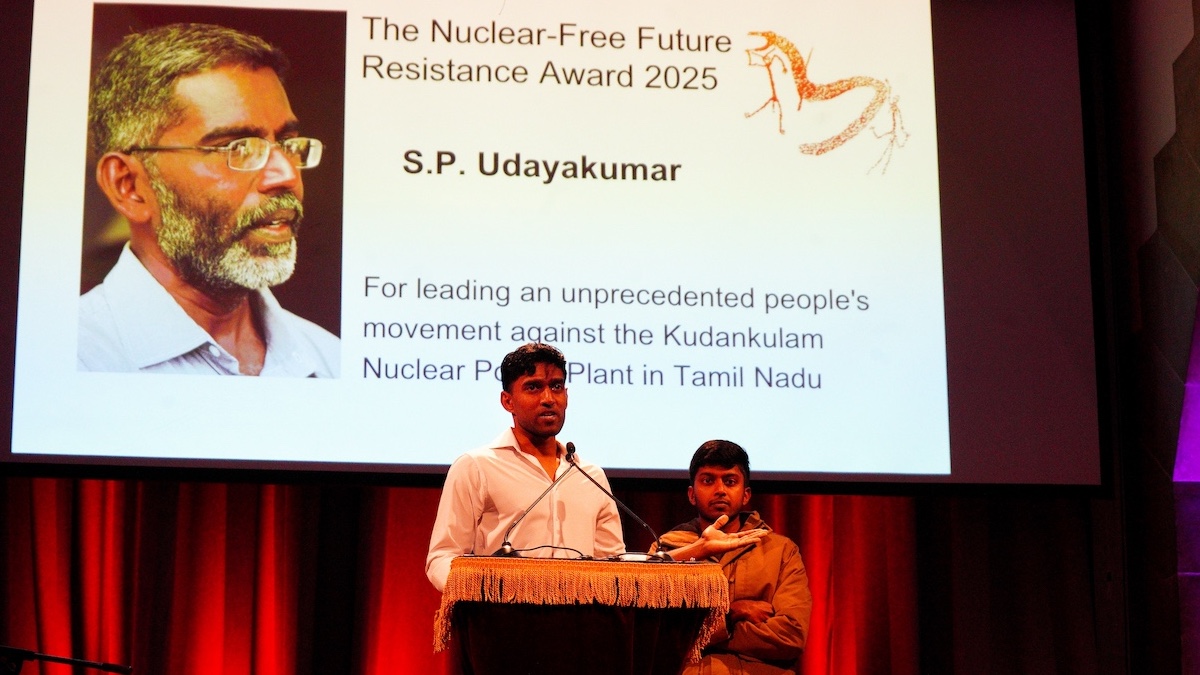
S.P. Udayakumar and thousands of other Indian activists challenged a Russian nuclear plant
S.P. Udayakumar was awarded the 2025 Nuclear-Free Future Award for resistance. Owing to visa constraints he was not able to be present in New York City, where the Awards ceremony was held, to accept his prize in person. He delivered these remarks via a video recording, which was met with prolonged applause. We reproduce his speech here. (A report and photos of the 2025 Nuclear-Free Future Awards ceremony, was published last week.)
I am extremely happy and immensely grateful that the Nuclear-Free Future Awards family that includes Beyond Nuclear, IPPNW and the international jury have chosen me and our struggle for the 2025 “Nuclear-Free Future” Award in the resistance category.
Tens of thousands of people including children, youth, women and men are struggling against the Russian-supplied Koodankulam Nuclear Power Project near the southernmost tip of India. Several people have sacrificed their lives, scores of people have gone to prison, so many of us have braved police harassment, State surveillance, court cases, property losses, income deprivation, and umpteen number of various difficulties.
Lots and lots of religious leaders, community leaders, political leaders, lawyers, film personalities, intellectuals, writers, publishers, poets, artists, media persons, international human rights activists, even some conscientious government officials, police officers and the general public from all over Tamil Nadu and the larger India have contributed significantly to this 2011-2014 phase of a much longer struggle.
I know that you cannot honor all the people who have taken part in our struggle and that I have been chosen as a representative of all of them. On behalf of all those thousands and thousands of fellow protesters, I humbly accept this great award. Thank you!
Although I am disappointed that I could not be with you all this evening and accept this award in the hall where the ‘Great Emancipator’ President Abraham Lincoln’s voice had once reverberated, I am glad that my sons, who had to undergo so much suffering, are receiving this award from you and celebrating this timely and important recognition of our people and the struggle.
The struggle against the Koodankulam nuclear power project began back in 1988 right after the Chernobyl accident in April 1986. The government of India has adopted the 4-I strategy of Ignore, Insult, Intimidate and Incinerate. We were totally ignored when we asked for the basic information about the project, such as the detailed project report, environmental impact assessment, site evaluation study, safety analysis report etc. When we persisted with our campaign, we were called all kinds of names, that we were anti-Indian, anti-national, foreign-funded, American stooges, left-wing radicals and so forth.
When we still pressed ahead with our campaign, the State came down upon us heavily with 349 cases with very serious charges, including sedition, waging war on the state, attempt to murder and so on. We are attending court hearings even now. Our passports have been impounded, bank accounts frozen, ‘Look Out Circular’ issued, our properties vandalized, and we are still being treated as dangerous criminals.
We were physically attacked when we went for a dialogue with government officials, several of us were imprisoned for months together, and a few of us were shot to death by police, and killed by low-flying coastguard planes, and prison negligence etc.
Because of all this highhanded behavior of the State, the concerted campaign was ended in 2014 but we have been propagating our anti-nuclear messages to the people of India through peaceful and democratic means.
Our messages are simple and straightforward:
Nuclear power is NOT cheap, or safe, or clean, or climate-friendly.
Nuclear power and nuclear bomb are both sides of the same coin. Nuclear reactors are stationary bombs and nuclear bombs are moving reactors.
Nuclear power is not suitable for a country like India that is highly and densely-populated. As you all know, the world’s worst industrial disaster took place in the Union Carbide pesticide plant in Bhopal in December 1984. The debilitating chemical waste of the Bhopal gas disaster has just been removed after 40 long years.
Both nationally and internationally, the nuclear hawks and hawkers promote nuclear power as THE answer for climate destruction. But consider the amount of carbon-emitting power that is used for uranium mining, milling, reactor construction (with thousands of tons of steel and cement over 20-30 years of construction), reactor operation for 40-60 years, decommissioning, waste management and so forth! Can anyone honestly claim that nuclear power is the answer for climate destruction? Even if it was, can poisoned earth be the answer for polluted air? How are we going to deal with the dangerous nuclear wastes for the next 48,000 years?
Nuclearism is part and parcel of profiteering globalism. The India-US nuclear deal is not about India’s energy security, or national security or safeguarding India’s growth and development. This deal is a naked corporate business deal which will bring humongous profits to a few American corporate houses. Similarly, the nuclear deals that India has signed with Russia, France, Kazakhstan, Namibia, Argentina, and others will bring profits and prosperity to these countries’ corporate houses but will result in disaster and destruction for the poor in India. Yes, desire for profit, power, and prominence drives the nuclear industry.
On the other hand, it is hate, fear and recklessness that fuel this very industry. Some countries’ revision of nuclear doctrines, refusal to extend nuclear arms treaties, rising weapons count, continuing Uranium enrichment, constant testing, actual threat to use nuclear bombs, and several wars around the world poised to reach a “nuclear threshold” foretell the precarious situation of our global society today. Yes, Nuclearism and Fascism are inter-related. Fascism is the ideology behind Nuclearism and Nuclearism is the penultimate expression of Fascism.
When all is said and done, this beautiful planet of ours, the Earth, can be likened to a humongous commercial airplane with clear class divisions, limited supply of resources, lopsided opportunity structures, and unbalanced entitlement arrangements, etc. And this plane of ours has been hijacked by the P-5 and the other nuclear States such as Israel, India, Pakistan, North Korea and who knows who else?
The great poet, Robert Frost had predicted back in 1920:
Some say the world will end in fire,
Some say in ice.
From what I’ve tasted of desire
I hold with those who favor fire.
But if it had to perish twice,
I think I know enough of hate
To say that for destruction ice
Is also great
And would suffice.
The delegates of the Third Meeting of States Parties (3MSP) to the Treaty on the Prohibition of Nuclear Weapons (TPNW) who are meeting in New York City right now have a tough task ahead. We wish them all the best!
And let us continue to strive for a nuclear-free future that will have No Deals, No Mines, No Reactors, No Dumps, and No Bombs! Nowhere in the world!!
To quote my favorite Robert Frost again:
Woods are lovely, dark and deep,
But we have promises to keep!
And miles to go before we sleep,
And miles to go before we sleep!
Alert! Attack on No New Nukes Bans – Help push back!

A California and Nationwide Industry Assault on Nuclear Moratoriums
Apr 11, 2025, By Mary Beth Brangan, James Heddle – EON
Attempt to Reverse 1976 Moratorium
Despite multiple earthquake faults surrounding the three California nuclear reactor coastal sites harboring huge amounts of radioactive waste in tsunami zones, with no plan to deal with the tons of waste, a bill has been introduced in the state Assembly to increase nuclear use in our state. This also despite the devastating fires that occur regularly in California increasing the already staggering risks of nuclear reactors and the lethal long lived waste they produce.
Assemblymember Dr. Juaquin Arambula (D – Fresno) with main co-sponsors Assemblymember Diane Dixon (R – Orange) and Assemblymember Josh Hoover (R- Sacramento) introduced AB 305 . It would overturn California’s longstanding nuclear moratorium to allow for the construction of Small Modular Reactors (SMRs).
Nuclear Recidivism – Not Only In California
This is part of a national and international pattern. Recidivist nuclear revival forces have mounted coordinated national rollback efforts on state’s prohibitions on building new nuclear plants. Push for new nuclear build outs is happening through the Governor’s Association, as if it were ALEC. Pro-nuclear consortia are being formed with clusters of 10 states as a group.
On the international level, plans to decommission 7 nuclear plants in Spain, for instance, are also being rolled back. There activists are using our documentary SOS, The San Onofre Syndrome: Nuclear Power’s Legacy, in their efforts to ensure they are shut down and not given extended licenses, such as happened here in California with Diablo Canyon.
The underlying motivation is to attempt to rescue a failing nuclear power industry because it supports the infrastructure of research, education and labor force training for nuclear weapons production. Tritium, for instance, is a need. A ‘dual-use’ motivation is to provide power for the immensely energy guzzling Generative AI centers proliferating like weeds as key components in a planned social perception and population control grid. This is part of the agenda of the ruling elites who intend to destroy our old governmental structure of representational democracy and replace it with their transhumanist, technocratic vision.
As of December 11, 2024, 9 states still had nuclear moratoriums. Four states have already repealed moratoriums that had previously been in place:
- Wisconsin (2016)
- Kentucky (2017)
- Montana (2021)
- West Virginia (2022)
Activists in Oregon are mounting a huge fight to protect their moratorium.
We in California must join together to stop the insanity of producing more lethal radioactive waste lasting hundreds of thousands to many millions of years without any idea of how to keep it from ruining all life on earth.
Please Join Others in Taking Action!
Send letters of opposition by Tuesday, April 15!………………………………..https://planetarianperspectives.substack.com/p/alert-help-push-back-against-attack
Saudi Arabia, US on ‘pathway’ to civil nuclear agreement, US Energy Secretary says

The United States and Saudi Arabia will sign a preliminary agreement to cooperate over the kingdom’s ambitions to develop a civil nuclear industry, U.S. Energy Secretary Chris Wright told reporters in the Saudi capital
Riyadh on Sunday.
Wright, who had met with Saudi Energy Minister Prince
Abdulaziz bin Salman earlier on Sunday, said Riyadh and Washington were on a “a pathway” to reaching an agreement to work together to develop a Saudi
civil nuclear programme.
Reuters 13th April 2025 https://www.reuters.com/world/saudi-arabia-us-pathway-civil-nuclear-agreement-us-energy-secretary-says-2025-04-13/
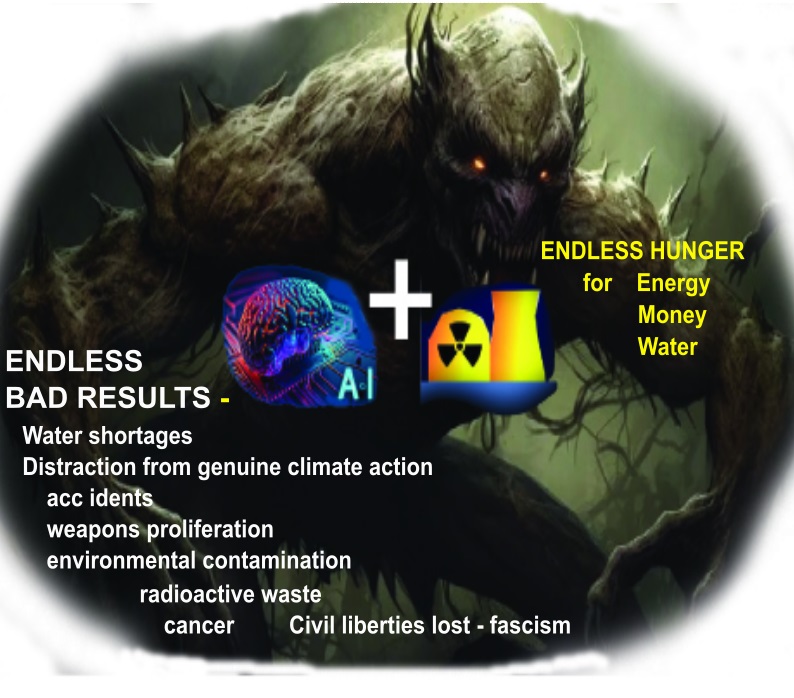
California Nuclear Plant Integrates AI for Efficiency
Oil Price By Haley Zaremba – Apr 13, 2025,
- The Diablo Canyon nuclear power plant in California is utilizing AI technology to improve the efficiency of its document retrieval processes, aiming to reduce the time and resources spent on managing technical documentation.
- While the initial use of AI is limited to document retrieval, there are concerns among lawmakers and watchdogs regarding the potential for broader automation and the safety implications within a nuclear setting.
- The convergence of nuclear energy and AI is being driven by the increasing energy demands of data centers, with tech leaders and the federal government exploring the symbiotic relationship between these technologies for future energy solutions.
……………………………………………………………………………………………………………………lawmakers are very concerned about what the introduction of artificial intelligence into nuclear power production could mean for the future, and are pushing for more concrete guardrails. However, under the Trump administration, such parameters may not be forthcoming. Trump has already walked back a Biden-era ??executive order outlining goals for AI regulation, which the current administration sees as anti-innovation.
While there is little risk in the use of AI for document retrieval, there is concern about what comes next.
“The idea that you could just use generative AI for one specific kind of task at the nuclear power plant and then call it a day, I don’t really trust that it would stop there,” Tamara Kneese, the director of tech policy nonprofit Data & Society’s Climate, Technology, and Justice program, was recently quoted by Cal Matters. “And trusting PG&E to safely use generative AI in a nuclear setting is something that is deserving of more scrutiny.”
Nuclear energy and AI have become increasingly entangled as the runaway energy demand growth of data centers has threatened domestic energy security as well as Silicon Valley’s decarbonization goals. Tech bigwigs like Bill Gates and Sam Altman have increasingly touted nuclear energy as a carbon-free solution to meeting AI’s fast-growing energy demand, and have even envisioned a symbiotic relationship between nuclear and AI, wherein machine learning can help plan and design more efficient and cost-effective next-gen power plants.
The federal government has also pushed this angle. The U.S. Department of Energy recently identified 16 federal sites that ??are “uniquely positioned for rapid data center construction, including in-place energy infrastructure with the ability to fast-track permitting for new energy generation such as nuclear.” https://oilprice.com/Alternative-Energy/Nuclear-Power/California-Nuclear-Plant-Integrates-AI-for-Efficiency.html
Kyiv working to repair Chornobyl nuclear site damaged by drone attack
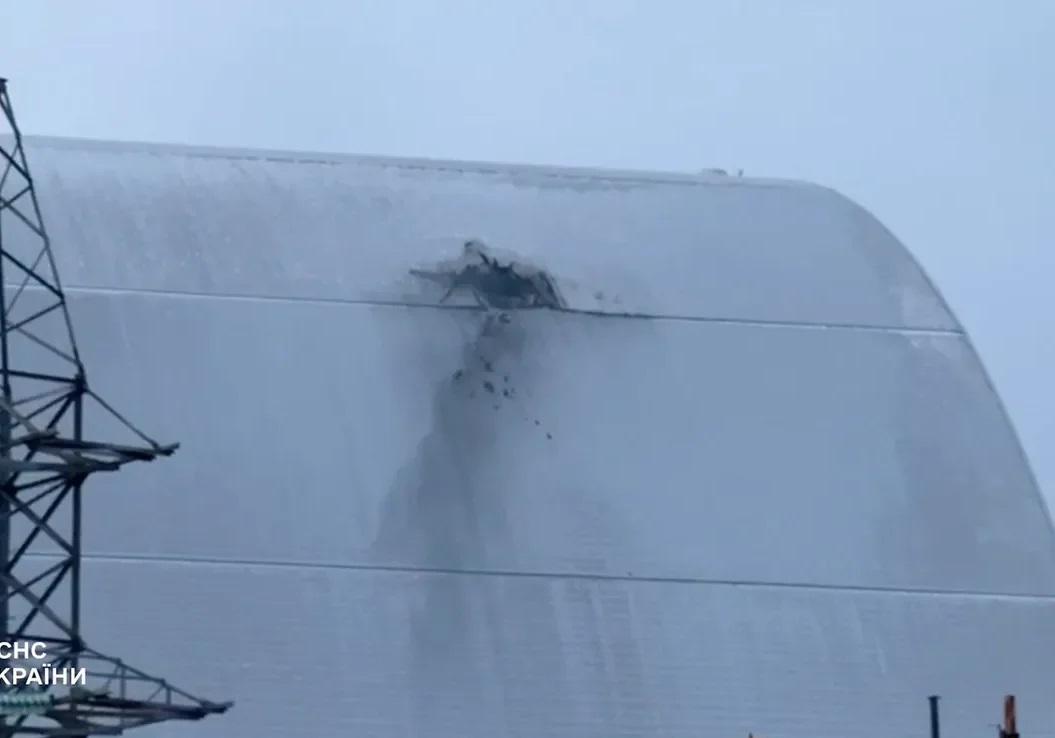
Environment minister says experts ‘actively working’ to prevent leaks in wake of February attack.
Ukraine is seeking solutions to repair the damage caused by a Russian drone attack to the
confinement vessel at the stricken Chornobyl nuclear power plant, a
government minister said on Saturday. Environment minister Svitlana
Hrynchuk said Ukraine was working together with experts to determine the
best way to restore the proper functioning of the containment vessel, or
arch, after the 14 February drone strike.
“We are actively working on
this … We, of course, need to restore the ‘arch’ so that there are no
leaks under any circumstances, because ensuring nuclear and radiation
safety is the main task,” she said. The arch was installed in 2019 to
cover the leaking “sarcophagus” underneath, hurriedly put in place in
the weeks following the 1986 Chornobyl disaster. The February drone attack
punched a large hole in the new containment structure’s outer cover and
exploded inside.
Guardian 13th April 2025,
https://www.theguardian.com/world/2025/apr/13/ukraine-war-briefing-kyiv-working-to-repair-chornobyl-nuclear-site-damaged-by-russian-attack
Moltex Canada pushes on with nuclear project as U.K. parent struggles

Matthew McClearn, Globe and Mail, Toronto, 14 Apr 25
The British owner of New Brunswick small modular nuclear reactor developer Moltex Energy Canada Inc. is up for sale as part of a U.K. insolvency proceeding.
Moltex Energy Ltd., a private company based in Stratford-upon-Avon, announced last month the appointment of two insolvency practitioners from accounting firm Azets Holdings Ltd. to manageitsaffairs. Azets hired appraisers Hilco Valuation Services to solicit offers for its assets, which are due May 7.
It’s the latest complication fortaxpayer-sponsored efforts to construct small modular reactors, or SMRs, in New Brunswick.
Moltex’s wholly owned Canadian subsidiary is one of two vendors partnered with New Brunswick Power to build reactors at Point Lepreau Nuclear Generating Station. Moltex Canada’s is known as the Stable Salt Reactor-Wasteburner (SSR-W), and it’s also developing a plant to reprocess spent nuclear fuel. The second company, ARC Clean Technology, is working on another reactor called the ARC-100.
Both were originally promised by 2030. But developing a novel nuclear reactor is a painstaking, resource-intensive process that can require hundreds of employees, billions of dollars and decades of effort. New Brunswick and the federal government backed startups with only one or two dozen employees, and they’ve struggled to raise funds privately.
Moltex’s British holding company was founded in 2014 by Ian Scott, who previously worked in the biological-sciences field including as a senior scientist at Unilever PLC. (A co-founder, John Durham, stepped down as a director in October.) According to its latest financial report, published in January, it employed two people during the year ended March 31, 2024, and lost £630,000 (about $1.1-million). For several years its reports raised uncertainty about its ability to continue as a going concern.
Britain’s administration process is similar to proceedings under Canada’s Companies’ Creditors Arrangement Act; according to the British government, it’s intended to provide “breathing space” while a rescue package or sale of assets is executed.
According to Moltex Energy Ltd.’s financial statements, its shareholders had provided its equity throughout its history; it carried no long-term debt. The company reported in 2023 that its future depended on raising external capital; it had enough cash flow to survive through December, 2025, albeit “there would need to be cuts.”
Rory O’Sullivan, chief executive officer of Moltex Energy Canada, was also a director of the parent company for much of the past several years. He said the British company’s shareholders would not approve the Canadian subsidiary’s fundraising efforts, effectively stalling them.
“The key here is we needed to get someone else in control of Moltex Energy Ltd. so that we could have a competitive sale process,” Mr. O’Sullivan said…………………………..
New Brunswick’s government attracted Moltex and ARC to establish offices in the province in 2018. The two companies have each estimated that it would cost around $500-million to develop their respective technologies…………………………
As for ARC, its CEO and other employees suddenly departed last summer; ARC has published no announcements on its website since then. The ARC-100 is undergoing a prelicensing review by the Canadian Nuclear Safety Commission. Spokesperson Sandra Donnelly said the company will complete its design by 2027 to support an application for a construction licence.
NB Power’s CEO, Lori Clark, presented SMRs as playing a crucial role in her utility’s plans to achieve “net zero” emissions. More recently, however, she acknowledged that neither project is likely to follow its original schedule, and the utility is now considering other reactors for construction at Point Lepreau.
Spokesperson Dominique Couture wrote in a statement that NB Power has been working on an environmental impact assessment for the ARC-100 during the past year. And it assisted Moltex’s development efforts for reprocessing spent fuel.
All this is far less than what the federal government envisioned in the SMR Roadmap, a 2018 document developed with extensive input from the nuclear industry. It promised demonstration projects across the country; successive federal budgets allocated hundreds of millions of dollars to support them.
Canadian Nuclear Laboratories was to have an SMR called the Micro Modular Reactor up and running at its Chalk River facility by 2026. But its partner in that project, Ultra Safe Nuclear Corp., initiated a court-supervised sale process under Chapter 11 of the U.S. Bankruptcy Code in October. Another partner, Ontario Power Generation, pulled out last year.
Of the demonstration projects contemplated in the SMR Roadmap, only one appears to be on track: OPG’s proposal to build a “grid-scale” SMR at its Darlington Station. This month it received a construction licence from the CNSC to build its first reactor, a BWRX-300 designed by U.S. vendor GE-Hitachi Nuclear Energy. If completed on schedule by 2028, it would be the first SMR in any G7 country. https://www.theglobeandmail.com/business/article-moltex-canada-pushes-on-with-nuclear-project-as-uk-parent-struggles/#comments
Iran says ‘indirect talks’ have taken place with US over nuclear programme – with more to follow

The talks come after US President Donald Trump warned Iran it would be in “great danger” if a deal wasn’t reached between the two countries.
Sky News 1 13 April 2025
The discussions on Saturday took place in Muscat, Oman, with the host nation’s officials mediating between representatives of Iran and the US, who were seated in separate rooms, according to Esmail Baghaei, a spokesperson for Iran’s foreign ministry.
After the meeting, Oman’s foreign minister Sayyid Badr Albusaidi thanked Iran’s foreign minister Abbas Araghchi and US Middle East envoy Steve Witkoff for joining the negotiations aimed at “global peace, security and stability”, in an X post.
“We will continue to work together and put further efforts to assist in arriving at this goal,” he added.
‘Very positive’ and ‘constructive’
Iranian state media claimed the US and Iranian officials “briefly spoke in the presence of the Omani foreign minister” at the end of the talks – a claim Mr Araghchi echoed in a statement on Telegram.
He said the talks took place in a “constructive atmosphere based on mutual respect” and that they would continue next week.
Speaking on board Air Force One on Saturday US President Donald Trump said the “talks are going okay”……………………………………………………..
Reuters news agency said an Omani source told it the talks were focused on de-escalating regional tensions, prisoner exchanges and limited agreements to ease sanctions in exchange for controlling Iran’s nuclear programme.
‘Great danger’ if talks fail
Donald Trump has insisted Tehran cannot get nuclear weapons.
He said on Monday the talks would be direct, but Tehran officials insisted it would be conducted through an intermediary.
Mr Trump also warned Iran would be in “great danger” if negotiations fail…………….
He added Iran “cannot have a nuclear weapon, and if the talks aren’t successful, I actually think it will be a very bad day for Iran”.
The comments came after Mr Trump’s previous warnings of possible military action against Iran if there is no deal over its nuclear programme. https://news.sky.com/story/iran-says-indirect-talks-taking-place-with-us-over-nuclear-programme-13347051
Ukraine is seeking solutions to the Chernobyl nuclear reactor’s damaged confinement vessel .
Ukraine is seeking solutions to repair the damage caused by a Russian
drone attack to the confinement vessel at the stricken Chornobyl nuclear
power plant, a government minister said on Saturday. Minister of
Environmental Protection and Natural Resources Svitlana Hrynchuk was
speaking outside the decommissioned station during the inauguration of a
0.8-megawatt solar power facility ahead of two conferences due to discuss
Chornobyl and other issues related to nuclear power operations.
Reuters 12th April 2025, https://www.reuters.com/world/europe/ukraine-seeking-solutions-damaged-chernobyl-confinement-vessel-minister-says-2025-04-12/
Ambassador does not deny Russian attempts to track UK subs
Alys Davies BBC 12th April 2025
Russia’s ambassador to the UK has not denied allegations that Russian sensors have been hidden in seas around Great Britain in an attempt to track UK nuclear submarines.
Andrei Kelin said that while he did not deny Russia was attempting to track British submarines, he rejected the idea that such activities presented a threat to the UK.
Asked on BBC One’s Sunday with Laura Kuenssberg whether he objected to the claims, Kelin said: “No”.
“I am not going to deny it, but I wonder whether we really have an interest in following all the British submarine with very old outdated nuclear warheads… all these threats are extremely exaggerated,” he said.
Pressed further by Kuenssberg, the ambassador added: “I’m denying existence of threats for the United Kingdom. This threat has been invented, absolutely, there is no threat at all from Russia to the UK.”
Kelin’s admission follows an investigation published by the Sunday Times earlier this month, detailing the discovery of alleged Russian sensors in seas around Britain.
In its investigation, the Sunday Times said the devices are believed to have been planted by Moscow to try to gather intelligence on the UK’s four Vanguard submarines, which carry nuclear missiles……………………………………………………………………………………..
https://www.bbc.co.uk/news/articles/c5yl2729nmjo
Nuclear waste sparks fury in Germany

Staff Writer April 4, 2025,
https://www.neimagazine.com/news/nuclear-waste-returned-to-germany-amid-protests/
The Pacific Grebe, a specialist nuclear transport vessel carrying radioactive nuclear waste from the UK, was met by anti-nuclear activists when it arrived at Nordenham port in north-western Germany. The nuclear waste was the result of reprocessing fuel elements from decommissioned German NPPs at the UK’s Sellafield site.
This was the second of three planned shipments. Seven flasks containing high level waste (HLW) were transported by rail from the Sellafield site in West Cumbria to the port of Barrow-in-Furness, where they were then loaded onto the Pacific Grebe, operated by Nuclear Transport Solutions (NTS).
Vitrified Residue Returns (VRR) are a key component of the UK’s strategy to repatriate HLW from the Sellafield site, fulfilling overseas contracts. The first shipment of six flasks each with 28 containers of HLW to Biblis took place in 2020.
he Pacific Grebe, a specialist nuclear transport vessel carrying radioactive nuclear waste from the UK, was met by anti-nuclear activists when it arrived at Nordenham port in north-western Germany. The nuclear waste was the result of reprocessing fuel elements from decommissioned German NPPs at the UK’s Sellafield site.
This was the second of three planned shipments. Seven flasks containing high level waste (HLW) were transported by rail from the Sellafield site in West Cumbria to the port of Barrow-in-Furness, where they were then loaded onto the Pacific Grebe, operated by Nuclear Transport Solutions (NTS).
Vitrified Residue Returns (VRR) are a key component of the UK’s strategy to repatriate HLW from the Sellafield site, fulfilling overseas contracts. The first shipment of six flasks each with 28 containers of HLW to Biblis took place in 2020.
According to Germany’s Federal Office for the Safety of Nuclear Waste Management (BASE – Bundesamt für die Sicherheit der nuklearen Entsorgung)) the transport licence for the latest shipment was approved in December. Until 2005 German utilities shipped used fuel from NPPs to La Hague in France and Sellafield in the UK for reprocessing: “The resulting liquid waste was then melted down into glass and has since been gradually returned to Germany,” BASE noted. “The last shipment of this waste from France was returned in November 2024.” There is one more shipment planned, after the current one, from the UK to complete the repatriation.”
BASE issued a licence in April 2023 for the storage of the vitrified waste at the Isar interim storage facility, which is licensed to hold a maximum of 152 casks of high-level radioactive waste and “according to current plans, there will be 28 fewer high-level waste casks there than originally intended, including the casks containing the vitrified waste”.
According to Germany’s Society for Nuclear Service (GNS – Gesellschaft für Nuklear‑Service), “The waste is massively shielded from external radiation. In the reprocessing plant, the waste is mixed with liquid silicate glass and poured into cylindrical stainless-steel containers, which are then sealed tightly after hardening. These containers, filled with the hardened glass mixture, are called “glass moulds”. For transport and storage, the moulds are placed in … massive, more than 100-tonne cast iron and stainless-steel containers, which have been proven in extensive tests to provide both strong shielding and to be safe under extreme conditions.”
Until 2011 reprocessed waste was sent to the Gorleben interim storage facility in Lower Saxony, where 108 casks of vitrified radioactive waste have been stored, which was “already a large proportion of the total waste to be returned from reprocessing”. BASE said, as part of the Site Selection Act of 2013 to seek a repository for high-level radioactive waste, the remaining vitrified waste abroad was to be stored in interim storage facilities at nuclear power plant sites.
“The aim was to avoid giving the impression that Gorleben had already been chosen as the site for a final storage facility during the open-ended search for a repository site. In 2015, the federal government, the federal states and the utility companies agreed to store the remaining radioactive waste in Biblis, Brokdorf, Niederaichbach (Isar NPP) and Philippsburg,” BASE noted.
France’s Orano completed the 13th and final rail shipment from France of vitrified high-level nuclear waste, to Philippsburg, in Germany in November 2024. In total 5,310 tonnes of German used fuel was processed at Orano’s La Hague plant up to 2008.
The latest shipment of waste from Sellafield is due to be transported to the interim storage facility at the site of the former Niederaichbach NPP in southern Bavaria. The Niederaichbach heavy water gas cooled reactor operated for only 18 months from 1972-1973. From 1975 to 1995 the plant was demolished and the site returned to greenfield condition. A monument marks its former location near the closed Isar NPP.
Germany’s Federal Company for Radioactive Waste Disposal (BGE – Bundesgesellschaft für Endlagerung) is in the process of identifying a suitable location for the permanent underground storage for 27,000 cubic metres of nuclear waste produced over the course of 60 years of German nuclear energy production.
On arrival at Nordenham port, the seven castor containers were transferred by crane from the Pacific Grebe to a train in the harbour, where tests were carried out to ensure legal radiation limits were not exceeded. The containers each measure four metres in length and weigh over 100 tonnes.
The train’s route to the Isar storage facility is not being publicised for security reasons.
Further protests are planned along the presumed route of the train over the coming days, including in the cities of Bremen and Göttingen. “Every castor transport is one too many because it only postpones the problem and does not solve it,” Kerstin Rudek, a spokesperson for the group Castor-Stoppen, said in a statement, adding that nuclear waste should not be moved until a safe, final storage location is determined.
1 This Month

of the week – Shut Down Drone Warfare!


Tell the Ukrainian Government to Drop Prosecution of Peace Activist Yurii Sheliazhenko

Petition to revoke the licensing of the Near Surface Nuclear Disposal Facility (NSDF) at Chalk River. https://www.ourcommons.ca/petitions/en/Petition/Details?Petition=e-7247
To see nuclear-related stories in greater depth and intensity – go to https://nuclearinformation.wordpress.com
-
Archives
- April 2026 (114)
- March 2026 (251)
- February 2026 (268)
- January 2026 (308)
- December 2025 (358)
- November 2025 (359)
- October 2025 (376)
- September 2025 (257)
- August 2025 (319)
- July 2025 (230)
- June 2025 (348)
- May 2025 (261)
-
Categories
- 1
- 1 NUCLEAR ISSUES
- business and costs
- climate change
- culture and arts
- ENERGY
- environment
- health
- history
- indigenous issues
- Legal
- marketing of nuclear
- media
- opposition to nuclear
- PERSONAL STORIES
- politics
- politics international
- Religion and ethics
- safety
- secrets,lies and civil liberties
- spinbuster
- technology
- Uranium
- wastes
- weapons and war
- Women
- 2 WORLD
- ACTION
- AFRICA
- Atrocities
- AUSTRALIA
- Christina's notes
- Christina's themes
- culture and arts
- Events
- Fuk 2022
- Fuk 2023
- Fukushima 2017
- Fukushima 2018
- fukushima 2019
- Fukushima 2020
- Fukushima 2021
- general
- global warming
- Humour (God we need it)
- Nuclear
- RARE EARTHS
- Reference
- resources – print
- Resources -audiovicual
- Weekly Newsletter
- World
- World Nuclear
- YouTube
-
RSS
Entries RSS
Comments RSS
 nuclear-news