Inside the New Mexico lab where the U.S. is moving into the most terrifying chapter of the nuclear arms race
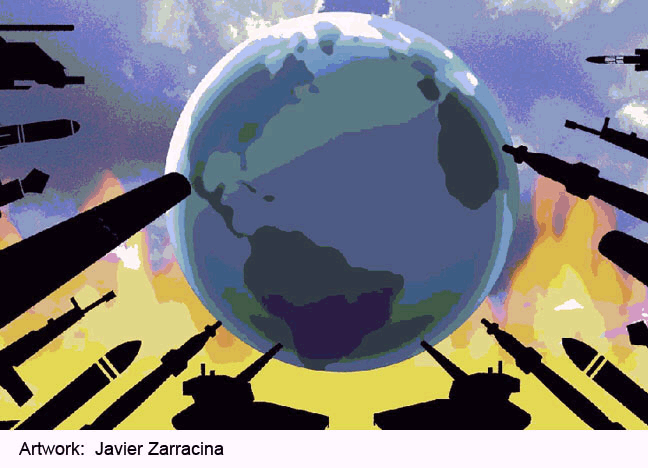
By JAMES REINL, 13 Apr 25, https://www.dailymail.co.uk/news/article-14597065/activity-new-mexico-lab-nuclear-arms-race.html
It weighs just 824lbs, but packs enough plutonium to vaporize a city center and kill and maim three million people in the blink of an eye.
Scarier still, production of America’s new B61-13 gravity bomb is seven months ahead of schedule, as scientists speed up work at their laboratory in the New Mexico desert.
The timeline was moved up due to the ‘critical challenge and urgent need’ for a new nuclear deterrent. It is 24 times more powerful than the atom bomb that levelled Hiroshima, Japan, in 1945.

00:33
02:24
Read More
They speak of an ‘urgent need’ for the new super-nuke, as everywhere from Russia to China, North Korea and even Britain boost their stockpiles of warheads.
Nuclear arms watchers say that, while overall global inventories have fallen since the Cold War, the number of warheads deployed for combat readiness is on the rise once again.
For some, this new nuclear arms race is scarier than when America and the Soviet Union built enough nukes to wipe out mankind many times over in the years after World War II.
That’s down to the wide array of states that possess the weapons now — which includes India, Pakistan, and, reputedly, Israel — and as a multipolar balance of power emerges.
As the US Trump administration slights its allies in Europe and Asia, the club of nine nuclear powers looks set to expand, perhaps quickly, and grow even more unwieldy.
In recent months, officials from Germany to Poland, South Korea, Japan, and Saudi Arabia have broken the nuclear taboo and spoken about acquiring nukes, or related technology.
Meanwhile, Iran’s religious hardliners have been spinning their uranium centrifuges in secret for years.
Joseph Cirincione, a national security analyst who advised the State Department in the Obama administration, warns of a ‘nuclear nightmare’ of more European nations going fissile.
‘Should they proceed, the spread of nuclear weapons would not be limited to Europe or our allies,’ says Cirincione.
‘The nuclear reaction chain could quickly spread to Asia, where Japan, South Korea and Taiwan face similar worries about the reliability of their defense agreements with America.’
This is all happening as US President Donald Trump slaps tariffs on nuclear-armed China, and many other big economies, in a trade war that’s raised tensions and roiled stock markets.
Scientists at Sandia National Laboratories in New Mexico recently said they were kickstarting development of the B61-13, a nuclear ‘gravity bomb’ that was originally slated to go into production for the US Air Force in 2026.
Gravity bombs are literally what they sound like, a bomb dropped from a warplane that lets gravity do all the work.
It would be dropped by the stealth B-21 Raider, and have a yield of as much as 360 kilotons, or 360,000 tons of TNT.
It would create a blast radius of roughly 190,000 feet, the length of two Manhattans.
If dropped over a city like Beijing, the B61-13 would likely leave some 788,000 people dead and 2.2 million injured.
Anything within a half-mile radius of the detonation site would be vaporized by the ensuing fireball, and the blast would demolish buildings and kill nearly everyone else within a mile.
Read More
Inside Trump’s bold plan to save America from a nuclear apocalypse… and what happens if it fails
Those within a two-mile radius of the blast site would also suffer from high levels of radiation that would likely kill them within a month.
Another 15 percent of the survivors would likely perish from cancer years down the line.
Currently, the US has some 5,044 nuclear warheads in its arsenal, with Russia being the only country that has more.
Together, they possess about 88 percent of all the world’s nuclear weapons.
The Federation of American Scientists says the US and Russia are bringing down the total number of nuclear weapons globally by dismantling their old, retired warheads.
But the number of warheads in global military stockpiles is actually increasing, says the group of atomic researchers.
Five nuclear-armed states — China, Pakistan, India, Israel, and North Korea — have all raised their nuclear stockpiles by more than 700 warheads these past 40 years.
Meanwhile, Russia’s invasion of Ukraine in 2023, and subsequent Western military aid to Kiev, stoked fears of a nuclear escalation.
Russian President Vladimir Putin in November lowered the threshold for Moscow’s use of its nuclear weapons.
Alarmed by this, the Bulletin of the Atomic Scientists in January moved their ‘Doomsday Clock’ closer to midnight than ever before.
The metaphorical timepiece is now at just 89 seconds before midnight — the theoretical point of annihilation.
Fears of a nuclear war come as such groups as the US National Nuclear Security Administration (NNSA) say work on a treaty to permanently ban nuclear testing has stalled, and Russia and China are adding buildings at their nuclear sites.
In February, the US government announced plans to restart its nuclear testing programs in secret underground facilities.
Fears of a nuclear war come as such groups as the US National Nuclear Security Administration (NNSA) say work on a treaty to permanently ban nuclear testing has stalled, and Russia and China are adding buildings at their nuclear sites.
In February, the US government announced plans to restart its nuclear testing programs in secret underground facilities.
In any case, the rise of China, which has some 600 nuclear warheads and is building more, complicates any negotiation process, as the nuclear arms race has more than two main players.
Former Russian president Dmitry Medvedev warned that more countries would get nuclear weapons in the coming years.
He blamed the West for pushing the world towards the brink of World War Three by waging a proxy war against Russia in Ukraine.
Trump has said the ‘power of nuclear weapons is crazy’ and supports a global effort to ‘denuclearize’ and has revived talks with Iran aimed at ending its bootleg nuclear program.
Iranian Foreign Minister Abbas Araqchi and US special envoy Steve Witkoff will meet in Oman on Saturday, after Trump threatened to bomb the Islamic Republic if discussions failed.
Yet Cirincione and others say the Trump administration is inadvertently making a global nuclear arms race more likely.
That’s because it is frosty toward long-standing US allies in Europe and Asia, including through the so-called ‘nuclear umbrella’ — a promise of nuclear protection in return for allies not seeking atomic weapons themselves.
From Berlin to Tokyo, alarm bells are ringing that Washington, the anchor of the Western security apparatus across Europe and Asia, is no longer a reliable guarantor of the ultimate deterrence offered by nuclear arms.
The clearest statement of nuclear intent has come from Donald Tusk, Poland‘s prime minister, who last month said the ‘profound change in American geopolitics’ has nudged Warsaw to seek ‘opportunities related to nuclear weapons.’
‘This is a serious race: a race for security, not for war,’ Tusk told Polish lawmakers.
Likewise, Friedrich Merz, the man who is set to be Germany’s next chancellor, said in February that it was time for Berlin to explore a ‘nuclear sharing’ deal with Britain and France.
Senior figures in South Korea, Japan, and Saudi Arabia, have also made statements about acquiring nuclear arms or technology.
Likewise, Taiwan, Turkey and Egypt, have declared no interest in acquiring a deterrent, but could well change tack if they lived in a neighborhood of nuclear states.
For many defense analysts, there is perhaps the greatest threat of proliferation beyond the nine nuclear states since the end of the Cold War.
‘Whether he meant it or not, Trump has sent a message that the US nuclear umbrella might one day be folded,’ a Western security source said last month.
‘Once a South Korea or a Germany signals that they’re going for the bomb, it will be hard indeed to stop others following suit.’
No comments yet.
1 This Month


Tell the Ukrainian Government to Drop Prosecution of Peace Activist Yurii Sheliazhenko

Petition to revoke the licensing of the Near Surface Nuclear Disposal Facility (NSDF) at Chalk River. https://www.ourcommons.ca/petitions/en/Petition/Details?Petition=e-7247


of the week – STOP SMALL MODULAR REACTORS IN CANADA
To see nuclear-related stories in greater depth and intensity – go to https://nuclearinformation.wordpress.com
-
Archives
- March 2026 (204)
- February 2026 (268)
- January 2026 (308)
- December 2025 (358)
- November 2025 (359)
- October 2025 (376)
- September 2025 (258)
- August 2025 (319)
- July 2025 (230)
- June 2025 (348)
- May 2025 (261)
- April 2025 (305)
-
Categories
- 1
- 1 NUCLEAR ISSUES
- business and costs
- climate change
- culture and arts
- ENERGY
- environment
- health
- history
- indigenous issues
- Legal
- marketing of nuclear
- media
- opposition to nuclear
- PERSONAL STORIES
- politics
- politics international
- Religion and ethics
- safety
- secrets,lies and civil liberties
- spinbuster
- technology
- Uranium
- wastes
- weapons and war
- Women
- 2 WORLD
- ACTION
- AFRICA
- Atrocities
- AUSTRALIA
- Christina's notes
- Christina's themes
- culture and arts
- Events
- Fuk 2022
- Fuk 2023
- Fukushima 2017
- Fukushima 2018
- fukushima 2019
- Fukushima 2020
- Fukushima 2021
- general
- global warming
- Humour (God we need it)
- Nuclear
- RARE EARTHS
- Reference
- resources – print
- Resources -audiovicual
- Weekly Newsletter
- World
- World Nuclear
- YouTube
-
RSS
Entries RSS
Comments RSS
 nuclear-news
Leave a comment