Recycling Nuclear Waste: A Win-Win or a Dangerous Gamble?
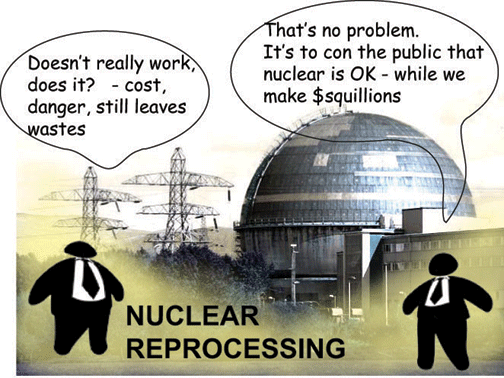
As interest in nuclear power rises, startups are pursuing plans to recycle spent fuel and reuse its untapped energy to power reactors. Advocates tout new recycling methods as a breakthrough, but many experts warn it will extract plutonium that could be used for nuclear weapons.
Yale Enevironment 360, By Rebecca Tuhus-Dubrow • April 2, 2025
Nuclear power plants keep their waste close by. Every nuclear plant in the United States includes an area onsite where spent fuel is being stored. This material — ceramic pellets stacked into rods and bundled together — consists mostly of uranium. But the spent fuel also includes elements that were created during the process: fast-decaying radionuclides such as cesium and strontium, as well as longer-lived, heavier elements, notably plutonium. Emanating intense heat and radiation, the spent fuel rods are placed first in cooling pools and then in “dry cask storage” — steel canisters that block these radioactive isotopes from escaping.
Most would see this legacy of radioactive waste as a burden and a danger. But some are now seeing it differently: as an asset and an opportunity. Although no longer capable of efficiently fissioning, spent fuel still contains significant amounts of untapped energy that can be harnessed and used again. In other words, it can be recycled — particularly in certain types of advanced reactors currently in development. Recycling would not only shrink the volume of radioactive material that would eventually need to be buried underground, advocates say, but it could also reduce the need to mine new uranium, another controversial aspect of the nuclear fuel cycle.
Recycling nuclear waste is probably the single biggest point of contention among people who otherwise support nuclear power.
It sounds like a win-win, as sensible as putting our aluminum cans in the bins with chasing arrows. And as interest in nuclear energy has grown in recent years — driven by climate concerns and, more recently, demand from energy-intensive data centers — so has enthusiasm in some quarters for recycling this waste stream. Late last year, the Department of Energy announced $10 million in funding for research on recycling technologies and at least two relevant bipartisan bills were introduced in Congress: one would “require the Secretary of Energy to study new technologies and opportunities for recycling spent nuclear fuel”; another would streamline licensing requirements for recycling facilities.
Several advanced nuclear startups, including Oklo and Curio, say they intend to run their reactors exclusively on spent fuel. Oklo, backed by OpenAI CEO Sam Altman and based in Santa Clara, California, is working toward building its first commercial unit at the Department of Energy’s Idaho National Laboratory. Jake DeWitte, Oklo’s CEO, told me, “Frankly, there’s enough energy content in the waste of today’s reactors to power the whole country for 150 years.”
In the last several years, while reporting a book on nuclear energy, I heard frequently from nuclear advocates about the possibility of recycling. It struck me as a promising solution that could mitigate several of the problems associated with nuclear power. But as I learned more, I realized that the concept, far from being a no-brainer, is intensely controversial — probably the single biggest point of contention among people who otherwise support nuclear power.
The fundamental issue is that reprocessing spent fuel involves extracting plutonium from fuel pellets. (Although the terms “reprocessing” and “recycling” are often used interchangeably, the former refers to separating out the usable material; the latter refers to deploying this material again in a reactor.) And nuclear nonproliferation experts are deeply concerned about any process that makes plutonium more accessible…………………………………..
Beyond proliferation concerns, there’s a host of other challenges, experts say. New waste streams are created along the way — everything that is touched during reprocessing, such as equipment, gets contaminated. And even after reprocessing, waste remains — the highly radioactive “fission products,” including cesium and strontium. …………………………………………………………………………………………………..
The greater concern is that nations, including those without nuclear weapons, could establish reprocessing facilities and use them to create bombs.
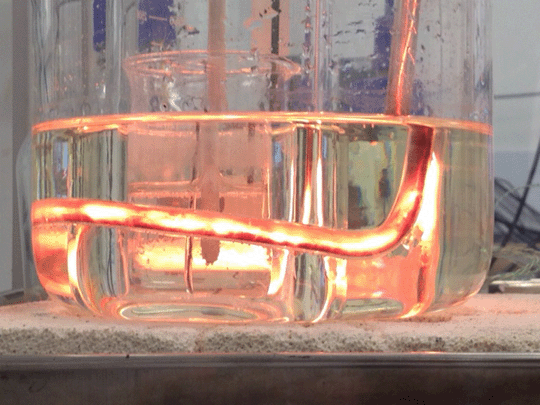
…………………………………………………………………..A crucial question is whether different reprocessing techniques can reduce the risks. Oklo is planning to use a technique called pyroprocessing, which was developed at Argonne National Laboratory, in Illinois, in the 1980s and 1990s, with the specific intention of reducing the proliferation risk……………..
………………. There is debate over how much pyroprocessing actually mitigates the risk. The finished product is still closer to weapons-usable than spent fuel that has not been reprocessed
…………..One expert worries that the prospect of recycling is being used to suggest that the nuclear waste problem is going to solve itself.…………………https://e360.yale.edu/features/nuclear-waste-recycling
No comments yet.
1 This Month

of the week – Shut Down Drone Warfare!


Tell the Ukrainian Government to Drop Prosecution of Peace Activist Yurii Sheliazhenko

Petition to revoke the licensing of the Near Surface Nuclear Disposal Facility (NSDF) at Chalk River. https://www.ourcommons.ca/petitions/en/Petition/Details?Petition=e-7247
To see nuclear-related stories in greater depth and intensity – go to https://nuclearinformation.wordpress.com
-
Archives
- April 2026 (68)
- March 2026 (251)
- February 2026 (268)
- January 2026 (308)
- December 2025 (358)
- November 2025 (359)
- October 2025 (376)
- September 2025 (257)
- August 2025 (319)
- July 2025 (230)
- June 2025 (348)
- May 2025 (261)
-
Categories
- 1
- 1 NUCLEAR ISSUES
- business and costs
- climate change
- culture and arts
- ENERGY
- environment
- health
- history
- indigenous issues
- Legal
- marketing of nuclear
- media
- opposition to nuclear
- PERSONAL STORIES
- politics
- politics international
- Religion and ethics
- safety
- secrets,lies and civil liberties
- spinbuster
- technology
- Uranium
- wastes
- weapons and war
- Women
- 2 WORLD
- ACTION
- AFRICA
- Atrocities
- AUSTRALIA
- Christina's notes
- Christina's themes
- culture and arts
- Events
- Fuk 2022
- Fuk 2023
- Fukushima 2017
- Fukushima 2018
- fukushima 2019
- Fukushima 2020
- Fukushima 2021
- general
- global warming
- Humour (God we need it)
- Nuclear
- RARE EARTHS
- Reference
- resources – print
- Resources -audiovicual
- Weekly Newsletter
- World
- World Nuclear
- YouTube
-
RSS
Entries RSS
Comments RSS
 nuclear-news
Leave a comment