Trump’s State Department Would Support Literally Any Israeli Atrocity
It’s clear that Trump’s State Department spokeswoman has been instructed to respond to any and all questions about Israeli atrocities in Gaza by blaming everything on Hamas, without even pretending to care whether the allegations are true.
For some background, Israel has just been caught perpetrating an atrocity so monstrous and so abundantly well-evidenced that even the mainstream western press have felt obligated to report on it. Outlets like the Guardian and the BBC are covering the story of how 15 medical workers for the Red Crescent, Civil Defense, and the UN were apparently handcuffed and executed one by one by Israeli forces in Rafah before being buried in a mass grave. According to Palestinian Civil Defense spokesman Mahmoud Basal, they were each shot more than 20 times.
(As an aside, the fact that Israeli forces have been known to bury the victims of their atrocities in order to hide the evidence is one of the many reasons why the official death toll from the Israeli onslaught in Gaza is definitely a massive undercount.)
Asked by the BBC’s Tom Bateman about these reports during a Monday press briefing, State Department spokeswoman Tammy Bruce responded by babbling about how evil Hamas is and how they are to blame for everything bad that happens in Gaza.
Here’s a transcript of the exchange:
Bateman: On Gaza, the UN’s Humanitarian Affairs Office has said that 15 paramedics, Civil Defense, and a UN worker were killed — in their words, one by one — by the IDF. They have dug bodies up, they said, in a shallow grave that have been gathered up, and also vehicles in the sand. Have you got any assessment of what might have happened? And given the potential use of American weapons, is there any assessment of whether or not this complied with international law?
Bruce: Well, I can tell you that for too long Hamas has abused civilian infrastructure, cynically using it to shield themselves. Hamas’s actions have caused humanitarians to be caught in the crossfire. The use of civilians or civilian objects to shield or impede military operations is itself a violation of international humanitarian law, and of course we expect all parties on the ground to comply with international humanitarian law.
Bateman: But there’s specifically a question on any — it’s a question about accounting and accountability given there may have been the use of U.S. weapons, so it’s a question about the State Department rather than Hamas. Is there any actions —
Bruce: Well, every single thing that is happening in Gaza is happening because of Hamas — every single dynamic. I’ll say again — I’ve said it, I think, in every briefing — all of this could stop in a moment if Hamas returned all the hostages and the hostage bodies they are still holding and put down its weapons. There is one — one entity that could stop it for everyone in a moment, and that is Hamas. This is — all loss of life is regrettable — it’s key, obviously — whoever it is, wherever they live. And this has been the nature of what fuels Secretary Rubio and President Trump in their willingness to expend this kind of capital early on in this term to make a difference and to change the situation. So I think that’s — that is the one thing that remains clear in all of this.
At no time does Bruce attempt to deny that the atrocity happened or cast doubt on the veracity of the claims, only justifying Israel’s actions by blaming Hamas. Again, this is a story about medical workers being handcuffed and then executed by gunfire.
Tammy Bruce does this constantly; she did it in response to two separate questions at a press conference last week. When asked about Israel’s assassination of Palestinian journalists Hossam Shabat and Mohammad Mansour, Bruce responded by babbling about October 7 and saying “every single thing that’s happening is a result of Hamas and its choices to drag that region down into a level of suffering that has been excruciating and has caused innumerable deaths.” When asked about the fact that people in Gaza have been unable to access clean drinking water under the Israeli siege, Bruce said, “Hamas did not perform to make sure that the ceasefire could continue, that they did not do what they said they would do. So we know, of course, when it comes to the ground water, of course, this is — it’s a crisis. It’s exacerbated by the fact that you have a terrorist group that just doesn’t care.
She did it again at a press conference the week before when asked by journalist Said Arikat if the State Department considers Israel’s use of siege warfare on a civilian population a war crime, saying “For the horrible suffering of the Gazan people, we know where that sits: it sits with Hamas,” adding that the people of Gaza “have been suffering because of the choices that Hamas has made throughout the years.”
Arikat, by the way, has just tweeted that on Monday he was not called on to ask a question for the first time in nearly 25 years of attending State Department press briefings. He is one of the very few reporters at the State Department who regularly asks challenging questions about US foreign policy.
Bavarian SMRs & Hydrogen Vans: What Could Possibly Go Wrong?
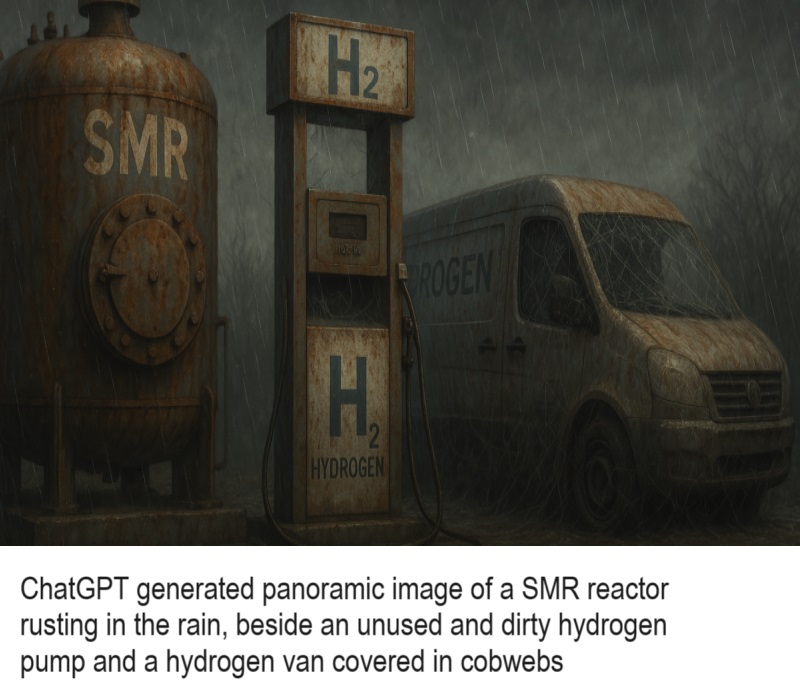
Michael Barnard https://cleantechnica.com/2025/04/01/bavarian-smrs-hydrogen-vans-what-could-possibly-go-wrong/
First Hydrogen Corp, a Canadian firm with more ambition than balance sheet, has now turned its sights on Germany — arguably the worst possible place to mix hydrogen hype with small modular nuclear reactors. The company, known mostly for a hydrogen van prototype and a team structure with more CEOs than engineers, is proposing a new strategy: use SMRs to produce hydrogen in Europe. Specifically, Germany.
The same Germany that just shut down its last nuclear plant, has strong anti-nuclear public
sentiment, and boasts some of the world’s most rigorous licensing hurdles for anything
remotely radioactive. As ideas go, this one isn’t just premature — it’s completely divorced from geopolitical, technological, and economic reality.
First Hydrogen’s European push is being channeled through its subsidiary, First Hydrogen
GmbH, an entity that appears to have been created to give the illusion of boots on the ground.
Back home, they’ve created First Nuclear Corp to drive this atomic angle, despite having no
nuclear licenses, no reactor designs, no partnerships with reactor vendors, and no market for
their product. The goal, supposedly, is to deploy SMRs to generate electricity that will then be
used to produce green hydrogen. This hydrogen would then presumably be used to fuel their
not-yet-commercial light commercial vehicles. Vehicles which, in independent UK trials,
consumed about 3.3 kilograms of hydrogen per 100 kilometers, making them far less efficient
than any battery-electric alternative, and certainly more expensive.
Let’s set aside for a moment the inconvenient truth that SMRs don’t exist yet in commercial
form. There are prototypes on paper, pilots under development, and timelines that stretch
comfortably into the late 2030s, assuming nothing goes wrong. But what’s really being
proposed here is to power a struggling hydrogen vehicle strategy with a non-existent nuclear
technology in a jurisdiction where nuclear projects are politically toxic and legally tangled. This is not a roadmap. It’s a Mad Libs of energy buzzwords.
Germany has made its stance on nuclear abundantly clear. After Fukushima, the country
committed to a complete nuclear phaseout, closing its last reactors in 2023. Public support for nuclear energy remains extremely low, and regulatory pathways for new nuclear builds are effectively blocked. That’s before we even get into the practicalities of siting, permitting,
insuring, and securing nuclear facilities in urban or semi-urban zones where hydrogen refueling infrastructure would plausibly be located. It’s like proposing to build a coal plant in the middle of Amsterdam to power electric scooters — technically possible, but politically suicidal and economically nonsensical.
But to understand why Germany is so allergic to nuclear, you have to understand the deeper
story of the Energiewende, Germany’s energy transition. It didn’t start in 2011 with Fukushima.
It started decades earlier, born out of a uniquely German mix of post-war anti-militarism,
environmental consciousness, and civic engagement. The anti-nuclear protests of the 1970s
weren’t fringe movements, they were formative. They helped shape political parties, most
notably the Greens, and built the cultural foundation for the country’s long-standing skepticism of nuclear energy. When Fukushima happened, it wasn’t a wake-up call for Germany, it was a confirmation of everything they already believed.
And here’s the thing: despite their nuclear exit, Germany has made enormous progress on
decarbonization. Their electricity mix now includes more than 50% from renewables,
dominated by wind and solar. They built the world’s largest solar industry (before China
undercut it), deployed tens of gigawatts of onshore and offshore wind, and invested heavily in grid infrastructure and storage. Per capita and against GDP, they emit far less CO₂ than most industrialized nations. Their carbon intensity of electricity has plummeted since the early 2000s, while industrial output remained robust. In short, Germany has done more of the hard work of decarbonization than most of its nuclear-hugging critics.
That doesn’t mean shutting down their nuclear plants was their best move. It wasn’t. Keeping
them online until their natural retirement age would have eased short-term energy price
spikes, especially during the Russian gas crunch. But the decision wasn’t made in a vacuum, and it wasn’t made by a government asleep at the wheel. It was the culmination of decades of cultural, environmental, and political alignment. If any country has earned the right to make that call, it’s the one that actually built a renewable-heavy grid and stuck with it through market ups and downs.
So for First Hydrogen to march into this context with a plan to pair nuclear technology Germany doesn’t want with hydrogen use cases it doesn’t need is more than tone-deaf, it’s
fundamentally incoherent. It misunderstands the culture, the policy, the economics, and the
actual energy system Germany has spent a generation building.
Then there’s the hydrogen problem itself. Hydrogen, for all its green branding, is an expensive
and inefficient energy carrier. Producing it via electrolysis requires vast amounts of electricity.
Storing it requires compression, liquefaction, or chemical conversion, all of which add cost and complexity. Transporting it is a logistical headache. Using it in vehicles loses 70 to 80% of the original energy. Add a nuclear reactor to the chain, and you’ve just stapled a megabucks solution to a kilobuck problem. It’s like powering your toaster with a jet engine. Sure, it works in
theory, but you’ll be out of money before the bread even gets warm.
And yet, if there’s one country where this kind of layered energy absurdity might get polite
applause instead of the deadpan stares it deserves, it’s Germany. Because while Germany has done many things right in its energy transition, it has also demonstrated a persistent, baffling irrationality when it comes to hydrogen.
This isn’t new. Michael Liebreich has been calling out the hydrogen hype for years. I’ve written
extensively about the groupthink — gruppendenken — that has gripped German energy policy circles, particularly in their obsession with hydrogen for end-use energy. Not for steelmaking or fertilizer — reasonable uses — but for heating buildings and driving cars and, now apparently, running vans on SMR-generated hydrogen. The evidence for this folly isn’t anecdotal, it’s in their modeling.
The dena-led Leitstudie Aufbruch Klimaneutralität (the German Energy Agency’s major
decarbonization pathway study) baked in hydrogen use at the end of every possible pipe. It
projected hydrogen-based heating, hydrogen transport, even hydrogen-based electricity
storage, despite the energy system losses stacking up like a Jenga tower made of burned
money. Similarly, the Prognos/PKI modeling , used in federal advisory processes, leaned heavily on magical hydrogen imports and vast, unexplained electrolysis buildouts, seemingly
unbothered by grid realities or cost curves.
These weren’t fringe speculations, they were foundational documents. Germany’s hydrogen
enthusiasm has created a policy environment where ideas that should be non-starters get
traction simply because they have the word wasserstoff in them. In that context, First
Hydrogen’s pitch to bring SMR-powered hydrogen production to Germany starts to make a
twisted kind of sense — not in physics, not in finance, but in the cultural logic of a country that,
for all its engineering rigor, still sometimes falls hard for the techno-utopianism of
overcomplicated solutions. It’s a country that earned its way to energy credibility with wind,
solar, and storage, and then occasionally turns around and tries to put a hydrogen jetpack on it for no good reason. So yes, the plan is absurd, but absurdity has a strange way of finding an audience where the right buzzwords meet the right policymaking blind spots.
And yet, First Hydrogen keeps raising small sums of money and announcing ever more
grandiose plans. In 2024, it closed tranches of convertible debentures amounting to a few
hundred thousand Canadian dollars, not enough to buy a single electrolyzer system, let alone fund a nuclear project. That’s on top of the roughly $9 million it has raised since 2020 which is supposed to fund a 35 MW electrolysis plant and a hydrogen delivery van manufacturing facility in Quebec as well.
The same company that hasn’t brought a product to market is now pitching itself as a future
builder of Europe’s nuclear-hydrogen infrastructure. The gap between vision and resources is
so wide you could drive their hydrogen prototype van through it and still have room for a
busload of skeptical engineers.
Balraj Mann, the founder, chair and CEO of First Hydrogen, had 20 firms he had founded,
owned, and was CEO of many of them when I looked at them a year ago. Now he’s added some more, and possibly has increased his $480,000 per year salary — just from First Hydrogen — based on this new international expansion. It’s convenient that these hydrogen plays appear to be a long way from his investors, reducing the likelihood of due diligence types actually looking at the lack of evidence of any there there.
What makes this spectacle more concerning is not that it exists — there are always hype-
chasers in clean tech — but that it continues to attract press coverage, grants, and in many
cases, government support. It raises a deeper question: why are we so willing to entertain the
layering of unproven technologies under the banner of innovation?
Hydrogen for energy plays keep failing and the countries into the first and biggest,
like Norway and Australia, are abandoning the space because it doesn’t make economic sense.
SMRs are decades away from commercial competitiveness, if they ever get there (unlikely),
more a form of intentional delay by right wing parties that can no longer just deny climate
change than an energy alternative. Stacking one onto the other doesn’t multiply opportunity, it multiplies uncertainty. Hydrogen with SMRs is such a classic case of multiplying hype that I
called it out specifically in my article from a couple of years ago, Two Wrongs Don’t Make A
Right: Adventures In Multiplying Hype.
In the end, First Hydrogen’s German SMR plan isn’t a moonshot, it’s a distraction. The world needs scalable, affordable, low-carbon solutions now. We have them: solar, wind, batteries,
grid interconnection, efficiency. Instead of doubling down on fairy dust, maybe it’s time we
started demanding fewer buzzwords and more kilowatt-hours. Until then, we’ll keep getting
pitches like this — powerpoint fantasies fueled by venture fumes and public confusion.
Buyer sought for nuclear energy developer as it collapses into administration

By Adam Beech, 31 Mar 2025, https://www.insidermedia.com/news/midlands/buyer-sought-for-nuclear-energy-developer-as-it-collapses-into-administration
A nuclear energy developer based in the West Midlands has been placed into administration, with a buyer now sought.
Jonathan Amor and Richard Oddy of Azets were appointed as administrators of Moltex Energy Ltd on 17 March following “the failure to achieve the majority shareholder consent to new investments” or “the sale of its assets”.
While the company is in administration, the subsidiary undertakings of Moltex Energy Canada Inc and MoltexFLEX Limited will continue to trade as usual and are unaffected.
The administrators intend to market the business and assets for sale, including the intellectual property and shareholdings of the subsidiary operations.
The intention is to seek an acquirer that is “well-positioned and suitably funded to develop the technology interests of the company further for the benefit of all stakeholders”.
Event to mark 40th anniversary of mysterious death of Willie McRae
The National 31st March 2025, By James Walker, https://www.thenational.scot/news/25052033.event-mark-40th-anniversary-mysterious-death-willie-mcrae/
AN EVENT is to be held in the Highlands to mark the anniversary of the mysterious death of Willie McRae.
In 1980, McRae – a top lawyer and senior SNP member – made headlines after representing a group opposed to dumping nuclear waste in the Ayrshire hills at a public inquiry.
He won, and the victory proved a major setback in plans for having nuclear waste buried across the UK.
But on the evening of Good Friday, April 5, 1985, McRae set off from his flat in Glasgow’s southside for his holiday cottage close to Dornie in Wester Ross. He never arrived.
Instead, on April 6, his car was found by the side of the road. He was in the front seat with a bullet through his right temple.
On Sunday, April 7, McRae died without ever regaining consciousness.
A post-mortem concluded suicide, but questions have persisted for decades. A gun was not found when the scene was first visited by the police, but was when the scene was searched the following week.
Now, a group of Yessers is looking to hold an event to draw new attention to McRae’s case.
“Forty years has passed since a man was found dying on a Highland road in mysterious circumstances. Not just any man, but a seeker of justice and a thorn in the side of the establishment,” Pete Smith, an event organiser and a member of Yes Highlands and Islands, told The National.
He added: “Willie McRae took a massive secret to his grave and we intend to seek justice for McRae by demanding a public enquiry into the case.”
There are six speakers lined up, including Ron Culley whose book Firebrand examines the McRae case in detail and is also mentioned on the flyer which has been created for the event (above).
A piper and – reportedly – a film crew will also be in attendance.
The organisers also wished to stress that this is not an independence event, although added that the “quest for Scotland’s self governance is of course linked to this killing”.
The event will be held at the Willie McRae Memorial Cairn, on the A87 at the side of Loch Lorne, at 12 noon on April 5.
Attendees will then head to the nearby Invergarry Hotel for speeches – with those wishing to attend asked to register via Eventbrite due to limited space.
Organisers were also keen to highlight that parking is limited near the cairn.
UK Treasury confident Sizewell C nuclear power investors will soon be‘teed up’ – crunch time for Sizewell.
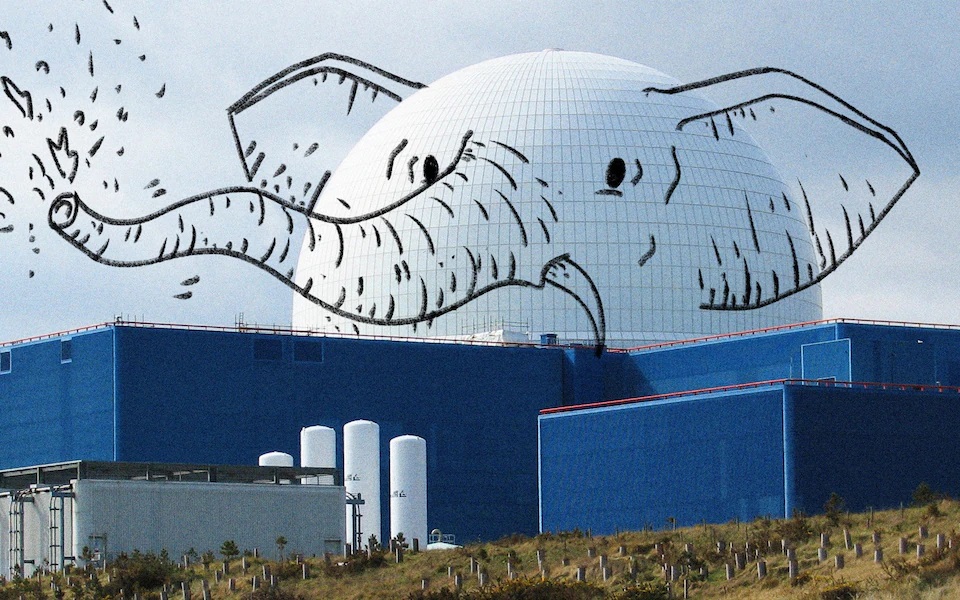
Ministers will decide whether to proceed with delayed
Suffolk scheme in June spending review. A senior Treasury minister has said
he is confident private financing for the Sizewell C nuclear power station
will be “teed up” in time for a final investment decision in June over
whether to proceed with the delayed project.
Darren Jones, chief secretary
to the Treasury, told the Financial Times that the crunch point for the
planned project in Suffolk was coming in just 10 weeks, at the time of the
government’s three-year spending review. “We have to make the final
investment decision [FID] which we will do at the spending review,” he
said. “FID will be taken in June.” Jones added: “You wouldn’t take
FID unless you’ve got all of your investors teed up. We will do.”
The UK government and French energy group EDF, the initial backers of Sizewell
C, have been trying to raise billions of pounds from investors and had
previously hoped to reach a final decision on investment last year. But the
process has dragged on and the price tag has soared since its £20bn
estimate given as recently as 2020.
Government officials and industry
executives expect Sizewell C will get billions of pounds of funding from
British taxpayers alongside investment from sovereign wealth funds and
institutional investors. The government has been negotiating with investors
including Centrica, Emirates Nuclear Energy Company, Amber Infrastructure
Group and Schroders Greencoat. They may not invest and ministers could yet
balk at the huge costs of the project. But Jones said the government had
already released a couple of billion pounds for the current year for
enabling works at the site.
FT 1st April 2025, https://www.ft.com/content/4a889ad7-6d41-47a9-a946-c2535ae2aaa6
Average person will be 40% poorer if world warms by 4C, new research shows

Economic models have systematically underestimated how global heating will
affect people’s wealth, according to a new study that finds 4C warming
will make the average person 40% poorer – an almost four-fold increase on
some estimates. The study by Australian scientists suggests average per
person GDP across the globe will be reduced by 16% even if warming is kept
to 2C above pre-industrial levels. This is a much greater reduction than
previous estimates, which found the reduction would be 1.4%. Scientists now
estimate global temperatures will rise by 2.1C even if countries hit
short-term and long-term climate targets.
Guardian 1st April 2025,
https://www.theguardian.com/environment/2025/apr/01/average-person-will-be-40-poorer-if-world-warms-by-4c-new-research-shows
Your move: Gamers join nuke industry in planning future atomic disasters
NFLA 1st April 2025
Following a £2.8 million investment made by Sellafield to transform a Whitehaven furniture department store into a high-tech digital and gaming hub[i], today nuclear industry bosses have announced that they are teaming up with Digital Gaming Content PHD students to embrace a new gaming genre – Atomic Disaster Gaming.
Under Project ‘Atomquake’, the students will be invited to participate in multiple team scenarios in which unprecedented catastrophes will be mapped out which place Cumbria’s population and environment in grave peril.
One such scenario relates to the possible location of a Geological Disposal Facility in West Cumbria in which the work of multiple giant boring machines tunnelling mass voids under the sea alongside the Sellafield site trigger earthquakes along the long-dormant Lake District Boundary Fault Zone.
Another envisages the ongoing leaks from Magnox silos contributing to the liquification of the Sellafield site.
Frightening stuff, and in parts true.
But if you were questioning the entire veracity of our story, you would be right to do so – please take account of the date.
In outlining this tale, we tip our hat to acknowledge software developers, Rebellion Developments, who have just released ‘Atomfall’, an acclaimed action game set in an alternate 1960s Cumbria, where radiation from the 1957 Windscale Fire has blanketed much of Northern England making it a contaminated quarantine zone. In the game, participants in the online world take on player characters who are engaged in a battle for survival.
The disaster outlined in ‘Atomfall’ almost came to pass, so, as life sometime imitates art, who is to say whether, in whole or in part, our innocent April Fool’s Day tale may one day also become our future reality.
(The NFLAs wish to thank Marianne Birkby from Radiation Free Lakeland for her contribution to this article and for the illustration she has kindly provided to accompany it)………………………………………………….https://www.nuclearpolicy.info/news/your-move-gamers-join-nuke-industry-in-planning-future-atomic-disasters/
UK nuclear deterrent: the mutual defense agreement is at risk in a Trumpian age
Prime Minister Keir Starmer recently boarded one of the UK’s four
nuclear-armed submarines for a photo call as part of his attempts to
demonstrate the UK’s defence capabilities as tensions with Russia
continue. However, Starmer faces a problem. The submarine, and the rest of
the UK’s nuclear fleet, is heavily reliant on the US as an operating
partner. And at a time when the US becomes an increasingly unreliable
partner under the leadership of an entirely transactional president, this
is not ideal. The US can, if it chooses, effectively switch off the UK’s
nuclear deterrent.
The Conversation 27th March 2025 https://theconversation.com/uk-nuclear-deterrent-the-mutual-defense-agreement-is-at-risk-in-a-trumpian-age-252674
Cumbria could be only option for nuclear disposal

(and still they intend to keep making the foul stuff!)
Ian Duncan, BBC News, 2 April 25
Cumbria could be the only area left in the search for a new nuclear disposal site, councillors have been told.
Members of Cumberland Council’s nuclear issues board were given an update on the search to pin down a site to build a geological disposal facility (GDF) on Monday.
Three areas had previously been shortlisted by government body Nuclear Waste Services (NWS) – Mid Copeland and South Copeland in Cumbria and Lincolnshire.
Councillors were told that Lincolnshire County Council plans to withdraw, however, the authority is due to meet in June after local elections, when the result could signal a change in a new council’s intention.
Nuclear waste would be stored at the GDF beneath up to 1,000m (3,300ft) of solid rock until its radioactivity had naturally decayed.
Earlier this month Lincolnshire County Council said it would pull out of talks unless it received “significant” further information about the plan.
Two surface areas of focus had been identified by NWS in Mid Copeland, east of Sellafield and east of Seascale.
In South Copeland, land west of Haverigg had been chosen.
The Copeland area is already home to Sellafield, where the vast majority of the UK’s radioactive nuclear waste is stored, as well as the world’s largest stockpile of plutonium…………….
The nuclear waste disposal site would need community support, the Local Democracy Reporting Service said.
NWS previously said construction would only start when a potential community had confirmed its “willingness” to host the facility……….
https://www.bbc.co.uk/news/articles/cqj4rvkd8e7o
-
Archives
- February 2026 (233)
- January 2026 (308)
- December 2025 (358)
- November 2025 (359)
- October 2025 (376)
- September 2025 (258)
- August 2025 (319)
- July 2025 (230)
- June 2025 (348)
- May 2025 (261)
- April 2025 (305)
- March 2025 (319)
-
Categories
- 1
- 1 NUCLEAR ISSUES
- business and costs
- climate change
- culture and arts
- ENERGY
- environment
- health
- history
- indigenous issues
- Legal
- marketing of nuclear
- media
- opposition to nuclear
- PERSONAL STORIES
- politics
- politics international
- Religion and ethics
- safety
- secrets,lies and civil liberties
- spinbuster
- technology
- Uranium
- wastes
- weapons and war
- Women
- 2 WORLD
- ACTION
- AFRICA
- Atrocities
- AUSTRALIA
- Christina's notes
- Christina's themes
- culture and arts
- Events
- Fuk 2022
- Fuk 2023
- Fukushima 2017
- Fukushima 2018
- fukushima 2019
- Fukushima 2020
- Fukushima 2021
- general
- global warming
- Humour (God we need it)
- Nuclear
- RARE EARTHS
- Reference
- resources – print
- Resources -audiovicual
- Weekly Newsletter
- World
- World Nuclear
- YouTube
-
RSS
Entries RSS
Comments RSS
 nuclear-news